
AMA Nats Lincoln '79: FF Glider
Chris Matsuno
A-1 Glider
First event off was A-1 Glider on Tuesday. Because of a rather confusing situation in which the Nats entry form indicated that AMA A-1 rules would be in effect while the contestant instructions indicated that FAI A-1 rules would be in effect, it was decided to fly both events separately. Contestants were required to declare whether they wished to compete under AMA or FAI rules, and models were required to conform accordingly.
Conditions were overcast to partly cloudy, relatively cool, and somewhat breezy. Maxes were set at two minutes for both classes. Flying strategy was generally to wait for lift on the ground, then tow up and release quickly. A few circle-tow models were seen, with Bill Jenkins flying his original design to second place in FAI. With the probable adoption of the FAI rules and deletion of the AMA rules (such a proposal is presently being considered by the Free Flight Contest Board), a trend toward more sophisticated, full-function circle-tow A-1 models seems likely. However, this seems in direct contradiction with the CIAM's establishment of A-1 as a beginner's event.
Some proponents and opponents of the switch to FAI rules regarded the situation as a good test of the two sets of rules, but this did not prove to be the case. The top two scores in FAI A-1 exceeded the winning AMA A-1 score, but the top five AMA scores were better than all except the top two FAI scores. All this proves is that neither set of rules is necessarily better, but that some models and modelers are better than others.
A-2 Glider
A-2 Glider (and Hand-Launched Glider, see below) were both flown on Friday. Except for the usual traffic jam at the timer's table at the beginning of each A-2 round, timer availability was not a severe problem. Flying conditions were very good, and several maxed the first round, promising hot competition through the day. An early casualty was Chuck Markos (77 WC Team member) who dropped his first flight.
Conditions were ideal for circle towing, and several A-2s were seen emulating control-line models. Straight-tow A-2 fliers had to be content with watching for signs of lift from the ground. Bubbles and swallows were generally the most reliable indicators. Early during the week, sharp-eyed bird watchers had noticed a good correlation between lift and swallows darting about at altitudes of 100 to 200 feet. (Normally, the swallows would be seen flying near ground level, presumably feeding on insects.) Word spread quickly, and many modelers relied heavily on the swallows. One theory had it that the swallows were feeding on insects that had been drawn up into thermals. Someone else mused that maybe the swallows were just having fun flying in the thermals, even though they are not considered soaring birds. Whatever the reason, these marvelously aerobatic little birds put on demonstrations of flying that would have put Jonathan Livingston Seagull to shame.
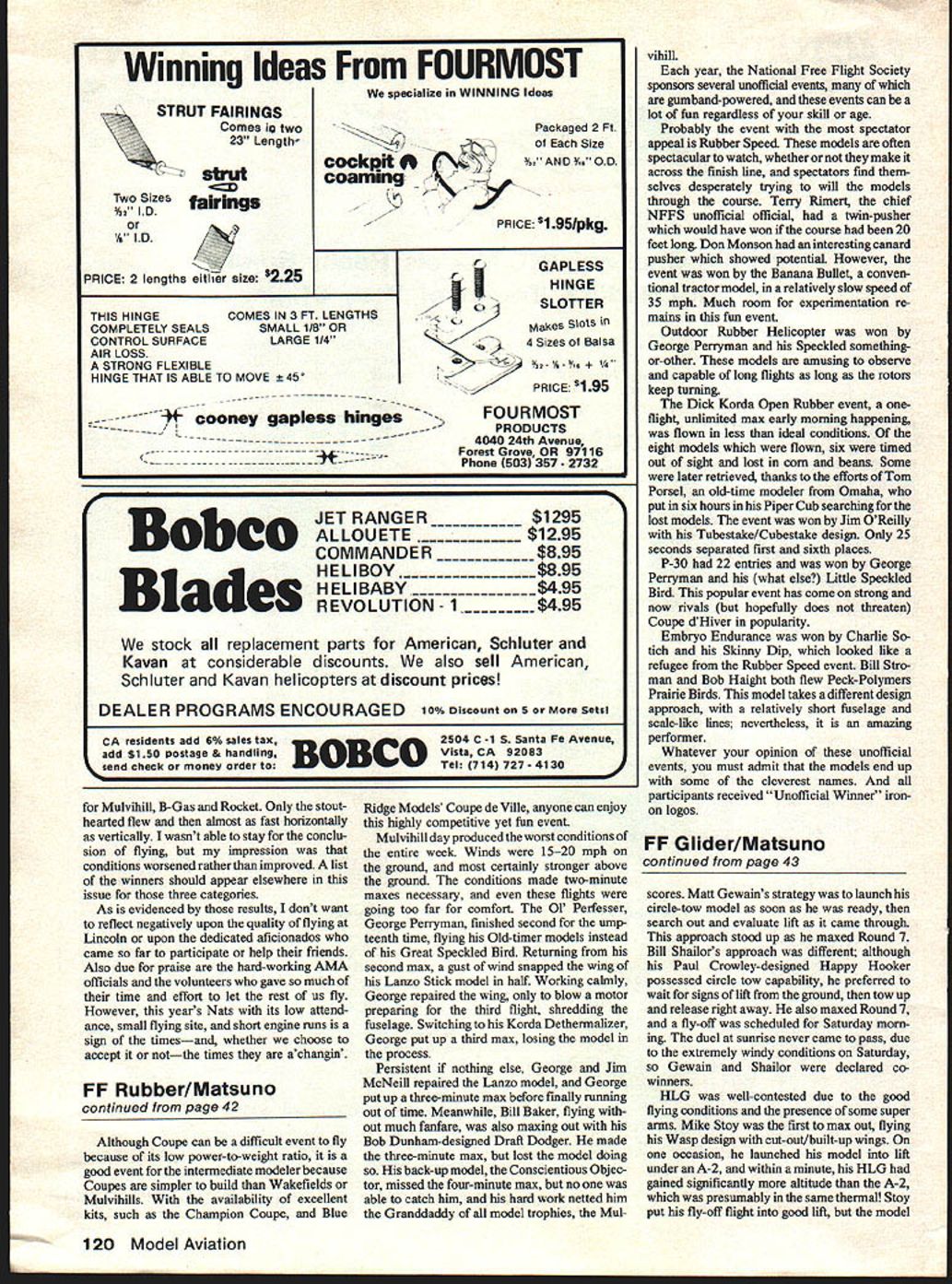
Wherever patches of air are going up, there are other patches of air going down, and thus, by the start of Round 7, only two fliers had perfect scores. Matt Gewain's strategy was to launch his circle-tow model as soon as he was ready, then search out and evaluate lift as it came through. This approach stood up as he maxed Round 7. Bill Shailor's approach was different: although his Paul Crowley–designed Happy Hooker possessed circle-tow capability, he preferred to wait for signs of lift from the ground, then tow up and release right away. He also maxed Round 7, and a fly-off was scheduled for Saturday morning. The duel at sunrise never came to pass due to the extremely windy conditions on Saturday, so Gewain and Shailor were declared co-winners.
Hand-Launched Glider (HLG)
HLG was well contested due to the good flying conditions and the presence of some superb arms. Mike Stoy was first to max out, flying his Wasp design with cut-out/built-up wings. On one occasion, he launched his model into lift under an A-2, and within a minute his HLG had gained significantly more altitude than the A-2, which was presumably in the same thermal! Stoy put his fly-off flight into good lift, but the model spun out and did not max. Still, he seemed to be in good position to become the first two-time winner of the Tulsa Glue Dobbers Trophy.
Bob Dunham of Tulsa (no one from Tulsa has won the trophy—yet) maxed out, but turned in a fly-off flight two seconds short of Stoy's. Larry McFarland, of the Texas HLG team, maxed out but didn't get much help on his fly-off flight. Bob Boyer, last year's trophy winner, was three seconds short of maxing out. Gerald Guiles was just one second short of maxing out. However, Larry Sargent, flying an original high-aspect-ratio design, maxed out and made good his fly-off flight, winning with four maxes.
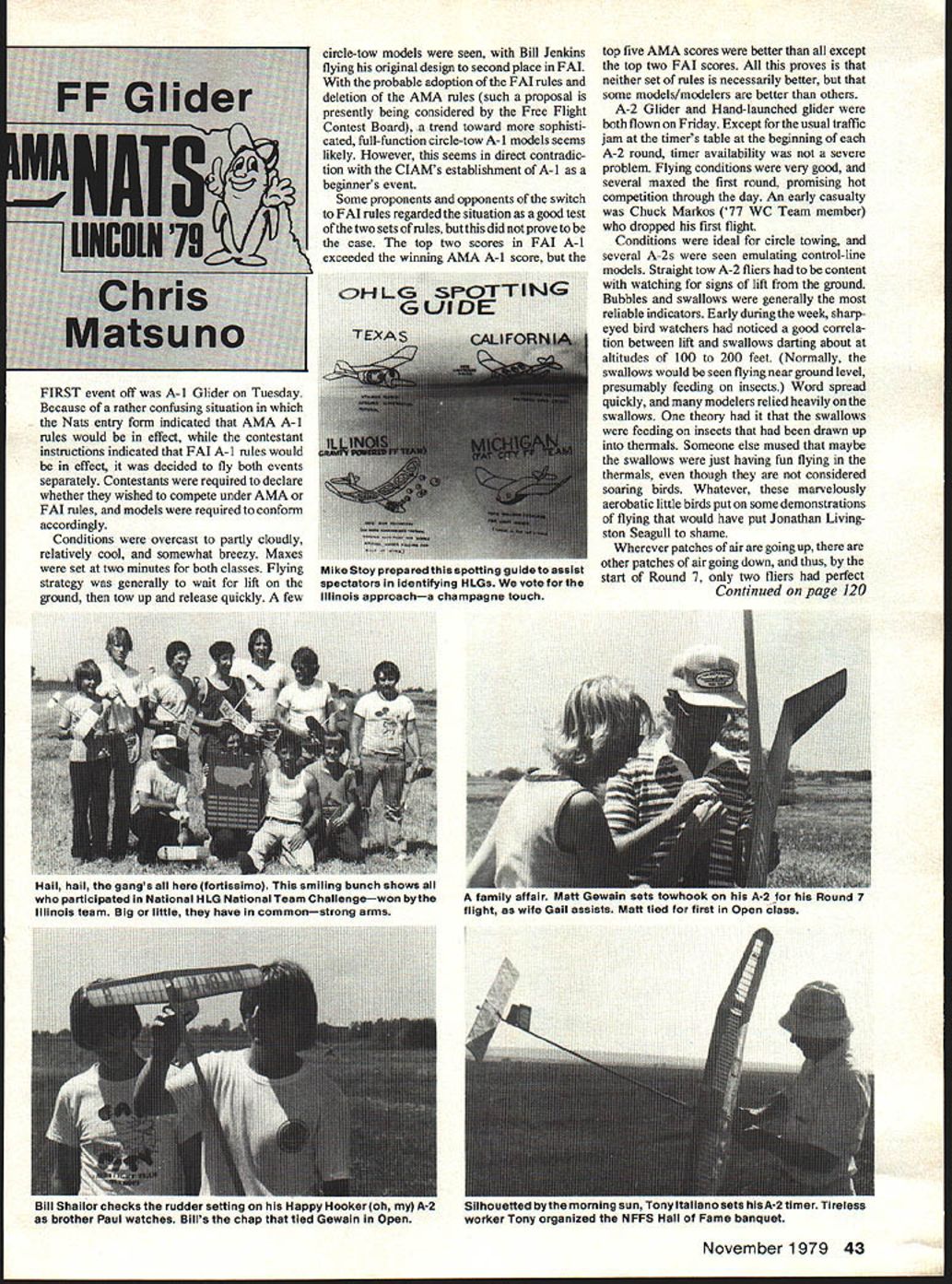
The excellent standard of HLG flying was spiced by the National HLG Team Challenge. The trophy for this event was donated by Steve Geraghty and Bob Boyer and replaces the California–Texas HLG Team Challenge Trophy. Three-man teams from all states are now eligible, and according to Geraghty, the only requirement is that teams must be rowdy.
- Winning team: Illinois Gravity Powered Free Flight Team (Stan Stoy, Mike Stoy, Bob Hayes)
- Second place: California team (Steve Geraghty, Bob Boyer, David Turgeon)
- Other teams competing:
- Fat City Free Flight Team (Detroit)
- Lone Star (or was that Pearl?) HLG Team (Texas)
Transcribed from original scans by AI. Minor OCR errors may remain.

