
AMA Nats Lincoln '79: FF Indoor Scale
Venue and overview
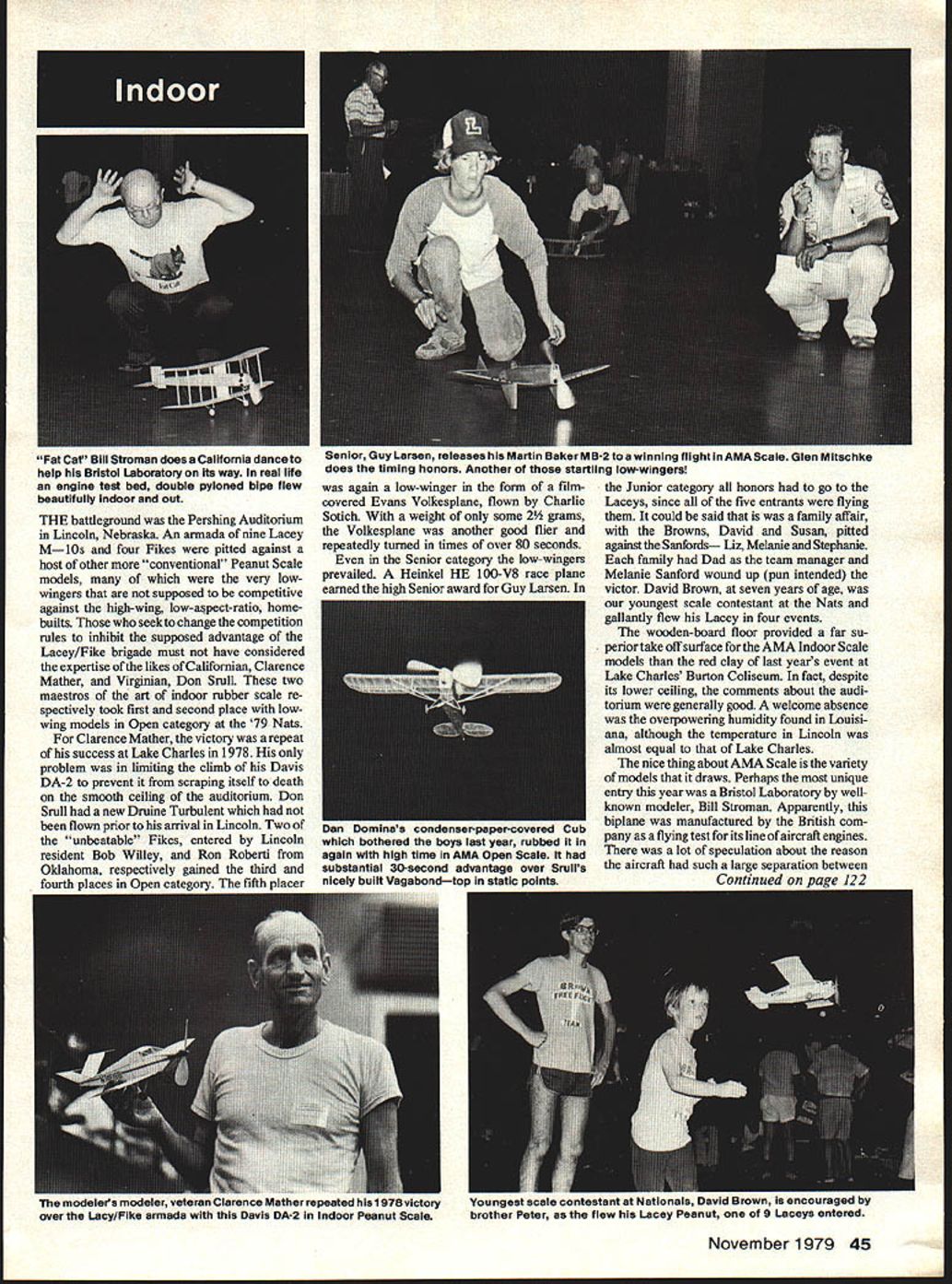
The battleground was the Pershing Auditorium in Lincoln, Nebraska. An armada of nine Lacey M-10s and four Fikes was pitted against a host of other more "conventional" Peanut Scale models, many of which were the very low-wingers that are not supposed to be competitive against the high-wing, low-aspect-ratio homebuilts. Those who seek to change the competition rules to inhibit the supposed advantage of the Lacey/Fike brigade must not have considered the expertise of the likes of Californian Clarence Mather and Virginian Don Srull. These two maestros of the art of indoor rubber scale respectively took first and second place with low-wing models in the Open category at the '79 Nats.
Open category
For Clarence Mather, the victory was a repeat of his success at Lake Charles in 1978. His only problem was in limiting the climb of his Davis DA-2 to prevent it from scraping itself to death on the smooth ceiling of the auditorium. Don Srull had a new Druine Turbulent which had not been flown prior to his arrival in Lincoln. Two of the "unbeatable" Fikes, entered by Lincoln resident Bob Willey and Ron Roberti from Oklahoma, respectively gained third and fourth places in the Open category. The fifth placer was again a low-winger in the form of a film-covered Evans Volkesplane, flown by Charlie Sotich. With a weight of only some 2½ grams, the Volkesplane was another good flier and repeatedly turned in times of over 80 seconds.
Senior and Junior categories
Even in the Senior category the low-wingers prevailed. A Heinkel He 100 V-8 race plane earned the high Senior award for Guy Larsen.
In the Junior category all honors went to the Laceys, since all five entrants were flying them. It could be said that it was a family affair, with the Browns—David and Susan—pitted against the Sanfords—Liz, Melanie and Stephanie. Each family had Dad as the team manager, and Melanie Sanford wound up (pun intended) the victor. David Brown, at seven years of age, was our youngest scale contestant at the Nats and gallantly flew his Lacey in four events.
Venue surface and atmosphere
The wooden-board floor provided a far superior takeoff surface for the AMA Indoor Scale models than the red clay of last year's event at Lake Charles' Burton Coliseum. In fact, despite its lower ceiling, comments about the auditorium were generally favorable. A welcome absence was the overpowering humidity found in Louisiana, although the temperature in Lincoln was almost equal to that of Lake Charles.
Unique entries and special awards
One of the most unique entries this year was a Bristol Laboratory biplane by well-known modeler Bill Stroman. Apparently this biplane was manufactured by the British company as a flying test for its line of aircraft engines. There was a lot of speculation about the reason the aircraft had such a large separation between its wings.
One model, underpowered by a .089 diesel, never did make the 20 seconds necessary to qualify. Even with the assist of a hand launch the Bellanca only managed 18½ seconds. For his all-day efforts at trying to get more pep out of the engine and his mighty heaves in trying to get an additional second or so out of his arm power, the National Association of Scale Aeromodelers awarded the builder a plaque for "the most detailed FF model to fly." A similar award went to Senior Tom Comparret for "most difficult model for a Senior to fly." Tom's model was a work of art (string art?) in the form of a Valkyrie. This 1911 aircraft was also known as an ASL and was one of the early pioneers of flight. The model had an Astro .02 for power but refused to leave terra firma; a subsequent hand launch ended its existence.
Outdoor Peanut and Gas Scale
The outdoor Peanut scalers had a ball with the abounding thermals. Bill Rogers' know-how with a Niesmith Cougar brought him the max that netted first place in Open. Tom Comparret also had luck with a Cougar but had to catch two thermals to get a first in Senior; his flight in the first boomer was unrecorded by a malfunctioning watch. Yet another Cougar secured a first in Junior for Carl Lindstrum.
The frustrations of the weather and site of the AMA Rubber event were forgotten in the perfect day for the Peanut and Gas Scale. After officials' flights were completed, many contestants continued to fly just for the fun of it. Bill Stroman showed that his indoor model, the Bristol Laboratory, flew even better outdoors. On the arrival of Jay Gerber, the AMA film cameraman, the sky was filled with the scale free-flight models to end what was for many the best day at the Nats.
Scoring and judging
In Indoor Scale events, only the best of three (Peanut) or four (AMA) flight times determines the flight score. Very often one hears comments from contestants who feel they were "robbed" of a trophy because of a low static score. We didn't hear any such comments this year, so we assume our judges did a good job. Our thanks go to these noble volunteers without whom we couldn't have had a contest.
Humidity, coverings, and performance
A check of the humidity indicator used by the building engineers showed a reading of 75% and the temperature inside was in the high 80s, which made the comfort index read something like "miserable." The high humidity had less effect on the pennyplanes since most of them are covered with a non-absorbing plastic polycarbonate film, while the Easy Bs (EZBs) are required to be tissue covered and water absorption became appreciable. Extra rubber cross section was the common approach to the problem, but the extra weight being carried reduced flight potential.
Pennyplane and Easy B results
Nevertheless, in Open Easy B, Stan Chilton won with the excellent time of 16:49, which is competitive with a full-size paper-stick, believe it or not. Stan's ship was super light and has done over 20 minutes in higher ceilings.
Clarence Mather followed at 14:22, with Dick Hardcastle recording a 13:51. In Junior, Mike Clem led all the way with 6:54, but was experiencing a little high anxiety during the last 10 minutes of the meet when Kevin Loeffler almost reached him with a 6:45 flight. Collin Dimaio was way out in front in Senior with 7:27.
The Pennyplane event was a see-saw battle in Open between Dick Hardcastle and Gordon Wisniewski, but "G-Whiz" ran out of rubber turns and official flights; Dick ended up the winner with 11:27. Dick was flying a biplane with both wings mounted on high posts and a large amount of separation. Texan Mike Clem won with 6:50 in Junior, and Collin Dimaio prevailed in Senior with a best flight of 6:23.
Monday: paper-sticks, film-covered ships, and ceiling strings
The next day, Monday, brought forth the high-performance and slower-flying paper-sticks and film-covered ships of both stick and cabin configurations. As usual, the paper-sticks were in the air first to test for turbulence and drift, but these problems were minimal compared to the real culprit—strings.
As flights reached ceiling height and began scrubbing, it was discovered the hard way that many strings and wire hooks were hanging from the ceiling, some dropping down three feet or more. The faster-flying and unbraced EZBs and pennyplanes experienced no trouble with these obstructions, but several paper ships were quickly snared and wound themselves tightly around the strings and were impossible to dislodge.
Talks with building personnel revealed that during a recent circus performance, hundreds of balloons were released and some had found their way into ventilators and stage lighting equipment, leaving string hanging down while the buoyant helium leaked away. These strings captured many ships before the meet was finished, and to compound the problem, the ensnared ships caused further obstruction. Once a ship is scrubbing on the ceiling it is impossible to effectively employ steering techniques to control its direction, and it finally became necessary to cut many ships loose.
Transcribed from original scans by AI. Minor OCR errors may remain.

