
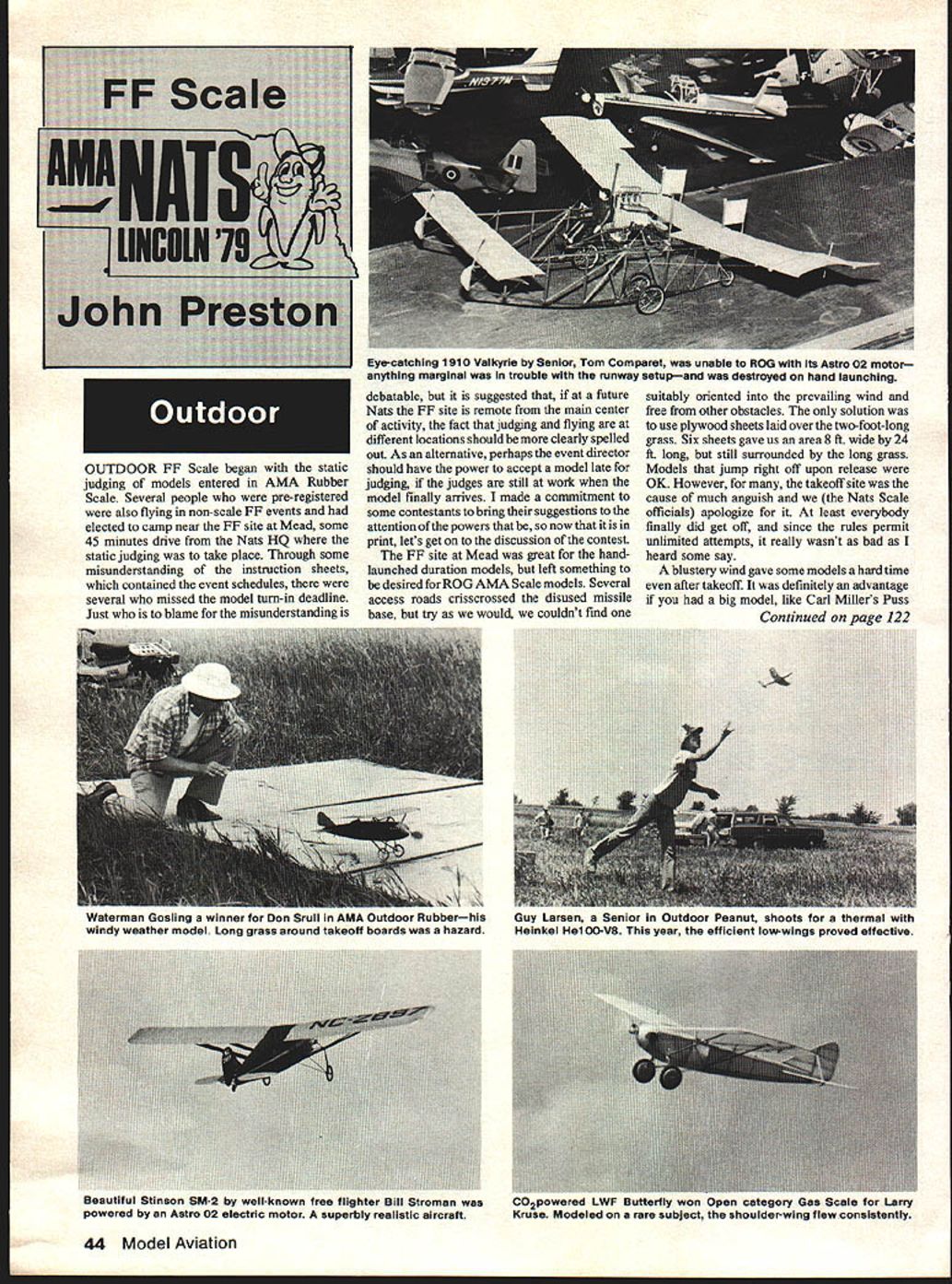
AMA Nats Lincoln '79: FF Outdoor Scale
John Preston
Outdoor
Outdoor FF Scale began with the static judging of models entered in AMA Rubber Scale. Several people who were pre-registered were also flying in non-scale FF events and had elected to camp near the FF site at Mead, some 45 minutes' drive from the Nats HQ where the static judging was to take place. Through some misunderstanding of the instruction sheets, which contained the event schedules, there were several who missed the model turn-in deadline. Just who is to blame for the misunderstanding is debatable, but it is suggested that, if at a future Nats the FF site is remote from the main center of activity, the fact that judging and flying are at different locations should be more clearly spelled out. As an alternative, perhaps the event director should have the power to accept a model late for judging if the judges are still at work when the model finally arrives. I made a commitment to some contestants to bring their suggestions to the attention of the powers that be, so now that it is in print, let's get on to the discussion of the contest.
The FF site at Mead was great for the hand-launched duration models, but left something to be desired for ROG AMA Scale models. Several access roads crisscrossed the disused missile base, but try as we would, we couldn't find one suitably oriented into the prevailing wind and free from other obstacles. The only solution was to use plywood sheets laid over the two-foot-long grass. Six sheets gave us an area 8 ft. wide by 24 ft. long, but it was still surrounded by the long grass. Models that jumped right off upon release were OK; however, for many the takeoff site was the cause of much anguish and we (the Nats Scale officials) apologize for it. At least everybody finally did get off, and since the rules permit unlimited attempts, it really wasn't as bad as some said.
A blustery wind gave some models a hard time even after takeoff. It was definitely an advantage if you had a big model. Notable results included:
- Carl Miller's Puss Moth spun out and did not max; he also had a D/T on this model and, as it turned out, he needed it.
- Bob Dunham of Tulsa maxed out but turned in a fly-off flight two seconds short of Stoy's.
- Larry McFarland, of the Texas HLG team, maxed out but didn't get much help on his fly-off flight.
- Bob Boyer, last year's trophy winner, was three seconds short of maxing out.
- Gerald Guiles was just one second short of maxing out.
- Larry Sargent, flying an original high-aspect-ratio design, maxed out and made good his fly-off flight, winning with four maxes.
The excellent standard of HLG flying was spiced by the National HLG Team Challenge. The trophy for this event was donated by Steve Geraghty and Bob Boyer, and replaces the California-Texas HLG Team Challenge Trophy. Three-man teams from all states are now eligible, and according to Geraghty the only requirement is that teams must be rowdy. The rowdy members of the Illinois Gravity Powered Free Flight Team (Stan and Mike Stoy and Bob Hayes) edged out the California team of Geraghty, Boyer and David Turgeon. Other teams competing were the Fat City Free Flight Team from Detroit, and the Lone Star (or was that Pearl?) HLG Team from Texas.
Larry Kruse flew a very pretty Star Cavalier (many called it a Monocoupe). Larry had a best flight of over a minute which, coupled with his second-highest static score, put him in second place. Top honors in Open went to familiar FF scaler Don Srull with a Waterman Gosling—his windy-weather model. Don had some problems finding a suitable trim, but once achieved it turned in consistent flights of close to a minute. These, coupled with his high static score, proved unbeatable. Third place in Open went to the Srull-designed Heinkel He 100D, now kitted by Flyline Models and flown by Ron Roberti.
An interesting model flown by Lloyd Wood was a Dayton-Wright Racer which placed fourth in Open. Tom Comparet, flying a model of a PAMA (a French homebuilt), was first in Senior, and Bill Langley's Tailwind won the Junior category.
Outdoor Peanut and Gas Scale were flown the following day in absolutely ideal conditions. What wind there was came from the abundance of thermals being generated at the site. A suitable stretch of road was used for the runway for the gas (and electric and CO2) models. Larry Kruse was the victor in Gas with a CO2-powered LWF Butterfly (see Flying Models, July 1979 for article and drawing).
Since the second-place model was Bill Stroman's electric-powered Stinson SM-2, it seems high time we changed the name of this event to AMA Motor Scale or something similar. After all, gas went out a long time ago in the Free Flight circles. At least the third place had an internal combustion engine in the form of a Cox .049-powered Taylormaster. Carl Miller was the builder and the model originated from a Comet kit of the '40s.
The prima donna in Open Gas Scale was Bob Haight's superb model of the Bellanca WB-2 "Miss Columbia." Underpowered by a .089 diesel, Bob never did make the 20 seconds necessary to qualify. Even with the assist of a hand launch the Bellanca only managed 18½ seconds. For his all-day efforts at trying to get more pep out of the engine and his mighty heaves in trying to get an additional second or so out of his arm power, the National Association of Scale Aeromodellers awarded him a plaque for "the most detailed FF model to fly." A similar award went to Senior Tom Comparet for "most difficult model for a Senior to fly." Tom's model was a work of art (string art?) in the form of a Valkyrie. This 1911 aircraft was also known as an ASL and was one of the early pioneers of flight. The model had an Astro .02 for power but refused to leave terra firma; a subsequent hand launch ended its existence.
The outdoor Peanut scalers had a ball with the abounding thermals. Bill Rogers' know-how with a Nesmith Cougar brought him the max that netted first place in Open. Tom Comparet also had luck with a Cougar but had to catch two thermals to get a first in Senior; his flight in the first boomer was unrecorded by a malfunctioning watch. Yet another Cougar secured a first in Junior for Carl Linstrum.
The frustrations of the weather and site for the AMA Rubber event were more than made up for by the perfect day for the Peanut and Gas Scale. After officials' flights were completed, many contestants continued to fly just for the fun of it. Bill Stroman showed that his indoor model, the Bristol Laboratory, flew even better outdoors. On the arrival of Jay Gerber, the AMA film cameraman, the sky was filled with scale FF models to end what was, for many, the best day at the Nats.
Transcribed from original scans by AI. Minor OCR errors may remain.

