
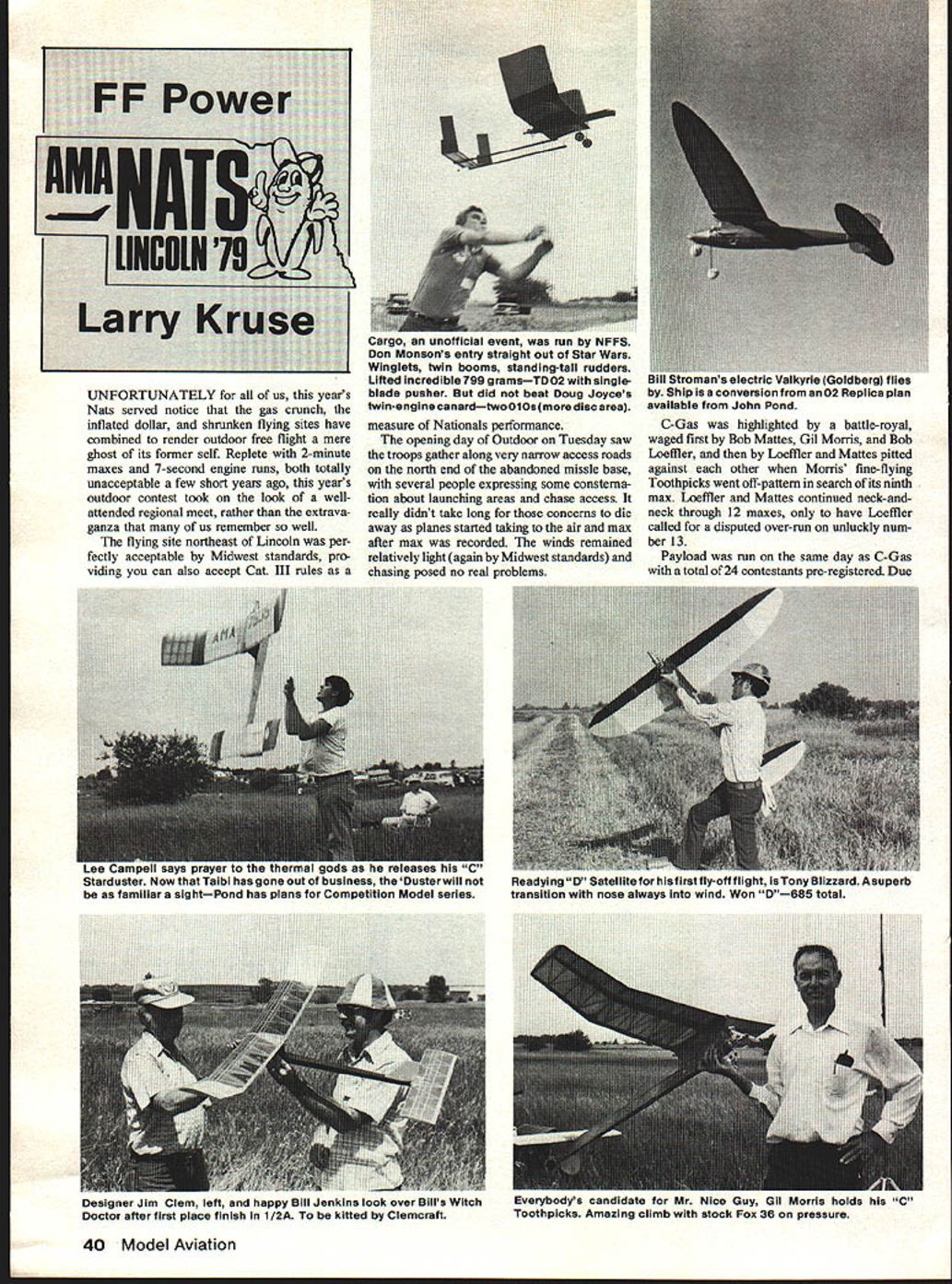
AMA Nats Lincoln '79: FF Power
Larry Kruse
Overview
Unfortunately for all of us, this year's Nats served notice that the gas crunch, the inflated dollar, and shrunken flying sites have combined to render outdoor free flight a mere ghost of its former self. Replete with two-minute maxes and seven-second engine runs — both totally unacceptable a few short years ago — this year's outdoor contest took on the look of a well-attended regional meet, rather than the extravaganza that many of us remember so well.
The flying site northeast of Lincoln was perfectly acceptable by Midwest standards, providing you can also accept Cat. III rules as a measure of Nationals performance.
Opening Day and C-Gas
The opening day of Outdoor Tuesday saw the troops gather along very narrow access roads on the north end of the abandoned missile base, with several people expressing some consternation about launching areas and chase access. It didn't take long for those concerns to die away as planes started taking to the air and max after max was recorded. The winds remained relatively light (again by Midwest standards) and chasing posed no real problems.
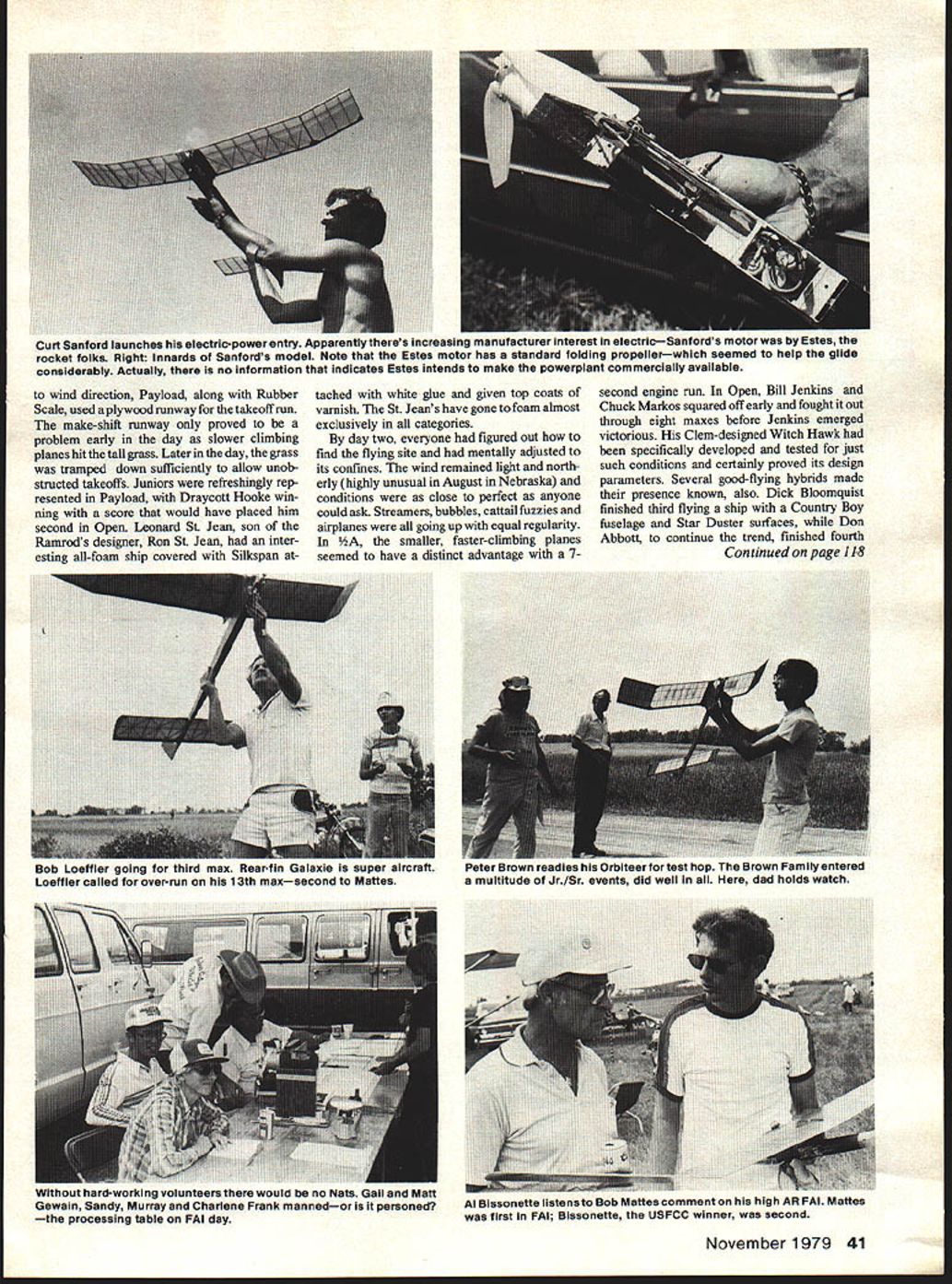
C-Gas was highlighted by a battle royal, waged first by Bob Mattes, Gil Morris, and Bob Loeffler, and then by Loeffler and Mattes pitted against each other when Morris' fine-flying Toothpicks went off-pattern in search of its ninth max. Loeffler and Mattes continued neck-and-neck through 12 maxes, only to have Loeffler called for a disputed over-run on an unlucky number 13.
Payload and Rubber Scale
Payload was run on the same day as C-Gas with a total of 24 contestants pre-registered. Due to wind direction, Payload, along with Rubber Scale, used a plywood runway for the takeoff run. The makeshift runway only proved to be a problem early in the day as slower-climbing planes hit the tall grass. Later in the day, the grass was tramped down sufficiently to allow unobstructed takeoffs.
Juniors were refreshingly represented in Payload, with Draycott Hooke winning with a score that would have placed him second in Open. Leonard St. Jean, son of Ramrod designer Ron St. Jean, had an interesting all-foam ship covered with Silkspan, attached with white glue and given top coats of varnish. The St. Jeans have gone to foam almost exclusively in all categories.
Day Two: 1/2A and Open
By day two, everyone had figured out how to find the flying site and had mentally adjusted to its confines. The wind remained light and northerly (highly unusual in August in Nebraska) and conditions were as close to perfect as anyone could ask. Streamers, bubbles, cattail fuzzies and airplanes were all going up with equal regularity.
In 1/2A, the smaller, faster-climbing planes seemed to have a distinct advantage with a seven-second engine run. In Open, Bill Jenkins and Chuck Markos squared off early and fought it out through eight maxes before Jenkins emerged victorious. His Clem-designed Witch Hawk had been specifically developed and tested for just such conditions and certainly proved its design parameters.
Several good-flying hybrids made their presence known as well. Dick Bloomquist finished third flying a ship with a Country Boy fuselage and Star Duster surfaces, while Don Abbott, to continue the trend, finished fourth flying an Okie Bird fuselage with Maverick surfaces. Apparently kit-bashing (in the literal sense) is not restricted to model railroading.
FF Power — continued
Days three and four, Thursday and Friday, were carbon copies of the previous day, except that the wind had changed to a southerly direction but remained light and variable. In fact, drift was so slight that, as I served as Contest Director (CD) for NFFS Cargo less than a quarter of a mile away from the main line, very few ships even came within range.
A-Gas
A-Gas was tightly contested by Gil Robbins and Gil Morris through seven maxes. Robbins finally topped Morris on his eighth max and Morris was not able to repeat his last year's win. Morris' electronic timer dropped out of his pocket during a retrieve and he assumed it was lost. Two flights later, as he crossed over a gully on his motorcycle, he saw it again, just in time to run over it with his front cycle wheel.
Some days it just doesn't pay to get up.
Senior Mark Woodrey had one of the fastest-climbing ships in evidence. Said one envious spectator, "I don't know why he bothers to throw that plane into the air. It's already moving so fast I can't see it." Woodrey won A-Gas, with Bill and Charles finishing second and third respectively.
F1C
F1C had proportionately very few contestants, but those who were there were top drawer. Bob Mattes' high-aspect-ratio ship topped USFFC champ Al Bissonette's "95+5" by 70 seconds. Bissonette slid into second place when Chuck Markos put up a flight late in the third round on only a three-second engine run. Chuck had been checking his engine cut-off on a short run and forgot to reset the timer. At that, he dropped only five seconds to finish behind Bissonette in third place.
D-Gas
D-Gas once again saw Bob Loeffler and a big version of his rear-fin Galaxy in the thick of the fray, only to finish second to Tony Blizzard and his Satellite. Blizzard's ship had one of the most consistent and prettiest power patterns there. Where some ships tend to either roll out or snap into the glide mode, the big Satellite seemed to just ease over the top after the engine cut and hang there infinitely, nose into the wind, before it ever began its glide circle.
Sal Taibi finished third in D. Regrettably, Sal informed us that his firm, Competition Models, had gone out of business in June. Sal said he had about 100 Duster kits left and that when they were gone only the plans would be available from John Pond. The quality and availability of free-flight kits has been diminished significantly with the shutdown of Competition Models.
Electric Power
Electric power probably showed more experimentation and originality than any other event flown at the '79 Nats. While free flight in general falls victim to the criticism of stagnation, electric is an event trying to find itself. Entries ranged from a Midi-Pearl-looking ship by Curt Sanford, powered by a new Estes .020 electric with a folding prop, to Bill Stroman's replica Valkyrie.
Bill Jenkins won the event with a scaled-down Clem Country Boy in an amazing time of 13:31. Bill Baker finished second with a conversion of Frank Heeb's Stratavox. You have to develop a whole new mental set to accept a truckin' Pearl climbing silently—the first hint that comes is that you've lost your hearing. Electric will take some getting used to, but Bob Boucher is not the only true believer any more.
Saturday Blow-out, Mulvihill, B-Gas and Rocket
In direct contrast to the beautiful weather of the previous five days, Saturday was a blow-out for Mulvihill, B-Gas, and Rocket. Only the stout-hearted flew, and then almost as fast horizontally as vertically. I wasn't able to stay for the conclusion of flying, but my impression was that conditions worsened rather than improved. A list of the winners should appear elsewhere in this issue for those three categories.
Mulvihill day produced the worst conditions of the entire week. Winds were 15–20 mph on the ground, and most certainly stronger above the ground. The conditions made two-minute maxes necessary, and even these flights were going too far for comfort.
The Ol' Perfesser, George Perryman, finished second for the umpteenth time, flying his old-timer models instead of his Great Speckled Bird. Returning from his second max, a gust of wind snapped the wing of his Lanzo Stick model in half. Working calmly, George repaired the wing, only to blow a motor preparing for the third flight, shredding the fuselage. Switching to his Korda Dethermalizer, George put up a third max, losing the model in the process.
Persistent if nothing else, George and Jim McNeill repaired the Lanzo model, and George put up a three-minute max before finally running out of time. Meanwhile, Bill Baker, flying without much fanfare, was also maxing out with his Bob Dunham-designed Draft Dodger. He made the three-minute max, but lost the model doing so. His backup model, the Conscientious Objector, missed the four-minute max, but no one was able to catch him, and his hard work netted him the Granddaddy of all model trophies, the Mulvihill.
A Note on the Nationals
As is evidenced by those results, I don't want to reflect negatively upon the quality of flying at Lincoln or upon the dedicated aficionados who came so far to participate or help their friends. Also due for praise are the hard-working AMA officials and the volunteers who gave so much of their time and effort to let the rest of us fly. However, this year's Nats, with its low attendance, small flying site, and short engine runs, is a sign of the times—and, whether we choose to accept it or not—the times they are a-changin'.
Ridge Models' Coupe de Ville—anyone can enjoy this highly competitive yet fun event.
Unofficial NFFS Events
Each year, the National Free Flight Society sponsors several unofficial events, many of which are gum-band-powered, and these events can be a lot of fun regardless of your skill or age.
- Rubber Speed: Probably the event with the most spectator appeal. These models are often spectacular to watch, whether or not they make it across the finish line, and spectators find themselves desperately trying to will the models through the course. Terry Rimer, the chief NFFS unofficial official, had a twin-pusher which would have won if the course had been 20 feet long. Don Monson had an interesting canard pusher which showed potential. The event was won by the Banana Bullet, a conventional tractor model, in a relatively slow speed of 35 mph. Much room for experimentation remains in this fun event.
- Outdoor Rubber Helicopter: Won by George Perryman and his Speckled something-or-other. These models are amusing to observe and are capable of long flights as long as the rotors keep turning.
- Dick Korda Open Rubber: A one-flight, unlimited-max early-morning happening, flown in less than ideal conditions. Of the eight models which were flown, six were timed out of sight and lost in corn and beans. Some were later retrieved, thanks to the efforts of Tom Porsel, an old-time modeler from Omaha, who put in six hours in his Piper Cub searching for the lost models. The event was won by Jim O'Reilly with his Tubestake/Cubestake design. Only 25 seconds separated first and sixth places.
- P-30: Had 22 entries and was won by George Perryman and his (what else?) Little Speckled Bird. This popular event has come on strong and now rivals (but hopefully does not threaten) Coupe d'Hiver in popularity.
- Embryo Endurance: Won by Charlie Sotich and his Skinny Dip, which looked like a refuge from the Rubber Speed event. Bill Stroman and Bob Haight both flew Peck-Polymers Prairie Birds. This model takes a different design approach, with a relatively short fuselage and scale-like lines; nevertheless, it is an amazing performer.
Whatever your opinion of these unofficial events, you must admit that the models end up with some of the cleverest names. All participants received "Unofficial Winner" iron-on logos.
Transcribed from original scans by AI. Minor OCR errors may remain.

