
AMA Nats Lincoln '79: FF Rubber
Chris Matsuno
Wakefield
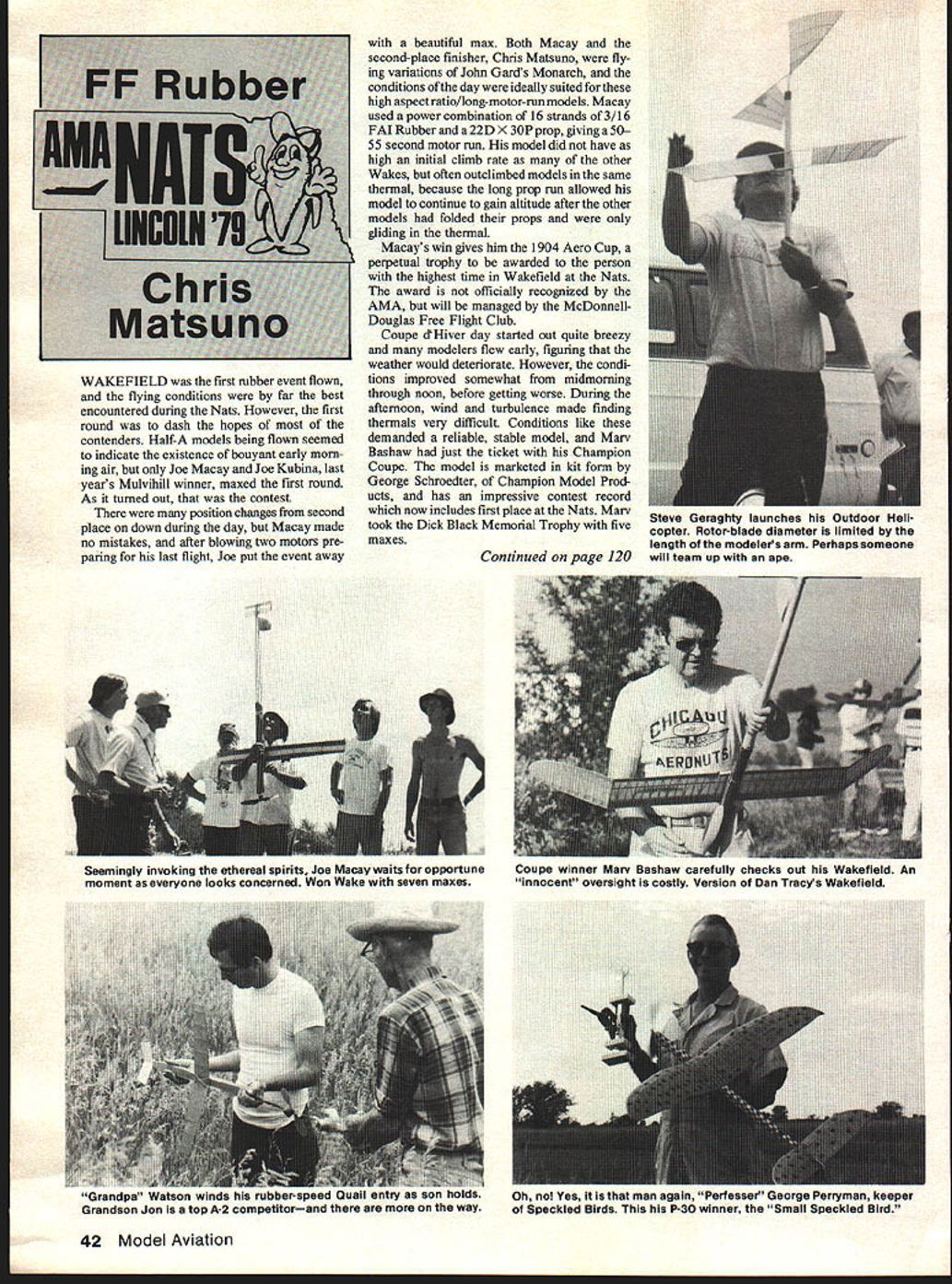
WAKEFIELD was the first rubber event flown, and the flying conditions were by far the best encountered during the Nats. However, the first round dashed the hopes of most contenders. Half-A models being flown seemed to indicate the existence of buoyant early morning air, but only Joe Macay and Joe Kubina, last year's Mulvihill winner, maxed the first round.
As it turned out, that was the contest. There were many position changes from second place on down during the day, but Macay made no mistakes. After blowing two motors preparing for his last flight, Joe put the event away with a beautiful max. Both Macay and the second-place finisher, Chris Matsuno, were flying variations of John Gard's Monarch, and the day’s conditions were ideally suited for these high aspect-ratio/long-motor-run models.
Macay used a power combination of 16 strands of 3/16 FAI rubber and a 22D x 30P prop, giving a 50–55 second motor run. His model did not have as high an initial climb rate as many of the other Wakes, but often outclimbed models in the same thermal because the long prop run allowed his model to continue gaining altitude after the other models had folded their props and were only gliding in the thermal.
Macay's win gives him the 1904 Aero Cup, a perpetual trophy awarded to the person with the highest time in Wakefield at the Nats. The award is not officially recognized by the AMA, but will be managed by the McDonnell-Douglas Free Flight Club.
Coupe d'Hiver
Coupe d'Hiver day started out quite breezy and many modelers flew early, figuring that the weather would deteriorate. Conditions improved somewhat from midmorning through noon before getting worse. During the afternoon, wind and turbulence made finding thermals very difficult.
Conditions like these demanded a reliable, stable model, and Marv Bashaw had just the ticket with his Champion Coupe. The model is marketed in kit form by George Schroedter of Champion Model Products and has an impressive contest record, which now includes first place at the Nats. Marv took the Dick Black Memorial Trophy with five maxes.
Although Coupe can be a difficult event to fly because of its low power-to-weight ratio, it is a good event for the intermediate modeler because Coupes are simpler to build than Wakefields or Mulvihills. With the availability of excellent kits, such as the Champion Coupe and Blue Ridge Models' Coupe de Ville, anyone can enjoy this highly competitive yet fun event.
Mulvihill
Mulvihill day produced the worst conditions of the entire week. Winds were 15–20 mph on the ground and almost certainly stronger aloft. The conditions made two-minute maxes necessary, and even these flights were going too far for comfort.
The O'Pefesser, George Perryman, finished second for the umpteenth time, flying his Old-timer models instead of his Great Speckled Bird. Returning from his second max, a gust of wind snapped the wing of his Lanza Stick model in half. Working calmly, George repaired the wing, only to blow a motor preparing for the third flight, shredding the fuselage. Switching to his Korda Dethmelanizer, George put up a third max, losing the model in the process.
Persistent if nothing else, George and Jim McNeill repaired the Lanza model, and George put up a three-minute max before finally running out of time. Meanwhile, Bill Baker, flying with much fanfare, was also maxing out with his Bob Dunham-designed Draft Dodger. He made the three-minute max but lost the model in the process. His backup model, the Conscientious Objector, missed the four-minute max, but no one was able to catch him, and his hard work netted him the Granddaddy of all model trophies, the Mulvihill.
Conditions for B-Gas and Rocket (and Mulvihill) were severe. Only the stouthearted flew, and then the models often flew almost as fast horizontally as vertically. My impression was that conditions worsened rather than improved as the day went on.
Unofficial Events (National Free Flight Society)
Each year the National Free Flight Society sponsors several unofficial events, many of which are gumband-powered. These events can be a lot of fun regardless of your skill or age.
Rubber Speed
Probably the event with the most spectator appeal is Rubber Speed. These models are often spectacular to watch, whether or not they make it across the finish line, and spectators find themselves desperately trying to will the models through the course. Terry Rimert, the chief NFFS unofficial official, had a twin-pusher which would have won if the course had been 20 feet long. Don Monson had an interesting canard pusher which showed potential. However, the event was won by the Banana Bullet, a conventional tractor model, in a relatively slow speed of 35 mph. Much room for experimentation remains in this fun event.
Outdoor Rubber Helicopter
Outdoor Rubber Helicopter was won by George Perryman and his Speckled something-or-other. These models are amusing to observe and capable of long flights as long as the rotors keep turning.
Dick Korda Open Rubber
The Dick Korda Open Rubber event, a one-flight, unlimited-max early-morning happening, was flown in less than ideal conditions. Of the eight models which were flown, six were time-winners and were lost out of sight in corn and beans. Some were later retrieved, thanks to the efforts of Tom Porsel, an old-time modeler from Omaha, who put in six hours in his Piper Cub searching for the lost models. The event was won by Jim O'Reilly with his Tubestake/Cubestake design. Only 25 seconds separated first and sixth places.
P-30
P-30 had 22 entries and was won by George Perryman and his (what else?) Little Speckled Bird. This popular event has come on strong and now rivals (but hopefully does not threaten) Coupe d'Hiver in popularity.
Embryo Endurance
Embryo Endurance was won by Charlie Soetich and his Skinny Dip, which looked like a refugee from the Rubber Speed event. Bill Strohman and Bob Haight both flew new Peck-Polymers Prairie Birds. This model takes a different design approach, with a relatively short fuselage and scale-like lines; nevertheless, it is an amazing performer.
Whatever your opinion of these unofficial events, you must admit that the models end up with some of the cleverest names. All participants received "Unofficial Winner" iron-on logos.
Observations and Closing
I don't want to reflect negatively upon the quality of flying at Lincoln or upon the dedicated aficionados who came so far to participate or help their friends. Also due for praise are the hard-working AMA officials and the volunteers who gave so much of their time and effort to let the rest of us fly.
However, this year's Nats—with its low attendance, small flying site, and short engine runs—is a sign of the times. Whether we choose to accept it or not, the times they are a-changin'.
Transcribed from original scans by AI. Minor OCR errors may remain.

