
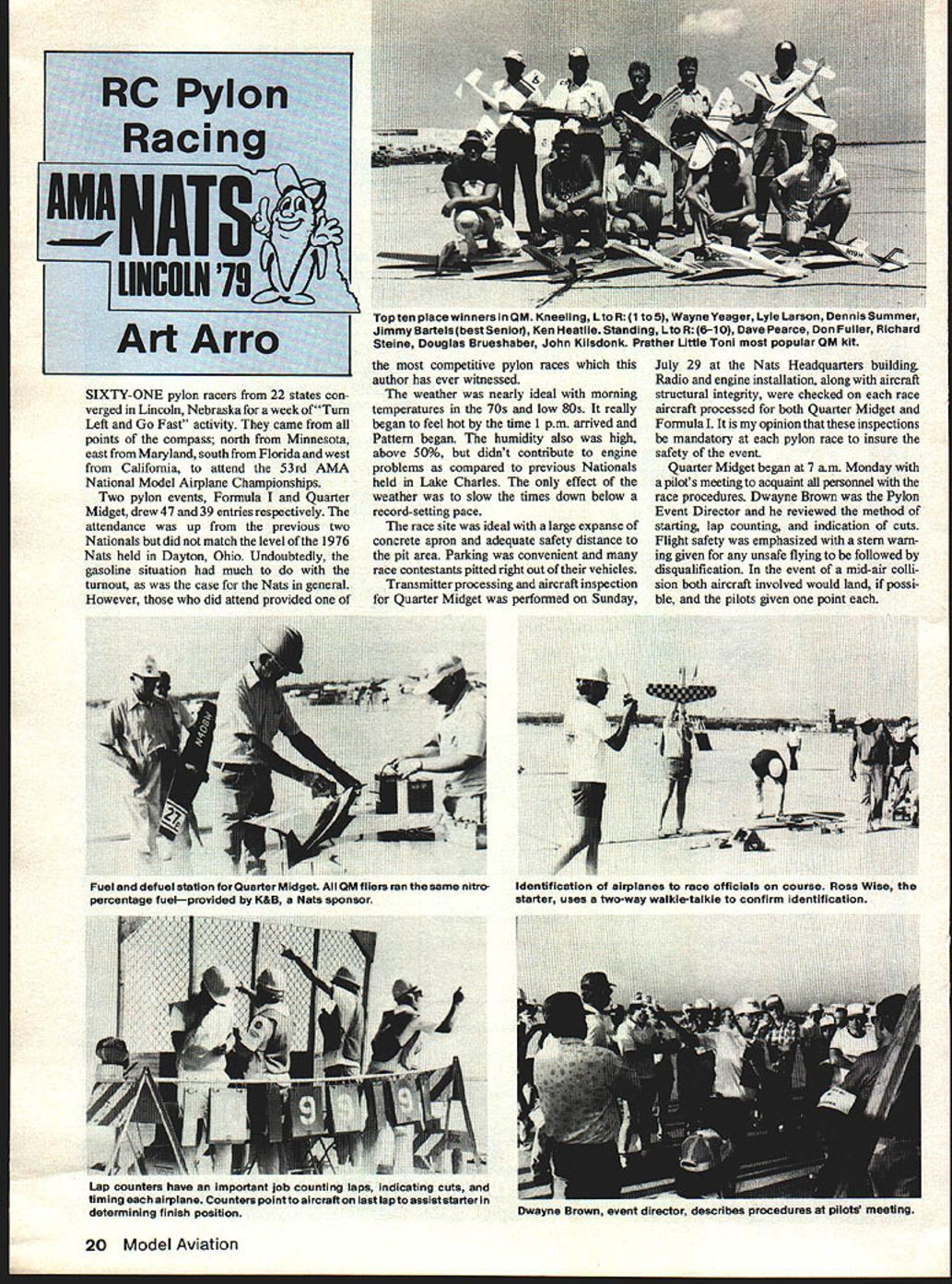
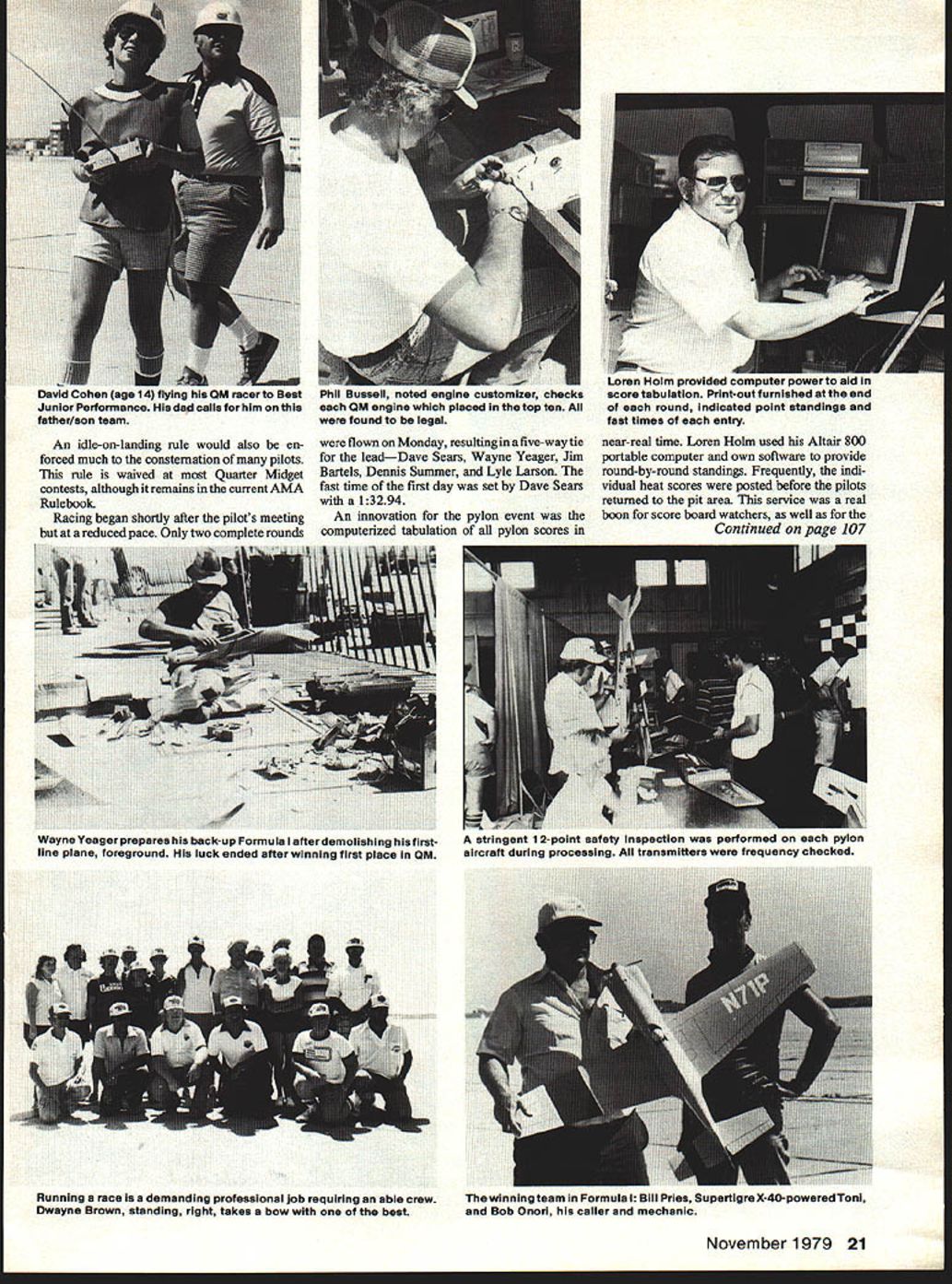
AMA Nats Lincoln '79: RC Pylon Racing
Art Arro
Overview
Sixty-one pylon racers from 22 states converged in Lincoln, Nebraska, for a week of "turn left and go fast" activity during the 53rd AMA National Model Airplane Championships. Pilots came from all points of the compass — north from Minnesota, east from Maryland, south from Florida, and west from California.
Two pylon events, Formula I and Quarter Midget, drew 47 and 39 entries respectively. Attendance was up from the previous two Nationals but did not match the level of the 1976 Nats in Dayton, Ohio. Gasoline availability likely affected turnout, as it did for the Nats in general. Nevertheless, those who attended provided one of the most competitive pylon races the author has witnessed.
The weather was nearly ideal: morning temperatures in the 70s rising to low 80s by early afternoon, with humidity above 50%. The weather did not cause engine problems as it had at previous Nationals (Lake Charles), but it did slow lap times slightly below a record-setting pace.
Site and Safety
The race site featured a large concrete apron with adequate safety distance to the pit area and convenient parking; many contestants pitted directly from their vehicles. Transmitter processing and aircraft inspection for Quarter Midget were performed on Sunday, July 29, at Nats Headquarters. Radio and engine installation, along with aircraft structural integrity, were checked for every race aircraft processed for both Quarter Midget and Formula I.
It was the author’s opinion that these inspections should be mandatory at each pylon race to ensure safety.
Officials and Procedures
- Event Director: Dwayne Brown.
- Procedures reviewed: starting methods, lap counting, cut indications, and flight safety rules.
- Rules enforcement: stern warnings for unsafe flying, with disqualification possible.
- Mid-air collision protocol: involved aircraft would land if possible and pilots given one point each.
- Idle-on-landing rule: generally enforced but waived for Quarter Midget at this Nats.
An innovation at this Nats was computerized tabulation of pylon scores. Loren Holm provided round-by-round score tabulation using an Altair 800 portable computer and his own software. Printouts after each round indicated standings and fast times; individual heat scores were often posted before pilots returned to the pit area.
Quarter Midget Racing (Monday–Wednesday)
- Start: Pilot’s meeting at 7 a.m. Monday to review race procedures.
- Monday: Reduced pace; two complete rounds flown. Five-way tie for the lead: Dave Sears, Wayne Yeager, Jim Bartels, Dennis Summer, and Lyle Larson. Fast time for the day: Dave Sears, 13.294.
- Tuesday: Pace increased; four complete rounds flown. Lost races (failure to idle on landing) separated leaders. Wayne Yeager led, with Lyle Larson second (22 points) and Dave Pearce third (21 points). Wayne set a new Fast Time of 1:31.8, which he held throughout the event. Several crashes occurred.
- Wednesday: Third and final day; three additional rounds flown (nine rounds total). Wayne Yeager retained the lead with 33.5 points (2.5 points down from a perfect score). Lyle Larson finished with 32 points; Dennis Summer with 31. Dave Pearce dropped to sixth after problems on Wednesday.
All place-winning aircraft and engines were impounded for inspection at the end of the ninth round. Phil Bussell inspected the winners’ engines and approved them.
Trophies to the Top Ten place winners were presented immediately afterward. Additional awards:
- Best Junior Award: David Cohen (also placed 18th overall).
- Best Senior Award: Jimmy Bartels (also 4th overall).
(Full final results were listed in the Competition Newsletter section of the issue.)
Formula I — Processing and Handicap Judging
- Aircraft and transmitter processing for Formula I began Wednesday afternoon; many pilots appreciated flying in the cooler, calmer early mornings.
- Handicap judging was held at 6 p.m. Wednesday in front of Nats Headquarters. Over 80 Formula I aircraft were judged to determine takeoff order during heats and to choose a Best of Show.
- Handicap judging is inherently subjective and functioned largely as a beauty contest. Judges considered hangar rash, crash damage, and undersides; three-view scale outlines were required but not judged.
Formula I Racing (Thursday–Saturday)
- Start: Thursday morning, signaled by many .40 engines being run up. A pilots’ meeting reviewed procedures; the crew handled a much faster pace after nine rounds of Quarter Midget.
- Heat format: A round consisted of a matrix of 12 heats of four planes each. As planes crashed or dropped out, two- and three-plane heats were flown. Ten rounds were scheduled to give competitors ample opportunity.
- Racing was fast and furious with many close and exciting heats. Crashes were limited on the first day but intensified on the second day as several aircraft struck the concrete runway.
- Notable crash: On Friday, a single heat ended with a three-plane collision after aileron problems and a wing-tip contact, leaving one aircraft to limp to ten laps and win that heat.
Final standings after ten rounds:
- 1st: Bill Preis — near-perfect score, 39 of 40 points (nine firsts and one second).
- 2nd: Dave Shadel — 38 points.
- 3rd: Eric Meyers — won flyoff for third.
- 4th: Bill Crowe.
- Fast Time: Jim Morehead — 1:17.91.
- Best of Show: Ron Schorr — Picador racer (second consecutive Best of Show win).
Eight of the Top Ten posted lap times in the high teens, reflecting a very high level of competition.
The Top Ten place winners at the Nationals automatically qualified for the NMPRA Formula I Championship Race to be held in October 1979 in Las Vegas, Nevada.
Appreciation and Closing
Trophy awards were presented amid much cheering and applause. Sincere appreciation was extended to Dwayne Brown and his crew, who provided 19 complete rounds of racing plus flyoffs. Without officials and volunteers, there would be no racing.
A farewell overheard between two children who had raced together summarized the spirit of the event: "See you again . . . next year."
Transcribed from original scans by AI. Minor OCR errors may remain.

