
AMA Nats: RC Aerobatics
Ron Van Putte
Overview
Was it windy in Lincoln at the Nats? Yes. I had been warned about wind in Lincoln, but nothing prepared me for what we experienced. More about that later.
RC Pattern was flown at Lincoln Air Park, an active field used by both commercial and military aircraft. The military flying was largely by an Air Force Reserve unit that operates F‑4 fighters. If you haven't heard an F‑4 take off, I don't recommend that your first time be during a Nats RC Pattern flight — many experienced that.
The full‑scale airplanes used two runways; the closest was parallel to the large ramp area we used and about 2,000 ft. away. The FAA was somewhat uneasy about our operation, so Nats officials monitored the flying to ensure an adequate safety zone. Fliers who let their airplanes stray into the safety zone were quickly reminded to bring them back in.
Attendance
- Total competitors: 179 (flew at least one RC Pattern flight)
- Sportsman: 53
- Advanced: 35
- Expert: 28
- Master: 15
- FAI: 48
Format and scheduling
The new Nats format proposed by Mike Harrison (Hot Springs, AR) split classes across the week:
- Sunday–Tuesday: Sportsman and Advanced
- Wednesday–Friday: Expert, Master, and FAI
This resulted in 88 fliers competing the first three days and 91 on the last three.
The flying was split between two sites, with two flight lines at each site. For Sportsman and Advanced the split was awkward — roughly 2½ lines of Sportsman and 1½ lines of Advanced — but equal judging exposure was arranged by using five sets of three judges for five rounds, with one judging set sitting out each round so each flier saw each judging set once. Weather differences over the three days could still affect “equal exposure,” and that couldn’t be avoided.
Exposure to judges was improved for Expert and Master because each had one flight line, while the FAI fliers shared two lines. Expert and Master fliers therefore had equal exposure every round, and the competition could be stopped after any round. FAI fliers had to fly even numbers of rounds to guarantee equal exposure.
- Expert: only four rounds were flown because 28 fliers made five rounds physically impossible.
- Master: 15 fliers completed five rounds easily.
- FAI: four qualifying rounds for all 48 fliers, then two finals rounds for the top 10; a late Friday shower delayed the finals about an hour, and FAI flying finished as the sun went down.
Weather and conditions
Early arrivals said we were lucky; they had been there the day before when winds were really bad. It was blowing 15–25 mph when we arrived on Saturday afternoon for transmitter processing. Locals assured us the wind always blew hard and always from the south in July. Sunday and Monday it blew hard from the north — tough on Sportsman and Advanced fliers trying to center maneuvers like Cuban Eight and Three Inside Loops. In heavy wind many pilots mentally reminded themselves to pull up; jaws and stomachs started to hurt. I found myself consciously willing myself to stop worrying — too much empathy makes a tough judge.
Monday night the wind changed to the opposite direction (south) and remained strong, so fliers had to cope all over again.
Wednesday, the first day of Expert, Master, and FAI, was almost windless until late afternoon. Temperature downtown Lincoln reached 101.0°F with relative humidity 17%, and we became dehydrated despite drinking constantly and frequenting the port‑o‑lets. The wind returned with a vengeance Thursday and Friday.
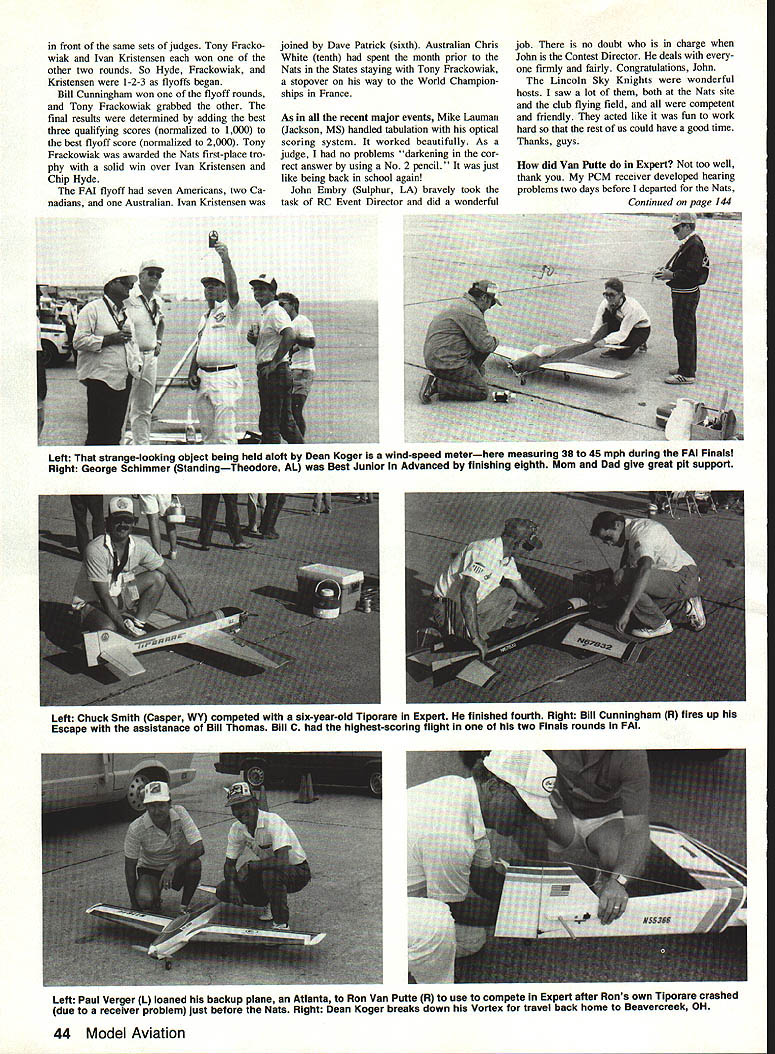
Flying a Pattern flight in winds of 38 mph gusting to 45 mph is an experience I’ll try to avoid. Because judges are supposed to judge the airplane's track rather than its attitude, many airplanes appeared as elevators during vertical maneuvers. If it seems like I’ve emphasized the wind at the expense of the competition, it's because the wind really overwhelmed the contest — each flight became a struggle for survival rather than a striving for excellence. Still, the better fliers in all classes were able to overcome the wind to a degree.
Probably the most impressive performance in the wind was by the tents used to shade judges and transmitter mounters. Those Porta‑Shade tents took a tremendous beating all week with very few failures; I can’t imagine anyone having problems with those tents in normal use.
One disadvantage of splitting Sportsman/Advanced from Expert/Master/FAI was that Sportsman and Advanced fliers missed the opportunity to observe and fly with the higher classes. Many fliers remarked they missed having the other classes around when they flew.
Competition summaries
Sportsman
After three rounds, the top five remained almost intact at the end. John Kasprak led early, but Gene Rodgers moved from third to win. Kasprak finished third. Kearney LeJeune was second after three rounds but ended up fifth despite some magnificent flights. Ron Hill moved up from fifth to second. Howard Morin (Best Junior) dropped from fourth to seventh, while Dennis Suding (Best Senior) moved into a higher placing.
Advanced
David Mertz, John Howell, Jr. (Best Senior), and William Graves held the first three places after both the third and the final rounds. Robert Campbell, Bob Campbell, and others rounded out the field with consistent performances. Robert Creager was not even in the top eight after three rounds but surged to fourth. Derek Emmett took fifth until one of his main gears collapsed on the landing of his last flight, costing him landing points and dropping him to ninth in a tightly contested class.
Expert
The top three were very close after three rounds — only 10 points separated them out of more than 2,400 points. Eugene Maxwell pulled ahead to win from Don Apostolico, who had led much of the way. Greg Froehlich finished third. The next three places were also close, with Chuck Smith and Michael McFarland edging out James Chafe.
Master
With only 15 fliers, the flying quality was excellent. Jim Eide was a solid leader. The next five places spanned only 14 points out of nearly 3,200 points. George Manning edged Pete Callas by 4½ points, while Pete beat Charles Lewis by 5½ points. Charles led Steve McCann and Richard Venero by only five points; Steve won fifth by a tiebreaker round score.
FAI
The top 10 FAI fliers flew two flyoff rounds after four qualifying rounds, all in front of the same sets of judges. Chip Hyde, Tony Frackowiak, and Ivan Kristensen were 1–2–3 as flyoffs began; Hyde, Frackowiak, and Kristensen each won one of the other two rounds leading into the flyoffs. Bill Cunningham had low flyoff rounds in one set, and Tony Frackowiak grabbed the other.
Final scoring added the best three qualifying scores (each normalized to 1,000) to the best flyoff score (normalized to 2,000). Tony Frackowiak was awarded the Nats first‑place trophy with a solid win over Ivan Kristensen and Chip Hyde.
The FAI flyoff field included seven Americans, two Canadians, and one Australian. Ivan Kristensen was joined by Dave Patrick (sixth). Australian Chris White (tenth) had spent the month prior to the Nats in the U.S., staying with Tony Frackowiak as a stopover on his way to the World Championships in France.
Tabulation and contest management
Mike Lauman (Jackson, MS) handled tabulation with his optical scoring system, which worked beautifully. As a judge, I had no problems filling in the correct answers with a No. 2 pencil — it felt just like being back in school.
John Embry (Sulphur, LA) bravely took the task of RC Event Director and did a wonderful job. There is no doubt who is in charge when John is Contest Director; he deals with everyone firmly and fairly. Congratulations, John.
The Lincoln Sky Knights were excellent hosts. I saw many of them both at the Nats site and the club flying field; they were competent, friendly, and hardworking. They made the event enjoyable for the rest of us. Thanks, guys.
Personal note
How did I do in Expert? Not too well. My PCM receiver developed hearing problems two days before I left for the Nats, and my Tiporae was destroyed when it planted itself in the Florida sand. Many fliers offered their spare airplanes when they heard I'd crashed and saw or heard about the fun‑fly airplane I'd brought to compete with.
I declined offers until Paul Verger (Lafayette, LA) offered his backup Atlanta and insisted I fly it, saying I shouldn't fly my damaged airplane and embarrass us all. I flew Paul's Atlanta, but learning to fly a strange airplane well in heavy wind was too tough a task to accomplish successfully. At least I looked like a Pattern flier. Thanks, Paul.
Closing
See you at the 1988 Nats in Chesapeake, VA.
Transcribed from original scans by AI. Minor OCR errors may remain.

