
AMA Nats: RC Aerobatics
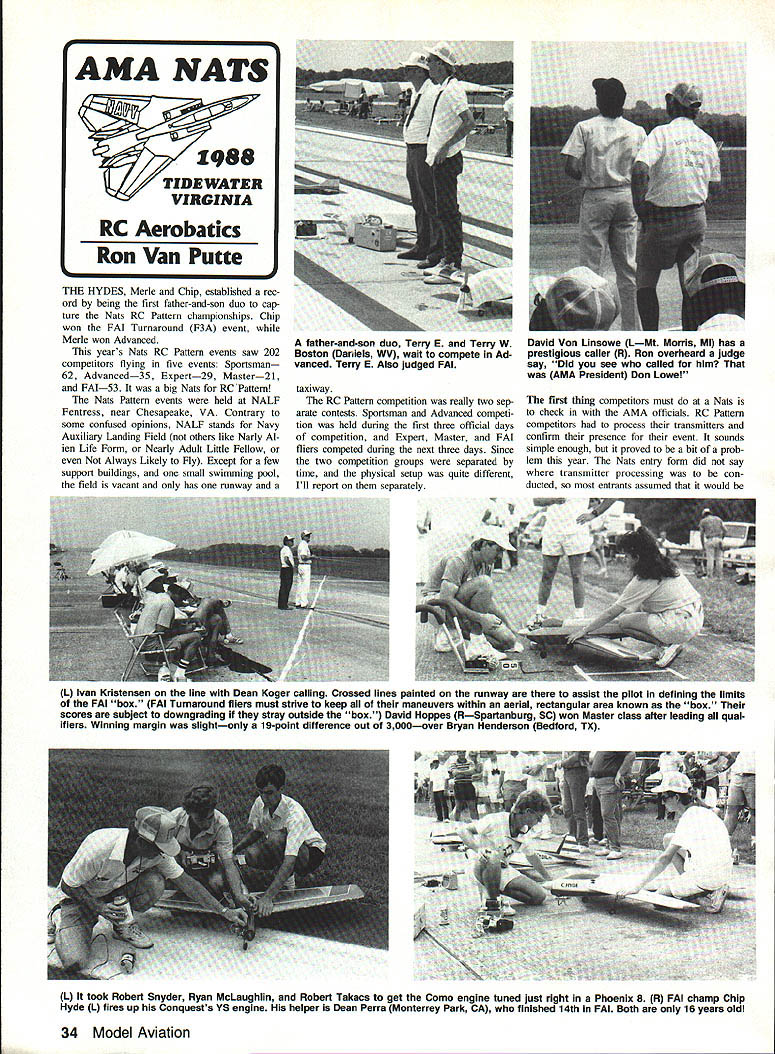
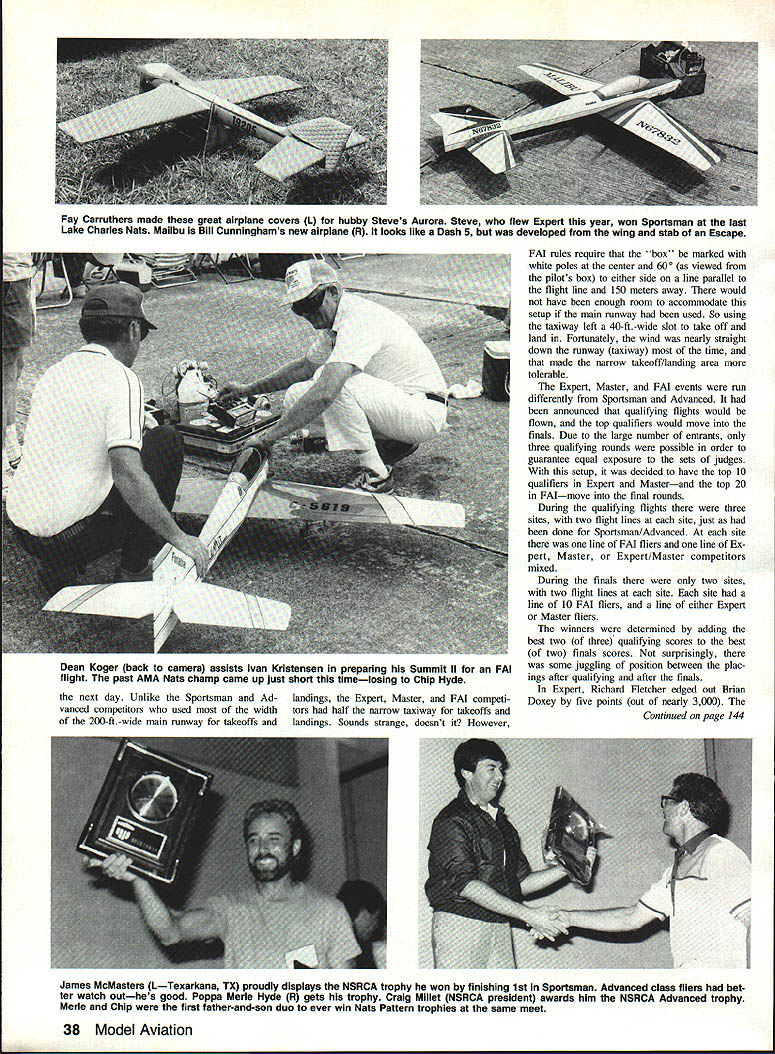
THE HYDES — Merle and Chip Hyde established a record by becoming the first father-and-son duo to capture Nats RC Pattern championships. Chip won the FAI Turnaround (F3A) event, while Merle won Advanced.
Overview and entry statistics
This year's Nats RC Pattern events featured 202 competitors across five events:
- Sportsman — 62
- Advanced — 35
- Expert — 29
- Master — 21
- FAI — 53
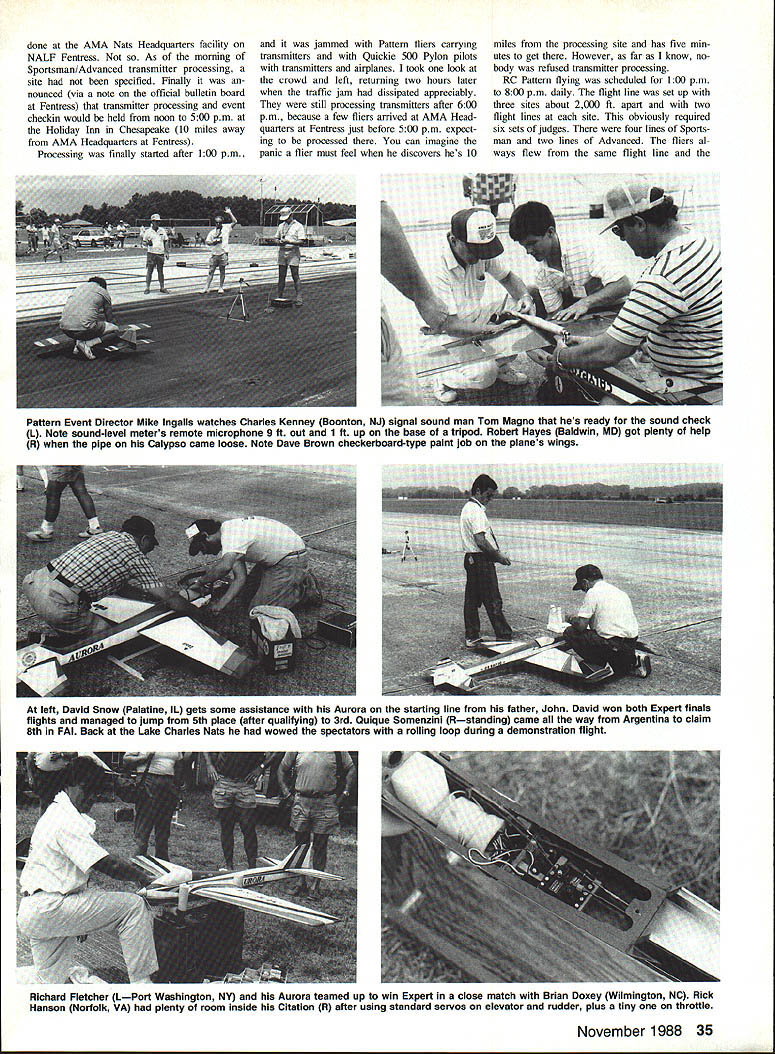
The Pattern events were held at NALF Fentress, near Chesapeake, VA. NALF stands for Navy Auxiliary Landing Field. Except for a few support buildings and a small swimming pool, the field is essentially vacant, with a single runway and a taxiway.
Competition format
RC Pattern competition was effectively two separate contests:
- Sportsman and Advanced — held during the first three official days.
- Expert, Master, and FAI — held during the next three days.
The time separation meant the physical setup and flight operations were different for the two groups.
Transmitter processing and check-in
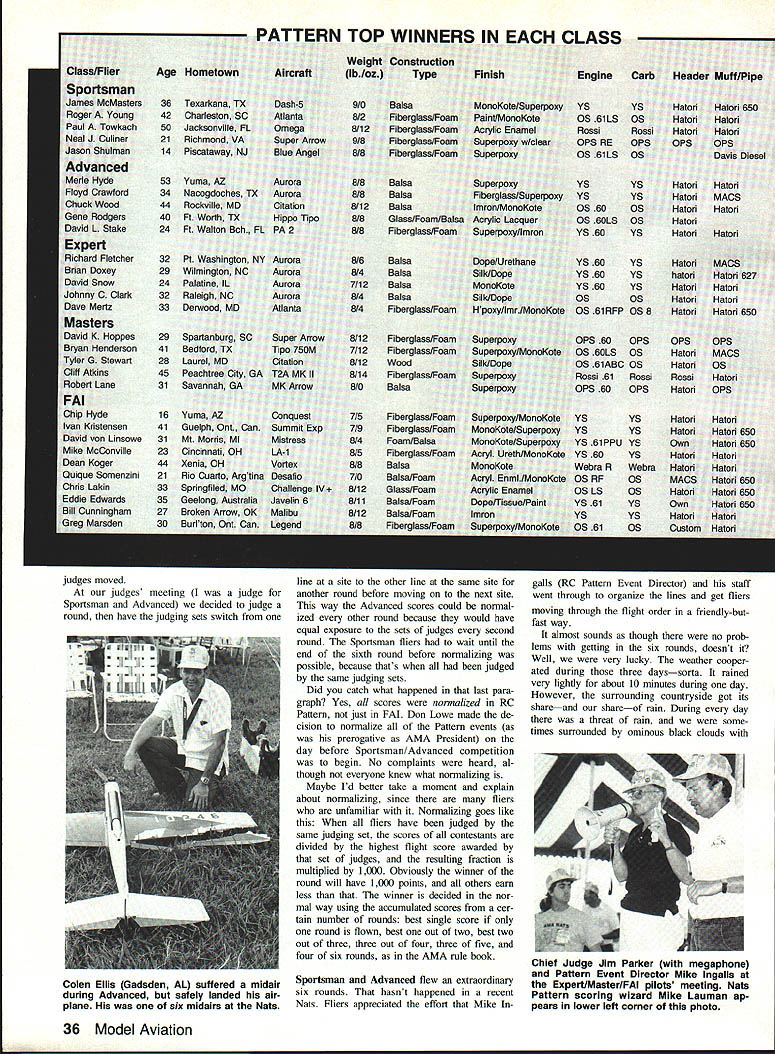
All competitors had to check in and process transmitters with AMA officials. This year the Nats entry form did not indicate the processing location. Many entrants assumed processing would be at AMA Headquarters at Fentress. A bulletin-board notice later announced that transmitter processing and event check-in would be held noon–5:00 pm at the Holiday Inn Chesapeake, 10 miles from Fentress. Processing did not start until after 1:00 pm and the area became jammed. Many competitors returned to the field and came back later. Transmitter processing continued after 6:00 pm for some who arrived late. As far as is known, no one was refused processing, but the confusion caused significant stress for some fliers.
Flight lines, schedule, and judging
- Flying hours: 1:00 pm to 8:00 pm daily.
- Flight line layout for Sportsman/Advanced: three sites about 2,000 feet apart, two flight lines per site (six sets of judges total — four lines for Sportsman, two for Advanced). Advanced fliers always used the same flight line.
- For Expert/Master/FAI the layout and takeoff/landing areas differed (see below).
At a judges' meeting the judges agreed to rotate judging sets within a site: a judging set would judge a round on one line, then switch to the other line at the same site for the next round before moving to the next site. This rotation was intended to equalize exposure to different judges across rounds.
Normalizing scores
All Pattern events were normalized (a decision made by AMA President Don Lowe). Normalizing works like this: when all fliers have been judged by the same judging set, the highest flight score awarded by that set is scaled so that the top score becomes 1,000 points; other scores are scaled proportionally. The winner of a round therefore receives 1,000 for that round; accumulated normalized scores determine contest standings according to the AMA rule book (best single if one round, best one of two, best two of three, three of four, three of five, and four of six rounds, etc.).
Sportsman and Advanced rounds and weather
Sportsman and Advanced flew an unusually long six rounds. Event Director Mike Ingalls and his staff organized flight lines and flight orders to keep fliers moving efficiently.
Weather cooperated enough to complete six rounds, though there were daily threats of rain and occasional distant lightning. Only light rain (about 10 minutes) fell on one day at the field.
Sportsman results
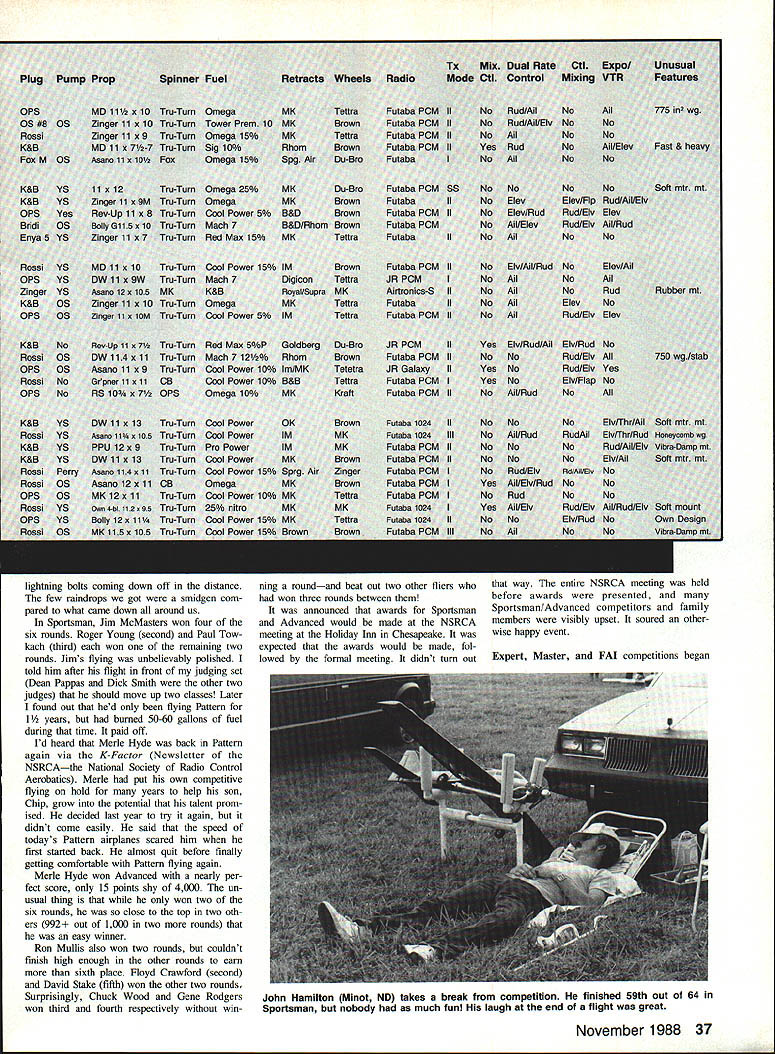
- Winner: Jim McMasters — won four of six rounds; consistently polished flying. He had only been flying Pattern about 1½ years.
- Second: Roger Young
- Third: Paul Touchek
Jim’s performances impressed the judges for their smoothness and consistency.
Advanced results
- Winner: Merle Hyde — nearly perfect accumulated score, just 15 points shy of 4,000. He won two rounds and finished very close to the leader in two others.
- Second: Floyd Crawford
- Third: Chuck Wood
- Fourth: Gene Rodgers
- Fifth: David Stake
- Sixth: Ron Mullis — won two rounds but had lower finishes in others.
A post-event award presentation was scheduled at the NSRCA meeting at the Holiday Inn in Chesapeake. The meeting proceeded before the awards were presented, which upset many Sportsman/Advanced competitors and family members.
Expert, Master, and FAI: format and setup
FAI Turnaround fliers must keep maneuvers within a rectangular aerial "box"; maneuvers outside the box are subject to downgrading.
Because FAI rules require the box to be marked at the center and at 60° to either side on a line parallel to the flight line 150 meters away, the main runway could not accommodate the required setup. Expert, Master, and FAI competitors therefore used roughly half the narrow taxiway for takeoffs and landings. That left a roughly 40-ft-wide slot for takeoff and landing; favorable winds (nearly straight down the taxiway) made this manageable.
Qualifying and finals format:
- Qualifying: three rounds (limited due to entrant numbers) with three sites and two lines per site (each site had one FAI line and one line mixing Expert/Master).
- Advancement: top 10 qualifiers in Expert and Master; top 20 in FAI advanced to finals.
- Finals: two sites with two lines each; each site had a line of 10 FAI fliers and a line of either Expert or Master.
- Scoring: winners were determined by adding the best two of three qualifying scores to the best (of two) finals scores (i.e., best two qualifying + best finals scores).
Positions often shifted between qualifying and final standings.
Expert and Master results
- Expert winner: Richard Fletcher — edged Brian Dovey by five points (out of nearly 3,000).
- Master winner: David Hoppes, Spartanburg, SC — won after leading the qualifiers; margin over Bryan Henderson (Bedford, TX) was 19 points out of 3,000.
FAI results
- Winner: Chip Hyde — FAI Turnaround champion (part of the first father-and-son Nats RC Pattern championship record with his father Merle).
Volunteers and facilities crew
A Nats depends on local AMA-chartered clubs providing manpower. Four Tidewater-area clubs provided major support:
- Norfolk Aeromodelers
- Tidewater Model Soaring Society
- Tidewater RC Incorporated
- Tidewater Whirlybirds
About 300 AMA members volunteered. A Facilities Crew of out-of-state volunteers also contributed many hours: Bob and Janet Landry; Paul and Peg Olivero; Gary Atta; Dick Petit; and Jim Buchanan of Underhill, Vermont. Jim Buchanan worked tirelessly and passed away one evening during Nats week in the facilities staging area; those who knew him said he went quietly while doing what he enjoyed—working with friends.
Special recognition was given to Virginians Mike Ingalls (Event Director) and Greg Kozlowski for leading the Tidewater-area workers who prepared and supported the Nats.
Notable mentions and captions (photo context)
- Crossed lines painted on the runway helped pilots define limits for the FAI box.
- Chip Hyde was seen firing up a Conquest YS engine in FAI competition.
- Several competitors and helpers were photographed assisting at starting lines, performing sound checks, or working on aircraft—examples of the teamwork visible at the event.
(End of article.)
Transcribed from original scans by AI. Minor OCR errors may remain.

