
AMA Nats: RC Pylon Racing
Wayne Yeager
Overview
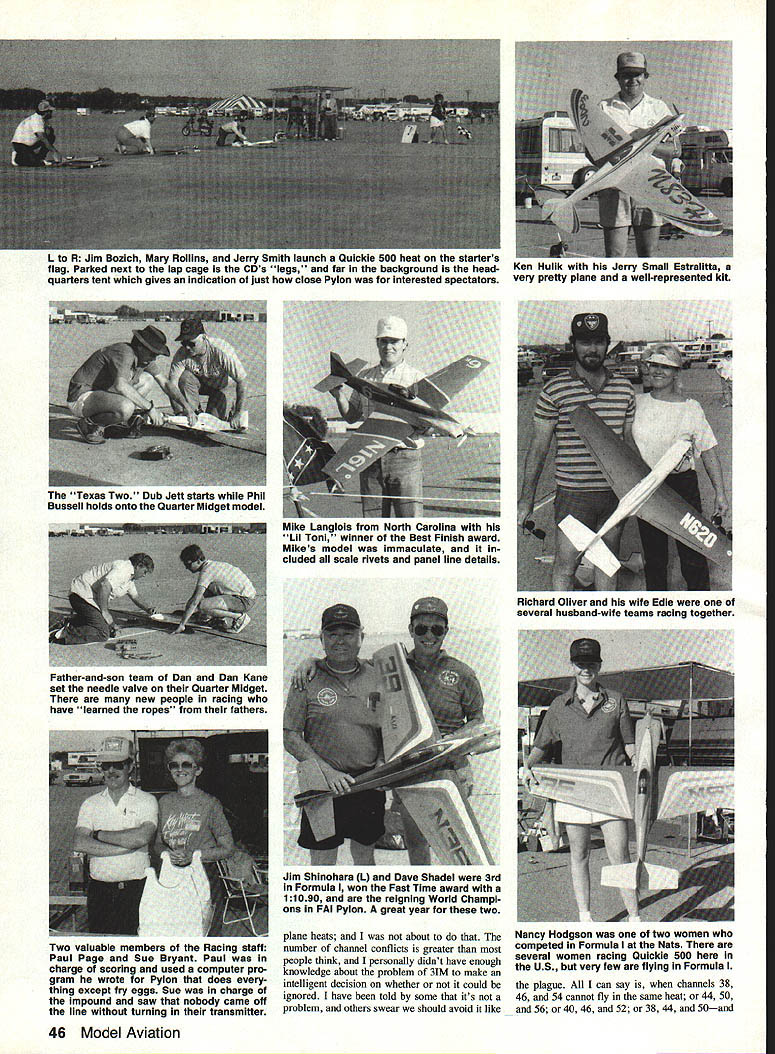
It was sunny, calm, overcast, windy, and it even rained one day, but none of it seemed to have any lasting effect on pylon racing—except for the rain. All in all we had six great days of racing at the 1987 Nationals in Lincoln, NE. As Pylon event director I also filled in as the writer for Model Aviation's usual pylon scribe, so when I refer to radical decisions by the CD, keep in mind who that was.
Lincoln proved an excellent site for pylon racing despite its miles of concrete and lack of tent stakes. Entry levels were high in some classes (Quickie 500 about 42 contestants; Formula I about 40) while Quarter Midget entries were lower (27). FAI turnout was small (three), which allowed us to reclaim some time and complete a full seven rounds plus flyoffs in the rain-interrupted Quarter Midget event.
Quickie 500
Processing for Quickie 500 produced an amazing variety of hybrids: high wings, low wings, straight tails, V-tails, flying stabs, flying rudders, undersize and oversize components—name it. Since this was Quickie 500’s first appearance at the Nats, the CD decided to begin the event with models as close to the rules as possible. As a result, many models arrived modified with added humps for height, tape on fuselage sides to meet width requirements, and foam tape on wings to meet thickness rules.
#### Rules and measurement issues
We ran into interpretation problems with some rules. For example, the rule book states firewalls must be a flat plate, 2 1/2 in. square. It does not specify whether a radius on the outer edge is allowed, nor where to measure the firewall minimum—at the forward face or at the rear where it mounts to the fuselage (or where the engine mount fastens). If you measure at the very front, firewalls with any radius appeared undersize. With no clear guideline, we decided to accept firewalls that met the required size at the back face. This is a reminder that clearer rule definitions are needed to avoid recurring disputes.
#### Channel matrix and transmitters
The channel matrix created another headache. There were roughly 10 different 31 MHz combinations that could not be eliminated unless we flew two-plane heats, which I was not willing to do. The number of channel conflicts is greater than most people expect, and I did not have enough expertise to judge whether some 31 MHz combinations could safely be ignored. On suggestion from Russ Kime, who has studied the problem, we ran Quickie from two different matrices stacked back-to-back—one using six heats per round and the other five heats per round. Drawbacks included that pilots in the five-heat matrix never raced those in the six-heat matrix, and Paul Page (my computer operator) had to create a third matrix to combine results for reporting. Time-consuming, but it worked.
I was later informed that all transmitters will be "Silver Stickered" in 1988, requiring narrow-band operation. Hopefully that will eliminate the matrix problem for future Nats.
#### Quickie results and notes
- The event was dominated by Rossi engines—16 of the top 20 fliers used Rossis, and the top six places went to Rossi-powered planes. Webra engines were the only other engines to break into the top 10.
- Fast times ranged widely by skill level: Charlie Brunner posted a fast 1:22.82, most fast competitors averaged around 1:35, and mid-range times were near 1:45.
- When the smoke cleared, the Brunner-Aut team won Quickie. Ken Heatlie (half of the S&H Team) finished a very close second. Jessica Thurrott, improving with each contest, tied for second initially but lost the tie-break in a flyoff—she’s already a serious contender.
Things remembered from Quickie: Russ Miller cutting on a freebie (he smiled through it); Arnie Wile not starting because his receiver was off; and that polite Texas kid, Mike Bussell Jr., who kept addressing me as “Sir.”
Quarter Midget
Quarter Midget racing began Tuesday morning. Based on the morning forecast I switched the course 180° to anticipate winds—unfortunately as soon as the first heat launched the wind swung back to the original direction so we were taking off downwind. We completed the first round, switched the course back 180°, and kept flying until a front brought rain around 11:00 a.m. We stopped with four rounds completed.
At that point Ken Hulik and Dennis Sumner (the other half of the S&H Team) were tied for the lead. Because FAI Pylon was so lightly attended, the Nats general manager and the RC category manager approved our request to borrow time from that event. Pilots agreed to stay over, and the next morning we completed three more rounds and the flyoffs, giving a total of seven rounds plus flyoffs.
- Dennis Sumner won Quarter Midget outright. He won his heats consistently and avoided errors.
- Lyle Larson and Henry Bartle tied one point behind and were required to fly off for second and third; both made double cuts in the flyoff, so Larson was awarded second based on faster time.
- Ken Hulik, after a midair that gave him a zero, finished fourth but claimed fast-time with a 1:15.26.
- Al Grove finished fifth.
Formula I
Formula I processing began after the F3D event and was a sight to behold: about 40 entries and roughly 60 Formula I models on the floor being prepped. Best Finish was awarded to Mike Langlois of North Carolina for an immaculate model including scale rivets and panel-line detail—unfortunately Best Finish often seems to be a jinx; Mike crashed his plane later.
Racing started Thursday morning shortly after 7:00 a.m. We completed roughly 3.5 half rounds before running out of time. After Round One ten pilots were tied having won heats; Dave Shadel set Round One fast time with 1:12.62. Through the rounds the field narrowed:
- After Round Three the leading contenders were Dave Shadel and Bob Smith.
- In Round Four Shadel, long regarded as nearly invincible, had a touch race and cut badly—he finished last in that heat.
- Bob Smith led after five rounds, but in Round Six he had two very short laps and failed to go around the pole, resulting in a double cut and a zero.
- Dave Pearce, who had been one point behind Smith, took the lead. He ran a race that secured at least a second-place finish, and despite a pylon cut in the final he still finished second in the heat—enough to win the overall contest.
Final placings:
- Dave Pearce — Champion
- Henry Bartle
- Dave Shadel, Bob Smith, Phil Bussell (tied)
The flyoff belonged to Shadel, who recovered spectacularly and posted the event fast time of 1:10.90. Smith was second in the flyoff with 1:12.43.
Jessica Thurrott also showed strong Formula I form with times of 1:19, 1:16, 1:14, and 1:13—shame she’s in an area with few Formula I racers.
Trophies were awarded to the top 10.
Memories and highlights
Notable moments from the Nats:
- Burt Rutan visited our site twice, expressed interest in pylon racing, and asked detailed questions about building techniques and materials.
- Equipment failures required several reruns—an issue we intend to correct if we run the event again.
- Course changes during Quarter Midget and the rain interruption that reduced one day’s flying.
- Bill Miller’s Formula I entry repainted in bright day‑glo orange so he could see it.
- F-4 Phantoms practicing touch-and-goes with afterburners—the loudest things I’ve heard except for some Harriers.
- An all-woman lap-cage crew that performed faultlessly and made my life easy; the guys seemed to take it easier when cuts were being questioned.
- A Combat model that flew into power lines, wrapped around them and provided a fireworks display before shutting down Nats headquarters briefly.
- The many Lincoln Sky Knights club members who worked hard despite never having seen a pylon race before—they kept coming back and were tremendous help.
- The many pilots, crew, and spectators who thanked us for providing six days of racing.
Staff, scoring, and impound
- Paul Page was in charge of scoring and wrote a computer program that handled nearly everything (including creating the combined matrix report).
- Sue Bryant managed impound and ensured pilots followed procedures when arming transmitters.
- Many volunteers from the Lincoln Sky Knights and others contributed long hours and great effort.
Recommendations and closing
- Clarify rule definitions—particularly firewall measurement and other dimensional tolerances—to avoid future disputes.
- The change to narrow-band (Silver Sticker) transmitters should help solve matrix/channel conflict issues at future Nats.
- Fix the equipment reliability issues that caused reruns.
Thanks to everyone who helped, competed, or came out to watch—your support made the event successful. For you people, I’d do it again anytime. See you next year in Virginia Beach.
Transcribed from original scans by AI. Minor OCR errors may remain.

