
AMA Nats: RC Scale
Bob and Dolly Wischer
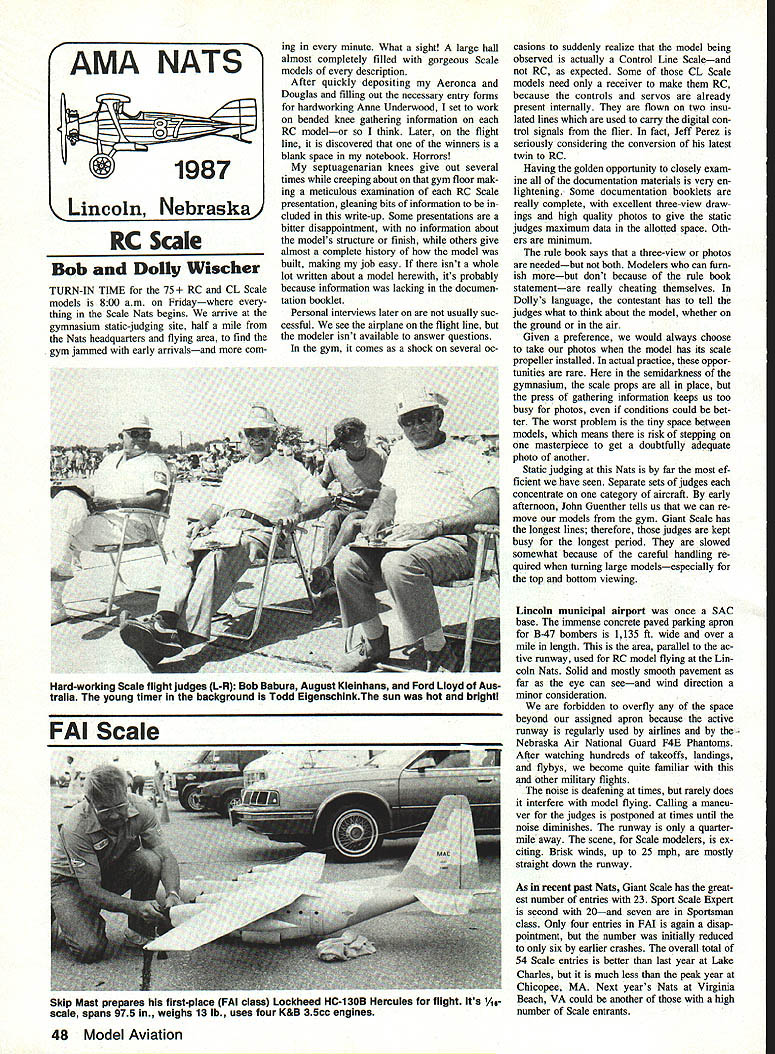
TURN-IN TIME for the 75+ RC and CL Scale models is 8:00 a.m. on Friday—where everything in the Scale Nats begins. We arrive at the gymnasium static-judging site, half a mile from the Nats headquarters and flying area, to find the gym jammed with early arrivals—and more coming in every minute. What a sight! A large hall almost completely filled with gorgeous Scale models of every description.
After quickly depositing my Aeronca and Douglas and filling out the necessary entry forms for hardworking Anne Underwood, I set to work on bent-knee gathering information on each RC model—or so I think. Later, on the flight line, it is discovered that one of the winners is a blank space in my notebook. Horrors!
My septuagenarian knees give out several times while creeping about on that gym floor making a meticulous examination of each RC Scale presentation, gleaning bits of information to be included in this write-up. Some presentations are a bitter disappointment, with no information about the model's structure or finish, while others give almost a complete history of how the model was built, making my job easy. If there isn't a whole lot written about a model here, it's probably because information was lacking in the documentation booklet.
Personal interviews later are not usually successful. We see the airplane on the flight line, but the modeler isn't available to answer questions. In the gym, it comes as a shock on several occasions to suddenly realize that the model being observed is actually a Control Line Scale—and not RC, as expected. Some of those CL Scale models need only a receiver to make them RC, because the controls and servos are already present internally. They are flown on two insulated lines which are used to carry the digital control signals from the flier. In fact, Jeff Perez is seriously considering the conversion of his latest twin to RC.
Having the golden opportunity to closely examine all of the documentation materials is very enlightening. Some documentation booklets are really complete, with excellent three-view drawings and high-quality photos, which give the static judges maximum data in the allotted space. Others are minimal. The rule book says that a three-view or photos are needed—but not both. Modelers who can furnish more, but don't because of the rule book statement, are really cheating themselves. In Dolly's language, the contestant has to tell judges what he thinks about the model, whether ground or air.
Given a preference, we would always choose to take our photos when the model has its scale propeller installed. In actual practice, these opportunities are rare. Here in the semidarkness of the gymnasium the scale props are all in place, but the press of gathering information keeps us too busy for photos, even if conditions could be better. The worst problem is the tiny space between models, which means there is risk of stepping on one masterpiece to get a doubtfully adequate photo of another.
Static judging at this Nats is by far the most efficient we have seen. Separate sets of judges each concentrate on one category of aircraft. By early afternoon, John Guenther tells us that we can remove our models from the gym. Giant Scale has the longest lines; therefore, those judges are kept busy for the longest period. They are slowed somewhat because of the careful handling required when turning large models—especially for the top and bottom viewing.
Lincoln municipal airport was once a SAC base. The immense concrete paved parking apron for B-47 bombers is 1,135 ft. wide and over a mile in length. This is the area, parallel to the active runway, used for RC model flying at the Lincoln Nats. Solid and mostly smooth pavement as far as the eye can see—and wind direction a minor consideration.
We are forbidden to overfly any of the space beyond our assigned apron because the active runway is regularly used by airlines and by the Nebraska Air National Guard F-4E Phantoms. After watching hundreds of takeoffs, landings, and flybys, we become quite familiar with this and other military flights.
The noise is deafening at times, but rarely does it interfere with model flying. Calling a maneuver for the judges is postponed at times until the noise diminishes. The runway is only a quarter-mile away. The scene, for Scale modelers, is exciting. Brisk winds up to 25 mph are mostly straight down the runway.
As in recent past Nats, Giant Scale has the greatest number of entries with 23. Sport Scale Expert is second with 20—and seven in the Sportsman class. Only four entries in FAI is again a disappointment; the number had been reduced by earlier crashes. The overall total of 54 Scale entries is better than last year at Lake Charles, but it is much less than the peak year at Chicopee, MA. Next year's Nats at Virginia Beach, VA could be another of those with a high number of Scale entrants.
Giant Scale
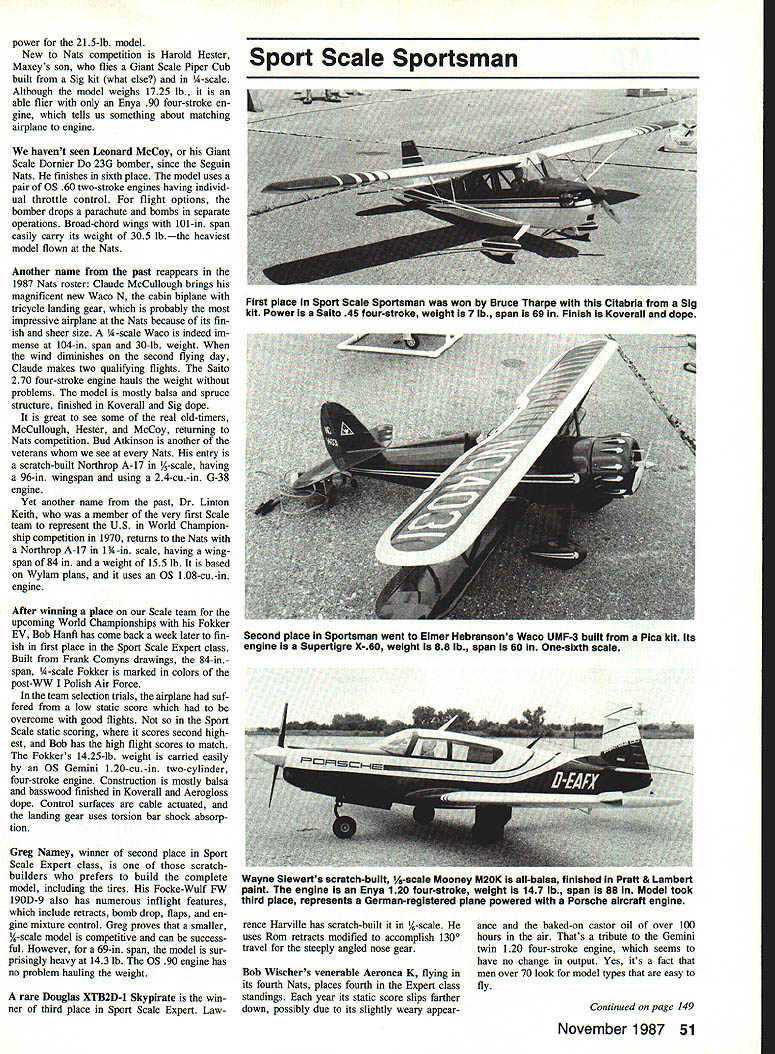
- Ramon Torres — Beechcraft T-34C-1 (1/5-scale)
- Built from Beech drawings with extensive external detailing and full cockpits.
- Retractable landing gear electrically driven with a realistic five-second cycle; working oleo struts and sequenced door operation.
- Fowler flaps operate as on the prototype; functional brakes are used as on the prototype (set before takeoff and released for acceleration).
- Full light system visible even in daylight.
- Fiberglass fuselage made from Ramon's molds.
- Engine: Moki 25 cc (1.5 cu. in.). Wingspan: 80 in. Weight: 20.3 lb.
- Note: The model was demolished on its third Nats flight for unexplained reasons.
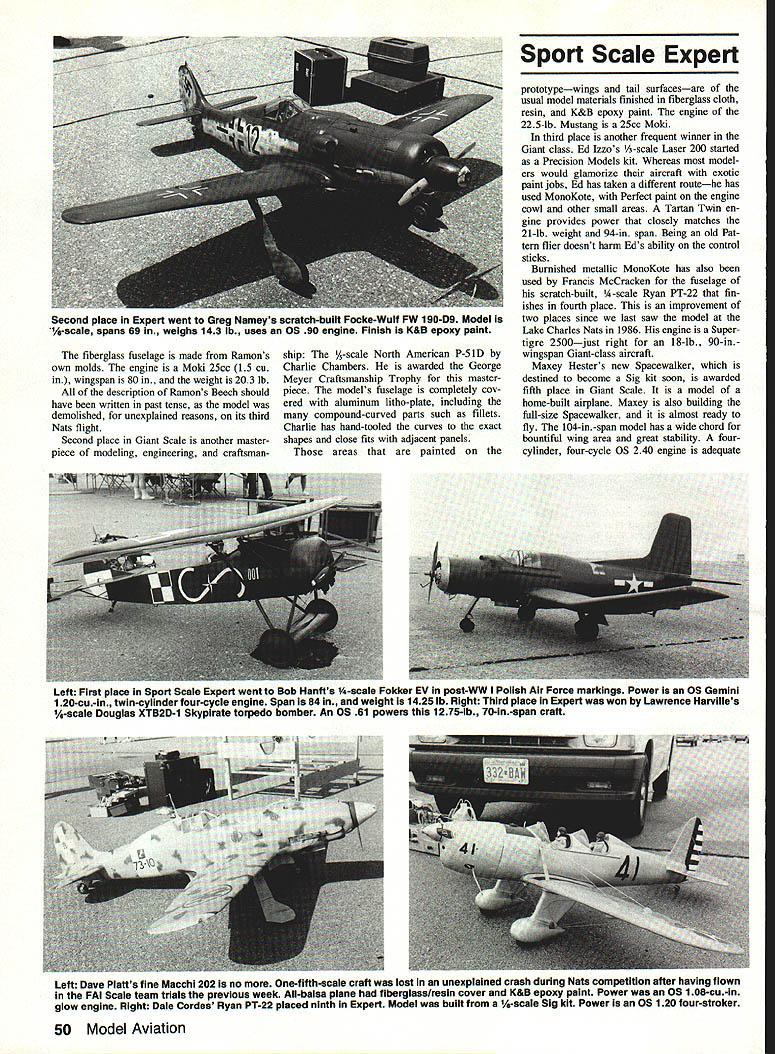
- Charlie Chambers — North American P-51D (1/5-scale)
- Awarded the George Meyer Craftsmanship Trophy.
- Fuselage completely covered with aluminum litho-plate, including compound-curved parts and fillets; hand-tooled for exact shapes and close fits.
- Wings and tail surfaces finished in fiberglass cloth, resin, and K&B epoxy paint.
- Engine: .25-cu.-in. Moki. Weight: 22.5 lb.
- Ed Izzo — Laser 200 (1/5-scale)
- Started as a Precision Models kit.
- Finish uses MonoKote with Perfect paint on the cowl and small areas.
- Engine: Tartan Twin. Weight: 21 lb. Wingspan: 94 in.
- Ed is an experienced Pattern flier and demonstrates excellent flying skill.
- Francis McCracken — Ryan PT-22 (scratch-built, 1/4-scale)
- Fuselage finished in burnished metallic MonoKote; twin glass-fabric construction.
- Engine: Super Tigre 2500. Weight: 18 lb. Wingspan: 90 in.
- Improved two places since Lake Charles Nats (1986).
- Maxey Hester — Spacewalker (prototype/home-built; 104-in. span)
- Soon to become a Sig kit.
- Wide-chord wing for stability and generous wing area.
- Engine: OS 2.40 four-cycle. Weight: not stated.
Additional notable Giant Scale entries:
- Harold Hester — Piper Cub (1/4-scale from a Sig kit). Weight: 17.25 lb. Engine: Enya .90 four-stroke.
- Leonard McCoy — Dornier Do 23G bomber (Giant class, last seen at Seguin). Uses twin OS .60 two-stroke engines with individual throttle control. Features parachute drop and separate bombing operations. Wingspan: 101 in. Weight: 30.5 lb (the heaviest model flown at the Nats).
- Claude McCullough — Waco N (1/4-scale, cabin biplane with tricycle gear). Wingspan: 104 in. Weight: 30 lb. Mostly balsa and spruce, finished in Koverall and Sig dope. Engine: Saito 2.70 four-stroke. Made two qualifying flights when wind diminished.
- Bud Atkinson — Northrop A-17 (scratch-built, 1/3-scale). Wingspan: 96 in. Engine: G-38 (2.4 cu. in.).
- Dr. Linton Keith — Northrop A-17 (1/3-scale, Wylam plans). Wingspan: 84 in. Weight: 15.5 lb. Engine: OS 1.08-cu.-in.
Sport Scale Expert
- Bob Hanft — Fokker EV (1/4-scale, 84-in. span)
- Built from Frank Czmyr's drawings; marked in post-WWI Polish Air Force colors.
- Weight: 14.25 lb.
- Engine: OS Gemini 1.20-cu.-in., two-cylinder four-stroke.
- Construction mostly balsa and basswood finished in Koverall and Aerogloss dope.
- Control surfaces cable-actuated; landing gear uses torsion bar shock absorption.
- Winner of Sport Scale Expert and a member of the World Championship team selection.
- Greg Namey — Focke-Wulf FW 190D-9 (1/5-scale, 69-in. span)
- Scratch-built, including tires; numerous finishing features such as retracts, bomb door, flaps, and engine mixture control.
- Weight: 14.3 lb. Engine: OS .90.
- Lawrence Harville — Douglas XTBD2-1 Skyraider (scratch-built, 1/4-scale)
- Rare type; uses Romi retracts modified to accomplish 130° travel for the steeply angled nose gear.
- Bob Wischer — Aeronca K
- Venerable entry flying its fourth Nats; static score has slipped over the years.
- Engine: Gemini twin 1.20 four-stroke. Noted for over 100 hours in the air.
- Lee Rice — North American P-51D Mustang (Royal kit, 1/5-scale)
- Once the dominant competitor, only three Mustangs were entered this year.
- Jerry Reiss — Art Chester's "Jeep" (1/4-scale, 52-in. span)
- Built from a Corvette kit; unusual, compact design.
- Engine: Saito .45 four-stroke.
Sportsman
- Bruce Thorpe — Cessna (Sig kit)
- Winner of the Sportsman class.
- Engine: Saito .45 four-stroke.
- Elmer Herbranson — Waco UMF-3 (Pica kit)
- Engine: Super-tiger X-60.
- One of two Nats Scale trophy winners whose flight score exceeded static score (the other was Greg Namey in Expert).
- Wayne Siewert — Mooney M20K (scratch-built, 1/5-scale, 88-in. span)
- All-balsa construction modeled after a Mooney with a Porsche engine.
- Engine: Enya 1.20 four-stroke.
FAI
The FAI portion of the Nats had only four entries after attrition during the team trials. Differences between the team trials (1988 FAI rules) and the Nats (current FAI rules) produced significant changes in complexity bonuses, affecting final placings.
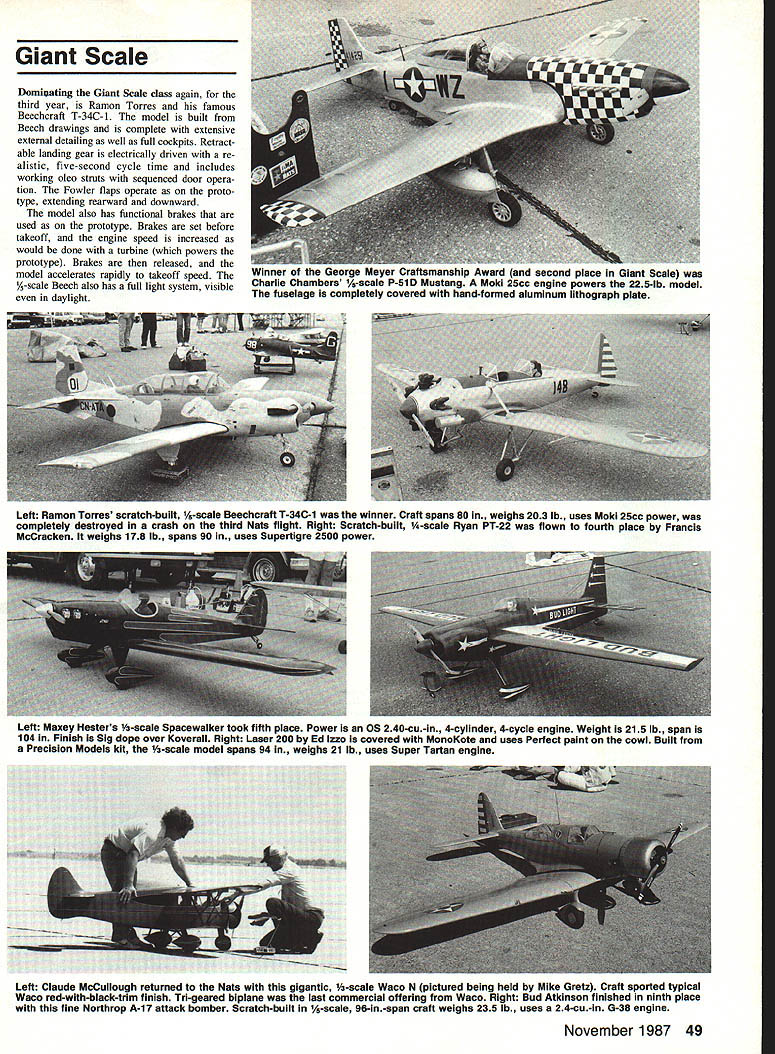
- Skip Mast — Lockheed C-130 Hercules
- Jumped from a 15% to 30% complexity bonus between competitions and became the Nats winner.
- Steve Sager — Stinson Tri-motor
- Gained a 230-point leap in static score compared to the previous week and a 25% bonus to place second.
- Bob Wischer — Douglas Mailplane
- Placed third.
- Gary Underhill — Bristol M-1
- Placed fourth.
Transcribed from original scans by AI. Minor OCR errors may remain.

