
AMA Nats: RC Scale
By John Preston
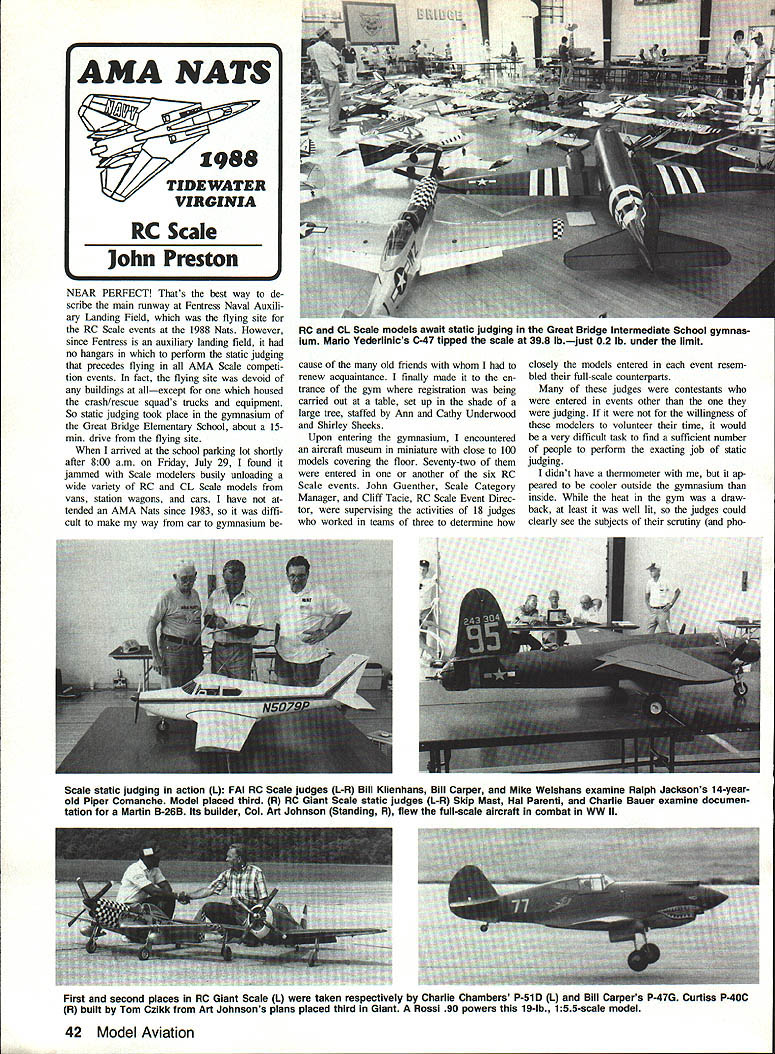
NEAR PERFECT! That's the best way to describe the main runway at Fentress Naval Auxiliary Landing Field, which was the flying site for the RC Scale events at the 1988 Nats. However, since Fentress is an auxiliary landing field, it had no hangars in which to perform the static judging that precedes flying in all AMA Scale competition events. In fact, the flying site was devoid of any buildings at all—except for one which housed the crash/rescue squad's trucks and equipment. So static judging took place in the gymnasium of the Great Bridge Elementary School, about a 15‑minute drive from the flying site.
When I arrived at the school parking lot shortly after 8:00 a.m. on Friday, July 29, I found it jammed with Scale modelers busily unloading a wide variety of RC and CL Scale models from vans, station wagons, and cars. I had not attended an AMA Nats since 1983, so it was difficult to make my way from car to gymnasium because of the many old friends with whom I had to renew acquaintance. I finally made it to the entrance of the gym where registration was being carried out at a table set up in the shade of a large tree, staffed by Ann and Cathy Underwood and Shirley Sheeks.
Upon entering the gymnasium, I encountered an aircraft museum in miniature with close to 100 models covering the floor. Seventy‑two of them were entered in one or another of the six RC Scale events. John Guenther, Scale Category Manager, and Cliff Tacie, RC Scale Event Director, were supervising the activities of 18 judges who worked in teams of three to determine how closely the models entered in each event resembled their full‑scale counterparts.
Many of these judges were contestants who were entered in events other than the one they were judging. If it were not for the willingness of these modelers to volunteer their time, it would be a very difficult task to find a sufficient number of people to perform the exacting job of static judging.
I didn't have a thermometer with me, but it appeared cooler outside the gymnasium than inside. While the heat in the gym was a drawback, at least it was well lit, so the judges could clearly see the subjects of their scrutiny (and photos didn't require a flash unit). I owe the judges a big vote of thanks for performing their tasks in an environment that was definitely uncomfortable—it reminded me of the first Nats at Lake Charles, LA. A constant flow of spectators through the gym and the video cameras made the arduous task even more demanding.
I went to the Giant Scale event because of the paperwork involved—to pore through documentation. Twenty‑nine models were entered. Sport Scale had a similar large turnout with a total entry of 32, equally divided between Sportsman and Expert classes. Different teams judged models entered in the two classes. During discussions, several people suggested Giant Scale should similarly split Sportsman and Expert. That seems like a good idea; I wouldn't be surprised to see such a suggestion submitted as a rules‑change proposal.
Because of the large entry, it was close to 5:00 p.m. before the Giant Scale judges finally completed their assignment and the real business could begin—a barbecue/banquet held on the school grounds and organized by the National Association of Scale Aeromodelers (NASA). I'm sure all appreciated the bountiful feast; I'm betting John Guenther, NASA president, was at least involved.
Now that I've returned home from the Nats I have to write this column—it's not in its usual place; its usual authors Bob Dolly and Wischer realize what a great job collecting necessary information, comparing lists of trophy winners, notes, and photos is. You can see the number of embarrassing voids. Please forgive the winners I did not manage to get photographs and information on many models. Flying took place at two sites about a quarter‑mile apart, and many times a model needed to be photographed at the other site while it was in the air. It's much easier writing a column about safety than trying to describe who won what in six different events.
Giant Scale
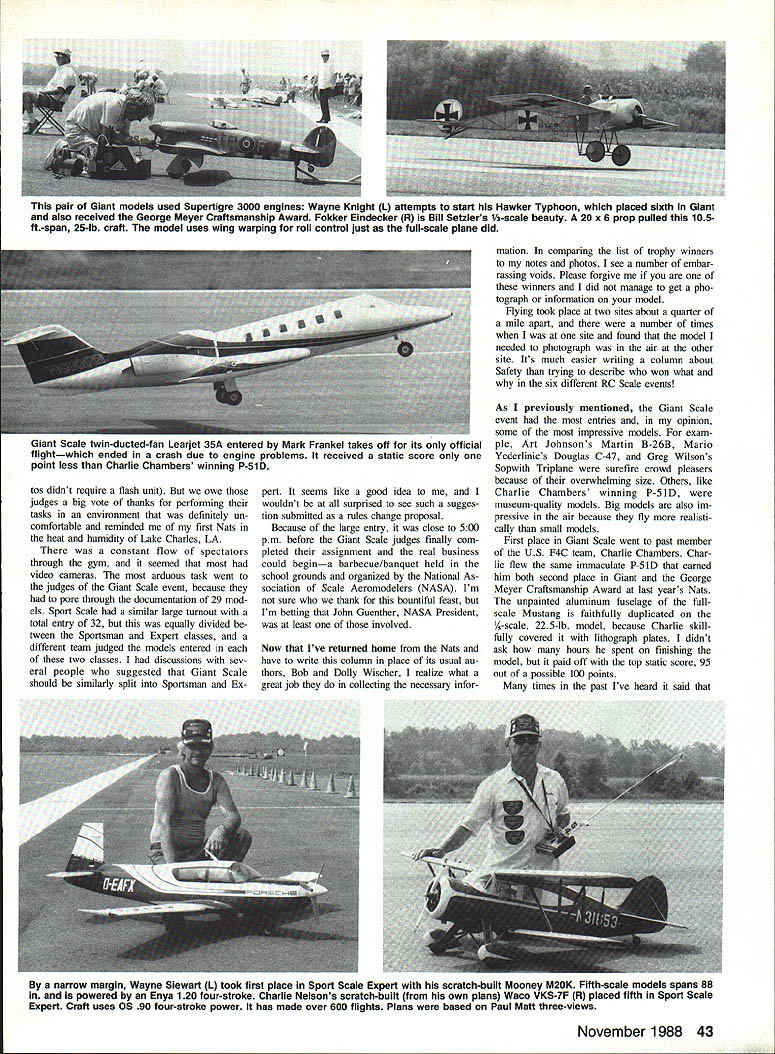
As I previously mentioned, the Giant Scale event had the most entries and, in my opinion, some of the most impressive models. For example, Art Johnson's Martin B-26B, Mario Yederlinic's Douglas C-47, and Greg Wilson's Sopwith Triplane were surefire crowd pleasers because of their overwhelming size. Others, like Charlie Chambers' winning P-51D, were museum‑quality models. Big models are also impressive in the air because they fly more realistically than small models.
Top placings in Giant Scale:
- 1st — Charlie Chambers, P-51D (1/3-scale, 22.5 lb.): Unpainted aluminum fuselage duplicated with lithograph paper. Top static score 95/100. Best two flights 90 and 88.67. Powered by a 25cc Moki.
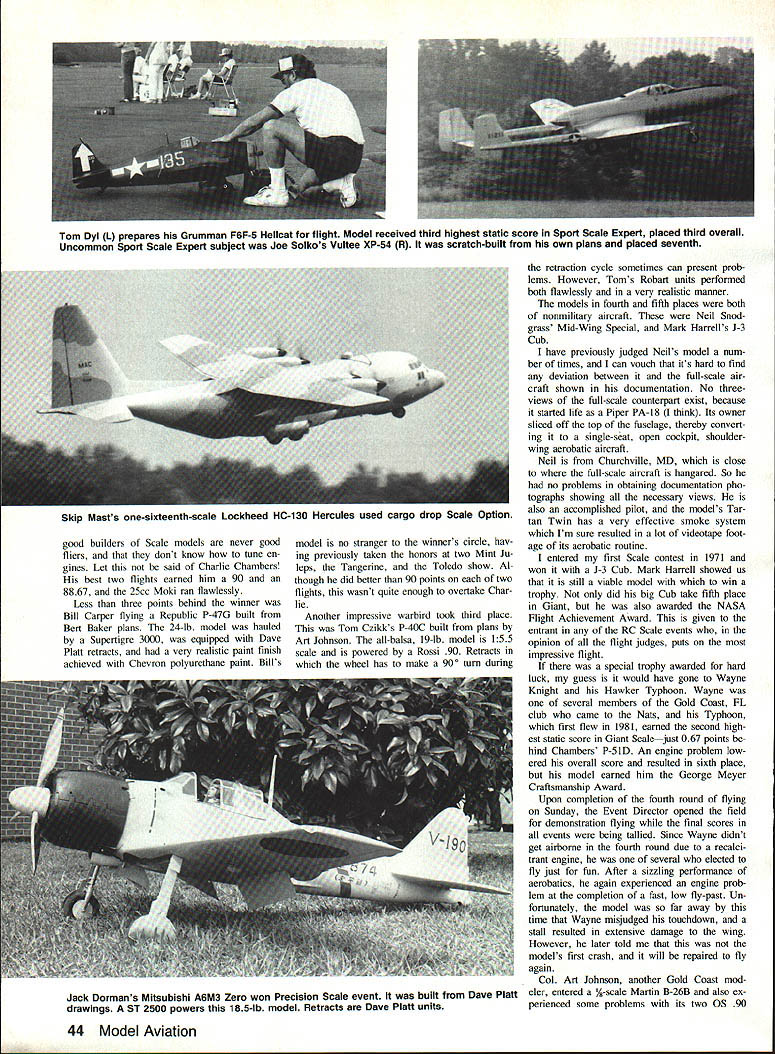
- 2nd — Bill Carper, Republic P-47G (24 lb.): Built from Bert Baker plans; powered by a Super Tigre 3000; equipped with Dave Platt retracts; Chevron polyurethane finish. Multiple previous show wins.
- 3rd — Tom Czikk, P-40C (all-balsa, 19 lb., 1.5:5-scale): Built from Art Johnson plans; powered by a Rossi .90. Robart retracts with 90° wheel rotation performed flawlessly.
- 4th — Neil Snodgrass, Mid-Wing Special: Extremely accurate to full-scale counterpart; Taylor Twin with effective smoke system; excellent documentation.
- 5th — Mark Harrell, J-3 Cub: Classic Cub design; also won the NASA Flight Achievement Award for most impressive flight.
If there was a special trophy for hard luck it might have gone to Wayne Knight and his Hawker Typhoon. Wayne, from Gold Coast, FL, had the second highest static score in Giant Scale—just 0.67 points behind Chambers' P-51D—but an engine problem lowered his overall score to sixth place. His model did earn the George Meyer Craftsmanship Award. After demonstration flying on Sunday, Wayne experienced another engine problem and a stall that caused extensive wing damage; he intends to repair and fly the model again.
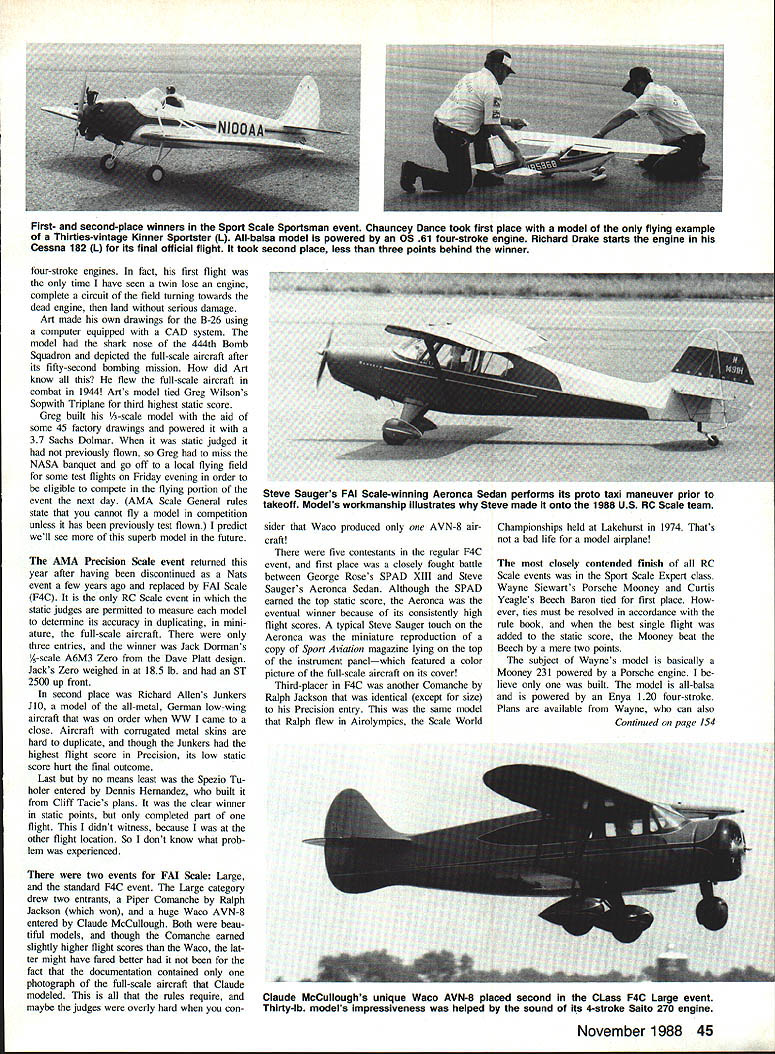
Col. Art Johnson, another Gold Coast modeler, entered a 1/3-scale Martin B-26B powered by two OS .90 four-stroke engines and experienced some problems. His first flight was the only time I have seen a twin lose an engine, complete a circuit turning toward the dead engine, then land without serious damage. Art made his own drawings for the B-26 using a CAD system. The model depicted the shark nose of the 444th Bomb Squadron after its fifty‑second bombing mission—Art flew the full‑scale aircraft in combat in 1944. Art's model tied Greg Wilson's Sopwith Triplane for the third highest static score.
Greg Wilson built his 1/3-scale Sopwith Triplane using some 45 factory drawings and powered it with a 3.7 Sachs Dolmar. When it was static judged it had not previously flown, so Greg missed the NASA banquet to perform test flights Friday evening to be eligible for the flying portion. I predict we'll see more of this superb model in the future.
Precision Scale
The AMA Precision Scale event returned this year after having been discontinued as a Nats event a few years ago and replaced by FAI Scale (F4C). It is the only RC Scale event in which static judges are permitted to measure each model to determine its accuracy in duplicating, in miniature, the full‑scale aircraft. There were three entries.
Placings in Precision Scale:
- 1st — Jack Dorman, A6M3 Zero (1/3-scale, 18.5 lb.): Dave Platt design; powered by an ST 2500.
- 2nd — Richard Allen, Junkers J10: All‑metal German low-wing aircraft. Had highest flight score in Precision, but a low static score hurt the final placement.
- 3rd — Dennis Hernandez, Spezio Tutor (from Cliff Tacie's plans): Clear winner in static points but only completed part of one flight.
FAI Scale (Large and F4C)
There were two FAI Scale events: Large, and the standard F4C event.
Large category:
- Winner — Ralph Jackson, Piper Comanche.
- 2nd — Claude McCullough, Waco AVN-8. Both beautiful models; the Comanche earned slightly higher flight scores. The Waco may have been penalized by limited documentation (only one photograph of the full-scale aircraft).
F4C event (five contestants):
- 1st — Steve Sauger, Aeronca Sedan: Consistently high flight scores clinched the win despite not having the top static score.
- 2nd — George Rose, SPAD XIII: Earned top static score but lost on flight scoring.
- 3rd — Ralph Jackson, Comanche: Identical to his Precision entry except for size; the same model he flew at Aerolympics (Scale World Championships) at Lakehurst in 1974.
Sport Scale
Sport Scale Expert class had the most closely contested finish of all RC Scale events. Wayne Stewart's Porsche Mooney and Curtis Yeagle's Beech Baron tied for first place. Ties are resolved per rules by adding the best single flight to the static score; the Mooney beat the Beech by a mere two points.
Notes on Expert class:
- Wayne Stewart — Porsche Mooney (Mooney 231 subject, Porsche engine): All-balsa; powered by an Enya .120 four-stroke. Plans and cowlings available from Wayne.
- Curtis Yeagle — Beech Baron: (Apologies—my notebook is silent on details.)
Other notable Expert-class finishers (in order of finishing):
- Tom Dyer, F6F Hellcat
- Jeff Foley, Me-109
- Charlie Nelson, Waco YKS-7F
- Skip Mast, C-130
- Joe Sokol, Vultee XP-54 (pusher engine, twin booms, double-taper wing; only two full-scale aircraft built)
Sport Scale Sportsman class:
- 1st — Charley Dancer, Kinner Sportster (only Kinner Sportster currently flying): All-balsa; OS .61 four-stroke; covered with Solartex and finished with Interlux polyurethane.
- 2nd — Richard Drake, Cessna 182: Lost nose-wheel steering prior to takeoff in the fourth round, which cost him a shot at first place.
The Sportsman event included the lone Senior entry in RC Scale: Stephen Chappis flew a clipped-wing J-3 Cub. His father placed fifth in the Open category of the same event flying another Mid-Wing Special.
Closing Remarks
Space precludes more description of the wealth of detail I observed on the host of Scale models—details that must cumulatively account for hundreds of thousands of hours spent in workshops around the country. I will pass on photographs that are not used in this Nats report to the regular authors of the "RC Scale" column in the hopes that if your entry in the 1988 Nats does not appear in this issue of MA you may see it in a future issue.
Transcribed from original scans by AI. Minor OCR errors may remain.

