
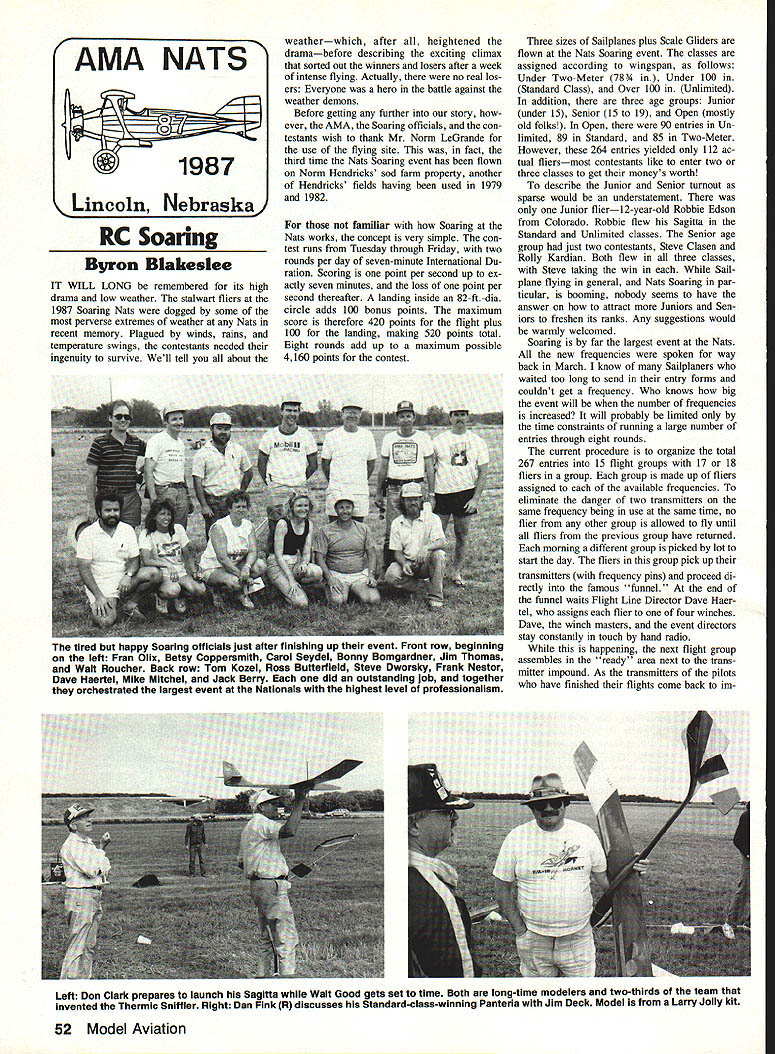
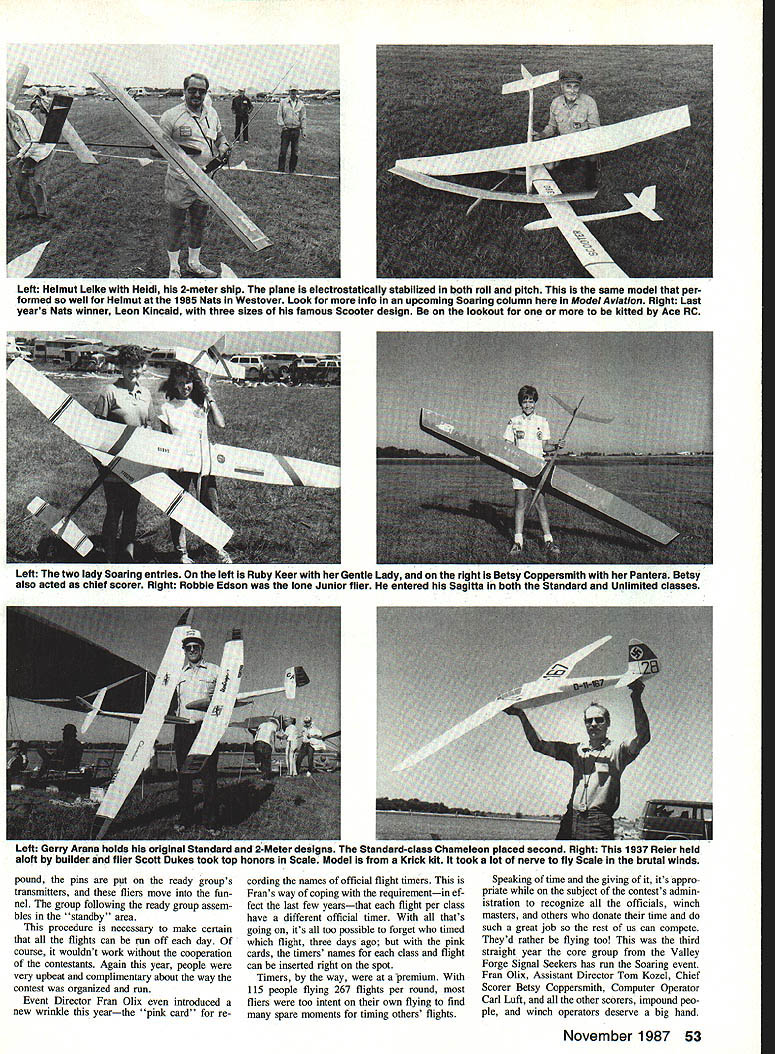
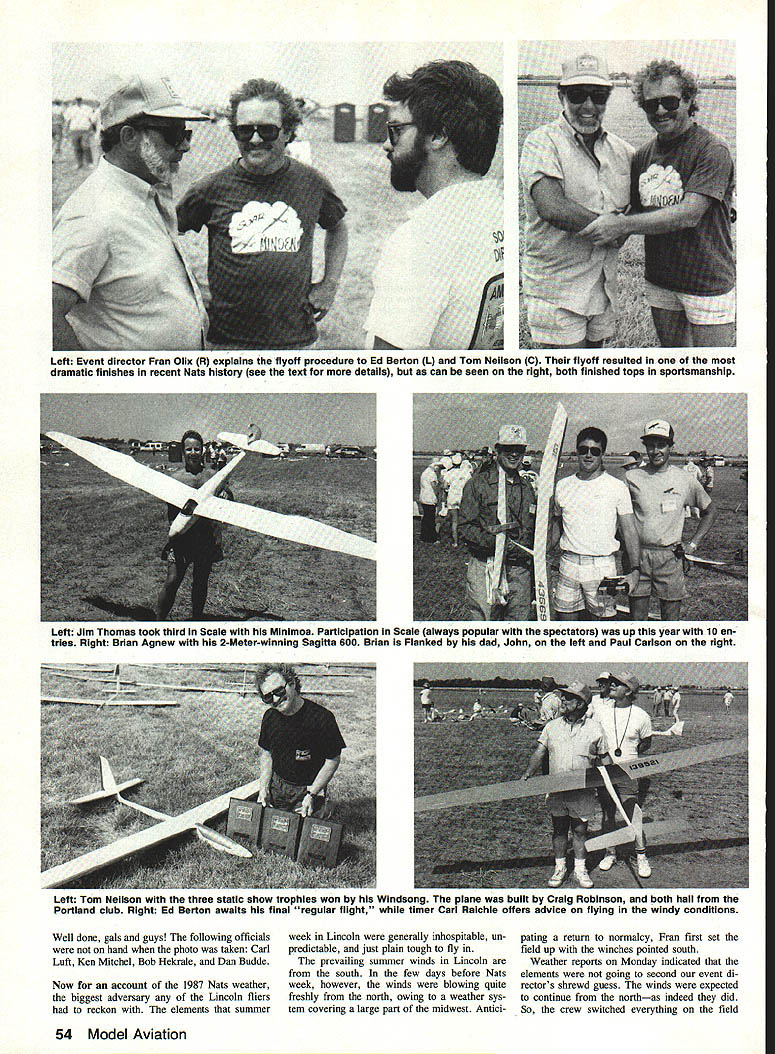
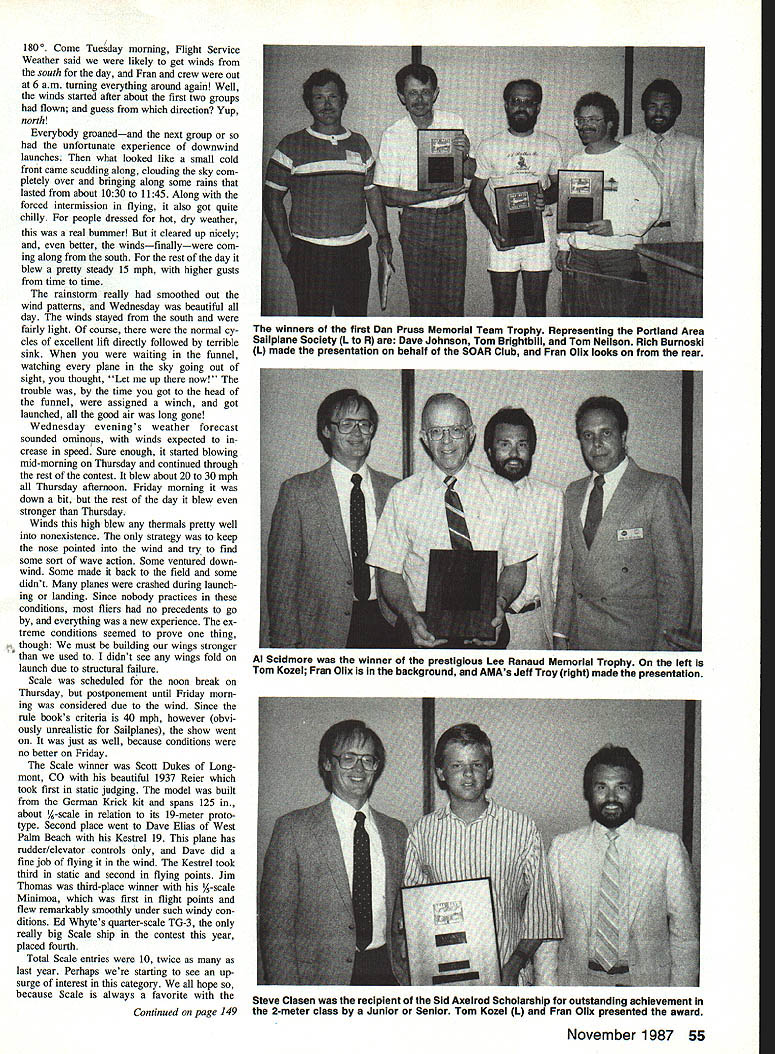
AMA Nats: RC Soaring
Byron Blakeslee
Overview
The 1987 Nats Soaring contest will long be remembered for its high drama and low, fickle weather. Stalwart fliers were dogged by winds, rains, and temperature swings that tested ingenuity and judgment. After a week of intense flying the contest produced winners — and lots of heroic performances against the elements.
Before the report, the AMA, Soaring officials, and contestants thank Mr. Norm LeGrande for the use of the flying site on Norm Hendricks' sod-farm property. This was the third time the Nats Soaring contest has flown from Hendricks' fields (previously used in 1979 and 1982).
Contest format
- Schedule: Tuesday through Friday, two rounds per day (eight rounds total).
- Task: Seven-minute International Duration scoring.
- 1 point per second up to exactly seven minutes (420 points).
- Loss of 1 point per second thereafter.
- Landing inside an 82-ft.-diameter circle: +100 bonus points.
- Maximum per flight: 520 points. Maximum contest total: 4,160 points.
Classes and age groups
- Classes by wingspan:
- Two‑Meter (under 78 in.)
- Standard (Under 100 in.)
- Unlimited (Over 100 in.)
- Scale Gliders (separate category)
- Age groups:
- Junior (under 15)
- Senior (15–19)
- Open
Entries on the roster totaled 267, but only 112 actual fliers showed up — many contestants enter two or three classes.
Junior and Senior turnout was sparse: the lone Junior was 12‑year‑old Robbie Edson (CO), who flew a Sagitta in Standard and Unlimited. The Senior group had two contestants, Steve Clasen and Rolly Kardian; both flew all three classes, with Steve taking the Senior wins.
Organization and procedures
- The event organized entries into 15 flight groups of 17–18 fliers to prevent frequency conflicts. Each group was assigned transmitters with frequency pins.
- Morning start groups were drawn by lot. Fliers proceeded into the famous funnel, where Flight Line Director Dave Haertel assigned each pilot to one of four winches. Dave, the winch masters, and event directors stayed in constant radio contact.
- The next group assembled in a "ready" area; when pilots returned their transmitters the pins were moved to the ready group's transmitters and they moved into the funnel. A following group waited in "standby."
- A new "pink card" introduced by Event Director Fran Olix recorded the names of official flight timers for each class and flight to comply with the requirement for different official timers per flight.
Timers and volunteers were at a premium; with many volunteers donating time, the event ran smoothly. Fran Olix, Assistant Director Tom Kozel, Chief Scorer Betsy Coppersmith, Computer Operator Carl Luft, the Valley Forge Signal Seekers race crew, winch masters, and many other scorers and impound people deserve recognition.
Weather and flight conditions
The week’s weather was the contest's biggest adversary. Prevailing summer winds in Lincoln are southerly, but a midwestern system had brought northerly winds before the event. The field was initially set for southerly launches, then switched to northerly when forecasts confirmed continued north winds. On Tuesday morning a last-minute forecast flip sent crews turning everything back to face south — but the winds again came from the north during early groups, causing downwind launches for some pilots.
A rain squall mid-morning caused a forced intermission and chilly conditions before clearing and settling into steady southerly winds (about 15 mph, with gusts). Wednesday was beautiful with light southerlies but the normal cycles of good lift followed by sink made timing launches difficult. Thursday saw winds increase to 20–30 mph and Friday was even stronger. High winds largely destroyed thermal activity; strategies shifted to heading into the wind and hunting for wave. Many pilots crashed during launching or landing in the extreme gusts. Scale was scheduled for Thursday noon but went ahead despite the wind; conditions were no better on Friday.
The extreme winds and broken lift shuffled leaderboards; many leaders could manage only two‑to‑three minute flights and had trouble landing inside the circle. Some top fliers established leads early and held on despite the chaos.
Scale competition
- Total Scale entries: 10 (double last year's).
- Static judging winner (Best Static): Scott Dukes (Longmont, CO) — 1937 Rieter (Krick kit), 125 in. span (~1/4 scale).
- Flying placings:
- Scott Dukes — 1937 Rieter (first in static judging)
- Dave Elias — Kestrel 19 (rudder/elevator only; second in flying points; third in static)
- Jim Thomas — 1/3-scale Minimoa (first in flight points; third overall)
- Ed Whyte — quarter-scale TG‑3
Pilots and spectators applauded the courage required to fly large, beautifully built models in the strong winds.
Two‑Meter class
A close early battle between last year’s winner Paul Carlson (flying a Prodigy) and last year’s runner‑up Brian Agnew (Sagitta 600) settled late. Paul led through round four but Brian surged with a 520 in Round Five. Brian averaged about 290 over his last three flights and held on to win.
Top Three — Two‑Meter
- Brian Agnew
- Tom Brightbill
- Terry Edmonds
Tom Brightbill flew a Sagitta 600 kit from Magnum Models.
Standard class
Dan Fink took the lead in round three and cruised to a comfortable win (about 140 points ahead of second). Noteworthy aircraft in Standard included Larry Jolly’s Pantera (flown by Dan Fink), Gerry Arana’s original Chameleon, Al Salmore’s Sagitta 900, a Bob Dodson Camano flown by Jim Thomas, and a straight‑wing Airtronics Cumulus flown by Scott Dukes. Dan resorted to taping a pound of lead on his Pantera to get the ballast he needed!
Top Standard placings:
- Dan Fink
- Gerry Arana
- Jim Thomas
- Also notable: Al Salmore, Scott Dukes
Unlimited class and the flyoff
After the last flight on Friday, computer checks revealed a tie for first in Unlimited between Tom Nielson (Portland) and Ed Berton (Florida), each with 3,487 points. A flyoff was called: the same seven‑minute task, but with a graduated 100‑point landing tape (to reward precise landings) — a crucial factor given the high winds.
- Ed won the coin toss and chose to launch second.
- Tom launched first, found little usable lift, and managed a 2:49 flight, missing the landing circle.
- Ed aimed for a shorter flight and a precise landing. He hovered into the wind, but during the landing the plane backed up in the wind, lost airspeed, and landed just outside the circle about 30 seconds short of Tom’s time.
- The flyoff was a close, sportsmanlike finish; both pilots displayed excellent airmanship and mutual congratulations.
Final Unlimited placings:
- Tom Nielson (won flyoff)
- Ed Berton
- Burnoski (Doole FB3)
- Watt Hill
- Al Salmore
- Paul Carlsson (Questor three-meter design)
Notes: Paul Carlsson’s Questor features a glass fuselage, polyhedral foam wings with Selig airfoils, and flaps for launch and landing.
Overall impressions and equipment trends
- Dodgson kit planes (Windsong, Camano, Pixie) remained very popular among top contestants — perhaps three dozen Dodgson planes in the contest.
- Aileron-equipped planes continue to gain popularity: estimated near half the fleet at this Nats, up from about one-third last year. Ailerons proved a blessing in the gusty conditions, especially for landing control.
Special awards and honors
- $1,000 Scholarship (excellence in Two‑Meter by a Junior or Senior): Steve Clasen (Modesto, CA).
- Hi Johnson Trophy (highest score in any class): awarded to Tom Nielson after the Unlimited flyoff.
- Lee Renaud Trophy (highest total score in all three classes): Al Scidmore (placed 5th Unlimited, 4th Standard, 12th Two‑Meter).
- Dan Pruss Team Trophy (new): awarded to the Portland Area Sailplane Society three‑man team (Tom Nielson, Tom Brightbill, Dave Johnson) — best combined placings.
- AMA National Static Show: Tom Nielson’s Windsong (built by Craig Robinson) won Best Sailplane, Best Craftsmanship, and Best Finish.
- Carl and Beth Goldberg Vital Person Award (by AMA Executive Director John Worth): Tom Kozel (assistant event director and Scale director).
- Author’s Special Person Award: Jim Thomas — for flying in all three classes plus Scale and working transmitter impound between flights.
Closing and upcoming events
Despite the wind-driven crashes and tense moments, the 1987 Soaring Nats provided plenty of drama and excitement. Many agreed it was a great contest and a memorable Nats.
Next year’s Nats is scheduled for Virginia Beach, VA.
Final note: the Fifth Annual Sailplane Symposium is coming up October 31–November 1. Speakers include Walt Good, Michael Selig, Roland Stull, Tom Runge, Pete Waters, Joe Wurts, and Leon Kincaid. For information contact Carl Mohs: daytime (608) 233‑8888; evenings (608) 238‑2321. Room reservations at the Ramada: 1‑800‑356‑7476 or (608) 244‑2481 — identify yourself as a symposium participant for the special block of rooms.
Transcribed from original scans by AI. Minor OCR errors may remain.

