
AMA: News
From AMA HQ, By the Executive Director: NO. 103
RC MASTERS FOLLOWUP
"I'm running a little late with my thank-yous but they are just as sincere as they were three weeks ago.
NSRCA is very pleased that AMA was so supportive and helpful at the Masters. We could not have done it without you and I hope we took enough of the load off your shoulders as to "prove" that we are serious in saying we want to work with AMA in improving pattern flying.
I think the Masters is super evidence that we can work together and produce some really nice results.
Thank you AMA from NSRCA and Dave and I. May our future be just as good.
Regards, Sally Brown, Sec/Tres NSRCA"
SPECIAL INTEREST ORGANIZATIONS
A recent exploration of controversy involved the possibility of establishing another national organization, as an "alternative" to AMA. That exploration appears to have run its course with the general conclusion that a better direction would be to work within the AMA structure to improve its operation rather than to reinvent the wheel. Prominent in many discussions on the subject was the question of where special interest organizations fit into the picture.
On one hand it has been advocated that such organizations should operate in lieu of AMA, each exercising authority in its sphere of influence. Thus the National Soaring Society would look after RC Soaring interests, the National Free
1974 INSURANCE CLAIMS
Received at HQ: 52 Claims
Closed: 47
Pending: 5 (4 Bodily injury; 1 a rocketry accident)
18 Closed with no payment because Home-owners coverage was primary; 1 Closed with no payment because of $100.00 deductible; 28 Closed with payment for a total of: $4,061.31. Meanwhile reserves have been established for the pending bodily injury claims which can end up being very expensive.
Note: 17 claims were for bodily injury accidents, 33 were for personal property accidents.
All cases noted as "closed with payment" were due to the fact that the AMA member had no other policy but AMA's. One exception—the member's Homeowners policy denied payment and AMA's took over.
Further Note: bodily injury claims require large reserves because such cases typically are not settled quickly and large medical allowances must be provided for. One large bodily injury claim can wipe out any savings or economics in other claim areas. Thus, while the number of claims is comparatively small, the potential for great cost escalation because of bodily injury cases is ever present. But that's what AMA liability protection is all about—to relieve the individual member of such worries.
AMA-FCC Frequency Efforts Continue
Filed with the Federal Communications Commission in the matter of Amendment of Part 97 of the Commission's Rules concerning operator classes, privileges and requirements in the Amateur Radio Service, on behalf of the Academy of Model Aeronautics:
- On December 16, 1974 the Commission released its Notice of Proposed Rule Making in the above-captioned proceeding proposing to institute a comprehensive revision of the Amateur Radio Service license classes. The Academy of Model Aeronautics, Inc., by its attorneys, hereby files its Comment in this proceeding.
- The Academy of Model Aeronautics, Inc. (hereinafter, the Academy), the Aeromodeling Division of the National Aeronautic Association, is the governing body for aeromodeling activities in the United States. Its current membership stands at 54,000.
- The Academy has been very gratified over the years that the Commission has consistently recognized that model aircraft flying is a scientific hobby of substantial social value and public significance, and has allocated a number of Citizens Radio Service frequencies for this important activity. These frequencies, in the 27 MHz and 72 MHz bands, are the most suitable for modeler use in view of the relatively low cost of the equipment for these bands, thus making radio controlled aeromodeling activities available to the many young people whose interests in aviation are fueled by model aircraft activities early in life. Unfortunately, 27 MHz band frequencies are adjacent to those used by the Class D Citizens Radio Service, some of whose members use them as "extra", unauthorized voice channels and a few who have actually engaged in the sport of "shooting down" radio controlled model aircraft, resulting in very substantial monetary losses for modelers and creating a potential danger to spectators when radio control aircraft go out of control. Modelers have both spread out frequency occupancy, and to avoid the above problems, turned to the 72 MHz frequencies, but there are inherent limitations in that band because of the use of adjacent frequencies by television stations on channels 4 and 5. These problems have been fully explained in the Academy's Comments in FCC Docket No. 19759 and are incorporated herein by reference.
- In short, in many areas of the country aircraft modelers are having increasing difficulty in pursuing their activities in a safe manner on the frequencies now available for their use and the only practical solution appears to be access to other frequencies which are not subject to the difficulties now encountered. The Academy was therefore most interested in the Commission's proposal to create a Communicator Class operator license, having no telegraphy examination requirement, which would allow access to the Amateur Radio frequencies above 144 MHz.
- The Academy believes that this new class of license offers an opportunity for radio control modelers to qualify for such Communicator Class Amateur licenses and to alleviate the problems heretofore mentioned by their using frequencies above 144 MHz for model control purposes. The Academy also believes that such qualification and use will lead many modelers to upgrade their skills to qualify for the Technician Class license in order to be able to use the 50-54 MHz Amateur Band. Use of this latter band by the Technician Class Amateur licensees is now a widespread practice. The Academy estimates that about fifteen percent of its membership, or about 5,000 modelers, hold Amateur licenses and use the 50-54 MHz band for their flying activities. Most of these licensees are of the Technician Class.
- The Academy respectfully submits that making Communicator Class licensees eligible for model radio control activities is clearly in the spirit of this proceeding in that it is in consonance with the "logical relationship between the qualification requirements and the operator privileges authorized at each license level." However, as written, the Docket and the proposed revisions to Part 97 of the Commission's regulations, appearing in the Appendix, do not provide specifically for such activity on the part of Communicator Class licensees. Therefore, the Academy respectfully requests that the Commission:
a. Expand existing Rule Section 97.99 (Stations Used Only for Radio Control of Remote Model Crafts and Vehicles) by adding a new subparagraph:
"(e). Amateurs holding Communicator Class licenses may operate equipment under the provisions of this Section on amateur frequencies above 144 MHz."
b. Expand the proposed Rule Section 97.7(g) by including a fourth subsection:
"(4) Emission A-1 or A-2 solely under the provisions of Section 97.99."
- The Academy also respectfully requests that consideration be given to continuation of mail examinations for the Technician Class license, and once attained by such examination, that the license be renewable. Further, the Academy requests that the Communicator Class license be made available with a mail examination basis and be renewable. The Academy's reasons for such requests stem from the following considerations:
a. The bulk of the nation's radio control modeling activities are carried on by Academy-chartered clubs and by those with at least a few members with higher level Amateur licenses. These clubs provide classes to instruct members in the appropriate written and code requirements. With the Commission's proposed tightening of the conduct of mail examinations, it is believed that the Commission can be assured of adequate competency on the part of the successful candidates for the two license classes.
b. In the case of the several thousand model radio control flyers who have already successfully qualified for the Technician Class licenses, the Academy submits that these licenses were earned in good faith and that to require these individuals to travel to an FCC examining location to renew this class of license would be an unwarranted hardship on the existing licensees.
- In summary, the Academy recommends that, if the proposed rule making is adopted by the Commission, it be modified to include the following provisions:
a. Permit radio control activities by Communicator Class licensees on frequencies above 144 MHz.
b. Permit Communicator and Technician Class licenses to be obtained by mail examination, and be renewable.
Respectfully submitted, The Academy of Model Aeronautics, Inc. By Jeremiah Courtney, its Attorney, Washington, D.C., July 16, 1975.
The AMA Frequency Committee currently consists of the following: John Strong, chairman; Dr. Walter A. Good, Bethesda, Md.; Richard Jansson, Wellesley Hills, Mass.; Lt. Col. C. T. Williams, APO New York, N.Y.; Bob Ablee, Hauppauge, N.Y., joined the committee in July—his recent individual efforts were recognized by the committee and he was invited to join the group to broaden its representation; Jim Sieradski; Jack Albers; and former California member Hugh Stock.
SPECIAL ORGANIZATIONS (CONT.)
Flight Society would look after FF needs, and so on. On the other hand it has come to light that all of the special interest organizations combined encompass only a minority of modelers--approximately 10% of the AMA membership.
This means that about 9 out of ten AMA members don't belong to such organizations and so they are unrepresented except for geographically elected officers in AMA. So, while the special interest organizations are influential and visible, there is a serious question concerning how much voice in AMA affairs they should be given. Until that is determined AMA's policy is to cooperate with all such existing organizations and to encourage the formation of others.
Meanwhile, a much larger block of AMA members are also members of AMA chartered clubs--about 54%. This suggests that clubs somehow should be included in any ideas about improving member representation in AMA policy making.
The special interest organization picture dramatizes a basic difference among two basic groups of AMA members. Most of the special interest organizations are competition oriented yet most AMA members are not. How, then, to better represent both basic interests?
The obvious but short sighted conclusion might be to restructure AMA and its budget to reflect the majority of members. Yet this could destroy what has been a very effective arrangement which benefits both groups. The simple fact is that both groups need each other.
Practically all technological progress has come from the minority--the competition enthusiasts who are constantly seeking performance improvements in engines, accessories, fuels, model design, equipment. They provide the "Indianapolis Effect"--testing and proving products for the ultimate benefit of all. Yet it's the dollars from the Sunday flier which provide the basis for the competition programs and services and which result in the better products that all enjoy.
We have positive proof of the benefits -- AMA membership and model aviation in general is at an all time high in numbers and activity. It would not be so without the drive and persistence of competition people who telescope development time for everything that modelers use. In effect, the ambition of the competitors enables the Sunday fliers to relax and enjoy what they are doing without having to get involved in the rat race of competition--the products of competition come to them freely and naturally, with minimum diversion from doing their thing.
So the status quo is a pretty good thing. It can be improved no doubt. But caution seems to be needed to avoid any serious disruption of what has been a mutually beneficial balance of interests. Toward that end the AMA Executive Council is currently reviewing the entire structure of AMA representation to see where current procedures and policies may be improved and where new variations may be added.
FLYING SITES
Individual AMA members working through local chartered clubs constitute the backbone of the U.S. aeromodeling. The club flying site itself forms the nucleus of club activities. But there is a steadily growing problem that is threatening to limit or curtail such activities. Clubs now find that more and more time is being spent on keeping the flying sites they have and acquiring additional fields as membership grows or the current facility is threatened.
AMA headquarters has spent many man-hours on the flying site situation, answering inquiries and helping solve local problems as they arise. An about-to-be printed AMA book called Getting & Keeping Flying Sites concludes that group efforts (clubs or alliances of several clubs) are generally the most successful in acquiring flying sites; that it's relatively easy for one or two outside the club to deny the use of a field as a modelport or shut an existing facility down so it's necessary to show that many people would be adversely affected in order to counter this threat. Noise may often be just an excuse for prohibiting the use of a local flying site when the real reason is usually that our activities are considered annoying and, therefore, an undesirable nuisance. Good public relations by local clubs and individual modelers with their flying site neighbors and throughout the community are an essential part of a necessary effort to counter this attitude.
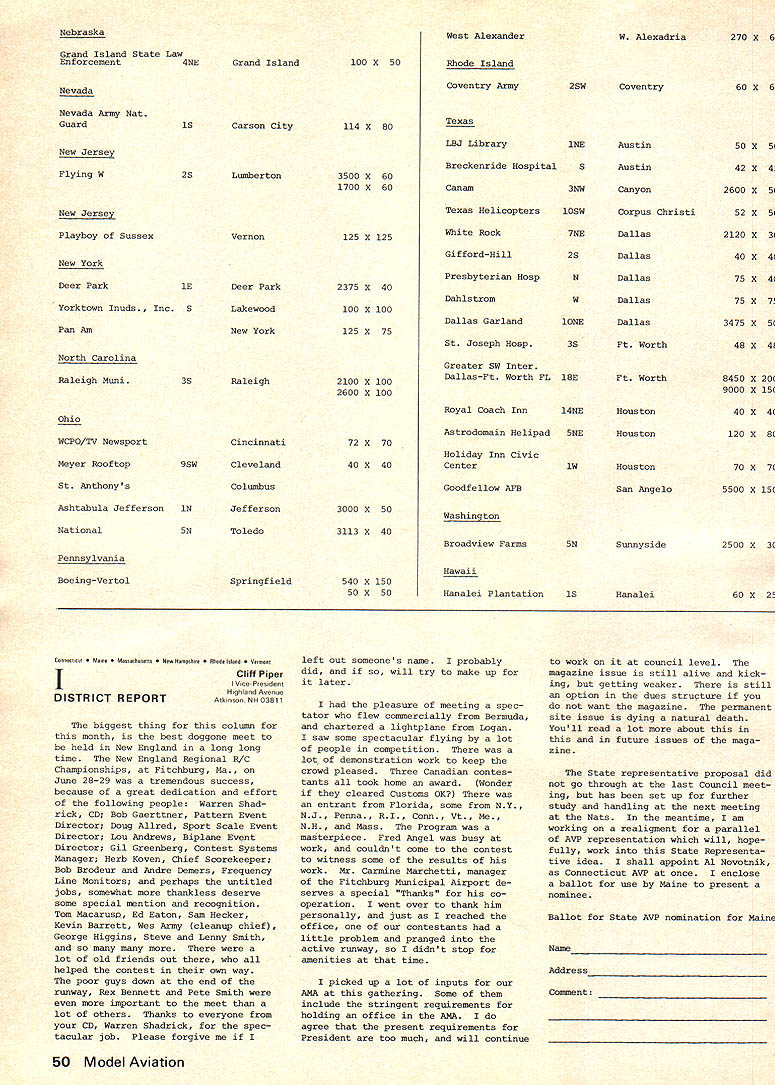
Basically, however, more flying sites are found for us and AMA headquarters is deeply involved in trying to aid the situation. One recent effort was in conjunction with Wes Jones of the Fly Away RC Club in the Washington, D.C. area. Wes has compiled (through the FAA Air Traffic Service National Flight Data Center) a list of potential flying sites considered "abandoned" by FAA. The list is published here. All sites are paved, some are heliports and some may have a small amount of full scale aviation activity or be slated for industrial construction. Each site, however, deserves a follow-up by interested AMA members and clubs for use as local flying sites or for national activities such as FAI Team Selection Programs or even a Nats. HQ would appreciate hearing the results of local efforts in locating the owner or controlling agency of each potential flying site and the feasibility of use for aeromodeling activity.
Go get 'em! And please give headquarters a status report on each, so we can record progress on our master list.
Hobe Steele
The list is broken down by states and includes the name of each facility, its distance (in miles) and direction from the nearest town, plus length and width of runways. For example:
New Jersey Flying W 2S Lumberton 3500 X 60 Playboy of Sussex Vernon 1700 X 60 125 X 125
The first site is 2 miles south of Lumberton, New Jersey and has two 60-foot wide runways, one 1700 feet long and the other 3500 feet long. The second site is in the town of Vernon and is obviously a 125 foot square helipad. Complete list below:
Alabama Sharpe Field 7NW Tuskegee 5000 X 300 “ 4600 X 300 “ 4800 X 300 “ 4500 X 300 “ 5000 X 300
Arkansas Conway County Gen. Hop. Morrilton 70 X 70
California Radeffer No. 2 5SE Anaheim 50 X 50 Radeffer No. 1 5NE Arcadia 20 X 20 Radeffer No. 3 Atwood 50 X 50 Meadows Field 4NW Bakersfield 200 X 150 Berkeley Muni. 2W Berkeley 215 X 170 Parsons Airpark 2E Carpinteria 2000 X 33 Di Giorgio Ranch Landing Strip 1NE Di Giorgio 2600 X 44 Downey 2SE Downey 400 X 170 Meadow View 7W Doyle 100 X 50 Radeffer 6 1NW Inglewood 50 X 50 Data Prod/HQ Bldg 22NN Los Angeles/ Canoga Pk. 40 X 40 Mercy Hosp. Helistop 1S Redding 120 X 60 Riverside 1W Riverside 525 X 130 E. L. Yeager 1NW Riverside 100 X 100 Sea World 5NW San Diego 50 X 50 ITT Industrial Products Div. 3NW San Fernando 60 X 60 Police Dept. Helistop 3S Santa Monica 103 X 85 Sonoma Skypark 3S Sonoma 2500 X 50 Williams 1NE Williams 2500 X 40
Delaware Mildred Memorial Hosp. Milford 40 X 40
Florida Springfield Pk. Jacksonville 75 X 75 Municipal Heliport 2 Jacksonville 40 X 40 Ho-Jo 8SW Orlando 94 X 108
Georgia Holiday Inn Marietta 2SE Marietta 50 X 50
Illinois St. Louis Downtown Airpark 4W E. St. Louis/ Collinsville 2747 X 50 Mitchell Field 3N Lombard 2471 X 25 Holiday Inn East 5E Springfield 300 X 300
Indiana Nad Crane 1SE Burns City 2782 X 20 Columbus Muni. 5S Columbus 4500 X 100 Starke County 1S Knox 2660 X 40
Iowa John Deere Dubuque Tractor Works 4NW Dubuque 2400 X 50
Kansas Strother Aux. No. 2 7W Arkansas City 4000 X 150 (another) 4000 X 150 Allen Air Park 1W Topeka 2300 X 32
Louisiana Alexandria-Pineville N Alexandria 3000 X 75
Maine St. Croix 1E Baring 2800 X 40
Maryland Davis 3N Laytonsville 20 X 20
Massachusetts Arthur D. Little, Inc. W Cambridge 100 X 100 Litton Industries W Fall River 150 X 150
Minnesota Earth Movers 1S Proctor 30 X 30 Southport 4SW Rosemount 2800 X 90
Missouri Columbia Municipal 2N Columbia 4000 X 100
Montana E & G 4W Butte 100 X 200 Conrad 1W Conrad 3600 X 75
AMA: News
ACADEMY OF MODEL AERONAUTICS 806 FIFTEENTH ST. NW., WASHINGTON, D.C. 20005 AMA HQ Executive Director
RC MASTERS FOLLOW-UP I'm running a little late. Thank-yous — just sincere. Three weeks ago NSRCA was very pleased; AMA supportive, helpful. Masters could have done — hope it took enough load off shoulders. Prove serious, saying want to work with AMA improving pattern flying. I think Masters super; evidence can work together, produce some really nice results. Thank AMA. NSRCA Dave. I may future just good. Regards, Sally Brown, Sec./Tres., NSRCA
SPECIAL INTEREST ORGANIZATIONS Recent exploration and controversy involved the possibility of establishing another national organization alternative to AMA. Exploration appears to have run its course; general conclusion — better direction would be to work within AMA structure, improve its operation rather than reinvent the wheel. Prominent discussions on the subject question whether special interest organizations fit the picture. On the one hand, it has been advocated such organizations should operate in lieu of AMA exercising authority in its sphere of influence. Thus, National Soaring Society would look after RC soaring interests, National Free...
1974 INSURANCE CLAIMS Received at HQ: 52 Claims Closed: 47 Pending: 5
- 4 Bodily injury
- 1 rocketry accident
- 18 Closed — no payment because homeowners coverage primary
- 1 Closed — no payment because $10,000 deductible
- 28 Closed — payment total $406,131
Meanwhile, reserves have been established. Pending bodily injury claims can end up being very expensive. Note: 17 claims bodily injury accidents, 33 personal property accidents. Cases noted closed without payment due to the fact AMA member had no other policy. AMA's exception: the member's homeowners policy denied payment and AMA took over.
Further note: bodily injury claims require large reserves because such cases typically are not settled quickly; large medical allowances must be provided. A large bodily injury claim can wipe out savings and upset the economics of other claim areas. Thus, number of claims is comparatively small but the potential for great cost escalation caused by bodily injury cases ever present — that's what AMA liability protection is about — to relieve the individual member of such worries.
Model Aviation filed Federal Communications Commission matter — Amendment Part 97, Commission's Rules concerning operator classes, privileges, requirements, Amateur Radio Service on behalf of Academy of Model Aeronautics.
- On December 16, 1974 the Commission released its Notice of Proposed Rule Making in the above-captioned proceeding proposing to institute a comprehensive revision of Amateur Radio Service license classes.
- The Academy of Model Aeronautics, Inc. (hereinafter Academy) Aeromodeling Division, National Aeronautic Association, is the governing body of aeromodeling activities in the United States. Its current membership stands at 54,000.
- The Academy is very gratified over the years the Commission has consistently recognized model aircraft flying as a scientific hobby of substantial social value and public significance and has allocated a number of Citizens Radio Service frequencies for this important activity. Frequencies in the 27 MHz and 72 MHz bands are suitable for modeler use in view of relatively low cost equipment in these bands, thus making radio controlled aeromodeling activities available to young people whose interest in aviation is often fueled by model aircraft activities early in life.
Unfortunately, the 27 MHz band frequencies are adjacent to those used by Class D Citizens Radio Service. Some members use extra unauthorized voice channels; a few have actually engaged in sport shooting down radio controlled model aircraft resulting in very substantial monetary losses to modelers and creating potential danger to spectators when radio control aircraft go out of control. Modelers have both spread out frequency occupancy to avoid the above problems and turned to 72 MHz frequencies. The inherent limitations of that band, because of use of adjacent frequencies by television stations (channels 4 and 5), problems have been fully explained in the Academy's Comments in FCC Docket No. 19759 (incorporated herein by reference).
- In short, in areas of the country, aircraft modelers are having increasing difficulty pursuing their activities in a safe manner with the frequencies now available for use. A practical solution appears acc...
acceptable.
Model Aviation filed Federal Communications Commission matter: Amendment of Part 97, Commission's Rules concerning operator classes, privileges and requirements, Amateur Radio Service, on behalf of Academy of Model Aeronautics
- On December 16, 1974 the Commission released its Notice of Proposed Rule Making in the above-captioned proceeding proposing to institute a comprehensive revision of Amateur Radio Service license classes. The Academy of Model Aeronautics, Inc. and its attorneys hereby file its Comment in the proceeding.
- The Academy of Model Aeronautics, Inc., hereinafter Academy — Aeromodeling Division, National Aeronautic Association — is the governing body for aeromodeling activities in the United States. Its current membership stands at 54,000.
- The Academy is very gratified over the years the Commission has consistently recognized model aircraft flying as a scientific hobby of substantial social value and public significance and has allocated a number of Citizens Radio Service frequencies for this important activity. Frequencies in the 27 MHz and 72 MHz bands are suitable for modeler use in view of relatively low cost equipment in these bands, thus making radio-controlled aeromodeling activities available to young people whose interest in aviation is often fueled by model aircraft activities early in life. Unfortunately, the 27 MHz band frequencies are adjacent to those used by Class D Citizens Radio Service. Some members use extra unauthorized voice channels; a few have actually engaged in sport shooting down radio-controlled model aircraft resulting in very substantial monetary losses to modelers and creating potential danger to spectators when radio control aircraft go out of control. Modelers have both spread out frequency occupancy to avoid the above problems and turned to 72 MHz frequencies. The inherent limitations of that band, because of use of adjacent frequencies by television stations (channels 4, 5), have been fully explained in the Academy's Comments in FCC Docket No. 19759 (incorporated herein by reference).
- In short, in areas of the country, aircraft modelers are having increasing difficulty pursuing their activities in a safe manner with the frequencies now available for use. A practical solution appears acceptable.
1974 INSURANCE CLAIMS
Received HQ 52 Claims Closed 47 Pending 5
- 4 Bodily injury
- 1 rocketry accident
- 18 Closed no payment because Homeowners coverage primary
- 1 Closed no payment because $10,000 deductible
- 28 Closed payment total $406,131
Meanwhile reserves have been established. Pending bodily injury claims can end up being very expensive. Note: 17 claims bodily injury accidents, 33 personal property accidents. Cases noted closed without payment due to the fact AMA member had no other policy; AMA's exception: the member's Homeowners policy denied payment; AMA's took over.
Further note: bodily injury claims require large reserves because such cases typically are not settled quickly; large medical allowances must be provided. A large bodily injury claim can wipe out savings in the economics of other claim areas. Thus number of claims comparatively small, potential great cost escalation can be caused if bodily injury cases ever present—that's what AMA liability protection is about—to relieve individual members of such worries.
Model Aviation Filed Federal Communications Commission Matter — Amendment Part 97, Commission's Rules Concerning Operator Classes, Privileges, Requirements, Amateur Radio Service, on Behalf of Academy of Model Aeronautics
- On December 16, 1974 the Commission released its Notice of Proposed Rule Making in the above-captioned proceeding proposing to institute a comprehensive revision of Amateur Radio Service license classes. Academy of Model Aeronautics, Inc. and its attorneys hereby file its Comment in the proceeding.
- The Academy of Model Aeronautics, Inc. (hereinafter Academy; Aeromodeling Division, National Aeronautic Association) is the governing body for aeromodeling activities in the United States. Its current membership stands at 54,000.
- The Academy is very gratified over the years the Commission has consistently recognized model aircraft flying as a scientific hobby of substantial social value and public significance and has allocated a number of Citizens Radio Service frequencies important to the activity — frequencies in the 27 MHz and 72 MHz bands — suitable for modeler use in view of relatively low cost equipment in these bands, thus making radio-controlled aeromodeling activities available to young people whose interest in aviation is often fueled by model aircraft activities early in life. Unfortunately, the 27 MHz band frequencies are adjacent to those used by Class D Citizens Radio Service. Some members use extra unauthorized voice channels; a few have actually engaged in sport shooting down radio-controlled model aircraft resulting in very substantial monetary losses to modelers and creating potential danger to spectators when radio control aircraft go out of control. Modelers have both spread out frequency occupancy to avoid the above problems and turned to 72 MHz frequencies. The inherent limitations of that band, because of use of adjacent frequencies by television stations (channels 4, 5), have been fully explained in the Academy's Comments in FCC Docket No. 19759 (incorporated herein by reference).
1974 INSURANCE CLAIMS
Received HQ 52 claims. Closed 47. Pending 5.
4 bodily injury; 1 rocketry accident; 18 closed — no payment because homeowners coverage primary; 1 closed — no payment because $10,000 deductible; 28 closed — payment total $406,131.
Meanwhile, reserves have been established — pending bodily injury claims can end up being very expensive. Note: 17 claims bodily injury accidents; 33 personal property accidents. Some cases noted closed with payment due to the fact the AMA member had no other policy. In a few instances the member's homeowners policy denied payment and the AMA took over.
Further note: bodily injury claims require large reserves because such cases typically are not settled quickly; large medical allowances must be provided. A large bodily injury claim can wipe out reserves for other claim areas. Thus, although the number of claims is comparatively small, the potential for great cost escalation exists whenever bodily injury cases are present. That's what AMA liability protection is about — to relieve an individual member of such worries.
AMA: News
RC MASTERS FOLLOW-UP
I'm running a little late — thankyous just sincere. Three weeks ago the NSRCA was very pleased the AMA was supportive and helpful. The Masters could not have done it without you. I hope we took enough load off shoulders. We proved we are serious about wanting to work with the AMA to improve pattern flying. I think the Masters were super — evidence we can work together to produce some really nice results. Thank you, AMA and NSRCA.
Regards, Sally Brown, Sec./Tres., NSRCA
SPECIAL INTEREST ORGANIZATIONS
Recent exploration of the controversy involved the possibility of establishing another national organization as an alternative to the AMA. That exploration appears to have run its course. The general conclusion was that a better direction would be to work within the AMA structure to improve its operation rather than reinvent the wheel. Prominent in the discussions was the question of how special interest organizations fit the picture. Some have advocated that such organizations should operate in lieu of the AMA exercising authority in its sphere of influence. Thus, the National Soaring Society would look after R/C soaring interests; National Free ... (continued on page 46)
1974 INSURANCE CLAIMS
Received at HQ — 52 Claims closed — 47 Pending — 5
4 bodily injury 1 rocketry accident 18 closed — no payment because homeowners coverage primary 1 closed — no payment because $10,000 deductible 28 closed — payment total $406,131
Meanwhile reserves have been established. Pending bodily-injury claims can end up being very expensive. Note: 17 claims — bodily-injury accidents; 33 personal-property accidents. Cases noted closed — payment due to fact AMA member had no other policy. AMA's exception: the member's homeowners policy denied payment; AMA took over. Further note: bodily-injury claims require large reserves because such cases typically do not settle quickly; large medical allowances must be provided. A large bodily-injury claim can wipe out savings in the economics of other claim areas. Thus, number of claims comparatively small, but potential great cost escalation can be caused if bodily-injury cases are ever present — that's what AMA liability protection is about: to relieve the individual member of such worries.
Model Aviation Filed Federal Communications Commission matter — Amendment Part 97
1 On December 16, 1974 the Commission released its Notice of Proposed Rule Making in the above-captioned proceeding proposing to institute a comprehensive revision of Amateur Radio Service license classes. Academy of Model Aeronautics, Inc. and its attorneys hereby file its Comment in the proceeding.
2 The Academy of Model Aeronautics, Inc., hereinafter Academy (Aeromodeling Division — National Aeronautic Association), is the governing body for aeromodeling activities in the United States. Its current membership stands at 54,000.
3 The Academy is very gratified over the years the Commission has consistently recognized model aircraft flying as a scientific hobby of substantial social value and public significance and has allocated Citizens' Radio Service frequencies important to the activity — frequencies in the 27 MHz and 72 MHz bands suitable for modeler use in view of relatively low cost equipment, thus making radio-controlled aeromodeling activities available to young people whose interest in aviation is fueled by model aircraft activities in early life. Unfortunately, the 27 MHz band frequencies adjacent to frequencies used by Class D Citizens Radio Service users have been misused by some who employ unauthorized voice channels; a few have actually engaged in sport shooting down radio-controlled model aircraft, resulting in very substantial monetary losses to modelers and creating potential danger to spectators when radio-control aircraft go out of control. Modelers have both spread out frequency occupancy to avoid the above problems and turned to 72 MHz frequencies, which have inherent limitations because of use of adjacent frequencies by television stations on channels 4 and 5. These problems have been fully explained in the Academy's Comments, FCC Docket No. 19759, incorporated herein by reference.
4 In short, areas of the country aircraft modelers are having increasing difficulty pursuing activities in a safe manner using the frequencies now available. A practical solution appears acc
Transcribed from original scans by AI. Minor OCR errors may remain.

