
AMA MEMBER RESPONSE TO FCC IS UNPRECEDENTED—OUTLOOK IS GOOD
When asked to stand up and be counted, AMA members came through like never before. They flooded Washington with letters echoing the AMA position opposing FCC Docket 20120. All through the month of May letters piled up in the FCC offices, and in the offices of Congressmen and the AMA.
Most of the letters were based on AMA's eight-page April letter sent to all AMA clubs and to many others (over 3,000 were mailed altogether and 500 more were distributed at the MAC show in California on May 2-3). This letter was also the basis for the RC Crisis article in last month's Model Aviation and AMA News.
Midway through the month the FCC reacted via Associated Press story, quoting from several of the AMA members' letters—it appeared that the FCC might be setting the stage to tell CB operators that modeler opposition could upset FCC plans to expand CB activity as rapidly and as extensively as had been proposed.
At press time (end of May) the public response period established by the FCC (until June 9) had not yet been completed so the final outcome was still in doubt. But the outlook was very hopeful due to the number and nature of letters to the FCC. Both in quantity and quality the letters were outstandingly impressive.
The vast majority were individual. They expressed the personal viewpoints of AMA member citizens from all walks of life—doctors, lawyers, housewives, salesmen, mechanics, engineers, teachers, students, etc.—the cross-section of people included old and young, male and female. Several of the best were from women modelers, emphasizing the family aspects of model aviation and the need for aid to youngsters. In practically all letters, however, the arguments were a mixture of logic and emotion; an extraordinary blending of intelligent and constructive statements.
There were many petitions and form letters, which added to the overall impact, but the obviously effective messages were those by individuals. This is what had been suggested and hoped for in the AMA call for support. If, therefore, the AMA position prevails, it will be mostly due to those who responded so quickly, so well, and in such numbers that no more needed to be asked.
Equally important (perhaps even more so) was the direct response to the FCC and the simultaneous pleas to Congressmen for help. Many congressional offices called AMA HQ during May to get further information so that constituent requests could be presented to the FCC. It was an effective demonstration of how government representatives are willing to respond on behalf of their voters, especially when presented with logical reasons for action.
Helping further was the FCC's eventual agreement in response to a formal request from AMA, to extend the public response deadline. Although the FCC action was later than had been requested, and with less of an extension, it was still helpful. AMA asked for a 30 to 60 day extension and got two weeks—not much but just enough to allow last month's Model Aviation and AMA News messages to get to thousands more modelers in time for more replies to the FCC.
When the extension was requested in April the hope was that an affirmative answer would be gotten before the rest of the model magazines would go to press at the end of the month, so that all their readers could get the word and join in the effort. But the FCC did not come through until early May, too late for most magazines' press dates (we just barely were able to put the extension date in last month's AMA publications).
While all this was going on there were some counter-productive happenings that interfered with, fortunately, did not prevent AMA's effort from proceeding. Some industry people had made statements suggesting that AMA was doing little, if anything, in the crisis. This caused a lot of time to be taken up by AMA HQ personnel explaining to callers that much was happening and that much more could happen if the phones could be kept free for the basic campaign to rally opposition to the FCC proposals.
An analysis of the disruptive phone calls revealed that the detractors were well meaning, but premature and uninformed. They were also in a less compromised position.
FCC LICENSE PROCESSING
The FCC announced that interest in the Citizens Radio Service has increased phenomenally during the past few months. During October 1975, for example, the Commission received over 300,000 Class D Voice license applications. During the same period in 1974 they received approximately 40,000 such applications. The recent influx of applications has created a large backlog of pending applications, and for this reason it is now taking about 12 weeks from the time an application is received for a license to be issued.
As a result of the backlog of pending applications, the Commission is being deluged with letters from applicants inquiring into the status of their applications. Unfortunately, the Commission's limited resources do not permit it to give a personal response to each letter it receives. Commission employees are currently engaged in processing and issuing Citizens Service licenses, and to respond individually to each letter received would cause further delay in the completion of those and other vital tasks. They emphasize that virtually every license application received is processed in about 12 weeks, and urge applicants not to inquire into the status of an application before this period has elapsed.
For those intending to submit applications for Citizens Service licenses, they urge that the following precautions be observed to ensure proper processing:
- Enclose a check or money order for the correct license fee, $4.
- Sign and date the application.
- Be sure your address is complete, including zip code.
- Recheck your application to ensure you have completed it.
- Enclose the application in a size 10 (business size) envelope.
Contest Problems
If you have applied for your FCC license but have not yet received it and wish to enter an AMA sanctioned RC contest, you can fly legally if you are under the supervision of someone who already has an FCC license of the same class you have applied for. This is officially from AMA HQ, verified by the FCC. whereas AMA had to represent many points of view. They had the luxury of a relatively simple viewpoint and dictatorship authority to act as they pleased. So they could act quickly and visibly, as if to say, "Look what I'm doing"
AMA, however, was immediately faced with contradictory demands. There were many advocating abandonment of the 27MHz frequencies to the CB'ers, while others de- manded protection for as long as possible. Further compromising the situation were people claiming CB interference problems on 27MHz but still wanting to retain operation on those frequencies. What they meant was that if the CB'ers operated legally on their own 27MHz frequencies, the RC'ers preferred to stay on the 27MHz RC frequencies.
This, however, was an unrealistic position because the FCC had already admitted an inability to prevent illegal CB operation. But it was also realized, from the incoming mail and phone calls, that many RC'ers were not hav- ing interference problems, so it was justifiable to ask for retention of the 27 MHz RC fre- quencies, at least during a reasonable (two year minimum) transition period.
In the end, as usual, AMA's position devel- oped so as to try to help everyone even where viewpoints differed. So we ended up pressing for keeping what we have, for as long as pos- sible, and also to get more help through the granting of additional frequencies beyond those we have now. Fortunately we have good arguments in both directions.
Predicting what the outcome will be at this time involves some wishful thinking. But there are some signs—mostly from unofficial remarks by some people in authority who are trying to be helpful but who cannot be quoted until the official FCC position is an- nounced—that we will receive new frequencies for RC.
What is uncertain is whether these will merely replace those to be taken away from 27MHz. A combination that is a possibility: replacement frequencies plus some others. A two step process is also being considered. In this combination we could get replacements
AMA News
and some others.
AMA MEMBER RESPONSE TO FCC IS UNPRECEDENTED; OUTLOOK IS GOOD
AMA members came through like never before. Letters flooded Washington echoing AMA's position opposing FCC Docket 20120. Through the month of May letters piled up at FCC offices and at the offices of Congressmen. Most letters were based on AMA's eight‑page April letter sent to clubs; others—over 3,000—were mailed. Altogether, 5,000 were distributed at the MACS show in California May 2–3. The letter was also the basis for the "RC Crisis" article in last month's Model Aviation (AMA News).
Midway through the month the FCC reacted via an Associated Press story quoting several AMA members' letters — it appeared the FCC might be setting the stage to tell CB operators that modeler opposition could upset FCC plans to expand CB activity rapidly and extensively. At press time the end‑of‑May public response period established by the FCC was until June 9. The final outcome was still in doubt, but the outlook was very hopeful due to the number and nature of the letters received by the FCC. Both the quantity and quality of the letters were outstandingly impressive. The vast majority of individuals expressed personal viewpoints. AMA members — citizens from all walks of life: doctors, lawyers, housewives, salesmen, mechanics, engineers, teachers, students, etc. — comprised the cross‑section of people, including old and young, male and female. Several of the best were women modelers emphasizing family aspects of model aviation and the need to aid youngsters practically.
The letters were, however, a mixture of logic and emotion — an extraordinary blending of intelligent, constructive statements and petitions and form letters added to the overall impact. Obviously the messages of individuals were effective. What is suggested and hoped is that, should AMA call for support again, members will respond quickly; such numbers need not be asked for twice.
Equally important was the direct response to the FCC and simultaneous pleas to Congressmen. Congressional offices called AMA HQ during May for further information so constituents' requests could be presented to the FCC. This was an effective demonstration of government representatives willing to respond on behalf of voters, especially when logical reasons for action were presented.
Helping further was the FCC's eventual agreement to extend the public response deadline. Although the extension granted was less than requested, it was still helpful. AMA had asked for a 30–60 day extension and got two weeks — much less than hoped but enough to allow last month's Model Aviation and AMA News messages to reach thousands of modelers and obtain replies. The FCC extension was requested in April in the hope an affirmative answer would be obtained before other model magazines went to press at the end of the month so readers could get word and join the effort. The FCC did come through in early May, but for some magazines it was still too late for press dates.
FCC LICENSE PROCESSING
The FCC announced interest in the Citizens Radio Service has increased phenomenally during the past few months. During October 1975, for example, the Commission received over 300,000 Class D voice license applications. During the same period in 1974 it received approximately 40,000 such applications. This recent influx of applications has created a large backlog of pending applications; the reason applications are now taking about 12 weeks from the time the application is received until the license is issued.
As a result of the backlog of pending applications, the Commission is being deluged with letters from applicants inquiring about the status of their applications. Unfortunately, the Commission's limited resources do not permit a personal response to every letter received. Commission employees currently engaged in processing and issuing Citizens Radio Service licenses feel that to respond individually to each letter received would cause further delay in completion of other vital tasks. Emphasis: virtually no license application is processed in less than about 12 weeks. Applicants are urged not to inquire about the status of their application before this period has elapsed.
Those intending to submit applications for Citizens Radio Service licenses are urged to observe the following precautions to ensure proper processing:
- Enclose check or money order for the correct license fee ($4).
- Sign and date the application.
- Be sure the address is complete, including zip code.
- Recheck the application to ensure all items are completed.
- Enclose the application in a size 10 business‑size envelope.
Contest Problems — Please note: If you have applied for an FCC license but have not yet received it and wish to enter an AMA‑sanctioned R/C contest, you can fly legally under the supervision of someone who already has an FCC license of the same class, or who has applied for one. AMA HQ will verify official status when needed.
I learned to my sorrow that one of our long‑time and experienced modelers had suffered a serious accident. Charlie Viosca was preparing his airplane to go out flying when he accidentally spilled a gallon of fuel across his starter battery terminals. He was able to get to the yard outside and roll in the grass to put out the fire, but unfortunately he was burned severely on his hands, feet, and legs. The latest report says Charlie will probably suffer no permanent vision impairment, but the recovery period will be long and, you can bet, painful.
A further thought — alcohol burns with a nearly completely invisible flame, and YOU MIGHT NEVER KNOW YOU WERE ON FIRE until you were in serious or even fatal condition.
I mentioned that Charlie Viosca was an experienced modeler, and this should remind most of us that we are used to handling potentially dangerous materials and devices and therefore are prone to be careless. I am sure that Charlie would at least feel that his experience was not quite such a complete disaster if it served to save one of us from the same fate. Hopefully he will be released from Baylor Hospital about the time you read this and will be at home at 3450 Salisbury, Dallas, Texas 75229. Cheers, Charlie!
EFFECTIVE NEW DIET — JIM
The name of my new, very effective new diet that I am now on is "INCREASED COST OF LIVING."
MORE SAFETY !!! Newsletter Copy:
Several things triggered my thinking about something we MIGHT ALL DO for both our own selfish well‑being and as a contribution to community good. I think it would be a great forward step if we, as organized aeromodellers, were to improve our knowledge of FIRST AID and EMERGENCY PROCEDURE, and then back this knowledge up by making sure that first aid materials are always handy no matter where we are.
THIS WOULD MAKE A PEACH OF A CLUB PROJECT: Appoint a SAFETY OFFICER or SAFETY COMMITTEE, and then get busy and invite the RED CROSS, POLICE, FIRE DEPARTMENT, or your hospital to put on a safety procedure program for your club. Get all the clubs in your area together (post issues of MODEL AVIATION and the charted club lists) for a paper in this area. It would be a great community gesture to add this many "emergency people" to your local populace. And publicize — people might be able to get or keep kids flying safe.
Aerospace people are "natural" for this sort of thing because we must be "calmer‑than‑ordinary" people or we couldn't fly model planes!
Please join me in this project, for the life you save might be mine, or I might save yours if I learn my lessons well.
I seem to remember, instead of a trophy I once won a $50 first aid kit at a contest in Oklahoma City. I patched up a lot of injured folks with that kit.
BE CONSIDERATE FELLOWS!!
A modeler's wife was heard to say, "The night before last you worked on your model all night until yesterday. Last night you worked all night again today. Tonight if you work all night again I'll pack it up and go to bed." I won't be here!
THE HISTORY OF R/C PRECISION AEROBATICS
Wynn Paul, editor of "STUNT NEWS" of the Precision Aerobatics model pilots' association, is anxious to gather all of the information he can about the history of contest line "Shut Flying." If you are a charter member or have any of this phase of our hobby's history, or if you have any information about it, please get in touch with Wynn Paul, 1640 Reynolds Dr., Lexington, Ky. 40505. I sincerely hope I can find time to furnish Wynn part of my share of that information since I was "in" on the very earliest development of control‑line flying and was instrumental in the...
AMA News
AMA MEMBER RESPONSE TO FCC IS UNPRECEDENTED — OUTLOOK IS GOOD
AMA members came through like never before — flooded Washington with letters echoing AMA position opposing FCC Docket 20120. Through the month of May letters piled up in FCC offices and in the offices of Congressmen. Most letters were based on AMA's eight‑page April letter sent to AMA clubs and others — over 3,000 mailed; altogether 5,000 distributed. At the MAC show in California May 2–3 the letter was also distributed. The letter was the basis for the RC crisis article in last month’s Model Aviation and AMA News.
Midway through the month the FCC reacted via an Associated Press story quoting several AMA members’ letters — it appeared the FCC might be setting the stage to tell CB operators modeler opposition could upset FCC plans to expand CB activity rapidly. At press time near the end of May, the public response period established by the FCC ran until June 9. The final outcome was still in doubt, but the outlook was very hopeful due to the number and nature of letters to the FCC. Both quantity and quality of letters were outstandingly impressive. The vast majority of individuals expressed personal viewpoints. AMA members are citizens from all walks of life — doctors, lawyers, housewives, salesmen, mechanics, engineers, teachers, students, etc. The cross‑section included old and young, male and female. Several fine women modelers emphasized family aspects of model aviation and the need to aid youngsters. Practically all letters, however, mixed logic and emotion in their arguments.
Equally important perhaps was the direct response the FCC received when AMA members’ pleas to Congressmen were made. Congressional offices called AMA Headquarters during May for further information so constituents’ requests could be presented to the FCC — an effective demonstration that government representatives were willing to respond on behalf of voters, especially when presented logical reasons for action. This helped FCC’s eventual agreement to extend the public response deadline. Although the FCC later granted less extension than requested, the two‑week extension was much more than had been expected and allowed many more modelers time to reply.
FCC LICENSE PROCESSING
The FCC announced interest in the Citizens’ Radio Service has increased phenomenally during the past few months. During October 1975, for example, the Commission received over 300,000 Class D voice license applications. During the same period in 1974 approximately 40,000 such applications were received. This recent influx of applications has created a large backlog of pending applications. For this reason it is now taking about 12 weeks from the time an application is received until a license is issued.
As a result of the backlog of pending applications, the Commission is being deluged with letters from applicants inquiring as to the status of their applications. Unfortunately the Commission’s limited resources do not permit personal responses to every letter received. Commission employees currently engaged in processing and issuing Citizens’ Service licenses point out that responding individually to letters received would cause further delay in completion of other vital tasks. Virtually every license application received is processed in about 12 weeks. Applicants are urged not to inquire about the status of an application before that period has elapsed.
Those intending to submit applications for Citizens’ Service licenses are urged to observe the following precautions to ensure proper processing:
- Enclose check or money order for the correct license fee — $4
- Sign and date the application
- Be sure the address is complete, including ZIP code
- Recheck the application to ensure all items have been completed
- Enclose the application in a size 10 business‑size envelope
Contest Problems: If you have applied for an FCC license yet have not received it and wish to enter an AMA‑sanctioned RC contest, you can fly legally under supervision if someone already has an FCC license of the same class or has applied. Official AMA Headquarters can verify FCC application status.
COMMUNICATIONS PAY OFF !!
Sure, I harp all the time about improving communications. AMA’s growth has been based on communications. A recent example of the value of communications took place on May 26 when a tornado roared into Dallas, touching down at five points on the north side of town. It destroyed homes, churches and shopping centers, WITHOUT ONE SINGLE REPORTED INJURY TO THE CITIZENS!!
Credit for this safety goes to the use of the 63 sirens of Dallas’ air‑raid warning system, plus police cars patrolling the streets in the tornado’s path with P.A. systems and sirens.
But even the rugged Dallas modelers had to quit flying until the storm was over!
SMILE — IT’LL FEEL GOOD!
Your face is your “passport” to social acceptance. Is it pleasant?
EDUKASHN IS GRATE!
But don’t confuse education with honesty. I know a fellow who speaks a dozen languages and he’s a liar in all of them!
DEL TORRE — A MODELER
It is always interesting to find out what people who are in the public eye do for relaxation. MEL TORRE was recently appearing at the Fairmont Hotel in Dallas, and in search of relaxing diversion he came by my hobby shop for an interesting hour’s visit. When I quizzed him about what kinds of aeromodeling he had enjoyed he said, “I tried ’em all, but right now I’m only able to build plastic models because that is all I can get in my luggage.”
LOVE IN A.M.A. — IN A SQUEEZE?
While in Anaheim, California, for the AMA Convention and another important functions, one of the Eastern AMA District Vice Presidents and the Lady Vice President of the Southwestern District were so glad to see each other that the ensuing big hug cracked one of the lady’s ribs!
I keep telling you how enthusiastic these local officers are! But be mindful that your AMA insurance covers only FLYING and not HUGGING and such!
POSSIBLE 1977 NATIONALS SITES
Being explored at present are BROWN FIELD in SAN DIEGO, CALIFORNIA and ELLINGTON FIELD at the NASA CENTER near HOUSTON.
APA SPENDS BUSY WEEK IN CALIFORNIA
The primary purpose of a gathering of the top officers of AMA in California was for the Spring Executive Council Meeting. To make as much use of our time and attendance as possible, a group of Councilmen also went down to San Diego to look at an attractive proposed “Nationals” site. On the way we also had the pleasure of visits to the manufacturing plants of Williams Brothers (Larry and Granger) and the impressive Kraft Systems plant as well as a tour of Phil Kraft.
The next day most of the Executive Council was privileged to tour the manufacturing plants of E‑Z B, K & B, and the Brodak Hobby Corporation. These visits with manufacturers were arranged not just to be informative but to bring concerted action and cooperation when solving important problems and to get them acquainted with the manufacturers personally. These visits cannot be hurried when making decisions on AMA matters.
A further objective of increasing the interchange of thinking in all phases of our activities, was an important reason for the special visitations and attendance by the Executive Council members. This is always a close meeting not to be handicapped by any secrecy, but in simple business with a local commitment and usually some Headquarters Staff and Association Vice Presidents and members present. All of this is always informative and a lot of fun.
For this meeting I invited representatives of all the modeling consumer magazines and representatives of some of the Special Interest Groups so that they could witness the Council in action. The Council Member’s ladies were also invited.
I feel assured that all visitors who did attend the Council meeting were impressed with the depth and breadth of our activities and that the Council is definitely at its best in the present operation. BILL NORTHROP of MODEL BUILDER MAGAZINE attended and is one page 63 of the June 1976 issue of his magazine was kind enough to say in part: “IT IS JUST A SHAME THAT THE MAJORITY OF AMA MEMBERS COULD NOT SEE AND HEAR THE COUNCIL IN ACTION.” I would dispel a lot of the mistrust and misunderstanding that persists. We wish to RECOGNIZE THEM AS A GROUP THAT IS DOING ITS BEST FOR AMA AS A NATIONAL ORGANIZATION, IF NOT FOR EACH AND EVERY MEMBER AS HE OR SHE SEES FIT.
Recognition from respected people like Bill Northrop, and the many members, is important and certainly deserved.
During this some weeks we also attended the SPHEROID “NATS” SHOW and had a good DISTRICT MEETING. I have just run out of space!!
***** all for now *****
AMA Response (from page 56)
now (by year end) and additional frequencies later (perhaps by the end of '77).
In the replacement situation one possibility would require only a crystal change to shift the existing 27 MHz frequencies just above the present CB range, to about the 27.28 MHz region. If this doesn't work out the chances are fair for new frequencies in the 35-42 MHz range. For the latter situation, conversion of existing equipment with more than just a crystal change will be necessary, but it may be a better long range solution since it will be further away from CB operations. Some combination of the two frequency groups is being investigated. The simple crystal change would permit a temporary transition period to amortize existing equipment, until the higher range frequency equipment (and conversion of existing equipment) can be provided for.
In any case we will know before long what will prevail. The FCC is anxious to let CB and RC people know what to expect, especially since there is considerable CB industry pressure for a decision soon (involving many millions of dollars more than the RC business). So the suspense should be over soon.
While we're waiting, it's good to know that the whole model aviation activity—modelers, industry, press—worked together to an extent never before seen. The total effort was tremendous. What dissension was involved was comparatively minor and caused more by impatience rather than outright motives.
AMA played a major part in the effort, as did other organizations, companies and magazines. But the most significant and the largest contribution came from the modelers themselves, most of them AMA members. Now we have to wait for the FCC to find out how successful the effort was. Whatever happens it seems safe to assume that we will end up better off than we would have if the FCC proposal had gone unchallenged.
Note: The official AMA position paper to the FCC was in final draft stage by AMA legal counsel at press time. It will be published in the next issues of AMA News and Model Aviation. Copies of most letters received by AMA were forwarded to our lawyer's office for extraction of unique ideas, phrases, arguments and statements. The job of extracting, compiling and blending was a difficult process, with the goal being provision of the most detailed and persuasive document possible.
AMA Response (from page 56)
- Nats
a. 1976 planning was reviewed and noted to be proceeding satisfactorily and on schedule though with some problems due to a two-site operation. Meanwhile entry forms had been distributed in late April.
b. 1977 possibilities were noted to be a repeat in Ohio, a return to Lake Charles, a new possibility at Houston, another new possibility of San Diego. The council indicated a willingness to have the Nats in California if site, financial and housing questions could be resolved.
- First Quarter budget reviews. A slightly more favorable financial situation for the first three months of 1976 was noted, in comparison to projections earlier in the year. However, a further improvement would be necessary to avoid a year end deficit and the necessity of a dues increase for 1977. The basic problem was noted to be continued inflationary effects—large increases in expenses exceeding smaller increases in income. The year-end financial report on the magazine operation was also reviewed with a surplus of $3,000 recorded. The council affirmed the previous policy that any surplus should go to further magazine improvements or reduction in magazine cost to the membership.
- Hutchinson property purchase. No action taken as a final version of an agreement with the airfield owner had not yet been produced—until such an agreement is approved by the council, the property purchase plans are tabled.
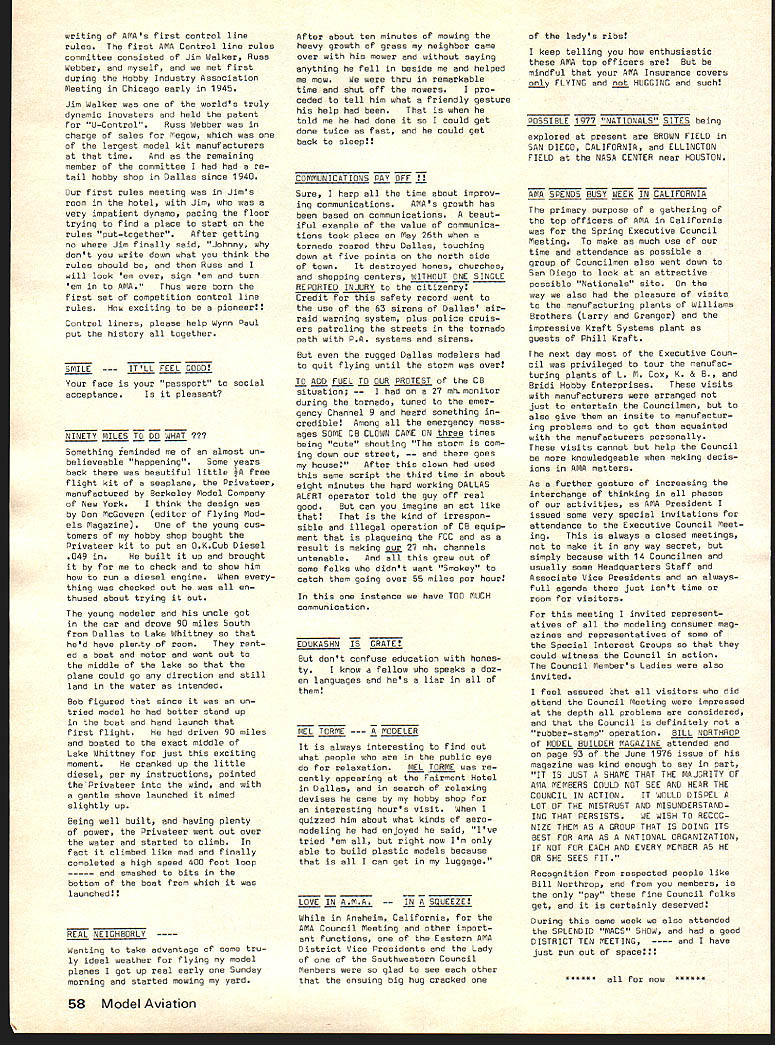
- AMA Museum. The need for a new museum, or at least storage space for the collection of artifacts, was noted by the donation to AMA at Toledo of the 1975 Best of Show Wright Brothers model by Bufford Gross of Peru, Indiana.
9a. Fun Fly sanctions. The need for better definition of such events was noted. District XV VP, Homer Smith, offered to supply a definition which was being successfully applied in his area; such definition to be added to current contest coordinator guidelines.
9b. CD Handbook. The council authorized HQ to use outside commercial services, if necessary, to get this long delayed project printed in 1976.
- Contest cash prizes. No action taken except to recommend that contest directors offer monetary awards where sponsors desired; a warning that acceptance may jeopardize amateur standing and eligibility to participate in other sports (depending upon local and/or state laws).
- Air Show Team program. Joint sponsorship by the AMA and the Hobby Industry Association described to be published shortly in Model Aviation. Leader membership for managers of AMA sanctioned Air Show Teams approved.
- AMA Awards. No nominations made.
- Officer reimbursement. Council members on official AMA travel are to be reimbursed (within previously approved limits) for lodging, parking, tolls, car mileage (at IRS rate), but no meals, approved. District officer (other than council) phone calls to be confined within the district and within previous limits—any overage to be approved by the district VP and HQ.
- Other Business
a. Film project. A change in priorities was approved, from current model show film project to new general interest film which would aid flying site acquisition by clubs.
b. FAA. A suggestion to designate model flying sites as danger areas for full scale aircraft was not acted upon, as not in the best interests of model aviation because it could give the FAA reason to look negatively on our activity.
c. HQ insurance. A long term disability plan for HQ employees was approved in principle, with final approval of a specific plan to be reviewed in August.
d. Recording of minutes. Attendance of the Assistant Executive Director or a HQ secretary at future council meetings was approved as a means of expediting availability of council minutes.
e. Officers' Guidelines book. Availability of the HQ procedures book in a new format was noted to be scheduled for the end of May, for council members and Associate VPs.
f. Youth programs. Glenn Lee described the need for AMA to work with such groups as Boy Scouts, EAA, ROTC, CAP, to promote use of model aircraft rather than full scale aircraft; he agreed to develop an outline of a program to be deployed this concept.
g. Indoor Committee complaints. A review of team selection committee procedures was made. It was noted that such procedures are to be approved by the appropriate special interest organizations, to assure adequate representation of their needs.
h. VP shirts. Such shirts are to be provided to VPs, for use at district functions and the Nats; HQ to have same embroidered with name, district and current term of office.
i. Next meeting. At the Nats, Wednesday, August 4.
AMA News
Key AMA people in the meetings have been John Strong, Chairman of AMA's Frequency Committee; Walt Good, former chairman and current committee member; John Worth, Executive Director; Jerry Courtney, AMA's legal counsel (plus several members of his staff). Very helpful, too, at the highest level of negotiations, have been several AMA members whose jobs in the Washington area put them on a first name basis with many government leaders.
MODELS AND FULL SCALE AIRCRAFT—AGAIN
One of the primary purposes of AMA is to be ready, behind the scenes, when panic situations of one sort or another crop up. An inherent problem with such situations is that they usually generate rumors, which can confuse people and cause needless worry.
One such situation happened recently in California. We got a message at HQ that the State Department of Aeronautics was going to ban model flying within five miles of an airport. On the surface this looked to be a real problem—a threat to many clubs. But the real situation turned out to be quite different and not really a threat.
After a number of phone calls, involving the AMA District X VP, Alex Chisolm, and the California Department of Aeronautics, it was verified that an addition to an existing law has been proposed to add model airplanes to a list of such things as kites and balloons which may be banned from flying within five miles of an airport. This, however, is not as threatening as it may sound.
The reason for the proposal is to provide a legal means of stopping flying near an airport, if necessary. The words, "if necessary," are important. The state found that if they found a dangerous situation, especially if some modelers were uncooperative, regarding model flying, they had no legal recourse under the existing law to solve the problem. So they propose to add "model airplanes" to the list of flying objects they can control if need be.
But it was made plain that, first of all, the proposal is only that. It may or may not pass preliminary examination by state legal people. If it does pass, the proposal will be published and there will be an opportunity for public comment before any decision is made. And AMA was promised to be notified if the law proposal gets to the published stage, so that AMA could alert all concerned.
AMA was also assured that if such a proposal becomes law it will not be applied to situations where there is an agreement between modelers and airport operators concerning model flying. The intent of the law is simply to provide a means whereby uncontrolled situations may need legal action to prevent a safety problem between models and full scale aircraft.
The state people, incidentally, noted that the FAA does not have any legal "teeth" in such a situation except in Terminal Control Areas (TCA) near big city commercial airports.
For those interested further, the proposed law would come under Title 4 of the California Public Utilities Code, which presently provides for flying or releasing balloons, kites, or rockets near airports as a misdemeanor or offense.
All this is to say that a warning flag is on the horizon regarding model flying near airports, so that it behooves all involved in such activities to be especially careful to avoid incidents with full scale aircraft. In other words, we need to keep the situation "cool" so as to avoid any undue pressure for more regulation of this type.
AMA will, in the meantime, be working to keep up with what's happening in this area and to advise when and where any AMA member can help, if any may be needed to help maintain the status quo. For now, no immediate action is needed but we thought you should be aware of what is behind the scenes while more information is being developed.
NOMINATIONS FOR 1977-78 OFFICERS
With Wednesday, August 8 as the deadline for submission of nominations for AMA officers, to be voted on in the 1976 election, only the following had been received as of May 25:
For AMA President (two-year term of office, 1977-78) John Byrne, current Vice-President for District II (NY-NJ), Bayside, NY. Earl Witt, current AMA Secretary-Treasurer, Chambersburg, PA.
For Vice-President (only even numbered district VPs will be elected this year for service in 1977-78) District II (NY-NJ) — John Grigg, Lockport, NY, currently Associate VP for District II. District VII (IL, IN, KY, MO) — Bob Vojslav, Woodridge, IL, currently member of the Nats Executive Committee, also former Associate VP.
For more information regarding nomination procedures, see the May 1976 issue of Model Aviation, page 59. A copy of the procedure is also available by mail on request to AMA HQ. It should be remembered that for those whose terms will end this year, they must be nominated before they can be elected to continue beyond 1976. The officers whose terms expire this year are: John Clemens, President; John Byrne, VP—District II; John Spalding, VP—District IV; Glenn Lee, VP—District VI; Murry Frank, VP—District VIII; Alex Chisolm, VP—District X. have only a salutary effect upon all RC flight operations — but which I found, upon returning to my own constituency, represented a repressive measure to the extent that many fliers who honored it were, by its terms, grounded — the phones soon rang and I was reminded that a number of clubs have been flying harmoniously and without interference within our congested District 2 environs as close to one another as 1.73 miles, 1.82 miles, 2.50 miles and 2.70 miles — in fact, I have since learned that the idea had its origin in a fear of "shoot-downs," rather than actual instances of this having happened — and in my opinion, this does not justify the "numerical" formula of damnation — leading to my resolution, introduced at the meeting just ended, calling for a practical, workable substitute Safety Code provision to read: "I shall operate my radio control transmitter and conduct all of my model aircraft activities with regard for the rights and privileges of others, and in strict compliance with all lawful authority, including but not limited to, the Rules and Regulations of the Federal Communications Commission and the Federal Aviation Administration" — and although my resolution got into the discussion which followed and which included the reading of statistics to establish the validity of a "numerical" limitation in the neighborhood of 5 miles and another report of measurements along this line, I shall continue to present my proposal at ensuing E.C. meetings until it is either approved or rejected — anyway, I am happy to report, as you may already have heard, that the enforcement of the "5-mile-limit" provision has been deferred pending further study and that the threat implicit in that provision to liability insurance coverage has been suspended to abide the event — I would strongly suggest that in the meantime, all clubs flying RC close to one another enter into some sort of joint written declaration that they have been flying and will continue to fly harmoniously and without mutual interference, and that, therefore, regulation by Safety Code, or otherwise, would be neither necessary nor desirable at this time, nor within the foreseeable future — if a numerical mileage limit is finally confirmed as part of the Safety Code, it is likely that an exception will be made where such a graphically expressed harmonious coexistence can be shown by clubs.
Frequency Fall-Out
Not that we wish our monthly report to become top-heavy with RC matters, but it should fill ALL modelers with pride to note that their colleagues of the remote-control specialty have mounted an unprecedented effort, along gigantic proportions, to express their feelings against the FCC proposal (Docket 20120) to reallocate the present five 27 MHz Class C (RC) frequencies to the Class D ("Citizens") Service, thus impairing the use of some 80,000 remote-control sets — club news-letters, too, are doing a magnificent job, by emphasizing the serious threat to our hobby and sport posed by the FCC proposal and urging all modelers of whatever specialty, to write letters of protest, not only to the FCC, but to their U.S. Senators and Representatives as well — and by going still further in providing numerical copy requirements, mailing instructions and, in some instances, furnishing the suggested contents to be included in the objecting letters — notable among the newsletters, which I have received within the past couple of days, are those of the Mohawk Radio Control Modelers, Jersey Coast Radio Control Club, Radio Control Club of Rochester and Monmouth Model Airplane Club — I hope you joined the protest by writing to your Senators and Representatives, as well as to the FCC by the extended deadline of June 9.
A Saddening Note
Our deepest sympathy to George Myers (former RC Contest Coordinator of District 2) and his family for their great loss, occasioned by the untimely death of Mrs. Myers, or "Doette," as she was affectionately known to Long Island modelers and all others who were fortunate to know this lovely lady.
David C. Fifield
Continuing efforts to increase representation of AMA members in upstate New York, I have just appointed as Associate Vice President in that region, David C. Fifield of 11 Lace Lane, Elma, New York 12065. Telephone: 518-371-8116 — Dave is highly regarded in his area and enjoys a well-earned reputation as a hard worker and a "doer"; prime requisites for one who undertakes to serve conscientiously as an AVP of the AMA. (Del) Kunkle steps down in order to provide for the appointment of Fifield.
Gear Up and Locked!!!
III DISTRICT REPORT
Don Lowe Dist. III Vice-President 2710 N. Kings Arms Circle Centerville, OH 45440
Associate Vice-Presidents Francis Flaherty, 5021 25th St., Vienna, WV 26101 Harry Penfield, Wharvey Dr., R.D. 1, Sewickley, PA 15143 Ralph S? (addresses as listed)
The most important thing happening these days that influences District III AMA members, and all modelers for that matter, is the proposed action by the FCC to gobble up our 27 MHz frequencies and give them to the CBers. I surely hope that all of you out there who are at all concerned about the future of RC modeling took some action on the matter. I wrote letters to my four Congressmen, the FCC and AMA Headquarters. My basic position is that even though some modelers are a minority in relation to the CB colossus we still have minority rights, and we have a peculiar need for frequency protection to assure safe operation. I also sense strongly that if radio is ever taken from us it is primarily for mobile travel information purposes, etc. It is almost useless!
I am writing this copy in May, and we are getting increasingly busy with Nats preparation and planning. Also returned from an AMA Executive Council meeting in California where I had the opportunity to attend the MAC Show.
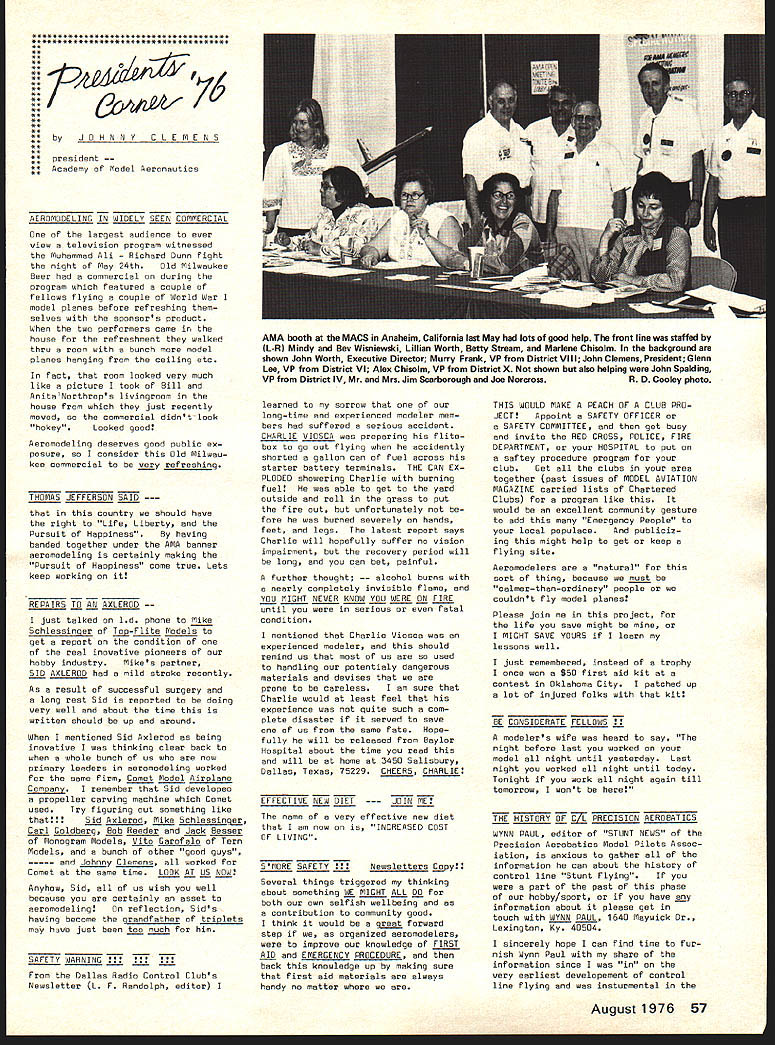
I have been involved in two national professional symposiums held here in Dayton. AMA was invited to have a display, using professional materials and Headquarters personnel plus much local support. These two symposiums were the National Association for RPVs and the National Electronics Conference. These displays and the resulting communication with people of similar interests were outstanding public relations efforts. Modeling was given a real boost in the eyes of important aviation, electronic and civic organizations and individuals. We even flew model helicopters inside the Dayton Convention Center for a large enthusiastic crowd! May was a very good month for modeling in Ohio.
I will not report the complete Executive Council agenda; however, a couple of items are worth mentioning. The five-mile RC flying site separation criteria is being suspended pending acquisition of more data and enlightenment on the precise nature of the problem. Clubs are being encouraged to conduct their own studies and report their findings.
The Hutchinson deal is still in limbo due to inability to locate the airfield property owner, Bill Seed, and conclude a satisfactory agreement for use of the airfield.
DISTRICT REPORT
Delaware • District of Columbia • Maryland • North Carolina • Virginia
John Spalding Dist. Vice-President 5803 N. Beltwood Dr. Lanham, MD 20801
Associate Vice-Presidents Charles Foreman, 6009 Phelps Rd., Mechanicsville, VA 23111 W. Bill Hines, 800 Tyvola Rd., Charlotte, NC 28210 Robert Kuklinski, 2043 Marsh Rd., Wilmington, DE 19810 Ronald Sondergaard, 14613 Wood Home Rd., Centreville, VA 22020 Paul A. Yadcoch, 6048 Winthrop Dr., Fayetteville, NC 28301
By the time you read this, the April 30 Executive Council meeting will be over and many of the issues considered at such length will have already been forgotten except by the interested few.
One of the items had an interesting background and development which I think you should know. At the previous council meeting, it was discussed that a couple of clubs were experiencing difficulty with radio operations due, it was felt, to the close proximity of their respective flying fields. The clubs had not been able to work out the problem, but had begun arguing, as I understand it, about who was established in the area first.
The council decided this was probably a harbinger of the future. The growth of RC could easily, it was felt, outstrip the number of properly separated fields. But the council did not want to be in the business of adjudicating disputes between clubs which might arise, so members were urged to work out their own arrangements and report their findings.
AMA News
tance was measured on a map and found to be much less on a straight line basis. It was then decided to have a joint meeting and talk things over.
Now, these people could easily have complained to AMA headquarters or written long letters to "aroused" magazine editors. They could have done many things critical or negative, but instead, they decided to report their situation to the VP and, most importantly, make quick tests to determine if there were problems. Also, they felt a report of these tests should be sent to the council for its information.
Associate Vice President for Delaware, Bob Karlsson, George "Scotty" Moyer, John Scott, Graham Lomax, and a dozen others from both clubs made tests the following weekend and the results surprised them. The report was subsequently read to the council members. District II VP, Don Lowe, had also made tests and reported on these. The council then made its decision from these and other reports from various districts.
The point I'm trying to make is that these good people perceived a problem posed by the rules, they talked among themselves, and they made a positive reaction, without threat or personality attack, within the structure of the system. The lesson is obvious.
The council and yours truly extend our sincere appreciation to the members of the First State Radio Control and the Delaware Radio Control Clubs.
The council has requested the Executive Director to notify all AMA clubs of the safety rules "suspension," and to request further data on this problem. In line with that and to stimulate your thinking, here is a reprint of a further letter from Bob Karlsson.
The following is a suggestion for a better change to the AMA safety code:
"I will not knowingly operate my transmitter at anytime I'm aware it could cause interference at any organized flying site. I will keep my transmitter in proper operating condition."
We conducted our test as quickly as possible. Some of the equipment was frequency counted at previous meets. I personally did the flying on 75.64 using the wrong transmitter, another of mine. The correct one was used to try to knock it down, which occurred at .9 miles, altitude 400 feet, aircraft flown about .25 miles towards "knock down" run.
If more information is required or requested, call on us, and we will get more testing equipment and give more detailed results. I do believe we proved five miles is unrealistic for all areas.
Just a word to let you know the members came through like never before. Washington was flooded with letters echoing the AMA position opposing FCC Docket 20120 throughout the month of May. Letters piled up in FCC offices and the offices of Congressmen. Most letters were based on the AMA's eight-page April letter sent to AMA clubs and others. Over 3,000 were mailed altogether and 500 distributed at the MAC show in California May 2-3. The letter was also the basis of the RC Crisis article in last month's Model Aviation/AMA News.
Midway through the month the FCC reacted via an Associated Press story quoting several AMA members' letters — it appeared the FCC might be setting the stage to tell CB operators modeler opposition could upset FCC plans to expand CB activity rapidly. At press time, the end of the May public response period established by the FCC was June 9; the final outcome was still in doubt, but the outlook was very hopeful due to the number and nature of letters to the FCC.
Both the quantity and quality of letters were outstandingly impressive. The vast majority of individuals expressed personal viewpoints. AMA members and citizens came from all walks of life — doctors, lawyers, housewives, salesmen, mechanics, engineers, teachers, students, etc. The cross-section included old and young, male and female. Several best women modelers emphasized family aspects of model aviation and the need to aid youngsters practically. The letters, however, were a mixture of logic and emotion; extraordinary blending of intelligent constructive statements and petitions form letters added to the overall impact. Obviously effective messages by individuals, which is what was suggested and hoped AMA would call for, were received quickly and well in such numbers that no further urging was needed.
Equally important perhaps was the direct response to the FCC and simultaneous pleas to Congressmen. Many congressional offices called AMA headquarters during May for further information so constituents' requests could be presented to the FCC. This was an effective demonstration of government representatives willing to respond on behalf of voters, especially when presented with logical reasons for action. Helping further FCC's eventual agreement was the formal request AMA made to extend the public response deadline. Although FCC action later requested less extension than asked, the AMA did secure a two-week extension — much less than hoped, but enough to allow last month's Model Aviation/AMA News message to get thousands of modelers time to reply. The extension was requested in April with the hope of an affirmative answer before other model magazines went to press; the FCC did come through in early May, but it was often too late for some magazines' press dates.
FCC LICENSE PROCESSING
The Commission announced interest in the Citizens Radio Service has increased phenomenally during the past few months. During October 1975, for example, the Commission received over 300,000 Class D Voice license applications. During the same period in 1974 it received approximately 40,000 such applications. This recent influx of applications has created a large backlog of pending applications. The reason it is now taking about 12 weeks from time application is received until license is issued is the result of the backlog.
As a result of the backlog of pending applications, the Commission is being deluged with letters from applicants inquiring the status of their applications. Unfortunately the Commission's limited resources do not permit a personal response to each letter received. Commission employees currently engaged in processing and issuing Citizens Service licenses state that to respond individually to each letter received would cause further delay in completion of other vital tasks. They emphasize virtually every license application received is processed in about 12 weeks. They urge applicants not to inquire about the status of an application before that period has elapsed.
Those intending to submit applications for Citizens Service licenses are urged to observe the following precautions to ensure proper processing:
- Enclose check or money order for the correct license fee of $4.
- Sign and date the application.
- Be sure the address is complete including ZIP code.
- Recheck the application to ensure all have been completed.
- Enclose application in a size 10 business-size envelope.
Contest Problems? Please Note — If you have applied for an FCC license yet have not received it and wish to enter an AMA-sanctioned RC contest, you can fly legally under supervision if someone present has an FCC license of the same class. If you have applied for an official class and AMA headquarters verifies your application has been mailed to the FCC, the contest director will normally permit you to fly under the supervision of a licensed club member until your license is received.
DISTRICT REPORT
Jim McNeill Dist. VII Vice-President 617 South 20th Avenue Birmingham, AL 35205
Associate Vice-Presidents: Richard E. Jackson, 101 White Blvd., Summerville, SC 29483 Chris Joiner, 1054 Warner Road, Columbus, GA 31909 Bill Kiser, 550 West Stone Dr., Kingsport, TN 37660 Tom McLaughlin, 4140 Fern Ct., Pine Glades, Pensacola, FL 32503 Luis Rodriguez, E-10, 5th St. Ext., Villa Rica, Bayamon, Puerto Rico 00961 Jim Whitley, 1605 Woodland St., SE, Decatur, AL 35601 Julie Woods, PO Box 127, Scooba, MS 39358
Pretty—Cynthia Cheatham holds an RC model for Roy Walton to photo. Roy and Bill Owen put together a pamphlet on the GCRC Club and passed it out at a recent Mobile, Alabama show. Founded in 1950, the Club sports 50 members. Roy and Bill have promised to mail the goodies in so we can feature a Club-of-the-Month.
AMA News
When asked to stand up and be counted, AMA members came through like never before — flooded Washington with letters echoing the AMA position opposing FCC Docket 20120. Through the month of May letters piled up in FCC offices and the offices of Congressmen. Most letters were based on the AMA’s eight-page April letter sent to AMA clubs and others — over 3,000 mailed altogether and 500 distributed at the MAC show in California May 2-3. The letter was also the basis for the "RC Crisis" article in last month’s Model Aviation/AMA News.
Midway through the month the FCC reacted via an Associated Press story quoting several AMA members’ letters — it appeared the FCC might be setting the stage to tell CB operators that modeler opposition could upset FCC plans to expand CB activity rapidly and extensively. At press time the public response period established by the FCC ran until June 9; yet the final outcome was still in doubt. The outlook is very hopeful due to the number and nature of the letters to the FCC.
Both the quantity and quality of letters were outstandingly impressive. The vast majority of individuals expressed personal viewpoints. AMA members — citizens from all walks of life: doctors, lawyers, housewives, salesmen, mechanics, engineers, teachers, students, etc. — made up a cross-section of people including the old and the young, male and female. Several of the best letters from women modelers emphasized the family aspects of model aviation and the need to aid youngsters. Practically all letters, however, were a mixture of logic and emotion — an extraordinary blending of intelligent, constructive statements and petitions. Form letters and petition-style letters added to the overall impact.
Obviously the messages of individuals — what was suggested and hoped for — and the call for AMA support will be effective. If the AMA position prevails it will be mostly due to the numbers who responded quickly as well as to the quality of the responses. Equally important perhaps was the direct response to the FCC and the simultaneous pleas to Congressmen. Congressional offices called AMA headquarters during May for further information; constituents’ requests could be presented to the FCC. This was an effective demonstration of government representatives willing to respond on behalf of voters, especially when presented with logical reasons for action.
Helping further the FCC’s eventual agreement was the formal request from the AMA to extend the public response deadline. Although the FCC later granted a shorter extension than requested, any extension was helpful. The AMA had asked for a 30- to 60-day extension but received two weeks — much less than hoped, yet enough to allow last month’s Model Aviation/AMA News message to reach thousands of modelers and provide time for replies. The extension requested in April hopefully would have been granted before the rest of the model magazines went to press; the FCC did come through in early May, but it was too late for some magazines’ press dates.
FCC LICENSE PROCESSING
The FCC has announced that interest in the Citizens Radio Service has increased phenomenally during the past few months. During October 1975, for example, the Commission received over 300,000 Class D Voice license applications. During the same period in 1974 the Commission received approximately 40,000 such applications. This recent influx of applications has created a large backlog of pending applications; it is now taking about 12 weeks from the time an application is received until a license is issued.
As a result of the backlog of pending applications, the Commission is being deluged with letters and telephone inquiries from applicants inquiring about the status of their applications. Unfortunately, the Commission’s limited resources do not permit a personal response to each letter received. Commission employees currently engaged in processing and issuing Citizens Service licenses point out that responding individually to the many letters received would cause further delay in completing other vital tasks. The Commission emphasizes that virtually every license application is processed in about 12 weeks and urges applicants not to inquire about the status of their application before that period has elapsed.
- Enclose a check or money order for the correct license fee — $4.
- Sign and date the application.
- Recheck the application to ensure all blanks are completed.
- Enclose the application in a size 10 business-size envelope.
Contest Problems: Please note — If you have applied for an FCC license but have not yet received it and wish to enter an AMA-sanctioned RC contest, you can fly legally under supervision if someone present has an FCC license of the same class. If you have applied for an official class and AMA headquarters verifies your application has been mailed to the FCC, the contest director will normally permit you to fly under the supervision of a licensed club member until your license is received.
AMA News
in cash prize contests their amateur standing in athletics could be jeopardized. 4. to have guidelines made up to define and explain sanctioning for Fun Flys.
Then there was much discussion on the FCC proposal to take the 27 MHz frequencies away from us. By now you all have the report from headquarters that explains what AMA needs you to do to help our situation, as it was in the previous issue, plus a separate mailing to AMA clubs. My club made it a project at our meeting two days after I got back, which included individual letters to FCC and copies to our Congressmen with petitions.
On Thursday, April 29, the day before the council meeting, we had the opportunity to visit a number of model oriented businesses and meet some great people. First the Cox Company where Bruce Tunberg gave us an excellent tour through their huge plant. Then over to Model Builder Magazine where Anita and Bill Northrop gave us the red carpet treatment. We had a lively visit with them over the lunch table at a nearby restaurant. From there we went to K & B Mfg. and met Jim Brodbeck, Jr., for a tour of that facility. Then to wind up the day we went over to Brief Enterprises and visited their three shops, directed by Joe Bridi. We could not have been treated any nicer by any of these fine people! No wonder we like modeling!
Saturday was the MACS Show and more nice people. We had a chance to see the folks from our Thursday tour plus lots more. Joe Bridi's son, Dave, "Dirty" Dan Rutherford from Model Builder and his wife, Sherry, plus AVP's from District X, Jim Scarbrough, Betty Stream, and George Williams. The show was broad, covering not only our hobby but trains and many specialized miniatures, plus handicrafts.
My participation in the council activities wound up with the District X meeting on Saturday night. Nine of the 11 districts were represented, plus Earl Witt, John Worth, and President Johnny Clemens. I'm sure Alex will be giving a more complete report on this meeting.
I'd like to finish with a sincere vote of thanks to the whole council for the effort and the time they spend keeping things going at AMA. Although all the council members made me feel at home and welcome as a newcomer, I'd like to give special thanks to Homer Smith, District XI, who spent a lot of his own time helping me through the details of my first AMA council meeting.
AMA members came through like never before. Washington was flooded with letters echoing the AMA position opposing FCC Docket 20120. Through the month of May letters piled up in FCC offices and in congressional offices. Most letters were based on the AMA's eight-page April letter sent to AMA clubs and others — over 3,000 mailed altogether, 500 distributed at the MAC Show in California, May 2–3. The letter was also the basis of the RC Crisis article in last month's Model Aviation/AMA News.
Midway through the month the FCC reacted via an Associated Press story quoting several AMA members' letters — it appeared the FCC might, setting the stage, tell CB operators modeler opposition could upset FCC plans to expand Citizens Radio activity rapidly and extensively. At press time the end-May public response period established by the FCC was June 9. Until the FCC completed a final action the outcome was still in doubt, but the outlook was very hopeful due to the number and nature of letters to the FCC. Both the quantity and quality of the letters were outstandingly impressive. The vast majority of individuals expressed personal viewpoints. AMA members — citizens from all walks of life — doctors, lawyers, housewives, salesmen, mechanics, engineers, teachers, students, etc. — a broad cross-section of people, included old and young, male and female. Several of the best women modelers emphasized the family aspects of model aviation and the need to aid youngsters.
The letters themselves were a mixture of logic and emotion; an extraordinary blending of intelligent, constructive statements and petitions. Form letters added overall impact. Obviously effective messages by individuals were what was suggested and hoped for when the AMA called for support. Therefore, if the AMA position prevails it will be mostly due to the volume and quality of the responses. Equally important perhaps was the direct response to the FCC and simultaneous pleas to Congressmen. Many congressional offices called AMA Headquarters during May to get further information, and constituents' requests could be presented to the FCC as an effective demonstration of government representatives willing to respond on behalf of voters, especially when presented with logical reasons for action.
Helping further FCC's eventual agreement was a request that the public response deadline be extended. Although the FCC later granted less extension than requested — AMA asked for 30 to 60 days and got two weeks — that was enough to allow last month's Model Aviation/AMA News message to reach thousands of modelers in time to reply. The extension was requested in April in hopes of getting an affirmative answer before the rest of the model magazines went to press at the end of the month so readers could get the word and join the effort. The FCC did come through in early May, but it was too late for some magazines' press dates.
FCC LICENSE PROCESSING
The FCC announced interest in the Citizens Radio Service has increased phenomenally during the past few months. During October 1975, for example, the Commission received over 300,000 Class D voice license applications. During the same period in 1974 it received approximately 40,000 such applications. This recent influx of applications has created a large backlog of pending applications. The reason is that it now takes about 12 weeks from the time an application is received until a license is issued.
As a result of the backlog of pending applications, the Commission is being deluged with letters from applicants inquiring about the status of their applications. Unfortunately, the Commission's limited resources do not permit giving a personal response to every letter received. Commission employees currently engaged in processing and issuing Citizens Service licenses say that to respond individually to every letter received would cause further delay in completion of other vital tasks. They emphasize that virtually every license application received is processed in about 12 weeks, and they urge applicants not to inquire about the status of an application before that period has elapsed.
- Enclose check or money order for the correct license fee: $4.
- Sign and date the application.
- Recheck the application to ensure all blanks have been completed.
- Enclose the application in a #10 business-size envelope.
Contest Problems? CDs Please Note
If you have applied for an FCC license but have not yet received it and you wish to enter an AMA-sanctioned R/C contest, you may fly legally under the supervision of someone who already has an FCC license of the same class. Contest Directors should verify FCC status as needed with official AMA Headquarters guidance.
AMA News
When asked to "stand up and be counted," AMA members came through like never before. They flooded Washington with letters echoing AMA's position opposing FCC Docket 20120. Through the month of May letters piled up at FCC offices and at Congressmen's offices. Most letters were based on AMA's eight-page April letter sent to AMA clubs and others — over 3,000 mailed; altogether 500 distributed at the MAC show in California, May 2-3. The letter was also the basis for the "R/C Crisis" article in last month's Model Aviation/AMA News.
Midway through the month the FCC reacted via an Associated Press story quoting several AMA members' letters — it appeared the FCC might be setting the stage to tell CB operators that modeler opposition could upset FCC plans to expand CB activity rapidly and extensively. At press time the end of May public response period established by the FCC ran until June 9, yet the completed final outcome was still in doubt. The outlook was very hopeful due to the number and nature of letters to the FCC. Both quantity and quality of letters were outstandingly impressive. The vast majority of individuals expressed personal viewpoints — AMA members, citizens, all walks of life: doctors, lawyers, housewives, salesmen, mechanics, engineers, teachers, students, etc. The cross-section included old and young, male and female. Several of the best women modelers emphasized the family aspects of model aviation and the need to aid youngsters practically.
However, letters and arguments were a mixture of logic and emotion. Extraordinary blending of intelligent, constructive statements and petitions in letter form added to the overall impact. Obviously, effective messages by individuals as suggested and hoped — if AMA call for support prevails — will be mostly due to numbers and the speed with which members responded. Equally important perhaps is the direct response to the FCC and simultaneous pleas to Congressmen. Many congressional offices called AMA Headquarters during May to get further information; constituents' requests could be presented effectively to the FCC. This was an effective demonstration of government representatives' willingness to respond on behalf of voters, especially when presented with logical reasons for action.
Helping further FCC's eventual agreement was a formal request from AMA to extend the public response deadline. Although the FCC later requested less extension than asked — AMA had requested a 30-60 day extension but got two weeks — that was just enough to allow last month's Model Aviation/AMA News message to get thousands of modelers time to reply. The extension requested in April was hoped to be granted before the rest of the model magazines went to press at the end of the month so readers could get the word and join the effort. The FCC did come through until early May, but it was too late for some magazines' press dates.
The FCC's action in this matter and the enthusiastic response of AMA members demonstrate the effectiveness of organized, reasoned activity in protecting the interests of model aviation. Thank you to all who wrote and telephoned — and a special thanks to Bob and Don for some real food for thought.
Transcribed from original scans by AI. Minor OCR errors may remain.

