
AMA News
Earlier this year, following an "Open Letter," a number of AMA members asked for an official response so the entire membership could have the benefit of answers to the questions raised. The response below is a composite of thoughts from several AMA Executive Council members, AMA's legal counsel, the AMA Executive Director and others.
Three basic subjects of interest to the future of model aviation were questioned in the Open Letter: noise, chartering and insurance. AMA's response addresses each subject. The material on insurance is recommended reading so members may be better informed about coverage provided by the AMA and to dispel misconceptions raised in the Open Letter.
OPEN LETTER
ALL AMA MEMBERS, OFFICERS AND STAFF
Gentlemen:
I am happy to report Omahawks R/C, Inc. now has sufficient funds to cover the expected legal expenses involved in the defense of the appeal action being considered by the Supreme Court of the State of Nebraska. This noise litigation will be won or lost through Omahawks' efforts and the individual financial support of modelers coast to coast.
I am no longer serving as president of the Omahawks R/C Club, nor do I speak for that organization. I address you, fellow AMA members, simply as another Academy member who is interested in the well-being and proliferation of a hobby I have enjoyed for over 50 years. In the Thirties I built and flew rubber and gas free flight. In the Forties control line was added. Since the early Fifties, R/C has been my major interest. I initiated my first model club in 1939, directed my first AMA‑sanctioned meet in 1946 and throughout the late Forties and early Fifties I organized and directed all of the AMA‑sanctioned Plymouth International Elimination Meets held in the Omaha area. In the Sixties and Seventies I continued to assist in the promotion of our hobby through sanctioned pattern and scale meets, mall shows, flying demonstrations and, of course, the National Multiwing Championships (held annually through most of the Seventies).
I have three concerns which I feel are of major importance and should be addressed by the Academy. You are the Academy. I ask that you give the following questions your thoughtful consideration. If you find that you also are concerned, let's address these problems and attempt to resolve them.
NOISE
Has the AMA, in the past, really come to grips with the noise problem? Are we, in fact, too noisy? Has the AMA, in court or through official negotiation, ever saved a flying site? Most importantly, is there, even now, a firm policy established that will not allow another flying site to be lost without an organized national effort to stand firm and protect our collective interests and rights?
CHARTERING
Is the AMA an organization of modelers for modelers? Or, in fact, is it an organization of chartered clubs dedicated to building an ever‑larger national entity? Chartered clubs are of great financial value to the Academy and the Academy is most certainly of value to many chartered clubs. But must every AMA member join a chartered club in order to be recognized as a loyal member of the Academy and share the full benefits of that membership? Must every club be chartered in order for it to be considered an asset to our hobby and for the Academy to survive?
INSURANCE
Is our current insurance program, as conceived by Alexander & Alexander, worth the premium? How much protection do we really have, considering the multitude of requirements involved, the fact that the policy has a $100,000 deductible, and the further fact that a reserve account of $100,000 has been set aside for the protection of our membership and their landlords? What claims have been paid in the past? Has a single noise suit ever been defended? What protection exists for a strictly injunctive action with no monetary demands made?
Very sincerely, O. L. Olson, Jr. AMA #9529
---
RESPONSE TO THE OPEN LETTER
Dear Mr. Olson:
Re: Response to "An Open Letter" (January 29, 1983)
On January 29, 1983, the AMA Executive Council heard, in person, your explanation of the suit filed against the Omahawks R/C Club for alleged noise pollution. The Council was sympathetic to the club's plight, but felt it could only support the cause in the capacity described below because the Omahawks had not been and were still not chartered with AMA at the time of certain developments. You were asked to keep the Council apprised as the situation developed.
In the meantime, it was moved and passed that the Council go on record as giving total moral support to the Omahawks and that they be given such additional support as might be recommended by our insurance company and legal counsel. This motion was reported in the May 1983 issue of Model Aviation (page 102). Further updates on the Omahawks' situation were reported in Model Aviation (June and July 1983, and March 1984 issues). The June 1983 issue (page 105) noted the Omahawks had a legal defense fund and were asking for donations; AMA offered to collect and forward any checks made out to Omahawks R/C Club, Inc. to help the fund drive.
John Worth's letter of April 27, 1983 restated that the moral support expressed by the Executive Council was based on advice from AMA's insurance broker and legal counsel. Both advisors expressed the view that AMA should monitor the legal proceedings and not become directly involved at that stage. Action by the AMA could have been taken if the advisors felt it appropriate, but counsel advised that any involvement by the Academy should be limited until the legal proceedings were more fully developed.
Our General Counsel offered to review all documents in the case, past and future, and indicated a willingness to provide direct consultation with the Omahawks' attorney if desired. We have forwarded documentation, statistics and other material from our files that might support the Omahawks' case. In a letter dated February 17, 1984, addressed to the Omahawks' attorney, our General Counsel requested him to "review the potential for the AMA's support" of the Omahawks' position before the Supreme Court, perhaps by filing an amicus curiae (friend of the court) brief or other form of support. He also requested copies of the relevant District Court decisions and pleadings filed with the Supreme Court to date.
---
Clubs, Chartering and Member Protection
Clubs and flying‑site owners can be sued for non‑flying accidents that may occur at the club flying field, meeting site or a club contest. Such accidents may be caused by a club member, a spectator or anyone participating in a club activity. The accident may involve a fall, hanging signs, construction of field facilities, or other non‑flying activities for which an individual AMA member's personal protection would not apply.
When a club leases property for a flying site, the property owner wants assurance of protection. AMA‑chartered clubs can provide the property owner with a certificate naming him as an additionally insured—something that frequently results in property use being granted.
Given the foregoing, it is clearly in the best interests of AMA members who belong to a club to charter their club with the AMA in order to receive insurance and other club benefits. All members of a chartered club, including officers, must be AMA members (except associate chartered club members, who are defined as the spouse, child or parent of an active club member who does not fly models as part of the club activity; such associate members must be listed on the charter application).
It is not a legal necessity for every club to be chartered, but clubs that do not charter should understand their exposures. Individuals in the Omahawks Club who were AMA members received the full benefits of their individual membership and were protected as individuals; those who were not AMA members did not directly benefit. Inasmuch as about half the Omahawks' membership chose not to become AMA members and not to charter, they did not enjoy the benefits shared by thousands of members of approximately 1,700 chartered clubs. That independence resulted in significant litigation expenses and time expenditures for that club.
---
Insurance
The case brought against the Omahawks posed a real threat. However, protection that could have provided the club with financial support—regardless of the case outcome—was not available because the club was not chartered and therefore was not covered under AMA's insurance in the way a chartered club would have been.
In a letter dated March 1, 1983 (enclosed with Mr. Worth's March 9, 1984 correspondence), our insurance broker, Alexander & Alexander, Inc., stated unequivocally that if the Omahawks had been chartered by the Academy, "the insurance company would provide defense coverage and pay any damages that would result from their legal liability concerning this suit. If a member is sued individually, our insurance company would defend them and pay any judgment against them that they would be liable for."
Our brokers developed the following major points of comparison between the Omahawks' policy and AMA's program:
- The limits of liability in the Omahawks' policy were quite low for their type of exposure. They were set at $300,000 bodily injury / $5,000 property damage. In the broker's judgment neither limit would be adequate if confronted with a serious bodily injury claim.
- The Omahawks' policy provided protection for the club only and did not extend protection to individual members who might be sued by someone outside the club.
- Because the Omahawks' policy covered only the club, it did not provide protection from one member to another, which is an important feature of the AMA insurance.
- The Omahawks' policy was written on a standard General Liability form. The AMA's insurance policy is written in a manuscript form tailored to the specific needs and exposures of our hobby. In borderline areas, the AMA policy would likely be in a better position to resolve coverage questions, since it has been developed over many years of test situations.
We and our broker encouraged the Omahawks to charter with the Academy, as AMA's insurance provides substantially greater coverage and is written to minimize or eliminate gray areas in coverage. It is difficult to comprehend why AMA's insurance program was questioned in the Open Letter—the AMA policy would have covered the club and many additional members; the Omahawks' policy did not.
The basic purpose of the AMA's decision to self‑insure the first $100,000 of property damage and bodily injury liability is twofold:
- To provide greater control over losses.
- To save money if it proves unnecessary to spend the $100,000.
Having a high deductible helps keep the overall premium rate down while maintaining adequate policy coverage. Coverage for the first $100,000, although borne by AMA rather than the insurance company, is part of the overall coverage provided by AMA's comprehensive general liability program and is subject to the same agreements, exclusions and conditions as included in the carrier's policy. The reserve account that has developed through the years of AMA's program provides an additional level of assurance that this self‑insured retention will not unduly jeopardize protection for AMA members.
Is our current insurance program worth the premium? The answer, in the judgment of AMA leadership and its advisors, is yes. Individuals who have AMA membership and clubs that charter with the AMA are provided, in the view and experience of AMA, with maximum protection at minimum cost. We therefore earnestly suggest that the present leadership of the Omahawks review their past course to see if becoming chartered is not the better route to take. Successfully surviving one legal challenge does not end the possibility of another. The costs of defending another suit need not be the burden they were previously if the Omahawks become part of the AMA family and assure themselves of the protection described.
---
District IV Report
Howard Crispin District IV Vice‑President 611 Beechwood Dr. Charlottesville, VA 22901
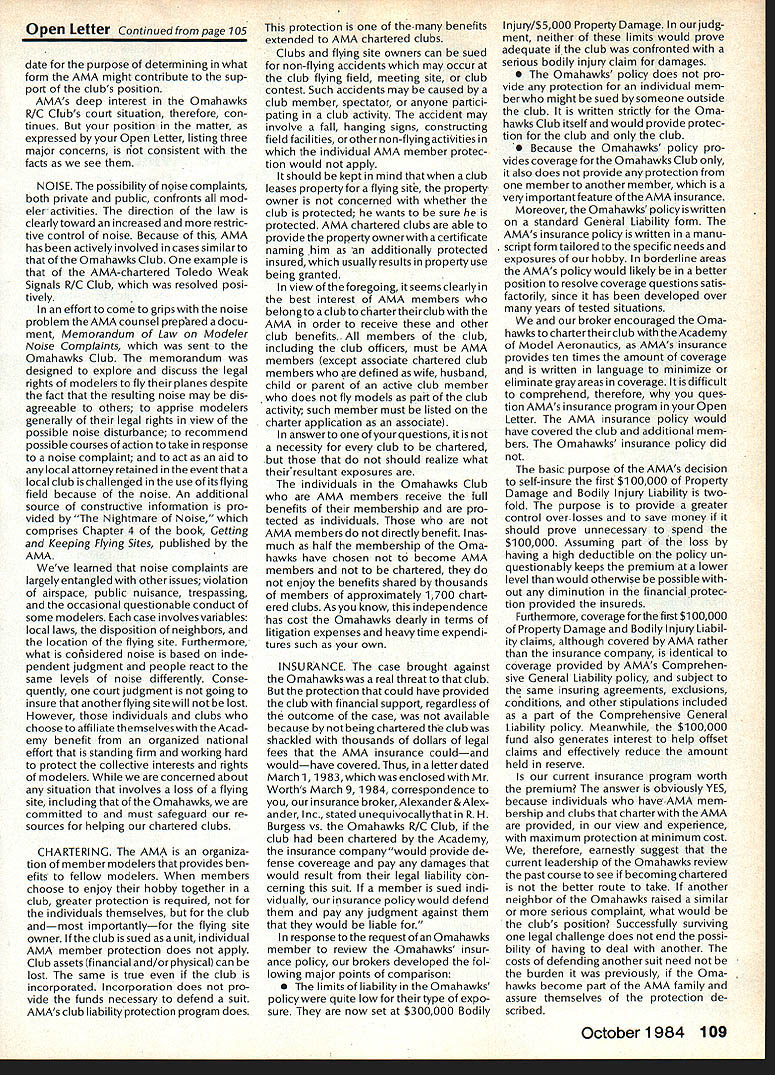
As this is written, District IV is about half way through the normal outdoor competition season. At this point it is difficult to speculate on whether overall entries are up or down. Early estimates say they are up, although some contests did have rather low turnouts. The summer weather has been unpredictable and has caused problems at times.
The Howard County Scale Contest at Bealeton a couple of weeks ago nearly had a disaster. Shortly after flying and the great roast beef dinner, a very large and violent thunderstorm struck the area. A couple of people were knocked down but, fortunately, suffered no injury. Some equipment was water‑damaged and one aircraft was lost the following day because water had permeated the equipment (not visible or apparent).
I attended several events where local clubs and AMA show teams introduced model aviation to the public. At Frying Pan Park, near Reston, a full day of activity was devoted to aviation. Model aviation was the prime display and entertainment. The NVCRC Gas Team performed under a variety of conditions with very loud aircraft and did a creditable job. We were assisted by another group (not an official team) which also performed professionally: the VVA(?) Club gas team, a circle‑burning group organized by the late Ray Decker, Dick Hausser and others. The group, along with some Control Line enthusiasts, drew a lot of attention and provided a good public show.
Other events included demonstrations on the 4th of July at Fort Meade, where the Meade Modelers handled the radio control demonstrations and the control‑line clubs put on slow, precision flying displays. These occasions were excellent ways to introduce model aviation to the public.
One unpleasant duty of an AMA vice president is reporting the passing of a member. On June 26 we lost Paul Hartlaub, Jr., of Cincinnati. Paul was a past president of the Queen City Control Line Club and was involved with MACA. He promoted control‑line activity in every way possible and was a friend to everyone. We extend our condolences to his wife Peggy, his son Paul III, and his daughters Karen, Teresa and Cheryl.
---
Mall Show Contacts (selected)
- Puente Hills Mall, 449 Puente Hills Mall, City of Industry, CA 91746; Tel. (818) 965‑5875; Contact: Wendy Moore; Event Date: October 18–23.
- River Road Mall, 120 River Road Mall, St. Louis, MO 63136; Tel. (314) 867‑1344; Contact: Sandra Zak; Event Date: August 27–September 8.
- Santa Rosa Plaza, 235 Santa Rosa Plaza, Santa Rosa, CA 95401; Tel. (707) 575‑0115; Contact: Judy Gray; Event Date: September 14–21.
- Seminary South Mall, 653 Seminary South, Fort Worth, TX 76115; Tel. (817) 927‑8459; Contact: Ed Draud; Event Date: October 15–20.
- Shannon Mall, 1000 Shannon Mall, Atlanta, GA 30291; Tel. (404) 964‑2200; Contact: Sharilyn Swinson; Event Date: September 12–23.
- Sharpstown Center, P.O. Box 36201, Houston, TX 77236; Tel. (713) 777‑5391; Contact: Donna Gruen; Event Date: September 3–8.
- Shapetown Center, 370 Cassazza Dr., Reno, NV 89502; Tel. (702) 323‑0430; Contact: Kim Wynant; Event Date: September 8–16.
We'll bring you more information as it comes. Get that plane entered and stake your claim to a trip to the Paris Air Show.
Geoffrey Styles Director of Public Relations
★ ★ ★ That's All For This Flight! ★ ★ ★
Transcribed from original scans by AI. Minor OCR errors may remain.

