
AMA NEWS
FROM THE SMOKE-FILLED ROOMS (The Council Digest, A Tale from Two Cities)
Although brief synopsis of the February 14 and April 30 AMA Executive Council meetings were published (Model Aviation, May and August 1976), the usual verbatim printing of meeting minutes was cancelled due to the need for space to cover the FCC-RC crisis of the past few months. Meanwhile, the minutes were offered on a mail request basis (you ask and AMA mails a copy).
The luck of publication, however, provided an opportunity for producing a more candid version of the minutes. The job was given to Ed Whalley, who writes a regular model news column for Flying Models magazine. Ed was challenged to see if he could come up with a more readable explanation of what happened at the council meetings—the minutes are typically dry and boring except to those who are especially interested in that sort of thing.
The result of Ed's efforts is published here, a summary of two council meetings wrapped up into one package. Hopefully, Ed's version will be more easily understood than the usual "official" record. Pro or con, we'd like to hear whether you prefer Ed's style or the official version. Your opinion can help decide how we do it in the future.
Rosslyn, Virginia, used to be the end of a streetcar ride out of the District. It consisted of the transit system's turnaround and a White Tower hamburger stand. There was a network of trails and a dirt road leading up the hill to Ft. Myer. It was once the get-off-and-walk point for horse soldiers coming back after a night in Washington and the staging area for their nightly assaults on the sawdust bars of Georgetown.
But if Rosslyn was known chiefly to the men of Ft. Myer, Anaheim, California, had achieved national prominence. Beery comedians and sidewalk wits could always count on a laugh when they delivered their version of the famous train call on the Jack Benny radio show, "All aboard for Anaheim, Azusa, and Cucamonga." Not funny? It all depends on your frame of reference.
In "now" terms, all the hick connotations have disappeared. Anaheim is part of greater Los Angeles, a sports center and a convention city. Rosslyn has long since rebuilt into a modern satellite city just across the Potomac from Washington. And with East and West Coast meetings of the Executive Council slated, it was not just chance that led to the meetings being sited in these two locations.
A Matter of Housekeeping
The Rosslyn meeting came in February; and it was, in many respects, merely a prelude to the meeting in Anaheim. President Johnny Clemens was pleased to note that "the entire Council" was in attendance. Present, too, was NAA's General Brooke Allen, who came to speak about the need for an updated agreement between AMA and NAA relative to the FAI franchise, a document which was unanimously approved by the Council and duly signed by Clemens.
Most of the housekeeping chores were ones which carry over from meeting to meeting: Nats-related items, budgetary considerations, the Hutchinson negotiations, safety legislation, administrative problems related to Boards and Committees, and ongoing matters related to AMA projects and public relations. Matters such as these seem to flow in an endless stream, to demand constant attention, and to be totally resistant to final solutions. But you've gotta give the boys "A" for trying; the meeting got under way about 9:30.
FCC SITUATION STILL FLUID — RC POSITION IMPROVED
Our campaign to avoid being merged with CB has apparently been successful. We have gotten the FCC's attention and interest regarding RC as a separate and distinct problem area. Although we are still not out from under the threat of having RC frequencies used for CB purposes, we have gotten indications of FCC support for the need to provide more frequencies for RC regardless of what happens to CB.
Meanwhile the FCC has found that it cannot expand the CB activity as much as had been proposed, even with the RC frequencies — instead of being able to offer 90 or more CB channels by the first of next year, the FCC now expects that only a total of 40 frequencies (including the current 23) is easily available; possibly 58. These amounts are without using the five 27 MHz RC frequencies and we're hopeful, with good reason, that the RC frequencies will not be added to the CB spectrum.
Discussions with FCC officials since the closing of public comments to the FCC proposals suggest strongly that we have won. the age limit battle and that Class C and Class D will probably not be merged. At the same time the discussions offer the promise of more frequencies for RC following some current explorations of what may be available.
In other words, FCC people are saying that we made a good case and they are trying to help us find an acceptable solution. That in itself is a noteworthy improvement in our position, compared to several months ago.
Let's look at what has happened to improve the situation. First of all, our letter-writing campaign was very effective. Out of about 1500 comments (response letters) to the FCC regarding Docket 20120, all but about a dozen were from RC people opposing the proposals (aside from one batch of several hundreds of postcards). Thus, the CB response was practically nil. Here's what "Industrial Communications," an electronics industry newsletter, said about the response:
"The Academy of Model Aeronautics has advised the FCC that there are about 450,000 people in the US who operate radio controlled models, and while not all of them filed comments with the Commission objecting to the proposed switch of five of their Class C radio channels at 27 megahertz to Citizens Band communications use, it would not be stretching the point too much to bet that any of them who did not file, at least has a friend who did."
As far as number of comments were concerned, the statements from individual modelers, clubs, manufacturers, and equipment distributors, won the race going away. Literally thousands of one-sheet comments protested the proposed deletion of the channels from radio control use.
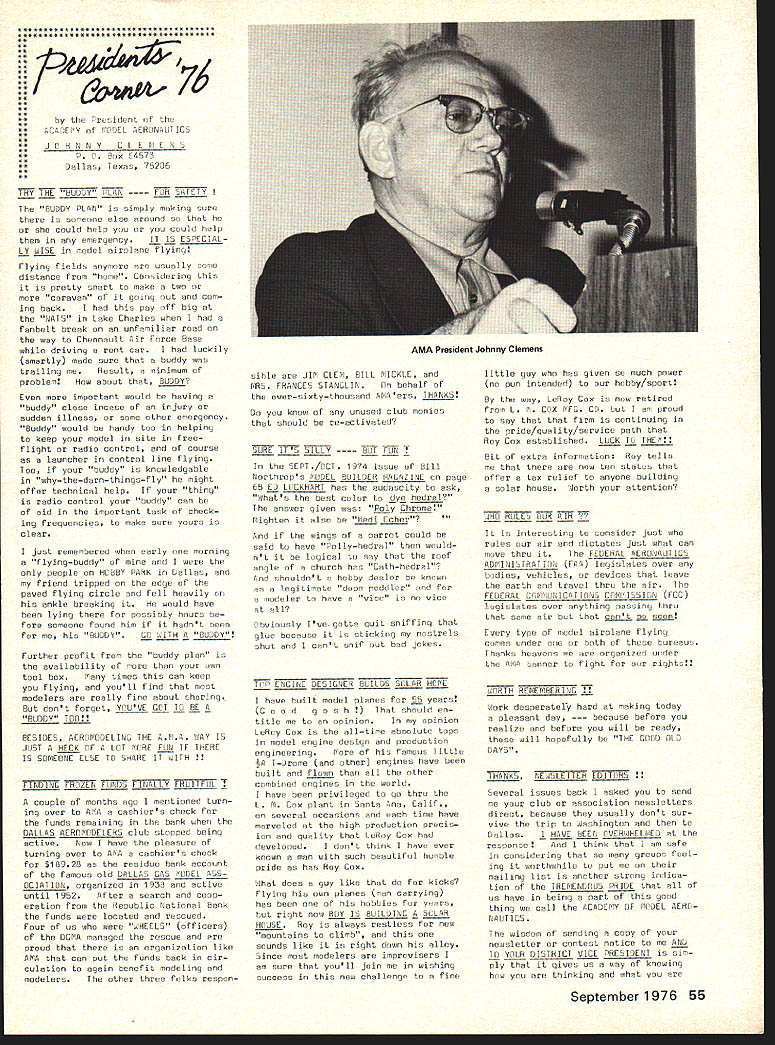
In addition to our lengthy AMA position paper (see elsewhere in AMA News) we were aided by responses from others which were helpful to our cause; such as the Amateur Radio Relay League, the Control Station Electrical Protection Association, the Hobby Industry Association, the American Society for Engineering Education, the Collier Division of Rockwell International and other principal modeling organizations, such as ROAR, AMYA, IMPBA, NAMBA. These responses enabled AMA to submit a follow-up position paper on June 24, to strengthen our arguments to the FCC. The text of that paper will be published next month.
But the effort didn't end with the paperwork. A key meeting was held in Washington on June 10 when AMA and RC industry representatives visited, in effect, the "White House." This was a visit to the Office of Telecommunications Policy — the official advisory body to the president concerning use of the airwaves. The result of this meeting was a promise, since fulfilled, for an OTP officer to speak to the FCC on our behalf. The next day the same AMA and RC industry representatives visited the FCC, to follow up a previous AMA visit.
Besides these meetings there were several other visits to the FCC to talk with officials about the problem and possible solutions. All the meetings were friendly, positive, and constructive. But they were also confusing. There seemed to be a lack of communication within the FCC — various key officials were saying different things due to lags of information between departments. At one point AMA became an information center — we were relaying messages from one official to another as we went from office to office. And there were days when more time was spent at the FCC than at AMA.
The investment of time and effort should pay off. The FCC is obviously desirous of helping us. But it is preoccupied with helping CBers first. And that's only natural since just on the recent month of CB license applications was more than 10 times the total for RC over the past ten years! So we're on the short end of the numbers game, but it definitely is not a hopeless situation.
We've got the FCC's attention and they're receptive to helping us. More meetings are expected and these should produce a fair compromise concerning continued use of the 27 MHz RC frequencies until others are made available. While that is being worked out, AMA will stay deeply involved.
It may take a few more months to really know how it will all come out. The FCC does not have any definite deadline for action, but it is under great public and political pressure to announce a decision before the end of the summer. So we will know soon. Until then membership letters and dues money have made our AMA effort possible. The cake is in the oven — we'll soon know how it will come out.
Council Digest (cont.)
A.M. and didn't break up until nearly midnight.
There were some positive accomplishments, routine matters routinely handled, which came out of the Rosslyn meeting. Nats schedule changes and additions were effected in order to save time and avoid conflicts. The NEC's recommendation to drop championships at the Nats was softened to mean axing only Scale, RC, Grand, Club and Team Champs. Nats volunteer staffers in key assignments who worked four days were granted up to $80 travel money and a night's free lodging for each day worked. Some good programs for Distinguished Service Awards: Hardy Brodersen, Dave Linstrum, and the Liberty Bell crew (Bob and Doris Rich, Ed Sweeney, Jr., Bob Satalis and Lee Taylor). Cliff Pifer was given a Fellowship. AMA fund-matching for employee retirement was changed from a max of 5% or $1000 to 5% or $1500 for the benefit of the three affected employees. John Worth left the room and was given a 10% raise. And the previous three-payment plan for a $1000 Life Membership was changed to a four-payment deal. All this was about a month before the FCC announced Docket 20120. So, understandably, Council members felt that they'd accomplished something as they filled the boardroom to hear of the new FCC move when the meeting was adjourned. They were looking forward to sunny California, Anaheim, the MAC Show, and a District X meeting in about ten weeks.
The FCC's "Bomb"
Late in March, the FCC exploded its bomb: a proposal to include CB voice operations on the 27 MHz frequencies; and to do it by the end of the year. There were also other goodies: the combining of Class C (RC) and Class D (CB) frequencies; the raising of the licensing age from 12 to 18; and the eventual elimination of the 27 MHz RC frequencies. The reaction to this at AMA HQ produced tremors felt all over the country and resulted in an angry feed-back to the FCC, Congress, President Ford, and anyone else in the path of the shock wave. Council members looked ahead to Anaheim with a set to their jaws and a glint in their eyes.
The Counter-Offensive Detailed
On April 30, the Council met at the Quality Inn in Anaheim to focus on the FCC Status Report. In his introductory remarks, Johnny Clemens called attention to the tremendous behind-the-scenes effort to counter Docket 20120. And John Worth delivered an update on the situation in which he stressed that the move had come as a complete sur- (continued on page 57) prise.
AMA News
FROM THE SMOKE‑FILLED ROOMS — Council Digest: Tale Two Cities
Although a brief synopsis of February 14 and April 30 AMA Executive Council meetings was published in Model Aviation (May–August 1976), the usual verbatim printing of meeting minutes was cancelled due to the need to cover the FCC‑RC crisis of the past few months. Meanwhile, the minutes were offered on a mail‑request basis — ask AMA for a mailed copy if lack of publication — however, this provided the opportunity of producing a candid version of the minutes. The job was given to Ed Whalley, who writes a regular model news column in Flying Models magazine. Ed was challenged to see if he could come up with a readable explanation of what happened at the council meetings. The minutes are typically dry and boring except to those especially interested in that sort of thing. As a result, Ed’s efforts produced a summary of the two council meetings wrapped up in a package. Hopefully Ed’s version will be easily understood as well as the usual official record. Pro/con — we’d like to hear whether you prefer Ed’s style or the official version. Your opinion can help decide the future.
Rosslyn, Virginia used to be the end of the streetcar ride out of the District. It consisted of the transit‑system turnaround, a White Tower hamburger stand, a network of trails and a dirt road leading up the hill to Fort Myer. Once you reached the “get‑off‑and‑walk” point, the horse soldiers were coming back after the night. Washington staging area, nightly assaults, sawdust bars — Georgetown and Rosslyn were known chiefly as places of Fort Myer men.
Anaheim, California achieved national prominence. Beery comedians and sidewalk wits could always count on a laugh delivered in the version of the famous train call on the Jack Benny radio show: “Anaheim, Azusa, Cucamonga.” Funny depends on the frame of reference; in time the hick connotations have disappeared. Anaheim is now part of the greater Los Angeles sports center and a convention city. Rosslyn has long since rebuilt into a modern satellite city just across the Potomac from Washington.
East‑West Coast meetings of the Executive Council were slated as just a chance to get meetings being sited in two locations. Matter of housekeeping: the Rosslyn meeting came in February and in many respects was merely a prelude to the meeting in Anaheim. President Johnny Clemens was pleased to note the entire Council was in attendance. Present, too, was NAA’s General Brooke Allen who came to speak about the need for an updated agreement between AMA and NAA relative to the FAI franchise document. It was unanimously approved by the Council and duly signed by Clemens.
Most housekeeping chores are ones that carry over from meeting to meeting: Nats‑related items, budgetary considerations, Hutchinson negotiations, safety legislation, administrative problems related to boards and committees, and ongoing matters related to AMA projects and public relations. Matters such as these seem to flow in an endless stream of demand and are constantly resistant to final solutions. You’ve got to give the boys credit for trying. The meeting got under way about 9:30 and continued into the afternoon.
FCC SITUATION STILL FLUID — RC POSITION IMPROVED
The campaign to avoid being merged with CB has apparently been successful and has gotten the FCC’s attention and interest regarding RC as a separate, distinct problem area. Although still under threat of having RC frequencies used for CB purposes, we have gotten indications of FCC support for the need to provide frequencies for RC regardless of what happens with CB. Meanwhile, the FCC has found it can expand CB activity much beyond the five 27 MHz frequencies proposed for CB use. Instead of being able to offer only 40 CB channels next year, the FCC now expects a total of 40 frequencies including the current 23 easily available, possibly 58 — amounts that, using five 27 MHz RC frequencies, give good reason to hope RC frequencies will be added to the CB spectrum.
Discussions with FCC officials since the close of public comments on the FCC proposals suggest strongly we have made a good case. AMA HQ, Executive Director and industry officials met with FCC representatives to present the industry viewpoint concerning the effects of current FCC proposals on business aspects of RC activity. Other meetings also took place to follow up earlier AMA representations. The situation is still fluid, battle lines and class‑type limits (Class C/Class D) will probably be reconsidered, but the prospects for obtaining adequate frequencies for RC use appear improved.
AMA News
doing. With that info we can sure act more intelligently in YOUR behalf. Hopefully you individuals members are receiving the replies that are actually in YOUR (or rather, OUR, because it is mine too!) organization. If it is not run by some member-run "think" you must be actually run by YOU thru your representatives on the Executive Council, per your wishes if your representatives know how you think.
NEWSLETTER EDITORS ATTENTION!! Be sure an address appears somewhere on your paper where you can be contacted. I am amazed at how many overlook this, without even a return address shown.
Several folks wrote to point out that my personal address was hard to find. I want to thank those who mentioned it and I do want to announce personally putting the publishing of this column under my own auspices.
THANKS FOR LETTING ME HEAR FROM YOU, and especially thank you for the cheering and encouraging little notes I find penciled on the margins. It makes me grin and think what great folks you are!
A BACKWARD FLYING MODEL PLANE is called a "canard." A backward acting model builder is called "stupid."
THE METRICS ARE COMING!
Since so many of the problems encountered in aeromodeling are based on measurements of various nature it might be useful for us to begin a "talk metric." The U.S. Congress in 1975 passed the Metric Conversion Act which will eventually dictate that we conform in measuring as the rest of the world does, basically with everything weighed or measured in "tens."
We still tend merrily to resist change but the metric system is actually far simpler than our present "dozens, pints, yards, inches and such." You will notice that much of our present day product packaging is already printing both U.S. and metric measures, pounds, ounces, etc. and ALSO METRIC MEASURES.
I would like to introduce you to a few simple "get-acquainted" phrases that you might memorize or pin up somewhere:
- A metric "pound" is a regular 36 inch yard, plus a little extra.
- A metric "liter" is a quart plus a little more.
- A metric "kilogram" is two pounds plus a bit extra.
- To convert inches into centimeters multiply the inches by 2.54.
- To convert centimeters into inches multiply centimeters by .394 (or for quicker approximation inches are 4/10 of the number of centimeters).
- As an example on an object with which we are familiar, Goldore's wall known Falcon "56" would be a Falcon "142." Many of the kits and models imported from other countries are already marked up in centimeters. It really isn't such a chore to remember that centimeters are 2.54 times the number of inches, and I think you will find that you can feel very "superior" to be in the "know."
For your control line flyers, standard 60 foot lines will be 18.28 meters on the metric scale.
And if there are any remote chance any girl watchers reading this, ideal measurements for a metric young lady might be something like 91-60-89. - JCH
A CHUCKLE FROM PAUL HARVEY
Commentator Paul Harvey has a great sense of humor which he shares with the listeners on his popular broadcasts. This morning he mentioned an interesting accessory item which might come in very handy for a free-flighter or an R/C'er who was having to choose models as a result of a fly-away. The device is a pocket compass with a mirror on the back. In use the compass can always tell you which way is North, — and the mirror can show you just who is lost!
AND PAUL WOULD APPROVE THIS ADVICE
Be sure you THANK SOMEBODY today for SOMETHING! — But above all thank GOD you are here to do it!
HATS OFF TO AMA'S FREQUENCY COMMITTEE
If you were aware of all of the communications and actions and time that is being put forth by our AMA "team" in making sure that our rights are recognized and respected in the "Frequency battle" you would be very proud! I am in a position to observe all this and I hope you will accept my judgment that they are doing everything they CAN and have done a sparkling job so far — not only putting their own efforts in motion, but coordinating efforts and actions with other organizations possible. AMA has worked directly with three groups who are even more completely concerned with the fate of our RC/27 MHz frequencies: the R/C car, power boat and sailing boat folks, the 27 mHz band sports and other loyal groups.
AMA is also working closely with the Hobby Industry Association (who made an excellent presentation to the FCC) and with the newly formed Radio Control Equipment Manufacturers group.
A copy of AMA'S OFFICIAL POSITION PRESENTATION to the FCC was sent me by our fine dedicated attorney, Jeremiah Courtney. I read it in one short trip to Denver, and it took the entire hour-and-one-half flight to read and absorb it. It was beautifully done, and ALL AMA should be proud of our stand. I particularly want to invite your applause to Frequency Committee members JOHN STROM and DR. WALT GOOD, to ATTORNEY COURTNEY, and to JOHN NORTH of AMA Headquarters.
While credit for exceptional effort should go to those folks there are many others who have certainly contributed their part. A TREMENDOUS TRIBUTE can be offered YOU OF OUR MEMBERSHIP and to the folks from the rest and face our groups who WROTE INDIVIDUAL LETTERS to the FCC. The FCC folks themselves told us that action would be the most effective move of all. I have seen copies of many of your letters (thanks for sending them to me) and John North sent me this.
I am not using my space to give you the technical information in the Frequency matter, as it is already covered in other pages of our magazine, but I did think it important that you hear about the spirit, inspiration, and effort that went into "our cause." May I finish this thought by saying that the AMA MEMBERS are VERY WELL THOUGHT OF by both the FCC and the FAA. They feel that we have done a sparkling job of policing our problems and maintaining theirs over the years. THAT'S THE WAY WE OPERATE!
NEWSLETTER IS CHANGED — 16 years old!
I am so darned proud of the communications network we have built by encouraging chartered clubs to publish newsletters! We are without a doubt the most communicative sporting members group in the world.
BUT NOW I'VE GOT SOMETHING NEW TO BRAG ABOUT! I am proud to point out that our organization which has gone predominantly adult with the great increase of interest in radio-control is more than proud to point out that the newsletter editor of the SIOUX FALLS (Dakota) R/C'ers "G.L.I.T.C.H." is STEVE BEERY who is 16 years young. In spite of the fact that Steve is so proud to be an AMA and Sioux Falls member he couldn't resist writing me a little personal note on the margin of his letter.
VANCE SUTTON is editor of "FLIGHT LINE," the monthly newsletter of the HUDSON R/C CONTROL SOCIETY in New York. Vance recently included the list of Chartered Clubs which published Model Aviation magazine and came up with some inter esting trivia. He said that far and away the most popular name for club newsletters was "NEWSLETTER." That is, the title originally and pretty obviously "POOR CHOICE." Who coined all that?
"THRUSTLINE" and "FLYER" were among the most popular, but Vance Sutton's vote as the most original title goes to "POOCHUTE." How about that?
IN YOU'D LIKE TO BE AMA PRESIDENT??
If your yearly work at being an AMA member (you get a two-digit job number) and you fill your home phone ringing all hours of the day and night, even if you find your name on someone else's 12th grade list of the most important people in this magazine's controversy, arguments about Hutchinson, the FAA, the FCC problems, unpopular FAIL ratings and such. And for "kicking on my cake" I have been subpoenaed into court as an "expert witness" for the third time in my life. This time it has to do with an air show crash near my home and I am forced to miss one week of flying time. It will be interesting to see how the jury treats our field of aeromodeling, but this is all too glorious! ALL FOR NOW.
Council Digest (from p. 54)
Pros. The FCC announcement had come only a few weeks after an AMA/FCC meeting exploring possible use of additional frequencies. No hint was given of the impending proposal even though Docket 20120 must have been in the writing stage at that time. The immediate HQ reaction to the proposal was to petition for a 30- to 60-day extension of the reply date to marshal opposing forces. And another meeting was set up to acquaint the Commission with AMA objections and to ask for extra time.
The furor at HQ generated a number of positive steps: There was a meeting of RC manufacturers at the Toledo show on April 2 and a briefing for the model press on April 3. News releases were distributed at the show and updates sent to AMA officials. Headquarters produced an eight-page position paper and distributed over 3,500 copies to clubs, the press, manufacturers, hobby shops, politicians, bureaus, and key individuals. So by the time Worth ticked off these developments, AMA's position had been defined, accepted, and a groundswell reaction against Docket 20120 had set in. The FCC had, by this time, promised new RC frequencies regardless of which way the proposal went. Under the circumstances, there was nothing left for the Council to do; and, amidst the swirl of mail flowing in, the FCC extended the reply period until June 9—a mere two weeks.
The Outlook
Due to the undeniable impression created by the unprecedented nature of the RC fraternity to the FCC, congressmen, and others in a position to help, the RC situation is bound to improve. Not the least important aspect of the overall effort was the Academy's determined public relations job, particularly the person-to-person contacts with individual Commissioners who were genuinely unaware of the magnitude of RC interest and activity. This new FCC awareness should prompt that body to actually service the visible, vocal, activist RC interest instead of merely tolerating it. The FCC now has the ball; the onus is on the Commission. So chalk up one for the good guys.
The Perennial Problem, Rules
The most persistent and knotty problem the Council deals with is the matter of rules—the ones that end up in the book. One would assume that the Contest Board could handle this, but the Council finds itself a sort of Court of Appeals. At Rosslyn, the matter of Mel Schmidt's vote on FF 76-11 came up for review. The point of contention is that Mel voted his conscience instead of the wishes of his constituency. The situation is not spelled out in either the AMA bylaws or the Board's rules. And there is no established appeal mechanism—which explains how such matters get kicked upstairs. Typically, such matters generate a good deal more heat than light; and after much discussion, the hot potato was passed back to the FF Contest Board on a close vote for further "review."
Another matter was Bill Pardue's proposal to change the final date for rules proposals from June 1st to September 1st. This seemed like a good idea to the Council in Rosslyn, so they went ahead and voted the change. But they've overlooked something; the idea had to be submitted to all Contest Board members first and then voted on jointly by the Council and CB chairmen. What to do? Put the question to the Boards by mail and settle the issue in Anaheim. The September date is now official.
How Close is 'Legal'?
Interference has always been the bane of the RC flier's existence. Acting upon the appeals of a number of clubs, the Rosslyn meeting enacted an addition to the Safety Code which specifies five miles between licensed operations. It seems that this was a simplistic solution to a complex problem. It was shown between the Rosslyn and Anaheim meetings that many groups were operating well within this distance without incident. To deny them insurance coverage would be manifestly unfair. With the Council reluctant to undo in order to please Peter what it had done to please Paul, it considered "waivers" for the affected groups. What do you do in a case like this, reverse yourself? Not quite. The boys came up with a motion stating that the wording of Item 4 of the Safety Code (five miles) will not be applied until the Council approves something else, to go in its place—a Suspension of the Rule. Neat!
Team Selection Procedures Firmed
The NFFS started something when it got involved in the team selection business. The ideas it generated were given a two-year trial and met with such approval that the Rosslyn meeting voted to grant permanent status to both the Indoor and Outdoor FF Committees. One proviso is that the Committees are required to submit their plans for each selection cycle to the appropriate, "AMA-recognized," special-interest group. The result is a clarification of roles and procedures and a degree of self-determination heretofore lacking in the FAI picture. The Council was so enthused with the whole idea that it officially commended NFFS and invited other groups to get into the act.
At Anaheim, the invitation to get moving along the same lines as the NFFS was reinforced by administrative measures calculated to grease the skids for those groups willing to commit themselves. The announced goal is to have all team selection committees operational by the end of the year. There are advantages which are not lost upon the Council to uniform procedures for parallel programs; hence, the urge to have all programs operated on the same basis.
FAI Rules Not So Clear
Although the Academy is clear about what it wants to do in the matter of Team Selections, exactly what will be done is pretty much up in the air. Clemens and Worth attended the FAI meeting in April and reported that the rules approved in December by the CIAM (FAI's aeromodeling committee) were accepted by the parent organization for national competitions but not, as yet, for WCs. In the meantime, the December changes are incorporated in the current AMA rule book and would be used for AMA meets and preliminary Trials. Which rules will be used for the Finals depends upon a pending review by the FAI; the relationship of Finals dates to this review, and the individual proclivities of TSCs and program participants. Conceivably, a team could be selected under one set of rules only to be demanded to use another.
The picture is further complicated by the announced three-year cycle for WCs, a notion which George Xenakis (representing NFFS at Anaheim) tried to persuade the Council to disavow on behalf of the FF fraternity. And while it seems likely that the U.S. will throw its weight against the move, Worth pointed out that no nation has volunteered to host the '77 FF WC—a development which might make a three-year cycle for this category automatic, at least for now.
Team Travel, a Not-So-Critical Crisis
In Rosslyn, the Council learned that the number of NAA "free" seats was being reduced due to escalating costs. With the Scale and Control Line Teams slated for overseas travel and with the probability of an Indoor Team's also being sent abroad, the boys sniffed an impending crisis on the wind. Over and above the usual costs for team travel within the U.S., an estimated $8,800 would be required for the Scale and Control Line Teams alone. Worth softened the blow a bit by noting that income from the programs would cover $3,800, but this left a probable deficit of $5,000. Well, if you want something, you gotta pay for it.
It was immediately agreed to "lend" the concerned programs the needed funds—the "loan" to be repaid by subsequent programs. And the price of FAI stamps for Open participants and Team Boosters was upped to $5.00 as a cost-sharing measure. The outlook wasn't exactly rosy.
Things looked a little better in Anaheim though. Some sharp travel arrangements made the projected "loan" less than had been anticipated. And the possibility was held out that the Indoor Team could travel via NAA seats. No action was therefore taken pending further Council Meeting.
On-Again, Off-Again Hutchinson
In spite of their not receiving a $10,000 pledge upon which they had predicted purchase of property adjacent to Sunflower Field, the Council voted 12-to-2 in February to go ahead and buy the Kansas site. The new string attached to the measure was Council approval of a written agreement from the owner for use of the surrounding airfield. By the end of April, the agreement was not in evidence; so, at Anaheim, the entire matter was tabled. If and when the promised agreement is delivered and approved, it will be reopened.
Cash Contests Should Be Labeled
The matter of cash prizes which had been brought up at a previous meeting and dropped without official action was once again picked up at Anaheim. This time, no-cash rule adopted by WAM, together with the problem of dual meet sanctions and the prompting of WAM officials, made a clarification of corresponding policy desirable. With a number of big-money meets already adding lustre to AMA competition and with the certain knowledge that merchandise may readily be converted to cash, the boys decided that the only problem involved might be one of a flier's amateur status. Therefore, they resolved that such meets should, like cigarettes, carry a warning: cash contests may be injurious to your amateur standing. The onus is on the buyer.
Some other council actions, either at Rosslyn or at Anaheim, were covered briefly in summary reports of the February and April meetings in the May '76 Model Aviation (p. 60) and the August issue (p. 56). The official minutes of both these meetings are still available upon request to AMA HQ—no charge.
AMA'S OFFICIAL COMMENTS TO THE FCC
Filed June 9, 1976:
Pursuant to the Commission's Notice of Inquiry and Further Notice of Proposed Rule Making in the above-captioned proceeding, the Academy of Model Aeronautics (AMA) submits the following comments.
- The AMA, the aeromodelling division of the National Aeronautic Association, is the governing body for model aircraft activities in the United States. Its membership at the end of 1975 was over 60,000. [Exhibit A, attached hereto, demonstrates the continued growth in AMA membership. Studies indicate that the total number of RC modelers including both AMA and non-AMA members is in the neighborhood of 450,000.] Over the years, the Commission has consistently recognized that radio control model aircraft flying is a scientific hobby of substantial social value and public significance. [Exhibit B, attached hereto, is a statement by Dr. Hugh L. Dryden, Deputy Administrator, National Aeronautics and Space Administration, describing the basic factors involved in aircraft model flying. Although Dr. Dryden's statement was made in 1965, it is apparent that his observations remain currently valid.] Similarly, the Commission has recognized the public interest elements involved in the radio control of model cars and boats in addition to model aircraft. Accordingly, it has allocated a number of radio frequencies for these important activities. In the 26.96-27.26 MHz band six frequencies are available for this purpose (although one of the frequencies, 27.255 MHz, is practically useless due to higher power Citizens Band operators who share the frequency). In the 72-76 MHz band seven frequencies are available: three shared by all types of models, such as cars, boats and aircraft; four exclusively available for model aircraft. All these frequencies are shared with land mobile interests. Due to this sharing some of the seven frequencies cannot be used in all areas.
EXHIBIT A
AMA MEMBERSHIP 1966-1975
HISTORICAL NOTES:
A. 1952 — 1st RC FREQUENCY APPROVED BY FCC (27.255 MHz)
B. 1958 — FIVE 27 MHZ FREQUENCIES APPROVED
C. 1966 — FIVE 72 MHZ FREQUENCIES APPROVED
D. 1971 — TWO ADDITIONAL 72 MHZ FREQUENCIES APPROVED
(Chart — AMA membership by year) 1966 — 17,410 1967 — 21,690 1968 — 25,585 1969 — 27,599 1970 — 32,157 1971 — 39,371 1972 — 46,842 1973 — 48,334 1974 — 52,452 1975 — 60,479 1976 — 65,000 (projected)
- As a group, the radio control (RC) modelers have consistently cooperated with the Commission and have an outstanding record of compliance with the Commission's rules. It is thus shocking that the Commission in the instant proceeding should propose to take action which would seriously prejudice the activities of the RC modelers. [See Exhibit C, which excerpts from comments in this proceeding typical reactions of individual RC aircraft modelers to the Commission's proposal.] Note: This exhibit consists of five pages of one-paragraph statements by AMA members from letters submitted to the FCC and to the AMA, emphasizing personal difficulties, hardships, and financial problems which would result from the FCC's proposed action.
- The principal actions proposed are as follows:
(a) Elimination of the Commission's regulatory identity of the RC modelers by merging the Citizens Radio Service Class C license category into Class D.
(b) Exclusion from RC modeling activities of youngsters less than 18 years of age.
(c) Reduction of the number of available frequencies for RC modeling by 40–66%, including complete withdrawal of all five exclusive use modeler frequencies. [Of twelve usable frequencies for model aircraft, only seven only seven would remain. Of eight usable frequencies for model boats and cars, only three would remain. The provision of an illusory model equipment amortization period which not only fails to fairly permit existing Class C equipment to be amortized but at the same time creates a pronounced and continuing hazard to the safety of life and property on a nationwide basis.
Each of these proposals is discussed below.
The Commission has proposed to eliminate the Class C category of licenses in the Citizens Radio Service and to combine the privileges of the Class C and Class D licensees. This means that all Class D licensees would have access to the 72 MHz radio control frequencies and even though the Commission's rules would, we presume, limit the use of the 72 MHz frequencies to radio control of models, the Class D licensees are well-known — and to the Commission's knowledge — for their indifference to FCC rules. Thus, there is a substantial probability that the RC modelers would find themselves competing for air time with illegal radiotelephone users of all the RC frequencies — a competition in which the modelers would be the losers in the face of the higher powers and taller antennas customarily used by Class D licensees. The only justification the Commission offers for this proposal is its desire to avoid "unnecessary paperwork" in its relations with licensing separate Class C and D licensees and handling separate license applications. The objectionable paperwork could of course be avoided by granting to the relatively small number of Class C licensees CB privileges (but not vice versa).
Unfortunately, it is all too clear on economic grounds that the Commission has lost sight of a basic objective involved in creating license categories in the first instance. Categories of licenses are established in order to provide specific services with like characteristics. Lumping the Class C category with Class D, however, goes in the opposite direction. There are very few similarities between a Class C station and a Class D station. Both technically and operationally, each class of station differs significantly from the other. [See Exhibit D, which sets forth in detail the operational and technical differences between Class C and Class D, including the effect of intermodulation.] To accommodate these sharp distinctions, the rules governing Class D operations will have to be made more complex at a time when the understanding of the Commission is attempting to simplify all its rules, including the rules governing Class D stations. The extent of the paperwork which would be avoided by the merger is not significant by the Commission. But, assuming no greater burden, the loss of the protections applying also for a Class D licensee, the Commission's adverse paperwork would still not increase sharply and the result would be to deprive the Commission of the crucial information it needs to regulate in that particular area. The Commission proposes to apply the same low standards for approval to the Class D licensee as it now does to the Class C licensee and to allow the broader licensee to use a greater power. This change will in effect eliminate the special safeguards and the enforcement mechanisms which today protect the safety of persons and property in RC activities.
80,000 27 MHz RC sets in regular operation. At least one manufacturer has stated that his current production of 27 MHz equipment is approximately 10,000 per year. This would hardly indicate a dwindling demand by RC modelers for 27 MHz frequencies. As a matter of fact, AMA records show that radio control modelcraft activity has increased at least 500 percent in the past 10 years and the Commission's own records will show that during the period July 1, 1975 to April 30, 1976, the total number of Class C stations increased by 52 percent to 62,362. This does not in any way reflect the total number of RC modelers, since many thousands of modelers operate under club licenses covering the operation of multiple transmitters. [AMA has over 1,200 officially chartered clubs, most of which list 50% or more of their members as RC. Most clubs, which average 25 members, have club FCC Call Signs, thus approximately 25,000 RC modelers may be conservatively estimated.] The rates at which licenses, further evidence that the few RC frequencies are not being fully used is found in letters received by AMA from modelers complaining of the congestion on the RC frequencies in the 72- to 76-MHz band and proposing, therefore, to operate on the 27 MHz frequencies, so as to avoid waiting times of more than or more to get a chance to operate their models on a particular frequency in the 72-76 MHz band. Also, numerous letters have been filed in the instant docket complaining that equipment investments in the 27 MHz band would be lost if the Commission's proposed waiver adopted. [The cost of frequency conversion ranges between $25–$100 per set, depending upon how much the replacement frequency is located.] Additionally, the AMA and perhaps some 500 radio control aircraft modelers have submitted to the Commission reports and information showing the numbers and kinds of equipment in use, the replacement costs, and a detailed estimate of the projected losses that the RC equipment investment amounts to about $20 million per year, but that the associated investment, in terms of the models themselves, the accessories, the expendables, (such as propellers and fuel), is far greater — estimated to be approximately $200 million per year. The individual modelers cannot afford to run the risk of interference to their operations because of the probability that serious personal injury or destruction of property, including the model as well as other property, might occur.
The many comments filed with the Commission clearly speak of the very real consumer consequences that can occur when a heavy abuser of relatively high power uses the same frequencies normally used by modelers. This abuse by radio-telephone operators has resulted in serious, unnecessary interference to the radio control activities in the past. Modelers are not out of control, are not rogue operators; they have neat, particular, and well-specified ways to avoid interference. Therefore, beyond the heavy monetary loss to the modeler, running in the hundreds of dollars per modeler, is the fact that these modelers can, by simple people and amateurism, cause serious damage to the property of others as a result of radio frequency interference, the inevitable consequence of the Commission's forfeiture and authorization of Class D licensees to share the 27 MHz Class C modeler frequencies.
Finally, before resolving the frequency allocation issue, the Commission should weigh the above-cited problems for its Class C licensees against the benefits of anticipated future Class D licensees. Such a comparison would make clear that the harm to the former is far more significant than the benefits which might accrue to the latter. In essence, the Commission has before it a decision as to whether to make available five additional frequencies to the Class D service which will ultimately have available more than 100 channels at the expense of the Class C service to which the loss of five frequencies would represent a reduction of their total frequency resources to almost 50%; actually 100% of the exclusive Class C modeler frequencies. The answer is clear. The Commission can achieve its objectives for the Class D licensees without affecting its Class C licensees in any manner whatsoever. We earnestly solicit the Commission to do so by maintaining the status quo of the five Class C 27 MHz frequencies.
It is also noted that the Commission's proposals in paragraph 8 of its Notice of Inquiry and Further Notice of Proposed Rule Making to alter plans to increase the number of channels available for Class D operations from 27 each (or require the use of the five Class C 27 MHz frequencies) plan (b) does not, yet plan (b) would provide 105 channels, comparable to 115 or 99 for plans (a) and (c), respectively. Plan (b) therefore appears to be a good compromise which would not require the Class D use of the 27 MHz Class C frequencies.
Alternatively, if the Commission feels that the 27 MHz channels should be reallocated, then there should be a transition period of at least 2 years in which an exclusive basis for at least five years, until alternative frequencies can be allocated and equipment converted to the new channels. [This would permit federal equipment amortization on an equitable basis.] Alternatively, further assurances are requested that the conversion to the new channels will be accomplished in such a manner as to minimize the disruption to the modeler community and to the public at large.
AMA HQ Executive Director, including reports; AMA President; Vice-Presidents; ACADEMY OF MODEL AERONAUTICS, Fifteenth Street NW, Washington D.C. 20005.
EXHIBIT D — Operational and Technical Differences between Class C and Class D, Including the Effect of Intermodulation
A. Operational Differences
- The Class C operation involves the direct line-of-sight control of model airplanes, car or boat at ranges from a few feet up to several hundred yards involving one person transmitting to an object, whereas the Class D CB use involves two-way voice communications to other people who are fixed station or to mobile units on the public correspondents 5 to 30 miles.
- Radio control takes place mostly on weekends during daylight hours in good weather. CB takes place at all hours on all days of the week in all types of weather.
- Most RC is conducted at fixed locations in remote areas, such as open fields or parks; by comparison, CB stations are located in population centers, in high density residential areas, and in areas where the potential for interference is far greater.
- RC requires airborne equipment which is small and light-weight in order to be carried by a model aircraft. Thus, the airborne equipment, receiver, battery and actuator, weighs only a few ounces. By contrast, most CB units are not restricted in weight and volume and hence can employ more complexity.
- Model transmitters and receivers must be separated to fulfill the purpose of one radio terminal in the other. CB transmitters and receivers are typically contained in one unit.
B. Technical Differences
- The RC technical requirements are necessarily much simpler; light-weight equipment which has followed the state-of-the-art over the years and has resulted in a standard A-1 type control signal. RC transmitters are typically one to four watts into a short (electrically inefficient) whip antenna combined with a single fixed frequency (crystal local oscillator) operated receiver with modest sensitivity and a narrow bandwidth to minimize intermodulation.
- By contrast, CB equipment typically uses a transmitter capable of operating on many switched frequencies, with four watts output into a long efficient antenna and is combined with a high sensitivity receiver with selectable channels. Yet the surge for more range is not satisfied for voice communications, even with the use of "power" mixers and power amplifiers. Hence there is no inherent limit to the desired power of the transmitter; it must be controlled by regulation rather than natural limitations.
C. Interference Potential
- Because of the above operational and technical characteristics, there is no obvious need to employ different technical requirements for the two types of service, namely RC and CB.
- The experience with the FCC technical requirements for Class C (RC usage) has shown that no interference has been caused by RC equipment to other services and hence by the restricted transmissions there has not been the necessity that the Commission's rules require the strict technical limits which are required for other services. Therefore, the risk of interference from RC transmissions to Class D operations is not comparable.
- Moreover, the experience with CB equipment has shown [as indicated in Docket 20210 that] new interference restrictions are reported to prevent interference to TV receivers and other services. These new requirements should be applied solely to the CB category, and not to the RC usage for the reasons indicated.
D. Intermodulation
- In response to the Notice of Inquiry re: spacing the effects of intermodulation on the choice of new CB or RC frequencies, the AMA makes the following observations.
a. Because all RC equipment interconnects uses an IF frequency of 455 KHz, it is subject to the same intermodulation interference as would be the CB situation. Further, because the IM is produced in the airborne RC receiver at the effect of the altitude of the model aircraft would make it more susceptible than the equivalent ground-based CB receivers. This conclusion has been confirmed by discussions with the FCC Laboratory personnel in Laurel, Maryland.
- Therefore, the AMA sees no relief in the adoption of new RC frequencies unless they are removed from the CB frequencies by more than the 455 KHz difference or the sub-harmonics of the 455 KHz.
FCC SITUATION STILL FLUID — RC POSITION IMPROVED
The campaign to avoid being merged with CB has apparently been successful. We have gotten the FCC's attention and interest regarding RC as a separate, distinct problem area. Although still under threat of having RC frequencies used for CB purposes, we have indications of FCC support for the need to provide frequencies for RC regardless of what happens with CB.
Meanwhile, the FCC has found it can expand CB activity much more than was proposed. Instead of being able to offer 90 CB channels next year, the FCC now expects a total of 40 frequencies, including the current 23, easily available, possibly as many as 58 — amounts which would use five 27-MHz RC frequencies. There is hope, for good reason, that RC frequencies will not simply be absorbed into the CB spectrum.
Discussions with FCC officials since the closing of public comments on the FCC proposals suggest strongly that we have made a good case.
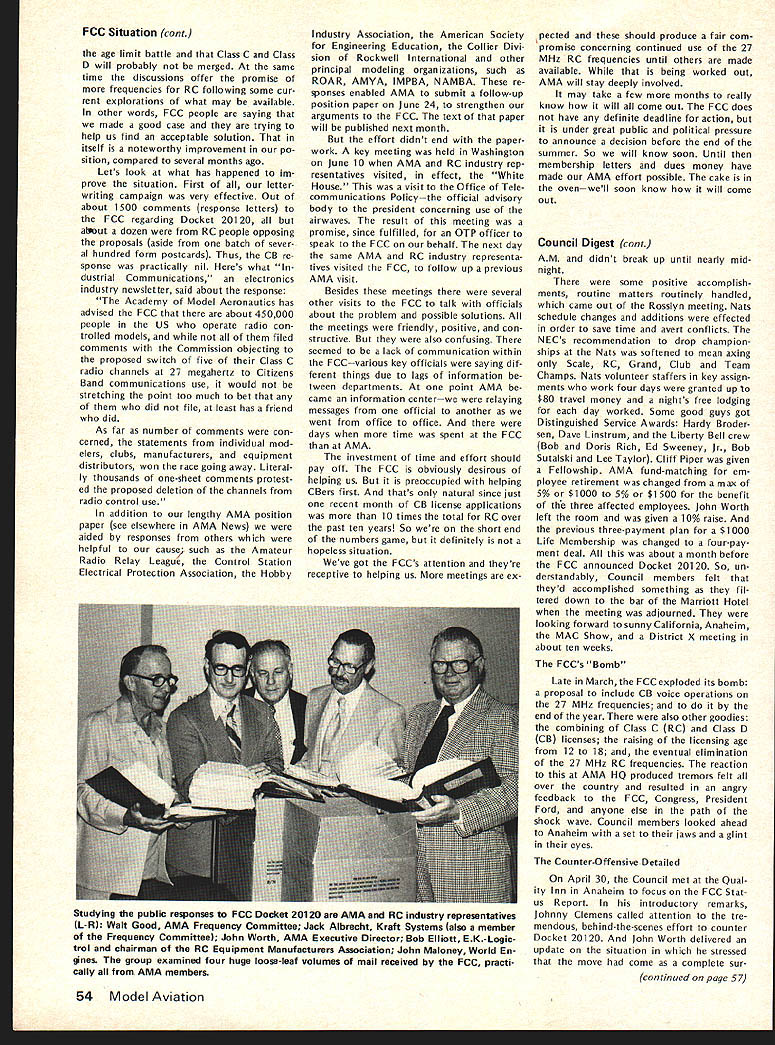
AMA and RC industry officials met June 11 with Lawrence Secrist, Administrative Assistant to the FCC Chairman, as a meeting follow-up to earlier meetings with AMA leaders. Present at the meeting were industry representatives who outlined the industry's viewpoint concerning the effects of current FCC proposals on the business aspects of RC activity. Other meetings also took place in June between AMA and FCC representatives.
The age-limit battle involving Class C and Class D will probably be merged. At the same time, discussions offer promise for frequencies for RC following some current explorations as to what may be available. In other words, FCC people are saying we made a good case by presenting the problems and the scope of RC operations. A meeting of aeromodelers representing all known Associations in District 2, to be held at JFK Airport (Pan Am Cargo Building No. 67) on Saturday, July 24, at 1:00 PM — the Associations listed below have been invited to send delegates and if you belong to such a group which is not listed, if you are reading this before July 24, please contact me at once, whether or not your organization can send a representative to the meeting, as we want to know about you: New Jersey Association of Model Airplane Clubs, Association of Model Airplane Clubs of Greater New York, Central New York Model Aircraft Association, Miniature Aircraft Association of Westchester, Suffolk County Miniature Aircraft Association, Metropolitan Air Racing Association.
Frequency Fraternization
I hope you have written those position letters to the FCC as well as your Senators and Congressmen, concerning the Docket 20120 threat relating to the 27 MHz sharing situation — and, if so, I hope that you have been more fortunate than I in receiving acknowledgements from these auspicious folk — Oh well!!!
Show Biz
AMA-sanctioned shopping mall shows are really on the upswing, numerically, in District 2 and elsewhere, providing a whole new area of PR exposure for model aviation — apply as you would for a contest sanction and thus acquire the same benefits — contact AMA HQ for further details — a week-long mall show in the Great Kills part of our District will be undertaken, beginning July 12, by the Staten Island Model Dredders, according to its communications VP, Walt Bernstein — and we would like to hear about your activities in this particular field of endeavor.
DISTRICT REPORT
Jim McNeill Dist. V Vice-President 817 South 20 Avenue Birmingham, AL 35205
Associate Vice-Presidents Richard E. Jackson, 707 White Blvd., Summerville, SC 29483 Chris Joiner, 591 Warren Road, Columbus, GA 31909 Bill Kite, 550 West Stone Dr., Kingsport, TN 37660 Tom McLaughlin, 4140 Arms Ct., Pine Glades, Pensacola, FL 32503 Luis Rodriguez, E-10, 5th St. Ext., Villa Rica, Bayamon, Puerto Rico 00961 Jim Whiteley, 1605 Woodland St., S.E., Decatur, AL 35601 Julie Woods, P.O. Box 127, Scooba, MS 39358
OK, we've been absolutely SWAMPED with requests wanting to know if Bryton got the grass cut last month in South Florida, so I won't keep you in suspense any longer.
NO, the Broward County officials did NOT cut the grass, after all, there is a certain municipal pride in saving face when abetted by a big flap. Anyway, who was that crabby upstart modeler who was going to tell them what to do? But it all ended happily for the County and for Bryton Barron's stalwart Free Fighters. In a rare display of County government genius, they BURNED the grass off, thus saving face and making the FFers happy at last. Certainly a clutch finish to a bizarre enigma, and if you had to go out on the street and buy this issue of Model Aviation, easily worth $1.25, to find out...
Come to think of it, ALL of the seven Associate AMA VPs are doing an UNUSUALLY GOOD JOB serving their respective districts for the Academy.
Julie Woods is keeping everybody happy in Mississippi. She is Associate VP for that state and lives in Scooba.
Richard Jackson is working VERY hard in S.C., firing off letters every day to defend AMA's position in the big frequency rip-off. Jim Whiteley, Luis Rodriguez, Chris Joiner are doing their share.
I want to tell you about your Associate VP in Florida. A longtime AMA servant, Mr. Tom McLaughlin, has engineered an FF contest for EIGHTEEN consecutive years in Pensacola, Fla. His FF wing-ding has grown to almost Nationals proportions. Last week he had way over 100, going on 200, contestants in his Fiesta-of-Five-Flags contest. You Free Flighters who live in District 5 (also 8 and 4) are missing a bet not to take this one in every June. A one mile plus square field of mowed grass and five mile winds. Check your contest listings in Model Aviation next year. This year's high spot was won by a gentleman who dropped in from District 8 and made everybody at Pensacola look stupid by easily grabbing the High Point, a long time personal friend of mine, whom I greatly respect, Mr. Doc Hummel of New Orleans (the dirty rat). finishing the trophies! Got a contest coming up? Check with your city, county or parish Bicentennial people.
The district Control Line meeting in Houston went well. About 50 or so turned out for it and the buffet meal. Eating all that food did not slow them down—it was a lively meeting. My thanks to the Houston Association and Bill Lee.
The contest, "Texas State CL Champs," was a great doing. Many contestants kept the action going. The huge crowd of spectators really got a good show on Saturday and Sunday. All day Sunday parking was at a premium—you could not park within three blocks of Melrose Park. Again, thanks to Bill Lee for a good contest and good crowd control. They made it on all the TV news broadcasts in Houston.
The "Controllers" of Oklahoma City had their Combat bash, and a full day of combat it was. Martin McGee and company kept things going and the spectators were many there also.
Got to Fort Worth in time to see the Scale flights at the "Thunderbirds" Lone Star aerobatic Convention. It was a pleasant day at Benbrook Lake. It was mostly overcast with only a light breeze. The flying looked good. No radio interference assured, E. K. Products had Jim Simpson on hand to monitor the frequencies. Ed Rankin kept things going briskly. It was good to see Johnnie Casburn working the Scale event.
I can't get in all of your contests, but I do get reports from most of them. Heard that the weather caught up to the Waco contest. The MARKS get-together at Little Rock was the greatest ever. Jim Winburn and Frank Osborne shared honors there. I also hear that the RC bash at Midland went well. I am sure that the CL contest will be its usual bang-up affair. I have to depend on all of these offers of the district to represent me at those I can't get to. If you don't remember who they are, the AVPs are listed under the photo. The other district officers are: John Deaton, CC; Larry Stanfield, CC; and the contests board members are: David Hyde, RC; Charlie Anaston, CL; Mark Valerius, FF; and Johnnie Casburn, Scale. They may be able to help you if you have a problem. If not, then you can always write to me. If I can't help you I can find someone who can.
You should be getting this issue just before the Nats. Let me remind you that, if you can, you should go. Even if you don't compete, it is our National Contest. It is usually the greatest thing going in our sport/hobby.
Sorry to hear about Charlie Viosca. Wish him a complete and speedy recovery. Get well quickly and get back with us all.
Check your contest calendar. Many contests are yet to come. August 21-22 is the date for the High Plains RC Championships. It will be hosted by SPLAT RC Club at Plainview, Texas. Co-hosting is Lubbock, Texas, Hobbs and Roswell, NM.
Finally got to meet John Cone (Lubbock) who did a lot of the leg work in getting the 10 acres for their flying field. John did a good job. Contingent from Lubbock were on hand for the Thunderbirds contest, including one ex-Wichita (Wichita Falls, Texas), Mike Nigro. Bert Duggal (retired Air Force) is back in our district. When Bert gets his back straightened out, he will be back into it again. Watch out Scale!
Larry Stanfield and Johnnie Casburn both told me that they were expanding their operations. Jay Lewis, if you want me to wear your hat, you will have to get Dave to send me one. Keep hearing about something coming out for the competitor from the Fort Smith engine works of Duke Fox. We should find out at the Dayton Nats.
A new RC club was chartered at Bryan, Texas. They put on a demonstration flight at the "Texas 500" race. Did so well that they have been invited back. They are trying to contact RC clubs and other RC folks in their area. Contact Mark Edwards, 308 Laurel, Bryan, Texas 77801.
IX DISTRICT REPORT
Stan Chilton Dist. IX Vice-President 1016 Hollenbeck Street Wichita, KS 67211
Associate Vice-Presidents Charles Brandon, 2020 Mariposa Blvd., Casper, WY 82601 Jack Hanson, 10909 Westmoreland, Huron, SD 57350 John Krech, 3780 5th St., Fargo, ND 58102 Jim Mowery, R. R. 2, Box 56, Greeley, CO 80631 Clarence Butterfield, 5102 Devine, Colorado Springs, CO 80915 Oscar Olson, 6111 Maple, Omaha, NE 68104
No District IX Report this month.
X DISTRICT REPORT
Alex Chisholm Dist. X Vice-President 1100 West Shaw Fresno, CA 93711
Associate Vice-Presidents Robert Barnes, 9800 Kona Mele Dr., Anio?, HI 96701 Glen Carter, 2020 Gull Court, San Mateo Creek, CA 94958 Ed Hargett, 2751 N. Campbell Ave., Tucson, AZ 85719 Don Parker, 2459? 25th St., San Jose, CA 95126 Jim Scarborough, 2501 Amherst Ln., Redondo Beach, CA 90277 Betty Stringer, 3723 Snowden Ave., Long Beach, CA 90808 Granger Williams, 131 Pawnee Street, San Marcos, CA 92069
We don't know yet how many people wrote to the FCC explaining their views on the need for more frequencies and the dangers of reducing the number of RC frequencies allocated, but this was a grand opportunity for all of us to join together and do something for ourselves and somebody else, all at the same time. It was real heartening to read all the letters (newsletters, even Free Flighters!), telling about how AMA has been wrestling with the FCC for us and asking readers to write to the FCC and back up AMA's fight.
Many of us are hoping that some real good will come out of our frequency battle with the FCC to the end that we can be allotted several sets of many new channels.
Here's an excerpt from "Bits From the Buzzards' Beak," newsletter from the Valley Vultures, Ridgecrest, California:
"Some of our members were noted in attendance at the recent MACS Show at the Anaheim Convention Center. The many beautiful Scale and Pattern aircraft on display, the RC flight demonstrations and the manufacturer's displays were most enjoyable as well as informative. The event which the Bell Jet Ranger (with collective pitch) really put on a good show. On a constructive note, I do think that the folks who put on the show should provide a larger flight area which is at a safer distance from the crowd. The fellow flying the "Whimpy" and Mark Smith with the "Windree" have been both obviously very competent fliers but my enthusiasm wanes rapidly when loops and spins are done directly over the crowd."
Dick Pratt, editor, makes an excellent point. Sure, it takes an extreme effort to put on this wonderful show, and there are valid reasons why the airshow had to be in such close proximity to viewers, but possibly the Orange Coast RC Club, BC Rees, Bruce Patton, Don Patton and all those fine people who do the work every year, can convince the City of Anaheim that more room is needed for the show next year!
Hey, all you RC Pattern fliers! Let me urge you once again to join the U.S. Pattern Judges Association. You get their newsletter and this informs you how to perform the maneuvers to get the best scores in competition. The AMA Rule Book describes the rules and the maneuvers and even has a "Judge's Guide." If you want points, be a part of the USPJA.
Send your name, AMA number, address and telephone number with six dollars to Noel Allison, USPJA Membership Director, 4174 West 120th Street, Apt. C, Hawthorne, CA 90250.
Not controversial issues, for a change, this month. Feels like vacation. Everybody must be busy on his favorite modeling endeavor. Hopefully, some are busy testing and trying to understand the new Rule Book so proper changes can be proposed.
XI DISTRICT REPORT
Homer Smith Dist. XI Vice-President
Associate Vice-Presidents Dick Carlson, 3025 Hoffman W., Spokane, WA 99205 Dave Carns, 2822 Fairbanks, Kootenai? Co., 83814 Simon Greene, 81 R. I. Box? , Boise? ID Robert O. Stahlk, 1120 Shady Lane, Albany, OR 97321
This month we are going to get back to what is going on in the clubs around the district. In your club's list included it is probably one or two of the reasons. I haven't been in your area recently or your club and may not see your newsletter.
Last month you told us about the exploits of the Mount Rainier Radio Control Society. If their efforts and tragedy are of benefit to others in helping them circumvent similar problems, the club will be pleased.
Some occasional news comes from the Palouse Ridge Runners RC Club. They are based in Moscow, Idaho and Pullman, Washington area, which should attest to their cohesiveness. The club seems to specialize in RC gliders and they should really have the topography for that kind of activity. Let me
AMA News
FROM THE SMOKE-FILLED ROOMS Council Digest Tale Two Cities
Although a brief synopsis of the February 14 and April 30 AMA Executive Council meetings was published in Model Aviation (May and August 1976), the usual verbatim printing of meeting minutes was cancelled due to the need to cover the FCC–RC crisis of the past few months. Meanwhile, minutes were offered on mail-request basis; ask AMA to mail a copy if not published. However, this provided an opportunity for producing a candid version of the minutes. The job was given to Ed Whalley, who writes a regular model news column in Flying Models magazine. Ed was challenged to see if he could come up with a readable explanation of what happened at council meetings — the minutes are typically dry and boring except to those especially interested in that sort of thing. As a result, Ed’s efforts produced a summary of the two council meetings wrapped up in a package. Hopefully Ed’s version will be easily understood in place of the usual official record. Pro or con? We’d like to hear whether you prefer Ed’s style to the official version; your opinion can help decide future procedure.
Rosslyn, Virginia used to be the end of the streetcar ride out of the District; it consisted of the transit system’s turnaround, a White Tower hamburger stand, a network of trails and dirt roads leading up the hill to Ft. Myer. Once a get-off-and-walk point, horse soldiers coming back after night maneuvers used it as a Washington staging area for nightly assaults on sawdust bars. Georgetown and Rosslyn were known chiefly as men from Ft. Myer.
Anaheim, California achieved national prominence when Beery comedians and sidewalk wits could always count on a laugh delivering the version of the famous train-call joke made popular on the Jack Benny radio show: “Anaheim, Azusa, Cucamonga.” Funny depends on frame of reference; in terms of hick connotations those have disappeared — Anaheim is part of greater Los Angeles, a sports center and convention city. Rosslyn has long since been rebuilt into a modern satellite city just across the Potomac from Washington.
East–West Coast meetings of the Executive Council slated just the chance led to the meetings being sited in the two locations. Matter of housekeeping: the Rosslyn meeting, which came in February, was in many respects merely a prelude to the Anaheim meeting. President Johnny Clemens was pleased to note “the entire Council in attendance.” Present, too, was the NAA’s General Brooke Allen, who came to speak about the need for an updated agreement between AMA and NAA relative to the FAI franchise document, which was unanimously approved by the Council and duly signed by Clemens. Most housekeeping chores were ones that carry over from meeting to meeting — Nats-related items, budgetary considerations, Hutchinson negotiations, safety legislation, administrative problems related to boards and committees, and ongoing matters related to AMA projects and public relations. Matters such as these seem to flow in an endless stream and demand constant attention, totally resistant to final solutions; you’ve just gotta give the boys a try. The meeting got under way about 9:30.
FCC SITUATION STILL FLUID
RC position improved. The campaign to avoid having RC merged with CB has apparently been successful; it has gotten the FCC’s attention and interest regarding RC as a separate, distinct problem area. Although still under threat of having RC frequencies used for CB purposes, we have gotten indications of FCC support for the need to provide frequencies for RC regardless of what happens with CB.
Meanwhile, the FCC has found it can expand CB activity without using many of the proposed RC frequencies. Instead of being able to offer 90 CB channels early next year, the FCC now expects a total of about 40 channels, including the current 23 easily available, possibly increasing to 58 by using five 27 MHz RC frequencies. There is hopeful reason to believe RC frequencies will not be added to the CB spectrum.
Discussions with FCC officials since the closing of public comments in June suggest strongly that we have made a good case. AMA headquarters, Executive Director and officers have been involved in the follow-up, and AMA RC industry officials met with FCC representatives on June 11. Lawrence Secrist, Administrative Assistant to the FCC Chairman, met with AMA leadership to hear the industry viewpoint concerning the effects of current FCC proposals on the business aspects of RC activity. Other meetings also took place in June between AMA and FCC representatives to continue discussions on the situation. The age-limit battle between Class C and Class D will probably be merged; at the same time, discussions offer promise for frequencies for RC following some current explorations of what may be available. In other words, FCC people are saying we made a good case.
Transcribed from original scans by AI. Minor OCR errors may remain.

