
Safety Is Always in Season
Geoffrey Styles Director of Public Relations
In case you haven't heard, May 1985 has been declared Safety Month — in fact, National Safety Month. That's a sneaky way to get an important statement repeated: a specific reminder that almost 100,000 AMA members need to be constantly conscious of problems that can develop through only a few seconds of carelessness.
Why have a National Safety Month? Just to remind each of you to be safety-minded. Industry has done the same thing where I spent many years of my business life. They have "Wise Owl" clubs for people whose eyes were saved because they were smart enough to wear safety glasses. Of course, some plants make safety glasses mandatory, but many people consider them a nuisance and won't wear them. Some plants even introduced suspension‑without‑pay rules for people found without safety glasses — you really do have to get hard on folks sometimes to make them look after themselves.
Catch phrases such as "Avoid Pinch Points" may not apply directly to every model aviation operation, but the meaning is clear: don't get your fingers into any area where a heavy weight is likely to fall and you can't get them out. The result can be a lost finger or a broken bone at the very least. Fingers are essential to enjoying life — scratching your wife's back, eating an ice‑cream cone, or assembling a servo are all difficult with a few fingers missing.
Remember World War II? There was a club for airmen who bailed out of damaged aircraft by parachute — sometimes called the Silkworm Club. Of course, wearing a chute was a requirement for flight crews, and it took training to learn how to use it. Preparation is always a very important part of a safety‑minded attitude.
Model aviators face another hazard every time a sortie is flown: the trip to the flying field. How many of you — and I mean never — fasten the seat belt once the car or van is headed to the field? Come on, be honest. Most accidents occur within 25 miles of home; how far is your flying site? I can hear someone saying, "Thank Heaven our site is 50 miles away" — that doesn't reduce the odds.
I talked to a museum visitor who told me about his 22‑year‑old son. The young man would wear his seat belt now and then but not always. One day dad asked how he'd feel if the only time he didn't wear the belt was the time he had a serious accident and was badly hurt. That comment woke him up; from then on the belt went on every time before he started the engine.
Whether in the workshop, on the road to the field or back home, or on the flight line, you must develop and use safe habits. This is not only for your well‑being but for those with family responsibilities. A lot hangs on your being able to go to work every day, provide necessities of life (food, shelter, clothing), and be an independent citizen. Not being able to accomplish those things can be pretty depressing, especially if you have a long life ahead of you.
Practical reminders:
- In the shop: work carefully, especially around power tools; ensure good ventilation when using toxic materials; keep X‑Acto knives and sharp objects secure so they don't roll off benches; keep sharp and harmful items out of the reach of children until they're old enough to be trained.
- On the road: obey the law, wear a seat belt, respect the rights of others, and make it a safe two‑way trip.
- At the field: keep out of the way of the prop, make adjustments from behind the arc of rotation, don't use damaged props, and don't use unqualified helpers.
It's really not very difficult — a lot of common sense is involved. AMA needs it. After all, how are we going to hit that 100,000‑member mark in 1985 if you don't take care of yourselves?
Good luck and good flying — that's safe flying!
CIAM—1984 Style
This year we had the pleasure of taking with us to the CIAM meeting three AMA district VPs so they could learn how that organization operates and be better prepared to act on items that come before the Executive Council relating to the FAI. Dave Brown (District 3), Howard Crispin (District 4), and Ed McCollough (District 11) were the observers from AMA, and I am sure they had their eyes opened.
In the past four years the meetings (two days' worth) have run smoothly, normally ending around 4 p.m. each day. This year saw extraordinary items that stretched the second day well past 8 p.m. Two significant items concerned money and the rising cost of operating World Championship meets.
It began when the Yugoslav delegate proposed the 1985 Free Flight World Championship with an entry fee of $175 — and that fee included no extra services such as housing or meals. Inflation hurts everyone, but that fee was out of line for many countries. The meeting bogged down for over an hour discussing basic fees required to run a World Championship. In the end, the hosts suggested a more favorable cost proposal subject to confirmation by their national aero club. The French said they might offer a more attractive package if given a few weeks; that offer would be considered if the Yugoslavs could not better theirs.
Then the Netherlands offered to host the 1985 RC Aerobatics World Championship with a basic entry fee of $370 — and additional required arrangements could add about $300 more, unless competitors found their own accommodations. The Belgians asked for a few weeks to put together a more reasonable proposal (around $100 entry) and were granted the opportunity. The CIAM Bureau now has the task of sorting which of the four countries will be awarded the two World Championships.
Other 1985 World Championships had more moderate proposals:
- Australia will host the F3B (soaring) meet.
- Romania will host the Space Models World Championship.
- Canada will host the first-ever F3C (helicopter) World Championship and the rebirth of the F3D (pylon) World Champs. Entry fee for the Canadian meet will be $70 Canadian (about $56 U.S.). The Canadian meet will be held in London, Ontario, from July 13 through July 20, 1985.
If you've ever wanted to see a World Championship — or be a participant — these present two accessible opportunities.
Elections
Most of you will know the AMA elections are over and done for 1984. Three of the four contested VP slots remain with incumbents. Jim McNeill was re‑elected as Executive Vice President for another three‑year term, capturing 43.2% of the vote for that office. Dave Brown was re‑elected as VP for District 3, with 50.6% — the only opposed candidate to win a clear majority in this election; the other elections were decided on a plurality vote. Ed McCollough, running unopposed, tallied 97.8% of the vote, with the remainder going to write‑ins.
The surprise came from District 7 where incumbent Hardy Brodersen was defeated by Peter Waters by the slim margin of 25 votes: Pete carried 39.9% of the vote to Hardy's 38.6%; Larry Phillips finished third with 21.4%.
My hearty congratulations to the winners. The losers can take solace in their strong participation in AMA's democratic process. To Hardy Brodersen, now retiring from the Executive Council, go my heartfelt thanks for a job well done — we will miss his stabilizing influence. To newcomer Pete Waters, a hearty welcome aboard — and a question: why take on this kind of burden in your otherwise placid lifestyle?
Results — 1984
Results provided by Raymond H. McGivern, Certified Public Accountant.
- Executive Vice President
- James McNeill — 7,262
- Dave Brown — 5,647
- Ed Izzo — 3,875
- Others — 28
- Total — 16,812
- District 3 Vice‑President
- Dave Brown — 1,241
- Earl Witt — 749
- Fred Blacksmith — 462
- Others — 2
- Total — 2,454
- District 7 Vice‑President
- Peter Waters — 733
- Hardy Brodersen — 708
- Larry Phillips — 392
- Others — 3
- Total — 1,836
- District 11 Vice‑President
- Ed McCollough — 812
- Others — 18
- Total — 830
(asterisks in some prints denote incumbents)
The Last VP Exposé
This will be the last in this series.
Air Show Teams and Flying Sites
Geoffrey Styles Director of Public Relations
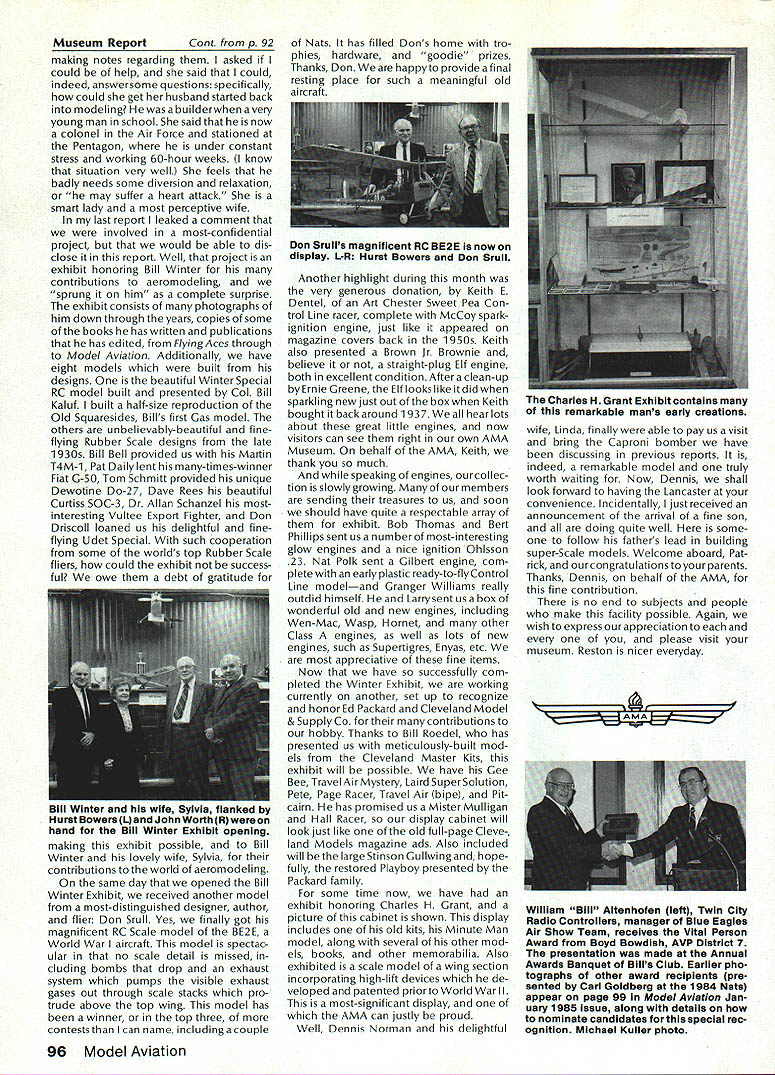
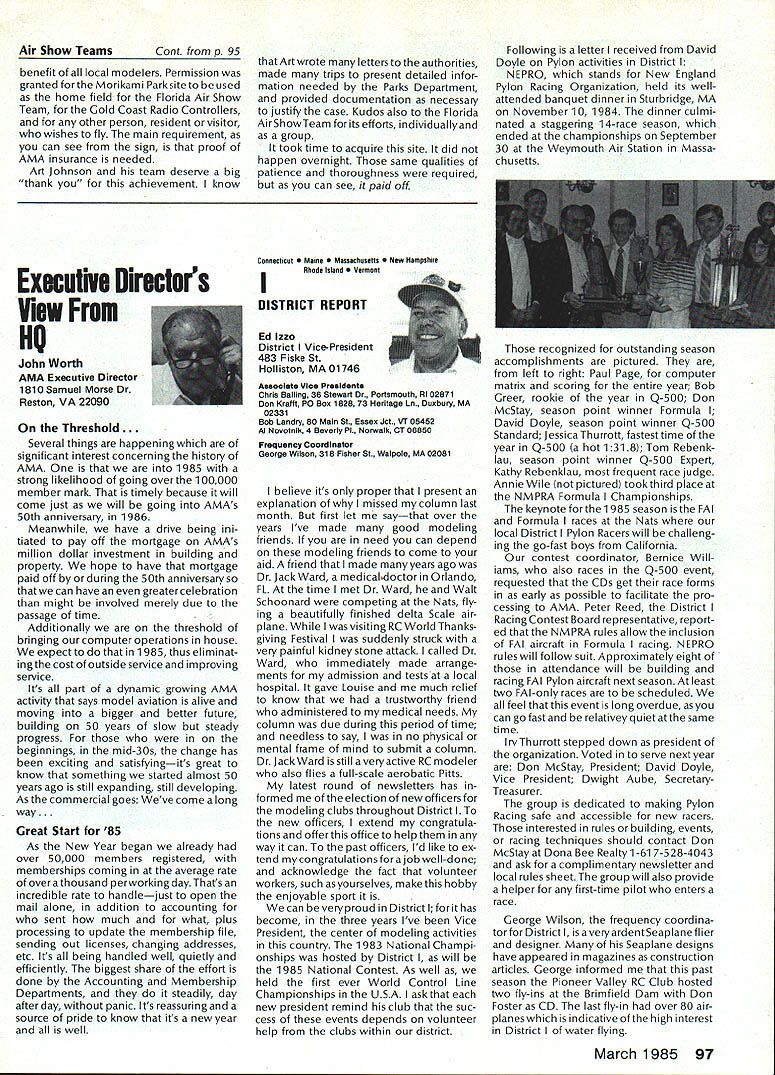
Just look at the pictures — a public flying site in a county park. How did that come about?
Col. Art Johnson, manager of the Florida Air Show Team and Associate Vice President in District 5, sent photographs to AMA Headquarters along with a letter that tells the story. The county flying site is located in Morikami Park in Palm Beach County. Note that AMA membership heads the list of requirements for use of the field by local residents. Another AMA item that helped clinch approval was the Official Model Aircraft Regulations (the rule book). The detailed information in the rule book convinced the Parks Department that model fliers are a responsible, safety‑minded group. Who says the rule book is only for competition fliers?
In addition, the insurance provision in the AMA comprehensive liability policy — which allows a chartered club to request an "added insured" certificate for the site provider — convinced the county their interests would be protected. That's an excellent reason for any group of aeromodelers to become a chartered club.
The Florida Air Show Team sealed the deal with a flying demonstration for county officials. A variety of aircraft were brought to the site, and the team put on a complete air show for the county commissioners and Parks Department personnel. The skills and polished show routine developed by the team during many public exhibitions helped win approval for the site.
Museum Report
Hurst G. Bowers
Cold winds are blowing, leaves have fallen, and in northern Virginia it is a time when modelers leave the flying fields for the workshop. Visits to the museum in Reston have delighted ever‑increasing numbers of AMA members and guests. In fact, visitors not involved in modeling have heard about the museum; after seeing it they leave with a wonderful appreciation of what the hobby has to offer.
I have just been informed by AMA HQ of the Executive Vice President election results. I extend my congratulations to Jim McNeill for his re‑election. With a membership approaching 95,000 and a yearly budget of over three million dollars, we cannot run the Academy like a large model club. To ensure protection and wise expenditure of members' dues, sound business practices, budget control, and reporting must be administered by the Executive Vice President. I will watch this area closely and report any deviations or recommendations not adhering to good business practices.
Keep your decibels low and your safety high — and make every effort to help beginning modelers.
If you haven't visited the museum lately, plan a trip. Bring a friend — you'll be surprised how many non‑modelers leave with a new respect for what we do. Happy flying.
III District Report
Dave Brown District III Vice‑President 4560 Layhigh Rd., Hamilton, OH 45013
Associate Vice Presidents:
- Eva Biddle — 2165 Street Road, Warrington, PA 18976
- Joe Eiben — 36890 Valley Forge Dr., Solon, OH 44139
- Francis Fluharty — 504 E. 21st St., Vienna, WV 26101
- Corky Heinzman — 52 N. 108 North, Holgate, OH 43527
- Laird Jackson — 1025 Walnut St., Philadelphia, PA 19107
- Eugene Shealey — 2177 Euclid Ave., Scottdale, PA 15683
Frequency Coordinator:
- James Bearden — 5552 Foxrun Ct., Cincinnati, OH 45239
- Phone: (513) 542‑4406
'Twas just before Christmas, and all through the house we were in a panic... the months go by fast when you have a deadline. The last month was full, with the trip to Paris for the FAI Plenary Meeting and the election tally. The fact I'm writing this column is evidence of the election outcome: I lost the EVP election to Jim McNeill (congrats, Jim), although I did finish ahead of Ed Izzo. I was ribbed about always finishing second, but I did win re‑election as District III VP over Earl Witt and Fred Blacksmith; thanks to them for running.
The FAI meetings in Paris were interesting; I now have a far better idea of what we're up against. While I thought the game was played by hardball rules, it's run more like sandlot baseball — rules and boundaries can shift depending on who's involved. I was impressed with the U.S. delegation's knowledge and individual stature, but disappointed by the lack of unified stature as a unit on the plenary floor. We seem to have influence on subcommittees and technical meetings, but that influence can diminish on the plenary floor.
One amusing incident: the French Aero Club rents its hall for banquets. When the FAI meeting ran late, the club started moving walls and rearranging the hall while delegates tried to continue — embarrassing for delegates, funny for spectators. Delegates finally moved to a smaller room to finish.
At one point CIAM rejected two World Championship bids because entry fees were too high, even though there were no other bids for those events (RC Aerobatics and FF). In both cases it's expected that fees will be reduced or other bids will be offered. Some aerobatic hosts were making large profits hosting World Championships, yet there was no rush to host more.
I got a letter from a District III member complaining about non‑modeling mail from AMA — loan offers, credit cards, etc. These offers come through the NAA (National Aeronautic Association), of which AMA is a division, and are approved by the Executive Council. They sometimes involve a percentage of profits going to AMA and can include group services (major medical, etc.) that some members appreciate. I see no harm and some benefit.
I'd better get this in to the Express or Carl will skin me alive.
Happy flying — Dave
IV District Report
Howard Crispin District IV Vice‑President 611 Beechwood Dr., Charlottesville, VA 22901
Associate Vice Presidents:
- Warren Abernethy — 9205 Carendon, 3, Upper Marlboro, MD 20706
- Bob Chambers — 205 Tipton Rd., Newport News, VA 23606
- Bill Holmes — 2100 Ivyton Road, Charlotte, NC 28210
- Raymond Leckman — 465 Christopher Ln., Christiansburg, VA 24073
- Scott Moyer — 10 Orchard Lane, Wilmington, DE 19809
- Charles Spear — Rt. 3 Box 794, Mocksville, NC 27028
Frequency Coordinator:
- Paul Yacoubcsi — 6048 Winthorpe Dr., Fayetteville, NC 28301
- Phone (evening): (919) 488‑5886
Maynard Hill, AMA 14, has done it again! Maynard studies records, analyzes what it takes to break them, engineers the design, assembles the team, and sets new records. It sounds easy, but a lot of hard work is involved — engineering and flying skills that result in success.
Transcribed from original scans by AI. Minor OCR errors may remain.

