
The New Frequencies: A Status Report
A. What Has Happened Since 1983?
In January 1983 the AMA Frequency Committee led an effort to provide for a safe, orderly transition to the use of 80 newly acquired frequencies for RC models. Fifty of those frequencies were designated for model aircraft; 30 were designated for surface models (cars, boats, and the like).
A phase-in plan was adopted by AMA that was designed to:
- To allay the fears of modelers who insisted that their equipment not be obsoleted by AMA action;
- To allow for phase-out of the existing seven frequencies; and
- To permit adequate time for development of new equipment.
Summary of the phase-in plan:
- Retained the existing frequencies until January 1, 1988.
- Blocked use of new channels immediately on either side of the old frequencies (the new frequencies are just 10 kHz away from the old frequencies).
- Blocked use of the new channels at the upper and lower ends of the two bands (72 & 75 MHz) where image (i.e., 900 kHz) might cause problems.
- Kept all channel separations to a 40 kHz minimum.
In retrospect, the phase-in plan has been effective. It has become clear that previously existing RC equipment does not operate well with 20 kHz separations when AM and FM are used on adjacent channels. European modelers experienced similar problems; in some areas the marketplace approach led to bans on AM use (for example, Germany) or significant AM/FΜ interference (England). The phase-in plan gives AMA a chance to solve such problems in a timely manner and to avoid unnecessary crashes and hazards.
RC system demands are more stringent than almost any commercial communications system. A commercial data system typically does not "crash" when it receives an invalid signal; it simply fails to receive valid data. Mobile communications systems seldom must operate well very close to a high-power out-of-band transmitter. By contrast, our RC sets must operate reliably when taxiing relatively close to fellow modelers on adjacent channels.
B. How Can We Make the Transition?
The transition can be made by adhering to the phase-in plan and pressing on with advanced radio designs. The Frequency Committee is confident we will be able to use all or almost all channels by 1991. However, the modeling community must cooperate to avoid or solve problems. Individuals, club frequency-control authorities, and Contest Directors should adopt the following guidelines:
- Flight lines should be separated by a minimum of 20 ft (30 ft desirable) to avoid transmitter intermodulation.
- Taxi lines and flight paths should be at least 50 ft from the flight line to minimize adjacent-channel and receiver intermodulation interference.
- Exercise extreme caution in pit areas. Do not operate transmitters less than 20 ft from each other to avoid transmitter intermodulation. Place pit areas behind specific flight lines; transmitters actually used for flight should be placed in an impound area under positive frequency control.
- Transmitters more than a year old should be checked for frequency-occupied bandwidth using a properly calibrated spectrum analyzer and an accurate frequency reference. It is also wise to have receivers tuned to the transmitter at the same time.
- Some AM transmitters will interfere with modern FM systems. Older AM transmitters (10–15 years old) may have wide AM modulation sidebands; modelers must exercise patience while the transition proceeds.
- Despite item 5, it is practical to have FM and AM receivers that are narrow-band, dual-conversion. Properly designed narrow-band receivers can work with 20 kHz separations if common sense practices (separation distances, frequency control) are observed.
- The AMA Frequency Committee urges manufacturers not to introduce "1991 systems" until they are thoroughly tested and evaluated in the actual environment.
AMA News
Museum
Cincinnati recently sent the museum five exceptional 2" precision scale models: two Wedell-Williams racers, a Caudron-Renault racer, a Waco Cabin, and a Curtiss Hawk P-6E. They were originally built by Joseph Mintkiewicz of Waterford, PA. These models have a long history of contest wins and will be magnificent exhibits for the museum.
The engine collection is growing thanks to donations from Granger and Larry Williams, Richard Hartley, Louis Roberts, Bert Phillips, Bob Thomas, and many others. Of particular significance is the collection received from Mr. William Dablinbor (Cleveland, IL). He has promised about 200 engines; 127 have been received and are currently on exhibit. This interesting group includes many Soviet and East European diesel engines and a wide variety of others ranging from a new, in-the-box Mills .75C to an unusual horizontal creation made from Cox parts that presents a very small cross-sectional area. The Elf engine donated by Keith Denton remains a crowd attractor, as does the M-5 radial on loan from Vince Mankowski. Ernie Greene has helped clean and restore engines, but much work remains in this and other model categories.
Restorations are also underway. Jim McNeill is diligently working on the Goldberg sailplane. We have received Dick Korda's pylon gas model powered by an inverted Brown Jr. engine, magnificently restored by Matt Basta (Marion, IL). Matt also donated an authentic pre-World War II Cleveland Balsa Butchers cotton T-shirt in mint condition — likely the last one in existence. Ambassador Robert Munn (Orem, UT) built and presented a fine replica of the famous Korda Wakefield, which is on exhibit alongside the pylon/gas model.
Coverage of modeling disciplines is fairly complete except for electric-powered and ducted-fan exhibits. Roland Boucher of Leisure Electronics visited Reston and has agreed to provide excellent electronic-power exhibits. Bob Violett is urged to consider contributing one of his A-4D models, which would be a priceless addition.
The museum's library is growing and promises to be a valuable resource on the history and development of aeromodeling and a research medium for modelers. We have most of the world's modeling publications but still have gaps in hard-cover references, notably Jane's All the World's Aircraft and the Aircraft Yearbook series. Members are urged to search their shops, bookshelves, and attics for donations.
Data recovery and indexing remain major problems. The goal is to inventory, index, and place information into a computer data bank for instant retrieval, and to preserve old magazines on microfiche with a viewer for visitors. These goals require time and money; both are in limited supply, but constructive plans are underway, and with member support we will succeed.
Frequencies
No FM or AM receiver can reject energy that falls within the bandpass of the IF filters — a transmitter with energy in that band cannot be corrected on the spot by the modeler. In some cases the manufacturer may no longer exist or correction may be uneconomical. Many modelers insisted that new equipment be compatible with old equipment; FM radios on all frequencies would solve many problems immediately.
It is practical to develop FM and AM receivers that are narrow-band and dual-conversion; they will work with 20 kHz separations if common-sense practices and frequency control are observed. Present receivers are not truly narrow-band in many cases; buyers should give preference to modular units that permit future introduction of improved RF decks and receivers.
The AMA Frequency Committee urges manufacturers not to introduce "1991 systems" until those systems are thoroughly tested and evaluated in real-world operating environments.
Film Library
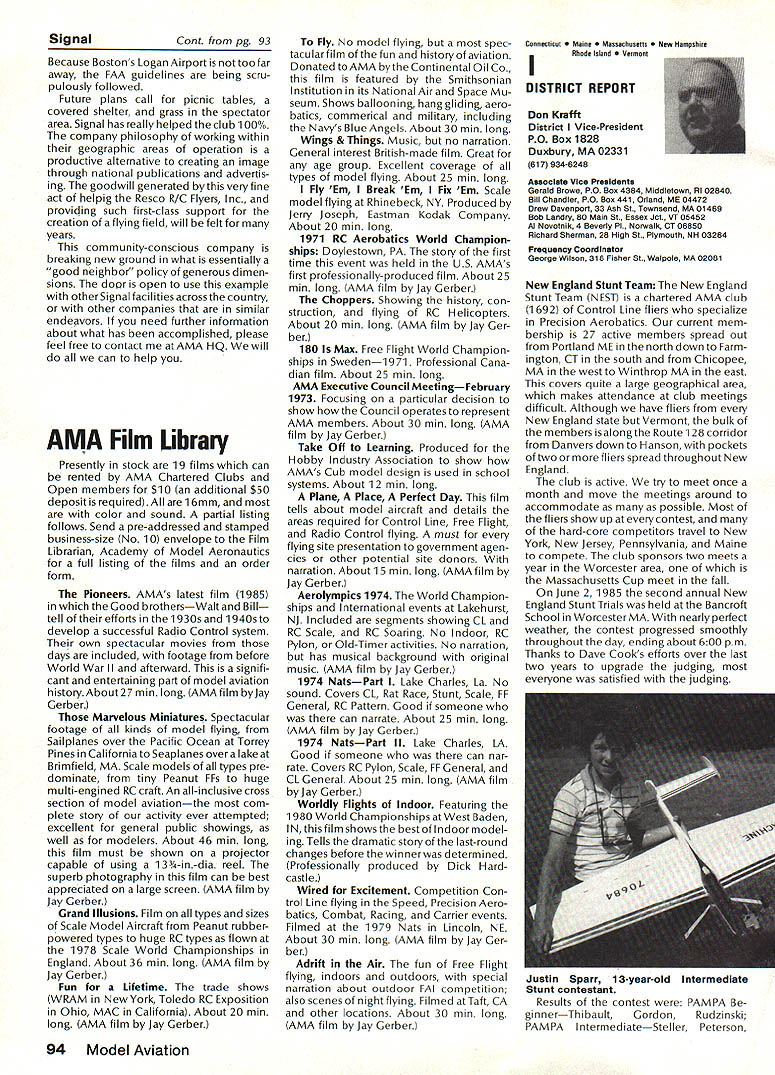
The film library has 19 films available for rent to AMA Chartered Clubs and Open members ($10 rental, $50 deposit). All are 16 mm; most are in color with sound. Send a pre-addressed, stamped business-size (No. 10) envelope to the Film Librarian, Academy of Model Aeronautics, for a full listing and order form.
Selected titles:
- The Pioneers — The Good brothers (Walt and Bill) on early RC development; includes pre- and post-WWII footage. About 27 min. (AMA film by Jay Gerber).
- Those Marvelous Miniatures — Spectacular footage of model flying from Peanut FFs to huge RC craft. About 46 min. (AMA film by Jay Gerber).
- Grand Illusions — Scale model aircraft at the 1978 Scale World Championships in England. About 36 min. (AMA film by Jay Gerber).
- Fun for a Lifetime — Trade shows (WRAM, Toledo RC Exposition, MAC). About 20 min. (AMA film by Jay Gerber).
- To Fly — A spectacular film on aviation history; donated by Continental Oil Co. Featured by the Smithsonian. About 30 min.
- Wings & Things — British-made, music only, no narration. About 25 min.
- Fly 'Em, I Break 'Em, I Fix 'Em — Scale model flying at Rhinebeck, NY. About 20 min.
- 1971 RC Aerobatics World Championships — Doylestown, PA. About 25 min. (AMA film by Jay Gerber).
- The Choppers — History, construction, and flying of RC helicopters. About 20 min. (AMA film by Jay Gerber).
- 1980 Is Max — Free Flight World Championships in Sweden. About 25 min.
- AMA Executive Council Meeting — February 1973. About 30 min. (AMA film by Jay Gerber).
- Take Off to Learning — How AMA's Cub model is used in schools. About 12 min.
- A Plane, A Place, A Perfect Day — Details areas required for CL, FF, and RC flying. About 15 min. (AMA film by Jay Gerber).
- Aerolympics 1974 — World Championships at Lakehurst, NJ. No narration; musical background. (AMA film by Jay Gerber).
- 1974 Nats — Part I — Lake Charles, LA. No sound. About 25 min. (AMA film by Jay Gerber).
- 1974 Nats — Part II — Lake Charles, LA. About 25 min. (AMA film by Jay Gerber).
- Worldly Flights of Indoor — Features 1980 World Championships at West Baden, IN. Professionally produced by Dick Hardcastle.
- Wired for Excitement — Control Line competition at the 1979 Nats. About 30 min. (AMA film by Jay Gerber).
- Adrift in the Air — Free flight, indoor and outdoor, with scenes of night flying. About 30 min. (AMA film by Jay Gerber).
President's Corner
By John C. Grigg President, Academy of Model Aeronautics 6387 Badger Drive, Lockport, NY 14094 Home: (716) 434-3955 — Work: (716) 631-6314
Under‑Developed?
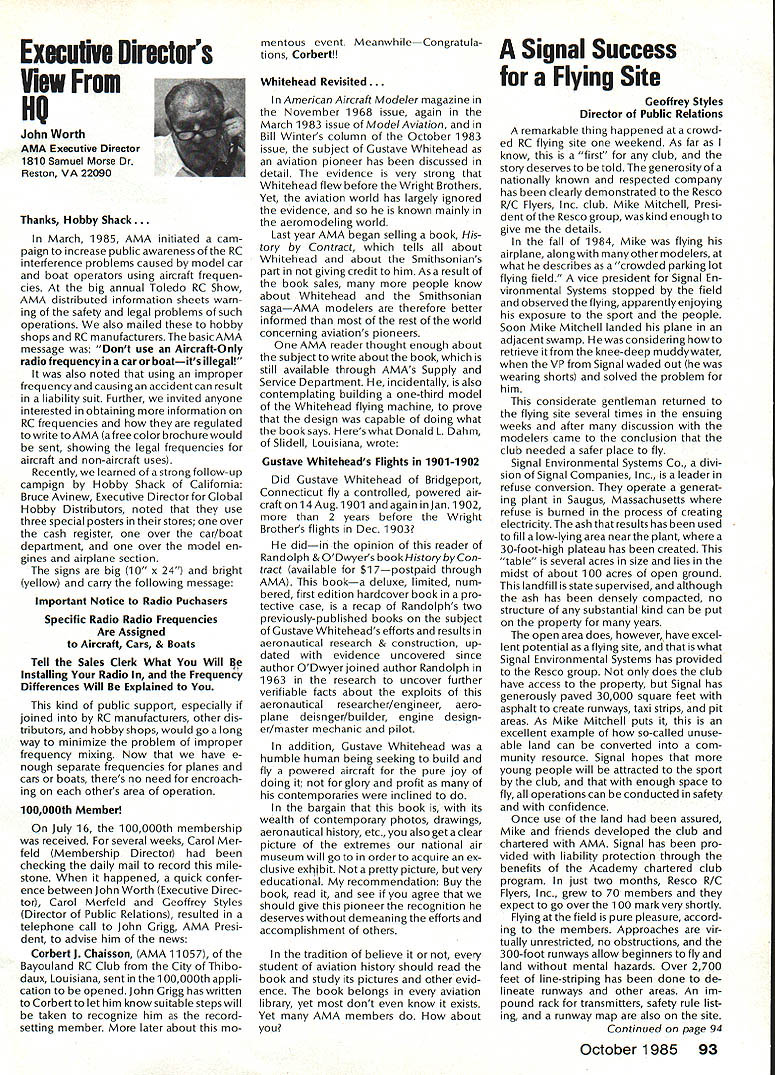
John D. Herter, now in Port-au-Prince, Haiti, is secretary of the Haitian American Modelers — the first non-U.S. protectorate club chartered by AMA. All 36 members sent a club check for $500 to support the AMA mortgage fund. The club solicited $18 from adult and senior members and $10 from Juniors to reach their goal. They will be recognized in the AMA museum with a plaque. If this small club can raise such funds, what might be possible among the remaining 1,800 AMA clubs?
July 16, 1985 — 100,000th Member
On July 16, 1985 Mr. Corbert Chaisson of Thibodaux, LA (AMA 11057) became the Academy's 100,000th member. The selection was random, determined by the day's mail. Congratulations to Mr. Chaisson — and now, who will be the 200,000th member?
Beginners' Special
At the NEFS/NIMAS Indoor Championships the editor saw simple, excellent-flying beginner models: a slingshot-launched glider with wings and tails cut from the styrofoam food tray covers (McDonald's-style) and a similar rubber-band, propeller-driven version. Commercially produced by Fly Max (John Voorhees), these kits would be useful for school programs. Contact Fly Max, 1429 Fox Dale Place, Sidney, OH 45365.
Right on the Nose!
An excerpt from a newsletter column ("The Pen of the Prairie") criticizes AMA leadership and the influence of Special Interest Groups, claiming a pyramid organization and poor fiscal priorities. Points raised include concerns over committees, staffing, and spending without broad member polling. The president plans a short rebuttal in next month's column.
Not Legal!
The president has witnessed modelers operating radio systems on the 6-meter band (around 53 MHz) without proper FCC licensing (Technician class or higher required). Unlicensed operation on this band can result in fines and imprisonment. If you wish to operate on the 6-meter band, obtain the proper license.
District Reports
District I Report — Don Kraft
P.O. Box 1828, Duxbury, MA 02331 — (617) 934-6248
Associate Vice Presidents:
- Gerald Browne, P.O. Box 4384, Middletown, RI 02840
- Bill Chandler, P.O. Box 441, Orland, ME 04472
- D. E. Davenport, 303 Ash St., Townsend, MA 01469
- Roy Laraby, Box 541, Essex, VT 05452
- Al Nowotnyk, 84 Beverly Pl., Norwalk, CT 06850
- Richard Sherman, 28 High St., Plymouth, NH 03324
Frequency Coordinator:
- George Wilson, 316 Fisher St., Walpole, MA 02081
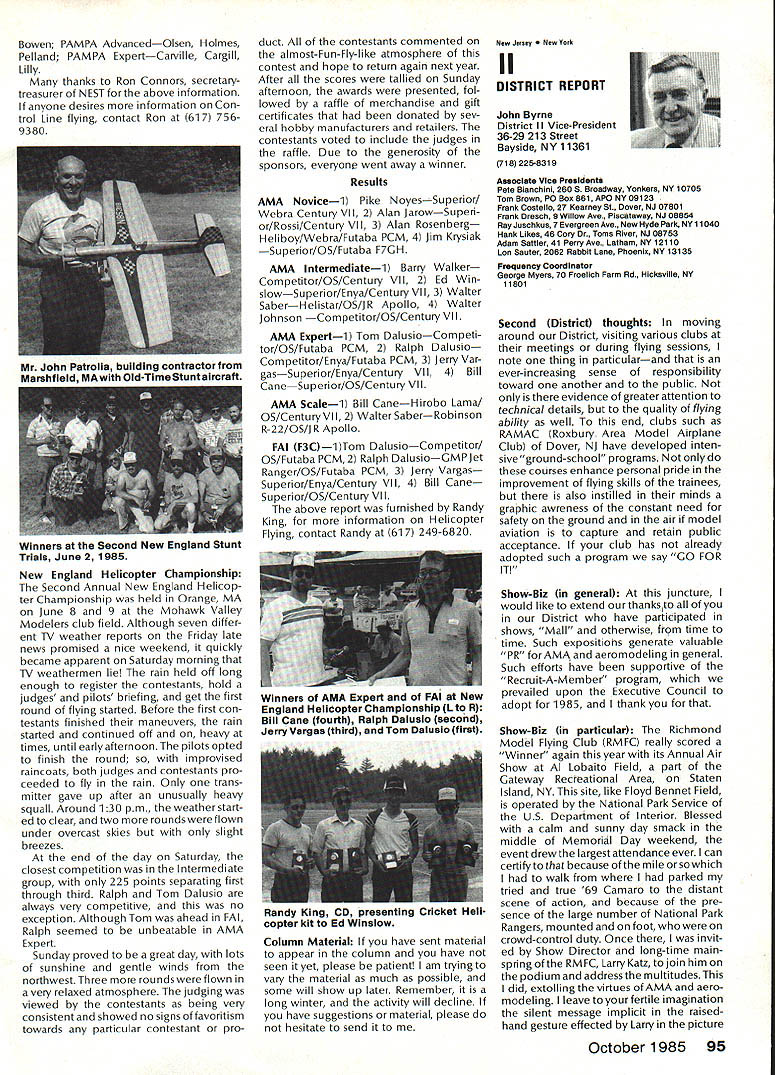
New England Stunt Team (NEST) — chartered AMA club (1962) of Control Line fliers specializing in Precision Aerobatics. Membership is 27 active members across New England. The club meets monthly rotating locations and sponsors two meets a year, including the Massachusetts Cup.
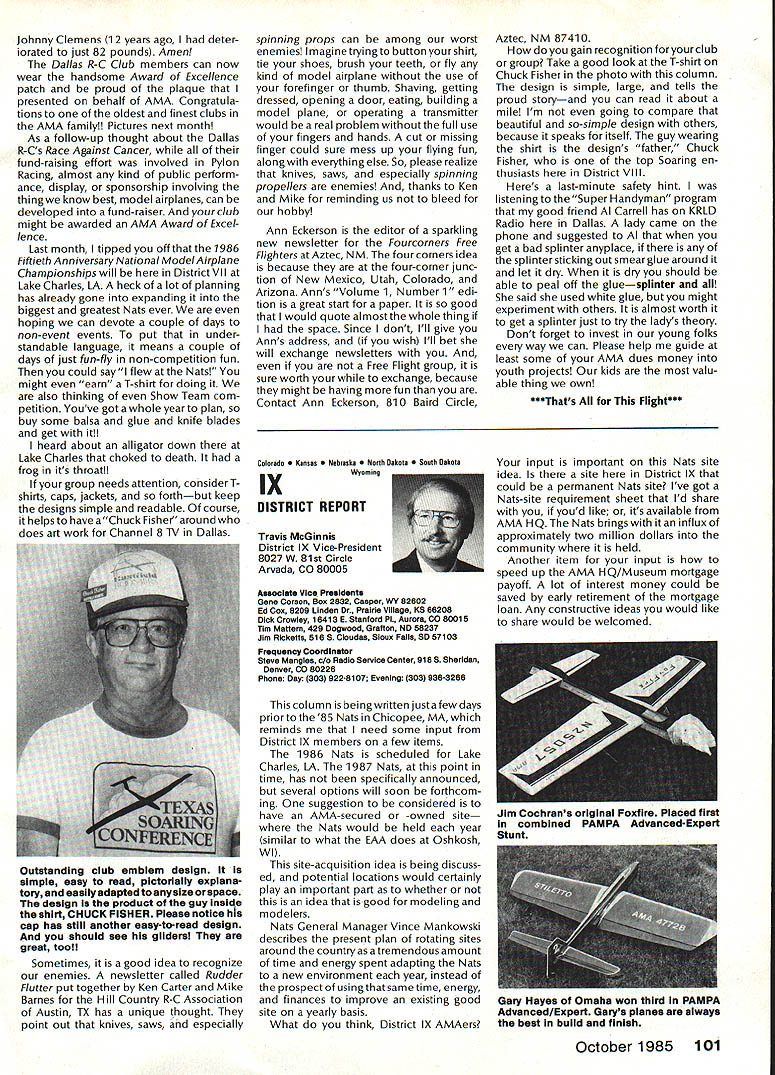
On June 2, 1985 the second annual New England Stunt Trials was held at the Bancroft School in Worcester, MA. Weather was nearly perfect and the contest progressed smoothly. After scores were tallied, awards were presented and a raffle distributed donated merchandise and gift certificates. Participants appreciated the friendly atmosphere.
Results:
- AMA Novice:
- Pike Noyes — Superior/Webra/Century VII
- Alan Jarow — Superior/Kossi/Century VII
- Alan Rosenberger — Heliboy/Webra/Futaba PCM
- Jim Krysiak — Superior/OS/Futaba F7GH
- AMA Intermediate:
- Barry Walker — Competitor/OS/Century VII
- Ed Winslow — Superior/Enya/Century VII
- Walter Saber — Helistar/OS/JR Apollo
- Walter Johnson — Competitor/OS/Century VII
- AMA Expert:
- Tom Daluiso — Competitor/OS/Futaba PCM
- Ralph Daluiso — Competitor/Enya/Futaba PCM
- Jerry Vargas — Superior/Enya/Century VII
- Bill Cane — Superior/OS/Century VII
- AMA Scale:
- Bill Cane — Hirobo Lama/OS/Century VII
- Walter Saber — Robinson R-22/OS/JR Apollo
- FAI (F3C):
- Tom Daluiso — Competitor/OS/Futaba PCM
- Ralph Daluiso — GMP Jet Ranger/OS/Futaba PCM
- Jerry Vargas — Superior/Enya/Century VII
- Bill Cane — Superior/OS/Century VII
For helicopter flying information contact Randy King at (617) 249-6820.
District V Notes
- District 5 needs a member for the Electric Flight Advisory Board to assist contest boards in reviewing electric-flight proposals.
- Cloud Dancers Show Team (Kissimmee, FL) returned from Costa Rica; Don Mudelman and Tommy Veloskey won prizes; Tommy won the Grand Prize Drawing — a $24,000 ocean-front lot.
- Walter Rozelle (Atlanta, GA) broke an FAI Free Flight record previously held by Bill Jenkins at the MACH Mid-Summer Meet in Huntsville, AL.
- TRAC News (Tampa RC Aircraft Club) reported an exciting King Contest.
- Bill Johnson (Panama City, FL) ran a successful Delta Dart building session for youngsters (ages 6–10). Fourteen-year-old Steve Young is now flying his first RC model.
- RAMMS club (Montgomery, AL) deputized all 75 members as assistant safety officers.
- Ed Izzo (former AMA VP) joined RCACF of Orlando and coordinates the Tangerine meet, which will include a ducted-fan fly-in with major prizes.
- John Olan (Longwood, FL) achieved perfect scores on both RC and FF CD exams.
- Safety reminder: "Keep them fingers out of the prop!"
District VI Report — Bryant Thompson
511 S. Century, Rantoul, IL 61866 — (314) 487-1957
- Returned from California and attended the Scale Master Redwood Regionals. Met attendees who sported AMA bumper stickers — a reminder to display yours.
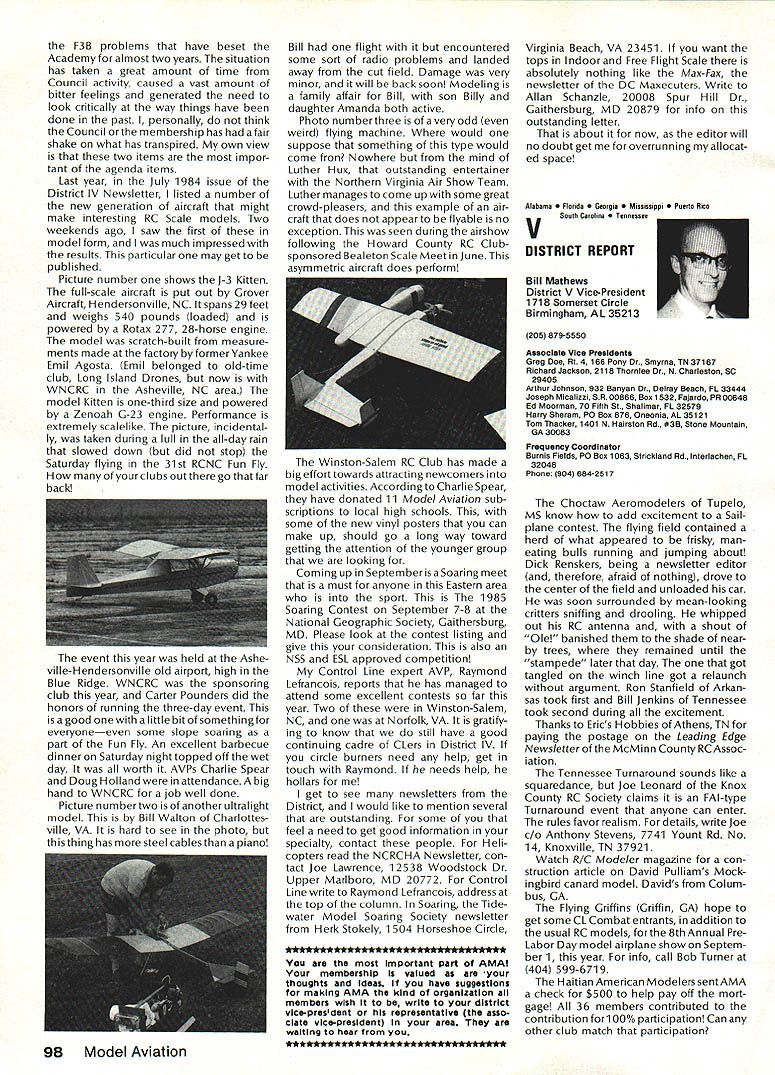
- Mentioned a one-third scale J-3 Kitten scratch-built by Emil Agosta, powered by a Zenoah C-23, with scale-like performance.
- Attended the 31st NCAC Fun Fly at Asheville-Hendersonville old airport; event included slope soaring and a barbecue dinner.
- Recommended an audio meter (Viz model WE-130A, suggested retail $149) to collect noise data.
- District AVPs are asked to be more active; the VP plans visits to western parts of the district.
- Pontiac MAC was featured on "Good Afternoon Detroit" with a professional presentation on learning to fly.
- Announced the Macedonia Sailplane Symposium '85 on November 9–10.
District VII Report — Peter Waters
117 E. Main, Upper Level, Northville, MI 48167
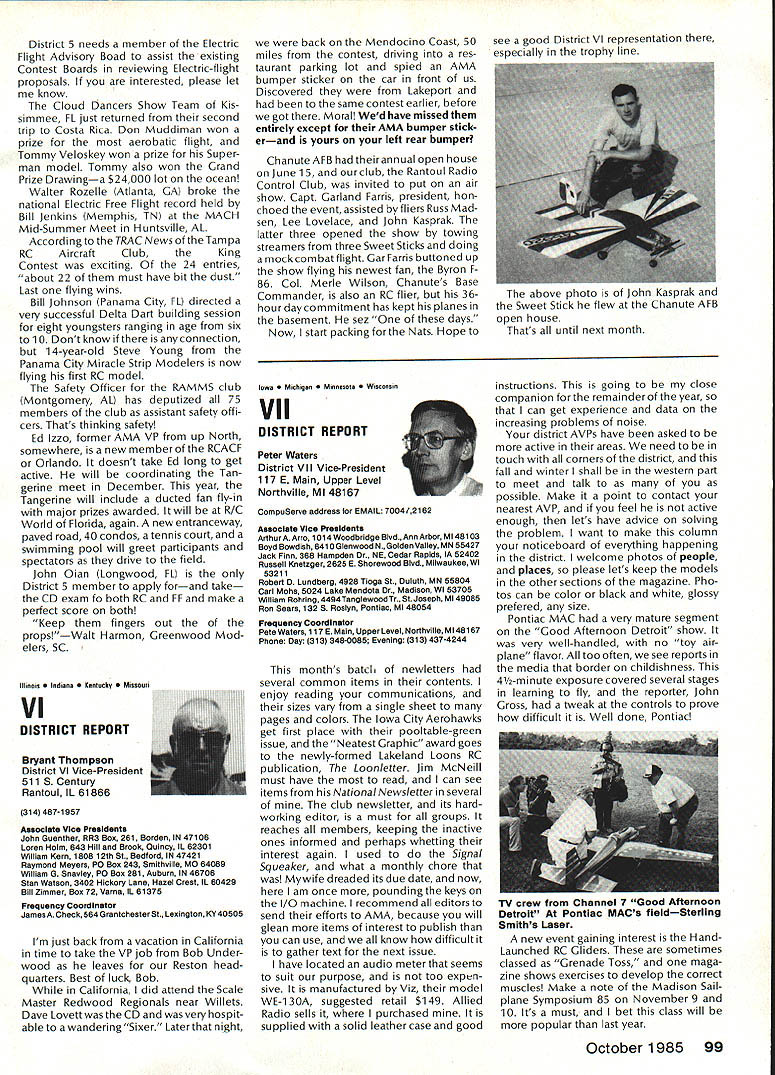
- Chanute AFB open house (June 15) included an RC air show presented by the Rantoul Radio Control Club; Capt. Garland Farris and others performed.
- Preparing for the Nats and encouraging District VI representation.
- Praised several newsletters; recommends editors send copies to AMA to increase exposure and idea exchange.
- Noted the popularity of Hand-Launched R/C Gliders and previewed an upcoming Soaring contest at Lake Charles, LA (1986 Fiftieth Anniversary Nats planning underway).
- Safety and publicity tips: use simple, readable T-shirt and cap designs for club recognition.
Around District IX — Bob Reed
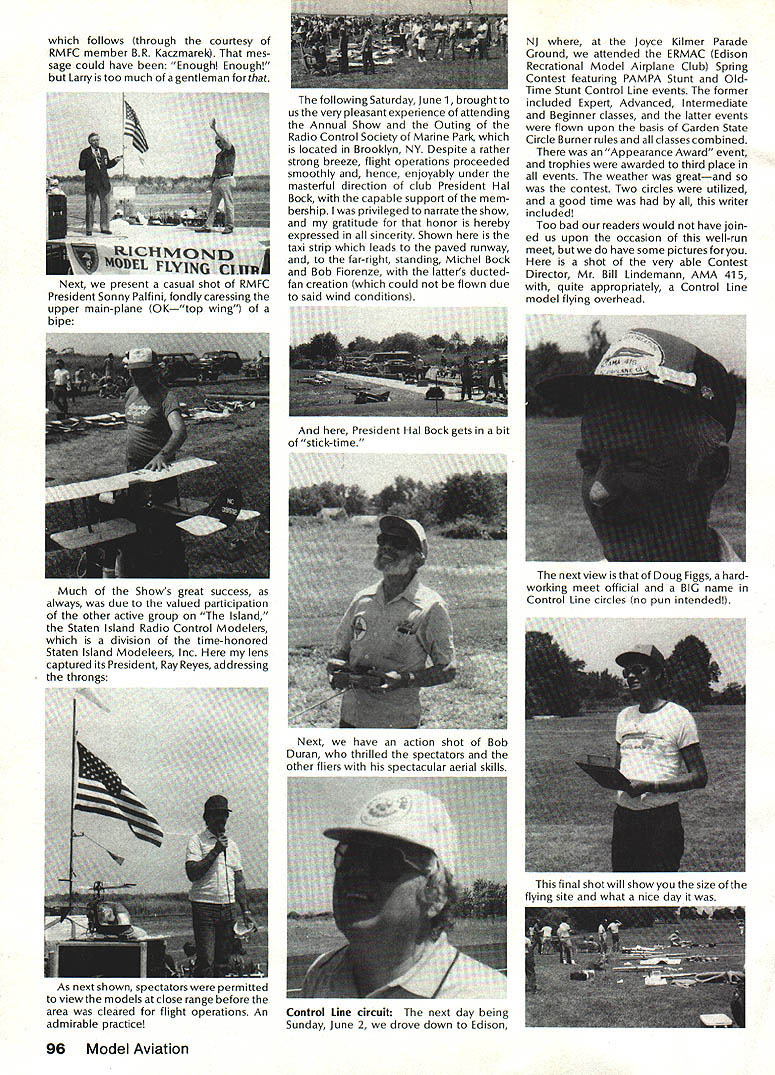
Orbiting Eagles (Omaha) held a Class A Control Line contest on June 9 at Seymour-Smith Park. Events included Stunt, Navy Carrier, 1/2A Scale Racing Class II, Sport Race, Sport Scale, and Slow Combat. About 40 contestants participated. Highlights:
- Scale honors to Mike Pratt (Zlin).
- Carrier and Profile trophies to George Lieb.
- Marvin Denny coached young Chris Shearer in Slow Combat; Chris placed second.
- Todd Lee (Topeka) won PAMPA Beginner-Intermediate Stunt.
- Jim Cochran won PAMPA Advanced-Expert Stunt.
- Melvin Schudde won 1/2A Scale Racing Class II; Bob Burr won Sport Race.
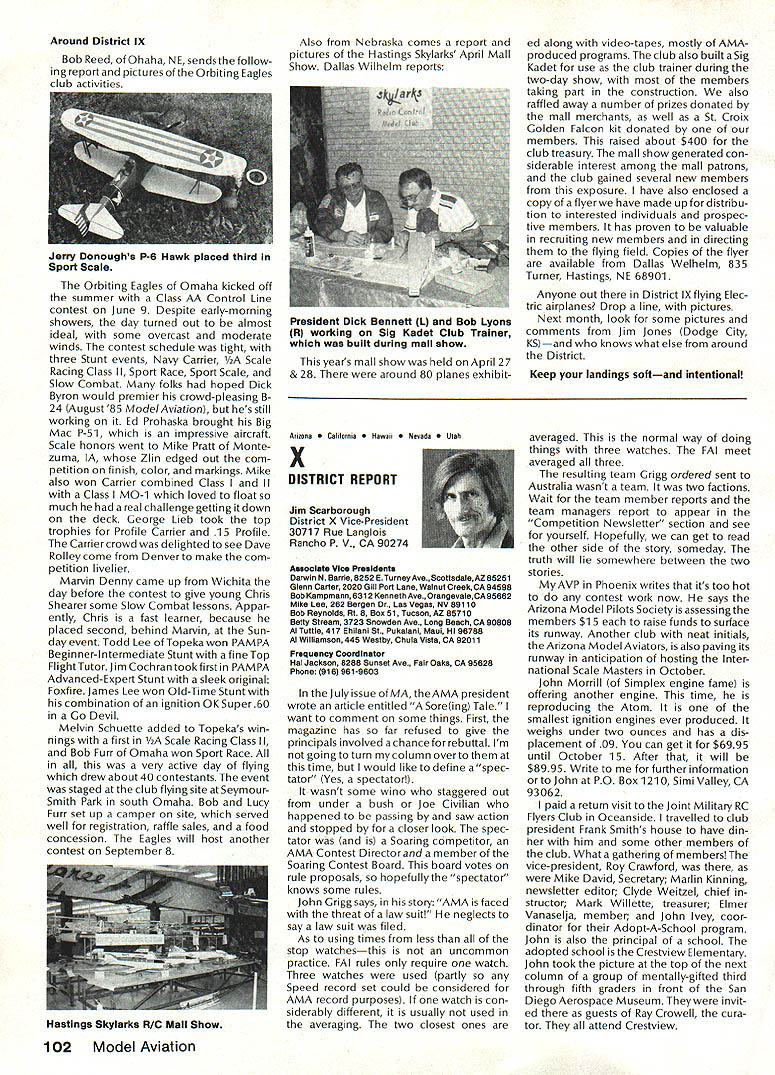
Hastings Skylarks held an April mall show (April 27–28) with about 80 planes exhibited and videotapes. The club built a Sig Kadet for club trainer use and raffled prizes to raise about $400. The show generated new members. Contact Dallas Wilhelm, 835 Turner, Hastings, NE 68901 for flyers or information.
Call for District IX: send articles and pictures of electric airplane activity for possible coverage.
Miscellaneous Items
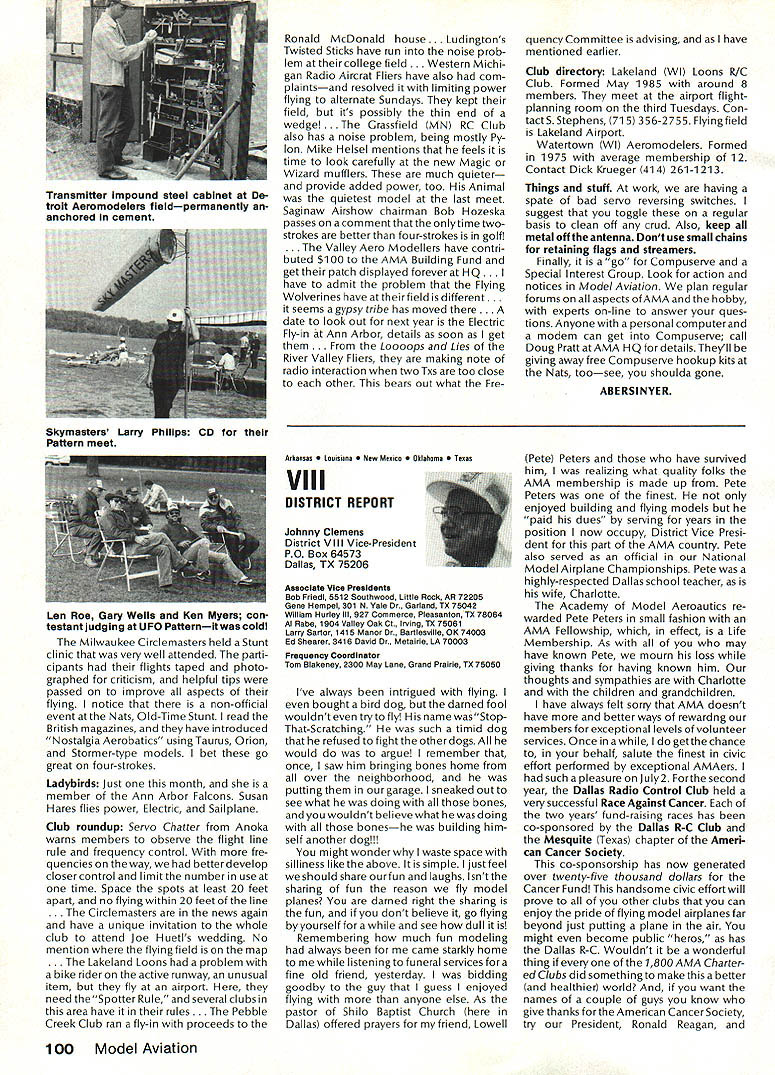
- Noise and neighbor relations are recurring concerns; some clubs have limited high-power flying to alternate Sundays to resolve complaints.
- New quieter mufflers (Magic/Wizard) have been noted as effective.
- The Valley Aero Modellers contributed $100 to the AMA Building Fund and received recognition at headquarters.
- Safety reminders: maintain working reversing switches on servos, keep metal off antennas, and avoid retaining flags/chains that could cause problems.
- Compuserve Special Interest Group: AMA plans online forums for hobby discussions; watch Model Aviation for details and Nats promotions.
— End of reformatted text —
Transcribed from original scans by AI. Minor OCR errors may remain.

