
Follow-up Action Needed by RC'ers
Instead of Donating to AMA Send Money to the FCC!
At press time the FCC situation was looking very favorable. Indications from FCC officers were that our mail campaign of May and June had been very effective. The inside word was that RC would not be lumped in with CB and that some new frequencies for RC were likely.
But what also was evident was the fact that the comparatively few Class C (RC) licenses on file with the FCC had caused our problems in the first place. The surface impression was bad when FCC records showed that as of April 30 there were only 62,362 Class C licenses compared with 4,296,280 Class D licenses for CB. Meanwhile ten times as many Class D licenses are being applied for each month than the total of Class C licenses applied for in the past ten years!
The comparison seemed to put us in a hopeless position. But we salvaged the situation by pointing out that the number of Class C licenses had doubled in the past year and that the rate of increase was continuing unabated. We also made a case for the fact that many of the Class C licenses were club type, representing hundreds of individual RC'ers. Thus we were able to justify the representation of several hundred thousand RC'ers rather than what the license total seemed to show. The growth of AMA in the past ten years, with mostly RC fliers, was also helpful in showing the FCC that our activity was active and expanding.
We made a good enough case to reverse the trend of thinking in the FCC. Now we have to build on that case, to strengthen our position, to show that there really are many more individuals participating in RC than the current license total indicates.
It's much easier to do now than it would have been a couple of years ago. When the FCC license fee went to $20, we saw a big surge in club licenses. The club license helped make it easy, financially, for newcomers to get involved with RC. But they absorbed so many individuals that our true numbers of participants were masked.
What we have to do now is simple and comparatively cheap, now that the cost of an individual license is only $4. During the recent mail campaign to the FCC, many people offered to donate money to AMA, to help the fight for greater recognition of RC. However, we pointed out that AMA was able to fund the fight out of regular AMA dues, that this was one of the basic benefits of AMA membership—the representation of members before such government agencies as the FCC and the FAA.
Instead of donations to AMA, what is needed are license applications to the FCC. The most direct and effective "donation" is the $4 license fee, by those who are not yet individually licensed. A great increase in the number of licenses over the next few months will really drive home the message to the FCC that RC is growing rapidly. Maybe we can't hope to match the CB totals, but we certainly can compete on the basis of rate of growth—the percentage of new licenses per month.
This is something every RC'er can get involved in. It's a simple and cheap investment in protection of what we have now and in getting more consideration in the future. It's an effort every AMA club can join, to encourage every club member to get his or her own FCC license. AMA can help. We will send, free, any number of FCC license applications to any club. We'll also do the same for any manufacturer who will put them in his kits or equipment; also any dealer or distributor who will provide applications to customers.
We want to eliminate any excuse by any individual that the license application is hard to find. This is not to say that club licenses are to be discouraged. They still have a very useful function—to make it easy for a newcomer to get started in RC. But as soon as possible, newcomers should be urged to convert to their own licenses—the sooner the better.
It's important to get this campaign rolling NOW, for another reason. We must show the FCC that Class C and D licenses should not be merged, as has been proposed. We need to have as many Class C licenses registered as possible before the end of this year, in order
No Change to 27 MHz RC Frequencies!
We had to yank out a picture at the last minute to tell you as quickly as possible that although the FCC has expanded Class D CB (voice) channels to 40, the expansion does not involve any of the Class C 27 MHz RC channels (other than 27.255 MHz which already was shared). The new Class D (voice) channels resulting from Docket 20120 are from 27.235 to 27.405 MHz and become available January 1, 1977.
Although the FCC July 27 News Release, from which this was taken, has no details concerning Class C RC, and the full text of the FCC order wasn't expected to be released until another week or more, AMA's legal counsel was able to find out that there was no FCC action taken to merge Class C (RC) and Class D (voice) licenses as had been proposed. Thus Class C applications may continue to be filed by all formerly eligible, including youngsters. The FCC notes that allocation of additional Class D (voice) channels is an interim measure and that studies are underway in the whole area of personal communication.
Credit timely and massive response by AMA members and others in the campaign by AMA, model industry and model press to keep 27 MHz activities as before. The next phase of the campaign—to obtain new frequencies for RC—will be pursued for improvement of our status quo. More info next month.
AMA FOLLOW UP STATEMENT TO FCC
Following the June 9 deadline for public response to the FCC concerning Docket 20120, additional responses—called "reply comments"—could be filed by June 24. These reply comments are responses to comments filed by June 9. Thus, AMA could file comments on others' comments. AMA did, as follows:
- The Academy of Model Aeronautics (hereinafter referred to as Academy or AMA) respectfully submits its reply to comments in the above-captioned proceeding (Docket 20120).
- First, the Academy notes the numerous comments from individual citizens, businesses and organizations that have been filed with the Commission supporting the proposition that the 27 MHz Class C frequencies should continue to be available for radio control (RC) purposes on an exclusive basis and the almost total lack of support for the reallocation of these channels. The hundreds of comments filed demonstrate that there is a continuing demand for remote control frequencies, and further express apprehension as to the disastrous consequences which would occur if the Commission were to adopt regulations permitting voice and non-voice RC operations on the same channels.
- The Academy believes that the proposals for elimination or sharing of the 27 MHz Class C channels are ill-advised, substantively and technically, and RC uses should not be subordinated to the requirements of Class D operations. Many comments filed with the Commission claim that these "requirements" are to some extent illusory since, even in the larger metropolitan areas, CB operators may find channels that are vacant or little used.
The natural use of CB radios appears to be for everyone to operate on common channels. We note particularly the comment of the Amateur Radio Relay League which makes the point that there is little correlation between numbers of license applications and the use of available channels. This is verified by the fact that all of the current growth of CB has come about on the existing channels. Based on comments filed with the Commission by AMA members who have both Class C and D licenses, most CB channels are comparatively unused, while a few are extremely busy. It is also clear that for a large portion of the CB community, CB is a hobby activity. It is a service in which licensees may operate radio systems similar to those used in the Amateur Radio Service but without the strict speed and examination requirements. The CB operators normally operate only on channels which are particularly popular in their area, leaving other channels lightly loaded. It appears that CB operators are looking for a family-world in which they can hear everyone close in their area but in which operation is magically ceased when they pick up the microphone.
- The numerous comments filed by RC users conclusively show that RC activities serve many useful purposes which should be encouraged by the Commission. These involve wholesome activities in which families may participate. Furthermore, it has been shown that early experimentation with model aircraft and other types of RC remote control activities has served as the foundation for subsequent careers in aviation, engineering and science. As the AMA comment demonstrates, many engineers, scientists and professional people are actively engaged in RC model activities and such operators are becoming more and more important to the military and the civilian companies engaged in development of aircraft and missile systems. Perhaps more than any other, the comment filed by Mr. Francis X. Bradley, Jr., Director, Projects and Federal Relations, American Society for Engineering Education, incorporated herein by reference, shows how RC activities help lead to scientific careers but are becoming more and more important for non-hobby applications.
- The AMA wishes to support the comment filed by the Central Station Electrical Protection Association (CSEPA) calling for continued allocation of 27 MHz Class C frequencies exclusively for non-voice operations for at least a seven-year period. The Academy is aware that the radio alarm industry uses the 27 MHz Class C frequencies in the operation of low-cost burglar and fire alarm systems. To date there are known instances of interference between RC and radio alarm operations on the Class C channels. To some extent, this is probably due to the fact that RC modeler activities are generally conducted in remote areas where the radio alarm operations are conducted within the urbanized areas. Furthermore, RC alarm systems typically operate at night whereas model operations are daytime activities. In any event, the AMA believes that the FCC should continue its policy of permitting similar types of operations to operate on common channels since these operations are generally not compatible with each other. It is important, however, to limit all users of these frequencies to similar levels of power so that a high power use does not preclude operation by low power users. Thus sharing of frequencies by similar types of RC activities of approximately equal power is reasonable but sharing of the Class C channels by both voice and non-voice RC systems is not practicable because this will result in destructive interference to RC activities.
The disastrous consequences for modelers were outlined in the AMA comments, and the problems of false alarms for the alarm industry were noted in the CSEPA comment. We therefore urge the Commission not to permit sharing of the Class C channels by any users other than non-voice RC systems. If the Commission's ultimate decision is to eventually reallocate Class C channels for CB purposes, then a realistic period (such as seven years, as indicated above) should be permitted for Class C systems to operate on their frequencies without co-channel voice operations, or such time as suitable alternate frequencies should be allocated. In this respect it is noted that the Commission's proposal to have Class C and D users share the existing RC frequencies for several years before exclusive use by Class D is not a realistic "grandfather" provision since it will not effectively render these frequencies useful for Class C, as is the current case of the shared 27.255 MHz frequency.
- As the AMA pointed out in its comments, the detrimental effects to Class C licensees by reallocation of the 27 MHz channels for CB Class D operations far outweigh the relatively small benefits to the CB Class D community by the reallocation. The loss of the 27 MHz channels would reduce by half the channels now available for RC operations at a time when RC modeler activities are increasing at a very substantial rate and while there is a need for more, not fewer, RC frequencies. If it is the Commission's intent to make as many channels as possible available to Class D licensees without serious damage to other licensees, perhaps the best compromise would be to protect the channels in the spectrum now available for RC use and give other Class D channels for CB purposes. The comments filed by the Collins Commercial Telecommunications Division of Rockwell International, i.e., instead of adding more 40 kHz channels, the Commission should add 35 channels at 4 kHz spacing restricted to sideband operations only. This would result in a total of 58 channels immediately available for CB operations without the reallocation of any 27 MHz Class C frequencies—more than doubling the present CB channel allocation. Then, over a suitable period as proposed, the entire Class D service could be switched to SSB-only channelization with 4 kHz spacing resulting in additional channels for CB Class D use. This plan would be done without any immediate effect on Class C assignments while allowing the Commission time to allocate replacement channels for Class C systems with a reasonable amortization period rather than the disastrous sharing proposal suggested. RC manufacturers would then be able to plan for eventual reallocation on the basis of a reasonable time schedule, as would CB manufacturers for the further growth of Class D operations. It is noted that while this proposal would require manufacture of new CB equipment, so would the Commission's proposal.
- There has been some suggestion informally from the FCC staff that perhaps Class C licensees could make use of frequencies at the upper end of 27 MHz if the Commission did not allocate the entire 58 channels as proposed but instead limited the new CB channels to 10 kHz separation as with the existing CB frequencies in order to eliminate anticipated IM interference problems. Officers of the Academy informally discussed this proposal with industry representatives, but there are a number of technical problems which make the suggestion unworkable. The suggestion would in effect still require Class C systems to share frequencies with voice CB operators and would still reduce the number of channels available for RC use to a point where RC operations would be severely impaired.
The AMA therefore strongly urges the Commission to reject proposals to share or reallocate the 27 MHz Class C channels for CB service. The Academy asks the Commission to maintain the existing allocation of 27 MHz Class C channels for exclusive non-voice RC operations and to provide such protection for those channels as is necessary to preserve the present and future usefulness of the RC service. From AMA HQ Executive Director: Including reports from AMA President and Vice-Presidents
Instead of donating money to the AMA, send money to the FCC? At press time the FCC situation looks very favorable. Indications are FCC officers' mail campaign in May–June was very effective. Inside word was RC would be lumped or given some new frequencies. What was also evident was the fact comparatively few Class C RC licenses filed with the FCC caused problems in the first place — surface impression: FCC records showed April 30 — 62,362 Class C licenses compared to 4,296,280 Class D (CB) licenses. Meanwhile ten times as many Class D licenses were being applied for each month. The total Class C licenses applied for in the past ten years in comparison seemed to put us in a hopeless position. The situation was salvaged by pointing out the number of Class C licenses doubled the past year and the rate increase was continuing unabated. Also made the case the fact Class C licenses are club type representing hundreds of individual RCers. Thus able to justify representation of several hundred thousand RCers rather than what the license total seemed to show.
Growth in AMA the past ten years — mostly RC fliers — was also helpful, showing FCC activity was active and expanding and made a good enough case to reverse the trend thinking at the FCC. Now we have to build the case and strengthen our position to show how many individuals are participating in RC, even though license total indicates otherwise. It's much easier now than it would have been a couple of years ago. When the FCC license fee was $20 we saw a big surge in club licenses. Club licenses helped make it easy financially for newcomers to get involved. RC absorbed individuals; the true numbers of participants were masked. What we have now is simple comparatively cheap licensing — now cost of an individual license is $4.
During the recent mail campaign FCC people offered, "Donate money to the AMA to help fight for greater recognition of RC." However they were pointed out the AMA is able to fund the fight out of regular AMA dues and basic benefits of AMA membership — the representation members receive before such government agencies as the FCC and FAA. Instead of donations to the AMA what we needed were license applications filed with the FCC. A direct and effective donation is the $4 license fee. If the individually licensed numbers greatly increase over the next few months it will really drive home the message to the FCC that RC is growing rapidly. Maybe we can't top CB totals, but certainly can compete on the basis of rate growth — the percentage of new licenses per month is something an RCer can get involved in. It's a simple, cheap investment in protection of what we have now and getting consideration for the future.
It's effort. AMA, clubs can join — encourage club members to get their own FCC license. AMA can help and will send free numbers for FCC license applications to clubs. The same manufacturers will put kits/equipment together; dealers and distributors will provide applications to customers who want them and eliminate the excuse individual license application is hard to find. If some say club licenses are discouraged, they still have a very useful function — to make it easy for a newcomer to get started in RC. As soon as possible newcomers should be urged to convert to their own licenses — the sooner the better. It's important to get the campaign rolling NOW.
Another reason is we must show the FCC Class C licenses should not be merged as has been proposed. We need to have Class C licenses registered, possibly before an end-of-year order.
Although FCC has expanded Class D (CB) voice channels (the 40-channel expansion does involve Class C 27 MHz RC channels; other 27.255 MHz already shared new Class D voice channels) resulting from Docket 20120, 27.235–27.405 MHz become available January 1, 1977. Although the FCC July 27 news release taken alone has no details concerning Class C RC, the full text of the FCC order wasn't expected to be released until another week. AMA's legal counsel was able to find out no FCC action had been taken to merge Class C RC with Class D voice licenses as proposed. Thus Class C applications may continue to be filed by the formerly eligible, including youngsters. The FCC notes the allocation of additional Class D voice channels is an interim measure; studies are underway in the whole area of personal communications.
Credit the timely massive response of AMA members and others to the campaign. AMA, model industry, and press keep 27 MHz activities before the Commission. The next phase of the campaign to obtain new frequencies for RC will be pursued to improve the status quo. More information next month.
October 1976
Followup Action Needed
RCers show dramatic increase since
FCC Follow Up (from p. 56)
A proposal recently discussed with FCC personnel at the Commission's Laurel laboratory led both the FCC and AMA to conclude that the problems to aircraft models would be just as severe, and possibly even more acute, than for CB operators, since all presently manufactured RC receivers use the same 455 kHz IF frequency as Class D stations and the Class C receivers, when flying in the air at higher altitudes, are subject to interference from a greater distance than land-based equipment. The Academy, however, would not agree to reconsider its position if actual testing with RC model equipment indicates that these channels might be less subject to interference for aircraft modelers than currently seems apparent. The Academy would also be happy to assist the Commission in connection with such test operations.
- The Academy believes that new frequencies for RC operations are needed higher in the spectrum so long as CB operations are located in the 27 MHz area and, in its comment, the Academy requested the Commission to allocate additional channels in the 30 to 50 MHz range or in the 72 MHz range. The Academy also believes that the area of consideration might be extended even further upward, possibly as high as 500 MHz. Of course, any such allocations should be proposed only after adequate testing and, again, the Academy will be pleased to participate in such test operations. Eventual use, however, of such high frequencies will depend on development of lightweight equipment by the land mobile community since the RC industry probably cannot support a major development effort at those frequencies. In the meantime, it is absolutely essential that RC modelers be able to continue using channels in the 27 and 72 MHz bands with a minimum of 20 kHz channel spacing in order to permit use of equipment now available.
- Finally, the Academy notes the technical restrictions proposed by the Commission and commented on favorably by others for operations in the 27 MHz band. The Academy believes that such restrictions are necessary for proper operation of single sideband and other systems. The proposed regulations, however, do not appear to exclude Class C type operations from the frequency tolerance, radiation suppression and other technical characteristics which are proposed to be changed. This should be clarified since we believe that the regulations should permit continued use of present Class C transmitters and receivers under the technical standards now applicable to such stations. Imposing new technical standards on RC systems would cause a severe hardship to low-powered operations which have not caused interference in the past and which have no need for such sophistication because the problems of Class D operation are not applicable to current Class C equipment. For these and all the reasons in the previous AMA comment, the Academy suggests that the Commission allow present RC radio equipment to be operated for an indefinite period subject to the condition that Class D stations not be permitted to operate on the same frequencies, until such time as other frequencies are provided for Class C operations elsewhere in the spectrum and until an adequate transition period is made available.
Respectfully submitted, Academy of Model Aeronautics, by John Worth, Executive Director; Counsel: Jeremiah Courtney, Irving Brownstein.
MORE TO AMA THAN IT MIGHT SEEM
To most members AMA is whatever relates to their particular interest. They see only what applies to them. That's natural. But there's far more to AMA and to appreciate how much more needs a broader view.
A recent experience at AMA HQ provided a good example of what most people don't see, beyond their own tip of the iceberg. It was just before the Nats—AMA's annual national championships. About a dozen HQ people were in the final stages of preparations for the big event and the pace was on the edge of frantic.
Only a few days remained before the crew would depart for Ohio and there was much yet to be done. The largest advance entry in many years was being processed, with many details yet to be taken care of in regard to entry fees, competition, event registration, dormitory and camping registrations, answering questions. At the same time recruiting of volunteer officials was still going on (especially for judges), with much telephoning. And materials were being gathered—all the supplies and equipment required to run the world's biggest model meet (over 2,000 participants!).
In the midst of the Nats effort, there was much else happening. There was a crisis with the FCC, threatening to completely disrupt RC, the largest segment of AMA activity. There was also a world championships going on (Control Line) which had required a considerable effort involving travel arrangements for the team and about two dozen others in the U.S. party. Calls were coming in asking for results of the world championships but no answers had been received yet. Meanwhile, travel arrangements for the indoor team were being made for their world championships in August—this had to be done before the HQ crew went to the Nats.
During all this the "usual" AMA business was going on. Membership questions—by mail and phone—were being answered regarding insurance, flying sites, engine noise problems, license numbers, post office delivery troubles. Team selection programs for RC Soaring and Aerobatics were being administered, as well as team selection committee operations for the Indoor and Outdoor team selection programs.
Contest Board problems were also being handled, including the processing of new rules proposals, replacement of rules and contest board chairman who had resigned and another who wanted to retire. Magazine production was in full swing while at the same time an extra-curricular project was going on—a souvenir Nats program book was being produced; also a contest director's handbook.
Special PR efforts were going on, besides those involved with Nats—air show team programs were being developed, a new membership brochure was being created, a membership information manual was being written, displays were being arranged for special public events.
Nats trophies were being engraved. The hundreds of forms used in the Nats were being printed, as were identification badges for all contestants and officials; insurance and business contracts regarding Nats concessions were being negotiated. Nats sponsorships were being solicited.
A record number of AMA memberships were also being processed, as well as a record number of club charters. Sanctions for contests were also being processed—part of over a thousand for the year—including daily updating of the ever-expanding contest calendar. National and world record applications were also being processed, with considerable checking to verify details of claims.
The pace of all this was hectic. Somehow in the midst of all the activity an occasional visitor was accommodated. And a continuing study of improved computer services was pursued. The phone lines were often saturated, as were typewriters and photocopy machines.
Often a remark was made that the average member has no concept of the total effort of Headquarters. It's true. You have to see it to appreciate it.
LESSONS FROM AIR SHOW TEAMS
Last month's Model Aviation magazine told of AMA's new show team program and the benefits to be derived from promoting our activity by flying demonstrations for the general public. Many air shows have shown that a tremendous positive effect can be generated in terms of public appreciation of what model aviation is all about.
But the effect can also be negative, if thoughtless or careless flight operations are involved. It's very easy, for example, in the enthusiasm of putting on a show, to want to try something new—something different to thrill the crowd. If that urge is given in to, the result can be great or it can be a disaster.
Some close calls by air show teams suggest very strongly that a public demonstration is no place to experiment. The urge to christen a new twin- or four-engine scale job by a first time flight in front of a crowd should be squelched. Besides not being worth the risk, such a flight is not covered by AMA insurance—see item one of the AMA Safety Code (on the back of the rule book).
In other words, test fly elsewhere. A risk exists even with tested models—a malfunction can happen anytime to anyone—so trying an untested model in front of a crowd is compounding the problem and the risk. It's especially risky if the pilot didn't build the model. Even the most expert flier needs to know his craft inside and out. If his skill as a pilot is to be of any use, it can only help if the equipment is familiar.
Another pitfall to avoid is sudden switching of show routine. It often happens that some problem prevents a scheduled flight from going off on time. The tendency is to "fill in" with somebody else, to keep the crowd from getting restless. The intent is good but it needs to be used in a controlled fashion.
A standby pilot, trained and ready to substitute, is preferable to juggling a previously set flight order. Some pilots rotate easily at a change in routine; others don't. The substitute needs to be someone familiar with the show team's routine and knowledgeable about how to fit in with the disrupted schedule.
In general, surprises (among the fliers) should be avoided. One show recently broke up three airplanes in the space of a half hour. Part of the reason was due to pressure from signals being changed in mid-show. If a show has to be cut short, experience says that it should be done by cutting something out rather than rushing the pace.
When model flying is mixed with full scale aircraft flying, scheduling often goes to
AMA News
10-YEAR HISTORY IN WORKS
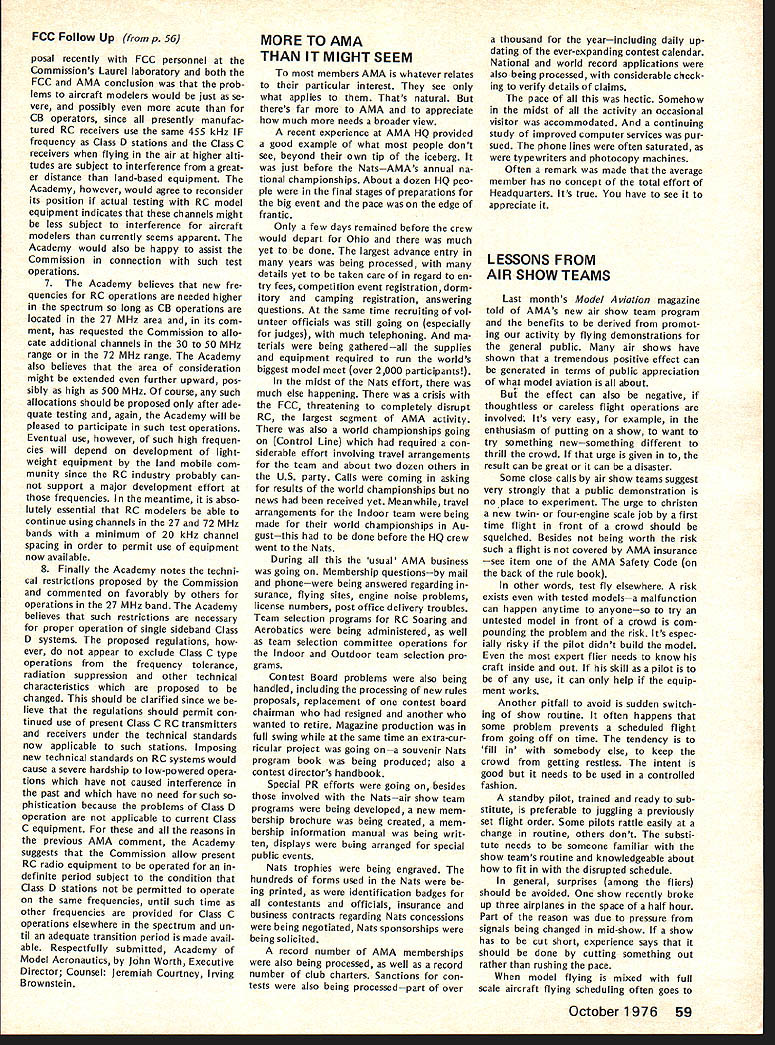
A decision to publish a 10-year history book of the Academy of Model Aeronautics was made earlier this year at AMA Headquarters. Work has already begun on this important document, announced Jim McNeill, AMA Historian, last week. Photo below shows Lucy Ann McNeill with mock-up of new book.
All of the SPECIAL INTEREST groups will be contacted directly by McNeill for contributory inclusions of both historical facts, special events, and pictures. The AMA History Book will reflect each SPECIAL INTEREST group in its pages very much the way the material is presented to the AMA Historian. It is important, therefore, for each group to present its facts, dates, names, etc., as it wants them to appear in this permanent milestone of modeling history.
From a mere 18,000 in 1967 to over 61,000 members today, the Academy has undergone unparalleled expansion, and mushroomed into the largest hobby organization in the United States. AMA feels certain that every affiliated group will want to see itself included in this book.
ALIENS CAN NOW GET FCC LICENSES
Until just recently it was impossible for non-citizens to get an FCC license for the Citizen's Band. Now, however, it is possible since the FCC has dropped its previous prohibition against alien licenses. The only restriction now is that licenses will not be granted to "a foreign government or a representative thereof." Citizens of other countries, unless they are employees of their country's government, are not representatives and therefore are eligible to obtain an FCC license for RC operation in the U.S.A.
APPLIED FOR CLASS C (RC) LICENSE, BUT GOT A CLASS D (VOICE) INSTEAD?
Some RC'ers have applied for a Class C license to fly RC and received, instead, a Class D voice CB license. If this happened to you, make a photocopy of it to keep while awaiting the correct license and return the Class D license to the FCC with a note explaining the error.
Although there was discussion at the FCC of combining Class C and Class D licenses, this is not the case and one cannot legally fly RC on a Class D license (or use a Class C license for voice). Apparently some Class D licenses were erroneously sent in response to Class C applications, and simply stating the error along with the Class D license should rectify the situation.
FCC ANNOUNCES FORM FOR INQUIRING ABOUT PENDING APPLICATIONS
The Amateur and Citizens Division Public Reference Section now has listings of licenses granted for applications filed before March 15, 1976. If you filed for a CB license on, or before March 15, 1976, and have not received your license, you may write:
Federal Communications Commission Amateur and Citizens Division Public Reference Section Washington, D.C. 20554
Providing the following information:
- Your name and address as you entered it on the application.
- Have you moved since you filed your application? If yes, send your new address.
- Date your application was mailed to the Commission.
- Was the application returned to you for any additional information or correction? If yes, give the date that you sent your application back to the Commission.
- Your birthdate.
Using this information, the Commission can research the status of your CB application and notify you of the results. In many cases, they will issue a license, but not received by the applicant.
If you filed for your CB license after March 15, 1976, do not inquire about the status of your application at this time. As new listings become available, public notices will be released.
LIABILITY PROTECTION DEPENDS ON LEGAL FLYING
Club Officers, CD's and every flyer should be aware that AMA liability protection is based on legal flying in accordance with the AMA Safety Code.
This means that with 27 MHz and 72 MHz equipment, an individual or club FCC Class C license is required, and for operation in the 6 meter band, the flyer must possess an FCC Technician Class License, or higher (Novice Class license does not permit any RC operation). To fly with improperly licensed equipment—such as flying on 6 meters with a Class D Citizens Band license—is illegal, and AMA liability protection would not apply should an accident result in a claim being made.
Of course this doesn't mean that your "Ham" buddy can't hand you his 6 meter transmitter for a flight even though you may possess only a Class C CB license. You're flying legally because he turned over the switch and is legally still in control of the transmitter equipment. Similarly, if one has applied for his Class C CB license, he can fly legally if he is under the supervision of another flyer in an area who is licensed to fly on the same frequency.
To ensure liability protection, everyone must be licensed for the equipment he flies and fly in accordance with the AMA Safety Code.
AMA News
Followup Action Needed
From AMA Headquarters: At press time the FCC situation is looking very favorable. Indications are that the FCC officers' mail campaign in May and June was very effective. The inside word is that RC would be lumped in with CB for some new frequencies. What is also evident is the fact that comparatively few Class C RC licenses were filed — that perception caused the problem in the first place.
Surface impression of FCC records showed April 30 — 62,362 Class C licenses compared to 4,296,280 Class D (CB) licenses. Meanwhile ten times as many Class D licenses are being applied for each month as Class C. The total Class C licenses applied for in the past ten years in comparison seemed to put us in a hopeless position. We salvaged the situation by pointing out the number of Class C licenses doubled in the past year and the rate increase is continuing unabated. We also made the case that Class C licenses are club type, representing hundreds of individual RCers. Thus we were able to justify representation for several hundred thousand RCers rather than what the license total seemed to show.
The growth of the AMA in the past ten years — mostly RC fliers — was also helpful in showing FCC activity is active and expanding. We made a good enough case to reverse the trend of thinking at the FCC. Now we have to build the case and strengthen our position by showing how many individuals are participating; the license total alone is not indicative.
It's much easier now than it would have been a couple of years ago. When the FCC license fee went to $20 there was a big surge in club licenses. Club licenses helped make it easy financially for newcomers to get involved. RC absorbed individuals and the true number of participants was masked. What we have now is simple and comparatively cheap — the individual license cost is $4. During the recent mail campaign FCC people offered to donate money to AMA to help fight for greater recognition of RC. However, it was pointed out that AMA is able to fund a fight out of regular AMA dues and basic benefits of AMA membership — the representation members pay for before such government agencies as the FCC and FAA. Instead of donations to AMA, what was needed were license applications to the FCC. That is the most direct and effective donation. If individuals become licensed, the great increase in the number of licenses over the next few months will really drive home the message that RC is growing rapidly.
Maybe we can't top CB totals, but certainly we can compete on the basis of rate growth — the percentage of new licenses per month is something RCers can get involved in. It's a simple, cheap investment in protection of what we have now and in getting consideration in the future. It's an effort AMA clubs can join in: encourage club members to get their own FCC license. AMA can help — we will send a free number of FCC license applications to a club. Manufacturers will put kits and equipment; dealers and distributors will provide applications to customers who want to eliminate the excuse that individual license application forms are hard to find. If club licenses are discouraged they still have a very useful function to make it easy for a newcomer to get started. As soon as possible newcomers should be urged to convert to their own licenses — the sooner the better. It's important to get the campaign rolling NOW.
Another reason we must show the FCC that Class C licenses should not be merged as has been proposed is that we need to have Class C licenses registered and possible before an end-of-year order. Although the FCC has expanded Class D CB voice channels, this expansion does not involve Class C 27 MHz RC channels. Other 27-255 MHz are already shared with new Class D voice channels resulting from Docket 20120; 27.235-27.405 MHz become available January 1, 1977. Although the FCC July 27 news release taken alone has no details concerning Class C RC, the full text of the FCC order wasn't expected to be released until another week. AMA's legal counsel was able to find out no FCC action had been taken to merge Class C RC and Class D voice licenses as proposed. Thus Class C applications may continue to be filed by formerly eligible applicants, including youngsters. The FCC notes the allocation of additional Class D voice channels is an interim measure while studies are underway in the whole area of personal communication.
Credit is given to the timely, massive response of AMA members and others in the campaign. AMA, the model industry and the press must keep 27 MHz activities before the FCC. The next phase of the campaign to obtain new frequencies for RC will be pursued; we will provide information next month.
New Jersey & New York
DISTRICT REPORT
John Byrne Dist. II Vice-President 36-28 23 Street Bayside, NY 11361
Associate Vice Presidents: Bill Borse, 77-06 98th St., New Hyde Park, NY 11040 David Fiedel, 11 Leete Lane, E. Islip, NY 11730 Frank Ging, 6382 Radmoor Dr., Lockport, NY 14094 Cliff Montplaisir, 187 Rotary Dr., Summit, NJ 07901 Jack Sammarco, 2062 Emerson Ave., Union, NJ 07083 James Slaughter, Chief, Crafts & Hobbies, USAF/EUROPE, Box 4067, APO New York 09009 Walter Thorne, 208 Windermere Rd., Syracuse, NY 13219
Second (District) Thoughts
This past weekend having been the "Independence Day" one, New York was replete with "tall ships," parades and block parties, but in my opinion there was only one way to really enjoy the occasion, and so I left it all behind and journeyed a hundred miles upstate to Galloway, N.Y., to participate in the 40th Anniversary Free Flight Contest of the SKYSCRAPERS — and although my plans for participating were dashed to bits by the sudden illness of a crew member, I nevertheless managed to swap yarns and pleasant reminisces with many good friends while there. Over the years I have shared the excitement of the screaming power-climb and the fervent wish for an altitude-holding transistion into "thermal country," which is the additive fascination and glory of free flight. I would not neglect the major categories of Rubber, HLG and A-1 Glider, and Coupe d'Hiver, which were also flown upon this auspicious occasion — unique, commemorative, one-of-their-kind trophies to third place in each category were custom designed and fabricated by Kevork Fajg, who also functioned most capably as CD — present were such stalwarts as Bob Hatschek (once secretary-treasurer of AMA), Cliff Montplaisir (one of our AVPs from New Jersey) and District 2 Free Flight Contest Board member Carroll Allen — and all the way from California, Mr. "Free Flight" himself, Sal Taibi — in short, it was a very wonderful "happening," and a memorable experience!
Remember September
You are hereby reminded that the Contest Board Rules proposal deadline was changed at the April 30 Executive Council Meeting from June 1 to September 1, 1976 — so if you wish to submit any such proposals, please send them promptly to your particular District Contest Board member at the address shown following his name elsewhere in this magazine — the need for this reminder was pointed up by a concerned telephone call which I received from our District 2 RC Contest Board member, Joe Friend, who reports that input to him is sadly lacking.
Cradle of Aviation
Nassau County celebrated a "Cradle of Aviation" at Mitchel Field, in Mineola, NY, during the week of July 25, and on that particular date, the MEROK E RC held its annual RC Pattern contest and, in conjunction with that, conducted a "Spirit of '76 Air Show" — Mel Carver, the president of MEROKE RC, conferred with us on this project and judging from the past MEROKE performance records we all know it was a successful event.
Transatlantic
It is a singular pleasure to report that District 2 now has an Associate Vice-President in Europe. I have appointed to that post James D. (Jim) Slaughter, originally from Wichita, Kansas, but now Recreation Specialist at USAF, Europe HQs. Jim's mailing address is: Chief, Crafts and Hobbies, USAF/EUROPE, Box 4067, APO New York 09009.
Gateway Bicentennial Celebration
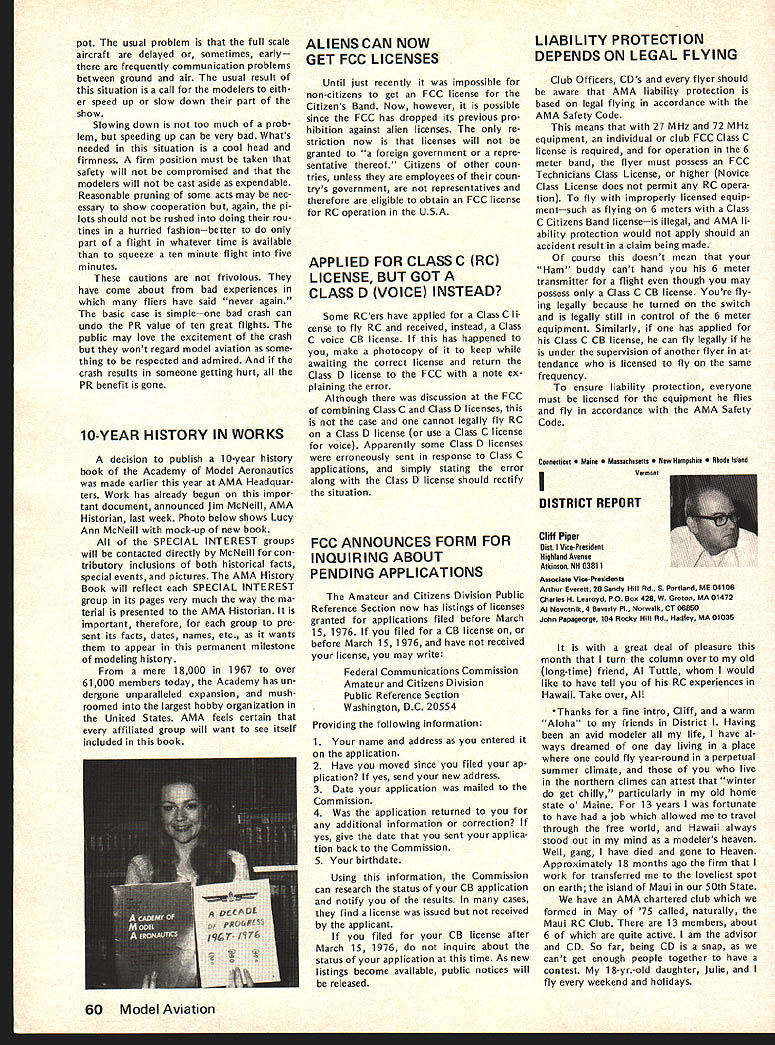
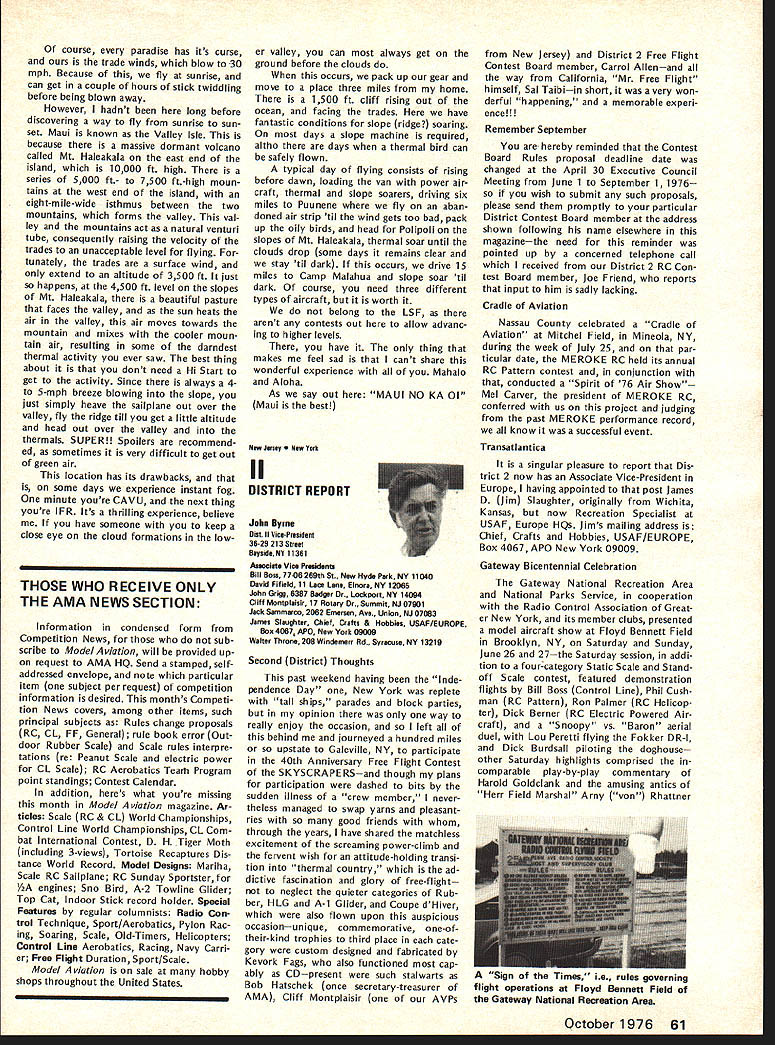
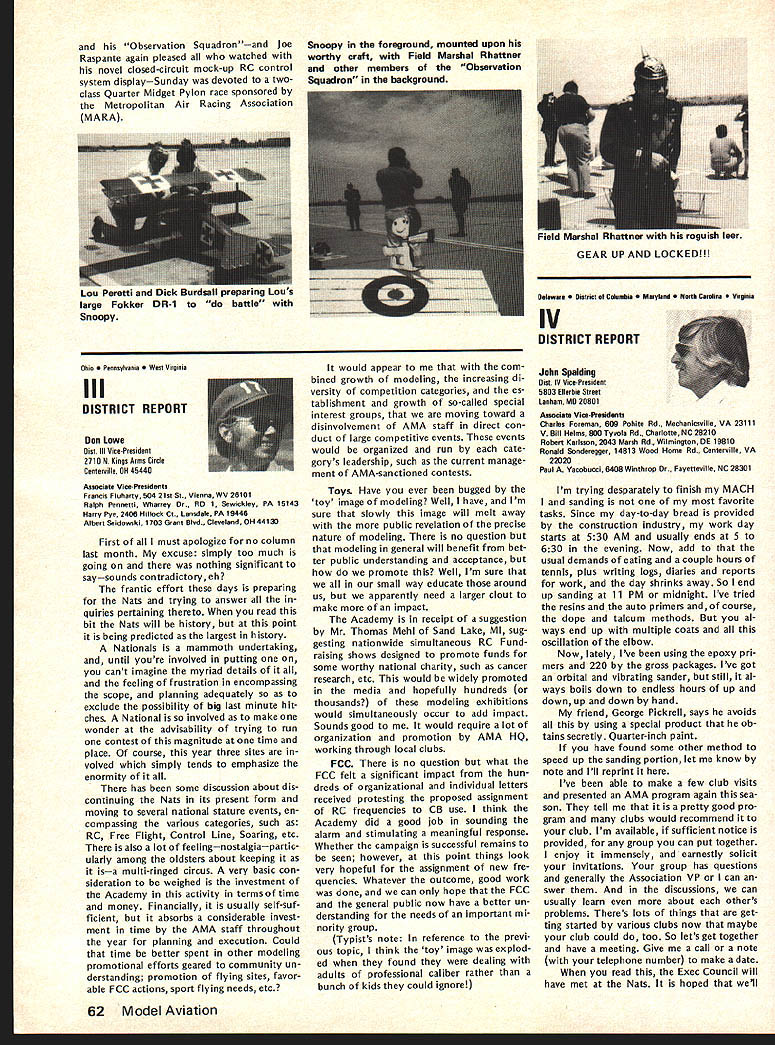
The Gateway National Recreation Area and National Parks Service, in cooperation with the Radio Control Association of Greater New York, and its member clubs, presented a model aircraft show at Floyd Bennett Field in Brooklyn, NY, on Saturday and Sunday, June 26 and 27 — the Saturday session, in addition to a four-category Static Scale and Standard Scale contest, featured demonstrations by Bill Boss (Control Line), Phil Gushman (RC Pattern), Ron Palmer (RC Helicopter), Dick Berner (RC Electric Powered Aircraft), and a "Soapy" vs. "Baron" aerial duel, with Lou Peretti flying the Fokker D-R1, and Dick Burdall piloting the doughnut-shaped "Herr Feld Marshal" Army ("von") Rathner. Other Saturday highlights comprised the incomparable play-by-play commentary of Harold Goldblatt and the amusing antics of "Herr Feld Marshal" Army ("von") Rathner.
A "Sign of the Times," i.e., rules governing flight operations at Floyd Bennett Field of the Gateway National Recreation Area.
AMA News
From AMA HQ — Executive Director (including reports from the AMA President and Vice‑Presidents)
Instead of donating to the AMA, send money to the FCC. At press time the FCC situation looked very favorable. Indications are the FCC officers' mail campaign in May–June was very effective; inside word was RC would be lumped in with CB and some new frequencies for RC likely. What is also evident is the fact comparatively few Class C RC licenses filed with the FCC caused problems in the first place. Surface impression: FCC records showed April 30 — 62,362 Class C licenses compared to 4,296,280 Class D (CB). Meanwhile ten times as many Class D licenses are being applied for per month.
The total Class C licenses applied for in the past ten years comparison seemed to put us in a hopeless position. The salvaged situation points out the number of Class C licenses doubled in the past year; the rate increase is continuing unabated. Also made the case that Class C licenses are club type representing hundreds of individual RCers. Thus we were able to justify representation of several hundred thousand RCers rather than what license totals seemed to show. Growth of the AMA in the past ten years, mostly RC fliers, also helped, showing FCC activity is active and expanding, which made a good enough case to reverse trend thinking at the FCC.
Now we have to build a case to strengthen our position — show really how many individuals participating in RC aircraft the license total indicates. It's much easier now than it would have been a couple years ago. When the FCC license fee went to $20 we saw a big surge in club licenses. Club licenses helped make it easy financially for newcomers to get involved; RC absorbed individuals and the true numbers of participants were masked. What we have now is simple and comparatively cheap — the cost for an individual license is $4.
During the recent mail campaign FCC people offered "donate money to AMA to help fight for greater recognition of RC." However, it was pointed out AMA is able to fund the fight out of regular AMA dues; basic benefits of AMA membership are the representation of members before such government agencies as the FCC and FAA. Instead of donations to AMA, what was needed were license applications to the FCC — a direct, effective donation is the $4 license fee. A surge in individually licensed persons and a great increase in the number of licenses over the next few months will really drive home the message that RC is growing rapidly. Maybe we can't top CB totals, but we certainly can compete on the basis of rate growth — the percentage of new licenses per month is something RCers can get involved in. It's a simple, cheap investment in protection; what we have now is getting consideration for the future.
AMA clubs can join the effort and encourage club members to get their own FCC license. AMA can help and will send free numbers of FCC license applications to clubs. Some manufacturers will put kits and equipment together; some dealers and distributors will provide applications to customers who want to eliminate the excuse "individual license application hard to find." Even if club licenses are discouraged, they still have a very useful function to make it easy for a newcomer to get started in RC as soon as possible. Newcomers should be urged to convert to their own licenses — the sooner the better. It's important to get the campaign rolling NOW.
Another reason is we must show the FCC Class C licenses should be merged as proposed; we need to have Class C licenses registered possibly before the end of the year order. Although the FCC has expanded Class D CB voice channels (40 expansion), this does involve Class C 27 MHz RC channels. Other 27.255 MHz already shared with new Class D voice channels resulting from Docket 20120; 27.235–27.405 MHz become available January 1, 1977. Although the FCC July 27 news release taken has no details concerning Class C RC, the full text of the FCC order wasn't expected to be released until another week. AMA's legal counsel was able to find out no FCC action had been taken to merge Class C RC and Class D voice licenses as proposed. Thus Class C applications may continue to be filed by those formerly eligible, including youngsters. FCC notes allocation of additional Class D voice channels is an interim measure; studies are underway in the whole area of personal communications.
Credit timely, massive response by AMA members and others to the campaign. AMA, model industry, model press — keep 27 MHz activities before the next phase of the campaign to obtain new frequencies for RC. We will pursue improvement of the status quo. Info next month.
October 1976
Academy of Model Aeronautics 815 Fifteenth Street NW Washington, D.C. 20005
Followup Action Needed: RCers show dramatic increase...
DISTRICT REPORT
Jim McNeill Dist. 5 Vice-President 617 20th Ave. South Birmingham, AL 35205
Associate Vice-Presidents: Richard E. Jackson, 107 White Blvd., Summerville, SC 29483; Chris Joiner, 5041 Warner Road, Columbus, GA 31904; Bill Klee, 650 West Shore Dr., Kingsport, TN 37660; Tom McLaughlin, 4140 Fern Ct., Pine Circle, Pensacola, FL 32503; Luis Rodriguez, P.O. Box 516, Sto. Is., Villa Rica, Bayamon, Puerto Rico 00960; Jim Whiteley, 1605 Woodland St., S.E., Decatur, AL 35601; Julie Woods, P.O. Box 127, Scooba, MS 39358
IMPORTANT!! IF YOU LIVE IN DISTRICT 5 READ THIS. Lots of news this month. I hope I can bootstrap enough space inches to get it all in.
First off, a NEW Control Line Contest Board Member for our District due to an unexpected resignation. Mr. Dave Hemsrough of Moncks Corner, SC, has agreed to accept this important post until 1977. (I hope he keeps it.) For years the CL Board has been dominated by speed boys, who did a good job. I want to try a pattern modeler this time. Dave was head judge for Jr./Sr. CL Stunt at '74 and '75 Nats, designer of nationally known CL kit, won '66 Nats in Stunt, etc. ... a good man.
Chris Joiner, president of new GEORGIA AERO. MOD. ASSOC., a state association of Georgia clubs, announced last week that seven Georgia clubs collected. They want the rest to join. Their aim is COMMUNICATION. To entice FF, RC, CL, everybody. An excellent idea. Chris, Bobbly Jones, of Columbus, is editing their GAMA RAY Newsletter for the state. If interested, write Chris or me for details to join.
Howard Spry, former president of the Spartanburg, SC, SKY KNIGHTS, writes: The SC State Dept. of Parks is building his club a beautiful flying site with paved runways 70 by 400 ft., running water and lights, etc. for RC and CL both. All this did not come easy. The Honorable State Senator, Paul Moore, has led the political charge for years to access these model airplane goodies.
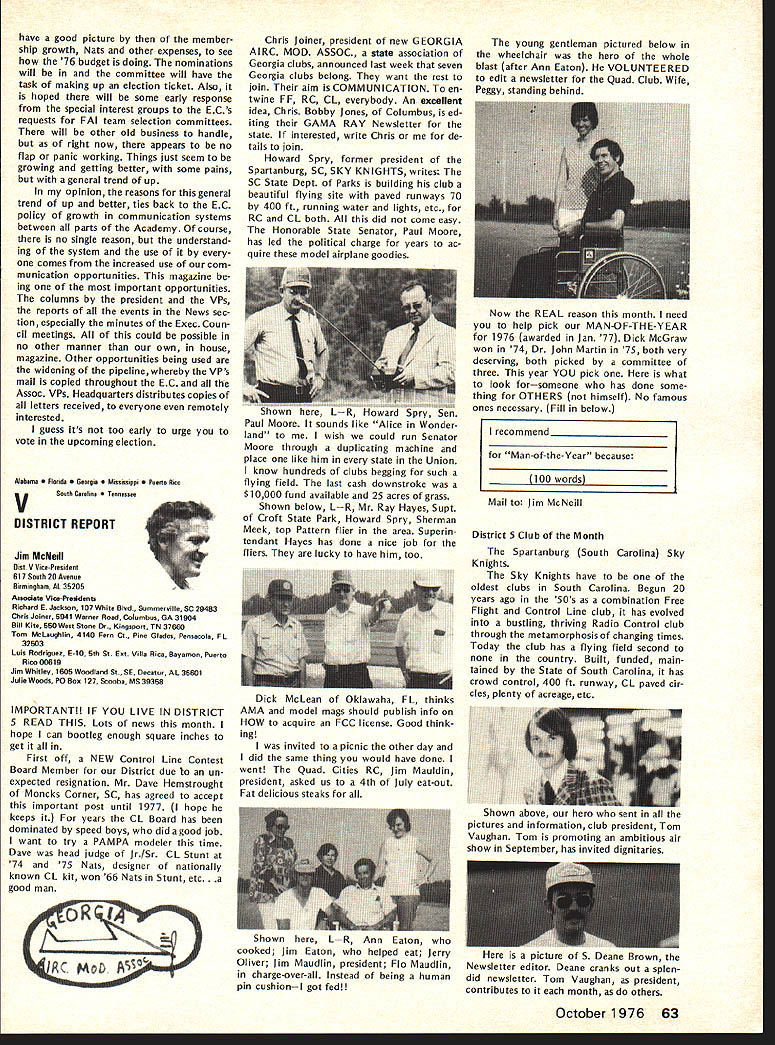
Dick McLean of Oklawaha, FL, thinks AMA and model mags should publish info on HOW to acquire an FCC license. Good thinking!
I was invited to a picnic the other day and I did the same thing you would have done. I went! The Quad Cities RC, Jim Mauldin, president, asked us to a 4th of July eat-out. Fat delicious steaks for all.
I recommend __________________________
for "Man-of-the-Year" because:
(100 words)
Mail to: Jim McNeill
District 5 Club of the Month
The Spartanburg (South Carolina) Sky Knights.
The Sky Knights have to be one of the oldest clubs in South Carolina. Begun 20 years ago in the '50s as a combination Free Flight and Control Line club, it has evolved into a bustling, thriving Radio Control club through the metamorphosis of changing times. Today the club has a flying field second to none in the country. Built, funded, maintained by the State of South Carolina, it has crowd control, 400 ft. runway, CL paved circles, plenty of acreage, etc.
AMA News
VI DISTRICT REPORT
Glenn Lee Dist. VI Vice-President 819 Mandrake Batavia, IL 60510
Associate Vice-Presidents Roger Gerst, 229 N. 22nd St., Quincy, IL 62301 Jackson Gill, 716 S. Locust, La Salle, IL 61301 John Matthias, 5034 Maclure Dr., Apt. C, Ft. Wayne, IN 46805 Sidney White, 5221 Courtview Dr., Cincinnati, OH 45239 Edwin Myer, 2414 Maywick Dr., Lexington, KY 40502 Robert E. Stagner, 1828 Seelter Dr., Poplar Bluff, MO 63001 Philip Sullivan, 3021 Spring Valley Ct., Anderson, IN 46011
No District VI Report this month.
VII DISTRICT REPORT
Hardy Brodersen Dist. VII Vice-President P. O. Box 1104 Birmingham, MI 48012
Associate Vice-Presidents Paul Carter, 6680 Lucille Ln., No. 18, Fridley, MN 55432 Keith McClure, 5730 Terrace Dr., Des Moines, IA 50312 Frank Morrissey, 14100 W. Park Ave., New Berlin, WI 53151 Wm. Rohling, 4944 Tanglewood Trail, St. Joseph, MI 49085
"...Them Fokkers was Messerschmidts!" I remember the punch line (which I happen to think is hilarious), but not the story. Just trying to get your attention, to direct it to the proposition of voting for the candidate of your choice for AMA Pres., and for the even-numbered district VPs. (No, that's not us, Joe). At this writing, the slate hasn't been shaped up for the national offices, so I am happy to be able to make endorsements. I recall that this district has something like 5,000 members. I'll bet less than ten percent of you will vote, you Fokkers.
I've had occasion to travel a little since I last took pen in hand. Been to Taft, CA for the West Coast FF Championships (where I cracked everything up) — to New York City, where I dropped in on district II VP, John Byrne, with a side trip to White Plains, NY (I almost wrote, Planes), to see MAN at Work, Walt Schroder — and then to Cleveland, and to Washington, DC (where the air was heavy with the Bicentennial not happening yet), to see the folks at AMA HQ, and to stand with my nose pressed to the window of the not-yet-opened National Air & Space Museum of the Smithsonian to get a look at the fantastic aircraft and spacecraft on display. Noticed that our sister NAA organization, the Parachutists, have a prominent display, and it had dawned on me that this is the right place for the Model Aircraft Museum about which there has been so much rhapsodizing. I therefore propose that our museum officers be directed to establishing a major permanent section there for the deposit and display of our historic models and to tell the story of model aviation from its beginnings to the present day.
My talks with John Byrne centered on the FAI three-year World Championships problem and the lack of a host for the 1977 F/F World Championships. One project, confidential at this writing, conceived by a fellow whose initials are Bob Hatschke, has promise for putting a bandaid on that problem. I say bandaid, because this is a necessary first step, but not an answer to the task of making two-year cycles for ten World Championship classes feasible in all aspects for all of the participating nations. Walt Schroder gave me the background on the RC Invitational Tournament conducted by MAN and Circus Circus in Las Vegas. The key is money. Much money. Anyone against money? I mean, money in significant figures as prizes to make some of the other branches of model competition pay attention, come and compete. From some quarters, there will be the predictable reaction against money prizes—expecting that it will lead to corruption, poor sportsmanship. "Anything like that between us?" "Walt?" An emphatic, "Nothing!" So let's get some money.
Some of the gents at Taft took exception to my remarks about using my best judgment, in a past column. My best judgment does not exclude listening to all voices in a contest of ideas. I hope to see the Taft event suffer somewhat reduced entry. The VTO voting controversy was depleting.
I plan a trip or two up toward Milwaukee, Oshkosh, Minneapolis. Maybe I can drop in on a meeting or two. See if I can be of some use to you guys that way. Let me know your club meeting schedules for the near future.
Talk about noses pressed to the window — in New York, it's the Village Gate (it's Monday night), the Museum of Modern Art (closed on Wednesday), and in Washington, D.C., it's John Worth, over at the FCC all day. Never mind about Cleveland.
VIII DISTRICT REPORT
Murry Frank Dist. VIII Vice-President 2933 Shannon Wichita Falls, TX 76308
Associate Vice-Presidents Bud Averitt, 1717 La Barranca NE, Albuquerque, NM 87111 Joe Barnett, 523 N. La Homa, Lubbock, TX 79606 Frank Osborne, 18 Mohave Dr., N. Little Rock, AR 72116 Bud Tenney, Box 545, Richardson, TX 75080
The next issue will carry the report of the '76 Nats. By the time you get this the Nats will probably be over. If so, I hope that I got to see many of you at Dayton. If you missed me there, and you have a problem, let me hear from you. Remember I can't help you if I don't know what your problem is!
AMA News
From AMA HQ Executive Director: At press time the FCC situation looked very favorable. Indications were that the FCC officers' mail campaign in May and June was very effective; the inside word was that R/C would be lumped into some new frequencies. What was also evident was the fact that comparatively few Class C R/C licenses on file at the FCC caused the problems in the first place. The surface impression from FCC records showed April 30: 62,362 Class C licenses compared to 4,296,280 Class D (CB) licenses.
Meanwhile, ten times as many Class D licenses are being applied for each month as the total Class C licenses applied for in the past ten years. By comparison this seemed to put us in a hopeless position. The situation was salvaged by pointing out that the number of Class C licenses doubled in the past year and that the rate increase is continuing unabated. We also made the case that Class C licenses are club type, representing hundreds of individual R/Cers. Thus we were able to justify representation of several hundred thousand R/Cers rather than what the license total seemed to show. The growth of AMA in the past ten years, mostly R/C fliers, was also helpful in showing FCC activity is active and expanding. This made a good enough case to reverse the trend of thinking at the FCC. Now we must build the case and strengthen our position to show how many individuals are participating in R/C, since the license total under-represents actual participation.
It is much easier now than it would have been a couple of years ago. When the FCC license fee was $20 we saw a big surge in club licenses. Club licenses made it easy financially for newcomers to get involved in R/C; the club license helped mask the true number of individual participants. What we have now is simple and comparatively cheap — an individual license now costs $4. During the recent mail campaign FCC people were offered donations of money to help AMA fight for greater recognition of R/C. However, it was pointed out that AMA can fund a fight out of regular AMA dues and basic benefits of AMA membership — the representation of members before such government agencies as the FCC and FAA. Instead of donations to AMA, what is needed are license applications to the FCC — a direct, effective donation. The $4 license fee, with many individuals licensed, would show a great increase in the number of licenses over the next few months and would really drive home the message to the FCC that R/C is growing rapidly.
Maybe we can't top CB totals, but certainly we can compete on a basis of rate growth — the percentage of new licenses per month is something R/Cers can get involved in. It's a simple, cheap investment to protect what we have now and to gain consideration in the future. It's an effort AMA clubs can join: encourage club members to get their own FCC license. AMA can help — we will send free copies of FCC license application forms to clubs. Also, manufacturers will put kits and equipment in the hands of newcomers and dealers/distributors will provide applications to customers who want them to eliminate the excuse that individual license application forms are hard to find. If club licenses are discouraged, they still have a useful function in making it easy for the newcomer to get started in R/C. As soon as possible newcomers should be urged to convert to their own licenses — the sooner the better. It's important to get the campaign rolling NOW.
Another reason to act now is that we must show the FCC that Class C and Class D licenses should not be merged as has been proposed. We need to have Class C licenses registered and in place before any end-of-year order. Although the FCC has expanded Class D (CB) voice channels, that expansion does not involve the Class C 27 MHz R/C channels. Other 27.255 MHz channels are already shared with the new Class D voice channels. As a result of Docket 20120, 27.235 to 27.405 MHz will become available January 1, 1977.
Although the FCC July 27 news release taken alone had no details concerning Class C R/C, the full text of the FCC order wasn't expected to be released until another week. AMA's legal counsel was able to find out that no FCC action had been taken to merge Class C R/C and Class D voice licenses as had been proposed. Thus Class C applications may continue to be filed by the formerly eligible, including youngsters. The FCC notes that the allocation of additional Class D voice channels is an interim measure while studies are underway in the whole area of personal communications.
Credit the timely, massive response of AMA members and others to the campaign. AMA, the model industry and the model press kept 27 MHz activities before the FCC during the next phase of the campaign to obtain new frequencies for R/C. We will pursue improvement in the status quo. More information next month.
Followup Action Needed
RCers showed a dramatic increase in response to the mail campaign. At press time the FCC situation looked very favorable. Indications are the FCC officers' mail campaign in May and June was very effective. Inside word is that R/C would not be lumped in with CB for some new frequencies. It is also evident from the fact that comparatively few Class C R/C licenses filed with the FCC caused problems in the first place. On the surface the impression from FCC records showed April 30 — 62,362 Class C licenses compared to 4,296,280 Class D licenses. Meanwhile ten times as many Class D licenses are being applied for each month as Class C. The total Class C licenses applied for in the past ten years in comparison seemed to put us in a hopeless position.
The situation was salvaged by pointing out the number of Class C licenses doubled in the past year and the rate increase is continuing unabated. This also made the case that Class C licenses are club type, representing hundreds of individual R/Cers. Thus we were able to justify representation for several hundred thousand R/Cers rather than what the license total seemed to show. The growth of AMA in the past ten years has been mostly R/C fliers. It was also helpful to show FCC activity is active and expanding. This made a good enough case to reverse the trend in thinking at the FCC. Now we have to build the case to strengthen our position and show the real number of individuals participating in R/C is far greater than the license total indicates.
It would be much easier now than it would have been a couple of years ago. When the FCC license fee went to $20 we saw a big surge in club licenses. The club license helped make it easy financially for newcomers to get involved. R/C absorbed individuals; the true numbers of participants were masked. What we have now is simple and comparatively cheap — now the cost of an individual license is $4.
During the recent mail campaign the FCC people were offered donations to AMA to help fight for greater recognition of R/C. However, it was pointed out that AMA is able to fund the fight out of regular AMA dues and basic benefits of AMA membership — the representation members have for such government agencies as the FCC and FAA. Instead of donations to AMA, what is needed are license applications filed directly with the FCC. A $4 license fee is an effective donation. If individually licensed, a great increase in the number of licenses over the next few months will really drive home the message that R/C is growing rapidly.
Maybe we can't top CB totals, but certainly we can compete on the basis of rate of growth — the percentage of new licenses per month is something R/Cers can get involved with. It's a simple, cheap investment in protection for what we have now to get consideration in the future. It's an effort AMA clubs can join by encouraging club members to get their own FCC licenses. AMA can help and will send free copies of FCC license applications to clubs. Manufacturers, equipment suppliers, dealers and distributors will provide applications to customers who want them to eliminate the excuse that individual license applications are hard to find. Say the club licenses are discouraged, they still have a very useful function to make it easy for the newcomer to get started. As soon as possible newcomers should be urged to convert to their own licenses — the sooner the better.
It's important to get the campaign rolling NOW. Another reason is that the FCC has proposed that Class C licenses be merged with Class D. We need to have Class C licenses registered and possible before the end-of-year order. The FCC has expanded the Class D CB voice channels; the expansion does not involve the Class C 27 MHz R/C channels. Other 27.255 MHz channels are already shared with the new Class D voice channels. As a result of Docket 20120, 27.235 to 27.405 MHz will become available January 1, 1977.
Transcribed from original scans by AI. Minor OCR errors may remain.

