
AMA NEWS
The New AMA Technical Director
When AMA moved its headquarters to the Washington, D.C., area in 1983, Technical Director Frank Ehling retired. For a period afterward the Technical Director position was left vacant while the new HQ operation settled in. By mid-1985 it was clear the organization needed a Technical Director to address a backlog of accumulated problems and to handle growing work in aeromodeling technology and competition operations.
By fortunate timing, Bob Underwood of the St. Louis area was available to take the position. Bob was concluding a career in the school system and was willing to relocate. The match between the job need, the available salary, and Bob’s background made the appointment possible.
Basically, the Technical Director’s responsibilities include modeling safety, competition rules and procedures, national and world records, team selection competitions, and national and world championships.
Bob Underwood — background and experience
- Age / family:
- 53 years old; retired fifth‑grade teacher with 30 years in the classroom.
- Married to Rae (also a teacher and active AMA volunteer).
- Two daughters: Anne (23), a teacher in St. Louis, and Cathy (21), a senior at Illinois College.
- Early modeling:
- Built Thermic .50s and scratch-built free-flight models as a youngster with help from his father.
- Flew small control‑line (CL) models powered by engines such as the Ardun .099 and Madewell .49.
- adult modeling and competition:
- Gained radio‑control (RC) experience with reed and hard‑tube sets; also flew boats.
- Became involved with the Nats through AMA Cub and Delta Dart programs.
- Active in the Greater St. Louis Modeling Association and served as Contest Director for combined contests, airshows, and demonstrations.
- Selected accomplishments:
- Member of four World Championship scale teams: 1976, 1978, 1982, 1984.
- Served as Contest Director for CL team selection events and on hospitality committees for World Championships.
- Served on RC and Scale contest boards.
- Organized the National Association of Scale Aeromodelers (1977).
- Wrote the Scale column for Model Builder magazine for six years.
- Nats Committee: Scale Category Manager and RC Event Director for five years.
The New Frequencies — a status report
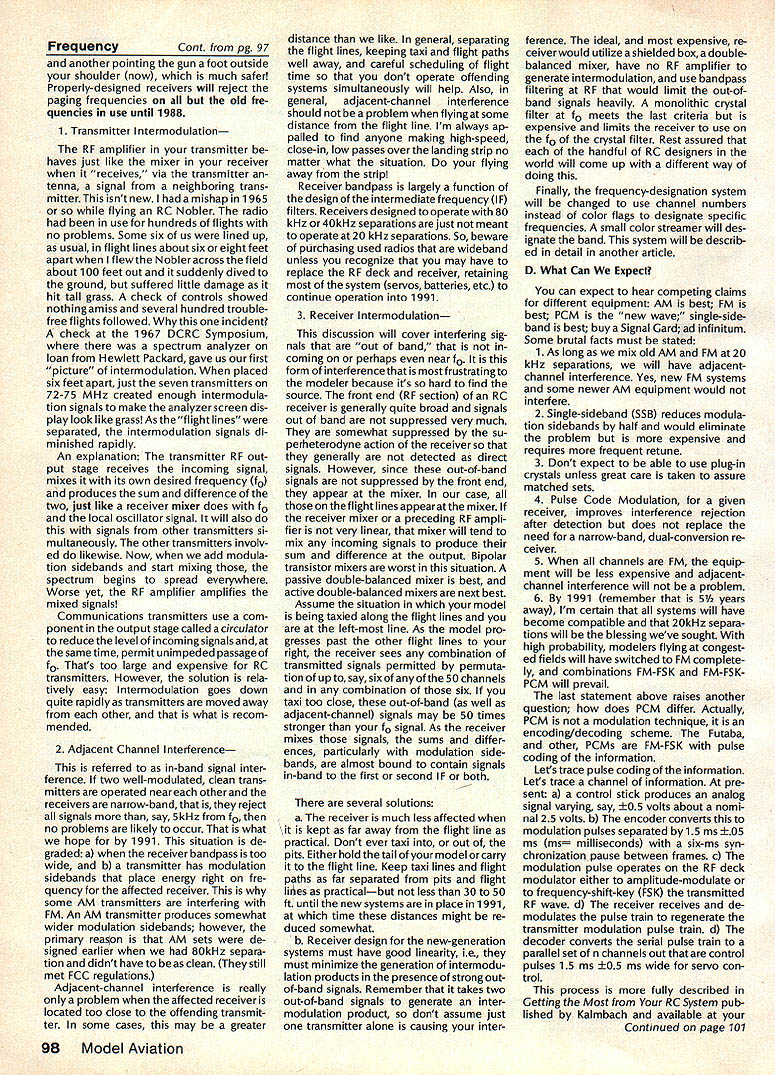
Last month, AMA Frequency Committee Chairman Fred Marks reported on developments since the FCC authorized many new RC frequencies in 1983 and outlined AMA’s phase‑in plan for the transition. That report noted several issues that must be resolved before full use of the new frequencies is possible.
This follow-up discusses what causes RC interference at the flying field, what to expect during the transition, and practical measures flyers can take to avoid or reduce interference.
#### What causes interference at the flying field?
- Human error / poor frequency control:
- The most common source historically has been inadvertent transmitter turn‑on or poor frequency bookkeeping at busy fields and contests.
- Commercial pagers:
- Prior to the new frequency plan, some pagers operated on the same channels and caused interference. Paging systems have since been shifted away from the new channels, but vigilance is still required.
- Intermodulation:
- Transmitter intermodulation can occur when transmitters are too close together on the flight line, producing spurious signals that affect receivers.
- Receiver intermodulation problems can also arise, particularly in crowded environments.
- Fly‑by situations:
- A “fly‑by” occurs when someone else’s transmitter is momentarily closer to your model than your own transmitter. Even if on a different frequency, a nearby transmitter can overload or desensitize your receiver and cause control problems.
- AM/FM interaction:
- Some operational problems surface when AM and FM systems operate together. The solution may require improvements to receivers and careful operational separation until a technical fix is widely adopted.
Practical guidelines:
- Maintain strict frequency control at contests and busy club fields.
- Enforce sensible separation between transmitters on the flight line.
- Be aware of fly‑by risks and avoid allowing uncontrolled transmitters near active models.
- Take precautions where AM and FM operate together; until receiver improvements are common, exercise extra caution.
- Treat interference reports seriously — they can prevent crashes and loss.
Fred Marks’ recommendations are based on field experience; adherence can prevent damage and loss. The plane you save may be your own.
Nats roundup and recent field reports
- General:
- The recent Nats was a large, successful event with visitors from abroad and extensive participation across disciplines. A few operational and logistical issues occurred, as is typical for an event of this scope.
- Radio problems:
- Interference on 72.320 MHz caused by a pager affected three sailplanes before the issue was resolved.
- Inter‑frequency problems occurred in Pattern where AM and FM operation overlapped. AM is not being banned; FM receivers will need to address the compatibility problem. Meanwhile, pilots should exercise caution.
- Weather:
- Rain cancelled one afternoon of RC Aerobatic flying but did not stop Free Flight, Scale, Wakefield, or CL combat events. Several competitors flew and scored well despite heavy rain.
- Theft incidents:
- A number of thefts were reported during the week: three cars were broken into and several models and equipment items taken. One person was arrested and some items recovered. Specific losses included unique models and expensive kits and tools. If you have information about stolen items, contact AMA HQ or the listed points of contact.
- Notable performances and winners:
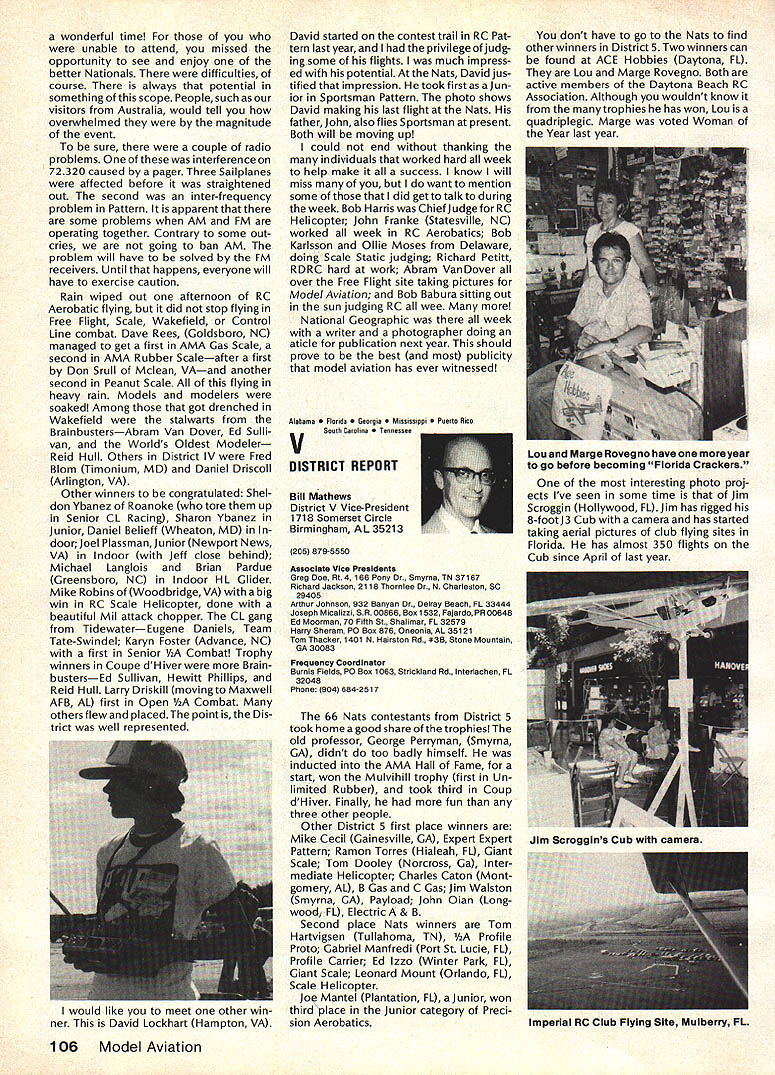
- Dave Rees: 1st in AMA Gas Scale, 2nd in AMA Rubber Scale, and 2nd in Peanut Scale — all flown in heavy rain.
- Sheldon Ybanez: dominant in Senior CL Racing.
- Sharon Ybanez: Junior CL winner.
- David (junior Sportsman Pattern): first place Junior in Sportsman Pattern (noted for rapid improvement).
- Mike Robbins: big win in RC Scale Helicopter with a Mil attack chopper.
- Various Wakefield and Coupe d'Hiver trophy winners from established Free Flight teams.
- Media / publicity:
- National Geographic had a writer and photographer at the Nats for an article planned for next year — likely very positive publicity for model aviation.
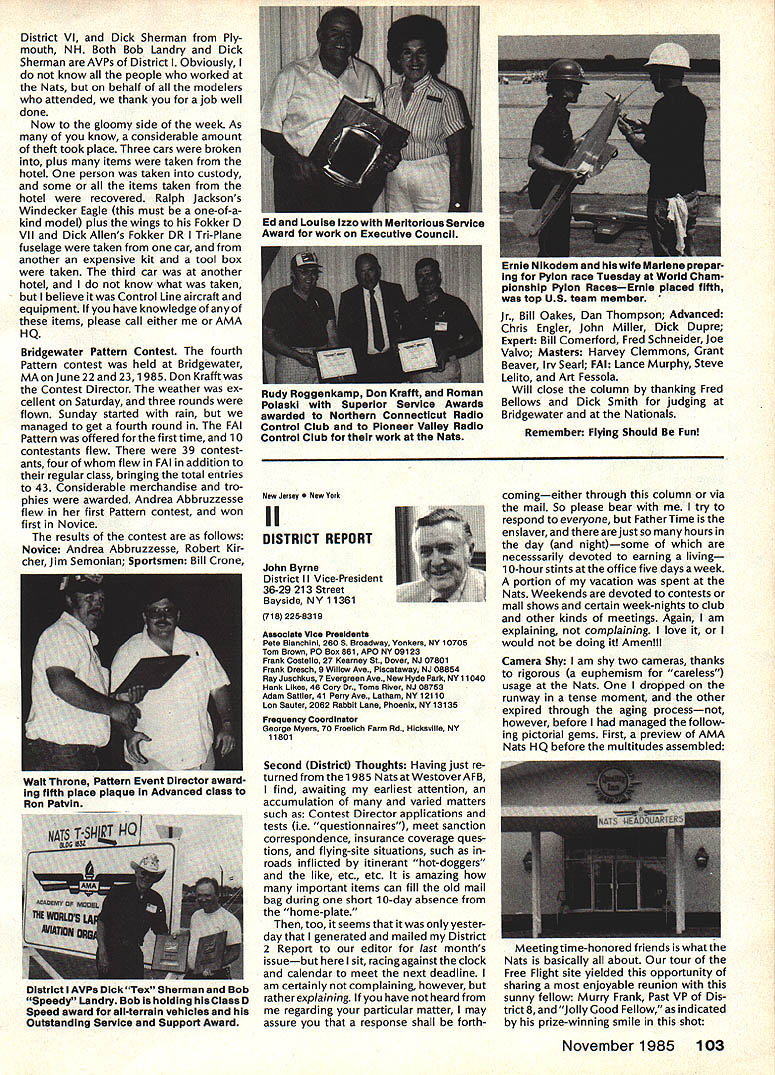
Bridgewater Pattern Contest
- Event: Fourth Bridgewater Pattern contest, Bridgewater, MA (June 22–23, 1985).
- Contest Director: Don Krafft.
- Conditions: Excellent on Saturday (three rounds flown); rain on Sunday but a fourth round was completed.
- Entries: 39 contestants, with 10 entrants in the FAI Pattern class (FAI offered for the first time); total entries amounted to 43 when factoring dual entries.
- Awards: Numerous trophies and merchandise; Andrea Abbruzzese won first in Novice in her first Pattern contest.
- Thanks to judges: Fred Bellows and Dick Smith.
District Report — District II (New Jersey • New York)
John Byrne District II Vice‑President 36‑29 213 Street, Bayside, NY 11361 (718) 225‑8319
Associate Vice Presidents:
- Pete Bianchini — 260 S. Broadway, Yonkers, NY 10705
- Tom Brown — P.O. Box 861, APO NY 09123
- Frank Costello — 27 Kearney St., Dover, NJ 07801
- Frank Dresel — 2 Willow Ave., Piscataway, NJ 08854
- Ray Jaskulich — 7 Evergreen Ave., New Hyde Park, NY 11040
- Hank Lisko — 46 Cory Dr., Toms River, NJ 08753
- Adam Sattell — 41 Perry Ave., Latham, NY 12110
- Lou Sauter — 2062 Rabbit Lane, Phoenix, NY 13135
Frequency Coordinator:
- George Myers — 70 Froehlich Farm Rd., Hicksville, NY 11801
Second (District) Thoughts:
- Returning from the Nats, John Byrne notes a backlog of matters awaiting attention: Contest Director applications and tests, meet sanction correspondence, insurance questions, and flying‑site issues (including problems caused by itinerant “hot‑doggers”).
- He asks for patience in responses due to time constraints (work commitments and extensive district duties) and thanks those who judged at Bridgewater and at the Nationals.
- Reminder: “Flying should be fun!”
Other news and notes
- Executive Council highlights and planning:
- 1986 Nats proposed for Lake Charles, LA, as a 50th‑anniversary celebration (dates to be confirmed).
- Nats Executive Committee beginning planning for 1987; Niagara Falls (US/Canada joint bid) and Muskogee, OK, among the ideas.
- Rules and administration:
- Protest rule change: Contest Director must accept and rule on any protest, but the protestor must be a contestant in the event being protested.
- Nats eligibility: Nats open to any AMA member or any modeler from another nation who can show membership in his national aero club.
- Technical and measurement tools:
- Headquarters plans to acquire sound/noise measuring devices for use by District VPs to help quantify noise complaints and identify trouble spots.
- Awards and programs:
- An annual award for technical development within the hobby is being established and will be administered by a council of past Vice Presidents.
- Computer communications:
- AMA is now online with services such as CompuServe and The Source. Plans include forums, programs, AMA news, contest results, and electronic mail for faster communications.
- Junior development:
- Discussion continues about programs to involve Juniors in team selection and mechanics’ roles. Liability and supervision concerns remain a primary factor in decisions.
- District highlights and club news:
- Fort Worth Planesmen to receive the AMA Club Award of Excellence for their long support of Free Flight and excellent meet announcements.
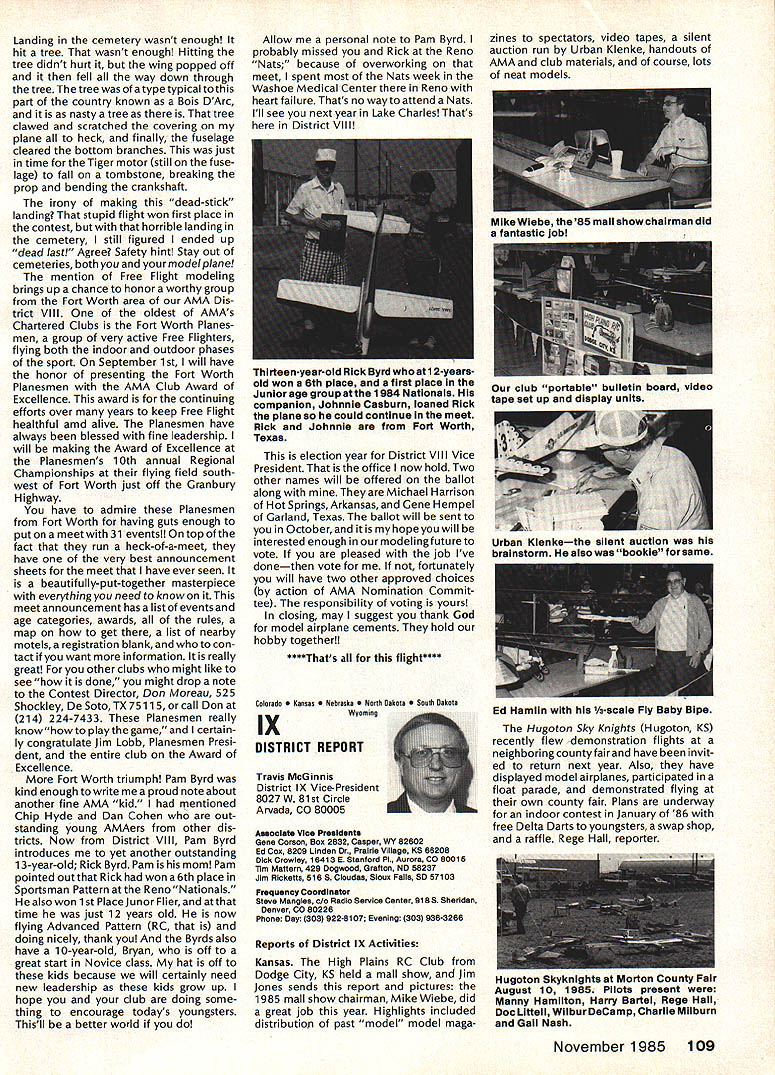
- Young flyers: Rick Byrd (13) and younger pilots are being recognized for strong performances; clubs are encouraged to support junior development.
- District VIII election year: several candidates will appear on the ballot; voting participation is encouraged.
- Safety anecdote:
- An example is given of a contest first‑place flight that ended in a disastrous cemetery landing that damaged the model — a reminder to avoid hazardous landing areas and to prioritize safety.
Closing
The transition to new RC frequencies and ongoing competition administration require continued attention to technical detail, frequency discipline, and contest procedures. AMA staff, volunteers, and competitors are working together to keep modeling safe, fair, and forward‑looking. Remember: exercise caution with transmitters, respect frequency control, and keep flying fun.
Transcribed from original scans by AI. Minor OCR errors may remain.

