
AMA News
Noise, Sound and Model Aeronautics
Howard Crispin
The heading may tend to confuse you, but the rationale behind it is important. The time has come to think of the resultant operating model‑engine sound level as sound rather than automatically calling it "noise." The level can be undesirable, to be sure, but calling it "noise" equates model engines with blockbuster rock next door, jackhammers tearing up the sidewalk, pile drivers down the block, or an F‑15 flying over at 1,000 feet with afterburner. We need to downplay the loaded term "noise."
Sound is a measurable value — something we can work with and control. This new column in Model Aviation will serve as a forum for disseminating data, information, and methods dealing with sound and its relation to the model aviation community, and to the preservation and obtaining of flying sites. The preservation of flying sites is of prime importance to the sport: without sites there are no clubs, and model aviation suffers.
AMA Committee on Sound Studies
A new committee — the AMA Committee on Sound Studies — has been formed to coordinate efforts to reduce operating sound levels so we can meet community and federal regulations. Yes, federal regulations do exist; they have largely been ignored, and we will examine them in a future article. As the committee gets moving, material from many sources will be directed through it to provide a unified front to tackle the problem.
Historically, a Noise Committee previously existed within the Executive Council and did good work within its scope. An early reference point is the FAI sound limit for F3A (RC Aerobatics) competition: measured at one meter from the engine on the ground at full power, maximum 105 dBA. Data from two F3A team selections and readings of Master/FAI aircraft at two Nationals helped answer the questions posed by that requirement. Attaining the F3A level is achievable, but the standard has limited value for broader model aviation — we will explore this further.
Outline for Future Actions
To reduce operating sound levels across all categories of model aircraft operation, broad community support is necessary. It serves no useful purpose to single out Free Flight, Control Line, Helicopter, Pylon Racing, Giant Scale, or Fun Fliers; all segments contribute to the overall problem. Among proposed actions:
- Request that Special Interest Groups (SIGs) get involved and appoint one individual as a go‑between to handle information flow and represent the SIG’s interests.
- Involve manufacturers and vendors of engines, propellers, mufflers, tuned pipes, and other accessories immediately and completely. Manufacturers will need to provide the materials and designs necessary to solve sound problems.
- Ask the FAI to reevaluate its sound‑measurement rules, expand beyond F3A, and consider standards applicable across the spectrum. Many model engines are manufactured outside the United States; CIAM representatives should consider international implications seriously.
- Review community ordinances and federal rules. The bottom line for many local ordinances is what is legally permissible at a neighbor’s property line — these permissible dBA levels are often very low. Ordinances typically measure dBA level, which may not reflect annoyance in all cases; four‑strokes may or may not help depending on the metric used.
Guidelines will be published showing how to perform a sound survey of a flying site, what equipment to use to meet local requirements, and hints on what to do with survey information. We will publish items useful to those willing to modify their equipment and provide correspondence‑derived information to help you deal with local authorities.
Above all, we need your assistance. If you have anything related to sound — data, measurements, ordinance examples, mitigation methods, or practical experience — send it to a committee member or to AMA headquarters.
Committee members:
- Howard Crispin (Chairman)
- Ed McCollough
- Vince Mankowski
- Dave Peltz
- Pete Waters
Refer to the AMA News section of Model Aviation for committee addresses.
---
Product Liability and Its Effect on Prices
Product liability concerns are a major barrier to technological innovation. The Aircraft Owners and Pilots Association told a U.S. congressional subcommittee that in the past ten years aircraft prices have risen almost twice as fast as the Consumer Price Index. Between 1974 and 1984 the CPI rose 123 percent, while the average list price of a single‑engine aircraft rose 257 percent.
Product liability drives up manufacturers’ costs (insurance and legal exposure), which in turn raises product prices. Lawsuits can be brought even when product liability seems tenuous: for example, a hobbyist who installed an oversized engine in an old kit suffered a serious accident and sued the (now discontinued) kit manufacturer plus multiple suppliers. Even when the manufacturer prevailed, legal fees and disruption nearly bankrupted the business.
Expect further product price increases as manufacturers renew insurance. Remember: manufacturers remain in business by making a reasonable profit; when their costs increase, so must prices. All the more reason to fly safely.
---
Club and District News
Free Flight and Meet Announcements
- Brooklyn Skyscrapers 50th Anniversary: The 50th Anniversary will feature a One‑Design contest using a 3/4‑size Korda Wakefield, Antique Wakefield events, and a mass launch for Twin‑Pushers, plus a full schedule of AMA and FAI events. Presented by the Eastern Free Flight Conference (Joe Wagner, President).
- Galeville (NY) 1986 schedule (provided by Bob Hatscheck, Brooklyn Skyscrapers):
- May 24–25 — Skyscraper Nationally Advertised AA‑Sanctioned Meet
- August 16–17 — Mid‑Hudson Valley Modelers Nationally Advertised AA‑Sanctioned 2nd Annual Meet
- August 30–September 1 — Skyscraper 50th Anniversary AA‑Sanctioned Meet
- September 13–14 — Bath Aeromodelers AA‑Sanctioned Meet
Flying Aces Nats MK V (Geneseo Airport, NY)
Scheduled for July 19–20. Events include:
- July 19: FAC Rubber Scale; Peanut Scale (FAC); Embryo Endurance; Greve Trophy Race; Thompson Trophy Race; WW I Peanut Combat
- July 20: GHP Peanut; FAC Jumbo Scale; FAC Power Scale; WW I Combat; Golden Age Mass Launch; WW II Combat
An indoor contest (Friday night) at the college gym will run GHP Peanut and No‑Cal Scale, providing a fun start to the Nats.
Club Highlights and Notes
- Knox County Radio Control, Inc. imported Scott Black to edit the club newsletter, now called The KCRC Aircrafter. The club’s annual Freeze Fly was held during snowy conditions.
- Middle Tennessee RC Society published an event schedule including: Cold Day in the Park, Frigid Fun Fly, Water Fun Fly, Picnic/Night Fly, Octoberfest Fun Fly, and Pattern Fun Fly.
- Ed Darley (Prop‑Blast, Meridian RC Club, MS) advises: give full‑scale aircraft the right of way.
- RC Video Magazine is gaining popularity as a club program.
- Indian River Control Society (South Florida) will host the Florida State Pattern Championships.
- Tri Cities Aeromodelers (TN) established a maximum noise level of 105 dB after serious complaints; most stock mufflers and tuned pipes met the test, while Senco, Magic, and Dubro mufflers generally did not.
- Bud Fletcher (Memphis RC Club) photographed the club’s new field: runways 30 ft wide by 300 ft and 400 ft. For directions, write Wesley Davis, Secretary, P.O. Box 34218, Bartlett, TN 38184.
- Armory R/C Modelers (MS) performed a static display and flight demonstration at Sulligent, AL, to support the local school district; student interest was high.
- Memphis Prop‑Busters produced a well‑received 30‑minute home video shown at the club banquet and shared with other clubs.
- Plane Talk (Cape Coral R./Sea Hawks) learned that AMA coverage can be void if the flier was not an AMA member at the time of an accident: a member joined AMA five days after a crash and was denied coverage.
Club Mail and Outreach
- Thanks to clubs that have added AMA News to their mailing lists. If your club hasn’t, consider sending newsletters to AMA News — it’s appreciated and read.
- Mall shows are an effective way to promote clubs and AMA; booths at conventions can help advertise the organization and attract members.
- Consider meeting locations like public libraries or schools, and programs like "Adopt‑A‑School" to attract youth.
Miscellany
- A member’s overnight bag with letters and messages was stolen from a car during a business trip; if you expected correspondence, please re‑send.
- Glendive R/C Bush Pilots moved their Fun Fly to July to avoid heat.
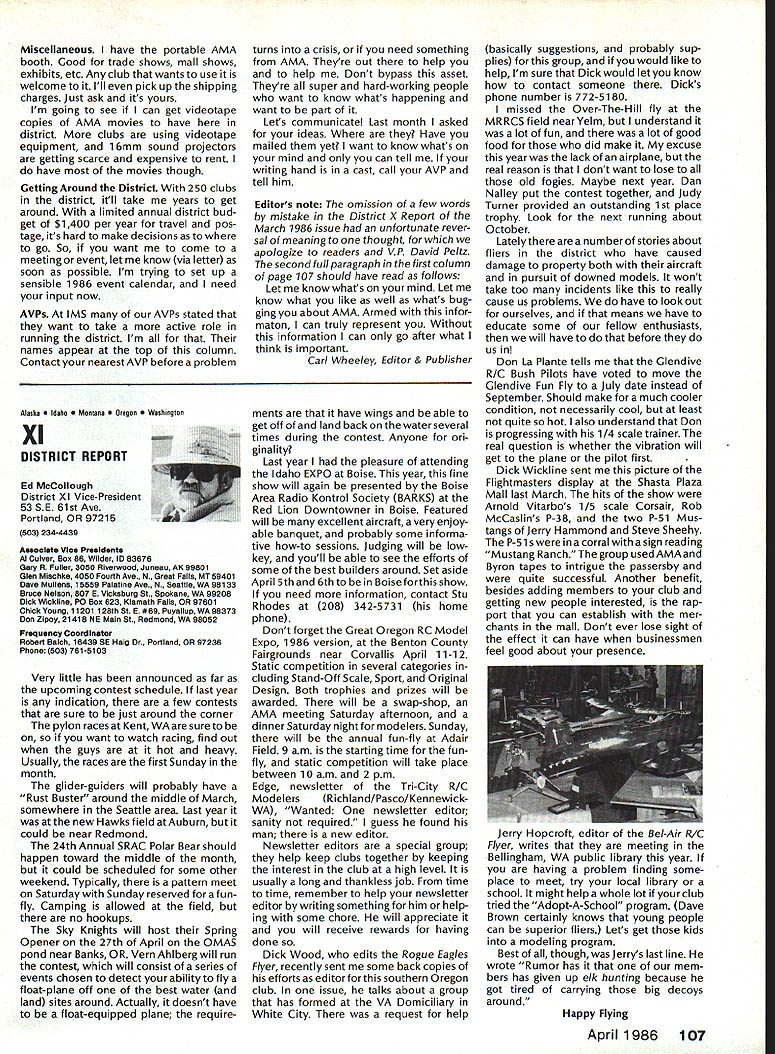
- Flightmasters display at Shasta Plaza Mall featured large scale aircraft and successfully engaged shoppers.
- Rumor: one club member gave up elk hunting because he got tired of carrying large decoys.
---
District 8 Report
(An overview and call to action from the District 8 Vice President)
With AMA membership rising above 105,000, District 8 now numbers near 15,000 members. Plans and proposals include:
- Recontact all current District 8 officers and appointees to reconsider and possibly refresh appointments; create meaningful and effective district roles.
- Hold a District 8 meeting in the Dallas/Fort Worth area (April–June) sponsored by clubs representing Radio Control, Control Line, Free Flight, and Soaring. The meeting aims to include AVPs, contest board members, contest coordinators, frequency experts, and club representatives. It will be a chance for constructive input and leadership development.
- Support the 50th Anniversary National Model Airplane Championships and Birthday Party (Lake Charles, LA, July 25–August 3). Competition events and funding will not be reduced; in fact, more time and money are being invested in competition at the Nats to allow the broader AMA membership to participate.
A light note: sweepstakes notices aside, the VP is committed to serving District 8 and helping build a well‑organized district.
---
Final Notes and Next Steps
- The next article will examine local ordinances and Federal government rules related to sound.
- Expect published guidelines on conducting sound surveys, recommended equipment, and practical mitigation measures.
- If you have relevant information, data, or experience, please send it to the AMA Sound Committee or AMA headquarters.
Happy flying — and please fly safely.
Transcribed from original scans by AI. Minor OCR errors may remain.

