
Mortgage Reduction Program
Geoffrey Styles Director of Public Relations
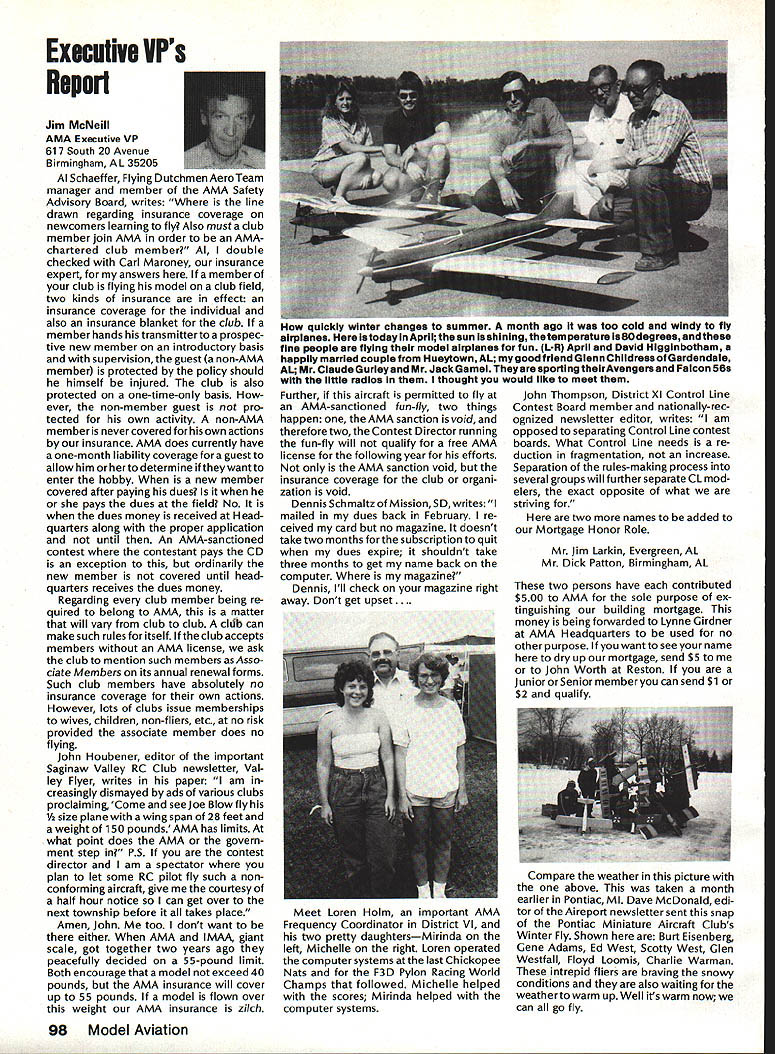
The 1986 Mortgage Reduction Program is underway. Joe Beshar, Mortgage Depletion Director, AMA 175, offered a plan to the Executive Council and his offer was accepted (see Model Aviation, May 1986).
A letter has been mailed to all chartered club presidents asking them to urge members to work actively for the elimination of the mortgage on the National Center for Aeromodelling. Immediate savings can be realized with every reduction in the outstanding mortgage. Annual interest costs on the building construction loan are running at about $65,000.
It is estimated that if every member can convince one non-AMA person to contribute only $5 for the benefit of model aviation, the mortgage could be chopped in half. This would help the entire AMA organization. If all present AMA members would pick up this challenge — not by taking money from their own pockets but by convincing others that it is a worthwhile purpose — that would be a huge step forward.
Can you do it? Sure you can. Are you willing to do it? That is a question only you can answer. If you feel having the National Center for Aeromodelling as a "Mecca" for all aeromodellers is one of the greatest things that has happened to the sport (ask anyone who has visited Reston — they'll tell you), then a bit of effort with friends, business associates, and neighbors is well worth it.
Give it a try. Pull in five-dollar bills and checks (they are tax deductible). Let's all work to get rid of this mortgage. We can do it if we convince others that our activity benefits the community and should be supported by it.
These two persons have each contributed $5.00 to AMA for the sole purpose of extinguishing our building mortgage. This money is being forwarded to Lynne Grider at AMA Headquarters to be used for no other purpose. If you want to see your name here or to help retire the mortgage, send $5 to me or to John Worth at Reston. If you are a Junior or Senior member you can send $1 or $2 and qualify.
---
AMA Film Library
Presently in stock are 19 films which can be rented by AMA Chartered Clubs and Open members for $10 (an additional $50 deposit is required). All are 16 mm, and most are in color with sound. Send a pre-addressed, stamped business-size (No. 10) envelope to the Film Librarian, Academy of Model Aeronautics for a full listing of the films and an order form.
Partial listing:
- Wings & Things — Music, no narration. General-interest British-made film, excellent coverage of all types of model flying. About 25 minutes.
- I Fly 'Em, I Break 'Em, I Fix 'Em — Scale model flying at Rhinebeck, N.Y. Produced by Jerry Joseph, Eastman Kodak Company. About 20 minutes.
- 1971 RC Aerobatics World Championships — Doylestown, Pa. The story of the first time this event was held in the U.S.; AMA's first professionally produced film. About 25 minutes (AMA film by Jay Gerber).
- The Choppers — History, construction, and flying of RC helicopters.
Good News! The AMA Film Librarian now has Beta videotapes available for sale at $25.00 each. Titles include:
- Those Marvelous Miniatures — 46 mins.
- Grand Illusions — 36 mins.
- Wired for Excitement — 30 mins.
- Adrift on the Air — 30 mins.
- The Choppers — 20 mins.
Order from: AMA Film Librarian, 1810 Samuel Morse Drive, Reston, VA 22090. Include $2.50 per tape for shipping and be sure to specify "Beta." All shipping charges are prepaid by AMA.
---
AMA News
Geoffrey Styles, Director, Public Relations
1986 Mortgage Reduction Program (summary)
- Joe Beshar, Mortgage Depletion Director, proposed a plan accepted by the Executive Council.
- Chartered-club presidents have been asked to encourage members to help eliminate the National Center mortgage.
- Annual interest on the construction loan is about $65,000.
- A $5 contribution from non-members convinced by current members could make a substantial dent in the mortgage.
Next Month
Back on schedule, but with another week between writing and deadline. If you have a club or individual to be mentioned, send information or call evenings at 804-296-2662.
---
Sound — Model Aeronautics
Howard Crispin
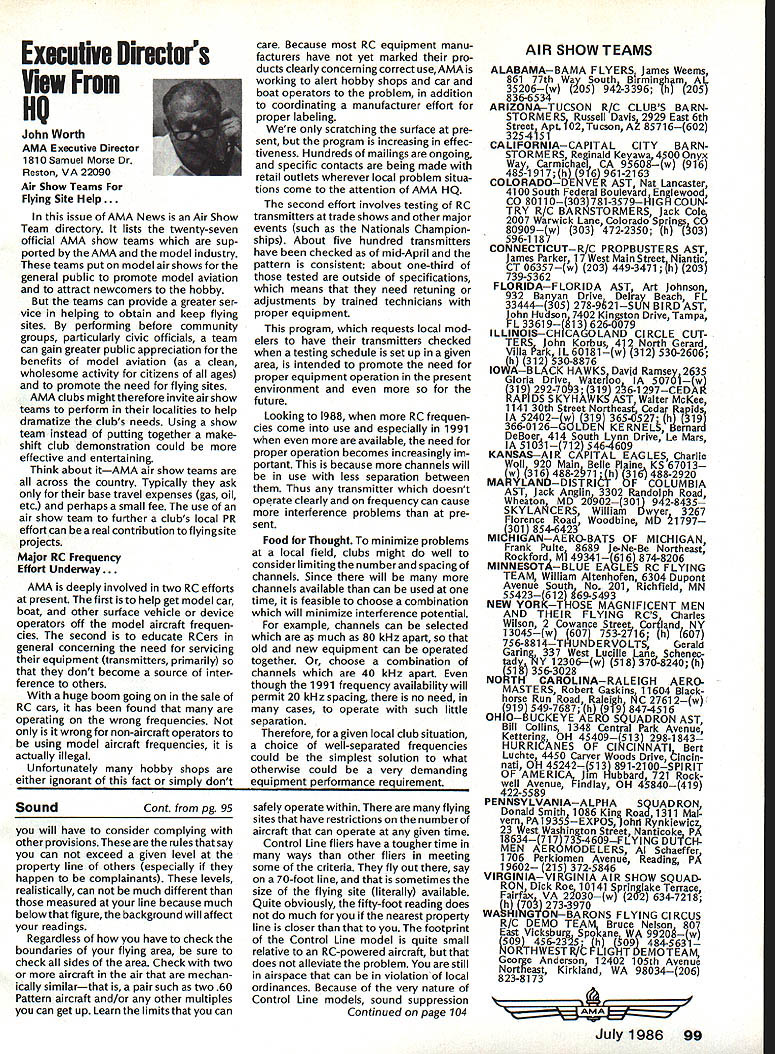
Community standards for acceptable sound levels vary. Many communities are drafting ordinances based on model documents prepared years ago. One commonly referenced document is the Model Community Noise Control Ordinance (EPA/National Institute of Municipal Law Officers), approved September 1975, a 58-page document available as PB262-005 from the U.S. Department of Commerce, NTIS (Springfield, VA 22161). Cost: $11.95.
The model ordinance is useful because:
- In areas that have not yet enacted ordinances, citizens can participate in public hearings and influence ordinance language.
- The document contains figures (decibels, distances) and suggested formats, but drafters omitted specific recommended sound levels and curfew hours in many cases to allow localities to set values appropriate to local conditions.
- The ordinance emphasizes protecting public health and welfare as the legal basis for control.
Purpose
The Model Community Noise Control Ordinance is intended as a basic tool for communities, large and small, to construct noise-control ordinances suited to local needs and conditions. Optional provisions suitable for larger communities (populations around 100,000) are included. Smaller communities or those with limited resources may adopt provisions that address their pressing noise problems. Adopted provisions should be realistic and consistent with state and federal law to minimize enforcement problems.
Background
The model ordinance grew out of the Federal Noise Control Act of 1972 (42 U.S.C. 4901 et seq.). Interest in noise abatement prompted revision of outdated ordinances and approaches that relied solely on nuisance law, which is often hard to enforce. The model preserves common-law remedies (Article VI provisions prohibiting noise disturbances) while adding definitive performance standards for motor vehicles and other sources. With improved monitoring equipment and clear standards, local ordinances should become more enforceable.
Specific Provisions (examples)
- Definitions: The ordinance generally uses the term "sound" rather than "noise" to avoid requiring proof that the sound was disturbing or unwanted when objective performance criteria are specified.
- "Powered motor vehicle" includes any self-propelled airborne, waterborne, or landborne plane, vessel, or vehicle not designed to carry persons, including model airplane, boat, car, or rocket (Section 3.2.23).
- Prohibited Acts (example): Operating powered model vehicles so as to create a noise disturbance across a residential real property boundary, in a public space, or within a noise-sensitive zone during specified curfew hours. Maximum sound levels for public spaces and residential property are referenced to tabled values and measurement distances (example given in Section 6.2.11 and Section 8.1). Noise-sensitive zones (hospitals, etc.) have special provisions (Section 6.2.16).
These sections help explain the source of many local laws and offer a starting point for participation in local ordinance development.
Muffler and Engine Noise
- Mufflers designed for specific engines vary; a muffler made for an OS 1.20 four-stroke was tried on an Enya 1.20 and did not perform as expected because Enya stacks are larger.
- Four-stroke engines may be quieter at certain frequencies, but their peak decibel level can still be high and benefits from muffler attention.
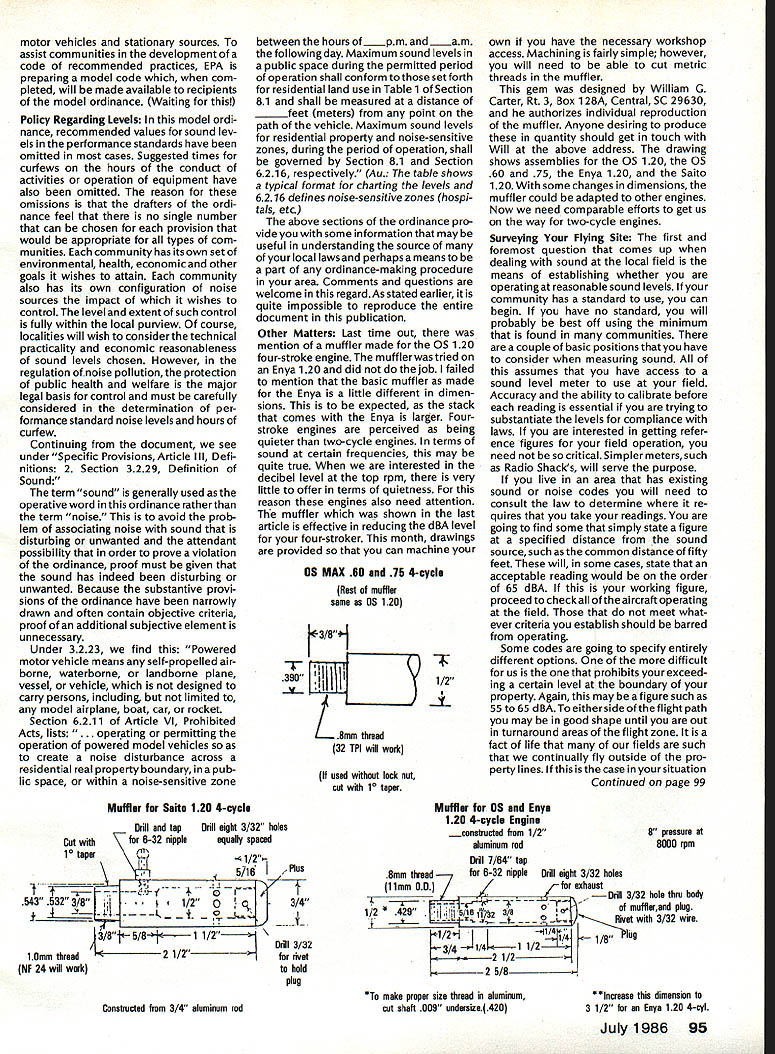
- A muffler design effective in reducing dBA for four-stroke engines was designed by William G. Carter (Rt. 3, Box 128A, Central, SC 29630). The design authorizes individual reproduction; commercial producers should contact the designer. Drawings are available for OS 1.20, OS .60/.75, Enya 1.20, and Saito 1.20; with dimensional changes, the muffler can be adapted to other engines. Machining requires the ability to cut metric threads.
Surveying Your Flying Site
If you are concerned about sound at your local field:
- Measure: If you don't measure, you won't know. A sound level meter is essential for reference figures; calibrate before each reading for accuracy. Simpler meters (e.g., retail models) can provide useful reference data.
- Check local codes: Some laws specify readings at a fixed distance from the source (e.g., 50 feet) and acceptable dBA figures (often around 65 dBA). Other codes measure at the boundary of the property (55–65 dBA). Know which standard applies in your area.
- Test multiple aircraft: Take readings with two or more mechanically similar aircraft in the air to learn operational limits.
- Control Line concerns: Control-line fliers may be constrained by site footprint; the common 50-foot measurement may not be appropriate if property lines are closer.
- Enforcement and equipment: Consider local transmitter testing programs and proper labeling of RC equipment. Clubs can limit the number and spacing of channels to reduce interference (e.g., use well-separated frequencies such as 80 kHz or 40 kHz where practical).
Comments and questions about local ordinance procedures are welcome; the full model ordinance is available from NTIS for those who want to study it in detail.
---
When Spring Comes...
Geoffrey Styles, Director, Public Relations
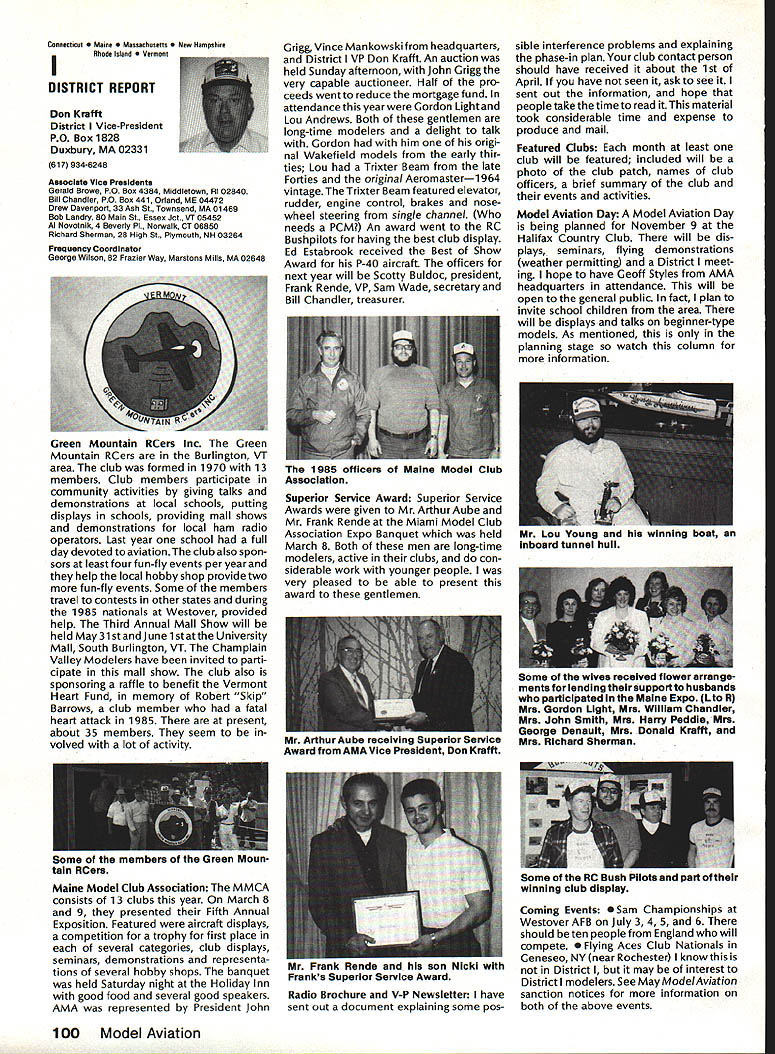
The flying season is upon us — broken props, bent landing gear, smashed fuselages, torn covering, and splintered balsa are often not far behind.
Highlights and club notes:
- Use Down Elevator: For inverted low fly-bys, down elevator instead of down throttle is advised (credit: Pushrod, Reelector Aeromodelers, Union City, TN).
- Crash Etiquette: After a crash, remain calm. Turn off the transmitter, return it to impound, and maintain composure. Onlookers should stay calm and offer supportive remarks or a beverage — poor etiquette includes cursing and slamming equipment.
- Smackaroonoy: An event occurring after overcoming invertaphobia.
- Mississippi’s Largest RC Fly-In: Greenwood Telefaire Airport, Greenwood, MS — Sunday, June 22. Quarter-scale helicopter sport, scale, control line, barbecue lunch, swap shop, and full-scale aerobatics. Call Mark Bowie at (601) 455-4268.
- R/C World Flyers: A new club in Florida forming an IMAA chapter; planning the Third Annual RC World Flying Festival (Thanksgiving weekend).
- Safety Note: Do not fly models over the pits — akin to pointing a gun at people. Editor Chris Gregory (Propwash) stresses safety.
- Monokotaton / Inversenomonotation: Terms referring to covering with MonoKote and applying heat incorrectly.
- Editor’s Choice Award: Indian River Kontrol Society (FL) recognizes outstanding newsletter articles.
- Club technology: Many newsletter editors are switching from typewriters to word processors and desktop publishing (examples: Sunbeam, Trac News).
- Flying sites: Many clubs struggle to maintain flying sites; some towns have multiple good sites and interest from full-scale owners.
- Fun-Fly Naming: Choctaw Aeromodelers debated naming a fun-fly after a living member, Doc Edwards, with good-natured discussion.
- Mall Show: Atlanta Drone Society used a mall show to explain they have no flying site while displaying models and VCRs.
- Small practical tips: Use No. 000 gelatin capsules to protect spare glow plugs; they seal out dirt and protect filaments (Amory R/C Modelers, MS).
A note of thanks to air show teams — they practice and expend resources to bring aeromodeling to the public.
Bill Mathews — "Safety is ... using your head, not losing your head!"
---
District & Club Roundup
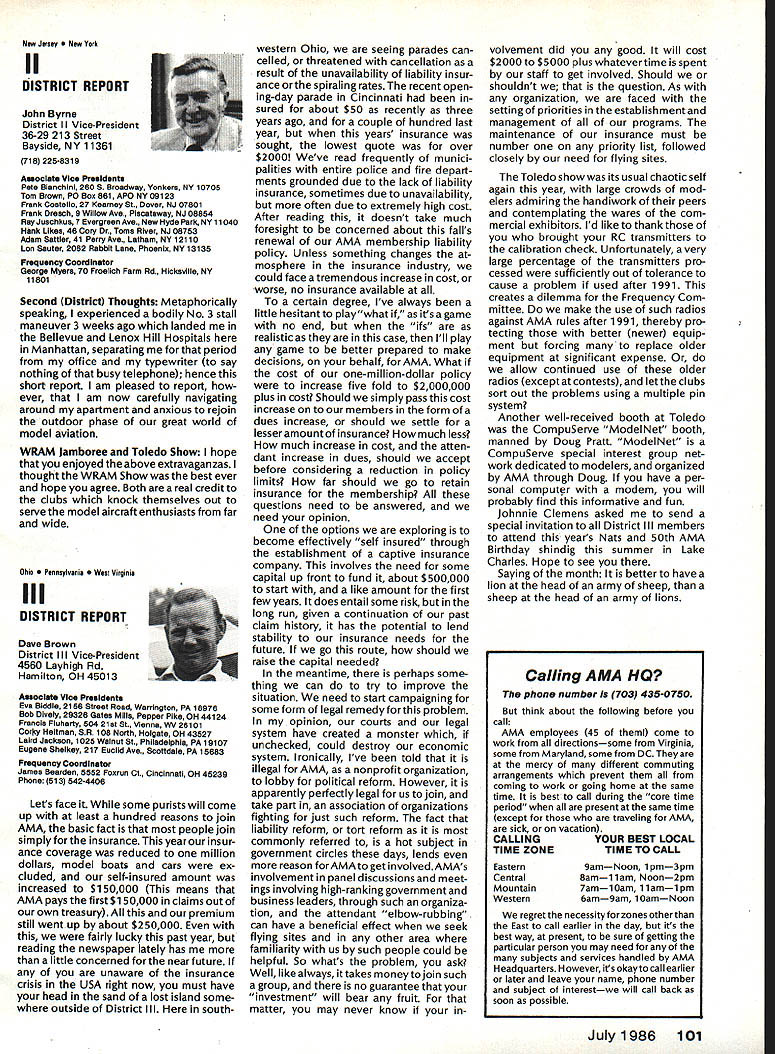
- CARDS at Lansing host the IMAA Rally of Giants at Grand Ledge Airport, July 17–20.
- District meeting planned in Grand Rapids this fall; Geoff Styles from AMA HQ to run a seminar on flying fields.
- Clubs are emphasizing safety — appoint safety officers and run checks on models as meets begin for the season.
- Tape libraries: Clubs building audio/video libraries; AMA Tech Tapes will soon be available.
Keep thinking Battle Creek for '87!
---
JUNIOR FLIGHT!
Ed Whitten Box 176, Wall St. Sta., New York, NY 10005
"Bring all the parts together in magnificent harmony." — Ludwig van Beethoven (applied here to model building)
Basics Review
Gold Basics (make a model fly):
- Correct balance point
- Correct wing-stabilizer difference
- Correct thrust angle
Silver Basics (make your model fly well):
- Lightweight airframe
- Correct propeller selection
- Correct power selection
Lightweight construction is the most important Silver Basic. Five rules for building light:
- Eliminate all unnecessary parts and details.
- Provide strength only where needed.
- Select wood with proper grain.
- Use glue sparingly.
- Keep covering light and apply as little dope as possible.
Parasitic Weight — A Graphic Illustration
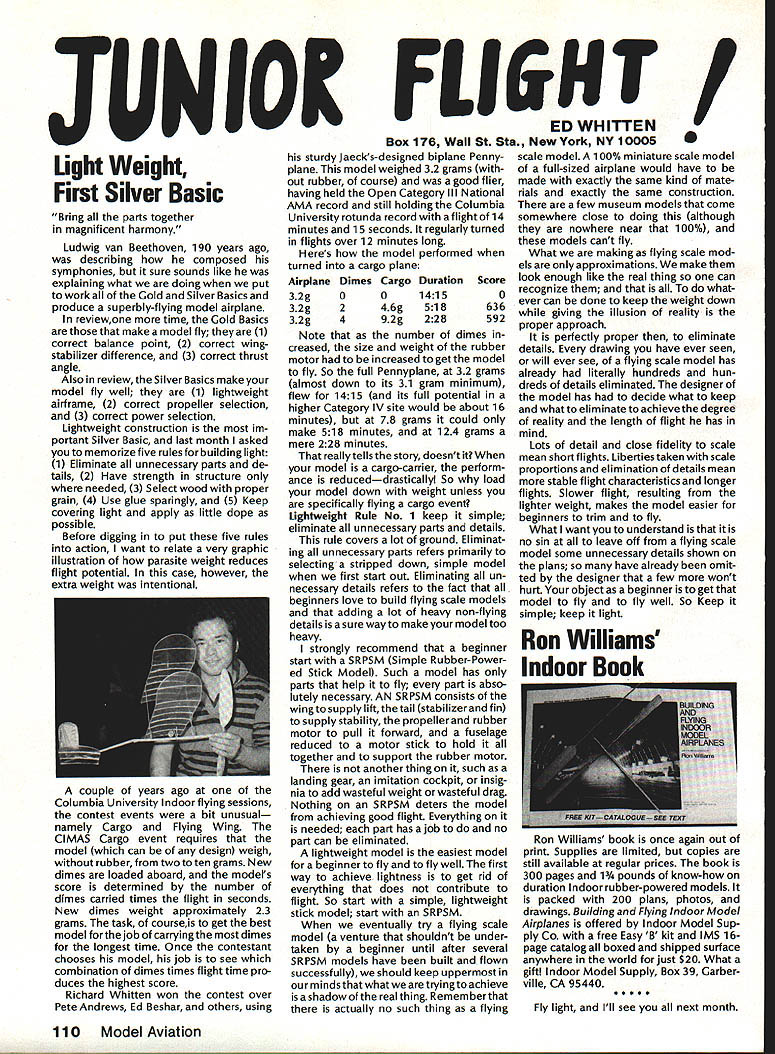
At a Columbia University indoor flying session, a Cargo event required models to weigh (without rubber) from 2 to 10 grams. New dimes weigh about 2.3 grams; the score was dimes carried × flight time (seconds). A Jack-designed biplane "Pennyplane" weighing 3.2 g (without rubber) regularly flew over 12 minutes and held records.
Performance when loaded with dimes:
- Model weight: 3.2 g, Dimes: 0, Cargo wt: 0, Duration: 14:15, Score: 0
- Model weight: 3.2 g, Dimes: 2, Cargo wt: 4.6 g, Duration: 5:18, Score: 636
- Model weight: 3.2 g, Dimes: 4, Cargo wt: 9.2 g, Duration: 2:28, Score: 592
As the number of dimes increased, rubber motor size and total weight increased and flight duration dropped dramatically.
Lesson: Extra weight drastically reduces performance — avoid adding unnecessary weight unless required for a specific event.
Lightweight Rule No. 1 — Eliminate Unnecessary Parts and Details
- Beginners should start with a simple rubber-powered stick model (SRPSM). An SRPSM includes only parts essential to flight: wing, tail, propeller, rubber motor, and a minimal fuselage (motor stick). No landing gear, cockpit details, or heavy scale embellishments.
- Flying scale models are approximations. Designers often eliminate many small details to achieve acceptable flight performance. Leaving off unnecessary details is not improper — it helps the model fly longer and more stably.
- A lightweight model is easier for beginners to trim and fly successfully.
Fly light, and I'll see you all next month.
Transcribed from original scans by AI. Minor OCR errors may remain.

