
27 MHz RC FREQUENCIES UNCHANGED BY FCC ACTION!
The FCC has acted to keep the existing five RC 27 MHz frequencies and to retain the Class C regulations without change.
The CBers will increase their channels from 23 to 40 with the addition of 17 channels between 27.230 and 27.410 MHz. The new channels are located on the upper end of the 27 MHz band and pose no threat to RC operation. The new CB channels become effective January 1, 1977.
The Second Report and Order on Docket 20120 was adopted on July 27, 1976. We quote from paragraph 9 of this document: "With respect to our proposal to reallocate present 27 MHz Class C channels to the Class D Service, we believe such an action is unwarranted at this time." Comments filed by the Academy of Model Aeronautics, as well as hundreds of individual radio control operators, indicate that significant use is presently being made of the 27 MHz Class C channels. We believe that, eventually, alternate frequencies must be found to supplant the present 27 MHz Class C allocation because of the increasing problem of interference by Class D users to Class C radio control operations. However, in as much as no such alternate frequencies are presently available, and because of the significant investment in 27 MHz radio control equipment by modelers, a reallocation as proposed in our Further Notice is premature.
It should be noted, however, that the Industrial, Public Safety and Land Transportation (mobile) services were not so fortunate. The new CB frequencies will come from their channels in the range 27.230 to 27.410 MHz in even ten kHz steps. Land mobile users in this frequency range will be allowed to continue operating on their presently assigned frequencies until December 31, 1976, but will have to share them with CB users and will not be afforded protection from interference by Class D Citizens Radio Service licensees.
Specifically, by taking the following steps in its Docket 20120 reallocation, the FCC has:
- Declined to allocate Class C Citizens Radio Service frequencies for Class D use or to combine Class C and Class D under a single license since comments filed indicated very substantial use of these frequencies by Class C licensees.
- Allocated 17 additional channels to the Class D Citizens Radio Service (making a total of 40 channels) to become available for use beginning January 1, 1977.
- Declined to allocate additional frequencies proposed since this would have made the frequency spread between the first and last channels more than 440 kHz, creating a potential for intermodulation (IM) interference problems.
- Required present land mobile licensees operating on the reallocated channels to change frequency by no later than December 31, 1979 and to share their frequencies with CB users in any event beginning January 1, 1977.
- Held that after September 10, 1976 station authorizations in the range 26.96 MHz to 27.41 MHz will be issued only to licensees in the Citizens Radio Service. No new licenses on these frequencies will after that date be issued to land mobile (Industrial, Public Safety and Land Transportation) applicants.
- Permitted both AM and single sideband operations on all CB frequencies with both upper and lower sideband use permitted.
- Required that second and higher order harmonic radiation be suppressed by at least 60 dB for all transmitters type accepted for use as Class D Citizens Radio Service stations. Compliance with this requirement must be demonstrated both with and without connection of all attachments permissible for use with such transmitters.
- Declined to adopt the proposed 25 Hertz frequency tolerance or the proposal to require information labels on Class D units.
- Adopted the requirement for engraving of serial numbers on CB units.
- Prohibited installation of any device, whether internal or external, designed to extend the frequency range of a Class D transmitter beyond its original frequency range. This would not prohibit the sale of 23-channel units modified before sale to cover additional frequencies allocated for CB use. Such modified units, however, would have to reapply for FCC type acceptance.
- Discontinued further rule making action regarding type acceptance/approval of antennas.
- Declined, for the present, to change the name of the Citizens Radio Service, although this change may be made at some later date.
- Declined to lower the age requirement for the Class D Service from 18 years to 16 years.
The Commission noted that about 4,000 land mobile licensees would be dislocated by the reallocation of frequencies to CB use. However, since the Class D service is growing at the rate of 1/2 million licensees per month, the Commission concluded that the public interest lay in allocation of additional channels for CB use rather than protection of the 4,000 existing land mobile licensees.
Fortunately, there were ten times as many Class C licenses on file, so the FCC had good reason to leave RC channels alone. To keep the situation as it is, and to improve it further, we need to up the ratio another tenfold. This can be done if all those using a club license apply for individual licenses. So, for everyone who feels in any way grateful for how the FCC campaign turned out, the best way to show appreciation and to further protect our position with the FCC, the need is to be sure that all those who do not now have individual FCC licenses get them.
Consider it a donation of thanks—a $4 contribution to help guarantee that RC interests are respected by the FCC. AMA will send license applications to anyone who requests them—no charge. Clubs may order in whatever quantity they need to get all their members individually licensed. It can be an effective meeting night to have everyone present fill out applications then and there—at one meeting, as a dramatic followup to the FCC.
We won a big battle, but there's more to the trend than a one-shot effort. The followup is even more important to the long range problem. AMA will be working on getting new frequencies—you can help by proving that there are many more RCers out there than the FCC previously believed.
RESULTS OF NATS COUNCIL MEETING
NO DUES INCREASE FOR 1977!
Following examination of the mid-year financial report the council voted unanimously to maintain the 1976 AMA dues structure as is for 1977. It was noted that this was in keeping with a promise made at the time of the last dues increase (1973) to not have another for at least five years.
NO CHANGE TO RC SITE SEPARATION.
Noting that many clubs had reported non-interfering operations within two miles of each other, the council agreed to keep the current suspension of AMA RC Safety Code Item 4 in effect, pending further data inputs concerning such operations.
1977 NATS POSSIBILITIES REVIEWED.
Oxnard, Calif., was presented as a new California possibility, following suspension of negotiations for Brown Field near San Diego. The new California site possibility is to be examined in further detail, prior to the next council meeting on September 18. Object is to compare this possibility with firm offers from Springfield, Ohio, and Lake Charles, Louisiana.
DISTINGUISHED SERVICE AWARD APPROVED.
Ted Thompson, Assistant City Manager of Springfield, Ohio, was voted this award for special efforts in connection with the use of Springfield Airport for the 1976 Nats.
NEXT COUNCIL MEETING IN DC.
September 18 is the date approved. It was noted that, due to the busy nature of FAA activities, needed extensive discussion would be better away from the time limitations and conflicts of attention inherent in a Nats meeting situation.
MINUTES OF NOMINATING COMMITTEE MEETING
Meeting convened at 8 PM at Stuart Hall, University of Dayton. Present were: District I, Chet Piper; II, John Byrne; III, Don Love; IV, Chuck Foreman; V, Jim McNeill; VI, Glenn Lee (arrived 8:16); VII, Hardy Brodersen; VIII, Murray Frank; IX, Stan Chilton; X, Alex Chisholm; XI, Homer Smith (arrived 8:14); Sec.-Treas., Earl Witt.
Nominations from HQ files not previously distributed were handed out along with a tabulation of nominations. It was noted that some nominations listed were verbal information and not in the file. Two nominations were presented from District IV by Chuck Foreman.
Meeting was called to order at 8:08 PM by the undersigned. It was noted that the secretary-treasurer was presiding as chairman by appointment of the president, with further instructions that Dist. I VP was to preside for
AMA News
The FCC has acted to keep the existing five R/C 27 MHz frequencies and to retain Class C regulations. The change will increase CB channels from 23 to 40 with the addition of 17 channels between 27.230 and 27.410 MHz. The new channels, located at the upper end of the 27 MHz band, pose no threat to R/C operation. The new CB channels become effective January 1, 1977. Second Report and Order, Docket 20120, adopted July 27, 1976.
In paragraph 9 of the document, with respect to the proposal to reallocate present 27 MHz Class C channels to Class D service, the Commission believes such action is unwarranted at this time. Comments filed by the Academy of Model Aeronautics as well as hundreds of individual radio control operators indicate significant use is presently being made of the 27 MHz Class C channels. The Commission believes that eventually alternate frequencies must be found to supplant the present 27 MHz Class C allocation because of increasing problems of interference from Class D users to Class C radio control operations. However, as no such alternate frequencies are presently available and because of the significant investment in 27 MHz radio control equipment by modelers, the reallocation proposed in the Further Notice is premature.
It should be noted, however, that Industrial, Public Safety and Land Transportation mobile services fortunate in that the new CB frequencies will come in the channels in the range 27.230–27.410 MHz in 10 kHz steps. Land mobile users in the frequency range will be allowed to continue operating on their presently assigned frequencies until December 31, 1976 and will have to share those frequencies with CB users; they will be afforded protection from interference by Class D Citizens Radio Service licensees. Specifically, taking the following steps in its Docket 20120 reallocation, the FCC has:
- Declined to allocate Class C Citizens Radio Service frequencies to Class D use or to combine Class C and Class D under a single license since comments filed indicated very substantial use of the frequencies by Class C licensees.
- Allocated 17 additional channels to the Class D Citizens Radio Service, making a total of 40 channels available for use beginning January 1, 1977.
- Declined to allocate additional frequencies proposed earlier since that would have made the frequency spread between the first and last channels 440 kHz, creating potential intermodulation (IM) interference problems.
- Required present land mobile licensees operating on reallocated channels to change frequency no later than December 31, 1979, to share frequencies with CB users in the event of the beginning of CB use on those channels on January 1, 1977.
- Held that after September 10, 1976 station authorizations in the range 26.96 MHz–27.41 MHz will be issued to licensees of the Citizens Radio Service. No new licenses for the frequencies will after that date be issued to land mobile (Industrial, Public Safety, Land Transportation) applicants.
- Permitted both AM and single sideband operation on CB frequencies; both upper and lower sideband use is permitted.
- Required that second and higher order harmonic radiation be suppressed at least 60 dB in transmitters of the type accepted for use by Class D Citizens Radio Service stations. Compliance with the requirement must be demonstrated with both the connection and attachments permissible for use with such transmitters.
- Declined to adopt the proposed 25 Hertz frequency tolerance proposal and to require information labels on Class D units.
- Adopted the requirement that serial numbers be engraved on CB units.
- Prohibited the installation of any device, whether internal or external, designed to extend the frequency range of a Class D transmitter beyond its original frequency range. This would prohibit the sale of 23-channel units modified before sale to cover the additional frequencies allocated to CB use. Such modified units, however, would have to reapply for FCC type acceptance.
- Declined to change the present name “Citizens Radio Service,” although a change may be made at some later date.
- Declined to lower the age requirement for the Class D Service (18 years remaining; proposal was 16 years).
The Commission noted about 4,000 land mobile licensees would be dislocated by the reallocation of frequencies to CB use. However, since the Class D service is growing at a rapid rate (hundreds of thousands of licensees), the Commission concluded the public interest lay in the allocation of additional channels to CB use rather than in protecting the 4,000 existing land mobile licensees. Fortunately, ten times as many Class C licensees filed with the FCC, providing good reason to leave R/C channels alone and to keep the situation from deteriorating further. If greater relief is needed in the future, it can be achieved by using club licenses or by individual applicants applying for appropriate authorizations.
AMA News
kind enough to mention to John Worth and he later that now they understood what AMA had been up against in trying to please them in the past with all those different opinions. And there is nothing wrong with the differing opinions, because they stem from the fact that these folks are just such dedicated competitors that they want the competitions to be perfect. This is when THOUGHTFUL COMPROMISE becomes a MUST!
The N.S.R.C.A. is being invited to join in the operation of their phase of the next year's "NATS" and are sure not wasting any time getting going. George Hill has ALREADY been to AMA Headquarters to find out just where to get started. That's great!
It has been a long hard pull, but our AMA-assisted SPECIAL INTEREST GROUPS are really becoming effective. The secret of the whole thing is to try to be understanding and willing to compromise to get things moving forward.
A MAN-POWERED DISASTER
It is a fact that man-powered aircraft fascinates commentator PAUL HARVEY. On his early broadcast this morning he had an item about the builder of one of these super-light and fragile craft that an aspiring aeronaut had just finished. He went to the place where the craft was stored — to find that the hangar had collapsed on it!
THE AIR FORCE MUSEUM — DAYTON, OHIO
Nearly everyone who attended the AMA "NATIONALS" in the Dayton-Springfield area of Ohio went to see the AIR FORCE MUSEUM. It is claimed to be the world's largest, and is complete military aircraft museum, and it is truly a fantastic place for anyone who is aeronautically "bent". The Museum is on the Wright-Patterson Air Force Base complex right next to where we were holding our AMA Nationals. A visit to the Museum was considered to be an extra "bonus" for all those attending the "NATS", and as a still extra bonus, admission to the Museum is free. If you ever have the chance, be sure to see it, BUT GO EARLY! The Museum closes at 5PM and it will take a long time to really enjoy it.
I suggest you plan to be there over the lunch period as the Museum has an excellent lunch room. The souvenir shop and the book and model shop are also both very good.
I haven't even mentioned the multitude of aircraft on display. It is overwhelming. BUT I MUST MENTION that a great part of the success of the display must be credited to the hundreds of MODEL AIRPLANES that it takes these fine museums like the AIR FORCE MUSEUM and the SMITHSONIAN AIR AND SPACE MUSEUM to tell the full story. SURE, we owe these museums a salute, BUT THE SURPRISE WAS THE TIP OF THE HAT TO AEROMODELING TOO!
And AMA modelers are everywhere! We were personally escorted through the museum by Museum Staff Member, JOE FALLO, who also just happens to be an AMA member #270003. Many of the models and dioramas on display are products of this skilled member. Joe was also kind enough to introduce us to the Curator of the Museum, Mr. ROYAL FREY, also an enthusiastic modeler. To ice the cake we learned from these two fine fellows that the Air Force Officer who will be taking command of the Museum in October is an avid and enthusiastic R/C modeler!
I'M NOT ALWAYS SMART!!
Someone asked me if, when I brushed my teeth, I used one hand or both hands. When I replied that, of course, I only used one hand, he said, "That's very interesting! How do you get the cap off of the toothpaste?"
ANOTHER FREE-FLIGHT HAZARD
BOB STIFFLET, several times National Champ, and I got a chance to visit for a few minutes at the NATS. Bob said he now owns a farm at Glen Rock, Pennsylvania. I mentioned that it must be nice to have your own farm to fly on so you didn't have to argue with some farmer about retrieving your wayward model plane. Bob agreed but said, "There is nothing more disgusting than losing your free flight model in your own corn field!"
FROM DCRC (Washington area) NEWSLETTER
A cartoon in the newsletter shows a plaque on the wall of a modeler's home with wording as follows:
GOD BLESS OUR DOPE SCENTED HOME.
To which we all say "AMEN".
WOMAN DISCOVERS NEW USE FOR "HEADACHE"!
From the same August DCRC Newsletter: an article, "Helpful Pointers" by KAREN TOBE, who is Sec.-Treas. of WOMEN IN NATIONAL GLIDER SOARING, says, "When you arrive home from a day of successful flying and the plane is still in one piece, I am free to talk of my newly acquired skill and to how everything has just the way I planned it. If, however, my 'skills' have made the plane to very badly need repair, I suddenly get a headache and have to go idle down for a couple of hours to relieve it. This trick gets me out of having to help with the repairs or listen to my husband mumble about what a mess I made of the whole day." SAME OLD "HEADACHE" STUFF!
MODEL PLANE CRASHES INTO HUDSON RIVER
Newsletter editor E. R. Van Gorder notes in the Mid-Hudson Modelers "Wing Tips" that Jim "CRASH" Baker of that club actually crashed a control-line model (of all things!) into the Hudson River, and that isn't easy unless you're treading water. "CRASH" Baker was a little too close to the shoreline, the plane inverted — had an engine snag — and dunked it! He claims he then just stood there and reeled it in like a fish!!
REMEMBER — RELAX!!
AEROMODELING IS SUPPOSED TO BE A HOBBY!
Probably the most relaxed and just downright FUN thing held in connection with the 1976 "NATS" at Dayton-Springfield-Ohio was the OLD TIMER or "GAS" competition. The other competition is keen still and competition is actually an "excuse" to get together and simply enjoy the combination of model planes and EACH OTHER!
COMPASSION AND APPRECIATION
IN AMA. In a letter from WILLIAM BELL, an AMA and SAM Member from Baltimore I learned of an action of concern and compassion that I thought you might enjoy sharing with me. Bell wasn't able to attend the SAM and NATS Championships because of recent surgery on his back. A bunch of Bell's buddies pressed a "get well" card around until it contained about 100 names, and then they sent it to him from Dayton to speed up his recovery. He now is absolutely determined to "get there next time". He asked me to express his appreciation, because if you will remember just those years ago the hundreds of messages I received from so many of you helped me thro' a "terminal" illness. Being kind to one another can return to you in so many ways!
Of course the sentimental side of William Bell's letter was the important part of it, but I discovered something else from his letter. His return address showed he lived at 113 DIDERAL DRIVE in Baltimore. Since he is an active modeler I thought that was just too much of a coincidence, so I looked it up in AMA's roster file. And sure enough, AMA-11520 Bell lives on that DIDERAL DRIVE. I've gotta quit sniffin' that glue! I gotta quit!
MODELERS' CONTRIBUTION TO AVIATION
The contribution that modeling makes to the world of full scale aviation is truly very impressive. Latest article to that is an article I found on page 68 of the September 1976 issue of POPULAR SCIENCE magazine. It is about a completely new concept of VTOL (vertical takeoff and landing) aircraft called the "NURDCRAKER" because it actually folds its wings to the middle and "dances on its tail." I admit I was sort of "ho-hum" about this proposed new design because it appeared to be strictly in the inventor's pipe-dream class. Then I caught an illustration that told the top of page 67 saying that this weird airplane had ACTUALLY BEEN BUILT AND FLOWN IN MODEL FORM. The article said it had been built by "one of ours", AMA Member 17505 NICK ZIROLI of Smithtown, N.Y.
I was no longer "ho-hum" and called Nick on the phone for confirmation. He was surprised to find out that his name was actually in the article, as he had never sent the little model article yet.
You'll have to see the article and the photos (in the issue of Popular Science, Sept.) to believe it, and I sure can't describe it. Nick says the model is about 7 feet long, with less than 5 foot wing span. It is powered by two radial engines plus counter-rotating props that turn in shroud housings. It weighs about 20 pounds and is flown at present on two .049s and is gyro-stabilized. Ziroli says the ship is highly maneuverable and performed under contract to Grumman under his own company for model tests.
THANKS NICK for helping add the dignity of importance to what we do with models!
TO ADD FURTHER DIGNITY TO WHAT WE DO —
I may wish to mention to any detractor of model aviation that the UNITED STATES right now has a terribly expensive vehicle parked on the planet MARS, and it was put there by RADIO CONTROL using the same principles and technology that we fly models with. Many of the technicians came directly from our aeromodeling ranks.
DON'T EVER LET NO ONE POKE FUN AT OUR MODEL AIRPLANES NO HOW!!
DID YOU JUST SUPPOSE TO LEARN YET, THO — Did you ever notice, you never see birds crash, and they can fly right thru trees without a scratch.
all for now
AMA News
The FCC has acted to keep existing five RC 27 MHz frequencies, retain Class C regulations, and change CB use to increase channels from 23 to 40. In addition 17 channels between 27.230 and 27.410 MHz (in 10 kHz steps) were added. The new channels located at the upper end of the 27 MHz band pose no threat to RC operation. New CB channels become effective January 1, 1977. Second Report and Order, Docket 20120, adopted July 27, 1976.
Paragraph 9 of the document states, in respect of the proposal to reallocate present 27 MHz Class C channels to Class D service, that such action would be unwarranted at this time. Comments filed by the Academy of Model Aeronautics and by hundreds of individual radio control operators indicate significant use presently being made of the 27 MHz Class C channels. The Commission believes eventually alternate frequencies must be found to supplant the present 27 MHz Class C allocation because of the increasing problem of interference between Class D users and Class C radio control operations. However, since no such alternate frequencies are presently available, and because of the significant investment in 27 MHz radio control equipment by modelers, a reallocation proposed in a Further Notice would be premature. It should be noted, however, that Industrial, Public Safety and Land Transportation mobile services fortunate in that the new CB frequencies will come in the channels range 27.230–27.410 MHz in ten kHz steps. Land mobile users in the frequency range will be allowed to continue operating on presently assigned frequencies until December 31, 1976, but will have to share frequencies and will be afforded protection from interference by Class D Citizens Radio Service licensees.
Specifically, taking the following steps in its Docket 20120 reallocation, the FCC has:
- Declined to allocate Class C Citizens Radio Service frequencies for Class D use or to combine Class C and D under a single license since comments filed indicated very substantial use of the frequencies by Class C licensees.
- Declined to allocate additional frequencies proposed since that would have made the frequency spread between the first and last channels 440 kHz, creating potential intermodulation (IM) interference problems.
- Required present land mobile licensees operating on reallocated channels to change frequency no later than December 31, 1979 to share frequencies with CB users; in the event, beginning January 1, 1977.
- Held that after September 10, 1976 station authorizations in the range 26.96 MHz to 27.41 MHz will be issued only to licensees of the Citizens Radio Service. No new licenses for those frequencies after that date will be issued to land mobile (Industrial, Public Safety, Land Transportation) applicants.
- Permitted both AM and single-sideband operations on CB frequencies; both upper and lower sideband use is permitted.
- Required that second and higher order harmonic radiation be suppressed at least 60 dB for transmitters type-accepted for use in Class D Citizens Radio Service stations. Compliance with this requirement must be demonstrated in connection with attachments permissible for use with such transmitters.
- Declined to adopt the proposed 25 Hz frequency tolerance and the proposal to require information labels on Class D units as proposed.
- Prohibited the installation of any device, whether internal or external, designed to extend the frequency range of a Class D transmitter beyond its original frequency range. This would prohibit the sale of 23-channel units modified before sale to cover additional frequencies allocated to CB use. Such modified units, however, would have to reapply for FCC type acceptance.
- Discontinued further rulemaking action regarding type acceptance/approval of antennas.
- Declined at present to change the name "Citizens Radio Service," although a change may be made at some later date.
The Commission noted about 4,000 land mobile licensees would be dislocated by the reallocation of frequencies to CB use. However, since Class D service is growing at a rapid rate, the Commission concluded the public interest lay in allocation of additional channels to CB use rather than in protection of 4,000 existing land mobile licensees.
OCTOBER IS SPECIAL TO MODEL AVIATION
October has again been proclaimed as National Hobby Month by a U.S. Senate Resolution and endorsed by a Presidential Message.
"In our industrialized society," said President Gerald Ford in his National Hobby Month Message, "hobbies provide a greatly needed stimulus and outlet for the inventiveness of our people." During this October observance, all Americans can be heartened by the vitality our nation derives from the wealth of hobbies pursued by citizens of all ages and walks of life.
This nationally publicized event presents an opportunity to recruit and develop community relations or to plan activities for the month.
AMA clubs can take advantage of this opportunity to participate in this nationally publicized program by joining in with any of the many national organizations planning related activities for that period.
Such organizations should welcome the cooperation of an AMA group and be receptive to project ideas.
The American Library Association, for example, is proposing to its 9,000 public library members that during the month they expose books on hobbies and conduct exhibits and demonstrations. Public library superintendents or managers would welcome the suggestion to promote books on RC, Control Line or Free Flight. They may also welcome an offer of a speaker on the subject, as well as films and displays of models.
Many American Legion Posts, as in past National Hobby Months, will hold exhibits of the models of the aircraft its members flew while in the Air Corps and U.S. Air Force. They, too, would welcome a speaker to a community meeting especially if it touched on the educational aspects of AMA and model aviation, which would tie in with the Legion's "Career Education" project.
The National Recreation and Parks Association is suggesting to its members that they schedule hobby events during the month. In many communities parks are excellent sites for model flying demonstrations. They would welcome a volunteer or a club who would organize such an event and would not be averse to having it preceded or followed by a talk on why model aviation activity is good for youth.
Kiwanis Clubs, whose program is directed toward youth, is a natural forum for a model aviation message aimed at youngsters.
October is also Hobby Month for the Boy Scouts of America. Most any Scoutmaster, especially Explorers, would probably call a special meeting of his members and their parents to hear about how they can enjoy the benefits of model aviation.
Thousands of schools will schedule hobby activities as they did last year. This is fertile ground for an AMA club to seed its model aviation message to faculty members. Volunteers to conduct an after-school session for students and teachers with, if possible, films and demonstrations should result in a warm invitation from principals.
And don't forget our Delta Darts. Sponsoring a contest or co-sponsoring it with a community organization or school is a sure-fire way, as well as the other suggested activities, for promoting an AMA club and getting local support for those times when it's needed; such as obtaining a flying field, or retaining the present one. If you still don't know what our Delta Dart program is, request info from AMA HQ.
The Hobby Industry of America, the nonprofit sponsor of National Hobby Month, which is chaired by Dinah Shore, has a packet listing suggested activities including posters and Award Certificates for presentation to contest entrants which may be had at no cost, on request from Hobby Month, Hobby Industry of America, 200 Fifth Avenue, New York, New York 10010.
FCC TECHNICIAN LICENSES
John Strong, Chmn. AMA Frequency Committee
On June 15, 1976 the FCC released their first report and order regarding Docket 20822. The effective date of this order is July 23, 1976.
For those of you who may not recall what this is about, this is the docket which was released by the Commission as a guide for the overall restructuring of the Amateur Radio Service.
This is the first of a series of reports regarding the overall restructuring program and affects only those who hold a Novice or Technician license.
The majority of RC fliers who make use of the 6 meter frequencies are holders of a Technician (conditional) license. This class license in the past has been available only through the mail. As of July 23 there are new restrictions placed on this type of license and without a physician's certificate, you will not be able to take it by mail—henceforth, you will have to appear before an FCC examiner to take the test.
For those of you who already hold a Technician (conditional) license, there is no happy note. There will be no more credits by the FCC to call in Technician licenses for re-examination. There is a "grandfather" provision which states that you will be given credit for element 3 if you want to update your license. Thus, all you have to pass will be the code and you have the General license and more latitude in frequencies available.
The Technician license will also be given Novice frequency privileges which is an effort in encouraging the use of CW, and thus, the upgrading of your license.
In that the Technician Class will now be allowed to use the CW portion of the 10 meters, there are those who may be tempted to convert 27 MHz equipment to the 28 MHz (10 meter) band. Can it be done? We are still waiting for a ruling on this but consider the fact that this is in the CW portion of the band and as the sunspot cycle shifts to its peak, this could offer some problems.
Other important changes which will take effect are:
- The Novice license is renewable with no wait.
- The Novice license is still available through the mail.
- There is a 250 watt power limitation.
- Element 2 of the Novice exam will be a part of all future written exams, i.e., General, Technician, etc.
THOSE WHO RECEIVE ONLY THE AMA NEWS SECTION:
Information in condensed form from Competition News, for those who do not subscribe to Model Aviation, will be provided upon request to AMA HQ. Send a stamped, self-addressed envelope, and note which particular item (one subject per request) of competition news is desired. This month's Competition News covers, among other items, such principal subjects as: Contest Line World Championships results (Speed, Team Race, Stunt), National Contest Results (Scale, RC, CL, Outdoor, FF, Indoor—state which category), Radio Control Aerobatics Team Program point standings, Rules-change proposals (General, FF, CL, RC, Scale), Contest Calendar.
In addition, here's what you're missing this month in Model Aviation magazine.
Articles: Peanut Packet, a neat case in which to carry your favorite Peanut and all your fly-by gadgets; 7th RC Soaring Nats reported by Dan Pruss; S.A.M. Old-Timer Nats reported by Jack Bolton; Special Feature: 30 pages of info and pictures on the 1976 Nats reported by Ron Van Putte, Bill Hager, Dan Pruss, Bud Atkinson, Walt Schoonard, Wynn Paul, Phil Bussell, Dick Perry, Gary Frost and Dick Mathis. Model Designs: Pogo, RC Formula I Racer by Harold deBolt; Midget Mustang, Nats-winning CL Scale Racer by John Ballard.
Model Aviation is on sale at many hobby shops throughout the United States.
LOST AND FOUND AT THE NATS
A half dozen Free Flight models were on hand at AMA HQ at the close of the Nats. The owners were traced and notified. Many more were lost, however. These may turn up as it is not unusual for reports of models being found to be heard for several weeks afterward.
If you were one of the unlucky ones to lose a model, and you haven't heard anymore since the Nats, it means that no word has been heard about your model. Meanwhile, one of the Ohio Nats officials has been designated as the contact man for any lost and found model information. He is:
Bob Laybourne Box 33 Donnelsville, OH 45319 Phone: (513) 882-6675
Aside from models, the following items were found at the Nats and are now in AMA's Washington headquarters. If you can identify any of the items as yours, it will be forwarded to you—no charge. Call or write AMA HQ. The phone number is (202) 347-2751.
- Wright Field
- Sunglasses
- Sweater
- Tool kit
- Fuel pump
- Fuel and pump
- Lens caps
- CL kit
- Hats
- Springfile
- Set of car keys
- Pocket knife
- One key
RC SAFETY RECORD
Out of 1,344,000* flight hours, Radio Control fliers had less than 35 accidents involving AMA insurance claims (of which 20 involved some property damage). This means that there was only one accident (most very minor) per 28,400 RC flight hours! Is aeromodeling the safest sport of all...?
*Based on an estimated average of four 15 minute flights per week-end during a seven-month flying season (April through October).
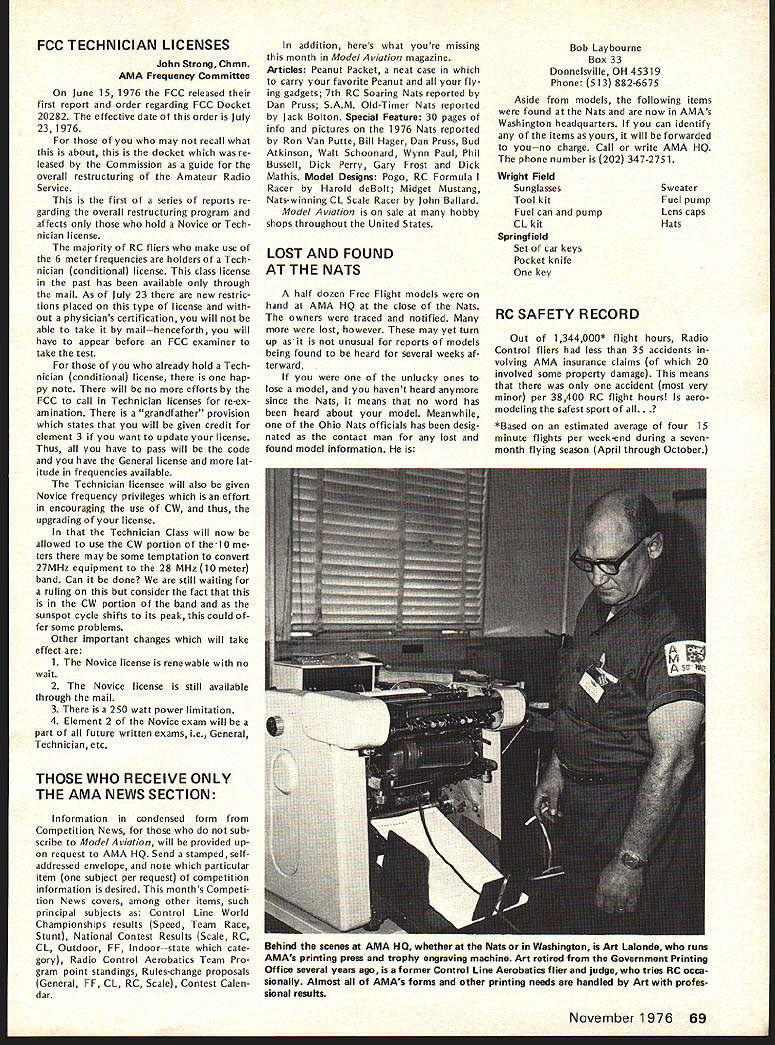
Behind the scenes at AMA HQ, whether at the Nats or in Washington, is Art Lalonde, who runs AMA's printing press and trophy engraving machine. Art retired from the Government Printing Office several years ago, is a former Control Line Aerobatics flier and judge, who tries RC occasionally. Almost all of AMA's forms and other printing needs are handled by Art with professional results.
AMA News
The FCC has acted to keep the existing five RC 27 MHz frequencies and to retain Class C regulations. Changes affecting CBers will increase CB channels from 23 to 40 with the addition of 17 channels between 27.230 and 27.410 MHz. The new channels, located at the upper end of the 27 MHz band, pose no threat to RC operation. The new CB channels become effective January 1, 1977. (Second Report and Order, Docket 20120 adopted July 27, 1976.)
In paragraph 9 of the document, with respect to the proposal to reallocate present 27 MHz Class C channels to Class D service, the Commission stated that such action would be unwarranted at this time. Comments filed by the Academy of Model Aeronautics, as well as hundreds of individual radio control operators, indicate significant use presently being made of the 27 MHz Class C channels. The Commission believes that eventually alternate frequencies must be found to supplant the present 27 MHz Class C allocation because of the increasing problem of interference from Class D users to Class C radio control operations. However, no such alternate frequencies are presently available, and because of the significant investment in 27 MHz radio control equipment by modelers, reallocation as proposed in the Further Notice would be premature.
It should be noted, however, that Industrial, Public Safety and Land Transportation mobile services are fortunate that the new CB frequencies will come in the channels in the range 27.230–27.410 MHz in ten kHz steps. Land mobile users in this frequency range will be allowed to continue operating on their presently assigned frequencies until December 31, 1976. They will have to share the frequencies and will be afforded protection from interference by Class D Citizens Radio Service licensees.
- Declined to allocate Class C Citizens Radio Service frequencies to Class D use or to combine Class C and D under a single license, since comments filed indicated very substantial use of the frequencies by Class C licensees.
- Allocated 17 additional channels to the Class D Citizens Radio Service, making a total of 40 channels to become available for CB use beginning January 1, 1977.
- Declined to allocate the additional frequencies proposed since that would have made the frequency spread between the first and last channels 440 kHz, creating potential intermodulation (IM) interference problems.
- Required present land mobile licensees operating on reallocated channels to change frequency no later than December 31, 1979, to share frequencies with CB users upon the event beginning January 1, 1977.
- Held that after September 10, 1976, station authorizations in the range 26.965 MHz–27.410 MHz will be issued to licensees of the Citizens Radio Service. No new licenses for land mobile, Industrial, Public Safety or Land Transportation applicants will be issued for frequencies in that range after that date.
- Permitted both AM and single sideband operations on CB frequencies; both upper and lower sideband use is permitted.
- Required that second and higher order harmonic radiation be suppressed at least 60 dB for transmitters of the type accepted for use in Class D Citizens Radio Service stations. Compliance with this requirement must be demonstrated both with connections and attachments permissible for use with such transmitters.
- Declined to adopt the proposed 25 Hz frequency tolerance proposal or to require information labels on Class D units.
- Adopted the requirement of engraving serial numbers on CB units.
- Prohibited the installation of any device, whether internal or external, designed to extend the frequency range of a Class D transmitter beyond its original frequency range. This would prohibit the sale of 23-channel units modified before sale to cover the additional frequencies allocated for CB use. Such modified units, however, would have to reapply for FCC type acceptance.
- Declined at present to change the name "Citizens Radio Service," although such a change may be made at some later date.
The Commission noted that about 4,000 land mobile licensees would be dislocated by the reallocation of frequencies to CB use. However, since the Class D service is growing at a very rapid rate, the Commission concluded the public interest lay in the allocation of additional channels for CB use rather than protection of the 4,000 existing land mobile licensees.
Fortunately, ten times as many Class C licensees filed with the FCC, giving good reason to leave RC channels alone. Keep the situation as it is; further need to raise the ratio another tenfold can be handled using club licenses applied for by individuals. President of District 2 and, as before, my worthy AVP John Grigg, of Lockport, NY, was selected to run our opposite me, and our names will appear on the ballot. Rally-Holla!!! It is point I wish to thank all of you who submitted my name to the Nominating Committee as a suggested candidate for the presidency of AMA, and who actively supported your belief in my worthiness of that trust in various ways. This was a most rewarding experience and I am duly grateful.
M.A.D. 2 AT ROCKEFELLER PLAZA
So successful was M.A.D. 2 (Model Aviation Day) at Rockefeller Plaza last year that we are having another shot at it again this year in the form of "M.A.D. 2" — on October 16, to be exact, with a rain (or snow) date of October 30. The Rockefeller Center people advised us that "M.A.D. 1" drew the second largest spectator attendance in their history, second only to the prestigious Christmas tree lighting ceremonies — and that covers a long and imposing list of "spectaculars" — again we shall fly "choppers" (and V/A Control Line) off the skating rink, right in front of Prometheus and disclose our usual bag of tricks, such as block-long taxiing demonstrations, static displays, and the like, but above all, we have been called upon to mount a block-long Bicentennial "Cavalcade of Aviation," depicted by model aircraft of five historical eras, to wit: Pre-WW I; WW I; Post WW I; the "Golden Age" of the '30s and '40s; WW II and, finally, Post WW II or "Jet Age." If you would like to display any models which you may have representing any of these eras, it is possible that we can use them in the Cavalcade, but if not, there will be a general static display section where you could show off your pride and joy. There will be various awards and those who display planes will not have to pay to park their conveyances — for further details, please phone me on any business day (the sooner the better) during the normal working hours of 9 AM to 5 PM at (212) 687-7660.
A FINAL IMPORTANT ELECTION NOTE!!
Your ballot will not be counted unless, in addition to having properly indicated your choice, you have also signed it, and set forth your District Number.
GEAR UP AND LOCKED!!!
III DISTRICT REPORT
Don Lowe Dist. III Vice-President
Well, the 50th Nats held at Wright-Patterson AFB, Dayton, Springfield and Columbus, Ohio, has come and gone. Whether it was a smashing success or a dismal flop is a function of each individual's point of view and particular involvement in the affair. Surely it was either the largest, or one of the largest, ever held, with over 2000 entries.
Some events, like RC Pattern, were much larger than ever (over 250 flew). That particular event required increasing the flight lines and judging staff by 50% over that originally predicted, spreading the events over three complexes, the use of two dorm facilities, and meshing WPAFB activities with normal government business and travel, which caused some administrative problems.
Weather was absolutely perfect at the outset (I ordered that), however, two days were marred with some rain.
This was the first Nats in which I directly participated in organizing and running, and I must say that it is a complicated problem. How John Worth and the other directors keep their cool and handle the 10 million problems that come up is beyond me.
The Nats is a tremendous experience for a lot of participants. Where else on earth can you witness such a concentrated multi-ring circus of every conceivable form of modeling known to man? There is no question but that the Academy works long and hard to put this affair on and that's the point I raised in my last column. My question has to do with priorities of our National governing body and the advisability of investing the total effort required to organize and run such an affair. I would be interested in your comments on this point. I think that we are all concerned about improving modeling in this country; meeting the needs of the average modeler; providing RC frequencies, etc., whatever is necessary to improve the image and quality of the hobby.
Well, AMA elections are coming up soon — have you no excuse or argument or gripe unless you get out and vote? If you don't like what's on the ballot — write something in — but vote!
IV DISTRICT REPORT
Delaware • District of Columbia • Maryland • North Carolina • Virginia
John Spalding Dist. IV Vice-President 5803 Elbrooke Street Lanham, MD 20801
Approximately one week before the Nats, I was sitting in my shop trying to cut out some Mother Nature and Murphy's Law and prepare my Mach I for its debut at the Nats, when the phone rang and it was John Spaulding. He had run into a conflict with his schedule and could not make the Executive Council meeting scheduled during the week of the Nats. He asked me if I would take his place and represent District IV.
Well, to say the least, I was delighted with the idea of seeing first hand, and being a part of an AMA Council Meeting. I guess a lot of you have wondered what goes on at the Council Meetings, and where some of the decisions are made, and where the information for these decisions comes from.
Now, guys and gals, here is my personal experience and impression of an AMA Executive Council meeting. To start with my arrival at AMA HQ in the hangar at Wright Patterson Field, I checked in with the registration clerk and explained that I was taking John Spaulding's place representing District IV. "Oh, yes, you're the new guy," was her response. John Worth told me that the meeting would be Wednesday or Thursday night, and the nominations committee (which consists of all the VPs and AMA Executive Director) would meet prior to the Council Meeting.
To make a long story short, the Council meeting started at 8 o'clock sharp on Wednesday evening. Just prior to the meeting, Earl Witt asked for a volunteer to help move in two more tables. Being the "new guy", I volunteered to help and promptly blew my cover by dropping a table on my foot, breaking three toes! Not wanting to miss the meeting, and because no one saw this neat act I had just performed, I decided not to say anything until after the meeting (actually I was biting my tongue so hard I couldn't talk anyway!)
As the Nominations Committee progressed through their business, I had a feeling of confusion and disorganization in the procedures. However, I did notice that the qualifications and eligibility of the candidates were thoroughly checked to see that those whose names were submitted were properly qualified and met the prerequisites required for that office.
The members of the Executive Council represent every section of the country, every phase of the hobby, and are trying to put across their viewpoints and interests expressed by the modelers in their district. It's a wonder the Council can ever make a decision on anything when these varied views all have to be considered! Each VP wants to put across his ideas on what has to be considered for his fellow VP's ideas also. This is a tremendous task to accomplish and it's no wonder the discussions get hot and heavy at times!
My main impression of the Council is that there is a tremendous pool of knowledge and dedication in this group of men, and that they are concerned about the average member's wishes and welfare. They are looking out for OUR interests and don't seem to be trying to make a name for themselves or to promote just their particular phase or interest in the hobby. They want to give equal effort to all phases of the hobby, and to gain as much information and background as possible on each decision they are faced with.
Keep in mind that these 14 or 15 individuals who are modeled just like you and me are trying to decide what is best for over 60,000 modelers.
Your VP really wants to represent you and the only way for him to do that is to have your comments and ideas. Let him know how you feel so that he really can represent YOU.
It was a great experience! (Chuck Foreman, AVP, District IV)
Thank you, Chuck, for your thoughts on the Executive Council's activities, but most of all for those broken toes endured in the line of duty!
You see, folks, first you got him to attend the meeting for you, then you get him to write the monthly column too! If you can't go to the trouble to add a crushed foot, too, you can award a Purple Heart with the Silver Star!
On the subject of nominations, I might as well start now to entreat you all to vote this time. Please VOTE, not only for the president of your choice, but also the VP of this District, either Fred Gregg or myself.
AMA News
The FCC has acted to keep the existing five RC 27 MHz frequencies and retain Class C regulations. The change will increase CBers' channels from 23 to 40, an addition of 17 channels between 27.230 and 27.410 MHz. The new channels, located at the upper end of the 27 MHz band, pose no threat to RC operation. The new CB channels become effective January 1, 1977. Second Report and Order, Docket 20120, adopted July 27, 1976.
In paragraph 9 of the document, with respect to the proposal to reallocate present 27 MHz Class C channels to Class D service, the Commission believes such action unwarranted at this time. Comments filed by the Academy of Model Aeronautics and by hundreds of individual radio control operators indicate significant use is presently being made of the 27 MHz Class C channels. They believe eventually alternate frequencies must be found to supplant the present 27 MHz Class C allocation because of increasing problems of interference from Class D users to Class C radio control operations. However, as of now no such alternate frequencies are available because of the significant investment in 27 MHz radio control equipment made by modelers; reallocation proposed in the Further Notice is premature.
- Allocated 17 additional channels to the Class D Citizens Radio Service, making a total of 40 channels become available for use beginning January 1, 1977.
- Declined to allocate additional frequencies proposed, since this would have made the frequency spread between the first and last channels 440 kHz, creating potential intermodulation (IM) interference problems.
- Required present land mobile licensees operating on reallocated channels to change frequency no later than December 31, 1979, to share frequencies with CB users in the event reallocation becomes effective January 1, 1977.
- Held that after September 10, 1976, station authorizations in the range 26.96 MHz to 27.41 MHz will be issued to licensees in the Citizens Radio Service. No new licenses for these frequencies will, after that date, be issued to land mobile Industrial, Public Safety or Land Transportation applicants.
- Permitted both AM and single sideband operations on CB frequencies; both upper and lower sideband use are permitted.
- Required that second (higher-order) harmonic radiation be suppressed at least 60 dB for transmitters of a type accepted for use in Class D Citizens Radio Service stations. Compliance with this requirement must be demonstrated; both connections and permissible attachments to such transmitters must meet the requirement.
- Declined to adopt the proposed 25 Hertz frequency tolerance and to require information labels on Class D units.
- Adopted a requirement that serial numbers be engraved on CB units.
- Prohibited the installation of any device, whether internal or external, designed to extend the frequency range of a Class D transmitter beyond its original frequency range. This would prohibit sale of 23-channel units modified before sale to cover additional frequencies allocated to CB use. Such modified units, however, would have to reapply for FCC type acceptance.
- Declined to change the present name "Citizens Radio Service," although a change may be made at some later date.
The Commission noted about 4,000 land mobile licensees would be dislocated by the reallocation of frequencies to CB use. However, since the Class D service is growing at a very rapid rate, the Commission concluded the public interest lay in allocation of additional channels to CB use rather than protection of the 4,000 existing land mobile licensees. problems are caused by people who don't read the rule book guidelines. Remember, contest sanction requests should be sent to the proper Contest Coordinator, not to me or AMA HQ.
I have received a few complaints about rules. The rules are voted on by your Contest Boards, we VPs have no control and little influence on rules making. All we do is appoint the people to the Contest Board positions. I believe District VI is very well represented; all your Contest Board members are active, knowledgeable AMA competitors. Some of our rules are so complicated it takes an active participant to understand them!
Roger Geers, my AVP from Quincy, IL, was at the Nats and attended the Executive Council meeting. I didn't get a chance to ask his impression of the meeting, maybe he will write about it later. They have an excellent group of modelers down in that area, and members of Quincy Falcons and Jacksonville Prop Kickers put on several flying demonstrations each year. I hope to have a good report on their air show co-sponsored by the Boy Scout Explorers Post of Taylor, MO, September 12.
Bob Stagner, another AVP from Poplar Bluff, MO, sent a nice letter and report. He has talked with their City Manager and they are working toward a city-sponsored model air park. The Free Lancers RC Club is another active group and they are also working with the Scouts in the Poplar Bluff area. I'll try to get a complete report on their successes, too.
I gotta cut this short, leaving for California on business!
VII DISTRICT REPORT
Hardy Brodersen Dist. VII Vice-President P. O. Box 1106 Birmingham, MI 48012
Associate Vice-Presidents Phil Currier, 6080 Lucas Ln., No. 18, Florida, MN 55432 Keith McClure, 5073 Trout Dr., Des Moines, IA 50312 Frank Morrissey, 1431 Lower Pl., Park Ave., New Berlin, WI 53151 Wm. Rohring, 4494 Tanglewood Trail, St. Joseph, MI 49085
No District VII report this month.
VIII DISTRICT REPORT
Murry Frank Dist. VIII Vice-President 2933 Blankenship White Plains, TX 76308
Associate Vice-Presidents Buzz Averill, 9117 La Barranca NE, Albuquerque, NM 87111 Ned Barnes, 5221 N. Lebanon, Sulphur, LA 70663 Frank Bodine, 18 Mohawk Dr., N. Little Rock, AR 72116 Bud Tenney, Box 545, Richardson, TX 75080
At this writing I am still getting over Nats week at Dayton, OH. It was a large Nats with over 2100 participating. The rain on Friday was more persistent than it was at Lake Charles. As that was to be my last day at Dayton, I used that time to take in the Air Force Museum (time well spent). I hope that all of you who went to the Dayton Nats also got to see the Museum.
As usual, Dist. VIII came home with more than its share of Nats trophies and plaques. Their names will be mentioned elsewhere in the magazine. They could hold a contest on Mars and Dist. VIII would do well. I would like to thank all of our district members who were at Dayton, Springfield and Columbus. It was nice to see Duke Fox there and looking so well after his operation. As you know, Duke is part of Dist. VIII. The new Fox .15 Ball Bearing engine turned in on in FAI Combat and Racing. It was also good to see Sid Axelrod of Top Flite after his hospital visit.
George Aldrich was at the Racing and Speed areas. George said his products were performing well also. Dicky Retz was at Combat and ensuring that his customers were doing well, which they were.
At Pylon I got to see Jerry Small and Jay Lewis (Hobby Market). They were doing well at the time. Still in hot demand are their "Fly RC" bumper stickers (still waiting for that hat, Jay). My trips to Springfield were hurried; up trips (gopher?), so I did not see many of our members who flew there.
The City of Springfield is serious about wanting the full Nats there. They would even like for all or part of our HQ operations to move there. They got a look at what we do and how many we are and they liked it. They decided that we weren't playing with TOYS after all—that it isn't a kid's game even for the kids.
The nominating committee had a rough time of it. Four good people were nominated and this had to be reduced to two names on the ballot. This was for president. The people on the ballot for president will be John Clements, incumbent, from Dallas, TX, and Earl Witt, present sec.-treas., from Chambersburg, PA.
There were two nominating letters for VP for our district. Both of them were from me (Murry Frank), so my name will be on the ballot. When I got home I found another nomination. This one was for Riley Wooten. The letter was dated August 3 and I had left for the Nats August 1. A copy was sent to HQ but could not have reached the nominating committee, which met August 4 at 8 PM. Remember, there is always a place for write-ins on the ballot.
My campaign will, as usual, consist of a lot of get out the vote. When the ballot comes, get it marked and back into HQ so it can be counted. You do not have to renew your membership at that time, but I recommend that you do.
It takes a strong AMA to be able to fight for us. The RC problem with the FCC proved that.
IX DISTRICT REPORT
Colorado • Kansas • Nebraska • North Dakota • South Dakota • Wyoming
Stan Chilton Dist. IX Vice-President 1410 S. South Hydraulic Street Wichita, KS 67211
Associate Vice-Presidents Charles Brandon, 2210 Mariposa Blvd., Casper, WY 82601 Max Hansen, 1909 Wisconsin, SW, Huron, SD 57350 John Kreckovich, 7810 Lowell St., Overland Park, KS 66204 Lonnie Kroebel, 1754 S. 9th, Fargo, ND 58102 Jim Monfroy, R. R. 2 Box 56, Stanley, KS 67547 Dave Minughough, 5102 Brady Rd., Colorado Springs, CO 80916 Oscar Olson, 6111 Maple, Omaha, NE 68104
1976 NATS
The Dayton–Springfield–Columbus, Ohio Nats will be reported elsewhere in Model Aviation, but I'd like to make a few short, diversified comments about this 50th Nats.
Most of you know that the AMA VPs meet at an Executive Council and nominating committee meeting on Wednesday of the Nats AT the Nats.
What is not generally known is what these VPs do the rest of Nats week.
Far from being a stodgy group of chairman plutocrats, you'll see members of the Executive Council active in every aspect of the Nats.
There are some who work from dawn to dusk running events (Smith, Brodersen, Frank, Spalding), some who fly, and I do mean competitively (Love, McNeill, Lee, Chilton), and some who help out at Nats HQ (Piper, Chisholm) and elsewhere (Byrne was an R/C judge). But most of all, they are all active in the sport and know whereof they speak when they are in the Council meeting representing your AMA members.
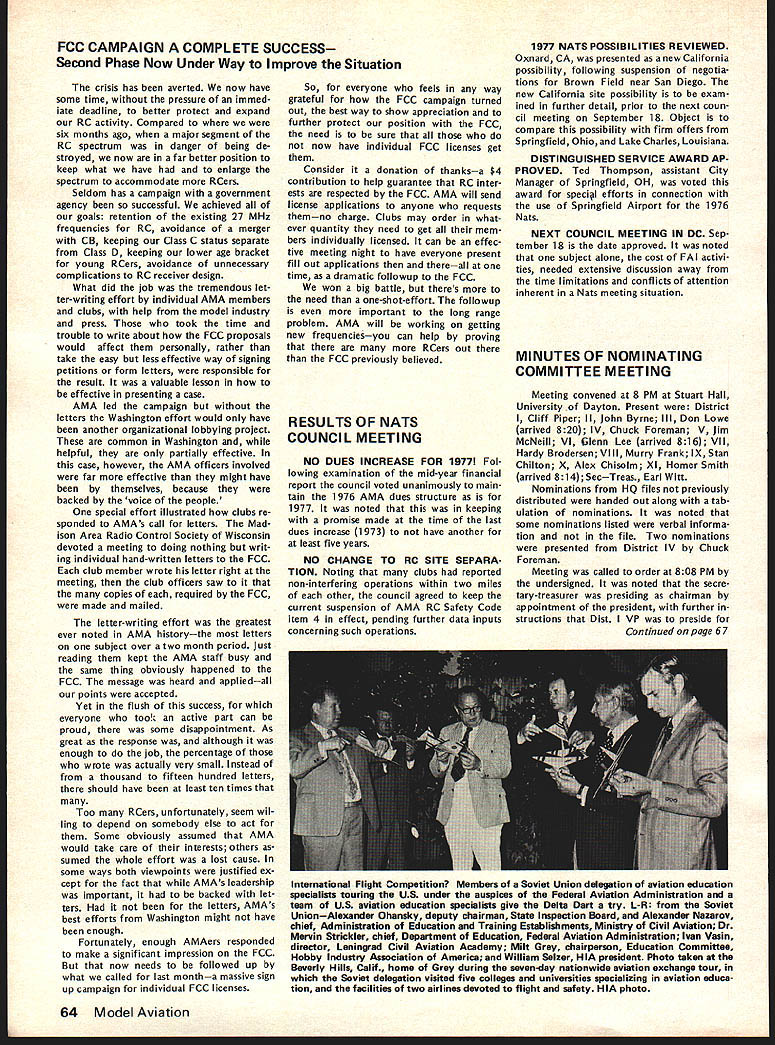
This year, in addition to the nominating committee meeting and the following Council meeting, on Thursday evening the Council members were invited to a social hour get-together with the Mayor, City Councilmen and women, City Manager, Assistant City Manager and civic officials of Springfield, where AMA members were cordially and enthusiastically invited to hold the entire '77 Nats at Springfield.
I've been an independent businessman for many years, and I can tell you that your group of VPs that met with the Springfield city officials presented themselves in a very professional, friendly, polite and business-like manner. I was proud to be a part of that group, which also included AMA Executive Director, John Clements; AMA Assistant Executive Director, Carl Maroney. And I include the votes of the AMA group who attended— all in all it was a super presentation of our AMA officials to the officials of Springfield.
NEWSLETTERS
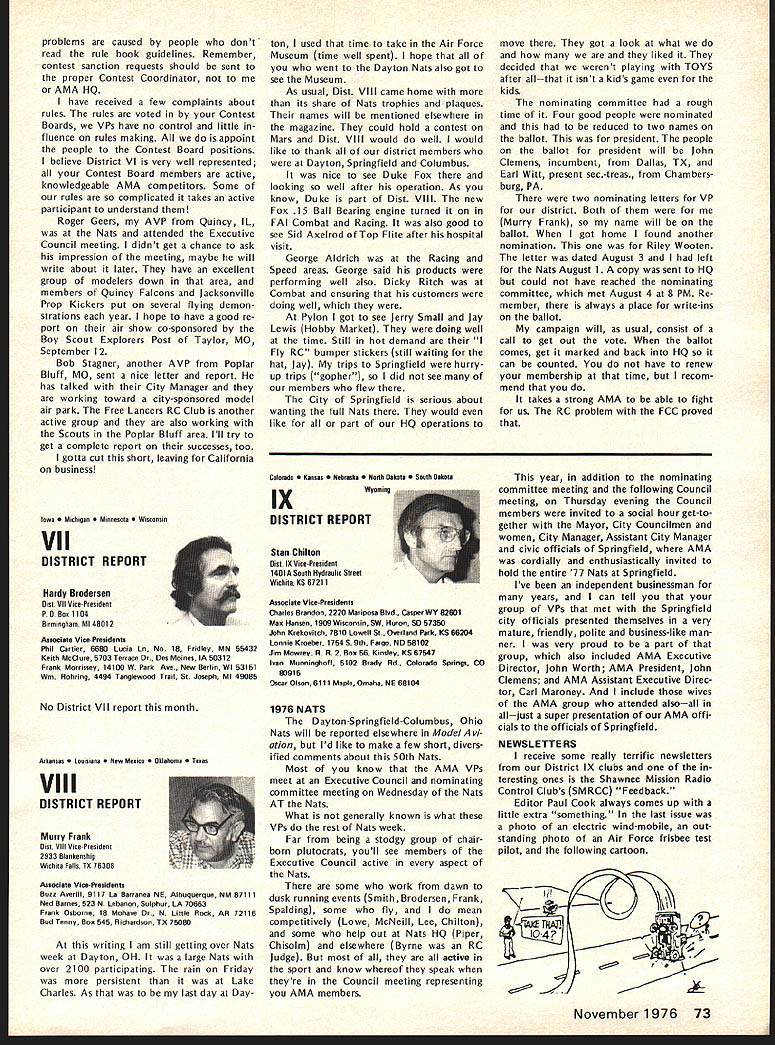
I receive some really terrific newsletters from our District IX clubs and one of the interesting ones is the Shawnee Mission Radio Control Club's (SMRCC) "Feedback." Editor Paul Cook always comes up with a little extra "something." In the last issue was a photo of an electric wind-mill, an outstanding photo of an Air Force frisbee test pilot, and the following cartoon.
AMA News
The FCC has acted to keep the existing five RC 27 MHz frequencies as Class C. Changes to the CB service will increase channels from 23 to 40 with the addition of 17 channels between 27.230 and 27.410 MHz. The new channels, located at the upper end of the 27 MHz band, pose no threat to RC operation. The new CB channels become effective January 1, 1977. (Second Report and Order, Docket 20120, adopted July 27, 1976.)
In paragraph 9 of the document, with respect to the proposal to reallocate present 27 MHz Class C channels to Class D service, the Commission stated it believes such action unwarranted at this time. Comments filed by the Academy of Model Aeronautics, as well as hundreds of individual radio control operators, indicate significant use is presently being made of the 27 MHz Class C channels. While it is believed that eventually alternate frequencies must be found to supplant the present 27 MHz Class C allocation because of increasing problems of interference from Class D users to Class C radio control operations, at the present time no such alternate frequencies are available. Because of the significant investment in 27 MHz radio control equipment by modelers, reallocation as proposed in the Further Notice was premature.
It should be noted, however, that Industrial, Public Safety and Land Transportation mobile services fortunate in that the new CB frequencies will come in the channels range 27.230–27.410 MHz in ten kHz steps. Land mobile users in this frequency range will be allowed to continue operating on their presently assigned frequencies until December 31, 1976. They will have to share the frequencies and will be afforded protection from interference by Class D Citizens Radio Service licensees.
- Declined to allocate Class C Citizens Radio Service frequencies to Class D use or to combine Class C and Class D under a single license, since comments filed indicated very substantial use of the frequencies by Class C licensees.
- Declined to allocate additional frequencies as proposed since that would have made the frequency spread between the first and last channels 440 kHz, creating potential intermodulation (IM) interference problems.
- Required present land mobile licensees operating on reallocated channels to change frequency no later than December 31, 1979. They will have to share the frequencies with CB users in the event the sharing begins January 1, 1977.
- Held that after September 10, 1976, station authorizations in the range 26.96 MHz–27.41 MHz will be issued only to licensees of the Citizens Radio Service. No new licenses for frequencies in this range after that date will be issued to land mobile (Industrial/Public Safety/Land Transportation) applicants.
- Permitted both AM and single-sideband operations on CB frequencies; both upper and lower sideband use are permitted.
- Required that second and higher order harmonic radiation be suppressed at least 60 dB for transmitters of the type accepted for use in Class D Citizens Radio Service stations. Compliance with this requirement must be demonstrated for both connector attachments permissible for use with such transmitters.
- Declined to adopt the proposed 25 Hertz frequency tolerance proposal and declined to require information labels on Class D units.
- Adopted the requirement for engraving serial numbers on CB units.
- Prohibited the installation of any device, whether internal or external, designed to extend the frequency range of a Class D transmitter beyond its original frequency range. This would prohibit the sale of 23-channel units modified before sale to cover additional frequencies allocated for CB use. Such modified units, however, would have to reapply for FCC type acceptance.
- Declined to lower the age requirement for Class D service from 18 years to 16 years.
The Commission noted about 4,000 land mobile licensees would be dislocated by reallocation of frequencies to CB use. However, since the Class D service is growing at the rate of 1A million licensees per month, the Commission concluded the public interest lay in allocation of additional channels to CB use rather than in protection of the 4,000 existing land mobile licensees.
Fortunately, ten times the number of Class C licensees filed with the FCC, giving good reason to leave RC channels alone to keep the situation from getting worse. Further need for an up-ratio another tenfold can be done by using club licenses rather than individual applications.
Transcribed from original scans by AI. Minor OCR errors may remain.

