
AMA News
Clubs / Flying Sites / Insurance
A whole new world of liability concern is brewing in connection with club and sanctioned-event activities. Until recently the primary insurance concern was protection from claims arising when a model hits someone or something. Increasingly, however, claims are for accidents only incidental to flying activity: a spectator trips over a tent guy wire, a person on a snowmobile hits a gate cable, someone gets a foot in a gopher hole—the scenarios are many. Courts and lawyers have been obtaining much larger judgments and settlements, so what once seemed minor can become a major financial matter.
Key points:
- Clubs are now more vulnerable to liability claims that are incidental to flying activities.
- There is an imbalance in insurance costs and coverage:
- Clubs receive coverage (flying and non-flying accidents) for a relatively low charter fee (historically about $20).
- Individual members pay for flying-accident coverage via membership (historically about $30).
- Flying-site owners have been covered by primary insurance for almost anything a club does on their property (flying or non-flying) at no extra cost, except in special situations.
- Insurance costs are rising steeply, forcing reconsideration of how coverage is offered and funded.
Possible responses under consideration:
- Limit club protection to flying accidents and charge separately for non-flying coverage (e.g., an additional fee).
- Continue to provide both flying and non-flying coverage as part of the charter fee but increase the charter fee substantially (proposals in discussion have suggested raising it to around $100).
- Consider increasing sanction fees to better cover site-owner and sponsor coverage costs.
Everyone is urged to provide input to the AMA Executive Council prior to its meeting (noted in the text as August 1) so council members know the membership’s thinking before decisions are made.
---
DCRC Case Study: Noise, Muffler Rules, and Site Management
The District of Columbia Radio Control Club (DCRC) in Rockville, MD, provides a useful example of local issues and solutions relating to flying-site management, noise control, and neighbor relations.
Site description:
- Built on a finished landfill (advantageous for regulations about fills).
- RC field fenced from parking; rail dividers separate pit area and flying area.
- Two runways (one closed to protect nearby homes), a pavilion for shelter/cookouts.
- Control-line area with paved circle and second pavilion (not used presently due to control-line fliers balking at mufflers).
- Fill is elevated relative to surrounding houses and roads, improving separation.
Community relations and procedures:
- Maintain a strong public-relations program and cooperate with local authorities.
- Set operating hours if needed to balance event needs and community comfort (DCRC: no flying before 0930 weekdays or weekends).
- Monitor and enforce muffler/sound rules; fly only in designated areas to maintain acceptable sound paths.
Noise/sound rules and testing:
- County ordinance example: do not exceed 55 dBA at homeowners’ property lines.
- DCRC determined that keeping aircraft at or below 103 dBA at three meters generally allows compliance with 55 dBA at the property line (but flight path, weather, prop changes, and muffler location affect results).
- If two aircraft each register 103 dBA at three meters, they should not be flown together at the same time.
- Many inexpensive sound meters (e.g., Radio Shack models) suffice for routine monitoring.
- A 3 dB change roughly represents a doubling (or halving) of perceived loudness.
Observations from contests and checks:
- Sound readings at a DCRC pattern contest ranged from 89 dBA to 103 dBA at three meters.
- Four-stroke engines often exceeded the 98 dBA FAI figure for .53 A; many two-strokes read between 91 and 98 dBA.
- Adjusting exhaust stacks and using appropriate mufflers, tuned pipes (muffled where permitted), and propellers can significantly lower noise. Prototype devices show promise of reducing levels by 6–7 dBA.
Advice:
- Adopt and enforce a muffler rule specific to your field.
- Establish clear reading procedures and designated measurement points.
- Recheck aircraft after member modifications.
- Keep records and test frequently; weather and equipment changes can alter readings.
---
New Engine and Equipment Tests
- K&B Manufacturing Sportster .20: Run on a test stand with a conventional muffler. On a 9×4 prop the engine produced about 8,400 rpm at three meters and 6,240 rpm at 50 ft. When mounted and partially cowled in an airplane, readings should improve; the engine should easily keep noise under 55 dBA at typical flight distances.
- Future tests planned: a new muffler for .60 engines and new-generation props for .60-class engines. Members are invited to send new equipment for testing and write-ups.
---
AMA's First Flying Sites Seminar
Geoffrey Styles, Director of Public Relations, reported on AMA’s first face-to-face Flying Sites Seminar held in Santa Ana, California (May 17, 1986). The seminar aimed to help clubs get and keep flying sites.
Background and resources:
- AMA published Getting and Keeping Flying Sites in 1971; a 1980 (and later) update includes practical documents for flying-site appeals.
- The materials package includes letters of support, endorsements (including a Presidential endorsement noted in the materials), lists of potential properties, and about 75 pieces of information to aid clubs.
Seminar highlights:
- About 85 attendees from 36 clubs attended.
- Speakers included AMA staff (Geoffrey Styles, David Peltz) and local public-relations and club leaders. A public official from Riverside, CA, spoke about working with local government.
- Barbara Renaud, President of Airtronics, represented the manufacturers’ viewpoint.
- The seminar covered success stories, lessons learned, PR techniques, legal/technical advice, and use of the AMA film "A Plane, a Place, a Perfect Day."
- Attendees found the program very useful; plans were suggested to replicate similar seminars in other districts.
Action items for clubs:
- Use the AMA package when presenting to local officials.
- Build and maintain good PR with neighbors and local authorities.
- Prepare notices and newsletters in advance when planning events; include follow-up reminders and request RSVPs.
---
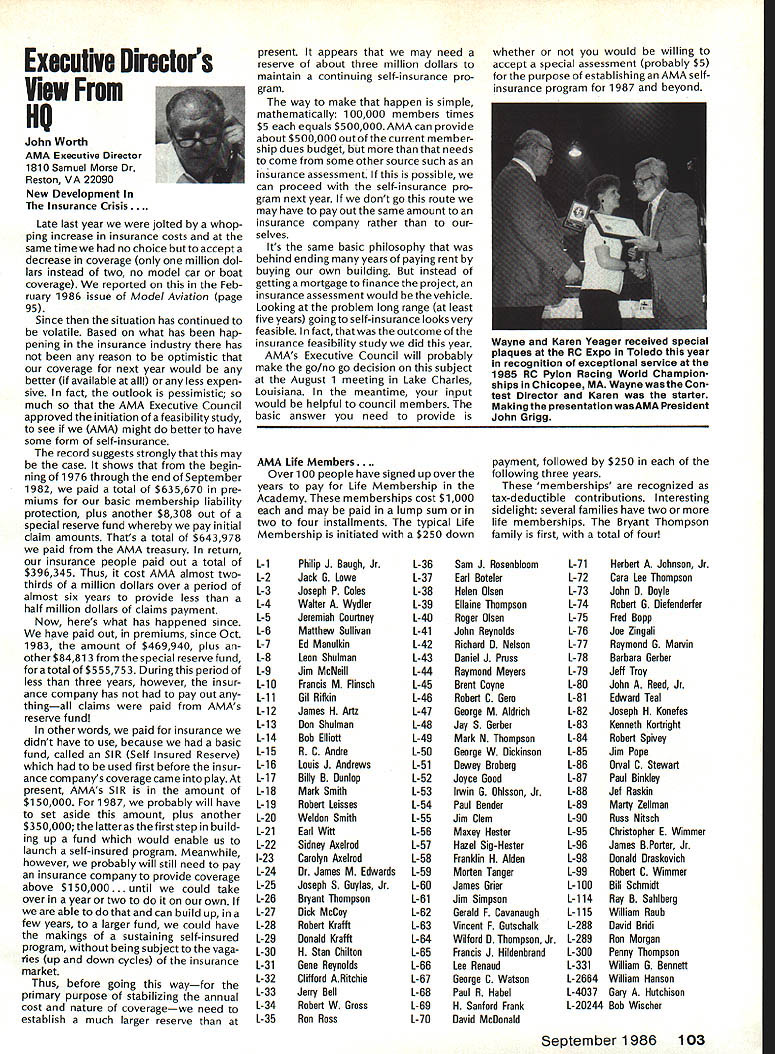
Executive Director's View From HQ
John Worth, AMA Executive Director 1810 Samuel Morse Dr., Reston, VA 22090
New development in the insurance crisis:
- Late last year insurance costs jumped sharply while coverage decreased (example: coverage dropped to $1 million instead of $2 million; no model car or boat coverage).
- The Executive Council authorized a feasibility study on whether AMA could pursue self-insurance.
Financial history and rationale:
- From 1976 through September 1982: AMA paid $635,670 in premiums plus $8,308 from a special reserve—total $643,978. Insurance companies paid $396,345 in claims.
- Since October 1983 (less than three years): AMA paid $469,940 in premiums plus $84,813 from the special reserve (total $555,753), while the insurance company paid nothing; all claims were covered from AMA’s reserve (Self-Insured Reserve, SIR).
- AMA’s existing SIR is $150,000. To move toward self-insurance, AMA would likely need to set aside the $150,000 plus an additional $350,000 as the first step toward building a larger fund.
- A long-term sustaining self-insurance program might require a reserve on the order of $3 million.
Funding options:
- Membership-based assessment: e.g., 100,000 members × $5 = $500,000.
- Some funds can come from the dues budget, but an assessment would likely be required to build the reserve quickly.
Governance:
- The Executive Council expected to decide on the self-insurance go/no-go at its August 1 meeting. Members were asked whether they’d accept a special assessment (probably $5) to establish an AMA self-insurance program for 1987 and beyond.
---
District Roundup and Club News
- Air Show Teams: Several AMA-sanctioned Air Show Teams perform regionally. For a list, see Model Aviation (July 1986). Contact for District 1 team: Jim Parker, 17 West Main St., Niantic, CT 06357.
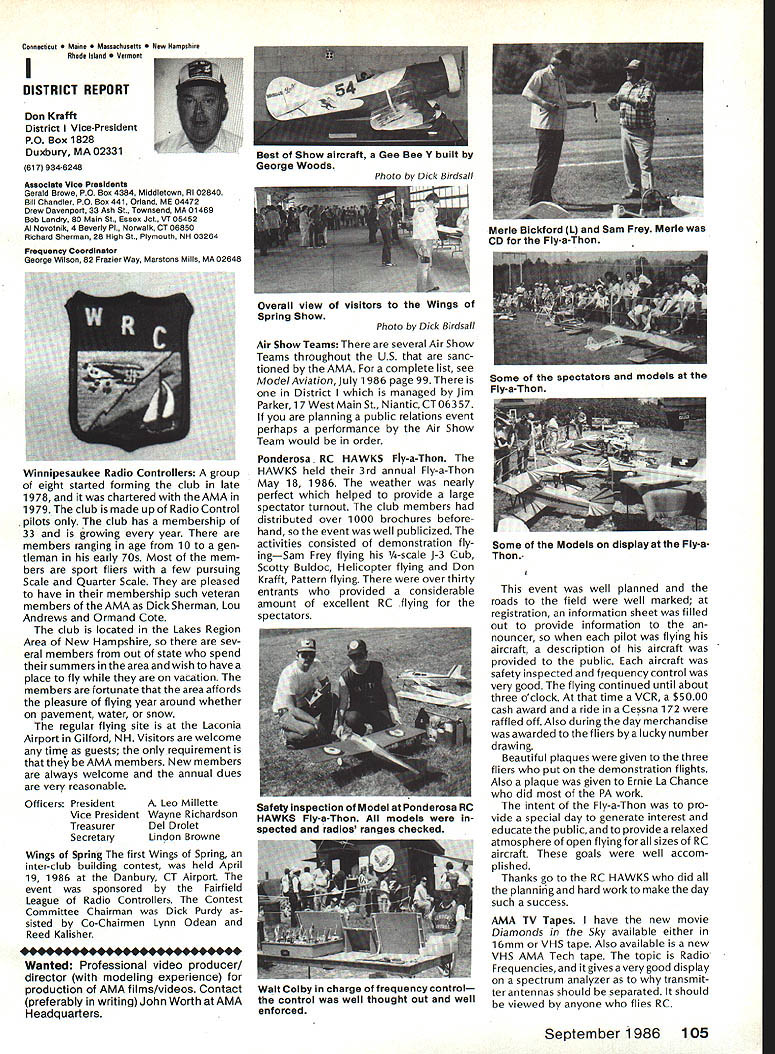
- Ponderosa RC HAWKS Fly-a-Thon (May 18, 1986): Third annual event; over 1,000 brochures distributed beforehand, strong spectator turnout, demonstrations (including a 1/2-scale J-3 Cub), safety inspections, frequency control observed, raffles and awards, and a relaxed open-flying atmosphere. Organizers commended for planning and execution.
- AMA TV Tapes: "Diamonds in the Sky" available on 16mm or VHS. New VHS AMA Tech tape on Radio Frequencies demonstrates spectrum analyzer usage and antenna separation—recommended viewing for R/C fliers.
- Timonium Mid-Atlantic Radio Control Show (May 31–June 1, 1986): Attendance and vendor booths up; AMA had a large display and membership service presence.
- Award of Excellence: Presented to Capital Area Soaring Association (CASA) at the Sugarloaf Classic Cross Country contest for maintaining and holding multiple soaring sites and promoting the sport.
- Beginners' Contest: RC Friends Club held a Pattern contest limited to Novice and Sportsman classes to encourage new entrants; turnout was good.
- ModelNet (AMA’s computer network on CompuServe): Over 2,000 users; 10 message boards and 10 data libraries containing AMA files, contest calendars, store lists, and high-resolution graphics. Contact Doug Pratt at AMA HQ for more information. On CompuServe type GO MODELNET; AMA e-mail addresses listed for council members on ModelNet.
Other visits and notes:
- Visits to fields in eastern North Carolina (Sanford MAC Giant Scale Fun Fly) and Hampton, VA (Southeastern Virginia RC Group) highlighted diversity of members and success by clubs that maintain good PR with nearby residents.
- Mortgage Depletion Fund: early club contributions noted (Chesapeake Bay RC Club $500; Greensboro Radio Aero Modelers $100). Members and clubs encouraged to participate.
---
Putting My Money Where My Mouth Is (F3B Matter)
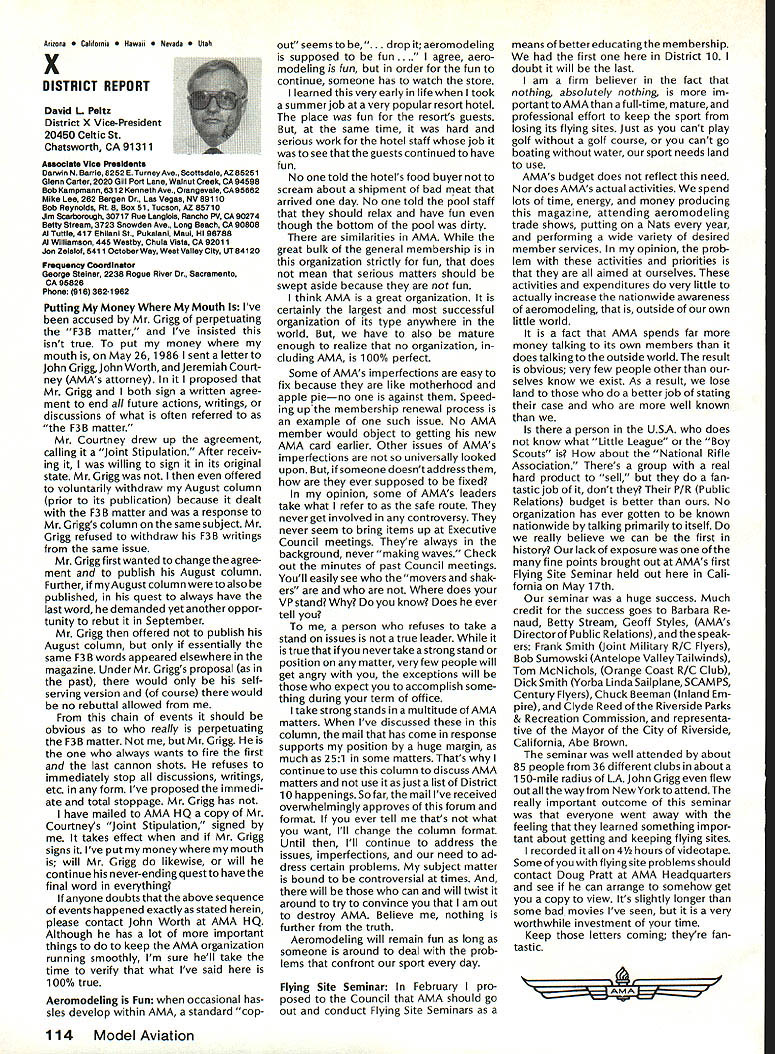
An exchange described a proposed "Joint Stipulation" intended to end further written or verbal discussion of the F3B matter. One party signed; the other sought modifications and additional publication privileges. The writer stated he signed the stipulation and urged the other party to do the same. For verification or details, contact John Worth at AMA HQ.
---
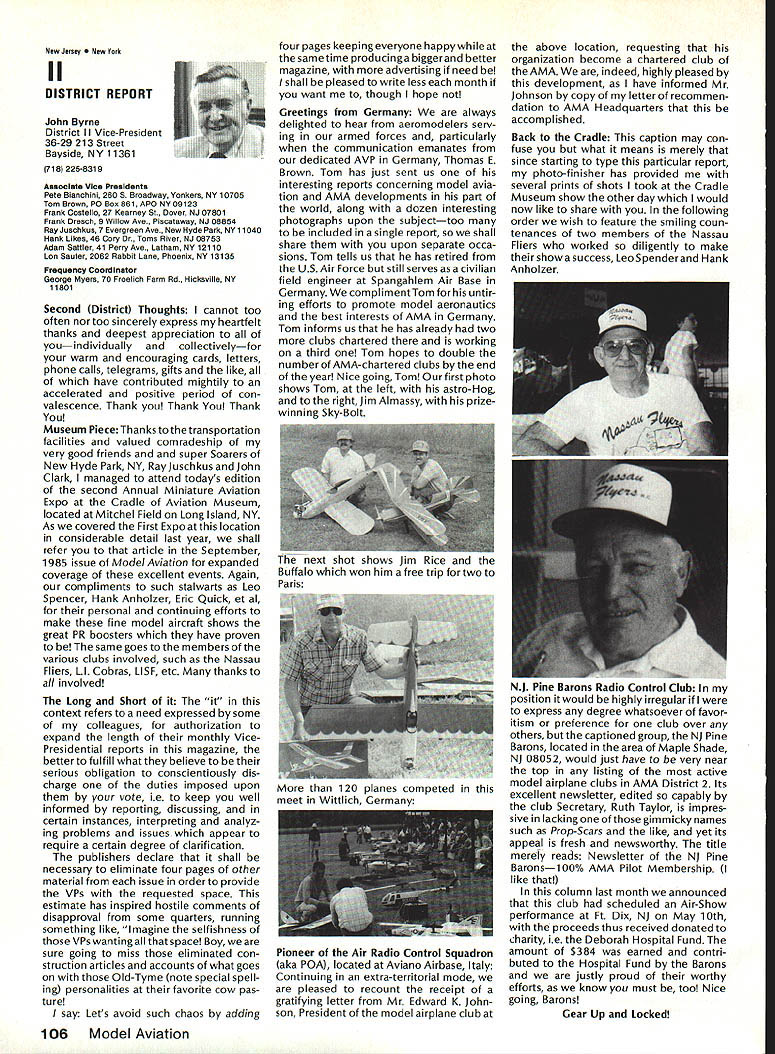
Aeromodeling Is Fun — But It Requires Work
Editorial points:
- Aeromodelling is a leisure activity, but sustaining the sport requires volunteers and leaders who will take stands on important issues.
- Some matters that affect the sport (membership processing speed, site acquisition, insurance, PR) require active leadership and cannot be dismissed because they are not “fun.”
- Leaders who never take positions are not providing the leadership the organization needs.
- The column author receives strong member feedback supporting issue-oriented commentary and will continue to discuss policy and operational issues in addition to district happenings.
---
Miscellaneous Notes and Appeals
- Appointments: A new AVP was appointed for the St. Louis area; Cal Ettel was named to provide local support.
- National contests and Nats site discussion: Opinions varied—some favor rotating several Nats sites to reduce travel; others favor a single permanent site.
- Requests and initiatives:
- Michael Balduzzi collecting information on aircraft museums, restaurant-converted aircraft, WWII towers, and factories for a pamphlet—contact at 124 East Foster Parkway, Fort Wayne, IN 46806; phone 219-744-1020.
- Members urged to contribute to mortgage depletion fund and other AMA causes.
- Club newsletter importance:
- Editors are key communicators; send timely notices and correct, complete newsletters (including editor name, club name, officers, and return address).
- Safety sections and frequency checks are widely adopted and valuable.
- Anecdotes and human-interest items: stories of club exploits, contests run by universities and colleges (cargo-carrying model contests), and other local successes illustrate the hobby’s breadth.
---
Closing
Clubs and individual members should:
- Take noise, safety, and liability issues seriously.
- Work proactively with neighbors and local authorities.
- Monitor sound levels and enforce muffler and flight-area rules.
- Participate in the insurance discussion and give the Executive Council their views on assessments and self-insurance.
- Use AMA resources (flying-sites package, seminars, ModelNet) to help acquire and keep flying sites.
Happy flying.
Transcribed from original scans by AI. Minor OCR errors may remain.

