
AMA News
How to Handle a Flying Site Problem
Geoffrey Styles — Director of Public Relations
There have been recent instances where a flying site on public property has come under public discussion. Complaints from nearby residents have prompted action by local officials (elected or appointed) in two common forms:
- A public meeting at the town building, advertised so interested parties can appear and speak pro and con.
- Introduction of a bylaw or ordinance, with public comment before the governing body.
If this situation develops in your community, take these steps:
- Prepare your case
- If the site is essentially safe and has a good multi‑year record, present a positive case to retain access.
- Expect opposition to focus on safety and noise. Do not give up without a struggle.
- Gather supporting evidence
- Make sound measurements and keep written records. A documented noise study shows you are concerned about neighborhood impact.
- Collect other facts: hours of operation, number of users/events, length of field use, safety record, photos, maps, and any mitigation measures you already use.
- Organize your speakers
- Identify no more than six capable speakers. Assign each a single topic (for example: noise, safety, skills, educational value).
- Rehearse every speaker; insist they stick to their assigned topic and avoid wandering into unrelated areas.
- Limit earlier speakers to about two minutes each; allow the clean‑up speaker up to five minutes. A well‑planned presentation should take less than seventeen minutes total.
- Control your public presence
- All club supporters attending should dress conservatively (shirt, tie, jacket if possible) and sit quietly unless called on to speak.
- No audience rebuttals, catcalls, laughing, or interruptions. Only designated club speakers respond to opposition comments.
- The clean‑up speaker should be capable of on‑the‑spot adjustment and factual rebuttal of wild accusations.
- Back up statements with documentation and resources
- Talk to AMA about printed materials and brochures that justify the sport, describe what other communities provide, and explain the recreational and educational value of model aviation.
- Prepare individual information folders for each councilor/trustee.
- Be a good neighbor
- Put yourself in the residents’ position: appreciate their desire for peace and concerns about safety.
- Do not dismiss neighbors’ fears—address them respectfully and factually.
- Encourage turnout: people gain courage from numbers. Real, organized local support looks far better than a lone defender.
In a nutshell: contact AMA early, gather your facts and documentation, prepare and rehearse a small, disciplined speaker team, present a focused, courteous case, and emphasize that your club wants to be a considerate neighbor.
---
Sound & Model Aeronautics
Howard Crispin Jr.
At the Nationals, large‑scale sound measurements were taken for the first time in the Academy's sound program. Coverage was not complete, but the data give a useful baseline and highlight where flying‑site retention problems may arise.
Key findings and observations:
- Radio Control (RC) Aerobatics:
- This event produces the largest sound footprint.
- Measured sound levels ranged from about 89 to 108 dBA at 3 meters.
- A reading of 108 dBA at 3 meters is very high (equivalent to double earlier permitted one‑meter readings). Many aircraft already operate well below the FAI standard, so there is little justification for running above it. Consideration should be given to adopting the FAI standard or a lower limit for Nationals and other competitions.
- RC Scale:
- Scale aircraft often measure around 106 dBA at 3 meters and can have large footprints.
- Builders often avoid external mufflers or visible installations that would spoil scale appearance; this can result in little or no muffling and even exhaust extensions that amplify sound.
- Scale pilots tend to fly farther out on the field, increasing the footprint.
- Free Flight:
- Some Free Flight models produce extremely high levels. A Class D Free Flight measured about 120 dBA at 3 meters — a level that can cause discomfort, pain, and hearing damage without proper protection.
- Free Flight usually operates in large open areas, which reduces neighbor complaints, but where proximity exists, caution is necessary.
- Pylon Racing:
- Pylon racing can reach about 118 dBA at 3 meters. The high revs push frequencies into ranges particularly annoying to people.
- The racing community will need to consider compromises (e.g., higher‑pitch props with lower RPM) to reduce levels.
- Control Line and Speed Models:
- CL categories span a broad range of sound levels and are complex to measure at contests because events are fast and often start from inside safety circles. Speed models can generate very high dBA readings.
Recommendations and next steps:
- Focus mitigation efforts on the minority of classes that create the largest footprints (RC Aerobatics and Scale).
- Encourage muffling, thoughtful engine/prop choices, and design installations that reduce noise without severely compromising scale appearance.
- Continue systematic sound testing across events and publish results; more testing is planned and correspondence is forthcoming.
- Educate competitors and Sunday fliers that many emulate contest pilots; reducing contest footprint will help community flying retention.
Note on measurement protocol:
- During the Nationals, microphones were placed 3 meters from the aircraft per FAI standards, with observers kept away from the microphone to avoid interference. Measurements were taken consistently against a set engine mark.
Conclusion: Sound is a growing concern for site retention. The data show clear areas for improvement and policy work to reduce footprints and preserve flying sites.
---
Around the Nats & Executive Council Notes
Workers, Workers!
- AMA hosted a volunteer appreciation party (Thursday) at a local restaurant (the Catfish Connection). Entertainment included clogging and square dance routines; the volunteers were thanked for their work supporting contestants at the Nationals.
Nominations and Executive Council
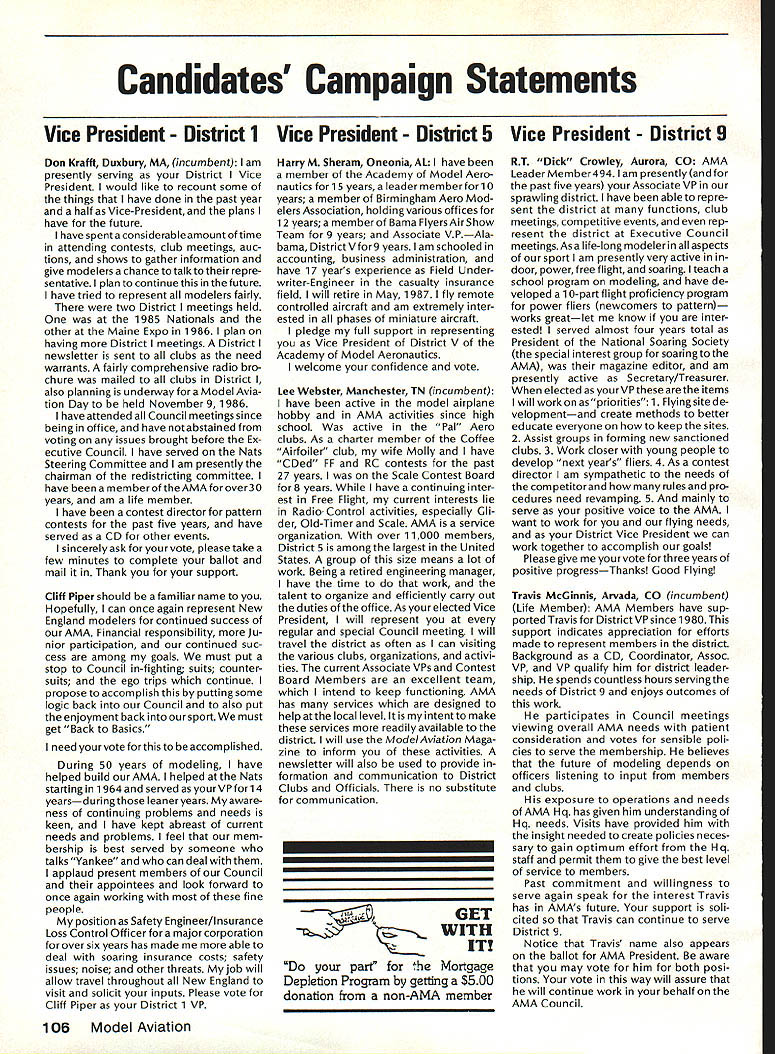
- Vice Presidents met at 8 a.m. for the officer candidate nomination meeting. The nominating committee (the VPs) narrows member nominations to a ballot maximum of three candidates per office.
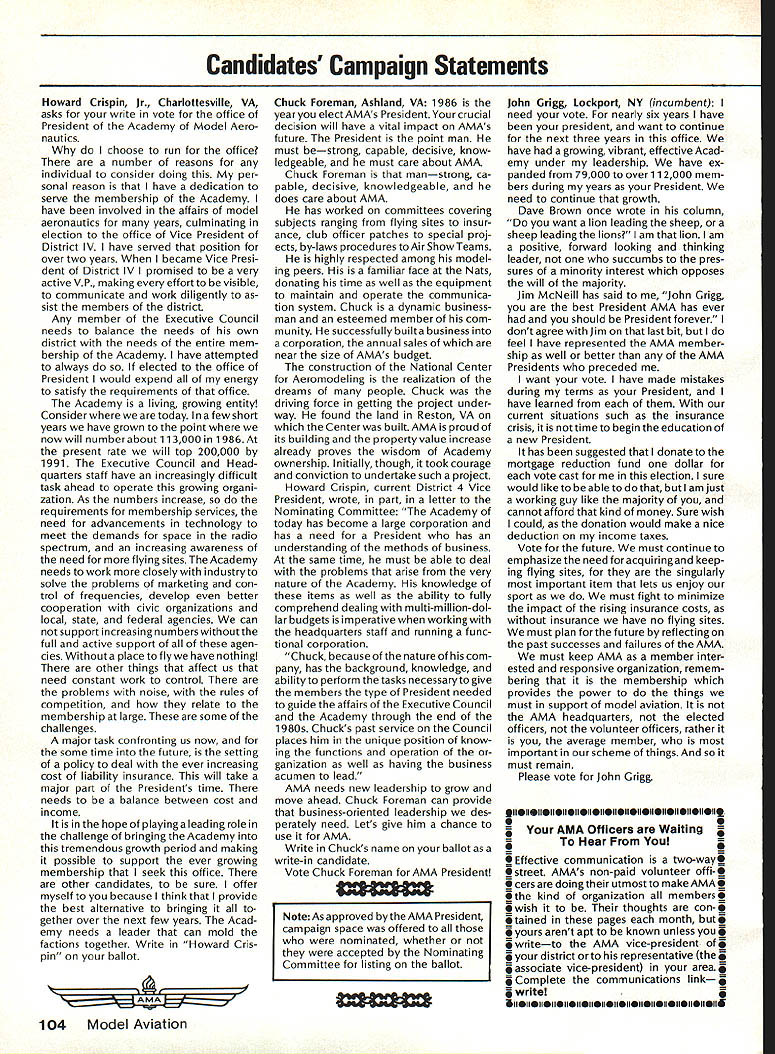
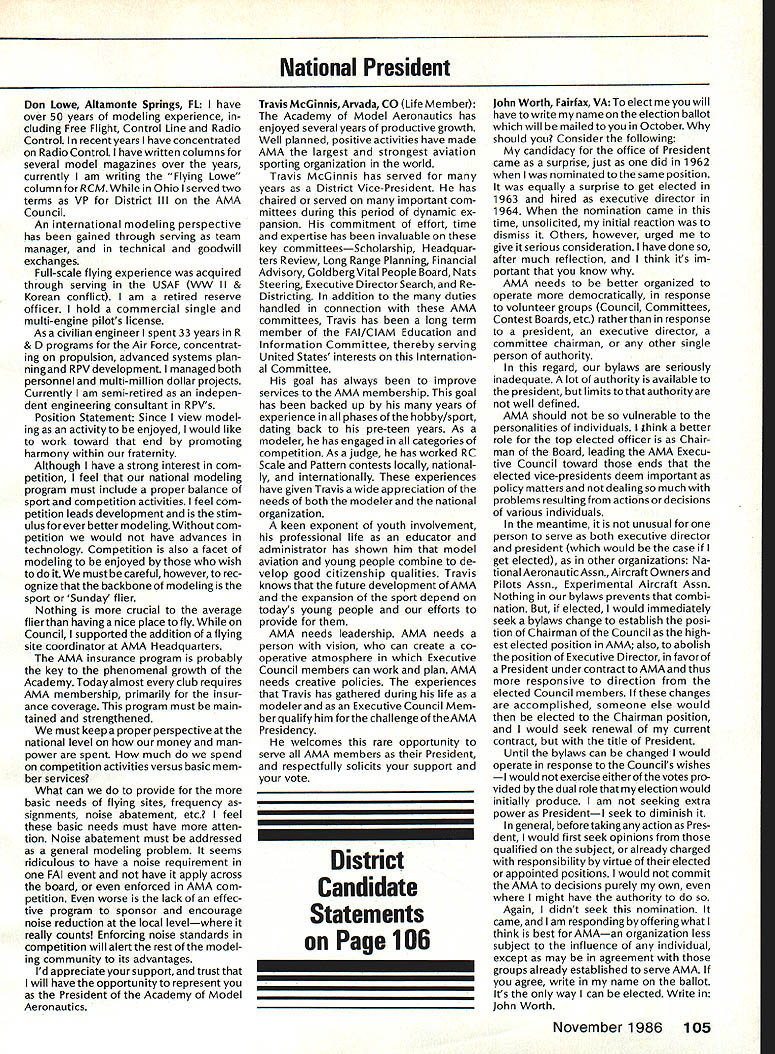
- This year the presidential ballot required substantial deliberation (seven nominees). Final ballot selections included John C. Grigg (incumbent), Don Lowe, and Travis McGinnis.
- The full Executive Council met following the nominating meeting. The session was scheduled to adjourn by 5:30 p.m. to prepare for the AMA 50th Anniversary party.
Happy Birthday, AMA — 50th Anniversary Party
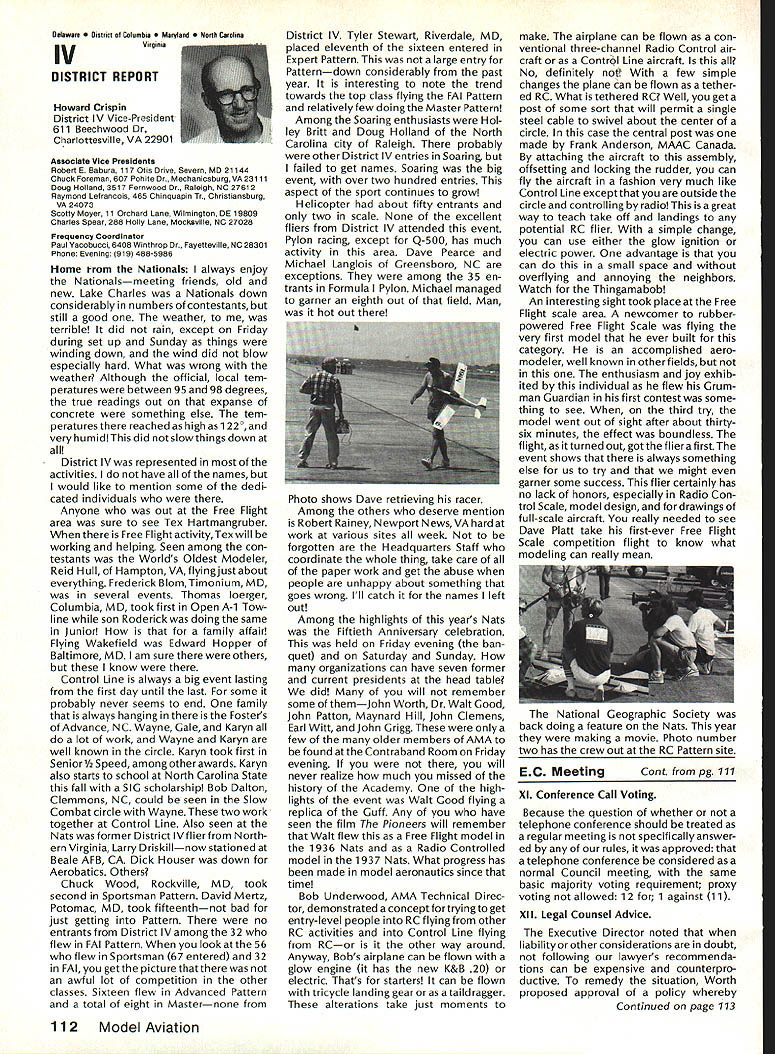
- The 50th Anniversary Party was a highlight. Many past presidents and notable modelers attended, including Vic and Joe Stanzel, George Aldrich, Art Adams, Walt Good (past president), John Worth (past president), Maynard Hill (past president), John Patton (past president), Johnny Clements (past president), and Earl Witt (past president).
- The event celebrated the history and community of AMA.
International Invitation
- Sincere thanks and reciprocal invitations were exchanged with M.A.A.A. representatives (Australia), inviting international participation at events.
Members: Your Officers Want to Hear From You
- AMA volunteer officers welcome two‑way communication. Members should write to their district vice‑president or associate vice‑president to complete the communications link and influence service and policy.
Notes from the Meeting Floor and the Nats
- The Nationals are changing: traditional work hangars (evening social/work areas) have diminished, AMA HQ and hobby shop hours are limited, and competitions run long hours (7:00 a.m. to 8:00 p.m.). Consideration is needed to restore social/work spaces to preserve the Nats’ spirit and exchange of ideas.
- The Nationals now face competition from specialized national events (US Free Flight Championships, SAM Champs, NMPRA Champs, IMA Fly‑In, etc.). These specialty events can attract attendees and reduce overall Nats participation.
- Suggestions have included rethinking Nats format and planning to maintain both championship status and a convention/social environment.
Field and Site Issues
- Delta Park (Portland) has been closed to RC flying after 35 years due to surrounding commercial development. Local umbrella groups are working with the city to find alternative sites.
- Free Flight groups and other categories face site‑specific challenges; suitable large open areas are essential for some events.
Council Business Highlights
- Insurance remains a major concern; options including self‑insurance are being explored.
- Compensation and reimbursement for contest directors and Nats workers were discussed.
- A contest board for electric events was established; Mitch Poling is a likely representative.
- Several standing rule proposals and bylaw amendments were discussed and referred as needed (e.g., publication deferral for personal attacks on officers, rules for conduct of competitions by the Executive Director, and AMA‑FAI governance clarifications).
People & Anecdotes
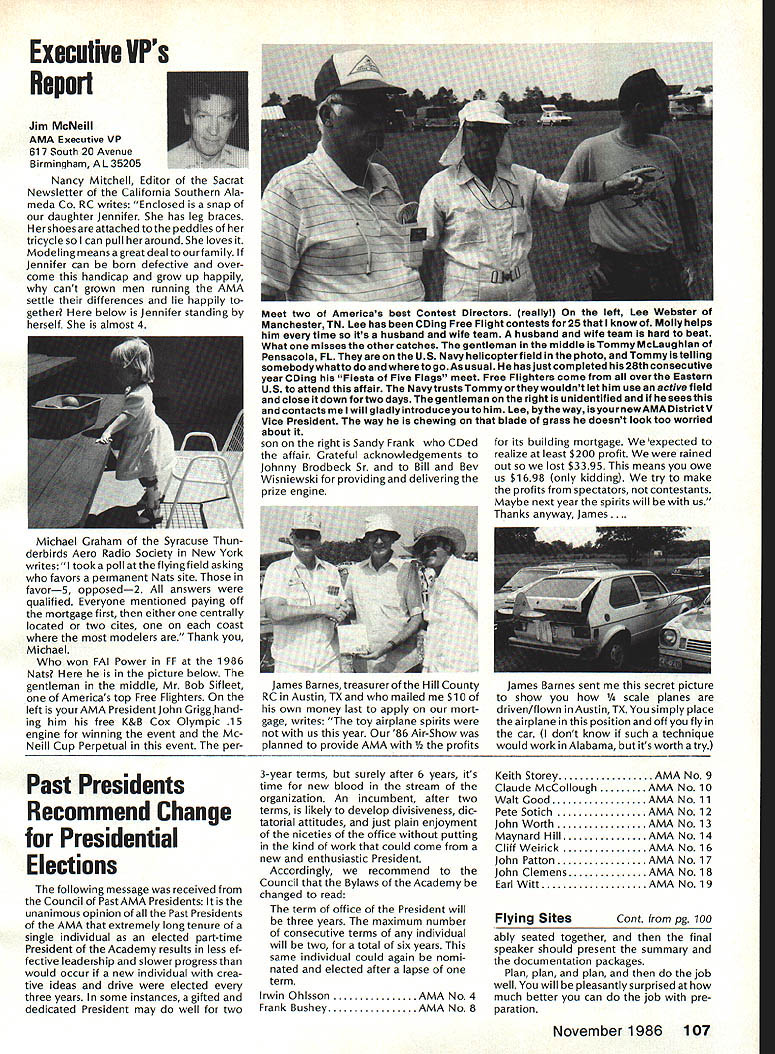
- Meet two long‑time Contest Directors: Lee Webster (Manchester, TN — long‑time FF CD) and Tommy McLaughlin (Pensacola, FL — 28 consecutive years CDing "Fiesta of Five Flags").
- James Barnes (Hill County RC, Austin, TX) shared an Air‑Show anecdote and a humorous note about a rainout loss.
- Electric events and fly‑ins show the relaxed, communal side of the hobby; sharing and helping persist at many contests.
---
Membership & Outreach
Why AMA Membership Benefits the Sunday Flier and Beginner
- AMA provides essential benefits that support all fliers:
- A place to fly — local clubs and AMA coordination help secure and maintain flying sites.
- Public support — AMA and local clubs help shape public opinion and defend flying sites.
- Market support — a strong hobby market yields better radios, engines, kits, and materials.
- Exposure to all facets of the hobby — Free Flight, Control Line, Indoor, and Scale builders benefit from AMA’s reach.
- Fellowship — social interaction and mentorship keep interest high; beginners benefit from hands‑on help and buddy flying.
- Clubs are encouraged to explore rental training programs and other outreach ideas to attract and retain new fliers. The AMA $5/30‑day membership is intended to lower barriers to entry for newcomers.
---
Closing Notes
- Sound, public relations, site stewardship, and organized, disciplined public presentations are all critical to retaining flying sites and growing the hobby.
- Contact AMA for advice, documentation, and printed materials early when site issues appear.
- Above all: be a considerate neighbor, present facts calmly and professionally, and support your club. Happy flying.
Transcribed from original scans by AI. Minor OCR errors may remain.

