
AMA News
Dues Increase Due to Insurance Crisis
For several years the AMA has faced a recurring crisis each September when members' liability insurance must be renewed. Insurers have frequently been unwilling to renew or have offered restricted coverage despite collecting substantial premiums. On September 13 (two weeks before the policy expiration) no affirmative renewal bids had been received; the incumbent carrier had refused to renew despite having been profitable (over $300,000).
The Executive Council voted to initiate a new AMA-funded member liability protection program. Under the new plan (effective last quarter of 1986 continuing through 1987):
- AMA will cover the first $500,000 of claims, plus up to an additional $1,000,000 if necessary — total potential coverage $1,500,000.
- Insurance company paper and administrative handling will be provided by insurance professionals, but AMA funds will be at risk (for legal/logistical reasons AMA is not becoming an insurer).
- The program restores coverage lost when aviation-only policies had to be accepted previously; coverage now includes model boats and cars as well as model aircraft.
- Money held in AMA reserve to pay claims will earn interest for AMA rather than being paid out as premiums to outside insurers.
Catch / funding implications:
- Building the required reserves is initially expensive and will require multi-year fund buildup.
- A bank guarantee for availability of roughly $1.5 million of coverage is required; the guarantee itself costs on the order of $20,000.
- To fund the program the Council adopted a dues increase (proceeds to be used solely for the insurance fund and related needs). Members and clubs will be asked to assist in funding until reserves are adequate.
Application / certification (patch/package):
- Application forms are available at AMA Headquarters or through club secretaries.
- Submit the application via your AMA club (procedure changed — applications are to be submitted via AMA clubs instead of via district AMA Vice Presidents). Chartered clubs may submit applications directly to AMA HQ.
- Include a check or money order (NO CASH) payable to Academy of Model Aeronautics in the amount of $2.50.
- Certification required on the application: applicant certifies they are a duly enrolled AMA member and have personally caused a model aircraft to become effectively airborne on at least one occasion during the applicable calendar month.
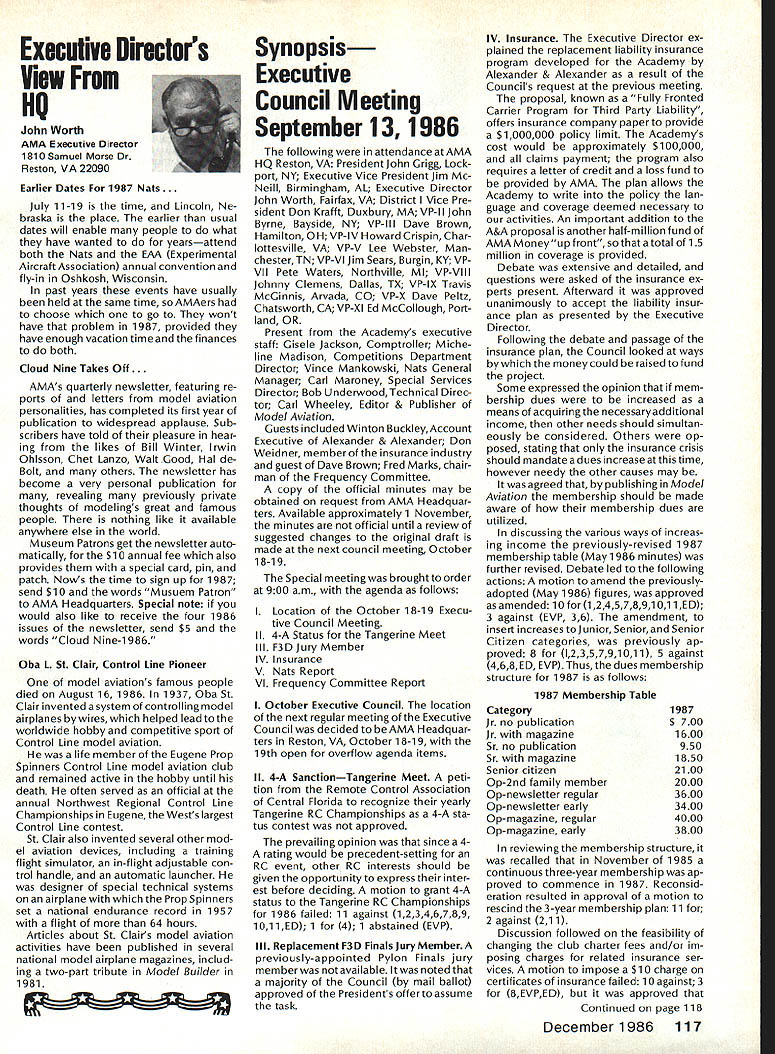
1987 Membership Rates (adopted)
- Jr., no publication — $7.00
- Jr., with magazine — $16.00
- Sr., no publication — $9.50
- Sr., with magazine — $18.50
- Senior citizen — $21.00
- Op — 2nd family member — $20.00
- Op — newsletter, regular — $36.00
- Op — newsletter, early — $34.00
- Op — magazine, regular — $40.00
- Op — magazine, early — $38.00
---
Executive Council — September 13, 1986 (Synopsis)
Attendees included President John Grigg; Executive Vice President Jim McNeill; Executive Director John Worth; District Vice Presidents I–XI (Don Kraft, John Byrne, Dave Brown, Howard Crispin, Lee Webster, Jim Sears, Pete Waters, Johnny Clemens, Travis McGinnis, Dave Peltz, Ed McCollough); and executive staff (Gisele Jackson, Micheline Madison, Vince Mankowski, Carl Maroney, Bob Underwood, Carl Wheeler). Guests included insurance representatives and committee chairs.
Agenda highlights:
- Location of October 18–19 Executive Council meeting (decided: AMA Headquarters, Reston, VA).
- 4-A status petition for the Tangerine RC Championships (petition to grant 4-A status for 1986 was not approved).
- Replacement F3D finals jury member (needed; handled by mail ballot).
- Insurance (detailed debate and unanimous approval of the proposed liability plan — see "Dues Increase" section).
- Nats report (site evaluations and planning).
- Frequency Committee report (minor revisions forthcoming; guidelines to be considered at October meeting).
Decisions and votes of note:
- Insurance plan approved unanimously (proposal described as a "Fully Fronted Carrier Program for Third Party Liability" arranged by Alexander & Alexander: $1,000,000 policy limit with AMA-provided loss fund and letter of credit; plus an additional $500,000 of "AMA money up front" for total $1.5M).
- After debate, Council decided to increase membership dues to raise funds for the insurance program.
- A prior motion (Nov 1985) to adopt a continuous three-year membership was rescinded (11 for; 1 against).
- Motion to impose a $10 charge on certificates of insurance failed (10 against; 3 for).
Nats Report (Vince Mankowski)
- Indianapolis site favorable but unavailable for 1987; available for 1988.
- Lincoln site confirmed for July 1–19, 1986; Control Line, Pattern, and Soaring sites in excellent condition; Helicopter to be flown from Skynighters' field; new Free Flight site identified.
- Manager will visit Free Flight sites with Category Manager and competitor to evaluate suitability.
- Modifications to schedule and policies (e.g., encourage advance entries; new Junior/Senior trophy policy).
Frequency Committee Report (Fred Marks)
- Committee refuted rumors of major changes to the Phase-in Plan; minor revisions to the Phase-in Plan and Frequency Flag Plan will be submitted.
- "Guidelines for Acceptable Introduction of the Full Set of RC Frequencies" draft will be presented for formal approval at the October meeting.
Official minutes: available on request from AMA Headquarters (approximately 1 November); minutes become official after review at the next Council meeting.
---
Public Relations & Outreach
- Liability protection is critical to members, clubs, and flying-site owners; AMA is cooperating with ATRA (and other associations) to press for reasonable legislative solutions and to get modelers' issues before state legislatures in 1987.
- AMA attendance at trade and consumer shows (Toledo, Pasadena, Puyallup, White Plains, Chicago, Baltimore, Philadelphia, etc.) is important for member service and recruitment; volunteers frequently assist at booths.
- Field trips and support: AMA staff have assisted clubs facing local opposition (examples: Nebraska proposed ban defeated in committee; Pennsylvania club forced to relocate; Depew, NY ordinance tabled; Montgomery County, MD ongoing). AMA emphasizes the need for a positive public image and courteous, quiet flying.
Flying Site Seminars & Field Assistance
- First AMA flying site seminar held in Santa Ana, CA (May) — attended by 86 people from 35 chartered clubs; additional seminars scheduled across districts into 1987.
- AMA continues to assist clubs dealing with local governments, ordinances, and public opposition.
---
FAI in the U.S.
AMA commentary encourages greater domestic emphasis on FAI (Fédération Aéronautique Internationale) event practice to improve international competitiveness. Key points and suggestions:
- Many U.S. fliers consider FAI events too difficult, time-consuming, or expensive; as a result only a handful specialize.
- Where practical, consider adopting FAI rules or aligning AMA classes with FAI to increase domestic practice and talent development.
Examples by category:
- Control Line (CL): FAI recognizes Speed (.15 cu in engine), Aerobatics, Team Race, Combat. Suggestion: adopt FAI .15 speed class (replace AMA class A), increase minimum line sizes for safety, consider adopting FAI aerobatics and K-factor scoring where similar, and emphasize Team Race and Combat to grow a deeper competitor pool for international selection.
- Free Flight: Consider replacing AMA Class A Gas with the FAI event to align practice and entry expectations.
- Scale: Differences are often in K-factor scoring and weight requirements; more domestic FAI-format contests could boost participation.
- Radio Control Aerobatics (FAI RC): Consider simplified FAI turnaround patterns for AMA categories to ease transition.
- Pylon / Formula 1: Consider shifting emphasis from loud Formula 1 to quieter FAI pylon classes to revitalize pylon racing.
- Helicopter: Emphasize FAI helicopter patterns; adjust lower-rated categories by reducing maneuvers to encourage wider participation.
- Electrics: New to competition; low entry numbers at selection meets suggest the need for broader domestic promotion.
- Soaring: Historically strong for the U.S.; entries at team selection meets are dwindling — include more FAI soaring tasks at local/national contests (possibly modify F3B tasks to encourage participation).
General recommendation: include more FAI events in local and national meets, with modest rule modifications where necessary, to develop broader competition experience and improve world-championship results.
---
Safety
Battery-charger/fire safety:
- A house fire was suspected to have been caused by a shorted cell in a battery pack left on charge overnight. Battery packs older than two years can be considered suspect; faulty cells, abused or old chargers, and loose wiring can cause overheating and fire.
- Precautions: have all equipment inspected regularly (not just transmitter/receiver — include servos, batteries, and chargers). Use charging systems designed for your equipment and never leave charging packs unattended if possible.
Eye injury anecdote (prop/needle-valve incident):
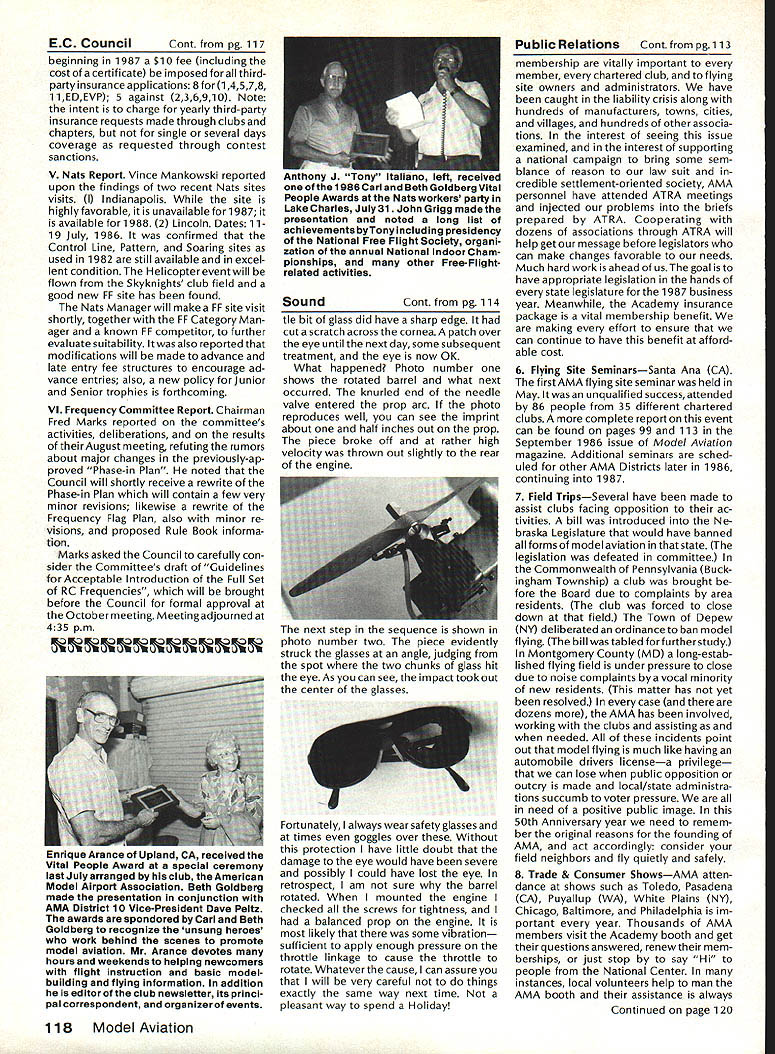
- An engine needle-valve knurled end entered the prop arc, broke off at speed and shattered safety glasses; a corneal scratch occurred but the eye recovered.
- Lesson: always wear safety glasses or goggles when running engines and flying. Check engine mounting and linkages; be vigilant for vibration and throttle rotation that can cause hazards.
---
Mortgage Depletion Program
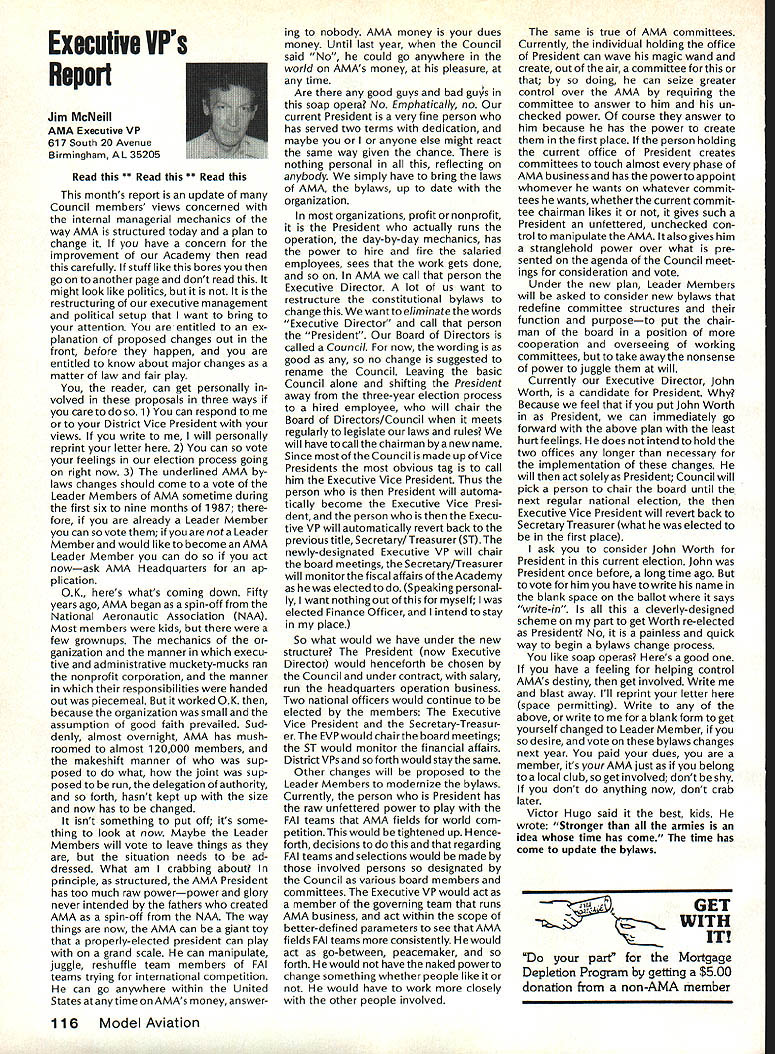
Goal: retire the mortgage on AMA Headquarters to save roughly $70,000 per year for programs such as public relations.
Suggested actions:
- Make a one-time $5 (or more) voluntary contribution with your dues next year.
- AMA clubs and members solicit a $5 contribution from non-AMA supporters.
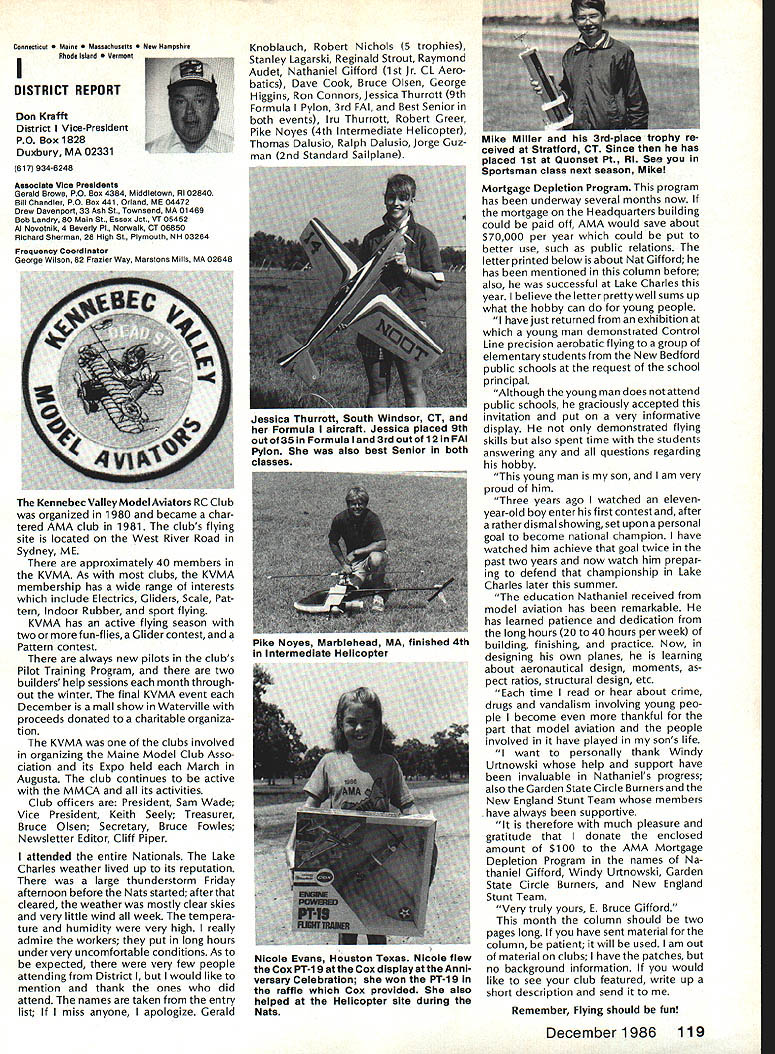
Donation example (excerpted & summarized): E. Bruce Gifford donated $100 to the Mortgage Depletion Program in honor of his son Nathaniel Gifford and supporting individuals/clubs that aided Nathaniel's development through model aviation.
---
Remember: flying should be fun — fly safely, respect neighbors, and support your club.
Transcribed from original scans by AI. Minor OCR errors may remain.

