
Should AMA Mandate Sound Levels?
Howard Crispin Jr.
When the subject is sound comes up, one question recurs more than any other: will the Academy mandate rules forcing modelers to get rid of loud engines immediately or meet some impossible-to-obtain level? There is widespread fear of such a mandate, in part stirred by other publications. For example, an editorial in Model Airplane News suggested a limit of 50 dBA at three meters — a level that is unattainable for general use and will not be required of everyone.
Some locales do have urgent needs to reduce sound quickly, and stringent local standards have been suggested. However, nothing has been said about imposing an Academy-wide standard treated the way we treat safety rules. That said, there are good reasons to establish maximum sound levels in certain competition categories.
RC aerobatic (F3A) competition provides a useful precedent. The F3A turn-around pattern exists primarily to build a cadre of fliers who can compete for team positions, and meeting a sound standard in that category is feasible with existing techniques and equipment (though at some cost). Adopting such a standard for aerobatic competition could help preserve flying sites and the future of contests — many competitions now record sound levels exceeding 108–109 dBA; reducing that to the high 90s or lower would protect both sites and events.
Other benefits include encouraging manufacturers to produce effective, lower-cost muffling systems. Currently, relatively few dedicated contest fliers will spend heavily on mufflers and pipes, and typical sport fliers are unlikely to follow unless costs come down. As contest-style quieter solutions become more common, sport fliers will often emulate them. A major problem today is the lack of effective, quality muffling systems at low cost; while it is feasible for many modelers to build effective mufflers, few do.
We live in a society that expects ready-to-fly convenience — an aircraft out of the box, started and flown. Fortunately, development for other reasons has produced many useful items, and some members are working on further development to address sound. So, will the AMA mandate a specified sound level? It is likely such mandates would be considered for certain types of competition flying, while clubs and site operators will determine specific local requirements. If you have no neighbor issues, you'll likely be left alone. There is also the medical reason for reducing sound — protecting hearing and the environment.
Some Photo Coverage
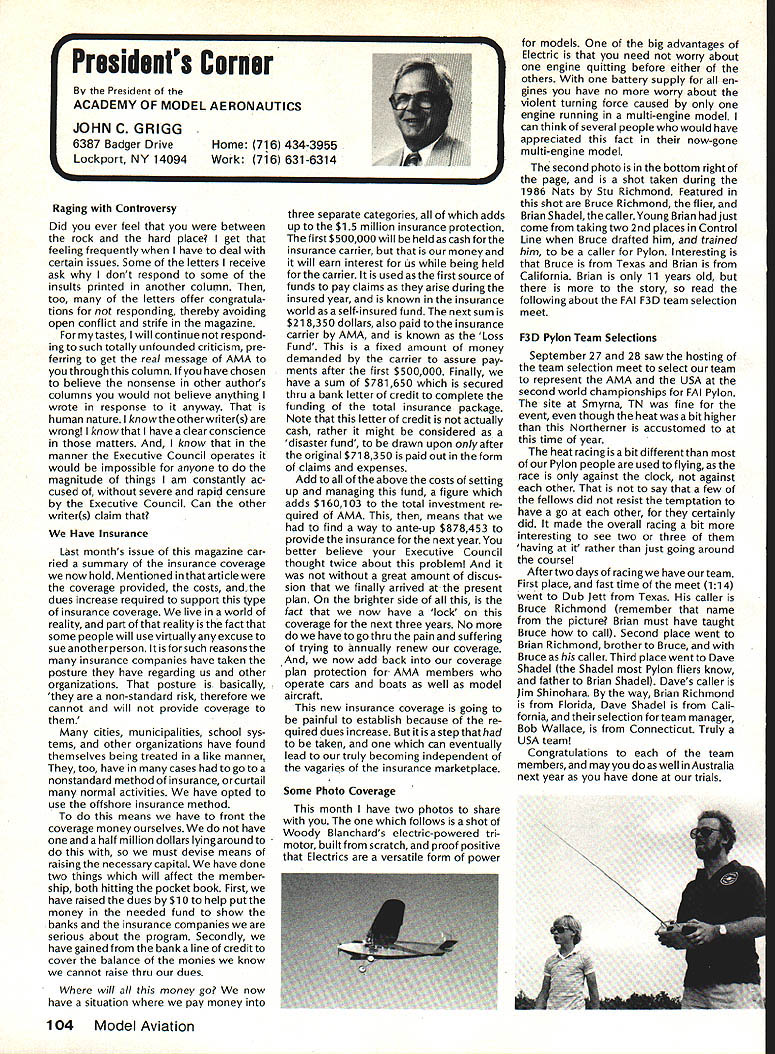
This month I have two photos to share. The first is Woody Blanchard's scratch-built electric-powered trimotor — proof that electrics are a versatile form of power. A big advantage of electrics in multi-engine models is the single battery supply, eliminating asymmetric thrust concerns when one engine quits.
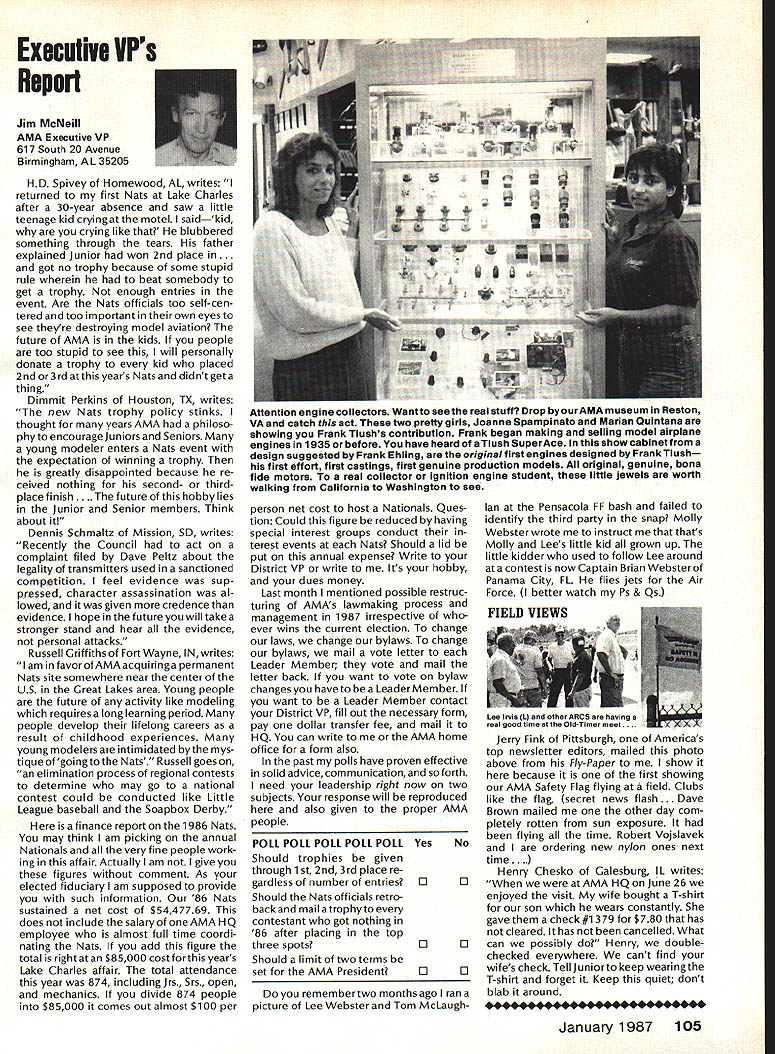
The second photo (bottom right of the page) was taken during the 1986 Nats by Stu Richmond. It features Bruce Richmond (flier) and Brian Shadel (caller). Young Brian, fresh from two 2nd places in Control Line, was drafted and trained as a Pylon caller. Brian is only 11 years old — more on that below in the F3D team-selection report.
F3D Pylon Team Selections
September 27–28 hosted the team selection meet to pick the AMA/USA team for the second FAI Pylon world championships. The Smyrna, TN site was fine, although warmer than some expected.
The meet uses heat racing against the clock rather than direct head-to-head racing. Still, several fliers briefly raced one another for excitement.
After two days of competition the team was selected:
- 1st place (and best time: 1:14): Dub Jett (Texas), caller Bruce Richmond
- 2nd place: Brian Richmond (Florida), caller Bruce Richmond
- 3rd place: Dave Shadel (California), caller Jim Shinohara
Team manager: Bob Wallace (Connecticut). Congratulations to the team and best wishes for the World Championships in Australia next year.
AMA News
Save Money — Help AMA (Checks Direct)
Last month's magazine ad (page 141) introduced a program that lets AMA members contribute financially while spending as usual. Instead of ordering checks through your bank, you can order through AMA via the Checks Direct mail-order service (AMA Checks, Minnesota). The service offers a variety of check styles, types (pocket, duplicate), special features, and AMA wing-design checks. About 15% of the cost of each order will be returned to AMA as a contribution instead of bank profit.
This program — along with other initiatives (credit cards, bank loans, etc.) — aims to generate income sources beyond dues. Successful alternate income streams can help prevent future dues increases and reduce AMA’s dues dependence.
Mortgage Depletion Program
The Mortgage Depletion Program recently received a $500 donation from non-AMA member Howard Crispin Jr.
Liability Insurance and Dues
AMA is funding its liability program and has implemented an insurance plan intended as a long-range solution to provide consistent liability protection for members, clubs, site owners, and event sponsors. The plan required a $10 open-member dues increase to help build reserve funds (targeting about $1 million in three years) so the program can become self-financing. This will only happen if yearly claims remain near current averages (about $120,000/year). Members must continue to practice safe modeling to keep claims low.
Elections and Member Participation
Ballots are being counted by the auditor. Historically only about one in five members votes; we hope a contested election will increase turnout. Officers elected by a minority is undesirable — please vote.
In-House Computer System
AMA’s new in-house computer system is functioning well, replacing an outside computer operation and improving membership-processing speed. This reduces dependence on outside services and gives AMA more control over operations as it begins its 51st year.
Homeowners Insurance Program
Many members may be missing a good homeowners insurance option available through AMA’s broker, Alexander & Alexander (Omaha, NE). The AMA program places coverage with Fireman’s Fund, featuring:
- Replacement-cost dwelling and contents coverage (rather than actual cash value)
- $5,000 all-risk coverage on models, parts, and equipment (with optional increase)
- Coverage for models lost from a flying site or unlocked vehicle, and for damage caused by helpers
To compare your current coverage with the AMA program, call toll-free 1-800-652-4829 (Nebraska: collect 402-388-2093).
Frequency and Radio Issues
Reports of interference have declined in several recent events, suggesting the phased radio-frequency changes are working. Still, members should monitor older transmitters for continued compliance as phase-out proceeds.
A letter from "Ol' Gabby WA8GPQ" compared the evolution of ham radio to RC radio: as systems improve, better use of spectrum becomes possible, albeit at cost. The implication: radios will improve over time; expect growing pains but better long-term performance.
Regional Events and Club News
20th Anniversary Rhinebeck WWI Jamboree
- The Rhinebeck Jamboree remains a highly recommended two-day model event. The landscape and people are memorable. A photo of CD George Busso and an overview photo of attendees were noted from the September 6 jamboree.
September 21 (contested events on the same day)
- The 30th Annual Pattern & Sport Scale Meet (L.I. Drone Society, Cedar Creek, Wantagh, NY) and the Second Annual Wally Rodriguez Memorial Air Show at Sunken Meadow State Park fell on the same date. Both events were well run. The Wally Rodriguez Memorial Air Show was an excellent tribute; thanks to the Long Island Flying Eagles, L.I. Helicopters, Long Island State & Recreation Commission, and CD Anton (Tony) Kirichenko for their efforts.
Ramona Air Show and Scale Masters
- Assistance and participation at the Ramona Air Show and the 1986 Scale Masters Championships at Mile Square were noted; full-scale aircraft displays and a large crowd made for successful events.
Southern California activities
- Numerous club meetings, presentations, and gatherings were attended in the San Fernando Valley, Simi Valley, San Diego, and the Bay Area. Several clubs and events were praised for professionalism and support of the hobby.
South Carolina State Pattern Championship (September 20–21, 1986)
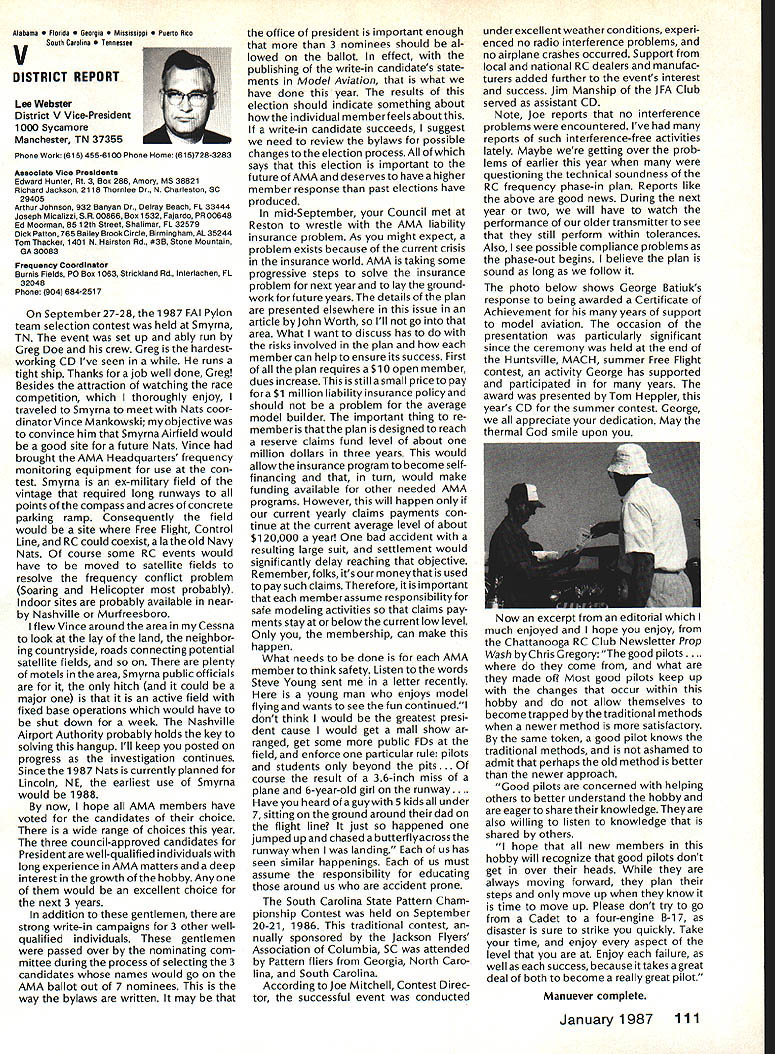
- Sponsored by the Jackson Flyers' Association of Columbia, SC, the contest saw fliers from GA, NC, and SC, faced no radio interference, and experienced no crashes. Support from RC dealers and manufacturers added to the event’s success.
Golden Valley Radio Control Association (Clinton, MO)
- An open house and local press coverage demonstrated what a small club (19 members) can achieve.
Morrison Model Aircraft Flyers (Morrison, IL)
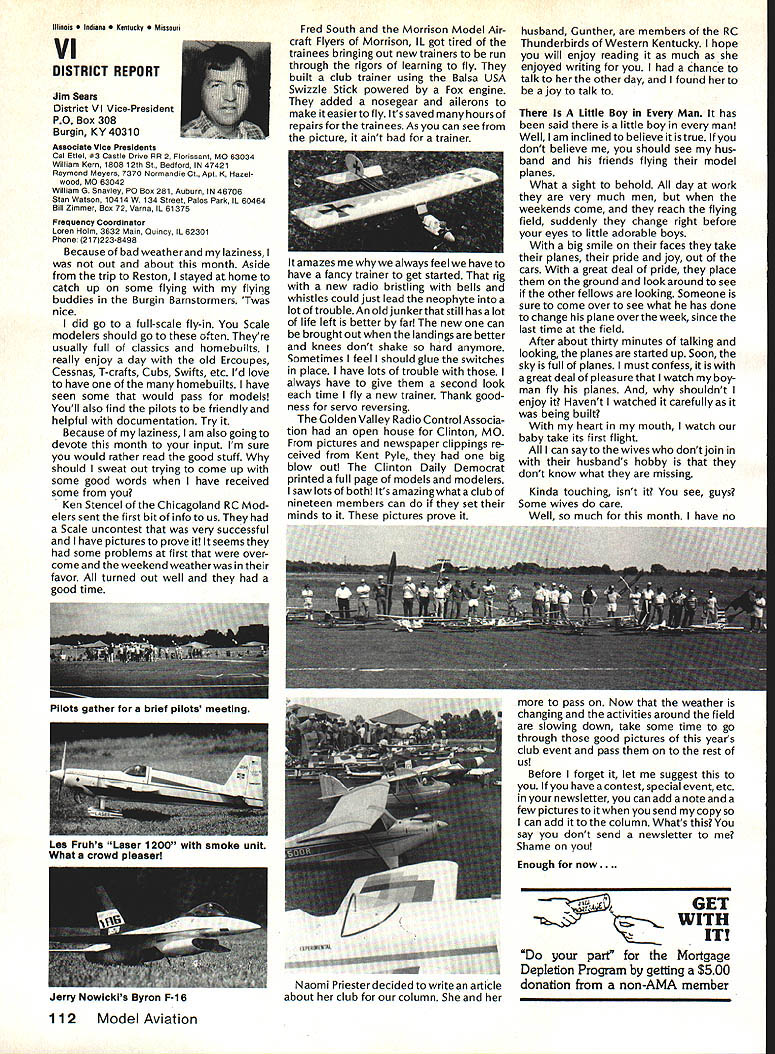
- Fred South and club members built a dedicated club trainer (Balsa USA Swizzle Stick with Fox engine), adding nosegear and ailerons to make it easier for trainees and reducing repair hours. A simple, robust trainer can be preferable to a fancy new trainer for beginners.
RC Thunderbirds (Western Kentucky)
- Naomi Priester contributed an article about her club; her enthusiasm and writing were noted.
Community, Education, and Public Relations
A Fall Cultural Series event, "Model Building," brought workshops, films, and teacher guides to Harrisburg. The program emphasized reading directions, care, concentration, and patience — valuable skills beyond model building. AMA was positively featured on local TV and in community outreach.
Members are encouraged to send contest reports, photos, and newsletter items for inclusion in AMA columns.
Safety and Responsibility
Members are reminded to think safety and educate those around them to prevent accidents. Examples include keeping children and non-pilots clear of pits and runways and supervising trainees carefully.
Editorial Excerpt — On Being a Good Pilot
From the Chattanooga RC Club newsletter Prop Wash (Chris Gregory):
- Good pilots keep up with changes, understand and respect traditional methods, help others learn, listen to differing knowledge, and move up skill levels responsibly. Don't rush from beginner to an advanced airplane too quickly; enjoy learning from failures and successes.
Miscellaneous
- Suggestion: treat some fly-ins like a toll road and charge per flight as a fair way to raise funds only from those who use the facility.
- South African Model Aircraft Association (S.A.M.A.A.) is commended for its excellent introductory booklet and magazine; members are encouraged to write to S.A.M.A.A., P.O. Box 35925, Northcliff 2115, South Africa.
- Redistricting, bylaws review, Nats structure, and AMA resource allocation were raised as topics needing attention in 1987 to better align priorities, representation, and international competition support.
Closing Notes
- The hobby is alive: Control Line, Free Flight, and Radio Control flying are all active and supported through AMA efforts.
- The best way to make your views known is to write them down and send them to your AMA Vice President — they represent you, but they need your input.
That's all for this month.
Transcribed from original scans by AI. Minor OCR errors may remain.

