
Sound & Model Aeronautics
Howard Crispin Jr.
There are some changes being made in the Sound Committee. We are adding people to broaden our expertise in sound and to develop remedies for problems we are encountering. For some time I have corresponded with Don Hyslop of Pewaukee, WI. Don is knowledgeable in this area and has access to further expertise. He is being added to the committee.
Don recently presented a paper on sound that gives an excellent general statement of where we are. Although part of the paper is a broad review, I am printing it as this month's sound article. I feel many of you can use it as a guide for reducing sound levels and for talking more accurately with neighbors, which may lead to mutual understanding.
In future issues there will be articles by other members of the committee that will go into technical details. Also coming up is a study of the 1986 Nationals; sorting the data is taking longer than planned.
Pebble Creek Flyers — background
The Pebble Creek Flyers, Inc., are located on 33 acres in the town of Waukesha just west of the city limits. For the first ten years the club seemed secure: the field is shareholder-owned, a mortgage was retired within the first decade, and the founders obtained proper zoning and air rights over surrounding farmlands.
About three years ago a residential subdivision began expanding toward the field. In response, the club has taken up the challenge to innovate, experiment, and learn to fly more quietly. I am touring Milwaukee-area clubs giving a talk and hope others will respond with the same enthusiasm.
Support Your Local Library
Geoffrey Styles Director of Public Relations
Sometimes model aviation seems like the weather — everyone talks about it, but nobody does anything about it. Part of the problem may be that aeromodelers talk mostly to other aeromodelers. We should be talking to people not already in the sport: neighbors, friends, coworkers, and especially youngsters.
Kids often have never seen a model airplane fly or had the chance to build one. What can clubs do? One simple effort is to provide a subscription to Model Aviation magazine for schools or public libraries.
- Special rates are available:
- Educational institutions (postage-paid): $9.00 per year
- Public libraries: $13.50 per year
- Clubs or individuals can buy subscriptions as gifts and include a gift card so recipients know the source.
This is a painless, simple junior program that can introduce youngsters to model aviation — you might even start someone on a career in aerospace.
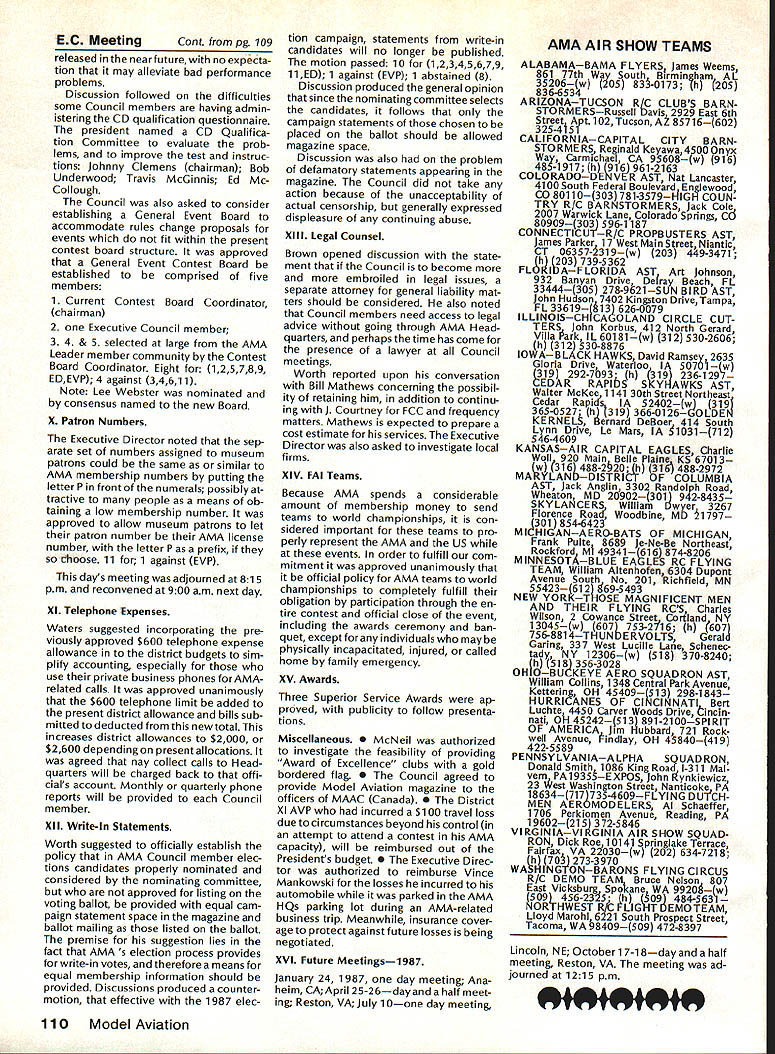
Synopsis — Executive Council Meeting October 18–19, 1986
Attendance
- President: John Grigg, Lockport, NY
- Executive Vice President: Jim McNeill, Birmingham, AL
- Executive Director: John Worth, Fairfax, VA
- District I VP: Don Krafft, Duxbury, MA
- VP‑II: John Byrne, Bayside, NY
- VP‑III: Dave Brown, Hamilton, OH
- VP‑IV: Howard Crispin, Charlottesville, VA
- VP‑V: Lee Webster, Manchester, TN
- VP‑VI: Jim Sears, Burgin, KY
- VP‑VII: Pete Waters, Northville, MI
- VP‑VIII: Johnny Clemens, Dallas, TX
- VP‑IX: Travis McGinnis, Arvada, CO
- VP‑XI: Ed McCollough, Portland, OR
- Ev Langworthy, NAA Executive Director
Present from Academy staff: Gisele Jackson (Comptroller); Micheline Madison (Competitions Director); Bob Underwood (Technical Director); Vince Mankowski (Nats General Manager); Doug Pratt (Special Projects).
Guests: Fred Marks (Frequency Committee chair); Jay and Mrs. Gerber (NFL Films); Cal Ettel (AVP District VI); Barbara Krafft; Lillian Worth.
A copy of the official minutes may be obtained on request from AMA Headquarters; they will be available approximately Feb. 1. Minutes are official after review and incorporation of suggested changes at the next Council meeting (Jan. 24, 1987). Meeting began at 9:00 a.m.
Announcements
- A congratulatory letter from the Society of Model Aeronautical Engineers (England) for the Golden Jubilee (50th anniversary) was read.
- A late agenda item from Dave Peltz will be placed on the next meeting's agenda.
- The propriety of using AMA letterhead and AMA-paid computer services in a campaign to obtain reciprocity was questioned.
- Canadians requested reciprocity concerning insurance coverage; follow-up discussion held.
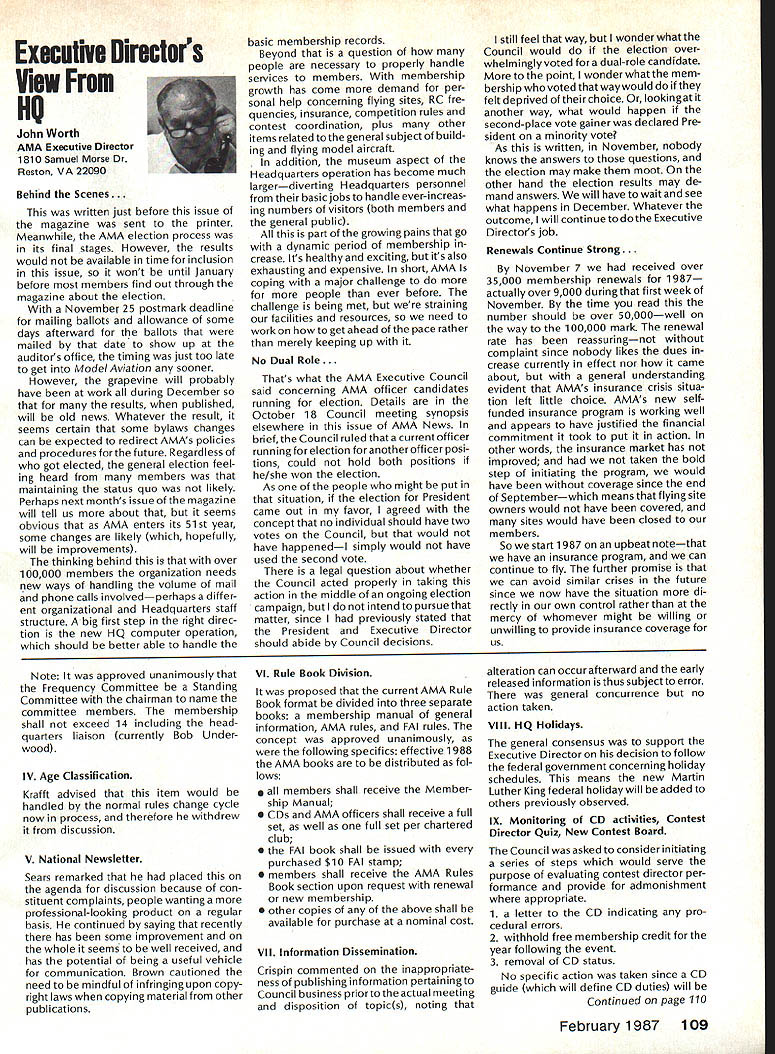
The Council voted unanimously that AMA provide insurance coverage, for normal sport flying in the USA as well as competition, to members of the Model Airplane Association of Canada.
I. Previous Minutes
- The August 1 and September 13, 1986 minutes were approved unanimously as amended.
II. Executive VP Report
- McNeill reported a post‑Nats budget evaluation showing an operating cost of $54,477. Expenses were below budget but income was short due to low attendance.
III. Committee Reports
#### A. Bylaws
- Chairman Crispin distributed a standing rule proposal on holding dual offices (executive director and president).
- After discussion, Council adopted a standing rule to Article X, Section 1 effective immediately: No person shall simultaneously hold two positions on the Executive Council. If elected or selected to a second position, the person must choose which office to retain within 48 hours of the announcement, otherwise they remain in the first office held.
- Vote: 8 for (districts 1,2,3,5,6,7,11, Pres); 4 against (8, ED, EVP, NAA); 2 abstained (4,9).
#### B. Executive Search
- Chairman Byrne reported two in-person meetings and criteria assembled for selection; another meeting planned.
#### C. Safety
- McNeill raised concerns about very heavy models. Two unanimous motions:
- Sanction applications shall include a statement signed by the Contest Director (CD) agreeing to enforce all AMA Safety Codes, with attention to overweight models.
- The same statement to be applied to charter club applications and renewals.
- All insurance (club and third-party) is void if a club knowingly allows flying outside Safety Code limits.
- The Safety and Sound Committees were assigned to review a local newspaper article and similar incidents and report recommendations at the next meeting.
#### D. Films
- Jay Gerber presented an NFL Films offer to produce a 30‑minute film to be marketed by NFL Films and offered on videotape to AMA membership. Council accepted unanimously.
#### E. Frequency
- Fred Marks discussed:
- Reaffirming the Phase‑In Plan
- Approving a new flag identification system (approved 11 for, 2 against)
- Radio Equipment Guidelines: Council approved distribution by registered mail to all known manufacturers/importers; lack of response will be considered affirmation; significant negative response would trigger reconsideration.
- Proceeding with an FCC petition to tighten Type Acceptance standards so occupied spectrum is 5 dB down at ±20 kHz from nominal center frequency (approved unanimously).
- Purchase of a spectrum analyzer and peripherals (IFR) for transmitter testing approved, up to $9,000 (approved unanimously). Analyzer to be housed at Headquarters and available to qualified personnel only.
#### F. Nats
- Steering Committee chairman McGinnis distributed an outline report. Income and expenses reviewed; expenditures under projections but income short due to low attendance/sponsorship. A suitable Free Flight site was found in Lincoln for the 1987 Nats. Council accepted the outline and commended staff.
#### G. Finance
- Chairman Brown reported the Sept. 30 balance sheet shows the Academy is 3% better than projected; budget in good state.
#### H. Sound
- Chairman Crispin announced that for the 1987 Nats at least one new sound meter and calibrator should be purchased; no objection.
#### I. Redistricting
- Chairman Krafft reported District X survey not yet sent; District VIII petitioned to be divided. Committee to review; Executive Director requested survey questions.
#### J. Awards Criteria
- Chairman Sears requested Ed McCollough be appointed to the committee (no objection). Goal: define criteria for each award; recommendations due next meeting.
#### K. Scholarship
- Chairman McGinnis clarified that unspent balances carry forward. The Council approved distribution of 1986 scholarships totaling $9,500:
- Wayne Boudreaux and Brent Wagnon: $2,500 each
- Lee Mickus: $1,500
- Sheldon Ybanez, Julie Botticello, Tien‑Seng Chiu: $1,000 each
#### L. Committees (General)
- Ratified committees and members:
- Bylaws Committee (Council appointed): Howard Crispin (chair), John Byrne, Jim Sears, John Grigg, John Worth, Micheline Madison, Bill Mathews (ex‑officio).
- Sound Committee (chair to select members): Howard Crispin (chair), Ed McCollough, Pete Waters, Dave Peltz, Vince Mankowski.
- Financial Committee: Dave Brown (chair), Jim McNeill, John Worth, Travis McGinnis, Bill Mathews (ex‑officio).
- Special Interest Groups Committee: Ed McCollough (chair), Howard Crispin, Dave Brown, Travis McGinnis.
- Nats Steering Committee: Travis McGinnis (chair), Pete Waters, Johnny Clemens.
- Real Property Acquisition Committee: Pete Waters (chair), Russ Kroeger, DeWayne Renken, A.J. Smith.
7a. Long Range Planning Committee for Flying Site Acquisition — discharged. 7b. Safety Committee (formerly appointed): Jim McNeill (chair), Jim Sears, John Clemens, Dave Brown.
- Scholarship Selection Committee: Bob Statnick (chair), Bob Underwood, Travis McGinnis, Betty Stream, Cliff Telford.
IV. Age Classification
- Krafft withdrew this item; it will be handled by the normal rules change cycle.
V. National Newsletter
- Sears discussed constituent complaints and the need for a more professional, regular product. Some improvement noted. Brown cautioned about copyright when copying from other publications.
VI. Rule Book Division
- Approved unanimously to divide the current Rule Book into three separate books effective 1988:
- Membership Manual: distributed to all members.
- AMA Rules Book: available to members upon request with renewal or new membership; CDs and AMA officers receive full sets; one full set per chartered club.
- FAI Rules Book: issued with each purchased $10 FAI stamp.
- Additional copies available for purchase at nominal cost.
VII. Information Dissemination
- Crispin commented on the inappropriateness of publishing Council business before meetings; general concurrence but no action.
VIII. HQ Holidays
- Consensus to follow federal government holiday schedule; Martin Luther King Day will be observed.
IX. Monitoring of CD Activities, Contest Director Quiz, New Contest Board
- The Council discussed measures to evaluate contest director performance and steps for admonishment (e.g., letter, withholding free membership credit, removal of CD status). No specific action taken; a CD guide defining duties will be developed.
Sound (Technical Article — Don Hyslop, excerpt)
"In the pursuit of learning more about sound (having a daughter who is a certified audiologist helps), I purchased a Radio Shack sound level meter and took readings of engines at our field. I also obtained an excellent booklet on noise control from Taylor Products in Elkhart, IN (muffler-producing division of Tecumseh Products) and researched governmental regulations and studies on noise control.
Sound level meters measure loudness in decibels (dB). Proper abbreviation is dB; dBA indicates the 'A' scale, which measures air vibrations more nearly the way the human ear and brain interpret sound.
Since the early 1970s the Federal Government has become more involved in noise research and regulation. OSHA prescribes maximum levels of sound for workers, and the EPA conducts basic research on noise and control.
Testing by the EPA shows the primary source of most recreational-vehicle noise (motorcycles, snowmobiles, model airplane engines) is the engine exhaust system; propeller tip speed is also significant. EPA ranks the average model airplane noise level at 78 dBA measured at 50 feet. That places model airplanes just below chain saws and snow blowers (82–84 dBA) and just above leaf blowers and tillers (76 and 71 dBA). Typical readings: a K&B .40 with stock muffler measures 74–78 dBA; a typical .60 engine measures 80–82 dBA.
EPA recommends redesign to achieve levels around 65 dBA. Because every 3 dB represents a doubling (or halving) of sound energy on the logarithmic scale, reaching 65 dBA means a substantial reduction in perceived loudness.
Typical conversational speech is about 60 dB; a noisy office about 70 dB. To illustrate the dB range, Taylor/General Radio provide this chart:
The Range of Sound
- 140 — Threshold of pain
- 130 — Pneumatic rock drill
- 120 — Loud automobile horn
- 110 — Punch press
- 100 — Automatic lathe
- 90 — Shouted voice
- 80 — Passing truck
- 70 — Noisy office
- 60 — Conversational speech
- 50 — Private business office
- 40 — Average residence
- 30 — Soft whisper
- 20 — Rustle of leaves
- 15 — Threshold of hearing, average
- 0 — Threshold of hearing, acute
Source: Sound or Noise by Julian Pawline, Taylor Products.
Can we achieve the EPA goal of 65 dBA for model airplane engines? Some pilots have. For example, Jim Bennett (Chicago area) registered 63 dBA at a Pattern contest by using a tuned pipe (often more effective than stock mufflers), inverting the engine to better cover it, burying the tuned pipe in the belly pan, and installing a longer, deeper‑pitched propeller to slow engine rpm (from ~14,000 rpm to ~11,000 rpm) and increase prop pitch.
Other pilots use three-bladed props that are shorter for better ground clearance; typical three-blade installations on .60-size competition engines were 10‑inch diameter with increased pitch.
Future sound-control measures include better mufflers and a return to long-stroke engines. High‑revving two-stroke ("square over square") engines produce higher-pitched noise; long-stroke engines run at lower rpm, lower pitch, and may be perceived as less objectionable even at similar absolute levels.
Human perception: people react more negatively to high-pitched sounds. Thus reducing pitch as well as absolute dB is important. Some ordinances set lower allowable levels for higher-pitched sounds (example: allow 66 dB at 50 feet for sounds under 300 cps, but only 39 dB for sounds above 4,800 cps). Speech typically falls between 500 and 2,000 cps; the ear responds between 20 and 20,000 cps and is most sensitive in the 100–12,000 cps range.
A typical two-stroke at 14,000 rpm produces an exhaust burst every revolution (~230 cps). A two-blade prop doubles the frequency; harmonics and overtones also increase perceived frequency. Thus the perceived cycles per second are higher than the exhaust rate alone.
Until manufacturers provide more effective mufflers, hobbyists can modify mufflers by lengthening the expansion chamber. Some mufflers disassemble; plumbing parts (chrome-plated copper sink drains and traps) can be adapted as extension pieces to reduce noise.
Useful tidbits from research:
- Doubling rpm increases noise by 9 dB (roughly triples perceived noise); reducing rpm is an effective control.
- Doubling propeller diameter increases dBA by about 3 dB; using larger, deeper-pitched props at slower rpm is wiser than increasing rpm.
- Doubling the distance from a point source reduces level by 6 dB; for non-point sources the drop may be less.
- Two airplanes each at 78 dBA next to each other combine to about 81 dBA; restricting the total number of aircraft operating simultaneously can reduce combined noise.
Practical steps to quieter flying include tuned pipes or better mufflers, larger higher‑pitch props run at lower rpm, engine installation techniques that shield the engine, and club policies limiting simultaneous operations or encouraging quieter equipment.
WRAM Show and Frequency Checks
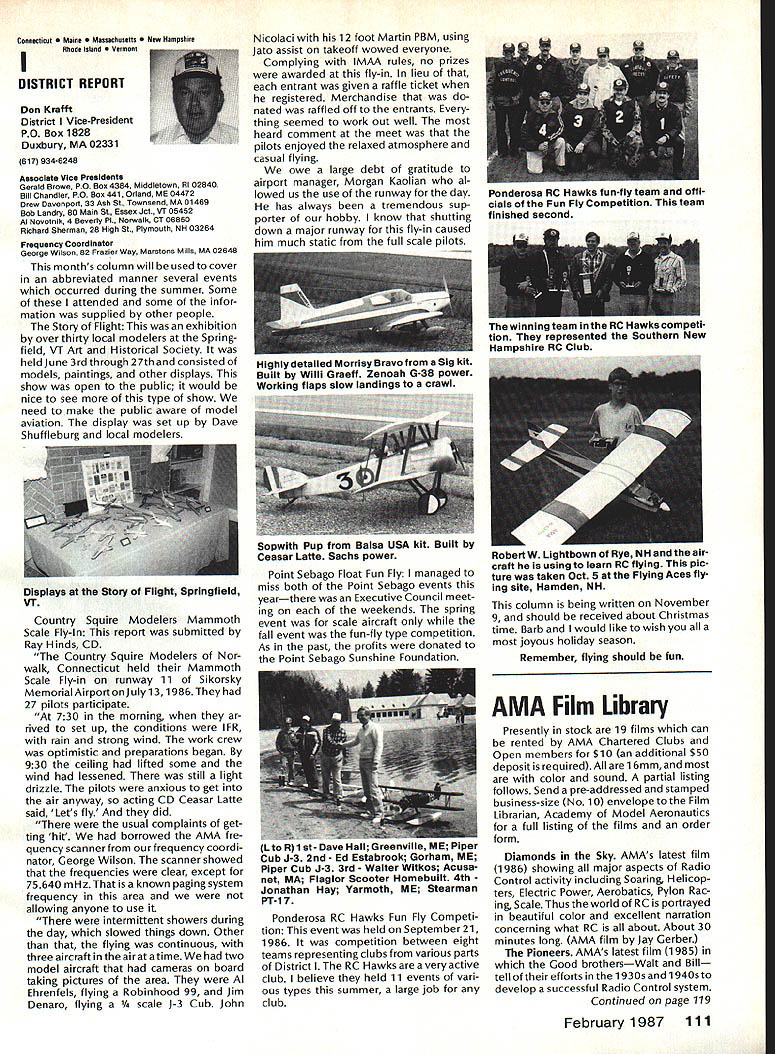
- WRAM Show (1987) will be at the Yonkers Raceway, Yonkers, NY (projected dates: Feb. 21–22, 1987). The larger site should allow more exhibitors.
- AMA will provide free, voluntary RC frequency checks at WRAM and other shows to determine whether transmitters operate within FCC guidelines. Limited registration cards available each day; transmitters accepted on a first-come basis.
District III Report
Dave Brown District III Vice‑President
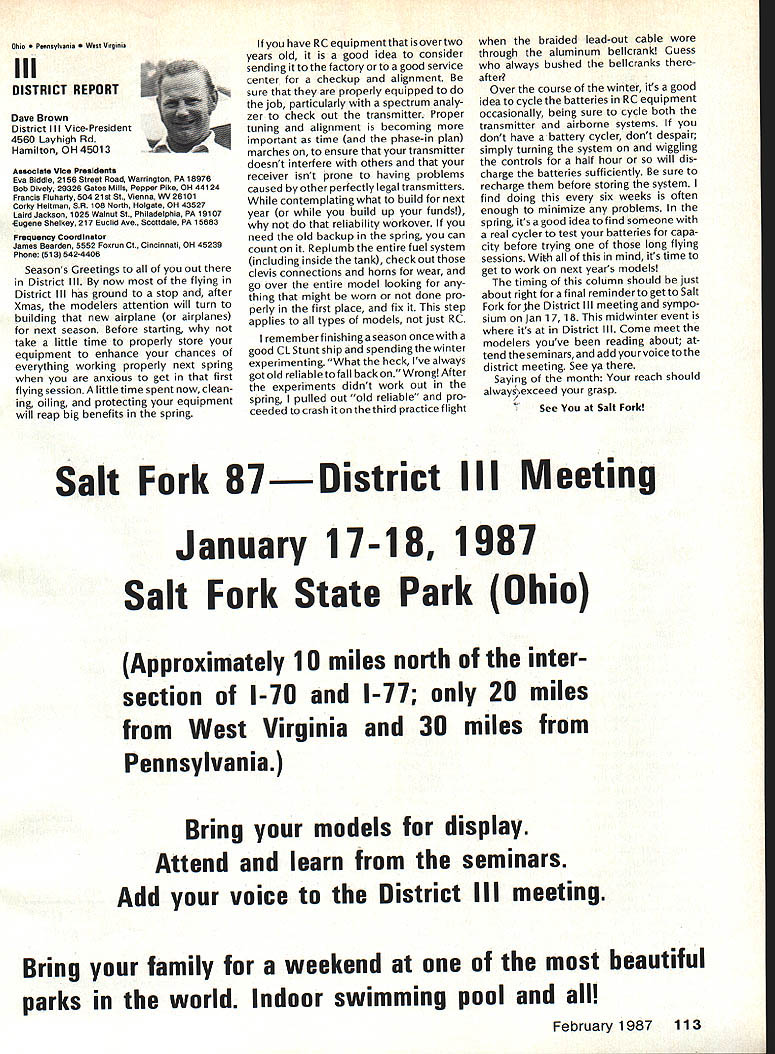
Season's Greetings to District III. Most flying in District III has ground to a stop for winter; now is a good time to store and service equipment so it will work properly in spring.
Maintenance tips:
- Consider sending RC equipment more than two years old to factory or a good service center for checkup and alignment; ensure they have a spectrum analyzer for transmitter checks.
- Replumb fuel systems, inspect clevis connections and horns, check for wear, and repair any issues before spring.
- Cycle batteries periodically over winter (every six weeks is often enough); if you lack a cycler, run the system with controls moving for about 30 minutes and recharge before storage. In spring, have battery capacity tested if possible.
- Inspect lead‑outs and other wear-prone items (I once crashed because a braided lead‑out wore through an aluminum bellcrank).
Upcoming events:
- Salt Fork District III meeting and symposium: Jan. 17–18. Attend seminars and meet fellow modelers.
See you at Salt Fork!
Miscellaneous Club News and Announcements
- National Free Flight Society Hall of Fame (1986) honorees included R.L. (Bob) Hastchek and others; congratulations extended.
- Several club newsletters and rosters were commended for quality and completeness; clubs are encouraged to include area codes in phone numbers and consider safety officers or field marshals.
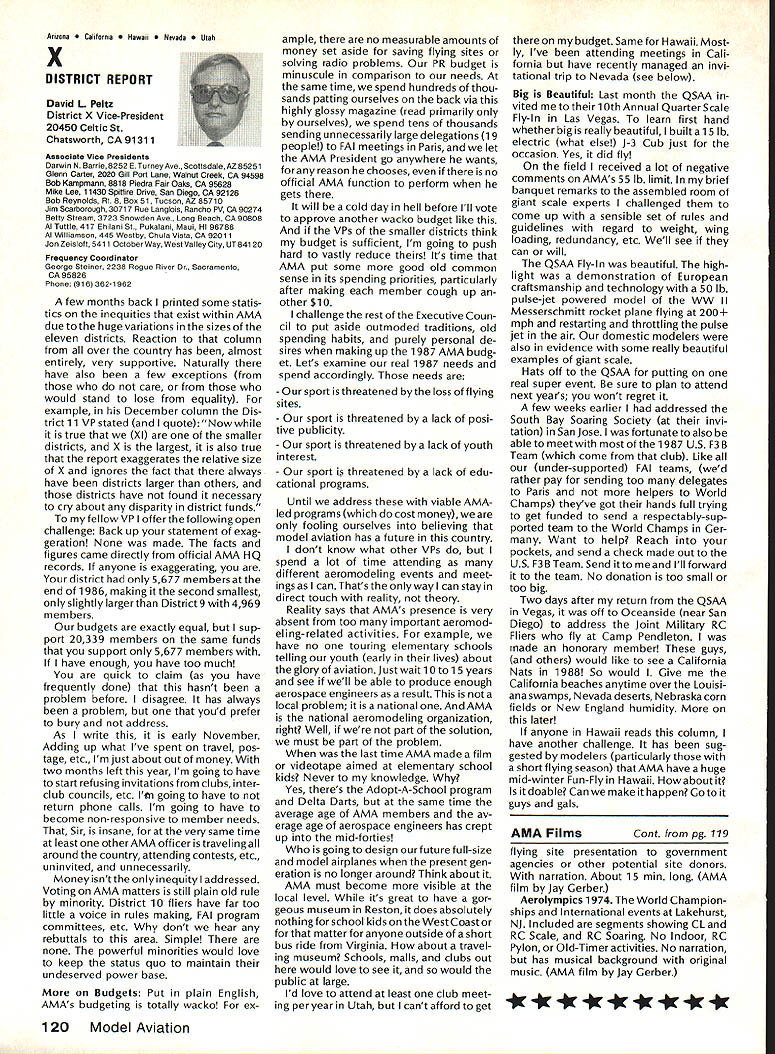
- Giant-scale events: QSAA Quarter Scale Fly-In (Las Vegas) featured impressive giant-scale aircraft and pulse‑jet demonstrations. Giant-scale groups have been asked to propose sensible rules addressing weight, wing loading, redundancy, etc., relative to AMA's 55‑lb limit.
Closing Notes
- Copies of the official Executive Council minutes may be requested from AMA Headquarters; they will be available approximately Feb. 1.
- The Council meets next on January 24, 1987, when suggested changes to minutes and additional agenda items will be addressed.
Transcribed from original scans by AI. Minor OCR errors may remain.

