
AMA News
1987 Nominating Procedure
The AMA Bylaws include standing rules that supplement the Bylaws concerning details of organization and operation. Among these standing rules are those governing the AMA Nominating Committee and the procedures for making nominations for AMA officers.
In 1987 the officers to be elected are the AMA Executive Vice‑President and the Vice Presidents for Districts 3, 7, and 11 to serve three‑year terms beginning in 1988. The procedures for nomination are as follows.
#### Nominating Committee
- Composition
- The Nominating Committee shall consist of all 11 Vice Presidents and the Executive Vice‑President.
- Members of the Nominating Committee shall not be barred from becoming nominees for office themselves.
- Voting proxies are permitted only when:
- the proxy represents the same district as the absent Vice President, and
- the absent Vice President has given written permission to the proxy to vote. (A telegram from the absentee will suffice as written permission.)
- An Open member designated by the absent E.V.P. may act as proxy for the E.V.P.
- The President may not appoint any member of this Committee nor be an ex officio member; neither may the Executive Director be a member of this Committee.
- Chairman
- The chairman of the Nominating Committee shall be elected from among the committee members by majority vote.
- The current AMA President, or in the President’s absence the Executive Director, will call the meeting to order. Once the chairman is elected, the President (or Executive Director) will relinquish the chair and leave the meeting.
- Recording Secretary
- The Recording Secretary shall:
- keep full, accurate, and detailed written minutes of the proceedings;
- assist the Teller in the distribution, collection, and tabulation of ballots;
- submit to the President, Executive Vice‑President, meeting chairman, and Executive Director a full written report of the meeting and results of all voting procedures within 48 hours after adjournment.
- Meeting Conduct
- The President (or Executive Director) shall open the meeting and preside while the committee members elect a chairman.
- The newly elected chairman shall dismiss the President (or Executive Director) and appoint a Recording Secretary and a Teller. The Teller shall not be a candidate for office.
- Candidate Nominations
- All nomination letters must be received at AMA Headquarters fifteen (15) days prior to convening of the Nominating Committee Annual Meeting.
- A letter of acceptance by the candidate must be on file at AMA Headquarters prior to the meeting.
- Because the Nominating Committee is scheduled to meet on July 10, the deadline for receipt of nominations at AMA Headquarters is close of business on Thursday, June 25.
- Selection of Nominees
- No more than three (3) nominees shall appear on the ballot for each elective office.
- The assembly shall examine, evaluate, and discuss all written proposals for candidacy. Nomination letters shall be read aloud by the Recording Secretary.
- The discussion period shall be limited to ten (10) minutes per candidate.
- An incumbent is automatically placed on the ballot, except that a vote by three‑quarters (3/4) of the committee against placement may withhold the incumbent's name from the ballot (see Bylaws, Article IX, Section 2).
- Voting
- One vote per person per ballot.
- Oral voting shall be by district, starting with District I and continuing numerically through District XI. If desired, voting by secret ballot shall be written.
- If the question of placing an incumbent's name on the ballot arises, that question shall be voted on before voting for other nominees. Voting for placement of nominees on the ballot shall follow the sequence: President, Executive Vice‑President, Vice Presidents.
- When three names are nominated for an office, elimination shall be by simple majority vote.
- Finalization Proceedings
- The Recording Secretary's report (see 3) shall be submitted to all Vice Presidents and the Executive Vice‑President within 15 days of the meeting for their comments, corrections, and approval.
- The report must be approved by three‑quarters (3/4) of the attendees at the meeting (Vice Presidents and E.V.P. or their proxies).
- Adjournment
- An affirmative vote on an adjournment motion, duly made and seconded, will adjourn the meeting.
---
Frequency Utilization Plan (overview and Phase‑In)
Fred Marks, Jack Albrecht, Warren Plohr
The AMA Frequency Committee provides these articles to inform modelers of developments and the status of RC frequency matters. The material below summarizes the AMA Phase‑In Plan and the AMA Frequency Use Plan as of early 1987.
Background and Phase‑In Plan
- In 1983 the FCC authorized additional RC channels, but because of technical limitations of much existing RC equipment, not all new channels could be used immediately without interference problems.
- The AMA Frequency Committee devised a Phase‑In Plan to make maximum use of authorized frequencies while minimizing modeler‑to‑modeler interference.
- The Phase‑In Plan split implementation into periods:
- January 1, 1983 through December 31, 1987 — implementation in some of the new channels;
- January 1, 1988 through December 31, 1990 — further implementation;
- January 1, 1991 — implementation of the remainder, ultimately providing a total of 50 channels for model aircraft use.
- The Plan was intended to be flexible; field experience during the phase‑in period would be used to adjust allocations.
Field Experience and 1986 Plan Modifications
- Transmitter RF spectrum checks at major RC trade shows indicated that about one‑third of units checked were out of tolerance in frequency and/or bandwidth.
- Excessive transmitter bandwidth can cause splatter and interference to nearby legal RC units; this can be reduced by narrow‑band transmitters and/or selective receivers.
- To ease transition from broad‑ to narrow‑band operation, the Committee modified the Phase‑In Plan in August 1986:
- Effective January 1, 1988, channels 12 through 34 (inclusive) will be reserved for use by narrow‑band transmitters only, spaced at 40 kHz between channels.
- A narrow‑band transmitter is defined as one whose RF output is down by 55 dB at ±20 kHz from the center frequency. Frequency tolerance must be within ±1,500 Hz.
- Channel 36 will not be used in order to provide an 80‑kHz buffer between channels 34 and 38.
- Upper‑band channels currently in use (38 through 56) remain in effect, spaced at 40 kHz; these channels may continue to be used by units that do not meet narrow‑band criteria. Narrow‑band units may also operate on those channels if they are presently in use there.
- As of January 1, 1991, the plan calls for all channels (11 through 60) to be spaced at 20 kHz. Continued evaluation will take place as 1991 approaches.
Important Notes and Frequency Flags
- The AMA Phase‑In Plan has generally worked well, particularly where RC clubs implement positive frequency control at flying fields.
- The addition of eleven new channels as of January 1, 1988 required modification of the frequency identification and control system (flags and color codes) to prevent duplication of identifiers.
- The FCC directed withdrawal of six old RC frequencies in the 72‑MHz band from RC model use effective December 20, 1987. After that date, those frequencies cannot be used for control of RC aircraft, boats, cars, or surface craft.
- Phase‑in schedule for frequency flags:
- New frequency flags may be used at the user's option beginning June 1, 1987.
- Beginning January 1, 1988 new frequency flags will be required at AMA‑sanctioned events and recommended for use at AMA chartered club fields.
- All new equipment produced for distribution and sale on or after June 1, 1987 should carry the new flag system, if the manufacturer normally provides a frequency flag.
- Suggestion: See Bob Underwood's "Frequency Asked Questions" column in the Competition Newsletter section of Model Aviation for further details.
---
AMA Radio Control Utilization Plan (as of February 1987)
Part I — Frequencies for Radio Control (overview)
- Allocation of the radio spectrum in the United States is controlled by the Federal Communications Commission (FCC). Remote control (RC) of model aircraft and model surface craft is restricted to certain radio bands; regulations impose technical and operational limits on transmitters and receivers and operator restrictions.
- The following is a summary of relevant RC frequency bands and important limitations. Frequencies are listed in megahertz (MHz). For full regulatory detail, see the Code of Federal Regulations (CFR) references listed at the end.
#### 1.1 RC operation in the Personal Radio Service (PRS) bands (CFR Part 95 and CFR Part 15)
- Operation is permitted without operator license, but PRS rules and usage restrictions must be complied with.
1.1.1 Six frequencies in 27‑MHz band:
- 26.995 MHz to 27.195 MHz on a 0.05‑MHz spacing (six channels), and 27.255 MHz.
- Regulations require crystal‑controlled transmitters with limits on power output.
- Rules permit operation of model aircraft and model surface craft and home‑built RC equipment.
- Because PRS is shared with other services, 27.255 MHz is not recommended for model aircraft RC; adjacent‑channel CB interference can occur.
1.1.2 Four frequencies (withdrawn Dec 20, 1987):
- 72.08, 72.24, 72.40, and 75.64 MHz.
- Transmitters and receivers must be FCC Type Accepted. Transmitter power limited to 750 mW. Only RC operation of model aircraft permitted.
- Use of these frequencies by car and surface craft was withdrawn by the FCC effective December 20, 1987 — it is a violation of federal law to use them after that date.
1.1.3 Three frequencies (withdrawn Dec 20, 1987):
- 72.16, 72.32, and 72.96 MHz.
- Type Acceptance required; power limited to 750 mW. RC operation of model aircraft and model surface craft permitted.
- Use withdrawn by the FCC effective December 20, 1987 — illegal to use after that date.
Warning: The seven frequencies listed in 1.1.2 and 1.1.3 are shared with other PRS users and may be subject to direct interference. RC model users must cease operation if mutual interference with other users occurs. Paging services and other users may cause interference to RC model operations; RC modelers currently have no regulatory recourse against such interference.
1.1.4 Fifty‑five frequencies in the 72‑MHz band:
- 72.01 MHz to 72.99 MHz in 0.02‑MHz spacing.
- Type Acceptance required; transmitter power limited to 750 mW. Only RC operation of model aircraft is permitted.
- The AMA Frequency Use Plan (Part 3) specifies the usable frequencies in this band.
1.1.5 Thirty‑three frequencies in the 75‑MHz band:
- 75.41 MHz to 75.99 MHz in 0.02‑MHz spacing.
Note: Frequencies in 1.1.4 and 1.1.5 are designated exclusively for RC model use on a not‑to‑interfere basis. Other PRS users are allocated these frequencies.
#### 1.2 RC operation in the Amateur Radio Service (ARS) bands (CFR Part 97)
- RC operation is permitted in the ARS bands only by FCC‑licensed Amateur Radio operators.
- Amateurs must operate within ARS regulations and have self‑regulated to a specific set of frequencies in accordance with the AMA Frequency Use Plan (Part 3).
- Use of ARS frequencies requires a current ARS license (see Part 4 enforcement details).
---
Part 3 — AMA Frequency Use Plan (summary)
3.1 Prior to January 1, 1988:
- The frequencies listed in the Official Model Aircraft Regulations (1986–1987) are recommended.
- Note: The following two‑color 72/75 MHz frequencies are withdrawn by the FCC effective December 20, 1987:
- 72.08 — brown‑white
- 72.12 — blue‑white
- 72.24 — red‑white
- 72.32 — purple‑white
- 72.40 — orange‑white
- 72.96 — yellow‑white
- 75.64 — green‑white
Warning: It is a violation of federal law to use these seven two‑color 72/75 MHz frequencies after December 20, 1987.
3.2 For January 1, 1988 to January 1, 1991:
- The AMA recommends a staged set of usable frequencies, including:
- 27‑MHz band single‑color frequencies (six channels; see Part 1.1.1).
- 53‑MHz band two‑color frequencies (seven channels).
- 50‑MHz band channels (a small set of channels designated for use).
- 72‑MHz band "aircraft use only" channels: even‑numbered channels in a coordinated set (for example, channels 12–58 with certain gaps).
- Channel 36 is not used to provide an 80‑kHz buffer between channels 34 and 38.
- Channel 58 may have usage restrictions to provide image‑response protection for lower channels.
- 75‑MHz band "surface use only" channels: a set of designated channels for surface craft.
Note: The plan above is intended to be applied with careful frequency identification (flags, pins, boards) and local field procedures to minimize interference.
3.3 For January 1, 1991 and beyond:
- The plan envisages full implementation with narrower channel spacing (e.g., all channels in the 72‑MHz band spaced at 20 kHz) and broader use as RC system designs allow.
- AMA Frequency Committee will monitor system design progress to ensure feasibility of the full channel set.
---
Part 4 — AMA Rules: Guidelines Applicable to RC
4.0 The following rules and guidelines apply to RC operation. Enforcement at AMA‑sanctioned events is as indicated.
4.1 Frequency identification and display:
- The Frequency Identification and Display System (Part 2 of the full plan) is recommended for all RC operating sites.
4.2 Frequency use enforcement:
- The AMA Frequency Use Plan (Part 3) will be enforced at all AMA‑sanctioned events and is recommended for all RC operating sites.
4.3 27‑MHz single‑color frequencies:
- These frequencies are subject to interference in certain areas. Use at AMA‑sanctioned events is permitted at the discretion of event officials.
4.4 Amateur Radio Service licensing enforcement:
- AMA event officials shall enforce Amateur Radio Operator licensing requirements at AMA events.
- A participant using ARS frequencies above 50 MHz for RC must hold a current ARS license of Technician, General, Advanced, or Extra Class.
- A participant using ARS frequencies below 50 MHz for RC must hold a current ARS license of General, Advanced, or Extra Class.
- Use of legal ARS frequencies other than those listed in Part 3 is permitted at sanctioned events at the discretion of event officials. For those frequencies, black‑and‑white ribbons with the frequency inscribed on the white ribbon are an acceptable frequency display.
4.5 Frequency pins:
- The use of frequency pins (often clothespins) to identify the frequency in use is encouraged at all flying sites. Pins shall be clearly marked with the color(s) or channel numbers they represent.
- RC transmitters shall be operated only when the correct pin is in the possession of the transmitter operator.
4.6 Active frequency monitoring:
- Active frequency monitoring at flying sites is encouraged. Scanning receivers, converters attached to AM radios, spectrum analyzers, or simple broad‑band receivers may be used to monitor for unwanted signals and inadvertent transmitters.
4.7 Transmitter spacing:
- It is recommended that flight operations be conducted with transmitters stationed nominally 20 or more feet apart.
4.8 Multiple flight lines:
- When multiple, separated flight lines are used at sanctioned events, aircraft from one line should be prohibited from approaching closer than 100 meters (300 ft.) to another flight line.
4.9 Transmitter restrictions (phase rules):
- From January 1, 1988 to January 1, 1991, only narrow‑band transmitters (as defined in AMA references) will be permitted to operate on Channels 12–34 inclusive.
- After January 1, 1991, only narrow‑band transmitters will be permitted to operate on Channels 00 through 50.
4.10 Image frequency considerations (superheterodyne receivers):
- Superheterodyne receivers are subject to image frequency response. Appropriate choice of the local oscillator (LO) crystal frequency can place the image response at a frequency that minimizes potential interference.
- Recommended LO placement for single‑conversion receivers using a 455 kHz IF:
- 27 MHz single‑color — LO below receive frequency
- 53 MHz two‑color — LO below receive frequency
- 50 MHz (CH00–CH09) — LO below receive frequency
- 72 MHz (CH11–CH16, etc.) — LO below receive frequency
- Use of LO placement should minimize image response.
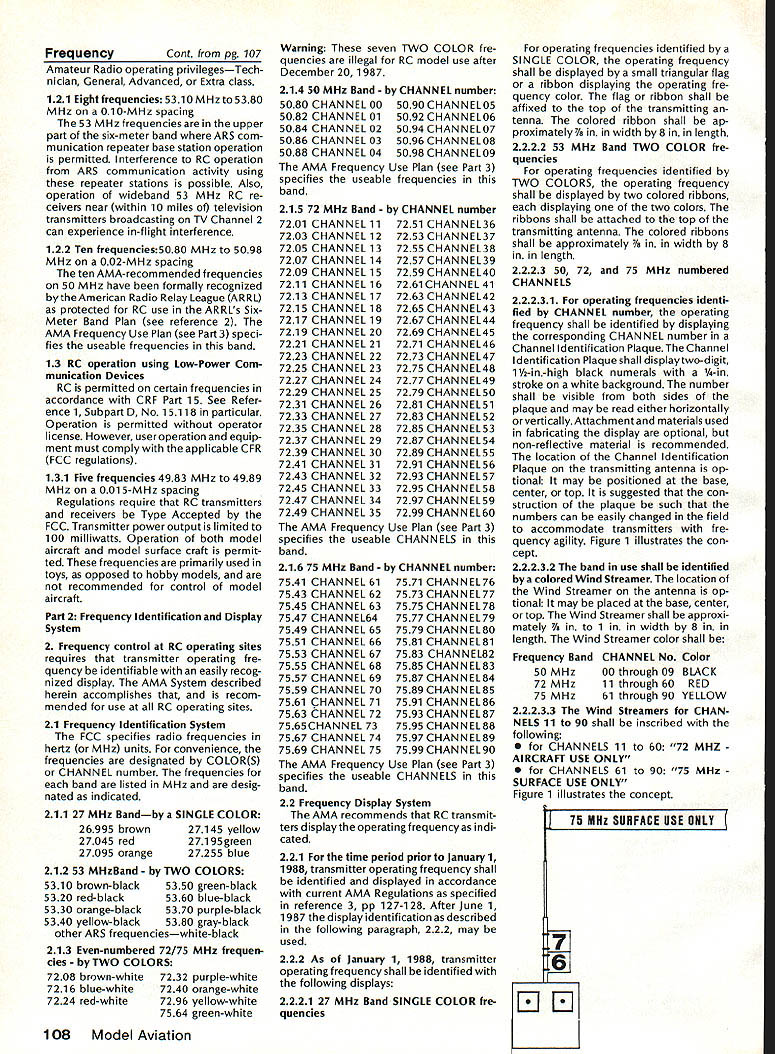
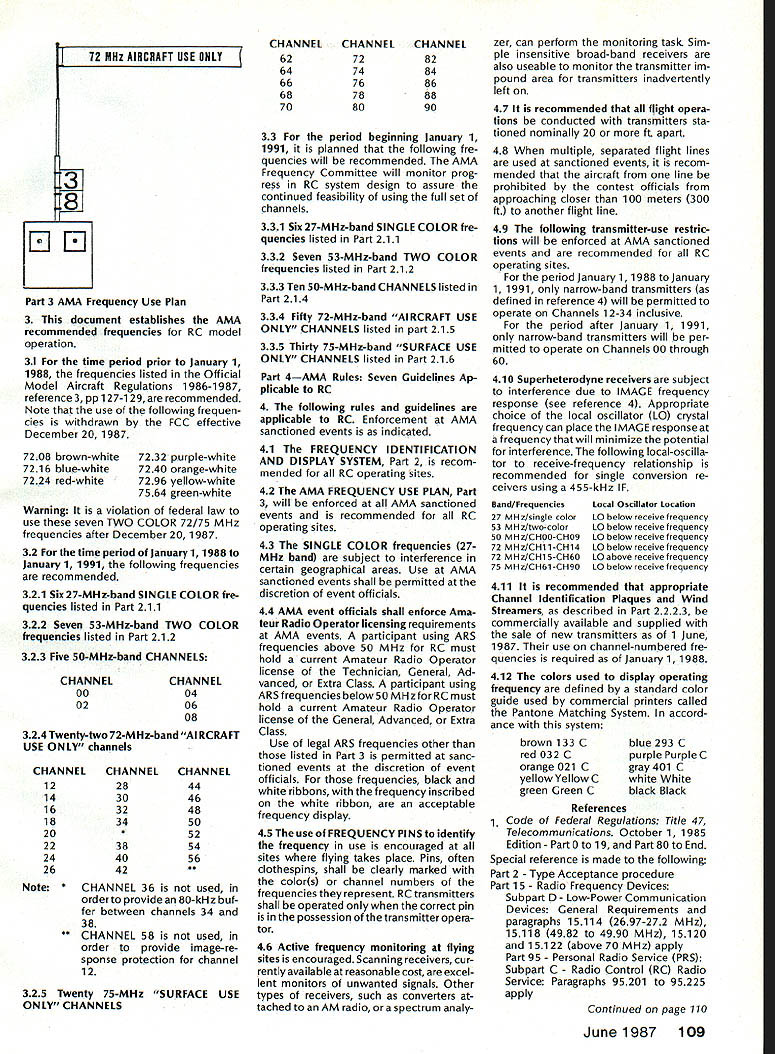
4.11 Channel identification plaques and wind streamers:
- It is recommended that Channel Identification Plaques and Wind Streamers be commercially available and supplied with the sale of new transmitters as of June 1, 1987.
- Their use on channel‑numbered frequencies is required as of January 1, 1988.
4.12 Color codes:
- The colors used for operating frequency display are defined by the Pantone Matching System. Example mappings include:
- brown 133 C, blue 293 C, red 032 C, orange 021 C
- purple (Pantone), yellow (Pantone), green (Pantone)
- gray 401 C, white (Pantone), black (Pantone)
---
References
- Code of Federal Regulations: Title 47, Telecommunications, October 1, 1985 Edition — Part 0 to 19, and Part 80 to End. Special reference:
- Part 2 — Type Acceptance procedure
- Part 15 — Radio Frequency Devices; Subpart D — Low‑Power Communication Devices; General Requirements and paragraphs 15.114 (26.97–27.2 MHz), 15.118 (49.82–49.90 MHz), 15.120 and 15.122 (above 70 MHz)
- Part 95 — Personal Radio Service (PRS); Subpart C — Radio Control (R/C) Radio Service; Paragraphs 95.201 to 95.225
(Continued on page 110)
---
AMA Film Library
Presently in stock are 19 films available for rent by AMA Chartered Clubs and Open members for $10 each (an additional $50 deposit is required). All films are 16 mm, most with color and sound. Send a pre‑addressed and stamped business‑size (No. 10) envelope to the Film Librarian, Academy of Model Aeronautics, for a full listing and an order form.
Partial listing:
- Diamonds in the Sky
- AMA's 1986 film showing major aspects of Radio Control activity, including soaring, helicopters, electric power, aerobatics, pylon racing, and scale. About 30 minutes. (AMA film by Jay Gerber.)
- The Pioneers
- AMA's 1985 film in which Walt and Bill Good tell of their efforts in the 1930s and 1940s to develop a successful radio control system, including their early movies. About 27 minutes. (AMA film by Jay Gerber.)
- Those Marvelous Miniatures
- Spectacular footage of many kinds of model flying, from sailplanes over Torrey Pines to seaplanes at Brimfield, MA. Predominantly scale models; excellent for public showings and modelers. About 46 minutes. Note: requires a projector capable of using a 1 3/4‑in. diameter reel; Super‑8mm photography is best on a large screen. (AMA film by Jay Gerber.)
---
Executive Director's Column
John Worth, Executive Director
- Working at AMA is not a "free ride." Staff travel and expenses are carefully controlled; travel is approved only when necessary. Dues dollars are used for programs that benefit the membership.
- Executive Council members (presidents and district vice presidents and associates) are volunteers; they are not paid employees.
- The Headquarters building was purchased with prior dues dollars; a mortgage financed construction; voluntary contributions paid for furnishings and equipment. A portion of dues and donations is applied to the mortgage.
- AMA operates many programs: flying field assistance, school programs for youth, FCC advocacy for RC frequencies, public relations, national championships, teams to world championships, and the magazine.
- Insurance is a primary member concern. AMA's insurance program helps keep flying sites open; without it many sites would close. AMA maintains cash reserves and letters of credit to support liability coverage.
- Financial overview:
- AMA had approximately $700,000 in cash reserves and an $800,000 letter of credit backing a $1,000,000 insurance policy.
- Average claims historically were less than $150,000 per year. Continued prudent budgeting and modest annual reserve rebuild make long‑term financial health feasible.
- If you have questions, write to John Worth, AMA Headquarters, P.O. Box 30290, Muncie, Indiana 47305, or call (317) 287‑1256.
---
District Reports
III District Report
Dave Brown, District III Vice‑President 4560 Layhigh Rd., Hamilton, OH 45013
Associate Vice Presidents:
- Eva Biddle, Warrington, PA
- Bob Dooley, Pepper Pike, OH
- Francis Fluhart, Vienna, WV
- Corky Heiman, Hublike, OH
- Laid Jackson, Philadelphia, PA
- Eugene Shekley, Scottdale, PA
Frequency Coordinator:
- James Beard, Cincinnati, OH — Phone: (513) 542‑4546
Highlights and commentary:
- Concerns have been voiced about AMA's fund‑raising to pay the mortgage; the district report clarifies that AMA is meeting mortgage payments and that in many circumstances it is financially sound to invest reserves rather than prematurely pay the mortgage (given interest differentials and bond provisions).
- The IRB mortgage terms include a $500,000 balloon payment due in a few years; refinancing options exist and are considered manageable.
- Insurance reserves and letters of credit are a key component of financial stability. Continued prudent claims management is important.
- District newsletters provide news from clubs, events, awards, and local activities. Members with specific questions are encouraged to contact the District Vice‑President.
IV District Report
Howard Crispin, District IV Vice‑President 611 Beechwood Dr., Charlottesville, VA 22901
Associate Vice Presidents:
- Robert E. Barbour, Severn, MD
- Chuck Foreman, Mechanicsville, VA
- Doug Robinson, Raleigh, NC
- Raymond Lefrancois, Prince George, MD
- Scotty Moyar, Wilmington, DE
- Charles Spear, Mooresville, NC
Frequency Coordinator:
- Paul Yockel, Fayetteville, NC — Phone: (919) 488‑5986
Highlights:
- Spring marks the start of the flying season; indoor and soaring activities continued through winter.
- The Executive Council meets annually for budget planning; budget and district boundary issues are often discussed at the April meeting.
- Discussion of mortgage retirement proposals (including member assessments) produced mixed feedback. The district VP emphasizes that the present mortgage obligation is being managed and seeks member input on any proposals that affect dues or assessments.
- The purchase of a computer system for AMA operations was supported as a necessary long‑term cost‑saving measure, given increasing membership and the impracticality of entirely manual record‑keeping.
- District boundaries and redistricting proposals were discussed; proposals to drastically alter district boundaries raised concerns about travel costs, service levels, and Council functionality.
- MARC Show at Timonium, MD, remains a major event; transmitters will be checked for calibration.
- Club newsletters and correspondence highlight local activities, safety discussions, youth involvement, and community image. Emphasis placed on professionalism, safety, and public relations.
VIII District Report
Johnny Clemens, District VIII Vice‑President P.O. Box 64573, Dallas, TX 75206
Associate Vice Presidents:
- Danile Ball, Mesquite, TX
- Michael H. Harrison, N. Springs, AR
- Gene Hemphill, Garland, TX
- William Hurley, Pleasanton, TX
- Bill Lee, Muskogee City, TX
- Larry Sartor, Bartlesville, OK
- Bob Shear, Meriden, LA
- Chuck Wood, Celina, TX
Highlights:
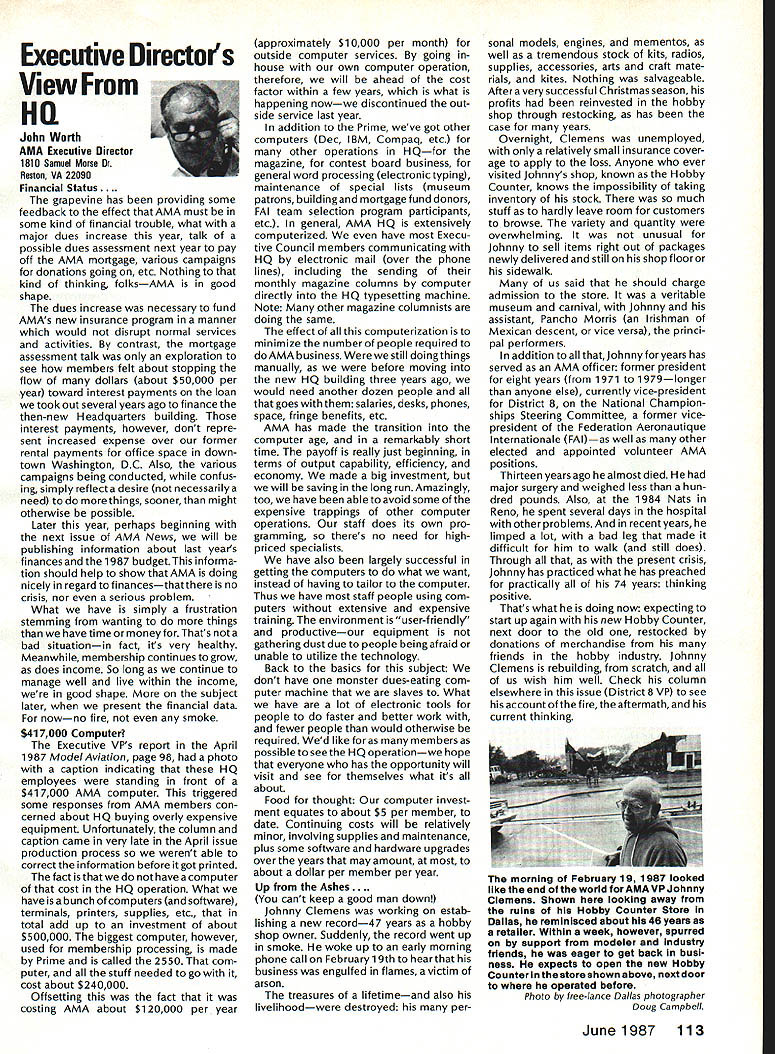
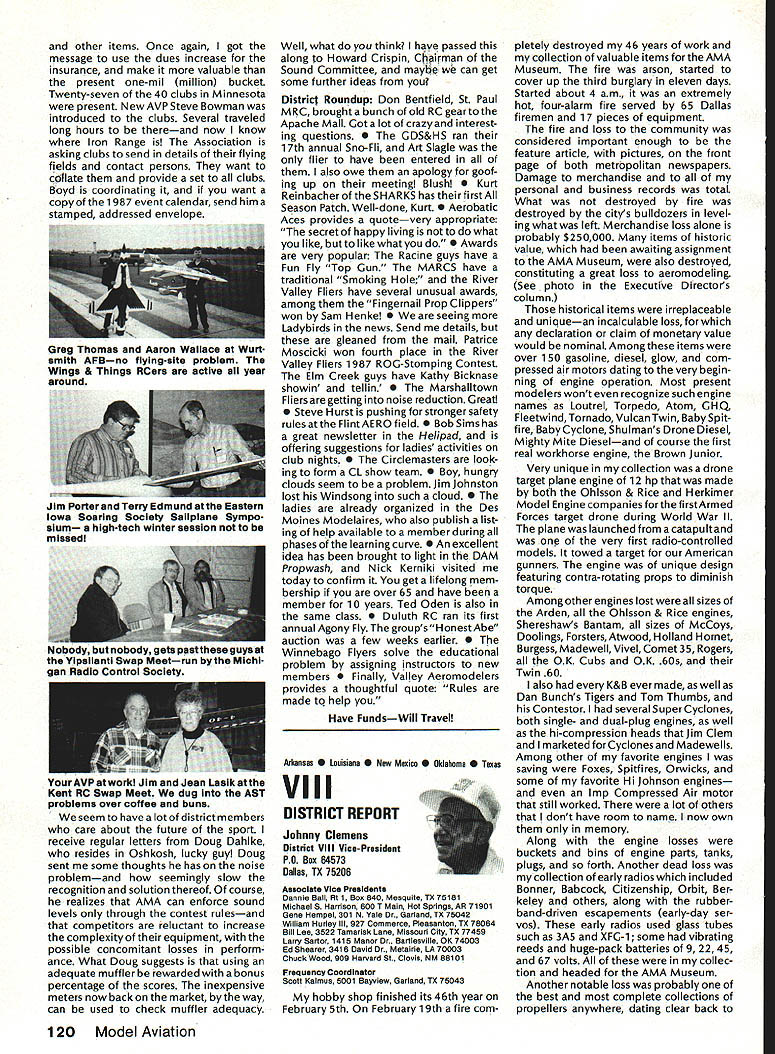
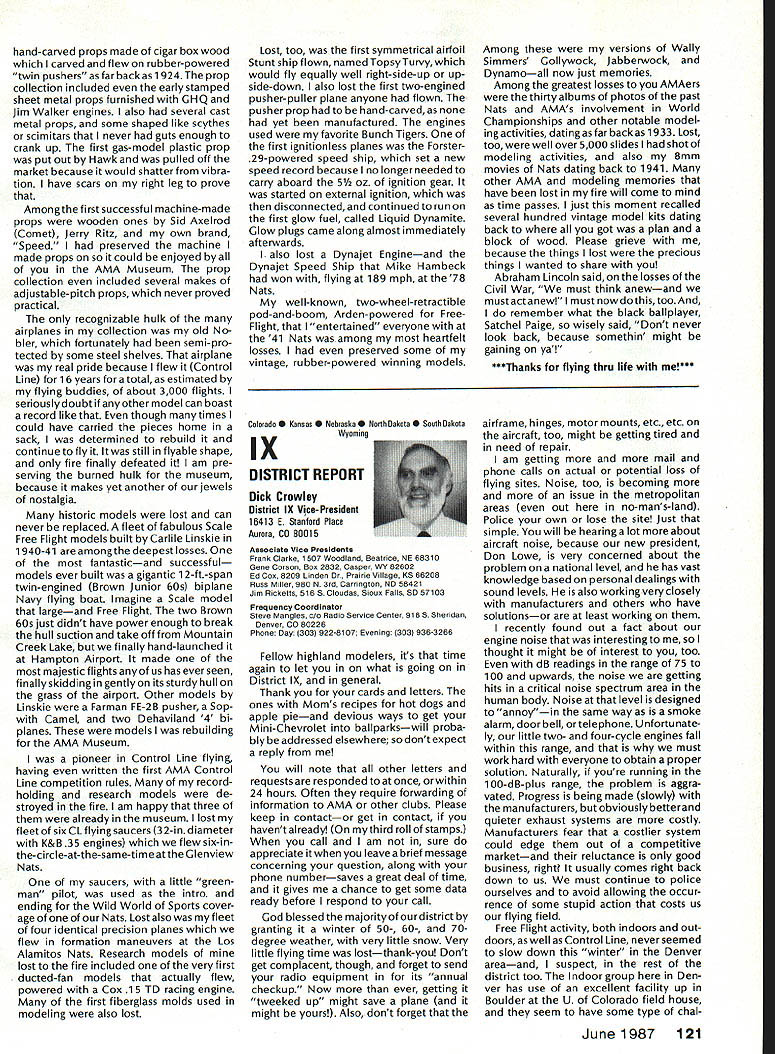
- The author reports a personal tragedy: an arson fire destroyed a long‑established hobby shop and a large donation intended for the AMA Museum. Losses included rare and irreplaceable model engines, early radios, propeller collections, slides, movies, and historical artifacts.
- The loss represents both personal and broader modeling community heritage; the author expresses grief and a determination to rebuild.
---
AMA Headquarters Services Staff (partial listing)
- Executive Director — John Worth
- Executive Coordinator — Joyce Hager
- Comptroller — Gisele Jackson
- Competition Services Director — Micheline Madison
- Nats General Manager — (name abbreviated in source)
---
If you have questions or wish to submit input on frequency matters or nominations, direct correspondence to AMA Headquarters (address available through Model Aviation or AMA contact pages).
Transcribed from original scans by AI. Minor OCR errors may remain.

