
AMA News
AMA's Financial Statement — 1986
In May of last year, having earlier approved the 1986 budget, the AMA Executive Council noted there would be a need for a dues increase in 1987. In deciding on a dues increase, the Council took into consideration increased revenues from growing membership — with an all‑time high membership total predicted for 1986 — and steady increases in operating costs. The dues increase was determined necessary to continue providing existing services. It was also noted that several years had passed since the last basic dues increase.
Back in May it appeared a general increase of $4 per adult member would return AMA to operating in the black for several years. At the same time, however, the liability‑insurance market was deteriorating; beginning in October 1986 AMA might have to pay much more for renewal coverage.
Regardless of the outlook, it was obvious early in 1986 that it would be a deficit year: the 1986 budget predicted a loss of about $113,000. As the year progressed and membership grew steadily (about 5% over the prior year), the projected deficit gradually decreased to just under $93,000 — about $20,000 better than expected.
In the fall of 1986 the situation worsened: no insurer was willing to provide the coverage needed. The problem became an emergency of availability, not just cost. A special AMA Executive Council meeting was held in September; the Council approved a significant measure in AMA's 50‑year history: AMA would fund its own insurance program. Insurance companies would continue to provide policies and claims services, but AMA committed to pay the bills.
Financial Report (continued)
To provide extra funding for the self‑insured program, the Council increased the previously approved basic dues rise from $4 to $10 per member, to supply the funds needed beyond operations to fund the new insurance program as of the end of September.
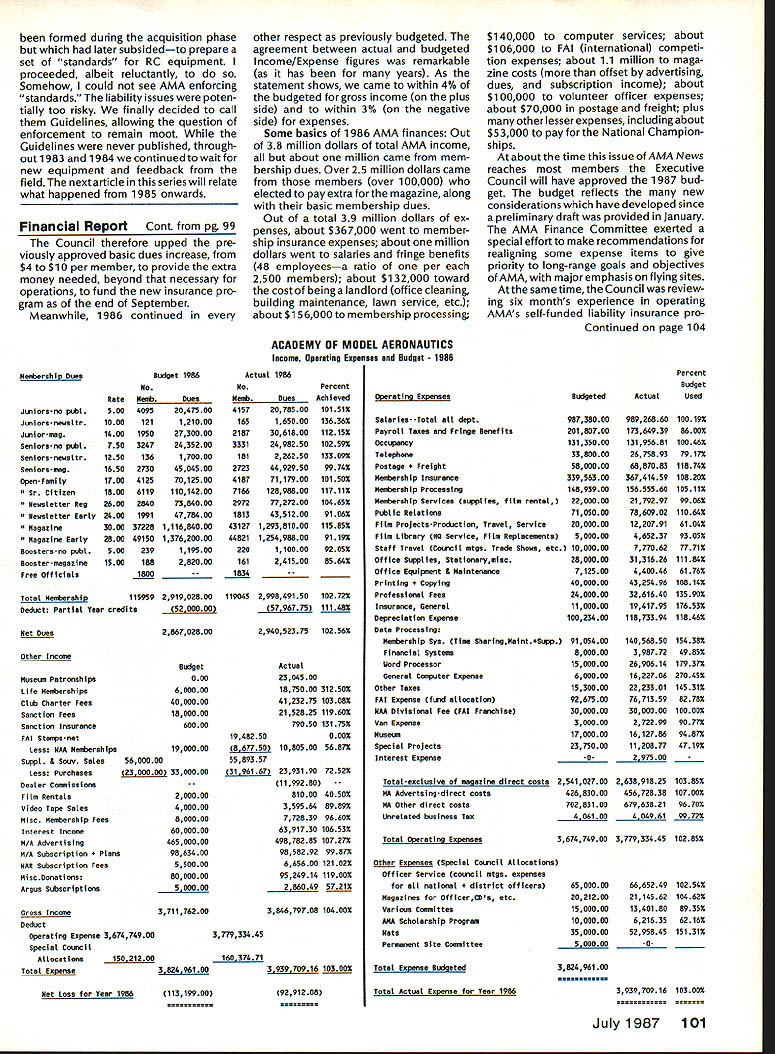
Meanwhile, 1986 proceeded largely as budgeted. Actual income and expense figures closely agreed with budgeted amounts — within 4% on gross income (plus side) and within 3% on expenses (minus side).
Some basics of 1986 AMA finances:
- Total AMA income: about $3.8 million; all but about $1 million came from membership dues.
- Magazine-related income: over $2.5 million from members (over 100,000) who paid extra for the magazine.
- Total expenses: about $3.9 million, including:
- Membership insurance expenses: about $367,000
- Salaries and fringe benefits: about $1,000,000 (48 employees — ~1 per 2,500 members)
- Building-related costs (cleaning, maintenance, lawn, etc.): about $132,000
- Membership processing: about $156,000
- Computer services: about $140,000
- FAI (international) competition expenses: about $106,000
- Magazine costs: about $1.1 million (largely offset by advertising, dues, and subscription income)
- Volunteer officer expenses: about $100,000
- Postage and freight: about $70,000
- National Championships: about $53,000
- Plus other lesser expenses
At the time this issue reaches most members, the Executive Council will have approved the 1987 budget. The Finance Committee recommended realigning some expense items to give priority to long‑range goals (with more emphasis on flying sites). The Council was also reviewing six months' experience operating AMA's self‑funded liability insurance program; initial indications showed a very favorable experience with minimal drain on reserves. Continuation of low drain would enable AMA to build further reserves in 1988, reducing the risk in maintaining the program.
Mortgage Honor Roll, Donations, and Member Letters
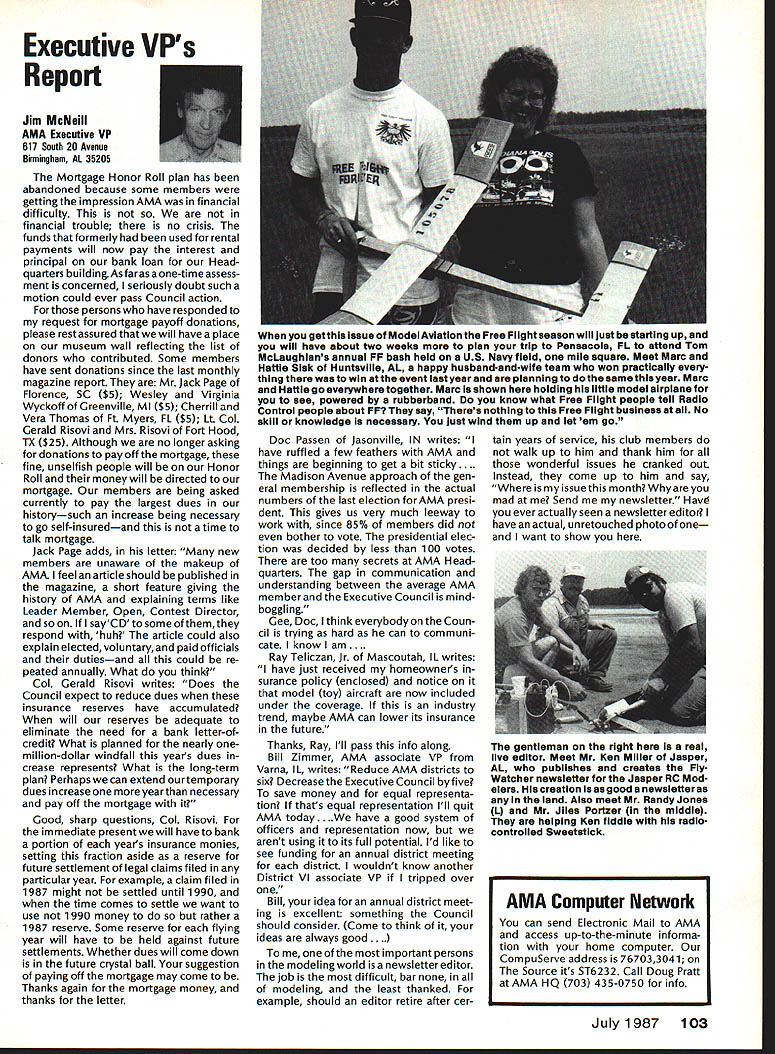
The Mortgage Honor Roll plan has been abandoned because it gave some members the impression AMA was in financial difficulty. AMA is not in financial trouble; there is no crisis. Funds formerly used for rental payments will now go to interest and principal on the bank loan for the Headquarters building. A one‑time assessment is unlikely to pass Council action.
Members who donated toward mortgage payoff will be recognized on the museum donor wall. Recent donors include:
- Jack Page, Florence, SC — $5
- Wesley and Virginia Wyckoff, Greenville, MI — $5
- Cherrill and Vera Thomas, Ft. Myers, FL — $5
- Lt. Col. Gerald Risovi and Mrs. Risovi, Fort Hood, TX — $25
Letters from members raised several questions and suggestions:
- Jack Page suggested a short annual feature in the magazine explaining AMA structure, membership categories (Leader Member, Open, Contest Director), elected/volunteer/paid officials, and common abbreviations (e.g., "CD").
- Col. Gerald Risovi asked whether dues would be reduced once insurance reserves accumulated, when reserves would be adequate to eliminate the need for a bank letter‑of‑credit, and what would be done with any windfall from dues increases.
- Response: A portion of each year's insurance monies will be banked as reserves against future claim settlements (e.g., a 1987 claim might not be settled until 1990). Whether dues will come down in the future is not decided; paying off the mortgage with excess reserves may be possible later.
- Doc Passe expressed concern about low voter turnout and perceived secrecy at AMA Headquarters. The Council strives to communicate and act in members' interest.
- Ray Teltz noted his homeowner's policy now includes model aircraft and suggested this trend might allow lower AMA insurance costs in the future.
- Bill Zimmer suggested consolidating districts and reducing Executive Council size to save money; he also proposed funding annual district meetings to improve representation and communication.
Summary
AMA operated in 1986 almost exactly per budget. Following the April 25, 1987 Executive Council meeting, the 1987 budget was expected to be published (in the August issue of Model Aviation, mailed in June) so members could see expectations for the year. Membership was running about 5% ahead of last year's all‑time high, with over 100,000 members signed up by the end of April; projections suggested a likely total near 125,000 for the year (exceeding the prior 120,000 figure).
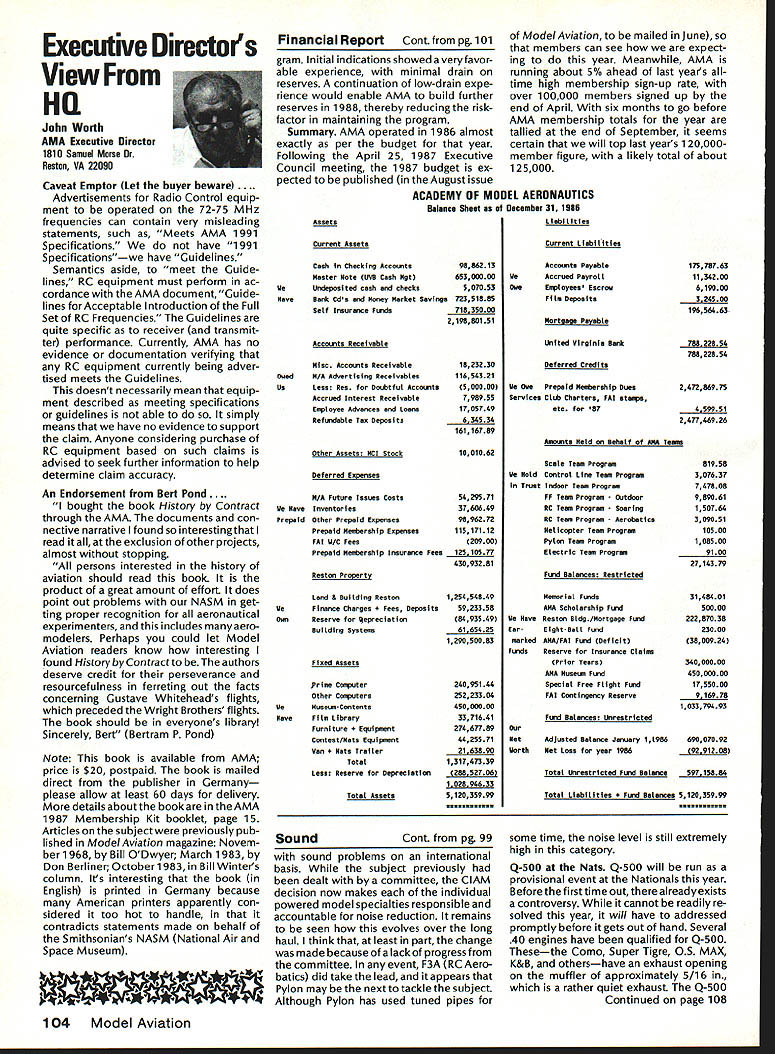
Academy of Model Aeronautics — Balance Sheet as of December 31, 1986
Assets
Current Assets
- Cash in Checking Accounts: $98,862.13
- Master Note (USG Cash Management): $653,000.00
- Undeposited cash and checks: $75,050.35
- Bank CDs and Money Market: $723,515.85
- Self Insurance Funds: $718,350.00
- Total Current Assets: $2,196,801.51
Accounts Receivable
- Misc. Accounts Receivable: $18,232.30
- M/A Advertising Receivables: $116,543.21
- Less: Reserve for Doubtful Accounts: $(5,000.00)
- Accrued Interest Receivable: $7,989.55
- Employee Advances and Loans: $17,057.97
- Refundable Tax Deposits: $6,345.34
- Total Accounts Receivable: $161,167.37
Other Assets
- MCI Stock: $10,010.62
Deferred Expenses
- M/A Future Issues Costs: $54,295.71
- Inventories: $37,605.07
- Other Prepaid Expenses: $98,962.72
- Prepaid Membership Expenses: $115,171.12
- FAI WC Fees: $(129.00)
- Prepaid Membership Insurance Fees: $123,707.07
Real Property
- Land & Building, Reston: $1,254,548.69
- Finance Charges — Fees, Deposits: $59,233.58
- Reserve for Depreciation: $(85,233.49)
- Building Systems: $61,615.00
Fixed Assets
- Printers: $240,951.44
- Other Equipment and Furniture: $252,233.05
- Leasehold Improvements: $35,716.41
- Computer Equipment: $33,716.47
- Library & Equipment: $27,677.07
- Contest/Misc. Equipment: $24,235.97
- Van & Parts Trailer: $21,463.45
- Total Fixed Assets: $1,317,473.39
- Less: Reserve for Depreciation: $(268,927.66)
Total Assets: $5,120,359.99
---
Sound & Model Aeronautics
Howard Crispin Jr.
Due to space needs for an extensive article on radio frequencies, the Sound & Model Aeronautics item appeared in the June issue. While frequency issues are important, the emphasis on sound and reducing model noise remains critical.
At the Toledo Show there was growing interest in sound‑level reduction. Some manufacturers and individuals still dismiss the need for quieter equipment or modify mufflers to gain power at the expense of noise. Noise problems may be specific to individual flying sites, but complacency threatens the hobby's future and risks jeopardizing FAI/CIAM participation. CIAM has changed its format for dealing with sound; AMA members should take standards and quieter operation seriously.
---
Fred Marks, Chairman, AMA Frequency Committee
(This article is part of a series providing a status report and brief history of AMA's acquisition of new radio frequencies. Recent related articles appeared in Model Aviation: June 1987, pages 106–110; April 1987, page 100.)
Brief History and Frequency Allocation
The AMA RC Frequency Committee is a standing committee of the AMA Executive Council. The chairman is appointed by the Executive Council via the president; the committee is responsible to the membership through the Council. The committee originated in the late 1940s under Dr. Walt Good, Ed Lorenz, Howard McEntee, and others.
Prior to the formation of the Frequency Committee, a ham radio license was required to fly RC. Since then, frequencies have become available that do not require a ham license; today an RC flier may have a ham license, but it is no longer required.
Key points of the committee's allocation plan presented to the FCC Commissioners in December 1981 and January 1982:
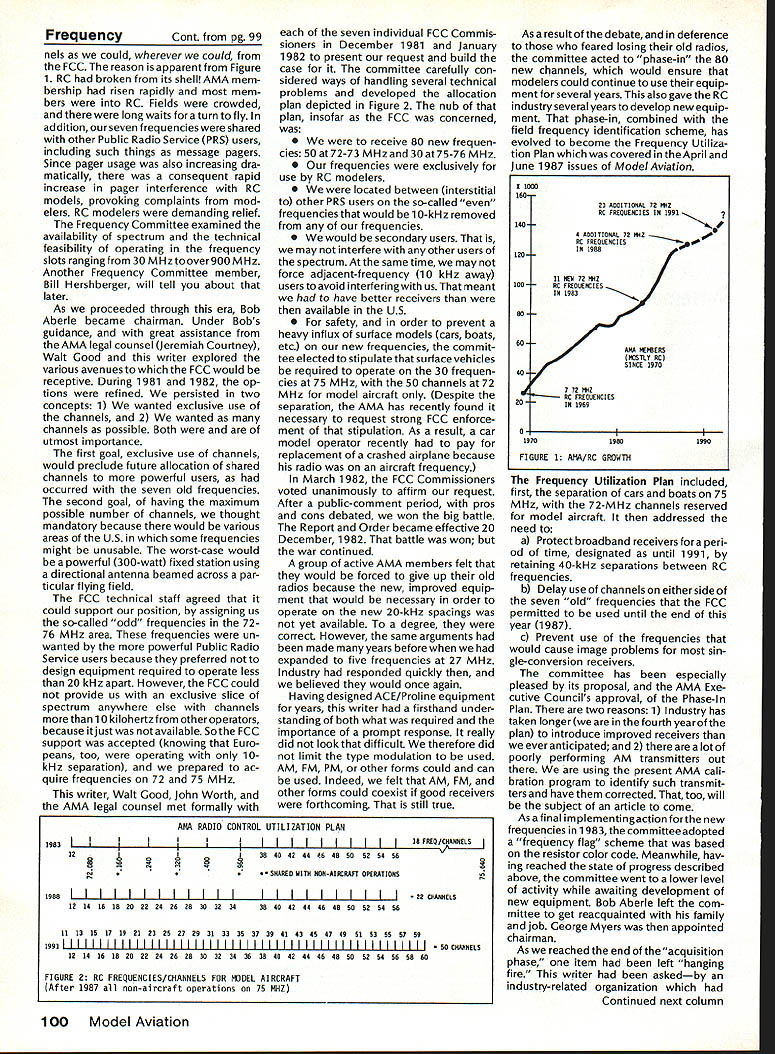
- AMA would receive 80 new frequencies: 50 in 72–73 MHz and 30 in 75–76 MHz.
- The frequencies would be exclusively for use by RC modelers.
- They would be interstitial to other PRS users on the so‑called “even” frequencies, which would be 10 kHz removed from any of AMA's frequencies.
- AMA would be secondary users: we may not interfere with other users, nor require adjacent‑frequency users (10 kHz away) to avoid interfering with us. This necessitated better receivers than were then available in the U.S.
- For safety and to prevent a heavy influx of surface models onto aircraft frequencies, the committee stipulated surface vehicles operate on the 30 frequencies at 75 MHz, with the 50 channels at 72 MHz reserved for model aircraft only. (Enforcement has sometimes been necessary — e.g., a car operator had to pay for replacement of a crashed airplane due to operating on an aircraft frequency.)
In March 1982 the FCC Commissioners voted unanimously to affirm AMA's request. After a public‑comment period, the Report and Order became effective December 20, 1982.
Some members feared having to discard old radios because the improved equipment needed to operate on new 20‑kHz spacings was not yet available. To accommodate them and allow industry time to develop equipment, the committee enacted a phase‑in of the 80 new channels. This phase‑in, combined with a field‑frequency identification scheme, evolved into the Frequency Utilization Plan (covered in Model Aviation in April and June 1987).
The Frequency Utilization Plan addressed:
- Protecting broadband receivers until 1991 by retaining 40‑kHz separations between RC frequencies.
- Delaying use of channels adjacent to seven “older” frequencies the FCC permitted until the end of 1987.
- Preventing use of frequencies that would cause image problems for most single‑conversion receivers.
The committee and the Executive Council approved the Phase‑In Plan for two reasons:
- Industry has taken longer than anticipated (the plan was in its fourth year) to introduce improved receivers.
- There were many poorly performing AM transmitters; the AMA calibration program is identifying and correcting these transmitters.
As a final implementational action for the 1983 frequencies, the committee adopted a “frequency flag” scheme based on the resistor‑color code.
---
VIII District Report
Johnny Clemens District VIII Vice‑President P.O. Box 84573, Dallas, TX 75206
Associate Vice Presidents:
- Dannie Ball, Rt. 1, Box 880, Mesquite, TX 75181
- Michael H. Harrison, 607 N. Main, Hot Springs, AR 71901
- Gene Messer, 801 N. Yale Dr., Garland, TX 76042
- William Hurley III, 927 Commerce, Pleasanton, TX 78064
- Bill Lyle, 3522 Tamarron Lane, Missouri City, TX 77459
- Larry Savin, 1415 Manor Dr., Bartlesville, OK 74003
- Ed Shrader, 3416 David Dr., Meridian, LA 39301
- Chuck Wood, 909 Harvard St., Clovis, NM 88101
Frequency Coordinator:
- Scott Kalson, 5001 Bayberry, Garland, TX 75043
Highlights and notes:
- AMA finally received national recognition when a contestant on "Wheel of Fortune" correctly guessed the puzzle "MODEL AIRPLANE."
- Weather extremes have been notable (floods, blizzards, tornadoes, high temperatures and winds).
- Johnny Clemens' 46‑year‑old hobby shop was set afire by a burglar on February 19. Much was lost; some items were destroyed by subsequent demolition. An 18‑year‑old arsonist has been arrested and is held on multiple charges.
- Clemens plans to reopen at 1909 Greenville Ave., Dallas, around May 15; community support has been strong.
- A surviving model (a Nobler control‑line model) was salvaged and will be preserved for the AMA museum.
- Clemens thanks newsletter editors who replaced staples with tape (staples tear fingers and are a hassle); he receives about 300 newsletters monthly and reads many of them.
- He encourages club involvement and newsletter exchanges as ways to grow the hobby.
---
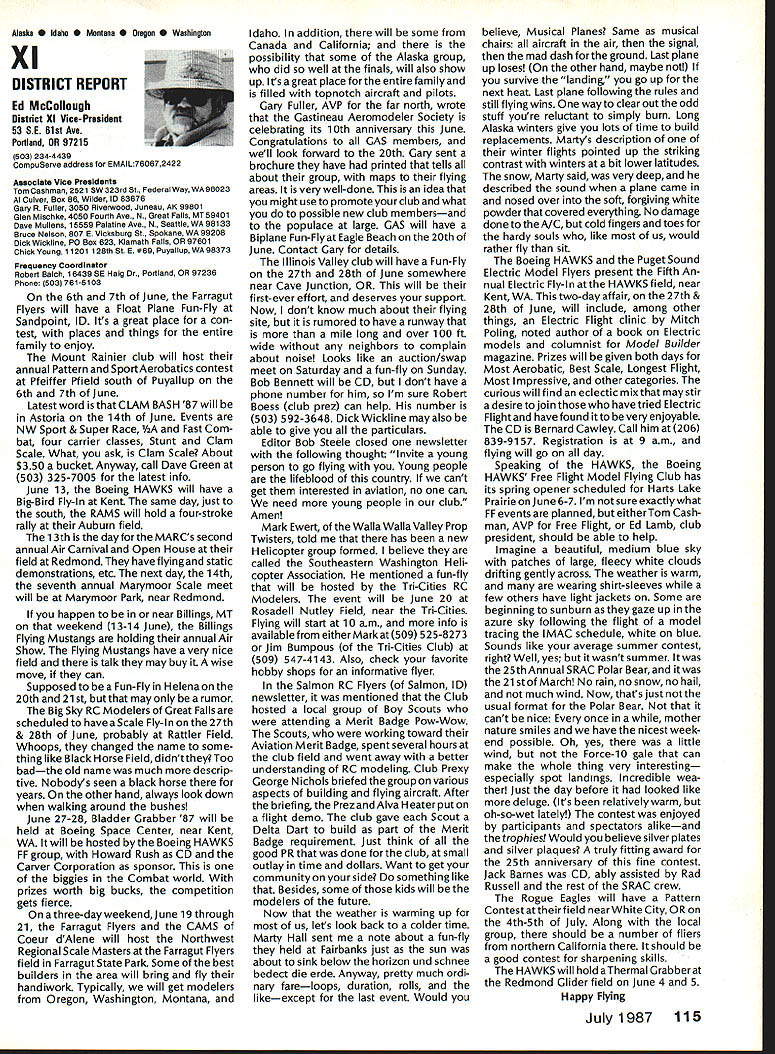
XI District Report
Ed McCollough District XI Vice‑President 53 S.E. 61st Ave., Portland, OR 97215 (503) 243‑4439 CompuServe: 76067,2422
Associate Vice Presidents:
- Tom Schramm, 2521 SW 32nd St., Federal Way, WA 98023
- Al Culver, Box 86, Wilder, ID 83676
- Gary R. Fuller, 3050 Riverwood, Juneau, AK 99801
- Glenn Hisseloh, 4050 Fourth Ave. N., Great Falls, MT 59401
- Dave Mullens, 15959 Palatine Ave. N., Seattle, WA 98133
- Bruce Nelson, 807 E. Vicksburg St., Spokane, WA 99208
- Dick Wickline, PO Box 623, Klamath Falls, OR 97601
- Chick Young, 11021 S. 128th St., E., PMB, Olympia, WA 98573
Frequency Coordinator:
- Robert Balch, 16349 SE Haig Dr., Portland, OR 97236 — (503) 761‑5103
June event highlights and club activities:
- June 6–7: Farragut Flyers Float Plane Fun‑Fly, Sandpoint, ID.
- June 6–7: Mount Rainier Pattern and Sport Aerobatics contest, Pfeiffer Field (south of Puyallup).
- June 13: CLAM BASH '87 in Astoria (NW Sport & Super Race, 1/2A and Fast Combat, four carrier classes, Stunt, Clam Scale).
- June 13: Boeing HAWKS Big‑Bird Fly‑In at Kent.
- June 13: RAMS four‑stroke rally at Auburn field.
- June 13: MARC Air Carnival and Open House, Redmond field.
- June 14: Seventh annual Marymoor Scale meet, Marymoor Park (near Redmond).
- June 13–14: Billings Flying Mustangs annual Air Show, Billings, MT.
- June 20–21: (Possible) Fun‑Fly in Helena.
- June 27–28: Big Sky RC Modelers Scale Fly‑In (Rattler/Black Horse Field), Great Falls.
- June 27–28: Bladder Grabber '87 at Boeing Space Center, near Kent (Combat event).
- June 19–21: Northwest Regional Scale Masters, Farragut State Park (hosted by Farragut Flyers and CAMS of Coeur d'Alene).
- June 20: GAS 10th anniversary Biplane Fun‑Fly at Eagle Beach (Gastineau Aeromodeler Society).
- June 27–28: Illinois Valley club Fun‑Fly near Cave Junction, OR.
- June 27–28: Boeing HAWKS and Puget Sound Electric Model Flyers—Fifth Annual Electric Fly‑In at HAWKS field near Kent (clinic by Mitch Poling; CD Bernard Cavell — (206) 839‑9157; registration 9 a.m.; $2).
- June 6–7: Boeing HAWKS Free Flight spring opener at Harts Lake Prairie.
- Other events: Polar Bear contest (25th Annual SRCR Polar Bear, March 21), Rogue Eagles Pattern Contest (July 4–5), HAWKS Thermal Grabber (June 4–5 at Redmond Glider Field).
Club outreach and youth involvement:
- The Salmon RC Flyers hosted Boy Scouts working on the Aviation Merit Badge; the club provided briefings, demonstrations, and Delta Dart kits for the Scouts.
- Encouragement to invite young people to fly and involve them in the hobby; youth are vital to the future of model aviation.
Happy flying!
Transcribed from original scans by AI. Minor OCR errors may remain.

