
AMA Guidelines for Narrow-Band Operation of 72–75 MHz Radio Control Frequencies
This presentation is in two parts, A and B. Part A, printed herein, covers the Background and Basis for the Guidelines; The Guidelines; Transmitter and Receiver; and Additional Requirements. Part B, to follow in October Model Aviation, covers Elements of Receiver Susceptibility; Interference Factors; and Procedures for Qualitative Field Tests. For further background, see previous articles in the April, June, July, and August issues of Model Aviation magazine.
The Guidelines presented here were developed by the AMA Frequency Committee at the request of the Radio Control Manufacturers Association (RCMA) so that the association can design and qualify radios for satisfactory operation in 1991 and beyond. The adequacy of the Guidelines has been confirmed by the design and testing of four generic radio systems. These systems were tested with deliberate adjacent-channel and third-order interference tests. The test results were complemented by analysis of data collected at several successive National meets, at the RC trade shows during the calibration program, and at various RC meets over the past four years.
The modeler is urged to study these Guidelines sufficiently to judge the adequacy of radio specifications and advertising. The Guidelines address the RF link only; the "bells and whistles" are of no importance to the performance of the RF link. Full-color ads that present the general wonderfulness of radios without addressing the technical performance required should carry little weight.
Five parameters for judging adequacy of radio performance are presented in the Guidelines. The modeler should demand to know the performance, in terms of these parameters, of any radio, new or used, that he contemplates purchasing. They are:
- Transmitter frequency stability
- Transmitter occupied spectrum
- Receiver rejection of adjacent channel interference
- Receiver resistance to third order intermodulation
- Receiver rejection of RF at the image frequency
The Guidelines explain each of the above parameters and give specifications for minimum performance levels. There is no assurance that equipment for which a manufacturer or dealer won't or can't provide the specified performance data will perform satisfactorily in the 1991 environment. Adherence both to the Guidelines for design of equipment and to those Guidelines aimed at proper operation in the field will help achieve the original goals of the Frequency Committee when it sought the 80 channels at 72 MHz and 75 MHz. Those goals were:
- Frequencies not shared with any other users.
- Enough frequencies so that the presence of high radiators on interstitial frequencies near flying sites in isolated instances would permit selection of other frequencies at the site.
- To foster the development and sale of radios having improved performance of the RF link.
- The preceding will not provide absolute immunity to interference but will certainly come as close as is humanly possible to achieving this.
Part A
Background
The AMA Frequency Committee has devoted the past eight years to the acquisition and implementation of new frequencies for radio control of both model aircraft and surface vehicles. Establishing and implementing a Phase-In Plan for New Radio Control Frequencies (reference 1) has helped to prevent, while it has not absolutely prevented, the chaos that might otherwise have existed. Adherence to the Phase-In Plan has been outstanding, as has adherence to the initial transmitter frequency identification system. As we approach the end of the first five years of the Plan, the Committee, after a careful review of operating experience, has made further recommendations for consideration and adoption. The new AMA R/C Frequency Identification and Control System (June 1987 Model Aviation) details the first revision of the transmitter frequency identification system to become operational during the latter part of 1987. What follows here, the Guidelines for acceptable introduction of the full set of RC frequencies, is the natural culmination of the process to date.
Basis for Guidelines
In formulating these Guidelines, "What will work in the field in 1991?" was the major issue that we dealt with. Our conclusions:
a) We may still have old transmitters in the field that have modulation sidebands down from a peak output by only 30 to 40 dB at the next channel, only 20 kHz away; and
b) There will be a number of non‑R/C users in the Public Radio Service and the Mobil Radio Service, some only 5 kHz removed from our frequencies.
Executive VP's Report
Jim McNeill AMA Executive VP 617 South 20 Avenue Birmingham, AL 35205
Terry Rimert of Baldwin, FL, writes: "I wish they would send me the National Newsletter. They stopped just when you started putting the safety stuff in it and making it worthwhile. I don't understand the weight limit deal on Giant Scale. At our local field anyone can fly anytime the field is open. No one can stop him. If a person is holding a contest and someone with a 100-lb. airplane comes out to fly and goes up, an AMA CD can't do anything about it. I've just seen something that scares me a lot. People flying in a thunderstorm. I told them they were asking for it, standing out there waving a lightning rod with lightning striking all around them. They just laughed. Never vote for an incumbent."
Terry, your letters leave me speechless. By the way, all newsletter editors qualify for the AMA National Newsletter. Simply mail your newsletter to AMA HQ with a note or write to me. We have a new twist to our NN, and very constructive. Any district vice-president can now use this as a district newsletter by simply adding his contribution page through HQ. Lou Ward isolates the mailings and all editors in that district get that particular VP's contribution on a monthly basis. Two district VPs are already availing themselves of this service. (I've been grinding that AMA National Newsletter out for six years, more as a help and a thank-you tribute to editors than anything else, and now it is beginning to catch on....)
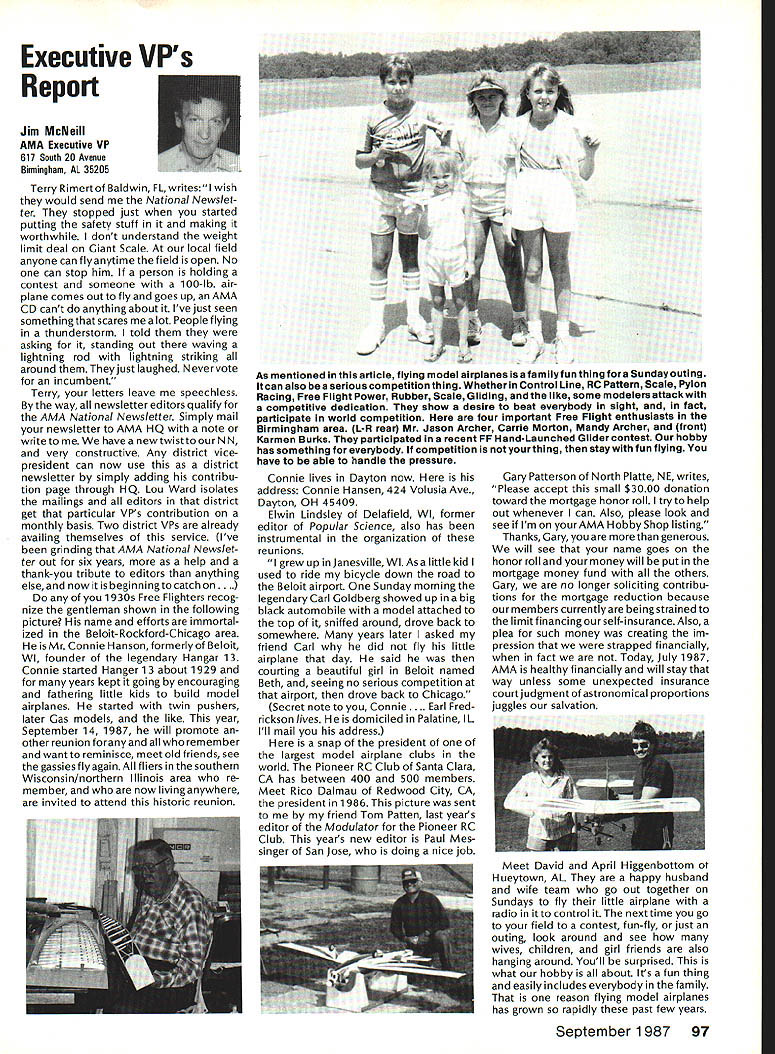
Do any of you 1930s Free Flighters recognize the gentleman shown in the following picture? His name and efforts are immortalized in the Beloit‑Rockford‑Chicago area. He is Mr. Connie Hansen, formerly of Beloit, WI, founder of the legendary Hangar 13. Connie started Hangar 13 about 1929 and for many years kept it going by encouraging and fathering little kids to build model airplanes. He started with twin pushers, later gas models, and the like. This year, September 14, 1987, he will promote another reunion for any who remember and want to reminisce, meet old friends, see the gassies fly again. All fliers in the southern Wisconsin/northern Illinois area who remember, and who are now living anywhere, are invited to attend this historic reunion.
Come live in Dayton now. Here is his address: Connie Hansen, 424 Volusia Ave., Dayton, OH 45409.
Elwin Lindsley of Delafield, WI, former editor of Popular Science, also has been instrumental in the organization of these reunions.
I grew up in Janesville, WI. As a little kid I used to ride my bicycle down the road to the Beloit airport. One Sunday morning the legendary Carl Goldberg showed up in a big black automobile with a model attached to the top of the car; it sniffed around, drove back to somewhere. Many years later I asked my friend Carl why he did not fly his little airplane that day. He said he was then courting a beautiful girl in Beloit named Beth, and, seeing no serious competition at that airport, then drove back to Chicago. (Secret note to you, Connie ... Earl Frederickson lives. He is domiciled in Palatine, IL. I'll mail you his address.)
Here is a snap of the president of the largest model airplane club in the world. The Pioneer RC Club of Santa Clara, CA has between 400 and 500 members. Meet Rico Dalmao of Redwood City, CA, the president in 1986. This picture was sent to me by my friend Tom Patten, last year's editor of the Modulator for the Pioneer RC Club. This year's new editor is Paul Messenger of San Jose, who is doing a nice job.
Executive Director's View From HQ
John Worth AMA Executive Director 1810 Samuel Morse Dr. Reston, VA 22090
Time to Un‑panic . . .
This year seems to be plagued with worries. All kinds of concerns have been heard at one time or another, mostly on the order of mountains being made out of molehills. Worries about the RC frequencies—along the lines of what will happen in 1988, or 1991—are a continuing saga, with all sorts of fears being expressed. Included have been tales of woe concerning "interference," due to the new frequencies.
Yet there is more RC activity going on now than ever before, most of it without problems. There are many thousands more RC fliers now than when new frequencies were introduced in 1983. And the "noise" we're hearing about interference is actually a lot less than was typical during the late '70s. At that time there was a real problem caused by interference from commercial pagers or "beepers," many of which were right on our 72 MHz frequencies.
Also, at that time we only had seven of those frequencies; so to lose two or three of them in a given locality imposed severe hardships on some flying sites. This was compounded by interference from model car and boat operations on some of the same frequencies. By contrast, there are much better conditions now. We have more frequencies available; the new ones are not on pager frequencies; and model cars and boats have more frequencies, too, so that they are not on the aircraft frequencies as much as they used to be.
Furthermore, the situation will improve when we get more frequencies in '88 and '91. This will mean that even if we have interference on some frequencies there will be plenty of others to go to, to get away from the problems.
Another seemingly "panic" situation, to some people, concerns insurance. When AMA had to go to self-funding its own program for this year, there were (still are, some) people who worried that AMA could not provide enough coverage. Yet, nothing has really changed except some wording in the insurance language (see next month's major article on what the AMA insurance program is all about).
AMA is continuing to provide liability protection, as it has since 1942—45 years! We're processing claims (not many, because there normally are not many). AMA's reserves are steadily building (they are not being depleted), and the program is in excellent shape. Keep this in mind: Some homeowner insurance policies which cover model flying accidents do so only up to a $100,000 limit—AMA covers up to a million dollars! Over the last 10 years or more we have averaged about $70,000, total, in claim payments per year. To sum up, there simply is not a problem.
Some folks have worried that AMA is in financial trouble, a misunderstanding which apparently has been caused by several factors: the constant appeals for money to aid AMA's mortgage, the large dues increase this year (mostly to finance AMA's new insurance program), and the fact that we had an operating deficit last year. Well, the mortgage is in good shape, whether we pay it off early or not. Paying it off early means we save a lot of money in interest payments, but it's not a crisis situation. At worst, we simply keep paying it off as we are paying rent.
The insurance program took a lot of money to set up, to assure that we would have adequate reserves; but aside from the initially heavy cash flow (into interest-bearing accounts) the program is running at minimum cost. Best feature: Whereas before we paid big premiums to insurance companies, now most of the money in the program is ours.
As far as last year's deficit goes, it was largely caused by having to operate duplicate outside computer services for a year longer than originally budgeted, until we had our new in-house system debugged. That, plus the normal erosion of inflation, put us in the red. This year, however, all is in order (we no longer have the duplicate computer service, and the start-up costs of the new insurance program have been covered), so we're projecting a healthy set of books for '87.
All this is to say, let's quit trying to find fire in the smog (it's not even smoke). Model Aviation activity is at an all-time high, the industry is booming, and there appears to be more flying than ever before. Let's enjoy it more.
Thanks, Toledo . . .
Again, as it has done for many years, the Toledo Weak Signals club held a raffle at its Model Expo, on behalf of AMA and model aviation in general. Proceeds from the raffle were sent to AMA, divided between the National Museum and the AMAA and Glen Sigafose Scholarship Funds. Enclosed also was a list of raffle winners, as follows:
Randy Geers, Taylor, MO; W. R. Willard, Fayetteville, NC; John Light, Greenville, OH; Greg Newman, Pasadena, CA; Gary Cochran, Medway, OH; Dick Owen, Hebron, OH; Richard Patrick, S. Greensburg, PA; Mike Morrell, Euclid, OH; G. H. Mosher, Milford, MI; Harry Brown, Elyria, OH; Jessica Linn, Flint, MI; Robert Beardsley, Defiance, OH; Don Cavanaugh, Clarksville, TN; Donna Drakes, Clawson, MI; (Apple Valley, CA entry); Gabe Vassam, Cleveland, OH; Irvin Polk, New York, NY; Charles Stager, Spring Lake Heights, NJ; Rick Moreau, Lake Station, IN; Greg Baron, Springfield, NJ; Robert Annabel, Munroe, MI; Shawn Beeson, Detroit, MI; Bruce Thorp, Grinnell, IA; James Noble, Northwood, OH; Skip Rumpl, E. Detroit, MI; Tom O'Rourke, Len Stein, Detroit, MI; David Russell, Toledo, OH; Richard Alvarez, Toledo, OH; Hank Hohnemann, Montezuma, IA; Dennis Cain, Clarksville, TN.
DISTRICT REPORT
Don Krafft District 1 Vice‑President P.O. Box 1828 Duxbury, MA 02331 (617) 934‑6248
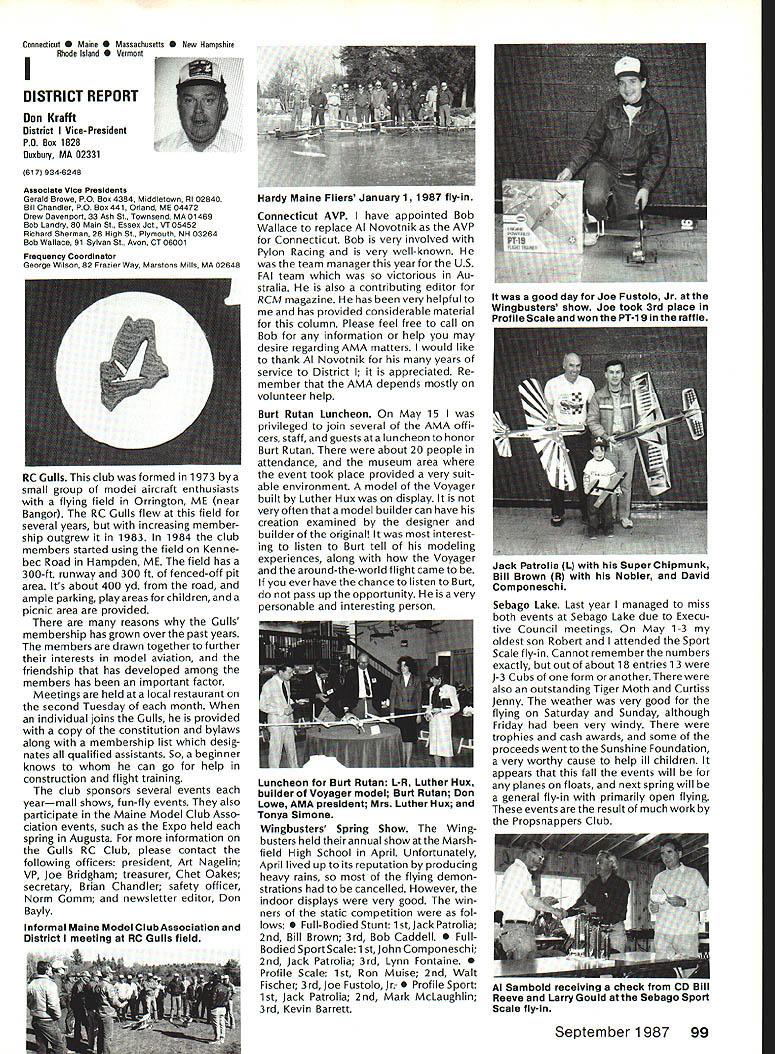
RC Gulls
This club was formed in 1973 by a small group of model aircraft enthusiasts with a flying field in Orrington, ME (near Bangor). The RC Gulls flew at this field for several years, but with increasing membership outgrew it in 1983. In 1984 the club members started using the field on Kennebec Road in Hampden, ME. The field has a 300‑ft runway and 300 ft. of fenced‑off pit area. It's about 400 yd. from the road, and ample parking, play area for children, and a picnic area are provided.
There are many reasons why the Gulls' membership has grown over the past years. The members are drawn together to further their interests in model aviation, and the friendship that has developed among members has been an important factor. Meetings are held at a local restaurant on the second Tuesday of each month. When an individual joins the Gulls, he is provided with a copy of the constitution and bylaws along with a membership list which designates all qualified assistants. So, a beginner knows to whom he can go for help in construction and flight training. The club sponsors several events each year—fun flys, fly‑in events. They also participate in the Maine Model Club Association events, such as the Expo held each spring in Augusta. For more information on the Gulls RC Club, please contact the following officers: president, Art Nagelin; VP, Joe Brigham; treasurer, Chet Oakes; secretary, Brian Chandler; safety officer, Norm Gumm; and newsletter editor, Don Bayly.
Connecticut AVP
I have appointed Bob Wallace to replace Al Novotnik as the AVP for Connecticut. Bob is very involved with Pylon Racing and is very well‑known. He was the team manager this year for the U.S. FAI team which was so victorious in Australia. He is also a contributing editor for RCM magazine. He has been very helpful to me and has provided considerable material for this column. Please feel free to call on Bob for any information or help you may desire regarding AMA matters. I would like to thank Al Novotnik for his many years of service to District 1; it is appreciated. I would like to remind that the AMA depends mostly on volunteer help.
Burt Rutan Luncheon
On May 15 I was privileged to join several of the AMA officers, staff, and guests at a luncheon to honor Burt Rutan. There were about 20 people in attendance, and the museum area where the event took place provided a very suitable environment. A model of the Voyager built by Luther Hux was on display. It is not very often that a model‑builder can have his creation examined by the designer and builder of the original! It was most interesting to listen to Burt tell of his modeling experiences, along with how the Voyager and the around‑the‑world flight came to be. If you ever have the chance to listen to Burt, do not pass up the opportunity. He is a very personable and interesting person.
Wingsbusters' Spring Show
The Wingsbusters held their annual show at the Marshfield High School in April. Unfortunately, the April weather lived up to its reputation for producing heavy rains, so most of the flying demonstrations were canceled. However, the indoor displays were very good. The winners of the static competition were as follows: Full‑Bodied Stunt: 1st, Jack Patroia; 2nd, Bill Brown; 3rd, Bob Caddell. Full‑Profile Scale: 1st, John Componeschi; 2nd, Jack Patroia; 3rd, Lynn Fontaine. Profile Scale: 1st, Ron Muise; 2nd, Walt Fischer; 3rd, Joe Fustolo, Jr. Profile Sport: 1st, Jack Patroia; 2nd, Mark McLaughlin; 3rd, Kevin Barrett.
It was a good day for Joe Fustolo, Jr. at the Wingsbusters' show. Joe took 3rd prize in Profile Scale and won the PT‑19 in the raffle.
Sebago Lake
Last year I managed to miss both events at Sebago Lake due to Executive Council meetings. On May 1‑3 my oldest son Robert and I attended the Sport Scale Fly‑In. I cannot remember the numbers exactly, but out of about 18 entries 13 were J‑3 Cubs of one form or another. There were also an outstanding Tiger Moth and Curtiss Jenny. The weather was very good for the weekend. Thursday had been very rainy, but Saturday and Sunday were fine. There were trophies and cash awards given to the winners and events were well organized by the Sunshine Foundation. I am sorry that I missed the Fun Fly but from what I saw the events will be very popular. These events are the result of much work by the Propnappers Club.
AMA News
Jersey Coast Radio Control Club. We take this opportunity to congratulate the JCRCC upon the occasion of the 25th anniversary of its creation in 1962. According to the latest issue of its newsletter, Aerodrome, edited by Charles Roedel, the club traces its origins to a meeting held by acting chairman Tom Henk on January 19, 1962. The club was given its present name and became incorporated in September of that year. It became an AMA‑chartered club on January 18, 1968. Club dues were set at $12 per year. (Oh, for the good old days!) I am further informed that the club's first newsletter was published on February 16, 1968 by Walt Bayonich. We are very proud of this outstanding District 2 club which, according to its present roll call, now comprises 93 members.
"Safety is Cheap and Makes Sense!" I consider this a great slogan and only wish that I had coined it; but I lifted same from the impressive newsletter of the Miniature Aircraft Association of Westchester, entitled the MAAW Flyer and edited by Ann Bruns. This is a multi‑interest model airplane club and, as such, abounds in members who are big in various specialties. There are members who concentrate on Langelius, Gorham, and Klings, to name just a few, as well as a number of members who were formerly identified with the Somers RC Club.
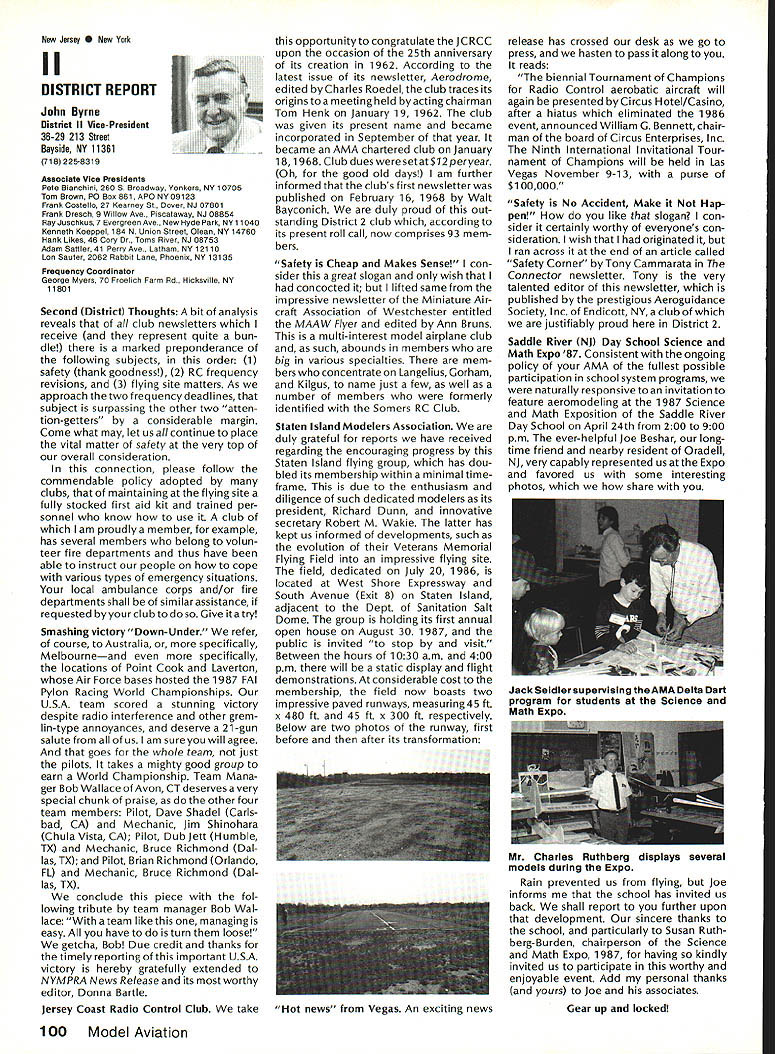
Staten Island Modelers Association. We are duly grateful for reports we have received regarding the encouraging progress by this Staten Island flying group, which has doubled its membership within a minimal time frame. This is due to the enthusiasm and diligence of such dedicated modelers as its president, Richard Dunn, and the innovative secretary Robert M. Wakie. The latter has kept us informed of developments, such as the evolution of their Veterans Memorial Flying Field into an impressive flying site. The field, dedicated on July 20, 1986, is located at West Shore Expressway and South Avenue (Exit 8) on Staten Island, adjacent to the Dept. of Sanitation Salt Dome. The group is holding its first annual open house on August 30, 1987, and the public is invited "to stop by and visit." Between the hours of 10:30 a.m. and 4:00 p.m. there will be a static display and flying demonstrations. At considerable cost to the membership, the field now boasts two mowed paved runways, measuring 45 ft. x 480 ft. and 45 ft. x 300 ft., respectively.
Hot news from Vegas. An exciting news release has crossed our desk as we go to press, and we hasten to pass it along to you. It reads: "The Biennial Tournament of Champions for Radio Control aerobatic aircraft will again be presented by Circus Hotel/Casino, after a hiatus which eliminated the 1986 event," announced William G. Bennett, chairman of the board of Circus Enterprises, Inc. The Ninth International Invitational Tournament of Champions will be held in Las Vegas November 9‑13, with a purse of $100,000.
"Safety Is No Accident, Make It Not Happen!" — How do you like that slogan? I consider it certainly worthy of everyone's consideration. I wish that I had originated it, but I ran across it at the end of an article called "Safety Corner" by Tony Cammarata in The Connector newsletter, the house organ of the talented editor of this newsletter, which is published by the prestigious Aeroguidance Society, Inc., of Endicott, NY, a club of which we are justifiably proud here in District 2.
Saddle River (NJ) Day School Science and Math Expo '87. Consistent with the ongoing policy of your AMA of the fullest possible participation in school system programs, we were naturally responsive to an invitation to feature aeromodeling at the 1987 Science and Math Exposition of the Saddle River Day School on April 24th from 2:00 to 9:00 p.m. The ever‑helpful Joe Beskar, our long‑time friend and nearby resident of Oradell, NJ, ably represented us at the Expo and came away with some interesting photos, which we now share with you.
Rain prevented us from flying, but Joe informs me that the school has invited us back. We shall report to you further upon that development. Our sincere thanks to the school, and particularly to Susan Rathgeber‑Burden, chairperson of the Science and Math Expo, 1987, for having so kindly invited us to participate in this worthy and enjoyable event. Add my personal thanks (and yours) to Joe and his associates.
Gear up and locked!
Guidelines shall comply with the AMA Phase-In Plan and the New AMA RC Frequency Identification and Control System. Transmitters using synthesized frequency generation shall have frequency selection identified by channel. It shall also be possible to change frequency while the transmitter is operating.
2.3 The manufacturer or importer of RC equipment shall provide the AMA with a properly verified, current copy of the FCC Type Acceptance Report for his equipment. In addition, receiver data specified in paragraph (4) below shall be included.
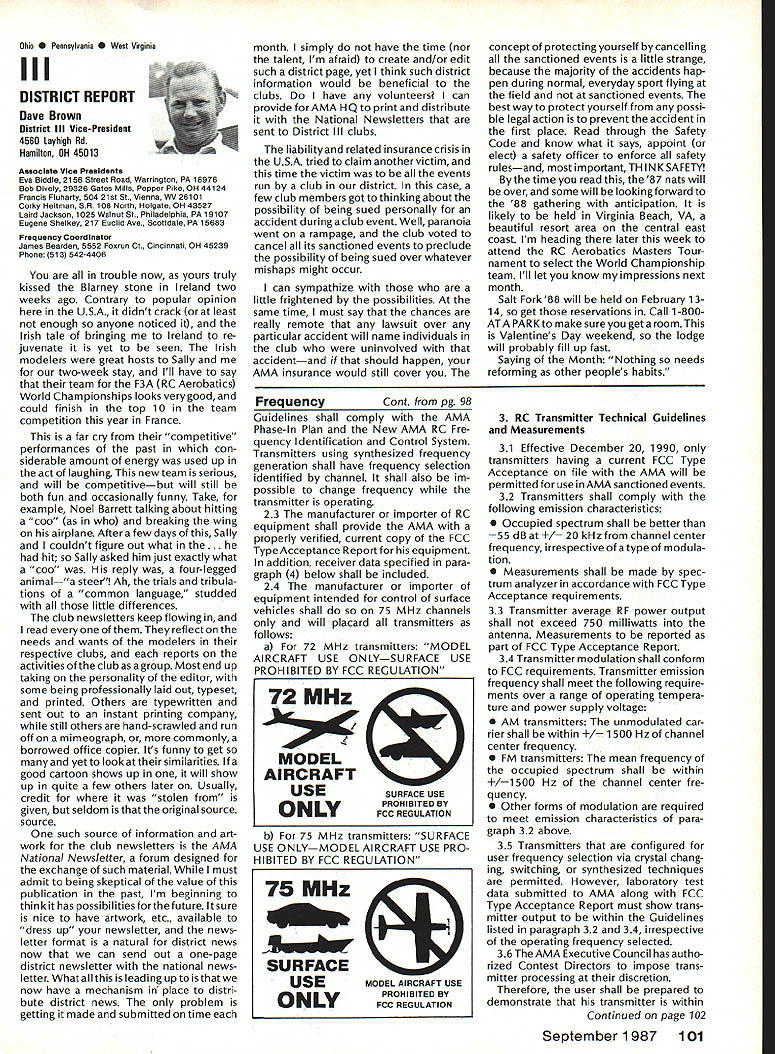
2.4 The manufacturer or importer of equipment intended for control of surface vehicles shall do so on 75 MHz channels only and will placard all transmitters as follows:
- For 72 MHz transmitters: "MODEL AIRCRAFT USE ONLY — SURFACE USE PROHIBITED BY FCC REGULATION"
- For 75 MHz transmitters: "SURFACE USE ONLY — MODEL AIRCRAFT USE PROHIBITED BY FCC REGULATION"
3. RC Transmitter Technical Guidelines and Measurements
3.1 Effective December 20, 1990, only transmitters having a current FCC Type Acceptance on file with the AMA will be permitted for use in AMA sanctioned events.
3.2 Transmitters shall comply with the following emission characteristics:
- Occupied spectrum shall be better than −55 dB at ±20 kHz from channel center frequency, irrespective of the type of modulation.
- Measurements shall be made by spectrum analyzer in accordance with FCC Type Acceptance requirements.
3.3 Transmitter average RF power output shall not exceed 750 milliwatts into the antenna. Measurements to be reported as part of FCC Type Acceptance Report.
3.4 Transmitter modulation shall conform to FCC requirements. Transmitter emission frequency shall meet the following requirements over a range of operating temperature and power supply voltage:
- AM transmitters: The unmodulated carrier shall be within ±1500 Hz of channel center frequency.
- FM transmitters: The mean frequency of the occupied spectrum shall be within ±1500 Hz of the channel center frequency.
- Other forms of modulation are required to meet emission characteristics of paragraph 3.2 above.
3.5 Transmitters that are configured for user frequency selection via crystal changing, switching, or synthesized techniques are permitted. However, laboratory test data submitted to AMA along with FCC Type Acceptance Report must show transmitter output to be within the Guidelines listed in paragraphs 3.2 and 3.4, irrespective of the operating frequency selected.
3.6 The AMA Executive Council has authorized Contest Directors to impose transmitter processing at their discretion. Therefore, the user shall be prepared to demonstrate that his transmitter is within specification in accordance with paragraphs 3.2 and 3.4 above. Where crystal change, RF module change, or frequency switching is to be used, the transmitter shall be subject to processing on all frequencies planned for use.
4. RC Receiver Technical Guidelines and Measurements
4.1 For purposes of standardization, proper receiver operation during tests should be taken as “greater than 10 dB signal‑to‑noise ratio at detection” (10 dB SINAD).
4.2 Adjacent Channel Rejection: If specified for 20 kHz channel separation, the receiver must reject all adjacent channel signals by 60 dB or better at ±8 kHz as demonstrated by laboratory test.
4.3 Image Rejection: Receivers specified for operation in the 72 MHz band must be shown by laboratory test to have signal rejection greater than 60 dB at the image frequency. Receivers specified for surface use on 75 MHz are not required to meet this image rejection requirement.
4.4 Intermodulation Interference Rejection
4.4.1 Receivers must be shown by laboratory test to have a Third Order Intercept Point at the input of the IF mixer better than −4 dBm. Tests shall be conducted in accordance with reference 1, with the Third Order Intercept Point calculated in accordance with paragraph 5, Part B of these Guidelines.
4.4.2 Intermodulation distortion and spurious response in the presence of high‑powered radiators shall be measured in accordance with reference 1. For the purpose of this test, “high‑powered radiators” are defined as either (a) signal inputs made directly to the receiver antenna terminal, or (b) signal input from a quarter‑wavelength radiator uniformly parallel to the receiver antenna. Radiated levels imposed shall be as follows:
- −8 dBm when made directly to the receiver antenna terminal with a 50‑ohm termination at the receiver.
- −20 dBm when radiated from a quarter‑wavelength radiator 18 in. away from the receiver antenna.
4.4.2.1 Receivers specified for 20 kHz separation shall exhibit no loss or spurious response in decoded servo output greater than ±20 microseconds when the receiver is subjected to single and two‑signal radiation as follows:
- Single radiator at any frequency equal to or greater than ±20 kHz from channel center frequency.
- Two‑signal—when two radiators are applied at any combination of frequencies that can produce a first‑mixer output within the bandpass of the receiver.
4.4.2.2 Single‑conversion receivers with a 455 kHz intermediate frequency shall meet the requirements specified in 4.4.2.1, except for signal frequencies that excite a unique response at the image frequency.
4.5 Single‑conversion receivers using a 455 kHz intermediate frequency shall have a local oscillator offset (high‑low injection) in accordance with the AMA Phase‑In Plan. The operating frequency of local oscillators used in receivers of a different configuration shall be at the manufacturer's discretion.
4.6 Receiver technical measurements made in accordance with this paragraph (4) shall be documented. A copy of the documentation shall be provided to the AMA along with the FCC Type Acceptance Report.
5.0 Additional Requirements
5.1 All flight operations must be conducted with transmitters stationed nominally 20 ft. apart.
5.2 When multiple, separated flight lines are used at selected events, flyers' aircraft shall be prevented by contest officials from approaching closer than 100 meters (300 ft.) to another flight line.
5.3 Where crystal changing is employed to switch operating frequency in the field, it is urged that the crystal and crystal receptacle utilize a keying configuration that:
- a) prevents interchanging receiver and transmitter crystals, and
- b) prevents interchangeability of crystals between equipment of different manufacturers.
It is urged that RC manufacturers, working through the RCHTA, establish a cooperative plan for assignment of a code for keying components.
5.4 Part B of these Guidelines documents a field test procedure that can verify compatibility of RC equipment. When used by RC operators, clubs, publications, and manufacturers, the procedure will correlate and standardize field test data.
See the next issue of Model Aviation magazine for Part B of this article.
VI DISTRICT REPORT
Jim Sears District VI Vice‑President P.O. Box 308 Burgin, KY 40310
Well, my month has been pretty busy! I've been catching up on traveling I didn't get to do last year, due to weather. This year, the weather gods are with us! I made all the trips I had planned for May, except a trip to Terra Haute. Let's hope the trend continues for the summer. Who knows where I'll have been by the time you read this? Maybe your club event.
The first stop took me to Ft. Wayne, IN to look in on the Glennbrook mall show. This was one first‑class mall show! I was very impressed by the displays and the expanse of the mall corridors they covered. Clubs from all over the surrounding area were in this one. To name a few from memory—but not all, I'm sure: the Fort Wayne Flying Circuits, the Tailspinners, LOFT, the DeKalb Flyers, the Spirits of America Show Team, Ft. Wayne Rocket Club, Driftwood Boat Club, and Evan Towne with his engine display. Sorry if I forgot anyone!
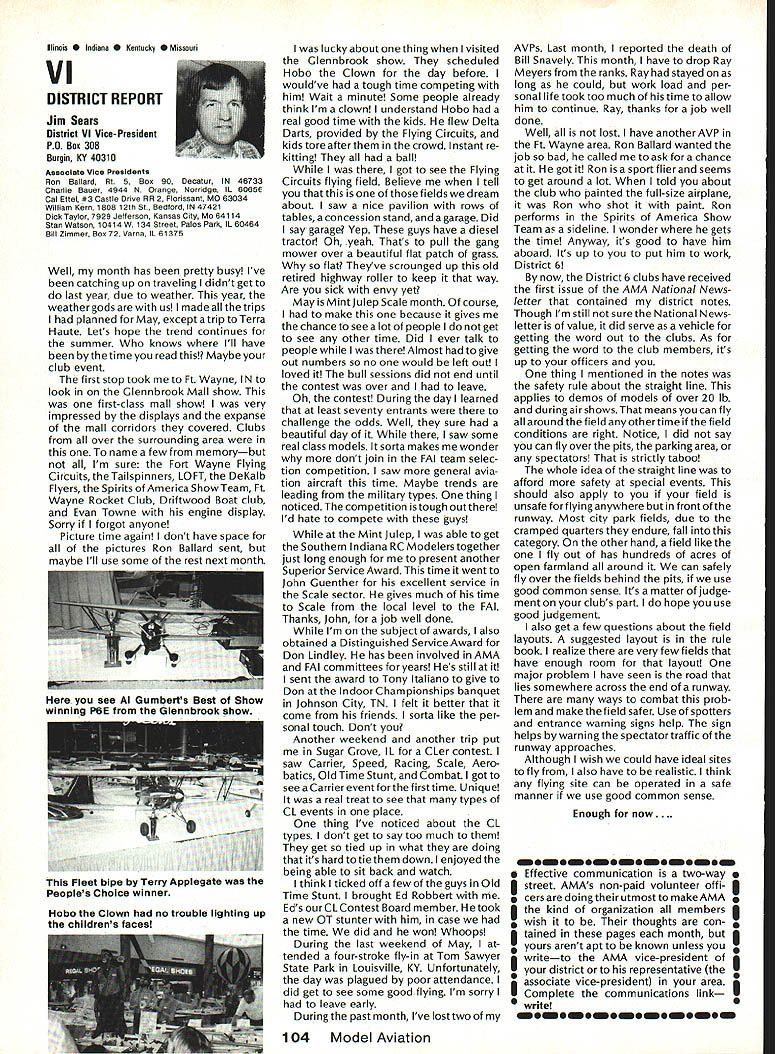
Picture time again! I don't have space for all of the pictures Ron Ballard sent, but maybe I'll use some of the rest next month.
I was lucky about one thing when I visited the Glennbrook show. They scheduled Hobo the Clown for the day before. I would've had a tough time competing with him! Wait a minute! Some people already think I'm a clown! I understand Hobo had a real good time with the kids. The Devil Darts, provided by the Flying Circuits, and kites tore after them in the crowd. Instant re-kitting! They all had a ball!
While I was there, I got to see the Flying Circuits flying field. Believe me when I tell you that this is one of those fields we dream about. I saw a nice pavilion with rows of tables, a concession stand, and a garage. Did I say garage? Yep. These guys have a diesel tractor! Oh, yeah. That's to pull the gang mower over a beautiful patch of grass. Why so flat? They've scrounged up this old retired highway roller to keep it that way. Are you sick with envy yet?
May is Mint Julep Scale month. Of course, I had to make this one because it gives me the chance to see a lot of people I do not get to see any other time. Did I ever talk to people while I was there? Almost had to give out numbers so no one would be left out! I loved it! The bull sessions did not end until the contest was over and I had to leave.
Oh, the contest! During the day I learned that at least seventy entrants were there to challenge the odds. Well, they sure had a beautiful day of it. While there, I saw some real class models. It sort of sent you in a tailspin if you're thinking about entering competition. I saw more general aviation aircraft this time. Maybe trends are leading from the military types. One thing I noticed. The competition is tough out there! I'd hate to compete with these guys!
While at the Mint Julep, I was able to get the Southern Indiana RC Modelers together just long enough for me to present another Superior Service Award. This time it went to John Guenther for his excellent service in the Scale sector. He gives much of his time to Scale from the local level to the FAI. Thanks, John, for a job well done.
While I'm on the subject of awards, I also obtained a Distinguished Service Award for Don Lindley. He has been involved in AMA and FAI committees for years! He's still at it! I sent the award to Tony Italiano to give to Don at the Indoor Championships banquet in Johnson City, TN. I felt it better that it come from his friends. I sorta like the personal touch. Don't you?
Another weekend and another trip put me in Sugar Grove, IL for a CL contest. I saw Carrier, Speed, Racing, Scale, Aerobatics, Old Time Stunt, and Combat. I got to see a Carrier event for the first time. Unique! It was a real treat to see that many types of CL events in one place.
One thing I've noticed about the CL types. I don't get to say too much to them! They get so tied up in what they are doing that it's hard to tie them down. I enjoyed being able to sit back and watch.
I think I ticked off a few of the guys in Old Time Stunt. I brought Ed Robbert with me. He's our CL Contest Board member. He took an O.T. stunter with him, in case we had the time. We did and we won! Whoops! During the last weekend of May, I attended a four‑stroke fly‑in at Tom Sawyer State Park in Louisville, KY. Unfortunately, the day was plagued by poor attendance. I did get to see some good flying. I'm sorry I had to leave early.
During the past month, I've lost two of my AVPs. Last month, I reported the death of Bill Snavely. This month, I have to drop Ray Meyers from the ranks. Ray had stayed on as long as he could, but work load and personal life took too much of his time to allow him to continue. Ray, thanks for a job well done.
Well, all is not lost. I have another AVP in the Ft. Wayne area. Ron Ballard wanted the job so bad, he called me to ask for a chance at it. He got it! Ron is a sport flier and seems to get around a lot. When I told you about the club who painted the full-size airplane, it was Ron who shot it with paint. Ron performs in the Spirits of America Show Team as a sideline. I wonder where he gets the time! Anyway, it's good to have him aboard. It's up to you to put him to work in District 6!
By now, the District 6 clubs have received the first issue of the AMA National Newsletter that contained my district notes. Though I'm still not sure the National Newsletter is of value, it did serve as a vehicle for getting the word out to the clubs. As for getting the word to the club members, it's up to your officers and you.
One thing I mentioned in the notes was the safety rule about the straight line. This applies to demos of models of over 20 lb. and during air shows. That means you can fly all around the field any other time if the field conditions are right. Notice, I did not say you can fly over the pits, the parking area, or your spectators! This is strictly taboo!
The whole idea of the straight line was to afford more safety at special events. This applies to everyone, not just you if your field is unsafe for flying anywhere but in front of the runway. Most city park fields, due to the cramped quarters they endure, fall into the category. On the other hand, a field like the one I fly out of has hundreds of acres of open farmland all around it. We can safely fly over the fields behind the pits; if we use good common sense. It's a matter of judgment on your club's part. I do hope you use good judgment.
I also get a few questions about the field layouts. I suggested layout is in the rule book. I realize there are very few fields that have enough room for that layout! One major problem I have seen is the road that lies somewhere across the end of a runway. There are many ways to combat this problem and make the field safer. Use stoppers and entrance warning signs. The sign helps by warning the spectator traffic of the runway approaches.
Although I wish we could have ideal sites to fly from, I also have to be realistic. I think any flying site can be operated in a safe manner if we use good common sense.
Enough for now ...
AMA News
The Ribcrackers and Fraser clubs have lost Orville Berry. He was another quiet mover in his clubs. Orville was struggling with illness for several years, but kept as active as he could. His flying buddies made special efforts to show their sympathies at his funeral.
We are seeing many clubs getting involved with safety by appointing a Safety Officer, a Safety Committee, or by other monitoring efforts. The Grassfield Flyers of Minnesota have enlarged on this by participating in a CPR program. This is being set up by a club member who is a doctor. What a great example for other clubs to follow.
I had a phone call last week, which was from outside our area, but I believe worth putting into this column. Picture a flying area in a large park; shady trees, human conveniences, parking lots. The flyer! Right in Anaheim, Los Angeles! The only restriction that applies is no internal combustion power! It seems that, once they'd been treated to hands-on flying at a demonstration, the City Fathers had become hooked on Electric. Another piece of information for your record books.
Keep your eyes on your nearest AVP. They are going to be keeping the lines of communication more active. I want you to make it a point of sending them your newsletters, asking them for CD forms, and any other items you need help with. They now have a nominal expense allowance, and I plan to have a general district meeting with all of them before the year is out. We need to get to know each other, and this will be the first time, as far as I know, that any AVPs and VPs have had such a meeting.
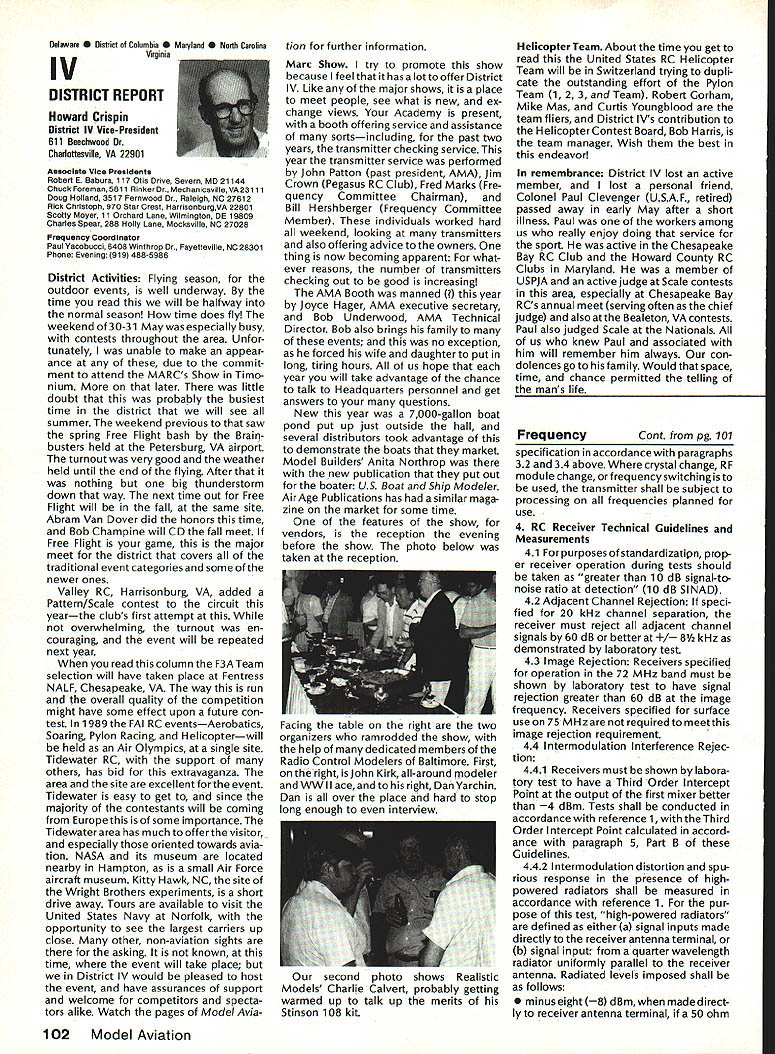
District Roundup: Noise is a topic in many newsletters, and several have set 85 dB at 20 ft. in all directions, on the ground. The Valley Aero Modelers have started action, but mention the case where the Wide World of Sports program showed how cars have to be muffled to keep tracks available. Sound familiar? Congrats to Saginaw Valley RC Club. They are 25 years old, and have prospective ladybirds too! The Aerobatic Aces had Donnie and Carol take the concession stand. Hmmm. Also, their bowling team won second place. Our farthest‑north club, Duluth RC Airplane, has AVP Steve Bowman doing takeoffs from a picnic table—probably waiting for the water to freeze. Dave Bales of the River City RC tells of popping into a local garage sale, and finding an old CL model that Dave built twenty years ago. It still flies. The Circlemasters have Gordy Teschendoff as their safety officer. Blackhawks has several venues for its shows to keep the club alive, and the Sharks has a training session for its instructors. The MARCS gives its instructors a bonus or two—free fuel and free membership. They run Beginners' Power Days, too. That's the best answer I have seen to date. A thousand attaboys to the MARCS. Finally, the following description of an aeroplane in the Aerohawks newsletter: "Mobile Overhead Vegetation Enhancer" ... a Crop Duster!
Sensible Sounds Sound Less
Sandy Frank is also the power behind the Weatherford (TX) Aeromodeling Society, and he has a unique way of "dragging" you to meetings. Rather than a complex and burdensome newsletter, he simply sends each member (and me) a postcard with such cryptic messages as, "FUN-FLY, at club field, Sunday, May 31, 2 p.m. till dark, cookout at 5 p.m., Top Gun Award to Winner. Club Meeting June 1st, 7 p.m., 105 N. Brazos, Weatherford, TX. Short Meeting with Program, C U THERE!" Now, honest, that is a heck of a lot of information—and all on just a postcard with a 14‑cent stamp! And I don't have to pull out any staples with my fingernails. If you'd like to exchange with Sandy, the address is: Dr. Sandy Frank, 105 N. Brazos, Weatherford, TX 76086. Phone: (817) 599‑7131.
If you are one who enjoys good newsletters, and especially if Free Flight is your thing, you'll really enjoy the Okie Free Flight Flyer put out by Bill Baker. Honest, Bill has more real information on team jamming pages than you can ever imagine. It runs from plans, to tech info, to contest results and contest announcements, and to who‑went‑where and what he won or didn't win. You can get in touch with Bill at: The Okie Free Flight Flyer, Bill Baker, 1902 Peter Pan, Norman, OK 73072.
Another awfully good newsletter is the Splatter Sheet of the South Plains Lines and Transmitters, Plainview, TX. The co‑editors are David McIlroy and Reggie Holland. Besides six crowded pages of news, calendars, and contest results, they wisely salt the paper with bits of humor. One of those humorous touches that tickled me was a report from the club secretary/treasurer, Howard Priest. Howard was commenting on the High Plains Meet, and said: "I just want to say one thing about the drawings. I started to throw away my tickets after the drawing, but I noticed that there was printed on them in big letters, 'KEEP THIS COUPON.' What I want to know is just how long do I have to keep the damned things? This is a real sore spot with me!"
The Plainview Splatter Sheet has some valuable (?) contest info, too, such as the following:
"CONTEST RULES #1 The Judge is Always Right! #2 In Case the Judge Is Wrong, Refer Back to Rule #1."
The Plainview bunch is an active group, and if you'd like to contact them or exchange, write to South Plains Lines and Transmitters R/C Club, 510 Grandview Dr., Plainview, TX 79072.
Another newsletter that has made an impression on me is an always‑good piece put out under the name of The Broken Prop by the Wichita Falls (TX) RC Club by combined president and newsletter editor Ken Guilford. Ken used to fly out of Clovis, NM, but his move to Wichita Falls was a lucky one for the Wichita Falls Club. You would do well to set up a newsletter exchange with Ken. You can contact him at P.O. Box 106‑B Falcon Circle, Wichita Falls, TX 76311.
The most recent newsletter that I have gotten from the JETERO RC Club in Houston had an interesting notice in it. The club paper is put out by the secretary, but it had a plea for a new editor. I quote:
"Wanted. Editor. Qualifications—Must be alive and able to operate at least one of the following: personal computer, Xerox machine, typewriter, or lead pencil. Should be able to donate at least one day's work a month, or four hours, or at least a few minutes. Should be able to spell and write like you'd gone to college. Should be able to take constructive criticism with a smile, and then forget it. For pay you'll get a gallon of fuel per year and the love of the club."
Now, do we have any takers for this Houston club job? You can contact Dan Shay, 431 W. Sunnyside, Houston, TX 77091.
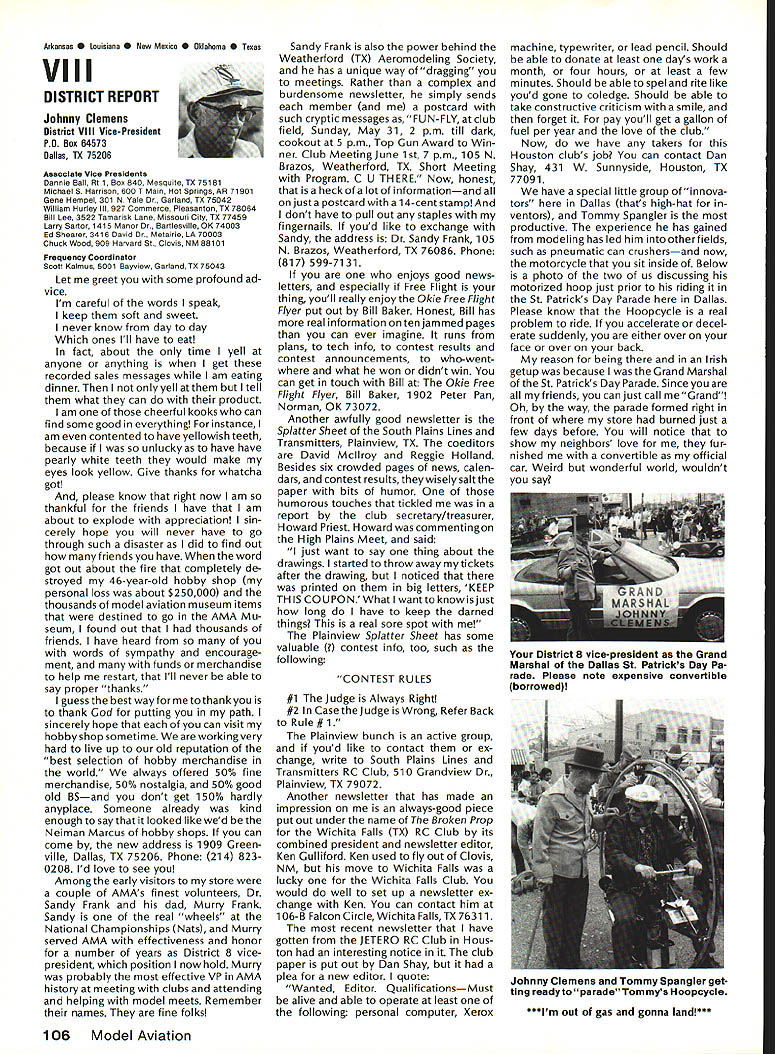
We have a special little group of "innovators" here in Dallas (that's high‑hat for inventors), and Tommy Spangler is the most productive. He is a fellow that has gained from modelbuilding and has him into other fields, such as pneumatic can crushers—and now, the motorcycle that you sit inside of. Below is a photo of the two of us discussing his motorized hoop loop just prior to his riding it in the St. Patrick's Day Parade here in Dallas. Please note that the hoopcycle is a real problem to ride. If you accelerate or decelerate suddenly, you are either over on your face or over on your back.
My reason for being there and in an Irish getup was because I was the Grand Marshal of the St. Patrick's Day Parade. Since you are my friends, you can just call me "Grand!" Oh, by the way, the parade formed right in front of where my store had burned just a few days before. You will notice that to row my neighbors' love for me, they furnished me with a convertible as my official car. Weird but wonderful world, wouldn't you say?
IX DISTRICT REPORT
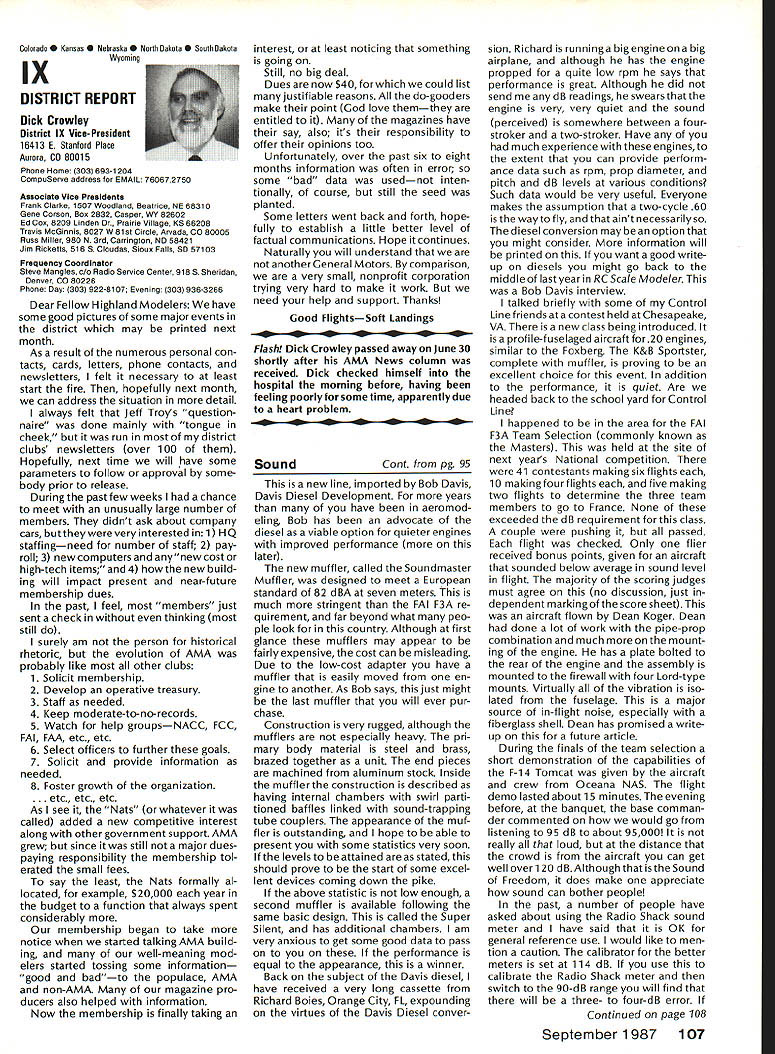
Dick Crowley District IX Vice‑President 16413 E. Stanford Place Aurora, CO 80015 Phone Home (303) 696‑1204 CompuServe address for EMAIL: 76067.2750
Associate Vice Presidents:
- Frank Clarke, 1507 Woodlands, Beatrice, NE 68310
- Gene Corson, Box 2832, Casper, WY 82602
- Ed Cox, 8201 Linder Dr., Prairie Village, KS 66208
- Travis McGinnis, 9307 W. 81st Circle, Arvada, CO 80005
- Jim Miller, 980 N. Rd., Carrington, ND 58421
- Rita Richards, 516 S. Clouds, Sioux Falls, SD 57105
Frequency Coordinator: Steve Mangelsdorf, Colorado Service Center, 918 S. Sheridan, Denver, CO 80226 Phone: Day (303) 922‑6107; Evening (303) 936‑3266
Dear Fellow Highland Modelers:
We have had some good pictures of some major events in the district which may be printed next month.
As a result of the numerous personal contacts, cards, letters, phone contacts and newsletters, I felt it necessary to at least start the fire. Then, hopefully next month, we can address the situation in more detail.
I always felt that Jeff Troy's "questionnaire" was done mainly with "tongue in cheek," but it was run in most of my district clubs' newsletters (over 100 of them). Hopefully, next time we will have some parameters to follow or approval by somebody prior to release.
During the past few weeks I had a chance to meet with an unusually large number of members. They didn't ask about company cars, but they were very interested in:
- HQ staffing—need for number of staff;
- payroll;
- new computers and any new cost or high‑tech items; and
- how the new building will impact present and near‑future membership dues.
In the past, I feel, most "members" just sent a check in without even thinking (most still do).
I surely am not the person for historical rhetoric, but the evolution of AMA was probably like most all other clubs:
- Solicit membership.
- Develop an operative treasury.
- Start as needed.
- Keep moderate‑to‑no‑records.
- Watch for help groups—NAC, FCC, FAI, FAA, etc.
- Select officers to further these goals.
- Solicit and provide information as needed.
- Foster growth of the organization.
...etc., etc., etc.
As I see it, the "Nats" (or whatever it was called) added a new competitive interest along with other government support. AMA grew; but since it was still not a major dues‑paying responsibility the membership tolerated the small fees.
To say the least, the Nats formally allocated, for example, $20,000 each year in the budget to a function that always spent considerably more.
Our membership began to take more notice when we started talking AMA building, and many of our well‑meaning modelers started to toss some information—"good and bad"—to the populace, AMA and non‑AMA. Many of our magazine producers also helped with information, as did other people.
Now the membership is finally taking an interest, or at least noticing that something is going on.
Still, no big deal.
Dues are now $40, for which we could list many justifiable reasons. All the do‑gooders make their point (God love them—they are entitled to it). Many of the magazines have their say, also; it's their responsibility to offer their opinions too.
Unfortunately, over the past six to eight months information was often in error; so some "bad" data was used—not intentionally, of course, but still the seed was planted.
Some letters went back and forth, hopefully to establish a little better level of factual communications. Hope it continues.
Naturally you will understand that we are not another General Motors. By comparison, we are a very small, nonprofit corporation trying very hard to make it work. But we need your help and support. Thanks!
Good Flights—Soft Landings
Flash! Dick Crowley passed away on June 30 shortly after his AMA News column was received. Dick checked himself into the hospital the morning before, having been feeling poorly for some time, apparently due to a heart problem.
Sound (continued)
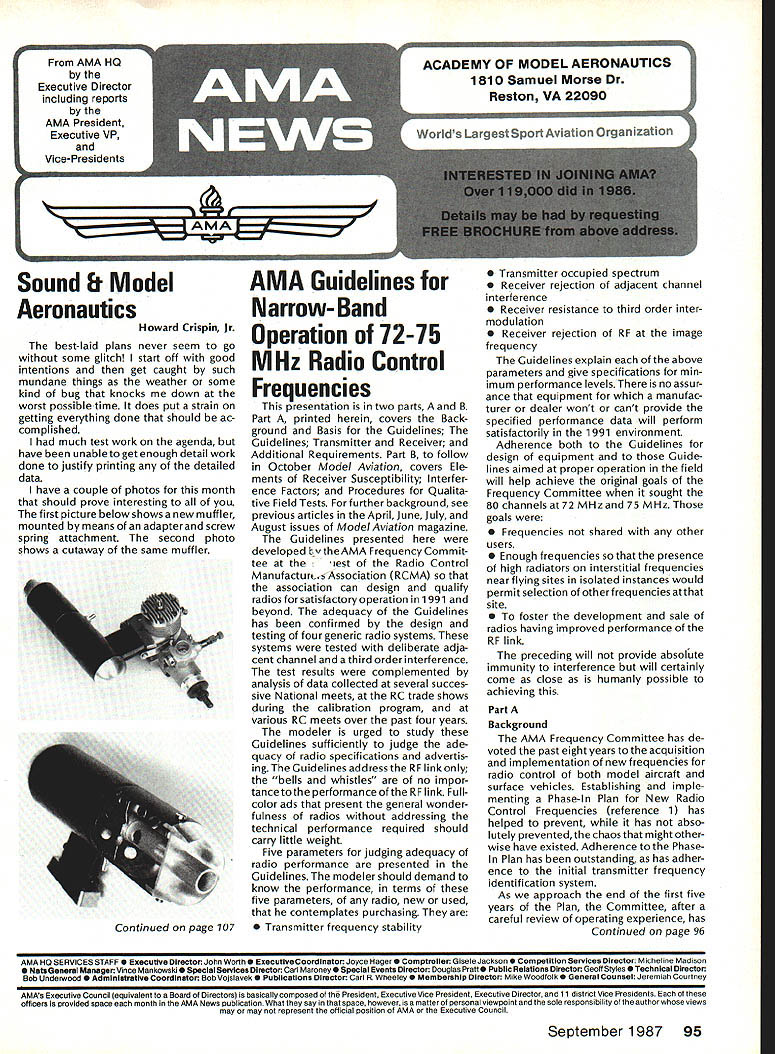
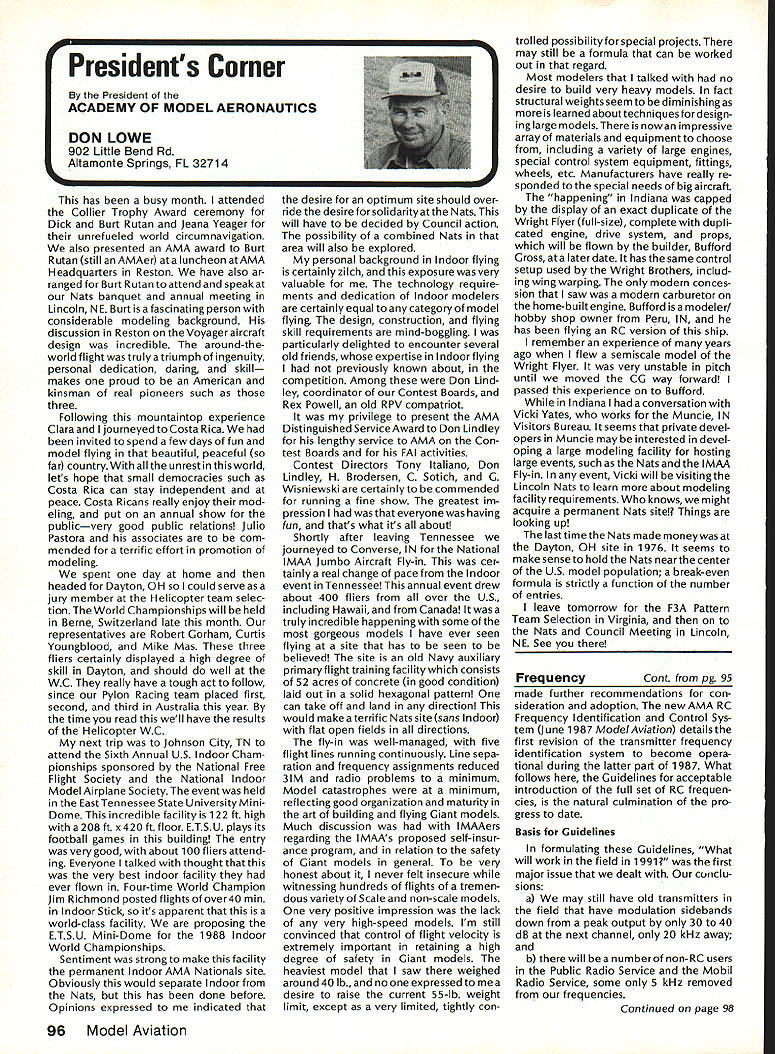
This is a new line, imported by Bob Davis, Davis Diesel Development, for more years than many of you have been in aeromodeling. Bob has been an advocate of the diesel as a viable option for quieter engines with improved performance (more on this later).
The new muffler, called the Soundmaster Muffler, was designed to meet a European standard of 82 dB A at seven meters. This is much more stringent than the FAI 93 A requirement, and far beyond what many people look for in this country. Although at first glance these mufflers may appear to be fairly expensive, the cost can be misleading. Due to the low‑cost adapter you have the muffler that is easily removed from one engine to another. As Bob says, this just might be the last muffler that you will ever purchase.
The construction is very rugged, although the mufflers are not especially heavy. The primary body material is steel and brass, brazed together as a unit. The end pieces are machined from aluminum stock. Inside the muffler the construction is described as having internal chambers with sound‑partitioned baffles linked with sound‑trapping tube couplers. The appearance of the muffler is outstanding, and I hope to be able to present you with some statistics very soon. If the levels to be attained are as stated, this should prove to be the start of some excellent devices coming down the pike.
If the above static test is not low enough, a second muffler is available following the same basic design. This is called the Super Silent, and has additional chambers. I am very anxious to get some good data to pass on to you and to the clubs and to anyone who can purchase one.
Back on the subject of the Davis diesel, I have received a very long cassette tape from Richard Boies, Orange City, FL, expounding on the virtues of the Davis Diesel conversion. Richard is running a big engine on a big airplane, and although he has the engine propped for a quite low rpm he says that performance is great. Although he did not send me any dB readings, he swears that the engine is very, very quiet and the sound (perceived) is somewhere between a four‑stroker and a two‑stroker. Have any of you had much experience with these engines, to the extent that you can provide performance data such as rpm, prop diameter, and pitch, and how well it lasts at various conditions? Such data would be very useful. Everyone makes the assumption that a two‑cycle .60 is the way to fly, and that it necessarily so. The diesel conversion may be an option that you might consider. More information will be printed on this in the October issue.
I happened to be in the area for the FAI F3A Team Selection (commonly known as the Masters). This was held at the site of next year's National competition. There were 41 contestants making six flights each, 10 making four flights each, and five making two flights to determine the three‑team members to go to France. None of these exceeded the dB requirement for this class. A couple were pushing it, but all passed. Each flight was checked. Only one flight received bonus points, given for an aircraft that sounded above average and sounded in flight. The majority of the competing judges base their decisions on (no discussion, just independent marking of the score sheet). This was an aircraft flown by Dean Koger. Dean had done a lot of work with the pipe‑prop combination and much more on the mounting of the engine. He has a plate bolted to the rear of the engine that supports the tail of the engine and is mounted to the firewall with four 1/4‑20 bolts. Virtually all of the vibration is isolated from the fuselage. This is a major in‑flight noise, especially with a fiberglass shell. Dean is planning a write‑up on this for a future column.
During the finals of the team selection a short demonstration of the capabilities of the new F‑14 Tomcat was given by the aircraft and crew from Oceanic NAS. The flight demonstration lasted about 15 minutes. The evening before, at the banquet, the base commander commented on how we would go from listening to 95 dB to about 95,000? I do not know the exact level. The crowd is from the aircraft you can get was well over 120 dB. Although that is the Sound of Freedom, it does make one appreciate how sound can bother people!
In the past, a number of people have asked about using the Radio Shack sound meter in the lower 30 dB range, and I have stated that it is OK for general reference use. I would like to make one comment on its use: the lower scale is set at 34 dB. If you use this to calibrate the Radio Shack meter and then switch to the 90 dB range you will find that there will be a three‑ to four‑dB error. If most of your usage is in that range, you can check it against a quality meter while taking a reading at three meters. This would give you a closer reference. If you cannot do this, it is better to leave the adjustments alone. Just a word of caution! Do not be misled into complacency!
Calling AMA HQ?
The phone number is (703) 435‑0750.
But think about the following before you call:
AMA employees (45 of them) come to work from all directions — some from Virginia, some from Maryland, some from D.C. They are at the office only during normal commuter hours for their location. It is best to call during the "core time" period when all are present at the same time (except for those who are traveling for AMA, ill, or on vacation).
CALLING YOUR BEST LOCAL TIME TO CALL
- Eastern: 9am—Noon, 1pm—3pm
- Central: 8am—11am, Noon—2pm
- Mountain: 7am—10am, 11am—1pm
- Western: 6am—9am, 10am—Noon
We regret the necessity for some zones other than the East to call earlier in the day, but it is the best way to get the particular person you need for any of the many subjects and services handled by AMA Headquarters. However, if you can't call earlier or later, we will call you back as soon as possible.
XI DISTRICT REPORT
Ed McCullough District XI Vice‑President 53 S.E. 81st Ave. Portland, OR 97215 (503) 234‑4439 CompuServe address for EMAIL: 76007,2422
Associate Vice Presidents:
- Tom Cashman, 2521 SW 323rd St., Federal Way, WA 98023
- Al Culver, Box 86, Wilder, ID 83676
- Gary R. Fuller, 3050 Riverwood, Juneau, AK 99801
- Glen Mischke, 4050 Fourth Ave. N., Great Falls, MT 59401
- Dave Nullens, 15559 Palatka Ave. N., Seattle, WA 98133
- Bruce Malcher, 8007 E. Vicksburg St., Spokane, WA 99208
- Dick Wickline, PO Box 623, Klamath Falls, OR 97601
- Dick Young, 11201 128th St. E. #69, Puyallup, WA 98373
Frequency Coordinator: Robert Balch, 16439 SE Muir Dr., Portland, OR 97236 Phone: (503) 761‑0033
Control Line activity picks up with Rapid Richard's Record Ratio Meet at Kent, WA on August 15–16. All Speed classes plus Carrier I & II and Endurance are scheduled.
If you have questions about frequency matters, it's best if you call or write Bob Balch. He is our frequency coordinator, and he has relieved me of dealing with stuff like that. In any case, I don't always get the up‑to‑the‑minute information that he is receiving, and thus he is much better informed. Besides, that's what we pay the large salary for. As a matter of fact, he would rather have you call than write. But if you must write, send him a phone number where he can reach you. A self‑addressed, stamped envelope would certainly help. Bob also works, and the best time to call him is in the evening.
While I'm at it, I know many of you are wondering what all the frequency changes mean as far as your personal use is concerned. I know there are some problems, such as the changes in the frequency identification system. I'm sure this will come up at the next Council meeting, so maybe we can find a way to ease into the change. Unless you are competing at the Nats, or some other competition where a regulation frequency flag is specified when you are flying, why worry? At your local flying site, all you do is satisfy club or local requirements. If, for example, you have the present system, all you have to do is to replace the two streamers with a single streamer indicating you are operating on an aircraft frequency. Then, when possible, you can replace the channel‑numbered placard with the correct style. One club is buying very lightweight vests and having a large white circle with the channel numbers put on the back. This should leave little doubt what channel you're using.
Of far more import is, "What do I do with my old radio?" Well, it depends. Far too many people are worrying about having to throw their radios away. That is not necessary nor even desirable. First, most transmitters that are ten years old or less can be set up on the new frequencies relatively easily. Even older models can be upgraded, in spite of what certain people have written. That's not the problem.
What does have to be replaced, especially to meet the 1991 specifications, is the receiver. Present regulations allow an 80‑kHz spacing between our operating frequencies—that is, between the "old" Blue/White, Yellow/White, etc. frequencies. The regulations change in December, '87, and we lose the "colored" frequencies.
1991 regulations call for 20 kHz between our frequencies. That doesn't mean that everyone has to run out and buy the latest gizmo. What is very necessary, though, is that each and every club sit down now and decide how they want to apportion the available frequencies. For example, with as many frequencies as are going to be available, there is no reason why a club cannot set up a plan that calls for the use of every third or fourth frequency. That way you will not only solve the not‑narrow‑enough receiver problem, but you will also eliminate the dreaded 3IM problem. It will be necessary for those who have not bought their radios with the plan in mind to send their radios off for updating. But be warned! At present Kraft Midwest, which is doing a lot of changeover work, is running about a six‑week window to turnaround.
With the right plan, depending on the particular needs of your location, there is no reason why present technology receivers cannot be used until you need to replace them for a reason other than that they are not narrow‑band enough. Naturally, those who are into competition and travel a lot will find it necessary to have the most up‑to‑date equipment, but they usually do anyway. It will be necessary for some contests to deal with frequency distribution problems in creative ways. And, it is going to be necessary for all of us to see that our equipment is checked every year. We are no longer going to have the luxury of going out flying with radios that are capable of blowing several others out of the sky. Get them checked and changed over.
Also, I've been asked if flying on the old frequencies will be illegal. The answer is yes, according to FCC regulations. You will not be allowed to fly the old frequencies at any sanctioned contest. Further, remember that the safety code holds that it is not so much what you are flying as how you are flying. If you cause injury or damage because you deliberately broke the FCC regulations by flying on an illegal frequency, no insurance will cover you.
While I'm on a radio kick, several people asked me to recommend radios that meet the new standards. Because this country is so large, frankly, I decline. In any case, if you understand that many problems come not from design and not from manufacture but from quality control among subcontractors, then you know why checking one, or a hundred, or even a thousand of one kind of radio is not going to tell you much about how the very next one off the assembly line will work. The old way is the best: talk to those using any particular brand and if what you hear is good, get one. Personally, I'm sending in three old Krafts to get them brought up to snuff, and I sure miss my Royal!
On August 15 & 16 the Willamette Modelers Club will host the Northwest Free Flight Champs Meet at Parker's field south of Albany, OR. This contest should have just about every event you could want. If you contact Bob Stalich and take notice, maybe they'll add anything you want that isn't already on the agenda. The FAI seminars are scheduled for Harts Lake on the 5th–7th of Sept. If you're going to fly or even just spectate, check first.
Coming up at Silverton, OR on the 9th of August is the Second Annual Home Days Fly‑In. This is not a contest, rather just open flying as part of the Davenport Days celebration and includes a demonstration of our hobby. If you'd like to be part of this public show, flying will be at the junior high at the NW end of town.
I just got word that OMAS will hold their annual two‑day extravaganza on the 22nd & 23rd of August. One day will be open to all sizes and the other will be for Big Birds only. As in the past, Saturday will be for all sizes. This one of the nicest sites around and is worth a visit, even without a plane. Actually, the sausage they have for sale at their concession booth is worth the trip. The flying and the aircraft then become an incredible bonus. Word is out that there will be some new planes on view. Ken Melvin is rumored to be getting an F4U ready. Even Dave Cobb is reputed to be coming out with a new aircraft, an L‑19. Head out to Banks, OR for a fine fly‑in and see.
There's a lot of stuff going on in the district. On Aug. 15th/16th in the Medford area is a Model Air Show. On the 16th the Benton Co. group has an RC Rally at their field at Adair Aerodrome. The Soaring group will be out at Thermal Search, run by PASS at their new field NW of Portland on the 15th & 16th of August. Their new field is about 25 miles west of Portland off Highway 26. Call Dave Johnson at (503) 252‑4984 or Barry Kurath at (503) 281‑3237 for more info.
That same weekend the Great Falls Soaring Society will have a Soaring Meet, probably at Blackhorse Field. The Eugene Glider Club will hold a soaring contest at Eugene on the 22nd & 23rd of August. The Lewis Co. Radio Modelers will hold a Soaring meet at Chehalis, WA on the 29th & 30th of August. I'm not sure of the sites, but any NWSS member, such as Dave Johnson, should be able to help. The Inland Empire Soaring Society hosts the North Idaho Soaring Championships at Farragut, ID on the 5th & 6th of Sept.
One of the best Fun‑Fly events will happen on Aug. 8 and 9 at Pfeiffer Field, south of Puyallup. Yep, it's time for the Mount Rainier Radio Control Society's annual Hog Holler BBQ & Fun‑Fly. If you like BBQ, don't miss it. Now, naturally, the real reason everyone shows up is for the flying, which will feature some of the best around. Great flying, prizes, and food make a fantastic weekend. The next Saturday, the 15th, the HAWKS will have a fly‑in at Kent. And, on the 29th, the RAMS have a fun‑fly/auction. Lots of fun will be happening.
The Farragut Flyers will hold the Fourth Annual International Float‑Fly at Sandpoint, ID on the 29th & 30th of August. Pattern (or Precision Aerobatics) meets include: Aug. 8 & 9 at Fry's Corner, BC by the RCFCBC; the Fun‑In‑The‑Sun Pattern Contest at Finley, WA hosted by the Tri‑Cities RC Modelers on the 15th & 16th of Aug.; the Billings Flying Mustangs Annual Pattern and Scale Meet at Billings, MT on Aug. 29 & 30; the Emerald Air Corps' Emeralds Pattern Contest including all classes at Springfield, OR.
Racing is starting again, with the MARCS Marymoor Beginners Pylon Race at Redmond on the 23rd of Aug. The Boeing HAWKS have an F‑500 meet at Kent on August 30.
Happy Flying!
Transcribed from original scans by AI. Minor OCR errors may remain.

