
AMA NEWS
A Frequency Time-out
Bob Underwood Technical Director
For quite a few months there have been articles in Model Aviation covering technical aspects of radio control operation: rule-book material, technical guidelines for radios, and concerns involving antenna design and placement. This month's article takes a somewhat different tack and is written by a radio nontechnician — your AMA Technical Director.
My task at Headquarters does not require me to know every little what‑ya‑ma‑call‑it, framistan, or widget in your radio system. Rather, I act as moderator between members, the Frequency Committee, industry, the FCC, and other interested parties. Some basic radio knowledge helps, but not in-depth expertise. What follows is an update on things affecting RC operation so you can fly without stumbling over regulations and other problems.
What about the aircraft/surface frequency problems?
During 1985–1986 we encountered many problems caused by incorrect use of frequency allocations — particularly model cars and robots being used on aircraft frequencies. The situation has improved dramatically. Two main reasons for the improvement were broad information distribution and the industry adoption of transmitter labeling: AMA developed red and yellow stickers supplied to manufacturers/importers (artwork provided free where needed).
Over the past two years several incidents of model airplane interference were reported, most involving surface models on aircraft frequencies; one crash was blamed on a promotional robot. Unfortunately, we have usually only received verbal reports and not sufficient documentation, so we are reluctant to publish specifics.
If you experience this type of interference, do the following:
- Document the incident carefully — names, dates, times, locations, frequencies, etc. Verify details; do not rely on second‑ or third‑hand information.
- Maintain your composure. Emotional outbursts may complicate later settlement of the problem.
- Determine your loss. If no bodily injury occurred, figure repair or replacement costs. Many cases end up in small claims court.
- Seek legal aid. If you meet resistance, consult an attorney — regional laws vary and Headquarters cannot offer specific legal advice.
- Obtain all available written documentation. AMA can provide documents (for example, FCC Part 95) and other references to support your case.
You may obtain general guidance from the Academy's attorney, Mr. Jeremiah Courtney. We also have a comprehensive document to help if deliberate interference occurs at your site — a very complex and emotionally charged problem. If you suspect improper frequency use, contact Headquarters. We have approaches to inform individuals or industry members; most cooperate when advised they could be in legal jeopardy for selling or using equipment improperly.
What are the AMA "rules" concerning radio control?
There are no one‑size‑fits‑all frequency control rules mandated by AMA for the sport flier at a local field. The Rule Book offers a recommended flying site layout, and the Frequency Committee provides many "highly recommended" guidelines; specific procedures vary by site and are the responsibility of the local club. With over 2,000 different site types nationally, flexibility is necessary.
Examples of differing approaches:
- The subtractive system: clothespins are stored on site; the pin on the antenna enables transmitter operation.
- The additive system: fliers carry their own pin/paddle and hang it on a peg board at the field.
Both systems work. AMA recommends that each field have some type of control; a future Safety Code radio section may state that explicitly. Note that the AMA Frequency Utilization Plan (approved by the Executive Council) contains a preliminary statement that flag and channel identification plaques are required at AMA‑sanctioned events. The plan continues to use “encouraged” and “recommended” for pins, monitoring, and flightline spacing.
Effective January 1, 1988, the Safety Code was amended to include: "I will operate my model using only radio control frequencies currently allowed by the Federal Communications Commission. (Only properly licensed Amateurs are authorized to operate equipment on Amateur Band frequencies.)" Using nontypical European frequencies, frequencies withdrawn from model service by the FCC, or operating without required licenses will violate the Safety Code. Remember: compliance with the Safety Code is required for AMA liability protection to apply.
What about the AMA–FCC relationship?
AMA has maintained a very good working relationship with the FCC. We are represented before the Commission by Mr. Jeremiah Courtney, whose expertise has been invaluable for rulemaking applications and resolving field office interpretations. Two examples:
- A field office misinterpretation of Part 95 led an insurance company to refuse payment for a crash; Mr. Courtney’s prompt action resolved the issue.
- Another robot/aircraft frequency incident led to AMA requesting clarification; the FCC revised Part 95 language to clearly state aircraft/surface frequency split requirements.
Members can be proud of this relationship. We will continue to work diligently with the FCC. In the near future we plan to submit a proposal for rulemaking to tighten equipment type acceptance requirements in anticipation of radio needs for 1991.
Where are we headed with radio control?
No system is bulletproof. The hobby will require cooperation among members, clubs, and industry to maximize enjoyment. Reports from the field vary — some describe frequent interference and equipment problems, others report trouble‑free operation — for several reasons:
- Emotions, money, and time stakes after a crash can skew perceptions.
- Pilot error can be misattributed to interference. I’ve seen pilots inadvertently hold sticks off‑center and blame radios.
- Good operating procedures and equipment maintenance reduce problems, even if you’re not a radio expert.
Three simple admonitions:
- Read what you can about frequencies, rule changes, and safety. Much useful information has been published; you may have missed it because your concerns at the time were elsewhere.
- Beware the self‑styled expert. Rely on knowledgeable sources; when in doubt about rules, contact Headquarters.
- Remember that frequencies authorized for model use are intended to be clear of other users. If your club experiences interference on the numbered channel frequencies, it may be due to nearby commercial operations on adjacent frequencies. The FCC granted 80 model frequencies because some may not be usable in every location.
There are many thousands of modelers who enjoy RC flight weekly. AMA — through the Frequency Committee, Headquarters, the FCC, and industry — will work to maintain this condition. Happy landings!
---
Sound & Model Aeronautics
Howard Crispin, Jr.
Standard
- A proposal will be submitted to the Executive Council asking to establish an acceptable sound level standard that can be attained universally within a relatively short period. The goal is a level that, when adopted, will reduce neighborhood noise complaints and induce manufacturers to design quieter equipment affordably.
- An accepted standard would likely become the operating norm at contests and especially at Nationals. Not all fields will adopt it (remote sites may not need it), but competition categories may require compliance.
- Research into quieter propellers, vibration isolation, exhaust/intake noise reduction, and related areas will be needed; costs will be incurred, but technology exists to make progress.
Vibration
- Reducing fuselage drumming (e.g., fiberglass skin vibration) can significantly lower perceived sound levels. Vibration mounts such as Lord mounts (stud/plate style) have been used effectively in competition aircraft.
- Installation planning: mount the engine on a flat plate with room to locate four Lord mounts between the engine plate and firewall. The Tech Products Corporation mount suggested is Item No. 51033, Style SS (stud/plate mount). Specs: studs on plate 3/8 in., 6‑32 thread; mount length ~9/16 in.; shock material neoprene (recommended over natural rubber for fuel resistance).
- Prices (catalog): approximately $2.50 each in small lots (1–23), $1.12 in medium lots (24–99), $0.96 in larger lots (100–499). Company minimum orders may apply; group purchases can reduce per‑installation cost. Plan mount placement during construction — firewall location and propeller clearance may require custom installations.
Field behavior
- A Control Line club recently lost a flying site after a confrontation with local residents involving children on skateboards and a nuisance complaint to police; the club was asked to leave. High sound levels make clubs vulnerable even when unrelated incidents are the immediate cause.
- Courtesy, good public relations, and quieter operation improve chances of retaining flying sites. Rude actions and avoidable disturbance will jeopardize access.
---
President's Corner
By the President of the Academy of Model Aeronautics DON LOWE 902 Little Bend Rd., Altamonte Springs, FL 32714
It's mid‑September and I’ve been back in Florida for a month. I attended a Pattern contest at Ft. Lauderdale and am preparing for the 1988 Nats planning session at Chesapeake, VA, and upcoming AMA Council meetings. I plan to attend the RCHTA Show and District meetings in Chicago and Denver, RC World Fall Festival, and the Tangerine Meet.
I try to feel the pulse of the membership by talking with many modelers. Most seem generally satisfied with how AMA is being run. District activity is increasing, and district meetings are important for sharing information.
Noise reduction is a major concern — many flying sites have been lost because of perceived noise. Public perception can be decisive. Advances include muffled carbon‑fiber tuned pipes for jets that meet FAA limits (98 dB at 3 meters) and quiet sport engines such as the K&B .45 Sportster. Quiet operation is achievable with effort.
Many clubs are implementing operational schemes to reduce radio failures, such as physically separating fliers and grouping frequencies — the "George Myers Pacific Plan" groups frequencies into three flight lines to reduce mutual interference. Radios are improving, but not yet perfect; clubs must use operational schemes that accommodate current equipment.
I’d like better integration of competition and sport fliers. A European concept of weekend events with one day of formal competition and one day of fly‑in/fun‑fly is attractive. Many modelers enjoy the low‑pressure social aspects of fly‑ins. I encourage sport fliers to learn basic disciplined aerobatics from Pattern fliers — it will improve your flying and enjoyment.
---
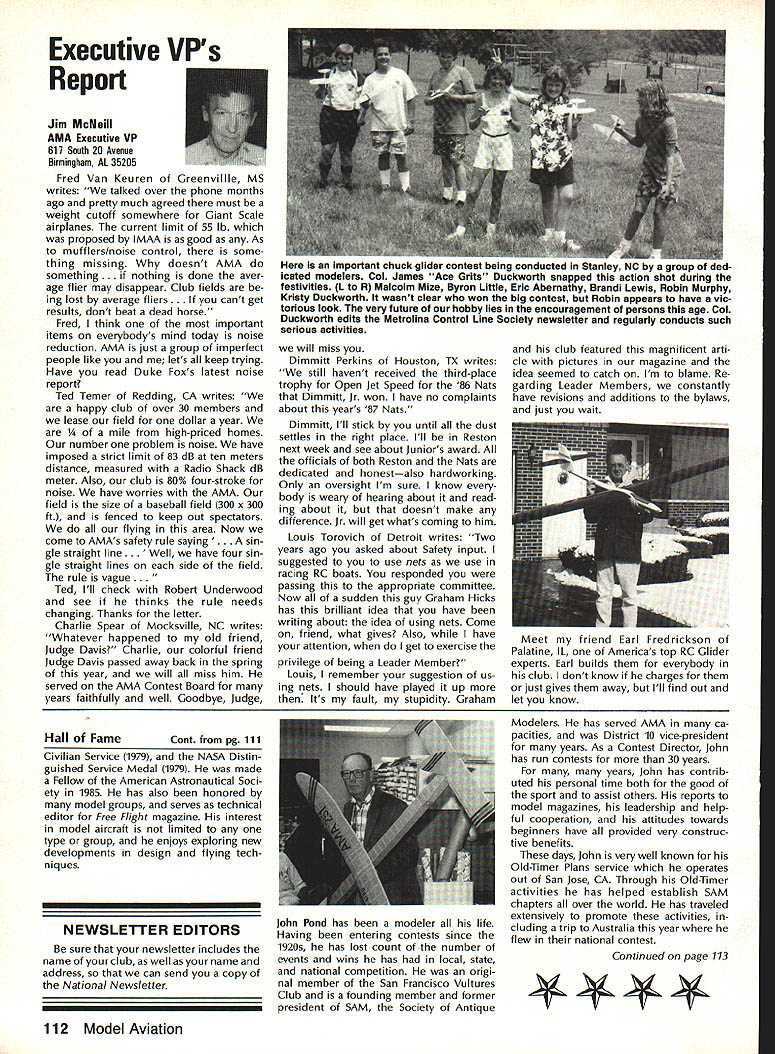
Executive VP's Report
Jim McNeill AMA Executive VP 617 South 20 Avenue, Birmingham, AL 35205
Reader letters and topics:
- Fred Van Keuren (Greenville, MS) raised the idea of a weight cutoff for Giant Scale airplanes and expressed concern about noise. Noise reduction is a top concern; AMA is working on it.
- Ted Temor (Redding, CA) wrote about his club’s strict 83 dB at 10 meters limit (measured with a Radio Shack meter), a high proportion of four‑stroke engines for noise control, and a question about safety rule wording regarding flight lines. I’ll consult Robert Underwood about possible rule changes.
- Charlie Spear (Mocksville, NC) asked about Judge Davis — he passed away this spring; Judge Davis served faithfully on the AMA Contest Board and will be missed.
---
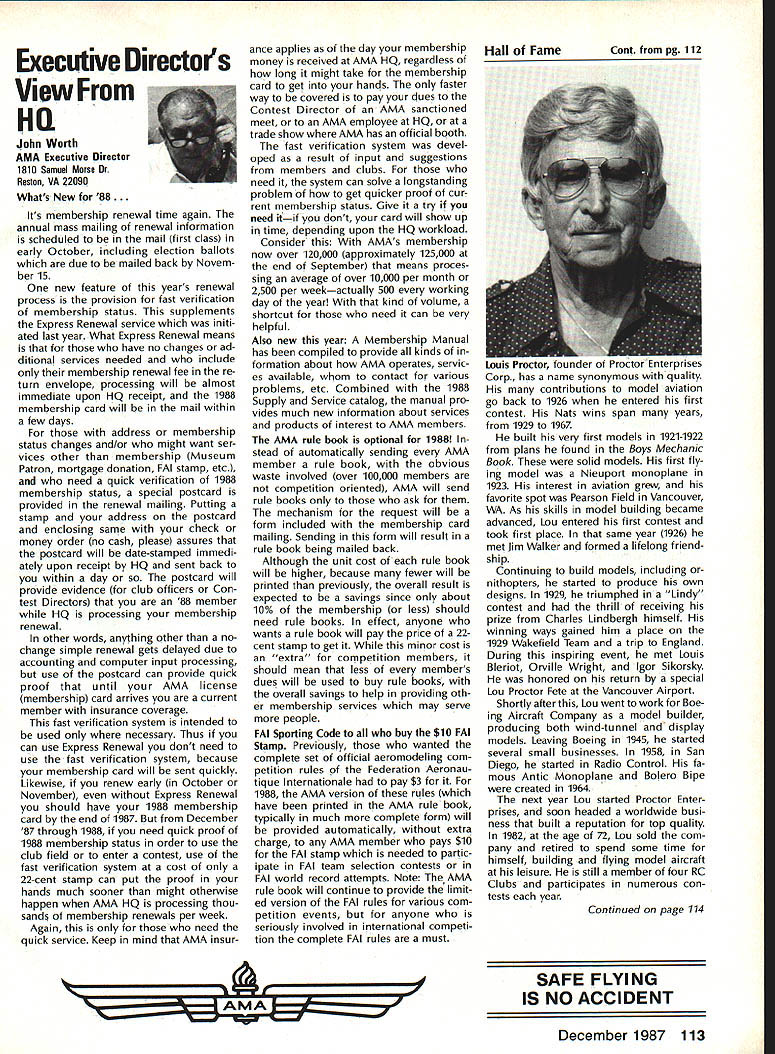
Executive Director's View From H.Q.
John Worth AMA Executive Director 1810 Samuel Morse Dr., Reston, VA 22090
What's New for '88
Membership renewal
- Annual renewal mailings (including election ballots) will go out first class in early October. Ballots are due back by November 15.
- Express Renewal: for members with no changes who enclose only the renewal fee, processing is nearly immediate and the 1988 membership card will be mailed within days.
- Fast verification postcard: for members with address or status changes or requesting additional services, a stamped postcard included in the renewal mailing can be enclosed with the payment. The postcard will be date‑stamped on receipt and returned within a day or so as proof of 1988 membership (useful for club officers or contest directors). This service is intended only for those who need quick proof; otherwise Express Renewal or early renewal should suffice.
Insurance coverage applies as of the day HQ receives membership payment. The fast verification system was developed from member input; use it when quick proof is required.
Other changes
- Membership Manual: new manual compiled covering how AMA operates, services available, and contact information. Combined with the 1988 Supply and Service catalog, this provides more member information.
- Rule book optional: Instead of sending every member a rule book, AMA will mail rule books only to those who request them via a form included with the membership card mailing. This reduces waste and overall printing costs.
- FAI Sporting Code: members who buy the $10 FAI stamp will receive a more complete version of the Fédération Aéronautique Internationale rules (useful for international competition). The rule book will continue to include a limited version.
Westover Air Force Base
- After the 1985 Nats the Air Force indicated base operations and construction might restrict modeler use. A meeting with the Base Commander on August 28, 1987, indicated Westover may be available to modelers on a limited basis in 1988–1989, depending on construction. Clubs will be contacted by letter when details are finalized. Modelers must remember they are guests and must conduct themselves accordingly.
AMA Computer Network
- Electronic mail: CompuServe address 762703,3041; The Source ST6232. Call Doug Pratt at HQ (703) 435‑0750 for information.
Events and thanks
- Reports on contests, including Firebird Classic '87 (Pattern contest at Marcy, NY) and other regional contests. Thanks to clubs, contest directors, manufacturers, distributors, dealers, and donors who provide merchandise and awards.
- Club volunteers: many contests and club activities rely on a small number of hardworking volunteers — your efforts are appreciated.
- In memoriam: recent passing of Leon Auger and Jerry Gisond; they will be missed.
---
1986 Hall of Fame
Ten distinguished model aviation personalities were elected to the Academy Hall of Fame for 1986. Nominations are made by AMA members; selection is the responsibility of the AMA Council and Past Presidents. Any AMA member may submit nominations (forms available from Joyce Hager, AMA Headquarters). Nominations should include supporting data and arrive at AMA HQ before March 31.
Hall of Famer highlight:
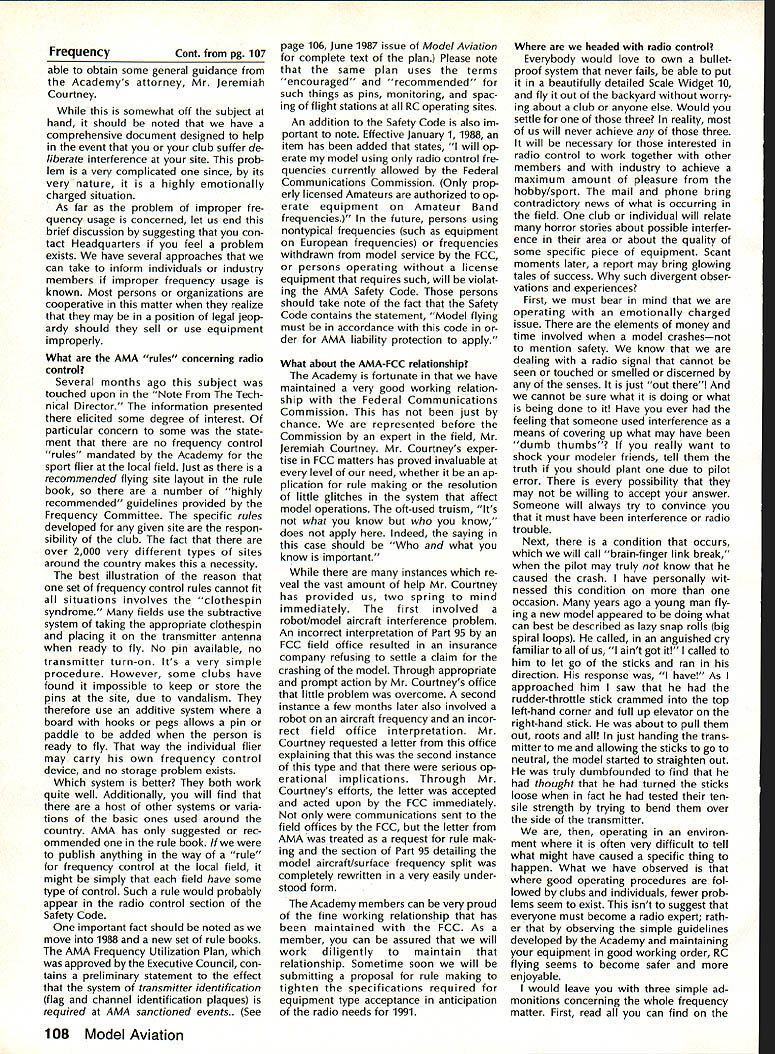
- Frank L. Cummings, Jr. — involved in model aviation for over fifty years; won contests at local, regional, and national levels; member of the USA Indoor Team (1964, 1966); National Champion 1947 and Grand Champion 1948 Plymouth International Contest. Frank always assisted others, especially beginners. Between 1931 and 1937 he worked on Los Angeles Times Playground Aircraft.
---
Safety for sale? No way!
Reader reaction to an earlier piece about revenue‑seeking flying‑site field marshals was overwhelmingly negative. Many wrote to praise unpaid volunteers who contribute to clubs and aeromodelling without thought of reward.
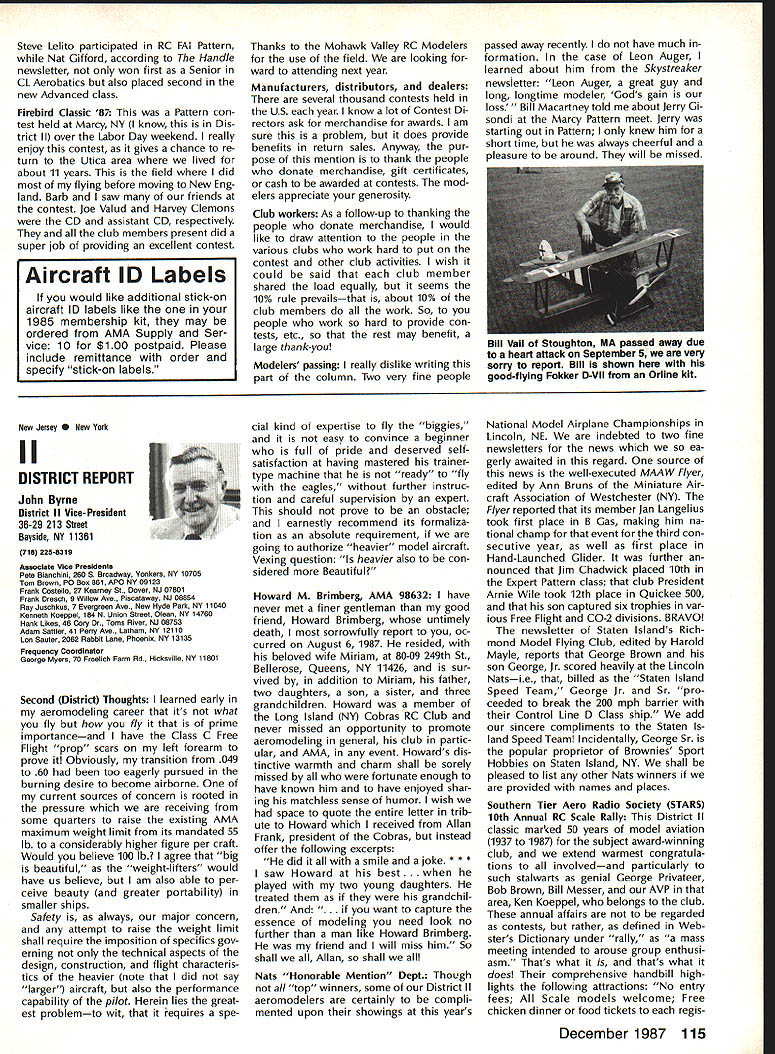
One such letter came from James F. Reilly (editor of Bipes and Barnstormers, Mohawk Valley Radio Control Modelers, Firebirds, Utica, NY) praising Bill Palmer, the club’s field marshal. Bill volunteers, pays his club dues like any member, and makes Firebird Field one of the finest flying sites in central New York. His compensation is a patch from AMA and the appreciation of his peers. Jim concluded: “This is a professional field marshal.” We thank Jim and Bill for their service.
---
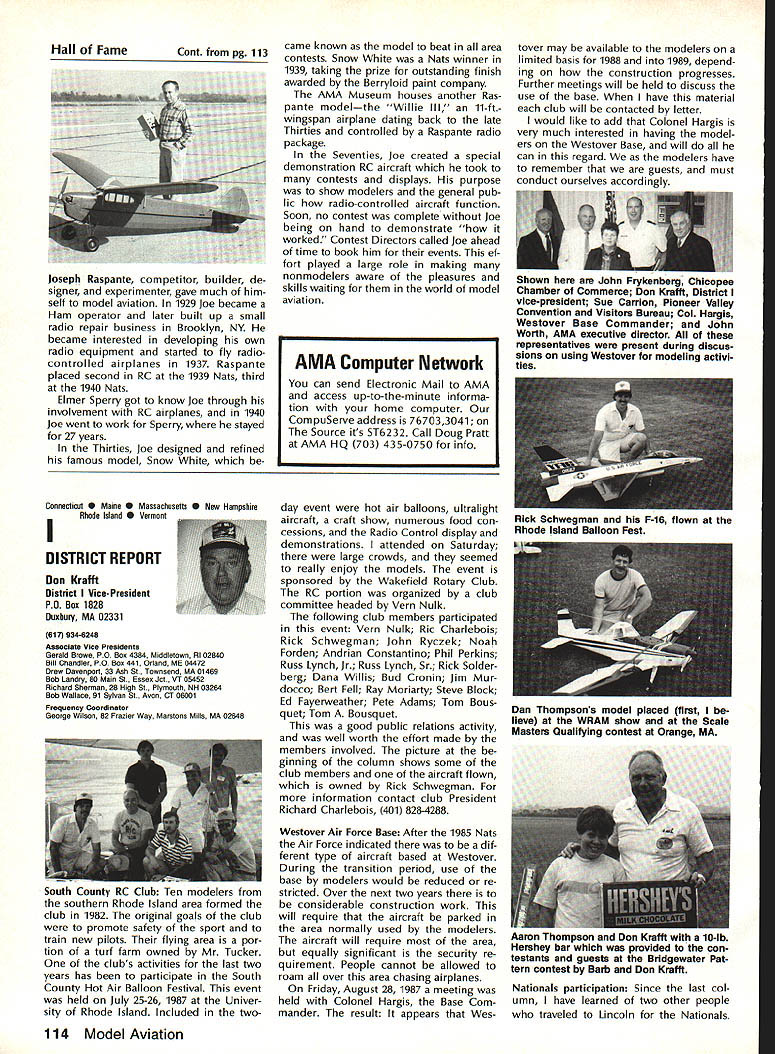
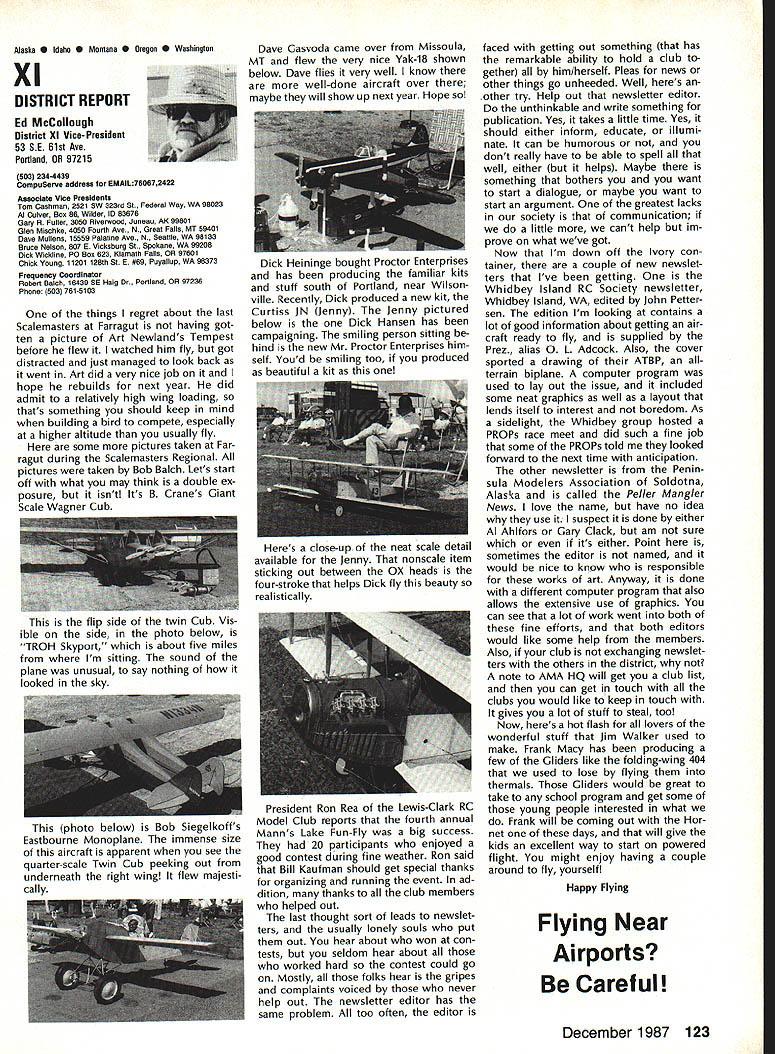
XI DISTRICT REPORT
Ed McCullough District XI Vice‑President 53 S.E. 61st Ave., Portland, OR 97215 (503) 234‑4439 CompuServe E‑Mail: 76067,2422
Associate Vice Presidents
- Tom Cashman, 2522 SW 33rd, Federal Way, WA 98023
- Al Culver, Box 46, Wilder, ID 83676
- Gary R. Fuller, 3508 Blackberry Ln., Juneau, AK 99801
- Glen McGhee, 4600 Fourth Ave., N., Great Falls, MT 59401
- Dave Mullens, 15529 Palatine Ave., N., Seattle, WA 98133
- Bruce Nelson, 807 E. Vicksburg St., Spokane, WA 99208
- Dick Wardle, PO Box 6223, Klamath Falls, OR 97601
- Chick Young, 11201 128th St. E., #69, Puyallup, WA 98373
- Beverly Coordinator, ??? (phone) 503/761‑5103
Scalemasters and contests
- At the Scalemasters at Farragut I missed photographing Art Newland’s Tempest before it crashed; he did a fine job and may rebuild it next year. Consider wing loading for high‑altitude competition.
- Photos from Farragut (by Bob Balch) included B. Crane’s Giant Scale Wagner Cub and Dave Gasvoda’s Yak‑18 from Missoula, MT.
- Dick Heininge purchased Proctor Enterprises and continues to produce classic kits; Dick Hansen has been campaigning a Curtiss JN (Jenny) kit with excellent detail and a four‑stroke engine that adds realism.
Club reports and newsletters
- Mann’s Lake Fun‑Fly (Lewis‑Clark RC Model Club) had 20 participants; thanks to Bill Kaufman and club volunteers.
- Newsletter editors often work alone; please help by contributing articles or contest reports. Exchanging newsletters with other clubs is a great way to share information — AMA HQ can provide club lists.
- Notable newsletters: Whidbey Island RC Society (editor John Petersen) and Peller Mangler News (Peninsula Modelers Association, Soldotna, AK) — both use computer layout and graphics and show strong editorial effort.
Hobby products
- Frank Macy is producing limited runs of classic gliders, such as the folding‑wing 404, useful for school programs and introducing kids to flying.
Happy flying!
---
JUNIOR FLIGHT!
Ed Whitten Box 176, Wall St. Sta., New York, NY 10005
Bostonian Proposed As an Official AMA Event
Unofficial popular events often become official AMA events; the Bostonian (also known in proposals as the "Boston Cabin") is under formal proposal by Don Lindley. Key points in Don’s proposal and discussion:
- Name: Keep "Bostonian" to avoid confusion with other events (e.g., Manhattan Cabin).
- Charisma percentage: Don proposed 20%, but New York experience suggests 30% is better to encourage scale appearance.
- Stabilizer limit: stabilizer area limited to 50% of wing area (acceptable).
- Minimum weight: 7 grams (10 grams for biplanes).
- Open cockpits allowed; all flying surfaces must be double covered.
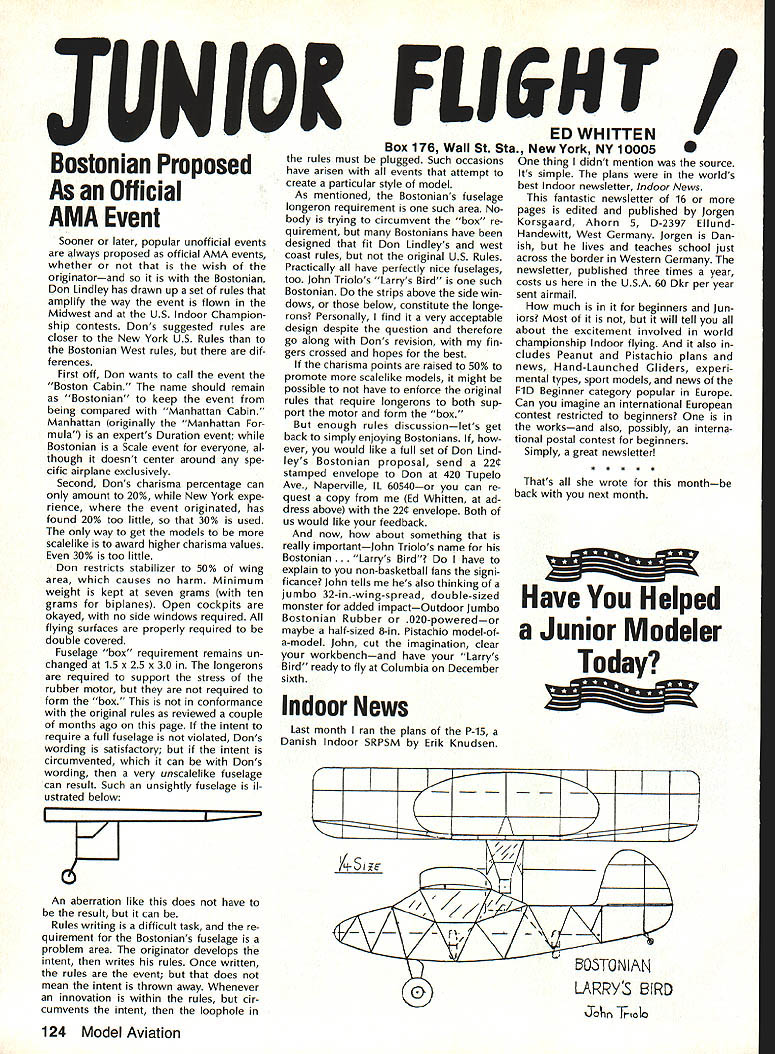
- Fuselage "box" requirement: original rules required longerons to both support the motor and form the box; Don’s wording allows some variation and may unintentionally permit less scale fuselages. Rule wording must preserve the event’s intent; loopholes should be closed if they circumvent the desired scale appearance.
If you want a copy of Don Lindley’s Bostonian proposal, send a 22¢ stamped, self‑addressed envelope to Don at 420 Tupelo Ave., Naperville, IL 60540, or request a copy from Ed Whitten (address above) and he will forward it.
John Triolo’s "Larry’s Bird" (a Bostonian design) is an example of creative entries; he is also considering a jumbo 32‑in. wingspan version.
Have you helped a junior modeler today?
Indoor News
- Last month’s plans of the P‑15 (a Danish Indoor SRPSM by Erik Knudsen) were sourced from Indoor News, a comprehensive indoor newsletter edited and published by Jørgen Korsgaard, Ahorner 5, D‑2397 Ellund‑Handewitt, West Germany. The newsletter (three issues per year) costs 60 Dkr/year (airmail) to the U.S.
- Indoor News covers world championship indoor flying and includes Peanut and Pistachio plans, hand‑launched gliders, experimental types, and F1D beginner category news. It’s a valuable resource for serious indoor enthusiasts and juniors.
That's all for this month — see you next month.
Transcribed from original scans by AI. Minor OCR errors may remain.

