
AMA NEWS
1988 Nominating Procedure
The AMA Bylaws include standing rules that supplement the Bylaws with details of organization and operation. Among those standing rules are the procedures for the AMA Nominations Committee and for making nominations for AMA officers. In 1988 the Vice Presidents for Districts 2, 4, 6, 8 and 10 will be elected to serve three-year terms beginning in 1989. The nomination procedures are as follows:
Nominating Committee
- Composition
a. All 11 Vice Presidents and the Executive Vice‑President shall sit on the Nominating Committee; together they constitute the Committee. b. Members of the Nominating Committee shall not be barred from becoming nominees for office themselves. c. Voting proxies are permitted only if the proxy is from the same district as the absent Vice President and the absentee has given written permission to vote. A telegram from the absentee is sufficient as written permission. An associate designated by an absent Executive Vice‑President (EVP) may act as that EVP’s proxy. d. The President may not appoint any member of this Committee nor be an ex‑officio member of it; the Executive Director may not be a member.
- Chairman
a. The chairman of the Nominating Committee shall be elected from among the committee members by majority vote. b. The current AMA President, or in his absence the Executive Director, will call the meeting to order. Once the chairman is elected, the President (or Executive Director) will relinquish the chair and leave the meeting.
- Recording Secretary
The Recording Secretary shall: a. keep full, accurate, detailed written minutes of the proceedings; b. assist the Teller in the distribution, collection, and tabulation of ballots; c. submit to the President, Executive Vice President, meeting chairman and Executive Director a full written report of the meeting and the results of all voting procedures within 48 hours after adjournment.
- Meeting Conduct
a. The President (or Executive Director) shall open the meeting and preside while the committee members elect a chairman. b. The newly elected chairman shall dismiss the President (or Executive Director) and appoint a Recording Secretary and Teller. The Teller shall not be a candidate for office and shall not participate as a teller for any office for which he or she is a candidate.
- Candidate Nominations
- All nomination letters must be received at AMA Headquarters at least fifteen (15) days prior to the convening of the Nominating Committee annual meeting.
- A letter of acceptance by each candidate must be on file at AMA Headquarters prior to the meeting.
- Because the Nominating Committee is scheduled to meet July 22, the deadline for receipt of nominations at AMA HQ is close of business Thursday, July 7.
- Selection of Nominees
a. Each elective office shall have no more than three (3) names placed on the ballot. b. The assembly shall examine, evaluate and discuss all written proposals for candidacy. Nomination letters shall be read aloud by the Recording Secretary. c. The discussion period shall be limited to ten (10) minutes per candidate. d. An incumbent is automatically placed on the ballot, except that a vote by three‑quarters (3/4) of the committee against including the incumbent’s name may withhold the incumbent from the ballot (see Bylaws, Article IX, Section 2).
- Voting
a. One vote per person per ballot. b. Oral voting shall be by district, starting with District I and progressing numerically through District XI and then the EVP. If a secret ballot is desired, ballots shall be written. c. If the question of placing an incumbent on the ballot arises, voting on that issue shall precede voting for other nominees and shall follow the sequence of President, Executive Vice President, Vice Presidents. d. When more than three names are nominated, elimination will be by the least number of votes. e. A simple majority prevails except where the 3/4 rule (see 6d) applies.
- Finalization of Proceedings
- The Recording Secretary shall submit the meeting report to all Vice Presidents and the EVP within 15 days for corrections and approval.
- The report must be approved by three‑quarters (3/4) of all attendees at the meeting (Vice Presidents and the EVP or their proxies).
- Adjournment
- An affirmative vote of an adjournment motion duly made and seconded will adjourn the meeting.
---
Executive VP's Report
Dave Brown AMA Executive VP 4560 Layhigh Rd. Hamilton, OH 45013
The mail bag has been full this month; unfortunately most of the mail has been complaints about the time it takes to get (or renew) an AMA license. Don Lowe and I plan to spend a few days at AMA HQ trying to get a better handle on the problem and to prevent reoccurrences. Last year the problem centered on the club renewal process, and that hasn't even started yet this year. If we can't process a simple membership application in a timely fashion, we're in deep trouble. I am a bit exasperated and hope we can straighten this out soon.
The reaction to the possibility of reducing our insurance coverage has both surprised and encouraged me. The vast majority of people I have talked with are willing to accept reduction as a necessity of survival. We still have a few months to consider our options; next year is the earliest we could implement drastic changes. Among the tough questions is what effect a reduction will have on our flying site owners. The first reaction is to leave their coverage at the $1,000,000 limit, but that could make them a more attractive target for lawsuits. If I were a lawyer looking for a big payoff, I'd concentrate on the entity with the deepest pockets, and putting site owners in that position may be counterproductive. Drop your VP a note with your ideas on this important item. In the meantime, it's very important that we all make an extra effort to avoid accidents by flying safely.
In last month's synopsis of the Executive Council meeting I reported that we were technically "in the red" on this year's budget. This isn't a crisis—our reserves can cover it, and the red ink is not likely to actually hit the paper. The situation is that original budgeted expenses plus recently added expenses exceed projected income in the original budget. However, due to a greater than estimated increase in membership, our income should be higher than originally estimated, so we should be in good shape.
One hidden milestone accomplished last month: Gen. Cliff Von Kann, President of the NAA, arranged to have the new FAA Administrator, T. Allan McArtor, send a letter to FAA Regional and Center Directors encouraging support for model aviation and our requests for flying sites. It's a powerful endorsement that could have a big, positive effect on our sport. Thanks to Gen. Von Kann and Mr. McArtor. Below is Mr. McArtor's letter to Gen. Von Kann:
"Dear Cliff:
Thank you for your letter and your commitment to aviation education. I particularly want to thank you for the many educational efforts and accomplishments of the National Aeronautics Association and the Academy of Model Aeronautics.
I, too, developed a love for flying through aircraft modeling, and I hope to encourage our nation's schools and youth group leaders to take advantage of the opportunities to enrich their lessons and increase the academic achievement of their students through aviation education programs and activities.
As you suggested, I am advising each of the FAA Regional and Center directors of your desire for support and cooperation in making model airplane flying sites available.
I look forward to a great year for aviation education in 1988. I understand that we will continue to be partners in many educational initiatives. That's the way it should be.
Thank you for your interest and support.
Sincerely,
T. Allan McArtor Administrator"
Till next month, keep 'em flying.
---
Not Getting AMA Mail?
During January 1988, close to eighty thousand (80,000) AMA membership manuals were mailed. As of mid‑February over five hundred (500+) were returned by the Post Office with address changes. Although AMA HQ was not notified of the address changes by the members involved, HQ made the corrections and remailed the manuals—an expensive and time‑consuming process done in the name of service.
Key points and guidance:
- Each year over one thousand (1,000) members move without notifying Headquarters. As a result, AMA mail continues to be sent to the wrong address until the Post Office advises of nondelivery and/or address changes. This wastes magazines because we typically get back only the cover; re‑mailing entire magazines is prohibitively expensive.
- AMA personnel process over twenty‑five thousand (25,000) address changes each year—an average of over 2,000 per month. It takes one full‑time person plus occasional help, and the direct cost is well over $25,000 per year (about $1 per change). The biggest problem is the temporary loss of service to the member.
- To avoid delays and missing magazines or other items, advise HQ of any address change as soon as possible—preferably prior to the move and with an effective date. You will get better service, help hold down costs, and possibly help avoid a dues increase.
- If you haven't received something you expect, report the delivery problem within about 30 days. Anything longer compounds the problem and often makes back issues unavailable—publishers are not set up to provide large numbers of back issues after initial distribution.
- When you send money, be specific in your correspondence: give dates, amounts, and what the payment was for. The top HQ priority upon receipt of money is to get it deposited in the bank—normally within three days. If your bank statement does not show a check to AMA a month or more after you mailed it, chances are AMA did not receive it. Notify HQ promptly if you do not receive what you paid for after your check has cleared.
Please believe that the HQ staff is dedicated to giving service and they can best help if you provide timely and specific information. As of mid‑February, HQ had processed over 90,000 memberships—more than was done in the entire year of 1983.
---
Insurance
A lot has been learned about the insurance business since AMA became self‑funded in 1987. Some important observations and actions:
- Offering insurance coverage can attract litigation toward the maximum available limits. Claimants and their lawyers often seek the largest amount available, whether or not it relates to the severity of the injury. In many instances claimants view the money as coming from "the insurance company" rather than from the organization providing the self‑funded coverage. For a self‑funded program like AMA’s, that perception can be disastrous because claim payments ultimately come from the organization’s funds.
- To reduce exposure and the size of the “carrot” on which claimants focus, the AMA Executive Council early in 1988 revised certain aspects of the insurance program. Because up to $1,000,000 per accident had been advertised for 1988 model‑flying members, the Council left that total‑per‑accident limit intact for site owners, but as of March 31, 1988, coverage for individual AMA members was defined as up to $500,000 for bodily injury and up to $500,000 for property damage.
- The Council and AMA’s Insurance Committee are exploring further revisions for 1989 to reduce the amount available per accident to better align coverage with realistic exposure. However, for practical purposes the coverage should remain effective in providing the amounts typically needed to settle claims; the major change is intended to reduce the incentive for high‑value claims.
- The million‑dollar limit per accident still applies to flying site owners; that amount is considered vital to retaining flying sites, since most property owners feel the need for higher coverage. Without their agreement to accept AMA coverage, the flying site program would be jeopardized.
- A prior change effective at the start of 1988 reduced coverage for members operating model cars and boats to a $100,000 limit, reflecting the generally lower risk in those activities.
- The Council has also taken steps to increase aggregate protection (an administrative action to help site retention), including increasing aggregate limits to provide better overall program stability.
The goal is to reduce AMA’s risk so the insurance program remains a viable membership benefit. Expect additional communications as the Insurance Committee completes its review.
---
Safety, Noise and Contest Conduct
Safety and noise control remain high‑priority items for AMA. The Safety Code is a document that can become a legal reference in the event of a liability suit, and it is being reviewed and revised from an insurance viewpoint. The Safety Committee Chairman asks for membership input: what are your pet safety issues? This is an opportunity to be heard and get something done.
Propeller safety
- Propeller incidents cause many modeler injuries. An example from the Jasper Club (Jasper, Alabama) described a wooden propeller exploding while two members were nearby; fortunately they were not in the prop arc and escaped injury. The incident underscores the importance of staying clear of the prop arc and following good procedure when adjusting engines.
- Before the flying season, check and recheck all gear: tighten screws and nuts, check hinge lines, inspect for looseness or damage. Find problems on the ground — not on the first flight after a long layoff.
Noise control
- Effective mufflers will produce more back pressure and can reduce maximum power output. Most sport models are overpowered and will still perform adequately with reduced power. Keep working on noise solutions; we'll master it in time.
Contest directing and behavior
- CDing (Contest Directing) can require difficult decisions and strong people skills. Rules sometimes need modification to fit field limitations, weather, safety, or other circumstances. When changes are necessary, inform contestants in advance, but the CD has the final say on how a contest is conducted.
- A report from Rod Gier (Helicopter CD at the Tangerine Internationals) described a disruptive contestant who delayed event start times and repeatedly harassed others. If true, the contestant’s behavior was unfortunate and deprived others of flight time. Most of us build and fly for fun — sportsmanship matters.
---
Club News, Newsletters and District Notes
- District 8 editorial notes: In selecting a District 8 vice‑president, communication ability is vital—95% of the job is communication. Associate vice‑presidents Mike Harrison (Hot Springs, AR) and Danny Ball have been commended for their communication and club outreach.
- Club newsletters of note:
- Glenn Gresens (Baton Rouge): BRRC Flypaper includes a .049 duration RC flying machine plan called the Express II; write to Glenn Gresens, 10224 Kenlee Dr., Baton Rouge, LA 70815.
- Dave Thomas (Texas Wings Club, Hurst, TX): Flight Lines included six pages of full‑size drawings for a simple fun‑fly airplane (.60 engine). Contact Dave Thomas, 1436 Simpson Dr., Hurst, TX 76053.
- Bill Gallagher (Dallas Radio Control Club): Newsletter is bright and well produced; contact Bill Gallagher, 6805 Harvest Hill, Rowlett, TX 75088.
- Oklahoma Radio Kontrol Society (TORKS TALK): bright blue cover for Swap Shop edition; contact Joe Wilson, 12401 Arrowhead Terrace, Oklahoma City, OK 73120.
- Don Collins (Westside RC Fliers, Oklahoma City): informative newsletter; contact Don Collins, 4433 N.W. 20th, Oklahoma City, OK 73107.
- South Plains Line & Transmitters Club (Plainview, TX): Jim Beyleu recently took over editing; contact Jim Beyleu, 1412 Itasca Rd., Plainview, TX 79072.
- AMA table display: The AMA table display is available for club use and has been in high demand. Phone during business hours Monday–Saturday at (214) 823‑0208 to reserve.
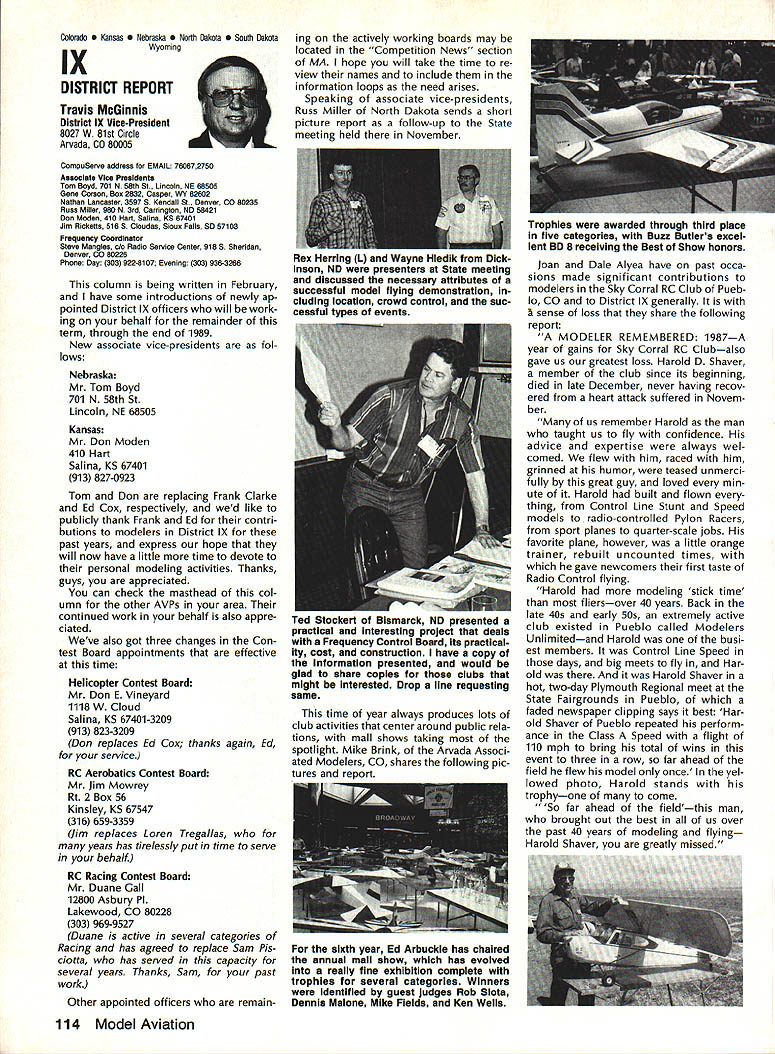
- Modeler remembered: Harold D. Shaver (Sky Corral RC Club, Pueblo, CO) passed away in late December. Harold was a long‑time modeler and mentor whose contributions and spirit are greatly missed.
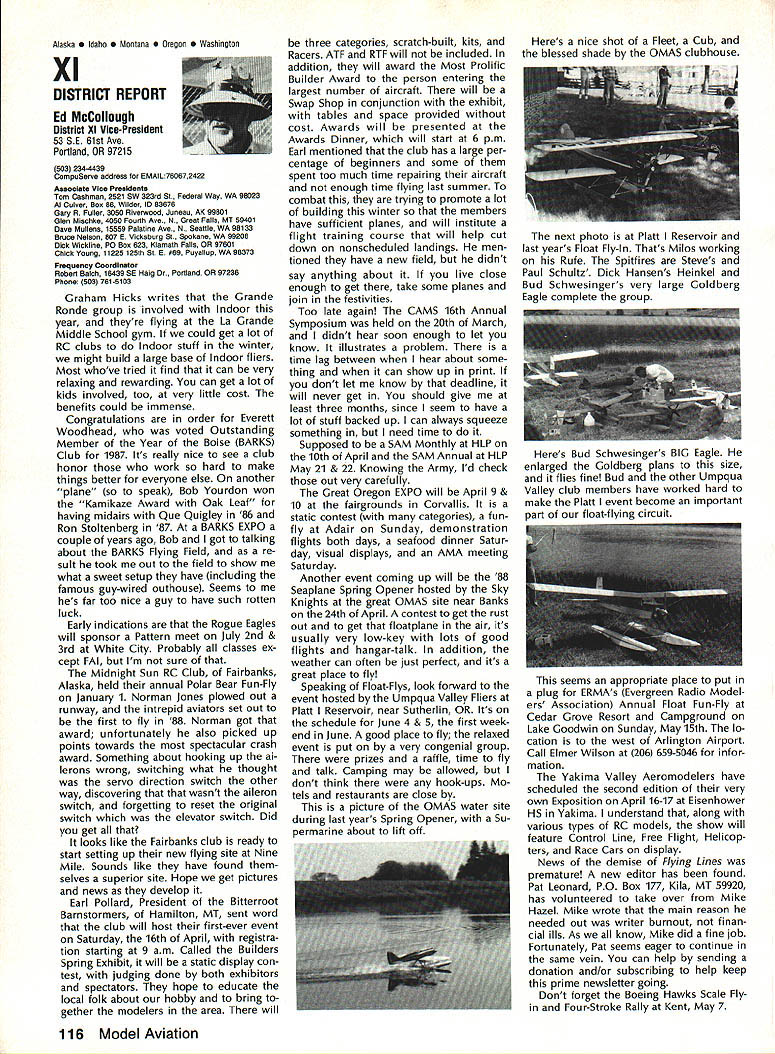
- Building categories and swap shop (club exhibits): Some events will use categories such as scratch‑built, kits, and racers (ARF and RTF generally not included). Swap shops with free table space may be provided; awards often presented at an awards dinner.
---
Events and Upcoming
- CAMS 16th Annual Symposium — held March 20 (note lead times: send info at least three months in advance for print inclusion).
- Great Oregon EXPO — April 9–10, Corvallis fairgrounds (static contest with many categories, fun‑fly at Adair on Sunday, demonstrations, swap meet, awards dinner, visual displays, AMA meeting Saturday).
- SAM Monthly — scheduled at HLP on April 10 (verify). SAM Annual at HLP May 21–22 (verify with organizers).
- Seaplane Spring Opener (Sky Knights) — April 24, OMAS site near Banks, OR.
- Boeing Hawks Scale Fly‑In and Four‑Stroke Rally — Kent, May 7.
- ERMA (Evergreen Radio Modelers Association) Annual Float Fly — Sunday, May 15, Lake Goodwin (call Elmer Wilson at (206) 659‑5046).
- Yakima Valley Aeromodellers Seaplane Fly‑In — May 21 at Highlander Pond.
- Umpqua Valley Fliers Float‑Fly — June 4–5, Platt Reservoir near Sutherlin, OR.
- Many other local club activities, mall shows and public relations events occur this time of year—check Competition News and club listings for details.
---
Your AMA Officers Are Waiting To Hear From You!
Effective communication is a two‑way street. AMA’s volunteer officers work hard to make AMA the organization members want. Their views appear in these pages each month, but we won’t know your views unless you write—to your AMA Vice‑President or to the Associate Vice‑President in your area. Complete the communications link—write!
*** Outta fuel! Gotta land! ***
Transcribed from original scans by AI. Minor OCR errors may remain.

