
AMA News
Synopsis — AMA Frequency Committee Meeting, March 12, 1988
Attendance
- Fred Marks, Chairman
- Committee members: Jack Albrecht, Steve Helms, Bill Hershberger, Dave Hilsenhoff, George Myers, Bob Novak, James Oddino, Warren Plohr, George Steiner, Pete Waters
- AMA President: Don Lowe
- AMA Executive Director: John Worth
- AMA Technical Director: Bob Underwood
- Bob Jackson, AMA Legal Counsel
- Representing the Radio Control Manufacturers Association (RCMA): Tom Runge (President), Barbara Renaud (Treasurer)
- Guests: Brad Booth, Frank Schwartz, Charles Hampton, Gil Rose
Minutes of the previous meeting (March 21, 1987) were reviewed and the published agenda for this meeting was examined; several items were added.
- Status / FCC petition
- Marks indicated the petition was ready and would be presented to the FCC shortly. A letter from RCMA showing manufacturers' support was received and the material has been reviewed by AMA legal counsel.
- The FCC presentation material was reviewed. Technical and legal points were discussed and some suggested changes were incorporated, including emphasis on safety.
- Marks summarized the petition request: that the FCC require all RC transmitters in the field as of January 1, 1991 to exhibit sidebands 55 dB down, plus or minus 20 kHz from the RC channel center frequency.
- The impact on continued use of older wideband transmitters was discussed. It was noted that the requirement would make all RC transmitters narrow-band.
- Several motions were considered:
- A motion to request that existing transmitters in the field be permitted for indefinite use — failed.
- A motion to amend the petition to permit existing transmitters to continue use on even-numbered channels 38–56 until 1995 — failed.
- A motion that transmitters in the 72–75 MHz band sold prior to the effective date of the proposed regulation be permitted for use until January 1, 1991 — approved unanimously.
- Transmitter Checking Program
- Marks presented an overview of the voluntary transmitter check program and thanked the many Frequency Committee members and others who donated their services.
- A motion that the AMA continue the voluntary transmitter check program throughout the year at trade shows and other events, when proper personnel are available, passed unanimously.
- The issue of authorizing service stations and others to apply RCMA/AMA stickers during a transmitter check was discussed. Guests Brad Booth and Frank Schwartz addressed the Committee.
- A motion to approach the RCMA to enlarge the transmitter check program through authorized service centers and other organizations was withdrawn after discussion revealed practical difficulties in enlarging the effort.
- A motion that the Frequency Committee develop a method authorizing additional testing stations passed. A subcommittee of Hershberger, Waters, Steiner, and Albrecht was appointed to finalize details before April 8.
- It was agreed that stations currently issuing stickers should apply for the new authorization and that the same RCMA/AMA stickers will continue to be used.
- Concern was expressed about possible physical damage to the AMA spectrum analyzer when loaned for use away from headquarters. By consensus, it was later resolved that the analyzer be hand-carried to events and operated only by members of the Frequency Committee; expense reimbursement may be requested from the benefiting organization.
- Waters demonstrated a computer control for a spectrum analyzer that speeds up transmitter checking. A motion to purchase the necessary hardware and software to similarly equip the AMA spectrum analyzer was approved unanimously.
- Testing and reporting of guideline RC equipment
- Independent testing of RC equipment to the AMA Guidelines and reporting of test results to AMA members were discussed.
- It was agreed that AMA should publish a list of transmitters and receivers known to meet the AMA Guidelines. Guidance for test data provided by manufacturers and reviewed by the Frequency Committee will form the basis for inclusion on the published list.
- A motion to modify the current AMA Frequency Use Plan to include channels 58 and 60 failed.
- Legal assessment of conflict of interest
- By consensus, Committee members directly involved with the RC industry agreed they would not vote on issues sensitive to possible conflict of interest.
- Policy concerning transmitter stickers
- Transmitters that pass the AMA/RCMA transmitter check are issued a Gold or Silver sticker. The AMA currently recommends, but does not mandate, the use of such stickered transmitters.
- The Committee agreed to recommend to the AMA Executive Council that transmitter stickers be required for sanctioned competition, effective January 1, 1989.
- Interim recognition for lower-band narrow-band transmitters
- A motion passed to provide an interim means for recognizing narrow-band transmitters used on the lower band without stickers:
- Contest Directors may accept a signed declaration from participants stating their lower-band transmitters are narrow-band.
- A published list of transmitters known to be narrow-band (based on current testing) will be developed.
- Thus, a Contest Director can accept any one of three criteria for lower-band use: the transmitter is on the published list; it has a Gold sticker; or the contestant signs the narrow-band declaration.
- Committee membership
- Three names were submitted for consideration as Frequency Committee members: Charles Perone (recommended by Dave Hilsenhoff), Larry Dungan (recommended by Don Lowe), and Lance Hally (recommended by George Steiner). Action will follow at a later date.
- Narrow-band receivers
- Information was presented indicating several narrow-band receivers have been developed that meet the AMA Radio Guidelines.
- Publishing of information
- It was proposed and accepted that a subcommittee produce one-page documents for quarterly publication in Model Aviation to give recommended ways to use RC channels. A subcommittee of Hilsenhoff, Oddino, and Plohr was formed to write these documents.
Items added to the agenda
- 27 and 53 MHz: It was agreed that transmitters operating on 27 and 53 MHz need not be required to be narrow-band or stickered due to wide spacing of channels.
- 50 MHz (channels 00–09): Narrow-band equipment will be required on 50 MHz channels 00–09 effective January 1, 1991. The AMA Frequency Use Plan will be revised to reflect this.
- Amendment to AMA Radio Guidelines (paragraph 4.3): Based on recent technical analysis and manufacturer acceptance, paragraph 4.3 was changed to read:
"Image Rejection: Receivers having an image response within their operating band (i.e., within the 72 or 75 MHz RC band), or any other AMA recommended band for RC model operation (see ref. 2 part 3), must be shown by laboratory test to have image signal rejection greater than 60 dB." This change enables single-conversion RC receivers using a 455 kHz intermediate frequency to meet the Guidelines.
- Discrepancy correction: A typo was noted in the earlier version of the Radio Guidelines where paragraph 4.2 specified ±8½ kHz instead of the correct ±7 kHz; the later specification is correct.
- Letters from members requesting consideration of a frequency assignment plan for competition and sport flying were received; the Committee will review and comment by mail.
The meeting was adjourned at 6:24 p.m.
---
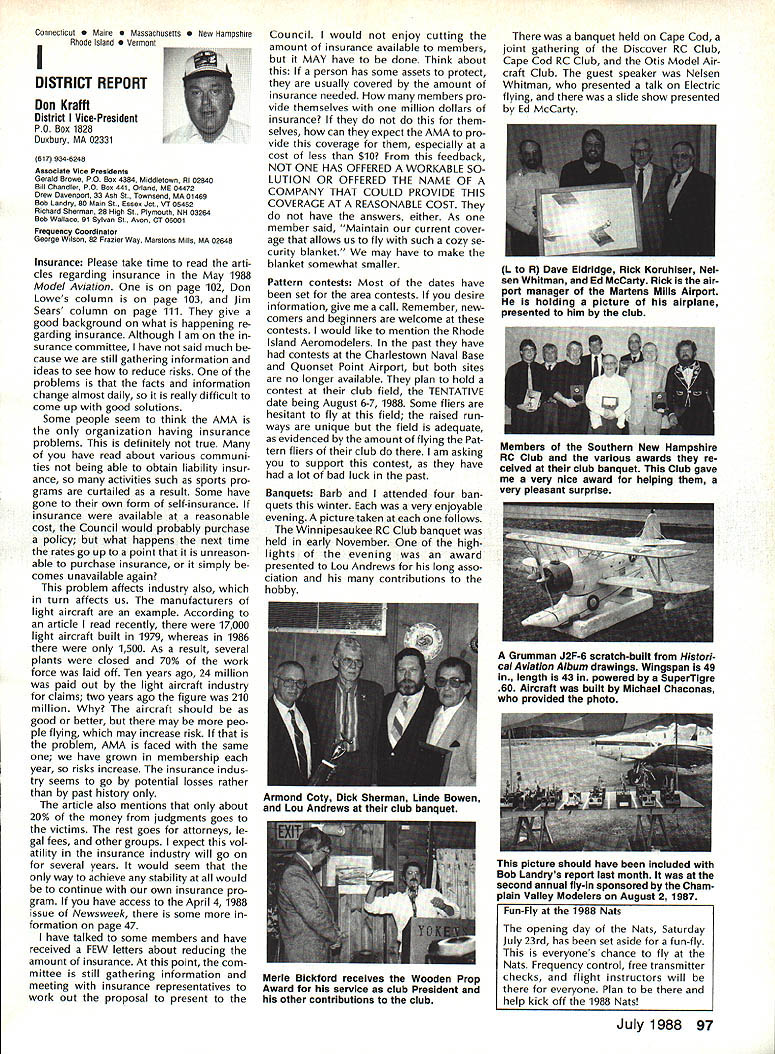
Fun-Fly at the 1988 Nats
- The opening day of the Nats, Saturday, July 23, has been set aside for a fun-fly.
- Frequency control, free transmitter checks, and flight instructors will be available for everyone.
- All members are encouraged to attend and help kick off the 1988 Nats.
---
District 2 Notes
Eastern States RC Championships
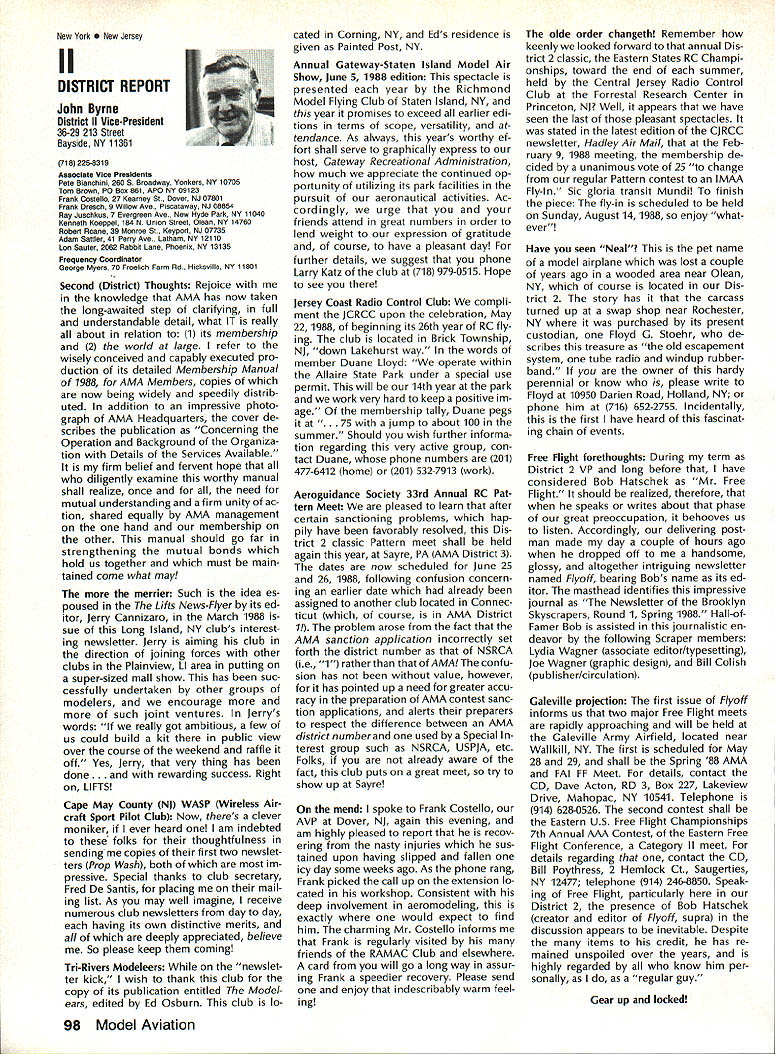
- The Central Jersey Radio Control Club has converted its regular Pattern contest to an IMAC fly-in. The fly-in is scheduled for Sunday, August 14, 1988.
"Neal" — lost-and-found model
- A model nicknamed "Neal" was lost several years ago near Olean, NY. It later turned up at a swap meet near Rochester, NY and was purchased by Floyd G. Stoer.
- If you are the owner or know who is the owner, please contact Floyd G. Stoer, 10950 Darien Road, Holland, NY or phone (716) 652-2755.
Free Flight / Flyoff newsletter
- Bob Hatschek (editor) has produced Flyoff, the newsletter of the Brooklyn Skyscrapers (Round 1, Spring 1988). Staff includes Lydia Wagner (associate editor/typesetting), Joe Wagner (graphic design), and Bill Cosh (publisher/circulation).
- Two major Free Flight meets at Galeville Army Airfield near Wallkill, NY:
- Spring '88 AMAC and FAI Free Flight Meet — May 28–29. Contact CD Dave Acton, RD 3, Box 227, Lakeview Drive, Mahopac, NY 10541. Phone (914) 628-0526.
- Eastern U.S. Free Flight Championships (7th Annual Nats Contest, Eastern Free Flight Conference, Category II) — contact CD Bill Porretta, 2 Hemlock Ct., Saugerties, NY 12477. Phone (914) 246-8580.
---
Flying Sites
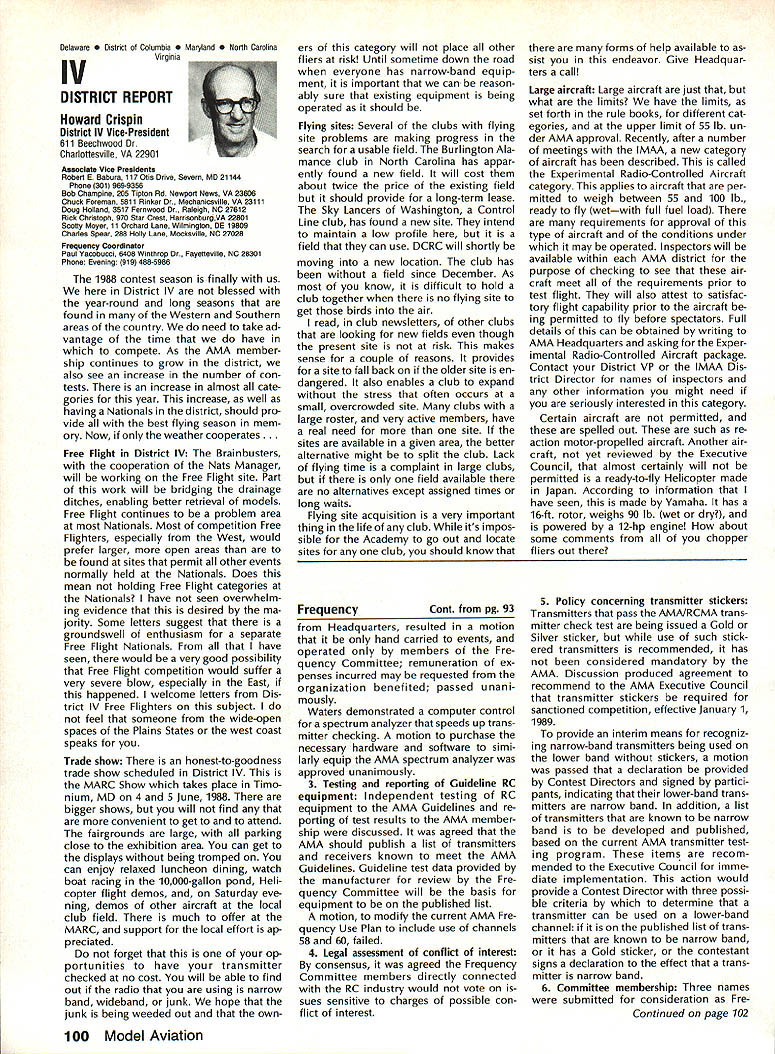
- Several clubs with flying site problems are making progress toward finding usable fields.
- The Burlington Airmodelers (NC) reportedly found a new field, though it will cost about twice the price of the existing field but should provide a long-term lease.
- The Sky Lancers of Washington (a control-line club) has found a new site and intends to maintain a low profile there.
- DCRC will be moving into a new location after being without a field since December.
- Many clubs are scouting additional fields even when the current site is secure — this provides backup and allows expansion when a roster grows. AMA Headquarters can provide assistance and advice; clubs are encouraged to call.
---
Large Aircraft (IMAA / Experimental category)
- The IMAA has described a new Experimental Radio-Controlled Aircraft category for aircraft weighing between 55 and 100 lb (ready-to-fly, wet weight).
- Many requirements exist for approval and for operational conditions. Inspectors will be available in each AMA district to verify compliance prior to test flights and before flights before spectators.
- For full details, request the Experimental Radio-Controlled Aircraft package from AMA Headquarters or contact your District VP or IMAA District Director for names of inspectors.
- Certain aircraft types remain prohibited. One example noted was a ready-to-fly helicopter reportedly made in Japan (reported features included a 16-rotor, about 90 lb weight, and a 12-hp engine); such designs will be reviewed, and comments from helicopter fliers are invited.
---
Calling AMA Headquarters
- Phone: (703) 435-0750
Best local times to call (when most staff are present)
- Eastern: 9 a.m.–noon, 1 p.m.–3 p.m.
- Central: 8 a.m.–noon, 12 p.m.–2 p.m.
- Mountain: 7 a.m.–10 a.m., 11 a.m.–1 p.m.
- Pacific: 6 a.m.–9 a.m., 10 a.m.–noon
- If you leave voicemail with your name, phone number, business, and best time to call, your call will be returned.
---
Club News
Jayhawk Model Masters (Lawrence, KS)
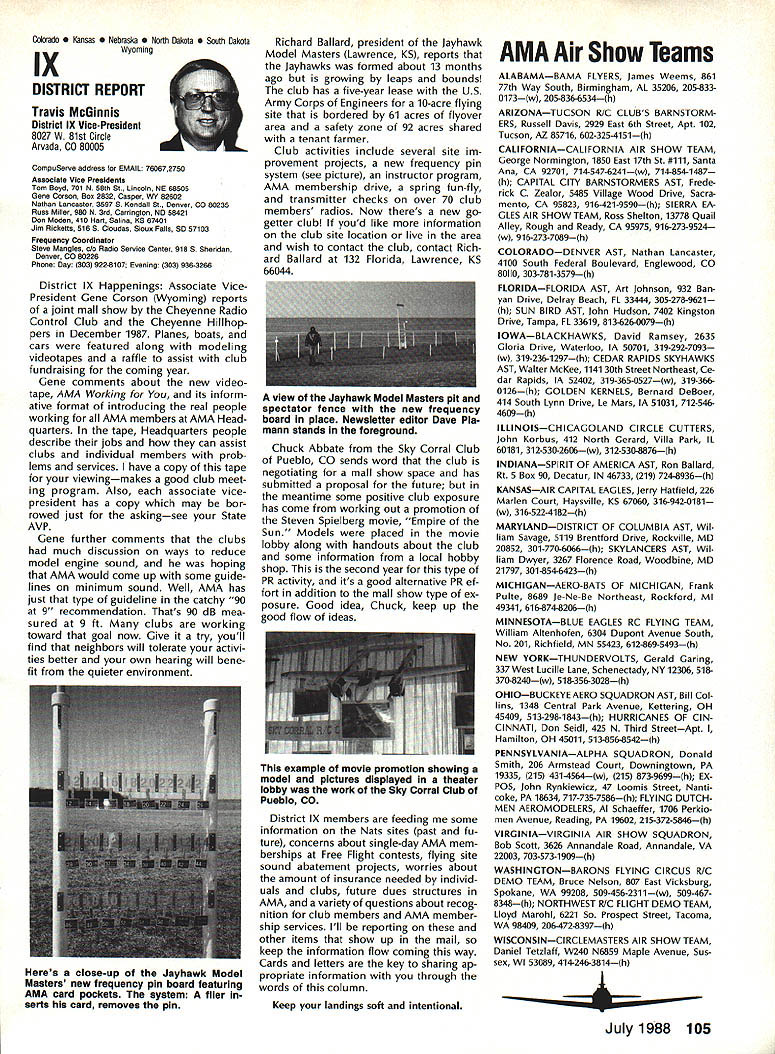
- Club president Richard Ballard reports the club is about 13 months old and growing rapidly.
- The club secured a five-year lease with the U.S. Army Corps of Engineers for a 10-acre flying site bordered by 61 acres of flyover area and a 92-acre shared safety zone.
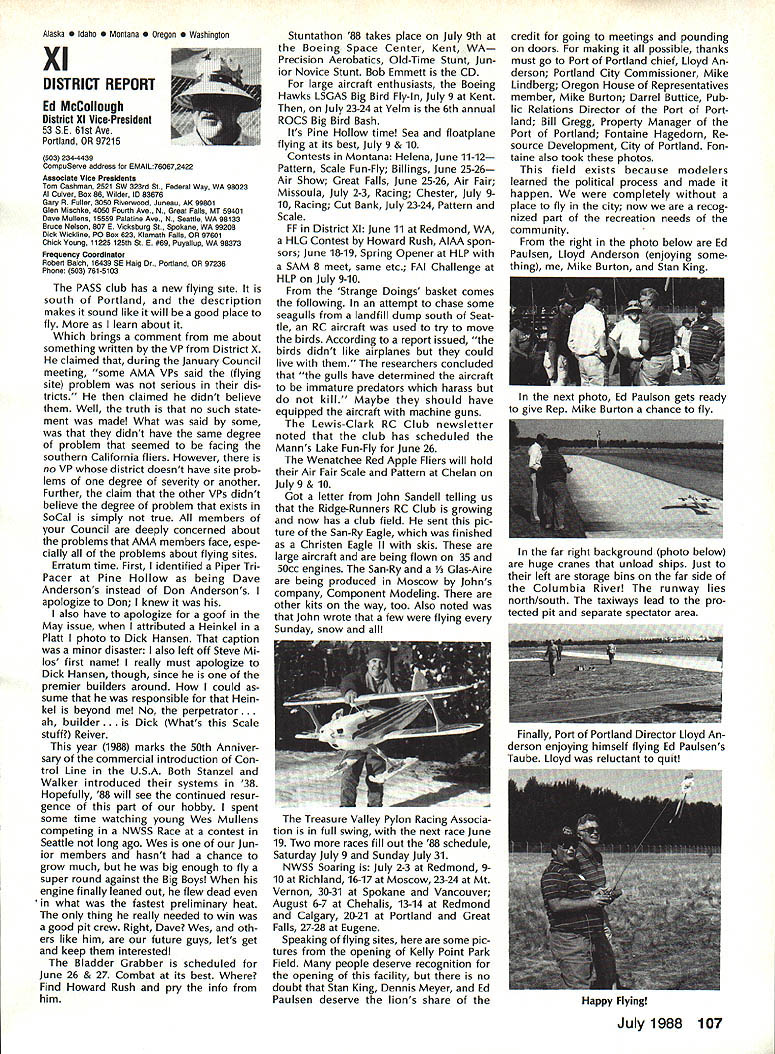
- Club activities: site improvements, a new frequency pin system, an instructor program, AMA membership drive, a spring fun-fly, and transmitter checks for over 70 members.
- Contact Richard Ballard, 132 Florida, Lawrence, KS 66044 for more information.
Sky Corral Club (Pueblo, CO)
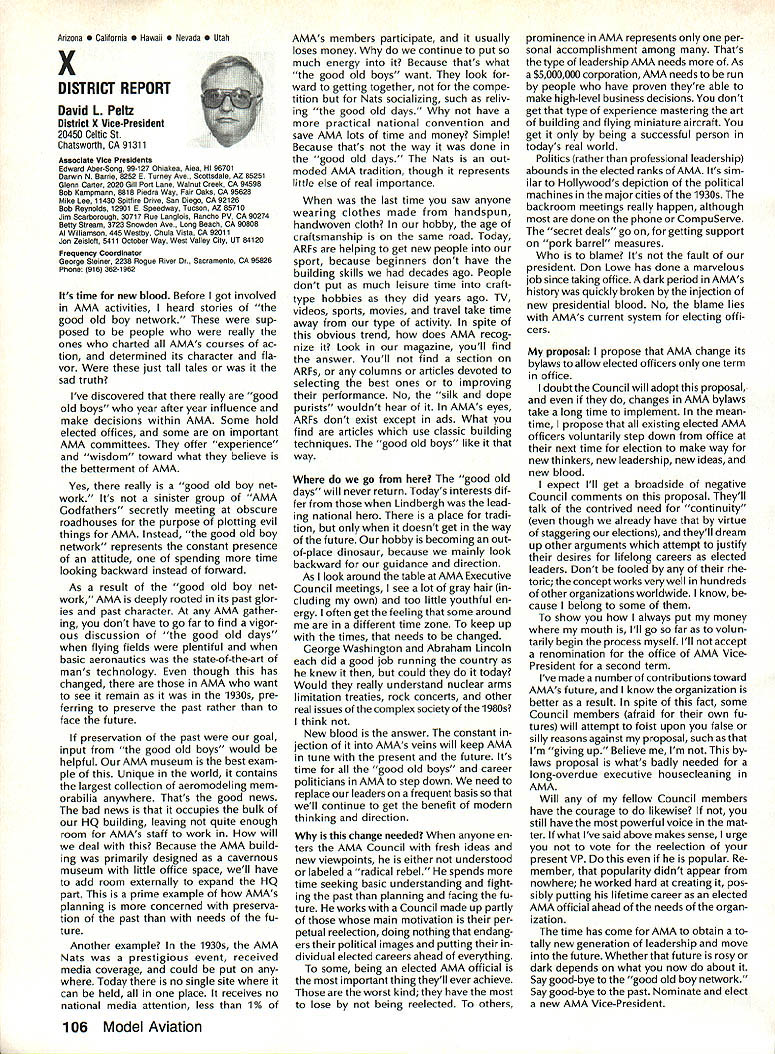
- The club is negotiating for mall show space and promoted models during the Steven Spielberg movie "Empire of the Sun," distributing handouts and raising club visibility.
---
Editorial / Opinion: New Blood for AMA Leadership
- The author argues that AMA needs younger leadership and more frequent turnover in elected offices.
- Traditions (such as the Nats and classic building techniques) are valuable but should not prevent AMA from adapting to current trends like ARFs (Almost-Ready-to-Fly kits) that attract new participants.
- The proposal: change bylaws to limit elected officers to one term. The author pledges not to accept renomination for a second term as AMA Vice-President and urges others to allow new leadership to emerge.
- The column emphasizes the need for professional leadership experience and fresh ideas to keep AMA relevant.
---
Miscellaneous
- District IX and other districts have raised topics including Nats site concerns, single-day AMA memberships at Free Flight contests, sound abatement projects, insurance needs for individuals and clubs, and recognition for club members and membership services. The columnist will report further as information is received.
- Keep your landings soft and intentional.
Transcribed from original scans by AI. Minor OCR errors may remain.

