
Sound & Model Aeronautics
Howard Crispin, Jr.
Sunday afternoon I heard an airplane powered by a Royal .40 flying without a muffler. It has been a long time since I heard such noise. It is amazing how loud one of those power plants sounds after you've become used to working with quiet engines. Fortunately, in this case there was no concern about the sound. Whether that will be true a week from now is another matter — you never know when a single complainant might show up at the field with the sheriff in tow, demanding that you shut down operations immediately.
Everyone at the field commented on the sound of that particular engine. Modelers are slowly becoming aware of the situation, and many are taking the time and expense to get quiet. However, progress in sound reduction by engine manufacturers has been insufficient. Several manufacturers have given lip service to the problem or have stated that the engines cannot be quieted. Really, what it boils down to is that most manufacturers simply do not wish to act — for two distinct reasons.
- Cost: New developments carry expense, and costs are usually passed on to the consumer. With the majority of engines now imports and prices at an all-time high, manufacturers understandably resist increasing costs. It is odd that today's engines are generally more expensive than in the past. Years ago the big cost item for a modeler was the radio; engines of the typical size were fairly reasonable. Today, with a few exceptions, engines are costly.
- Flyer behavior: In areas with no defined standards and no serious complaints, people fly at whatever sound levels suit them. Getting fliers to change habits is often more difficult than persuading manufacturers.
There is no question that very effective mufflers are available. What we need is a highly vocal campaign insisting that all engines come with effective mufflers capable of meeting the recommended standard of 90 dB at 9 ft. This goal is attainable, and there is little excuse for manufacturers not to cooperate in achieving it.
I won't try to prove either side right in this debate, but both sides need to take a hard look and realize the only reasonable approach is to establish flexible rules that allow operations to fit local circumstances. The five-person club in northern South Dakota that flies on Farmer Jones' back forty doesn't have the same needs as those who fly a one-mile-square field in California or a 150-person club in Ohio.
Till next month.
Note: The views above are my personal viewpoint and are the sole responsibility of the author; they may not represent official AMA policy.
AMA News
Roberts RC Trophy — Now in AMA Museum
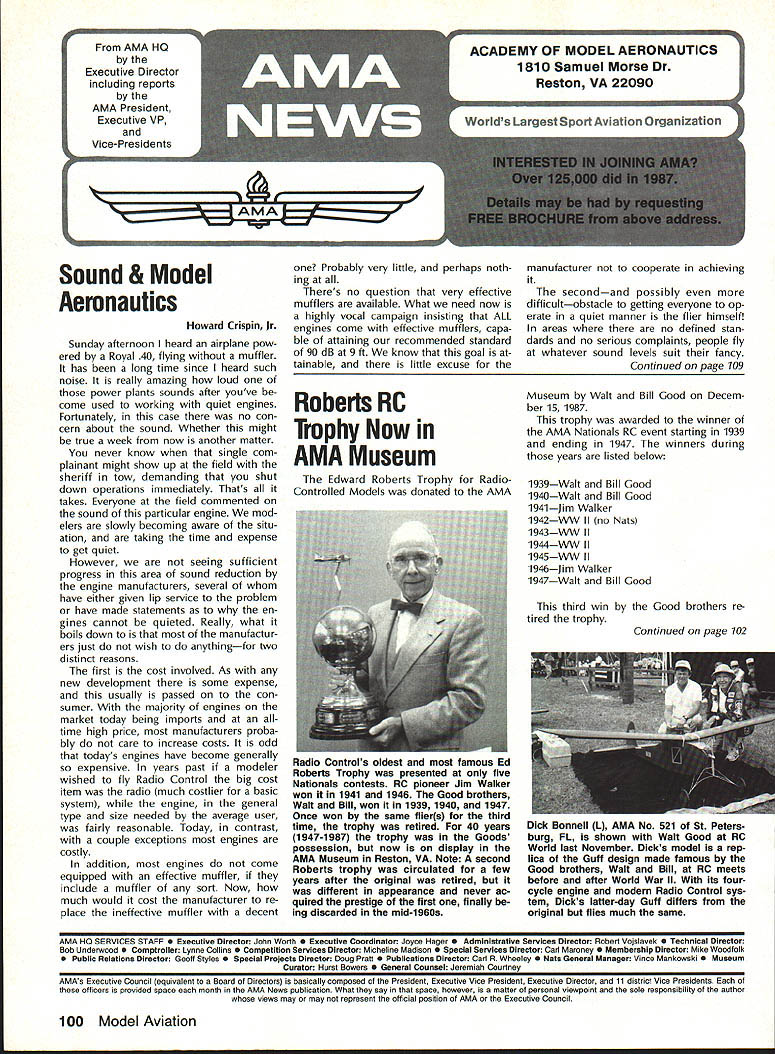
The Edward Roberts Trophy (Radio Controlled Models) has been donated to the AMA Museum in Reston, VA. The Roberts Trophy is the oldest and most famous RC trophy; it was presented at five Nationals contests. RC pioneer Jim Walker won in 1941 and 1946; the Good brothers, Walt and Bill, won in 1939, 1940 and 1947. Because a flier won the trophy three times, the original was retired for 40 years (1947–1987) and is now in the AMA Museum.
Note: A second Roberts trophy circulated after the original was retired. It had a different appearance, never acquired the prestige of the first, and was discarded in the mid-1960s.
Winners, 1939–1947:
- 1939 — Walt & Bill Good
- 1940 — Walt & Bill Good
- 1941 — Jim Walker
- 1942–1945 — WWII — no Nationals
- 1946 — Jim Walker
- 1947 — Walt & Bill Good
Exposure: Public Relations and Events
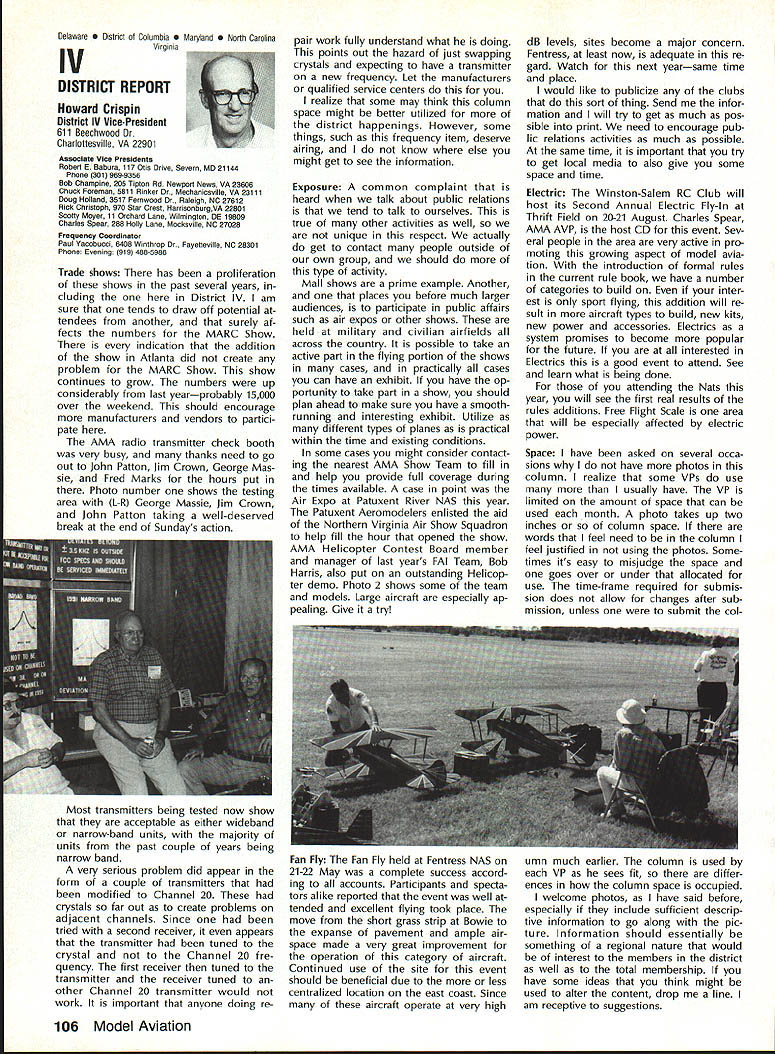
A frequent complaint about public relations is that we tend to talk only to ourselves. We do reach people outside our group and should do more. Mail shows are useful; so are public events such as air expos. These events are held at military and civilian airfields across the country and often allow flying demonstrations or exhibits.
- Plan ahead to make a smooth, interesting exhibit and use a variety of aircraft types as practical.
- Consider contacting the nearest AMA Show Team for help filling demo times.
- Try to get local media to provide coverage and space.
Example: The Air Expo at Patuxent River NAS — the Patuxent Aeromodelers worked with the Northern Virginia Air Show Squadron and featured helicopter demos by Bob Harris.
If your club participates in public events, send details and photos (with descriptive information) to the AMA News editor so they can be publicized.
Electric
The Winston-Salem RC Club will host its Second Annual Electric Fly-In at Thrift Field on 20–21 August. Charles Spear, AMA AVP, is the host CD. With formal electric rules now in the rulebook, there are many categories to build on. Electrics are especially promising for novice fliers and will increase aircraft types, kits, power systems, and accessories. At the Nats you will see the first real results of the rules additions; Free Flight Scale is one area particularly affected by electric power.
Photos and Column Space
Vice Presidents have limited column space. A photo typically uses two inches of column space. If words are needed, they may take priority over photos. Submit photos with sufficient descriptive information and regional interest. If you have suggestions for altering content, send them along.
Model Aircraft Near Full-Scale Aircraft
There is real risk when models operate near airports or full-scale flight operations. A visiting pilot encountering an unexpected model near the ramp or on approach can be alarmed, and the resulting publicity or complaints could jeopardize model flying privileges. Be cautious when flying on or near airports and avoid airspace conflicts. Complaints, combined with liability issues, can lead to loss of flying sites.
Field Report: Courtland, AL
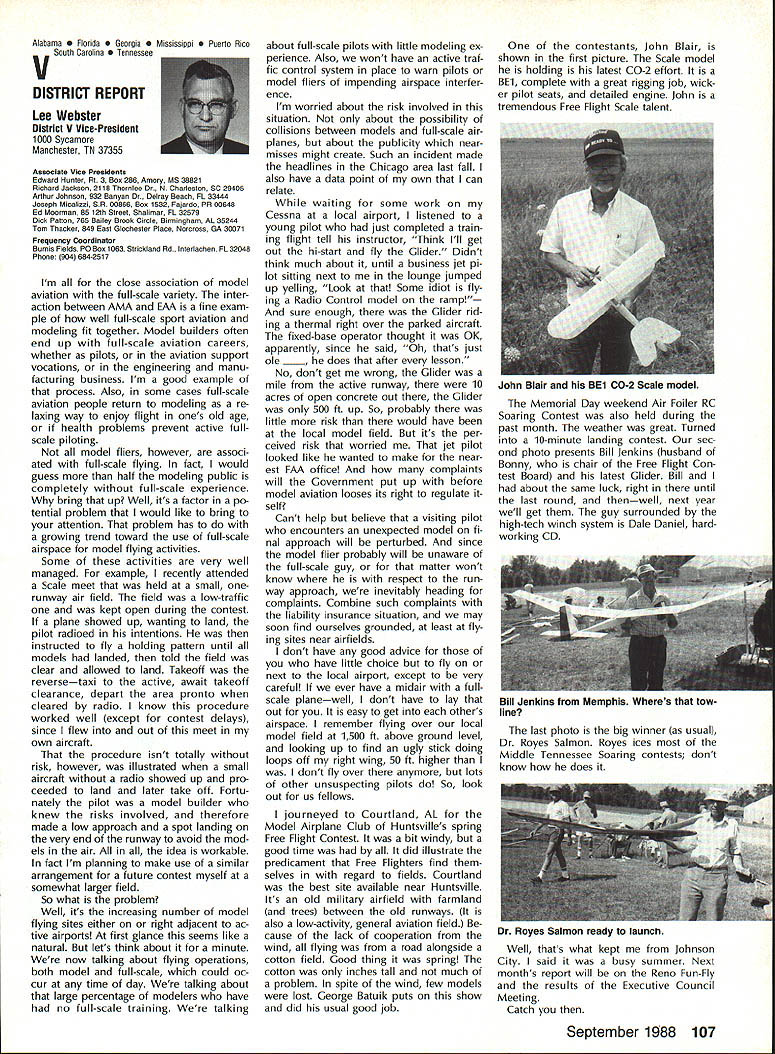
I attended the Model Airplane Club of Huntsville's Spring Free Flight Contest at Courtland, AL. The site is an old military airfield with surrounding farmland and trees; due to wind, flying was staged from a road alongside a cotton field. Despite the wind, few models were lost and the contest went well. Good organization makes these events successful — thanks to George Bartnik and others.
Getting and Keeping Flying Fields — Part II (Jim Shaw)
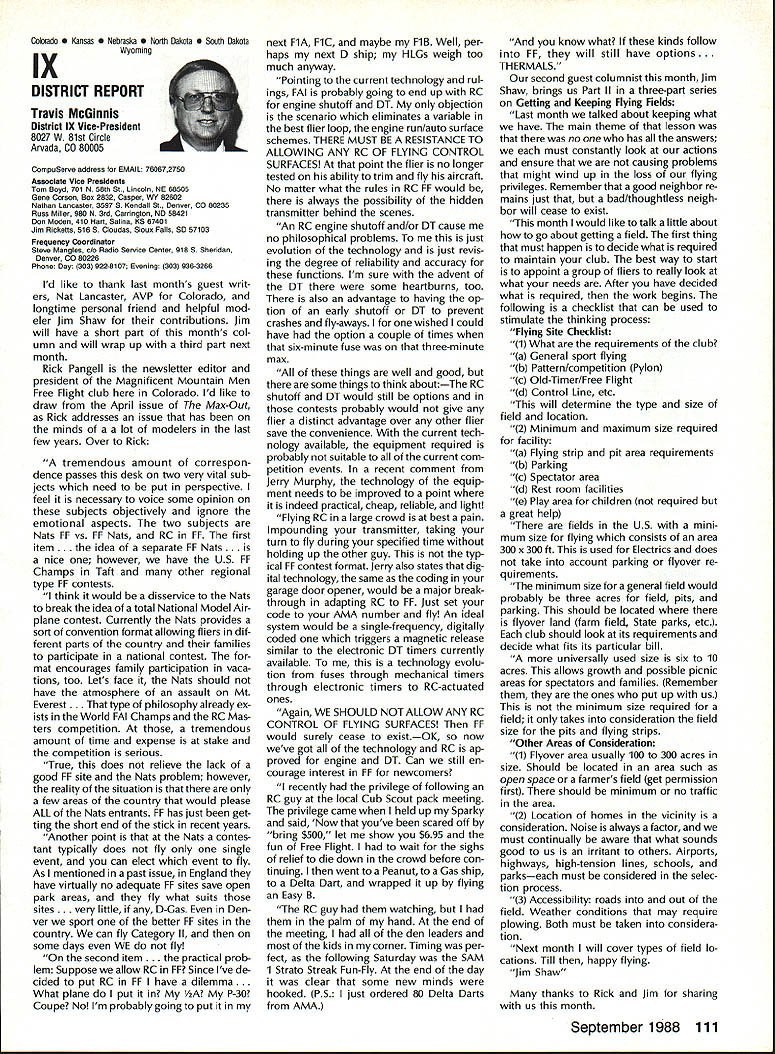
Last month we discussed keeping what we have; this month focuses on getting a field. Start by forming a group to determine club requirements, then use the checklist below to guide site selection.
Flying Site Checklist:
- What are the requirements of the club?
- General sport flying
- Pattern/competition (pylon)
- Old-timer/free flight
- Control line, etc.
- This determines field type, size, and location.
- Minimum and maximum size required:
- Flying strip and pit area
- Parking
- Spectator area
- Restroom facilities
- Play area for children (optional but helpful)
- Examples and guidelines:
- Electrics-only sites can be as small as 300 x 300 ft (does not account for parking or flyover).
- A minimum general field might be about three acres (field, pits, parking) with surrounding flyover land.
- A commonly used size is six to ten acres to allow spectator and picnic areas.
- Other considerations:
- Flyover area: usually 100–300 acres (farmland or open space, get permission).
- Nearby homes and noise sensitivity.
- Proximity to airports, highways, schools, high-tension lines, parks.
- Accessibility: roads, weather-related access (e.g., plowing).
Next month will cover types of field locations.
Club Sound Testing
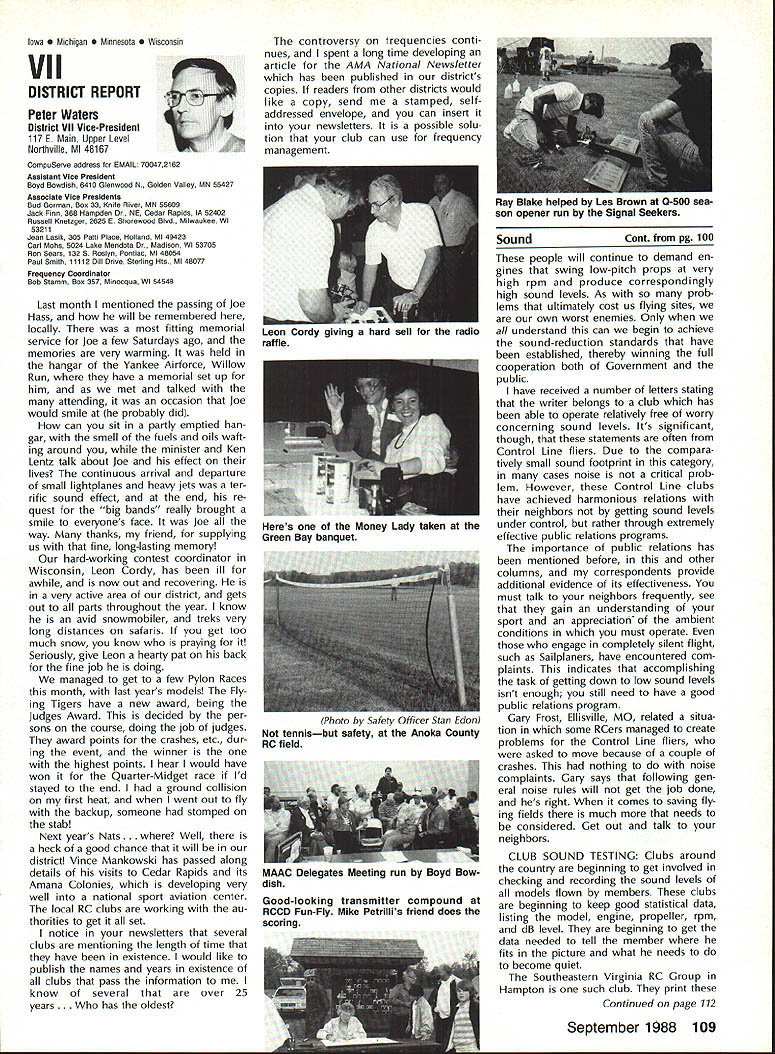
Clubs around the country are beginning to measure and record sound levels of models flown by members. They are collecting statistical data on model, engine, propeller, RPM and dB level to help members understand where they fit and what they need to do to become quieter. The Southeastern Virginia RC Group in Hampton is one example of a club conducting such tests.
Notes on Elections and District Vice-Presidents
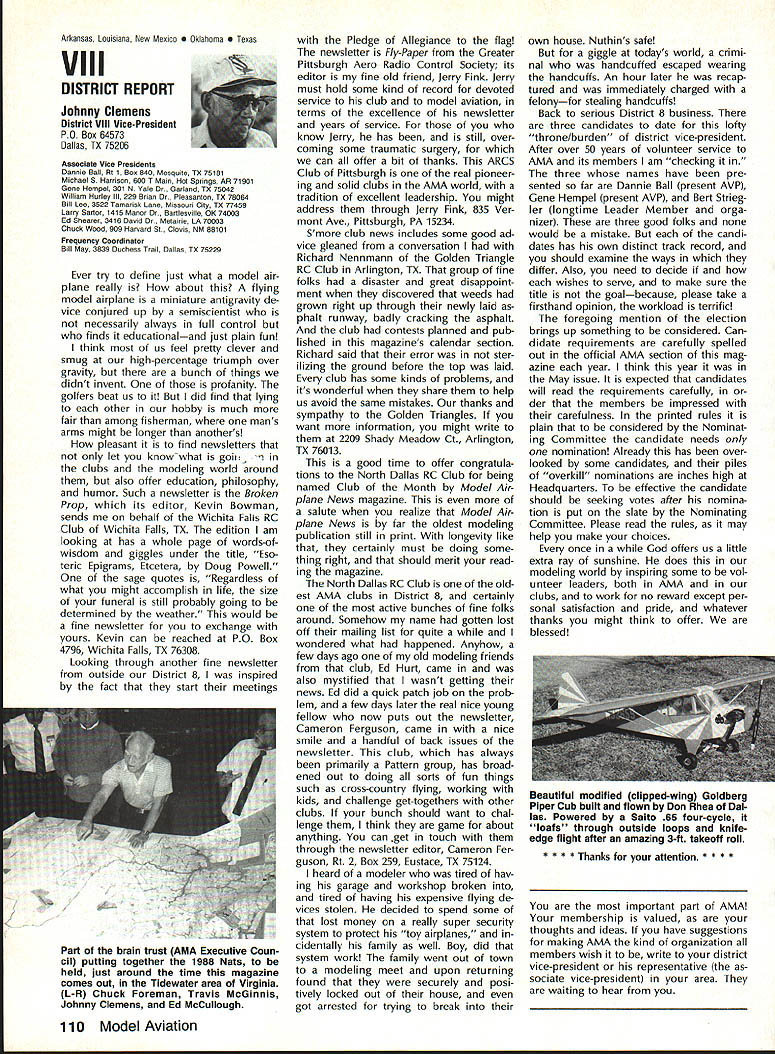
There are several candidates for district vice-president. Candidate requirements are spelled out in AMA publications; candidates should read the rules carefully. To be considered by the Nominating Committee, a candidate must already have at least one valid nomination. After the nominating committee places a candidate on the slate, that candidate should actively seek votes. Volunteer leaders provide vital service to AMA and its members.
AMA HQ Services Staff
- Executive Director: John Worth
- Executive Coordinator: Joyce Hager
- Administrative Services Director: Robert Vojalavek
- Technical Director: Bob Underwood
- Comptroller: Lynne Collins
- Competition Services Director: Micheline Madison
- Special Services Director: Carl Maroney
- Membership Director: Mike Noodtolk
- Public Relations Director: Geoff Styles
- Special Projects Director: Doug Pratt
- Publications Director: Carl R. Wheeley
- News General Manager: Wyman Mankowski
- Museum Curator: Hurst Bowers
- General Counsel: Jeremiah Courtney
Final Note
There is little excuse for manufacturers not to cooperate in achieving sound reduction. Effective mufflers are available; a vocal campaign and club-level testing, combined with good public relations and flexible local rules, are the best path to preserving flying sites and maintaining good community relations.
Transcribed from original scans by AI. Minor OCR errors may remain.

