
AMA News
Sound & Aeronautics — Howard Crispin, Jr.
STATEMENT There is a very real problem with sound levels in model aeronautics. Word has been circulating that the "90 dB at 9 ft" guideline is a mandatory requirement of the Academy. These claims have appeared in letters to public officials and in site‑acquisition efforts. The Academy has not established 90 dB at 9 ft as a mandatory rule. Stating otherwise sets a dangerous precedent and may prevent acquisition of flying sites or unduly restrict aircraft types.
We have the attention of engine, propeller, muffler/pipe manufacturers and of model fliers generally, and mandatory rules can be considered when appropriate. At present, only certain competition categories have mandatory sound‑abatement figures. The goal is to reduce noise at all operations; the 90‑at‑9 guideline is a valid standard for many problem sites, but it is not an Academy requirement. When in doubt, get a statement from AMA Headquarters.
SOUND ADVICE
- Adhere to the 90 dB at 9 ft guideline where possible to help preserve flying sites and good public relations.
FLYING NEAR AIRPORTS — BE CAREFUL!
- Free Flight or R/C flying near airports, or anywhere models could endanger full‑scale aircraft operations, must be avoided or conducted with a dedicated spotter watching for full‑scale traffic.
---
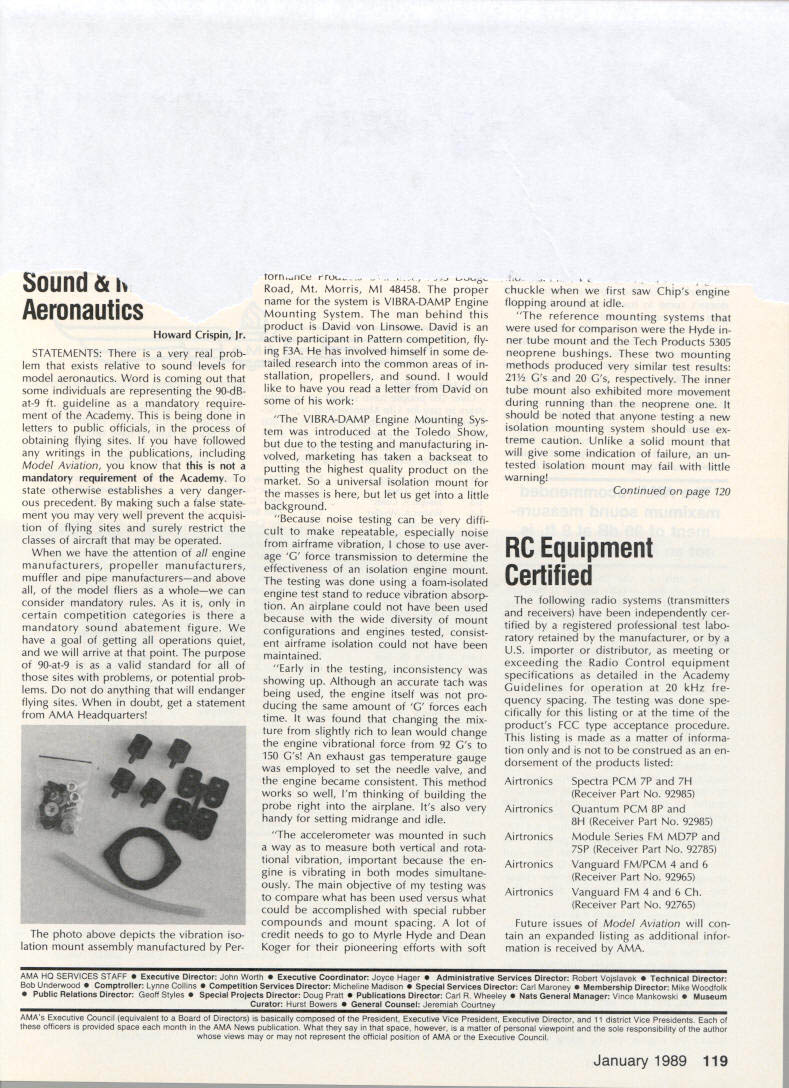
VIBRA‑DAMP Engine Mounting System — David von Linsowe
BACKGROUND David von Linsowe (active in pattern/F3A competition) introduced the VIBRA‑DAMP Engine Mounting System at the Toledo show. Marketing was delayed while testing and manufacturing were completed to ensure a high‑quality universal isolation mount. The product is recommended for .60‑size engines and is designed not to come into hard contact with the engine during normal running.
TESTING METHODOLOGY
- Because noise testing, especially for airframe vibration, is difficult to make repeatable, average G‑force transmission was used to evaluate isolation effectiveness.
- Testing used a foam‑isolated engine test stand to minimize airframe variables. An aircraft was not used so that consistent airframe isolation could be maintained across many mount configurations and engines.
- Early inconsistencies were traced to engine mixture: slight rich/lean changes altered vibrational force significantly (for example, about 92 G to 150 G). An exhaust‑gas temperature gauge was used to set the needle valve and stabilize the engine; this produced consistent results.
- An accelerometer was mounted to measure both vertical and rotational vibration, since the engine vibrates in both modes simultaneously.
- The objective was to compare common mounting methods to what could be achieved using special rubber compounds and mount spacing.
COMPARATIVE RESULTS
- Reference mounts: Hyde inner‑tube mount and Tech Products 5305 neoprene bushings.
- Test results: Hyde inner‑tube ≈ 21.5 G; Tech Products neoprene ≈ 20 G. The inner‑tube mount showed more movement during running.
- CAUTION: Unlike a solid mount, an untested isolation mount may fail with little warning; exercise extreme caution when testing new isolation mounts.
FIELD RESULTS
- At one event (Masters Tournament) the airplane was judged noisier in the air without the VIBRA‑DAMP mount; at the 1988 Nationals the same airplane/engine/pipe/prop combination with the VIBRA‑DAMP mount was judged quiet by most of the jury for the FAI in‑flight noise bonus.
- Note: exhaust system and prop‑tip velocity also play important roles; a soft‑mounted engine does not solve noise by itself.
---
Propeller Research — David von Linsowe (summary)
- Blade flex influences efficiency. Tests that used 4–5 layers of 3/4‑oz glass cloth on prop blade faces reduced noise but unexpectedly increased rpm (by about 800 rpm). The experience led to making props wider rather than simply increasing pitch.
- Wider blades can lower tip speed and rpm while maintaining flight speed and thrust; example: on a standard day with a .60 and a tuned pipe, wider blades produced 9+ lb static thrust at ~10,000 rpm while achieving the same flight speed at lower rpm than some high‑pitch props.
- Conclusion: to reduce prop noise you must lower tip speed without sacrificing performance; prop design must load the engine to the desired rpm with good efficiency at that rpm.
---
RC Equipment Certified
The following radio systems (transmitters/receivers) have been independently certified by a registered professional test laboratory retained by the manufacturer, U.S. importer, or distributor as meeting or exceeding Radio Control equipment specifications in the Academy Guidelines for operation with 20 kHz frequency spacing. This listing is informational and is not an endorsement.
- Airtronics Spectra PCM 7P/7H Receiver — Part No. 92985
- Quantum PCM 8P/8H Receiver — Part No. 92985
- Airtronics Module Series FM MD7P/75P Receiver — Part No. 92785
- Vanguard FM/PCM 4/6 Receiver — Part No. 92965
- Vanguard FM 4/6‑Ch Receiver — Part No. 92765
Future issues of Model Aviation will include expanded listings and additional information.
---
Technical Award — Bob Underwood, Technical Director
- In late 1985 the AMA Executive Council approved a Technical Award to honor developments that improve model aircraft performance, enable new tasks, simplify building or flying, and encourage safety or sound suppression.
- The award recognizes significant technical contributions to the hobby/sport. The first Technical Award honored Bob and Bill Hunter of Satellite City for introducing cyanoacrylate adhesives to the modeling community.
- Nominations: any two AMA members may nominate an individual or group. Deadline: September 1 each year. Send nominations to AMA Headquarters (Technical Director, Bob Underwood).
- Voting: AMA Council or Past Vice‑Presidents.
---
Aircraft ID Labels
- Additional stick‑on aircraft ID labels (like those in the 1988 membership kit) are available from AMA Supply and Service for $1.00 postpaid. Include remittance and specify "stick‑on labels" when ordering.
---
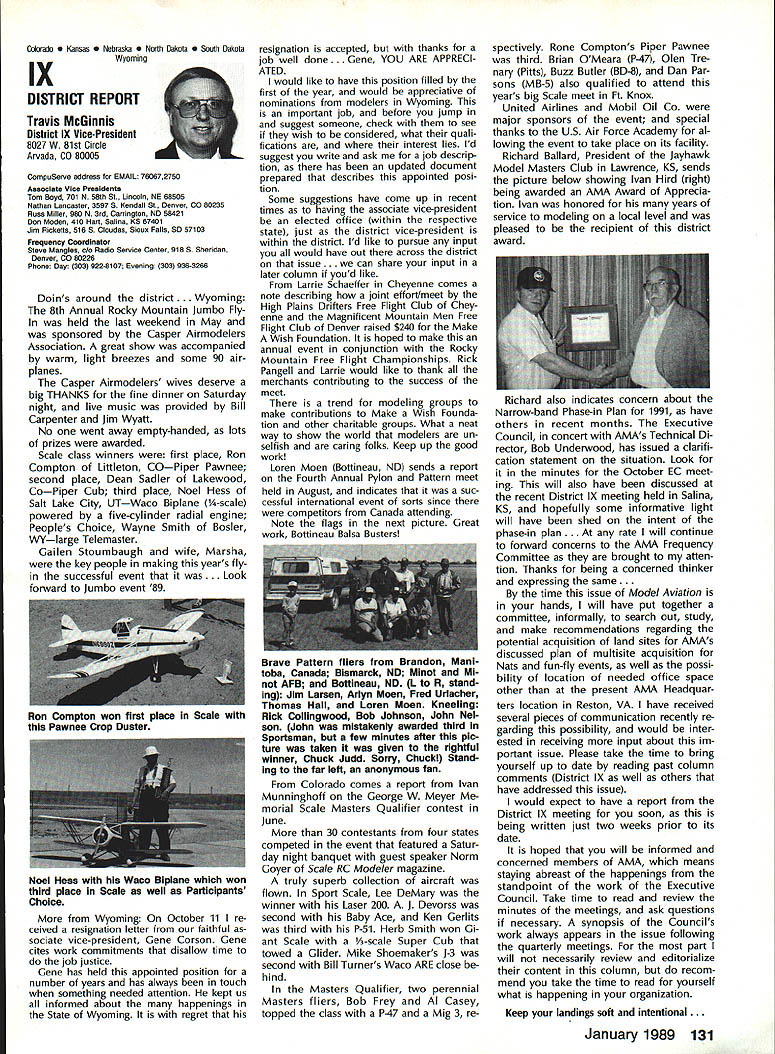
District IX Report — Travis McGinnis
8027 W. 51st Circle, Arvada, CO 80005
HIGHLIGHTS
- Wyoming: The 8th Annual Rocky Mountain Jumbo Fly‑In (Casper Airmodelers Association) was well attended with warm weather and about 90 airplanes. Many prizes were awarded. Scale class winners:
- 1st — Ron Compton (Littleton, CO), Piper Pawnee
- 2nd — Dean Sadler (Lakewood, CO), Piper Cub
- 3rd — Noel Hess (Salt Lake City, UT), Waco Biplane (½‑scale, five‑cylinder radial)
- People's Choice — Wayne Smith (Bosler, WY), large Telemaster
- Wyoming: Gene Corson resigned as associate vice‑president due to work commitments. Nominees for this appointed position are requested; contact Travis McGinnis for job description and details.
- Charity: A joint meet by High Plains (Drift) Free Flight Club (Cheyenne) and Magnificent Mountain Men Free Flight Club (Denver) raised $240 for the Make‑A‑Wish Foundation. Many clubs are supporting charities—encouraged.
- Bottineau Balsa Busters: Fourth Annual Pylon and Pattern meet (August) drew competitors from Canada.
- Colorado: George W. Meyer Memorial Scale Masters Qualifier (June) had 30+ contestants from four states. Sport Scale winner: Lee DeMury (Laser 200). Masters Qualifier top placers included Bob Frey (P‑47) and Al Casey (Mig‑3). Several qualifiers advanced to the Ft. Knox scale meet. United Airlines, Mobil Oil Co., and the U.S. Air Force Academy were major sponsors.
- Jayhawk Model Masters Club (Lawrence, KS): Ivan Hird received a District AMA Award of Appreciation for long service to local modeling.
- Frequency concerns: District members expressed worries about the Narrow‑band Phase‑in Plan for 1991. The Executive Council and AMA Technical Director issued a clarification; concerns continue to be forwarded to the AMA Frequency Committee.
- Land acquisition: An informal committee will explore potential AMA land sites for Nats and fun‑fly events and for offsite space separate from AMA Headquarters in Reston, VA. Input is requested from district members.
CLOSING
- Stay informed by reading Executive Council minutes and stay involved in AMA governance. Keep your landings soft and intentional.
---
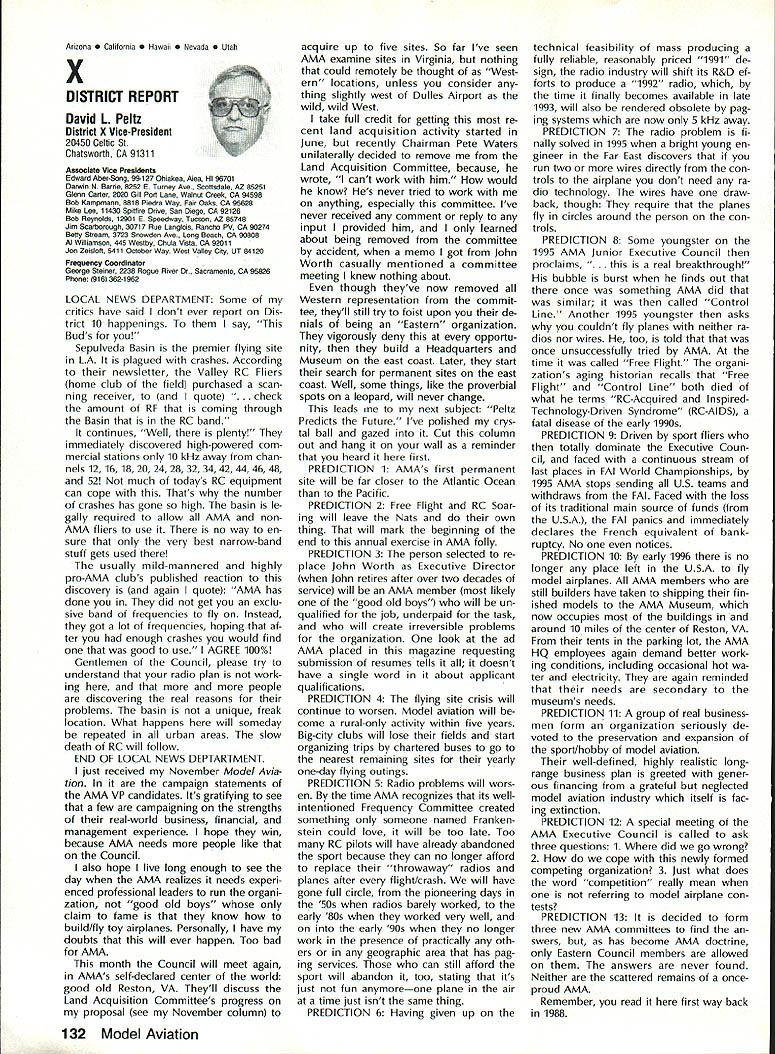
Peltz Predicts the Future (satirical predictions)
- AMA's first permanent site will be much closer to the Atlantic than the Pacific.
- Free Flight and R/C Soaring will leave the Nats and go their own way, signaling decline of the annual event.
- The replacement for long‑time Executive Director John Worth will be an underqualified AMA member who creates irreversible problems.
- The flying‑site crisis will worsen; model aviation will become mostly rural within five years as big‑city clubs lose fields.
- Radio problems will escalate; many R/C pilots will abandon the sport because replacement radios and airframes become unaffordable.
- Radio manufacturers will chase a new design that arrives too late and is already obsolete due to paging interference.
- In 1995 a Far‑East engineer "solves" the problem by running wires from controls to the airplane—planes must fly circles around the pilot.
- A youngster on the Junior Executive Council calls this a breakthrough until reminded of Control Line and Free Flight history.
- By 1995, strained by poor competitive results and governance, AMA stops sending U.S. teams to the FAI and withdraws; the FAI then collapses financially.
- By early 1996, few places remain to fly in the U.S.; enthusiasts ship finished models to the AMA Museum while employees camp in the parking lot.
- Businessmen form a competing organization with a realistic long‑range plan to preserve and expand model aviation.
- The AMA Executive Council forms committees (with Eastern members only) to study the situation but finds no answers.
- Remember: you read these predictions here first.
---
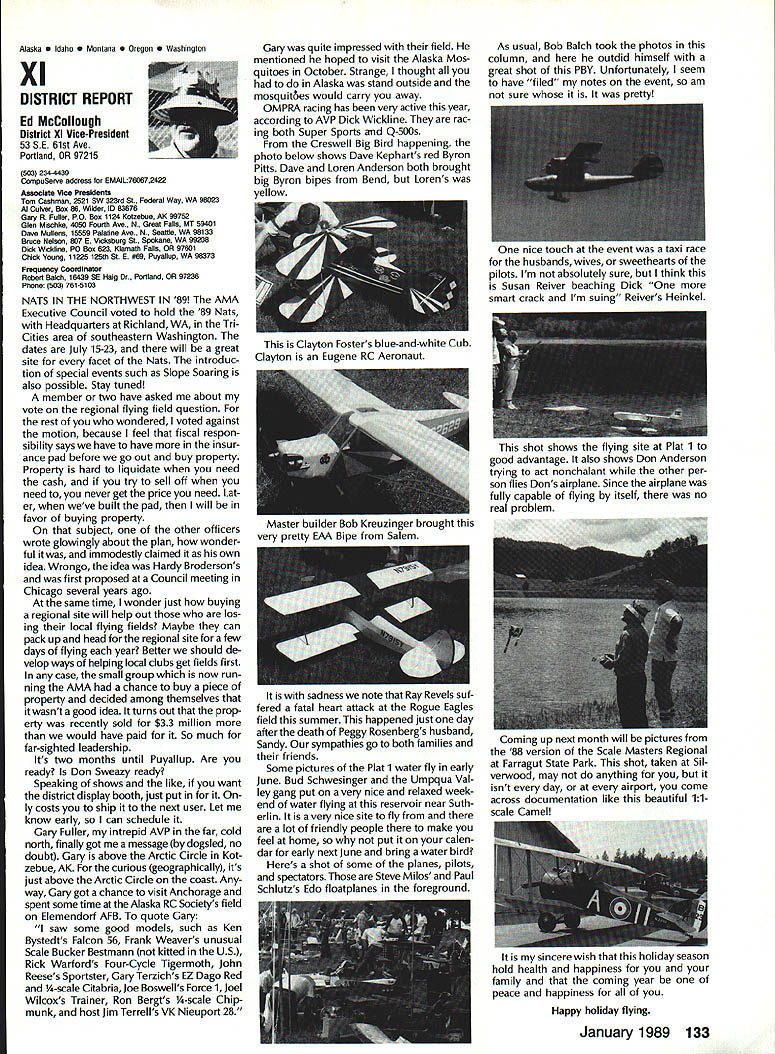
District Roundup & Club Notes
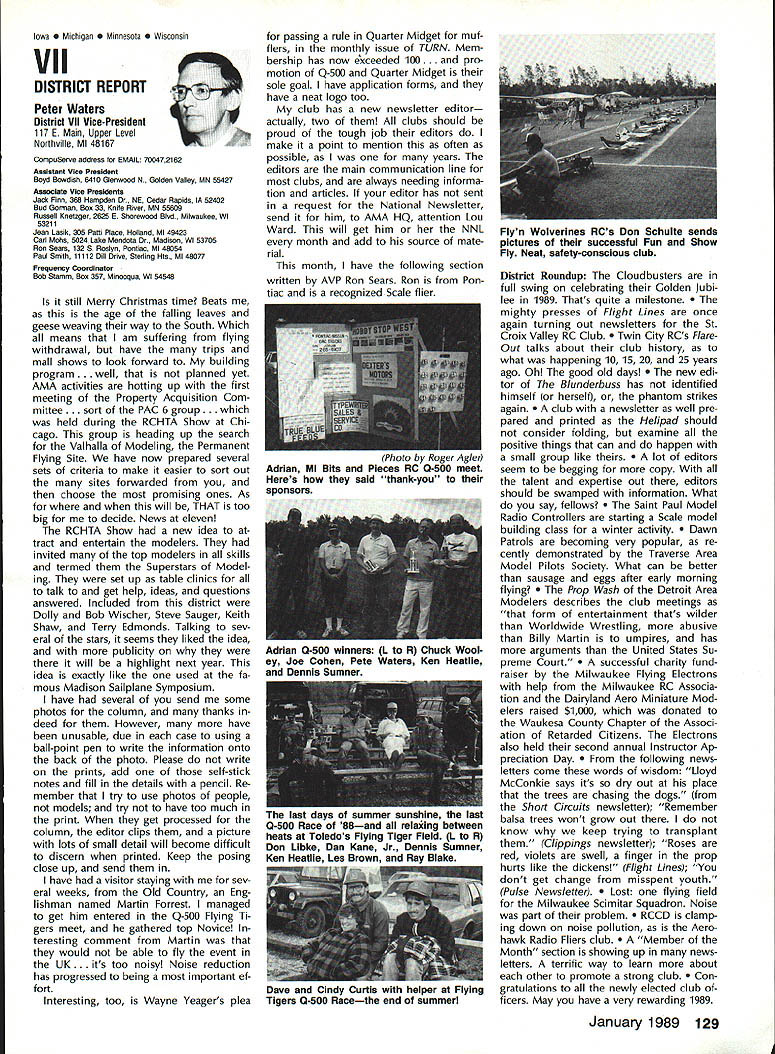
- Fly'n Wolverines RC: successful Fun & Show Fly; club praised for safety and organization.
- Cloudbusters: celebrating their Golden Jubilee in 1989.
- St. Croix Valley RC Club, Twin City RC, Helipad and other club newsletters continue to inform and entertain; many editors request more copy—members encouraged to contribute.
- Saint Paul Model Radio Controllers: starting a winter scale‑model building class.
- Traverse Area Model Pilots Society: Dawn Patrols are popular (sausage and eggs after early flying).
- Milwaukee Flying Electrons, Milwaukee RC Association, and Dairyland Area R/C Modelers raised $1,000 for the Waukesha County Chapter of the Association for Retarded Citizens and held an Instructor Appreciation Day.
- Several newsletters include lighthearted or humorous items and a growing "Member of the Month" feature—an excellent way to promote clubs and learn about members.
- Lost field: Milwaukee Scimitar Squadron lost a flying field partly due to noise complaints; other clubs are facing noise enforcement actions.
Congratulations to newsletter editors and club volunteers—best wishes for a rewarding 1989.
Transcribed from original scans by AI. Minor OCR errors may remain.

