
AMA News
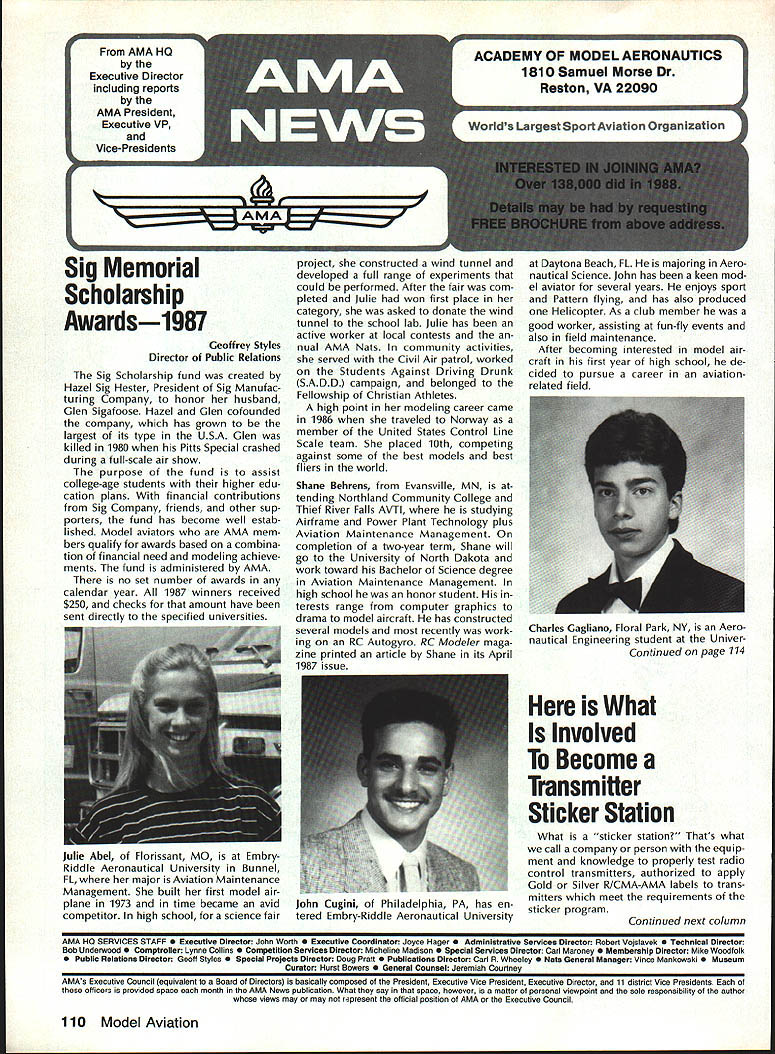
Sig Memorial Scholarship Awards — 1987
Geoffrey Styles, Director, Public Relations
The Sig Scholarship Fund was created by Hazel Sig Hester, president of Sig Manufacturing Company, in honor of her husband Glen Sigafoose. Hazel and Glen co‑founded the company, which became one of the largest of its type in the U.S. Glen was killed in 1980 when his Pitts Special crashed during a full‑scale air show.
The purpose of the fund is to assist college‑age students with higher‑education plans. Through contributions from Sig Company, friends, and other supporters, the fund is well established. Model aviators who are AMA members qualify for awards based on financial need and modeling achievements. The fund is administered by AMA. There is no set number of awards each calendar year. The 1987 winners received $250; checks were sent directly to the specified universities.
- Julie Abel, Florissant, MO — Embry‑Riddle Aeronautical University (Bunnell, FL). Major: Aviation Maintenance Management. Julie built her first model airplane in 1973 and became an avid competitor. In high school she constructed a wind tunnel for a science fair and won first place; the wind tunnel was donated to the school lab. She has worked at local contests and the AMA Nats, served with Civil Air Patrol, participated in the Students Against Driving Drunk (SADD) campaign, and belonged to the Fellowship of Christian Athletes. In 1986 she was a member of the U.S. Control Line Scale team at an international meet in Norway, placing 10th.
- Shane Behrens, Evansville, MN — attending Northland Community College and Thief River Falls AVTI; studying Airframe and Powerplant Technology and Aviation Maintenance Management. After the two‑year program he plans to attend the University of North Dakota for a B.S. in Aviation Maintenance Management. A high‑school honor student with interests in computer graphics, drama, and model aircraft, Shane has built several models (including work on an RC autogyro). RC Modeler published his article in April 1987.
- John Cugini, Philadelphia, PA — entered Embry‑Riddle Aeronautical University (Daytona Beach, FL). Major: Aeronautical Science. John enjoys sport and pattern flying and has built a helicopter. As a club member he assisted at fun‑fly events and in field maintenance. He decided to pursue an aviation career after becoming interested in models in his first year of high school.
- Charles Gagliano, Floral Park, NY — Aeronautical Engineering student (university).
Additional recipients (continued):
- Richard Lacy — active in school Science Club and Aviation Explorers; builds model aircraft with his father.
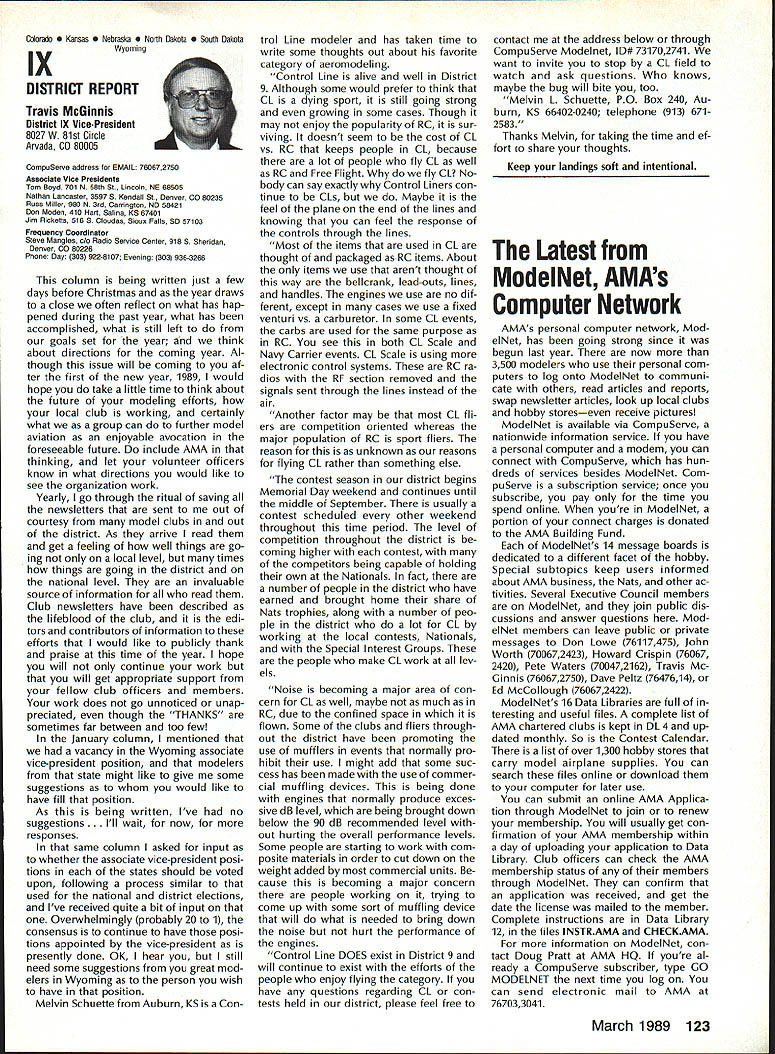
- David Peterson — San Diego State University; major in Journalism, minor in Theatre Arts; active in school media and teen‑activity programs; member of Yucaipa Valley RC Fliers.
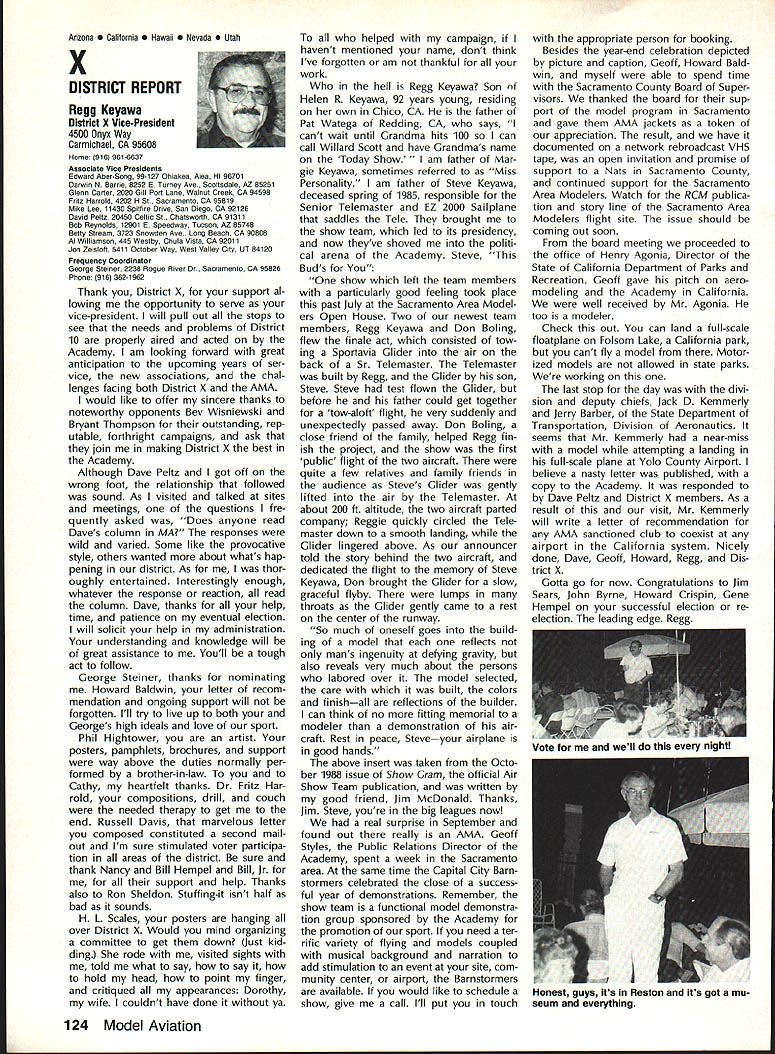
- Christopher Register, Elizabethtown, NC — University of North Carolina (Wilmington), majoring in Physics; began aeromodeling at age eight, has built 20+ models, taking flight training with a goal in commercial aviation.
Contributions to the Sig Memorial Fund may be sent to AMA, Reston, VA; funds expand opportunities for deserving college‑bound students.
---
What’s Involved? Become a Transmitter Sticker Station
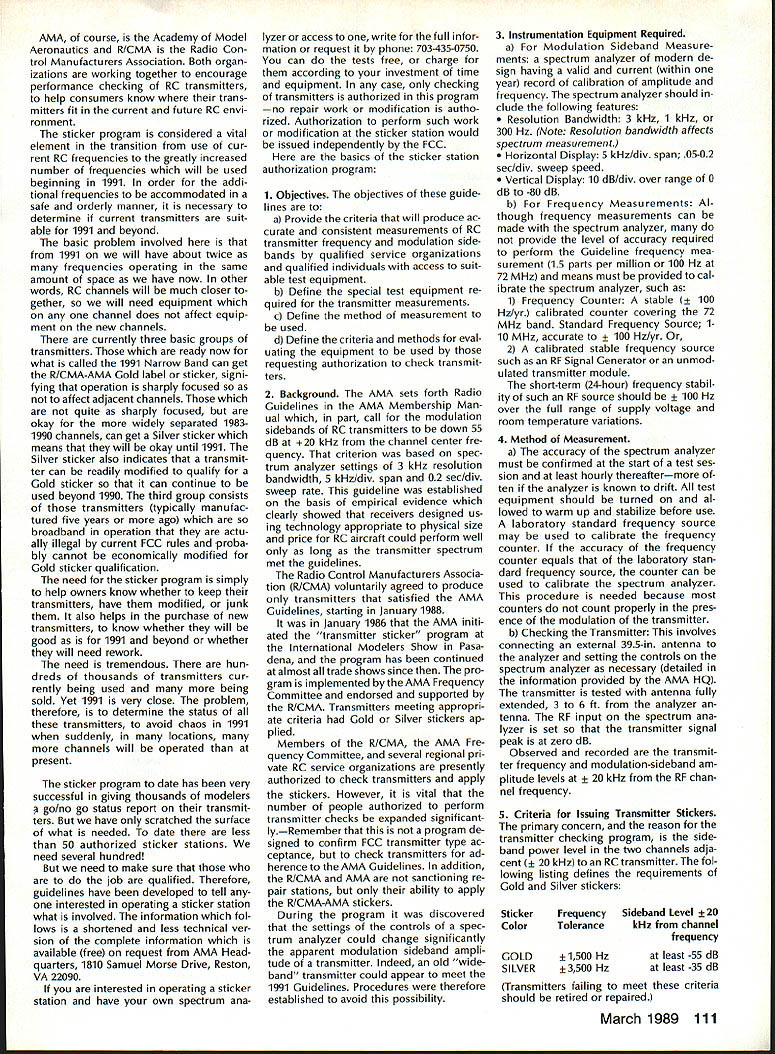
A "sticker station" is a person or company authorized to test radio‑control (RC) transmitters and apply Gold or Silver R/CMA–AMA labels to transmitters that meet program requirements. Stations must have proper test equipment and personnel trained in AMA procedures. Stations perform transmitter checks, record results, and apply the appropriate sticker. Only checking is authorized under the program; repair or modification is not authorized by AMA (such work requires FCC authorization or manufacturer authorization).
#### Objectives
- Provide criteria for accurate, consistent measurements of RC transmitter frequency and modulation sidebands.
- Define required special test equipment.
- Define the measurement method.
- Define criteria and methods for evaluating equipment and applicants for authorization.
#### Background
- AMA Radio Guidelines call for modulation sidebands to be down 55 dB at ±20 kHz from channel center frequency (based on specific spectrum analyzer settings).
- R/CMA agreed to produce transmitters meeting AMA Guidelines starting January 1986.
- The transmitter sticker program began January 1986 and is implemented by the AMA Frequency Committee with R/CMA support.
- The program checks transmitters for airworthiness to AMA Guidelines (not FCC type acceptance) and authorizes sticker application only.
Because spectrum analyzer settings can affect apparent sideband amplitude, procedures and strict settings are required to ensure consistent results. There are currently fewer than 50 authorized sticker stations; many more are needed, but applicants must meet qualification guidelines.
#### Instrumentation Required
- Spectrum analyzer (modern design) with current calibration (amplitude and frequency; within one year).
- Resolution bandwidth: 3 kHz, 1 kHz, or 300 Hz.
- Horizontal: 5 kHz/div, span .05–.2 sec/div, selectable sweep speed.
- Vertical: 10 dB/div over 0 dB to –80 dB.
- Frequency measurement support (spectrum analyzers often need calibration):
- Calibrated frequency counter (stable to ±100 Hz/yr) covering the 72 MHz band.
- Standard frequency source (1–10 MHz accurate to ±100 Hz/yr), RF signal generator, or unmodulated transmitter module.
#### Method of Measurement a) Confirm spectrum analyzer accuracy at the start of a test session and at least hourly; allow equipment to warm up. Use a laboratory standard frequency source or calibrated counter to calibrate the analyzer. b) Check the transmitter by connecting a 39.5‑in. antenna to the analyzer, set spectrum analyzer controls per AMA procedure. Test with the transmitter antenna fully extended, 3–6 ft from the analyzer antenna. Set RF input so the transmitter amplitude remains in the analyzer’s linear range (peak at 0 dB). Record transmitter frequency and modulation sideband amplitude at ±20 kHz from channel center.
#### Criteria for Issuing Stickers
- GOLD sticker:
- Frequency tolerance: ±1,500 Hz
- Sideband level at ±20 kHz: at least –55 dB
- SILVER sticker:
- Frequency tolerance: ±3,500 Hz
- Sideband level at ±20 kHz: at least –35 dB
Transmitters failing criteria should be retired or repaired by authorized parties.
If interested in operating a sticker station and you have access to a spectrum analyzer, request full information (free) from AMA Headquarters:
- AMA Headquarters, 1810 Samuel Morse Drive, Reston, VA 22090
- Phone: 703‑435‑0750
---
Frequency Alert (FCC Update)
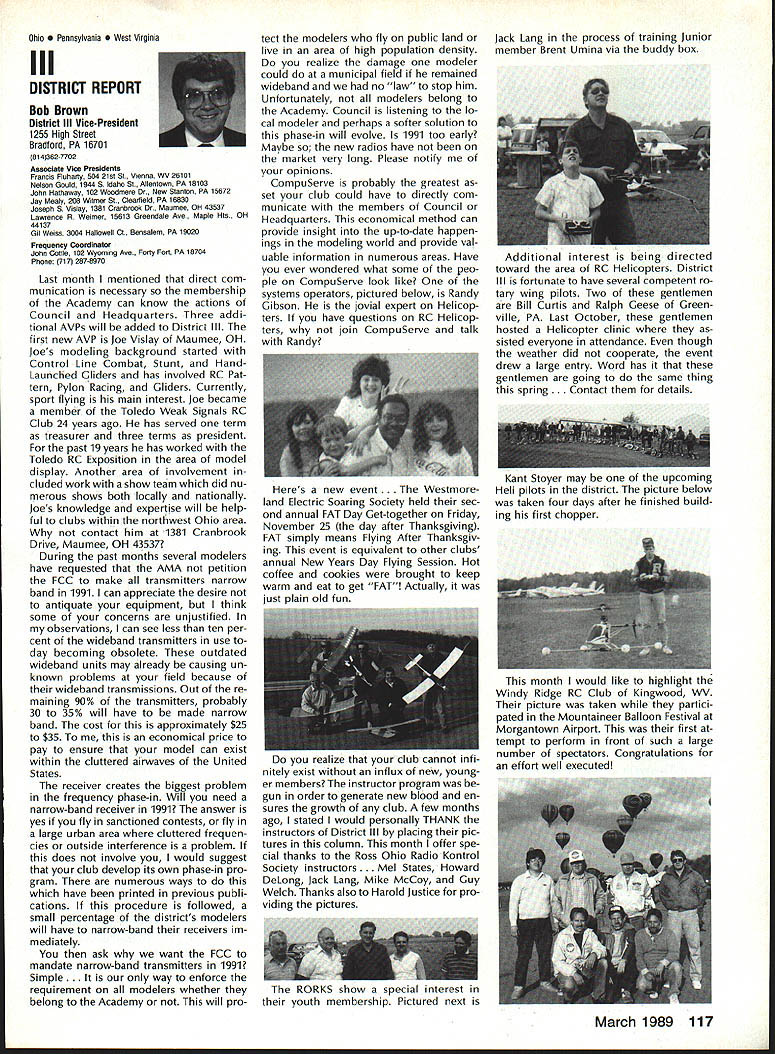
Recent FCC action confirms older transmitters can be modified ("narrowbanded") to operate with 20 kHz channel spacing without requiring a new type‑acceptance. A meeting between AMA representatives and the FCC in October 1988 led to a verbal agreement; the FCC confirmed the understanding in a letter dated December 14, 1988.
In summary:
- The necessary modification typically consists of adding a resistor and capacitor between the encoder and modulator circuits.
- These changes do not alter the equipment type and can be performed as a Class I permissive change (no filing with the Commission required, per Section 2.1001).
- Because Section 95.522 prohibits internal modifications of type‑accepted RC equipment by unauthorized parties, the modifications must be performed by the grantee (manufacturer) or its authorized representative; the grantee retains responsibility for changes.
Quoted FCC passage (excerpt): "This is in reply to your letter of October 20, 1988... the changes necessary... consist of the addition of a resistor and a capacitor between the encoder and the modulator circuits... these changes can be performed as Class I permissive changes... the equipment modifications must be performed by the grantee or its authorized representative."
---
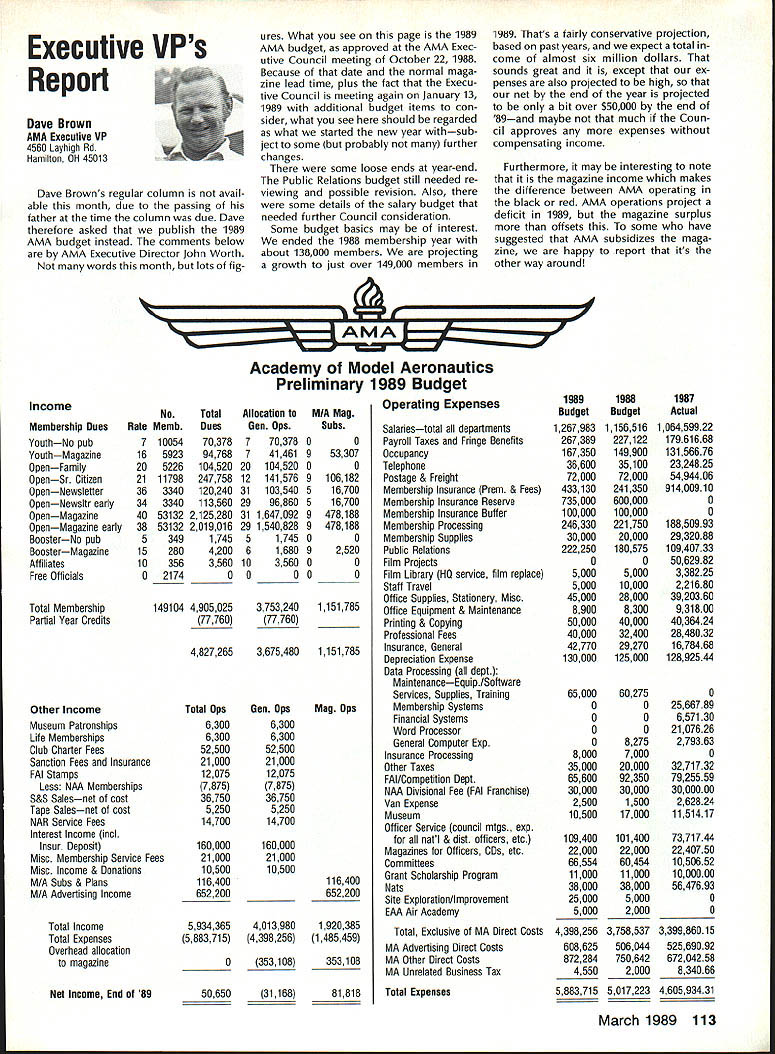
Executive VP’s Report (Budget Summary)
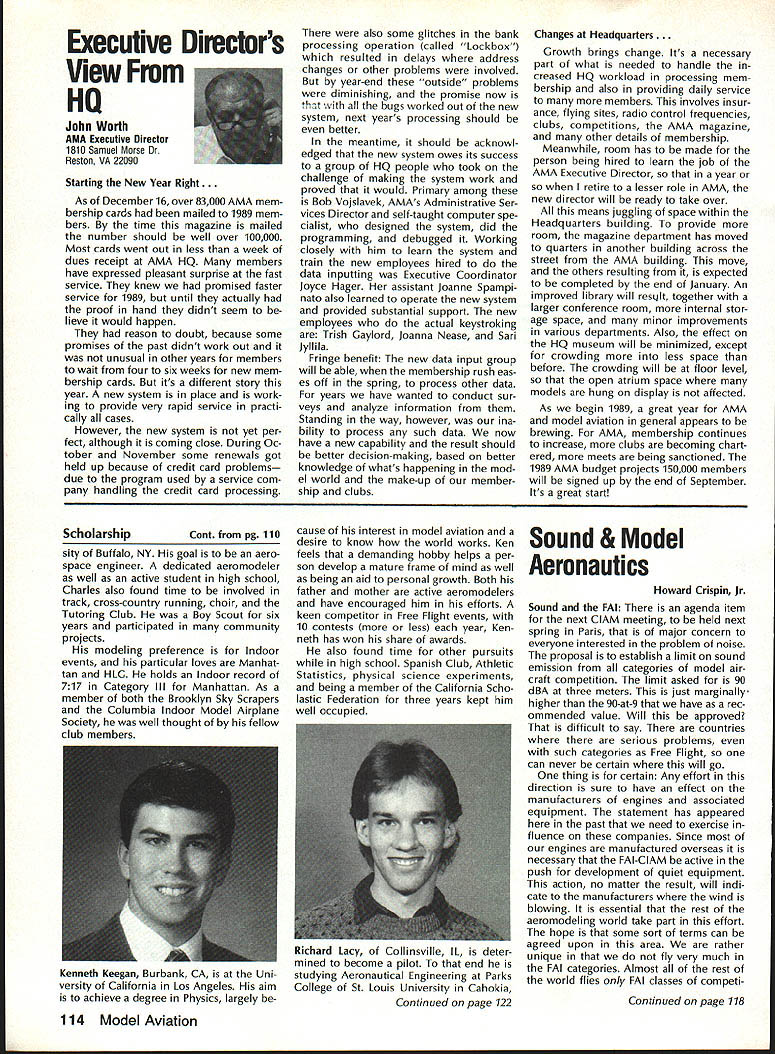
Dave Brown, Executive VP (regular column unavailable due to personal bereavement). Comments provided by John Worth, Executive Director.
- 1988 year‑end membership: ~138,000 members.
- Projected 1989 membership: just over 149,000 members (conservative).
- Projected total income for 1989: nearly $6,000,000.
- Projected net for 1989: only about $50,000 (small surplus; sensitive to any additional Council‑approved expenditures).
- Magazine operations produce a surplus that offsets an operating deficit; without the magazine, AMA operations would project a deficit.
The 1989 preliminary budget was approved at the AMA Executive Council meeting of October 22, 1988, and may receive minor adjustments at subsequent meetings.
---
AMA HQ Services Staff
- Executive Director: John Worth
- Executive Coordinator: Joyce Hager
- Administrative Services Director: Robert Voislavek
- Technical Director: Bob Underwood
- Comptroller: Lynne Collins
- Competition Services Director: Micheline Madison
- Special Services Director: Carl Maroney
- Membership Director: Mike Woodfolk
- Public Relations Director: Geoffrey Styles
- Special Projects Director: Doug Pratt
- Publications Director: Carl R. Wheeley
- Nets General Manager: Vince Mankowski
- Museum Curator: Hurst Bowers
- General Counsel: Jeremiah Courtney
---
Club & Competition Notes, Events, and Miscellany
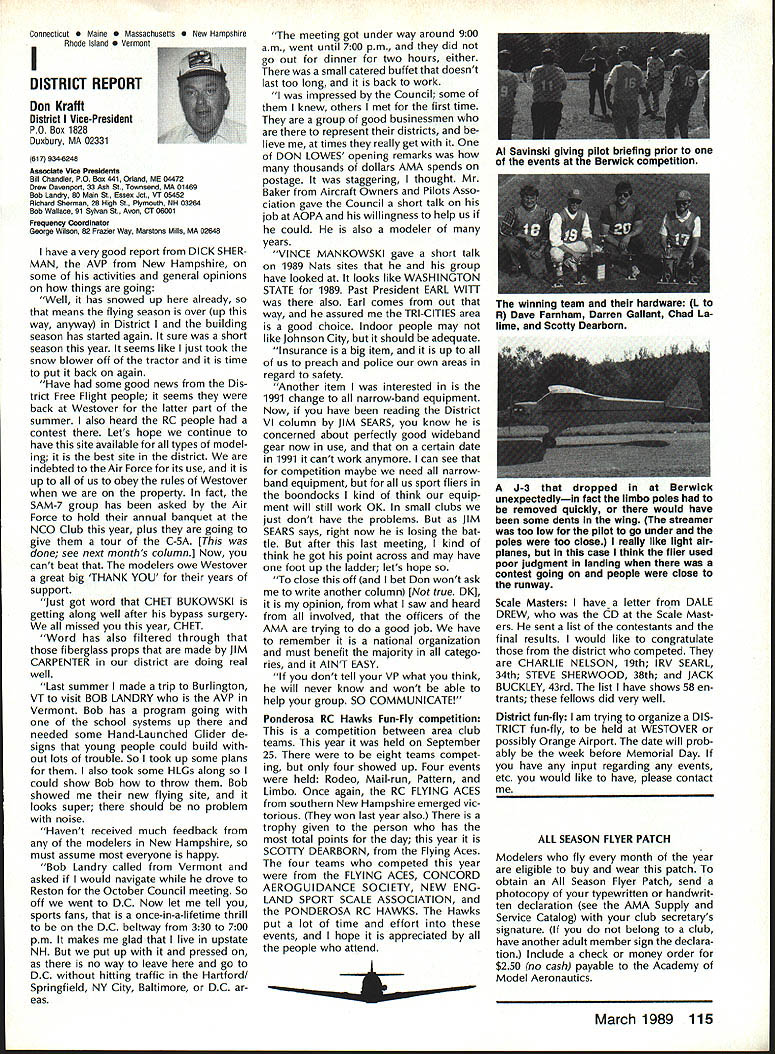
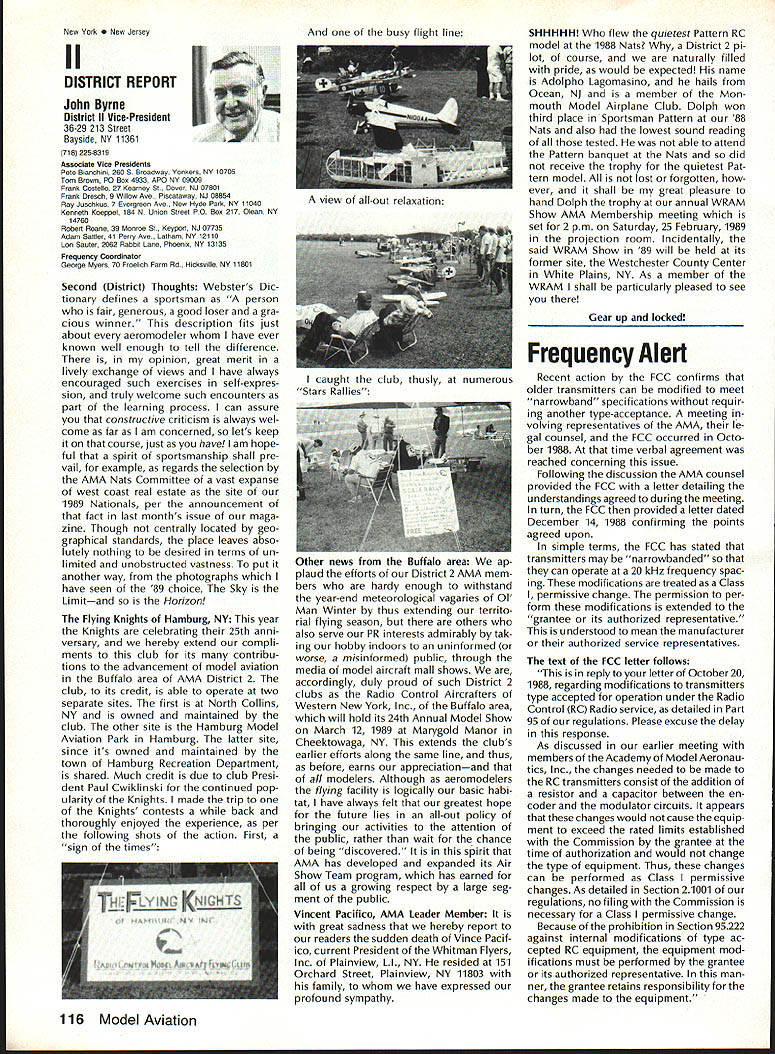
- Quietest Pattern RC model, 1988 Nats: Adolpho Laganosino (Monmouth Model Airplane Club), Ocean, NJ — third place in Sportsman Pattern and lowest sound reading; trophy to be presented at the WRAM Show/AMA membership meeting (2 p.m., Saturday, 25 February 1989).
- Giant Scale / Insurance guidance:
- AMA insurance generally covers models up to a takeoff weight of 55 lb (full of fuel). Models over 55 lb are not automatically covered.
- Models between 55 and 100 lb may be eligible under the Experimental Radio Control Aircraft Program (jointly developed by AMA and IMAA) if they follow specified procedures: certified inspector inspections during construction, prior to a specified flight test program, and after structural repairs or modifications, plus demonstration of airworthiness in a flight test program.
- Experimental program requires certified inspectors and additional procedures; large projects can be expensive to qualify.
- Noise and sound reduction:
- Increasing attention to noise reduction; suggested FAI item under consideration would adopt 90 dBA at 3 meters for all FAI competition categories.
- Engine manufacturers (many overseas) may respond to noise concerns as awareness grows.
- Winter building tips (from Bob Morris, KCRC):
- Inspect equipment thoroughly: bad switches, sticky servos, fuel‑soaked mounts, and worn bearings.
- Repair and recondition airframes where practical rather than replacing entire models.
- Buy narrow‑band radio equipment to avoid future problems.
- Ensure proper ventilation when gluing and painting; use a mask when necessary to reduce exposure to fumes.
- Local and regional events (examples and contacts):
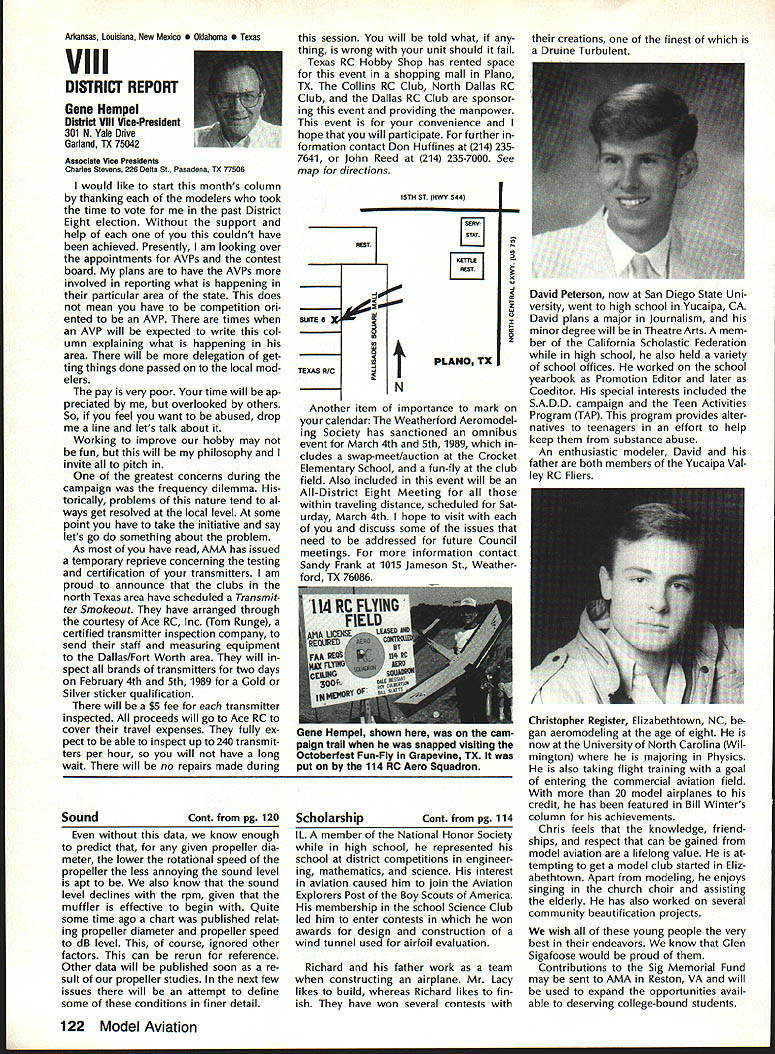
- Texas RC Hobby Shop event (mall location in Plano, TX) — sponsored by Collins RC Club, North Dallas RC Club, and Dallas RC Club. Contact Don Huffines: (214) 235‑7641 or John Reed: (214) 235‑7000.
- Weatherford Aeromodeling Society omnium: March 4–5, 1989 (includes swap meet/auction and fun‑fly). All‑District Eight Meeting scheduled Saturday, March 4. Contact Sandy Frank, 1015 Jameson St., Weatherford, TX 76086.
- Club newsletters: support your local newsletter editor by contributing content and timely information. Examples of good newsletters: Horsefeathers (Billings Flying Musicians) and The Rainbird Flyer (Rainbird Fliers, Ketchikan, AK).
- Racing and contest formats:
- Club 20 racing in Portland: minimum span 36 in., minimum area 400 sq. in., any K&B or O.S. .20FP engine with stock muffler and carb, one prop, 15% fuel (supplied), 1‑1/2‑in. spinner. Contact Jerry Holcomb, 1010 N.E. 122nd Ave., Vancouver, WA 98684.
---
If you need full technical guidelines, the complete (more technical) sticker station information is available free from AMA Headquarters (see contact info above).
Transcribed from original scans by AI. Minor OCR errors may remain.

