
AMA News
Sound & Model Aeronautics
Howard Crispin, Jr.
Comments: There have been articles in a number of model aviation publications that reflect a lack of understanding of — or a wish to avoid — the procedures by which competition rules are made. Most commonly, one will read statements to the effect that the AMA should do this or that, when in fact only the Contest Boards are empowered to take action. This is certainly true, under the present system, with regard to the determination of sound levels for competition categories.
The Contest Boards did not approve any arbitrary sound levels that would apply to all classes of competition. That vote did not affect the vote establishing sound levels for Radio Control Aerobatics. There is a need to reexamine how the Contest Boards operate. Under present provisions, all boards vote on general rules — but the difficulty lies in defining a "general rule." On the issue of establishing sound levels, why should Indoor, Soaring, and Electric have a vote on something that has nothing to do with their events? That is unsatisfactory.
The number of articles and component reviews addressing sound reduction is encouraging; much progress is being made. It is discouraging, however, to read assertions (for example by Peter Price in Scale RC Modeler) that the AMA refuses to take a stand on the sound issue due to lobbying by inside interests. Contrary to such claims, much has been done under the auspices of the Academy toward resolving the sound-level problem — including the continuing coverage in this column.
What would be the effect if the Executive Council mandated a single sound level for all Chartered Club fields? I doubt the membership could survive the impact without turmoil. Requiring various competition categories to meet a sound level not established by each category board could be disastrous for several years. Rather than imposing blanket limits, each category must work individually to reduce sound to levels appropriate for that category — or face continued erosion of available flying sites. Clubs must operate at quieter levels to protect what they have now. Modelers themselves are often their own worst enemies on these issues.
There is a proposal to establish sound levels for the FAI classes at the CIAM meeting in March. CIAM should consider establishing category-specific test programs: each group should attempt, individually, to determine feasible methods of implementation and report back after a predetermined period. European modelers often face more serious problems and may need more aggressive corrective direction. Voting yes or no on proposals without such preparatory work is shortsighted.
I see an overriding imperative: people in each category must form test groups to study sound-reduction measures. Currently, category representatives often automatically vote against mandatory sound levels, assuming such measures will be injurious, and then forget the matter. Appropriate steps must be taken so recommended levels can be phased in only after methods and capabilities for compliance are available.
Three basic steps to reduce aircraft sound:
- Install a good muffler or a muffled tuned pipe.
- Work with the propeller to determine the best combination of rpm and pitch for the quietest operation consistent with acceptable performance.
- Isolate engine vibration from the airframe (often the most difficult to achieve).
Given a good muffler, the combination of higher propeller pitch and lower engine speed has proven most effective. Whether this benefits all categories will be shown by testing. Under no circumstances should rules forbidding mufflers be accepted.
We should acknowledge writers, manufacturers, and vendors who have reviewed materials, conducted tests, and contributed money and effort. Their involvement has been instrumental in bringing progress over the past few years.
Big Tigers — muffler tests:
- Engines tested: Super Tigre 2000 and 3000.
- Mufflers compared: factory swing-line muffler (ST) and Whisper Muffler Type I (available from Eric's Quality RC Products, 1602 White Dove Drive, Winter Springs, FL 32708).
- Installation: both mufflers mounted similarly alongside the engine.
- Results (engines well loaded on a stand):
- ST muffler readings: 95–98 dB at running speeds.
- Whisper muffler (larger volume/design) provided significantly lower readings.
- 3000 with 20 x 10 prop at 6,600 rpm: 86 dBA.
- 2000 with 18 x 6 prop at ~7,800 rpm: 85 dBA.
- 2000 with 20 x 10 at 5,600 rpm: about 83 dBA (suitable for quarter-scale Cub-type installations).
- If soft-mounted and cowled, these mufflers can reduce engine noise to barely audible levels at distance; the propeller becomes the primary sound source. At idle, mufflers produced only a low-level popping.
- Whisper Muffler Type I is available for many engine types (.40s to 4.2 cu. in.); Eric's carries other types as well.
More next month.
---
1989 Nominating Procedure
The AMA Bylaws include standing rules supplementing the Bylaws concerning organizational details, including the AMA Nominations Committee and nomination procedures. In 1989 the following officers will be elected for three-year terms beginning in 1990: Vice Presidents for Districts 1, 5, and 9, and the AMA President.
AMA Membership Meeting
- Date/time: Saturday evening, June 10, 1989, at the National Fun‑Fly.
- Fun‑Fly dates/location: June 10–11, 1989, at Wright‑Patterson AFB, Dayton, OH.
- Composition
- a. All 11 Vice Presidents and the Executive Vice‑President shall sit on the Nominating Committee; they constitute the Committee in total.
- b. Committee members may be nominees for office.
- c. Voting proxies are permitted only if the proxy is from the same district as the absent Vice President and has written permission to vote. An Open member designated by the absent E.V.P. may act as proxy for the E.V.P. (a telegram from the absentee suffices).
- d. The President may not appoint any member of his Committee nor be an ex‑officio member; the Executive Director may not be a member.
- Chairman
- a. The chairman shall be elected from among committee members by majority vote.
- b. The Chairman shall be elected at the last Executive Council meeting before the Nominating Committee meeting.
- c. The Chairman must ensure all documents relating to the meeting are on hand.
- Recording Secretary
The Recording Secretary shall:
- a. keep full, accurate, and detailed written minutes;
- b. assist the Teller in distribution, collection, and tabulation of ballots;
- c. submit a full written report of the meeting and voting results to the President, Executive Vice President, meeting chairman, and Executive Director within 48 hours after adjournment.
- Meeting Conduct
- a. The Chairman opens and presides over the meeting.
- b. The Chairman appoints a Recording Secretary and Teller; the Teller shall not be a candidate for office.
- Candidate Nominations
- All nomination letters must be received at AMA Headquarters 15 days prior to the Nominating Committee meeting.
- A letter of acceptance by the candidate must be on file at AMA HQ 10 days prior to the meeting.
- Because the Committee is scheduled to meet on July 14, the deadline for nominations at AMA HQ is close of business Thursday, June 30.
- No person may nominate himself/herself for office.
- The candidate's campaign statement must accompany the acceptance letter.
- Selection of Nominees
- a. Ballots are limited (but not required) to three names per elective office.
- b. The Committee shall examine, evaluate, and discuss all written proposals for candidacy; at least one letter for each candidate shall be read aloud.
- c. Discussion periods shall be limited by the Chairman to reasonable time for ample discussion.
- d. An incumbent is automatically placed on the ballot unless 3/4 of the committee votes to withhold the incumbent's name (see Bylaws, Article IX, section 2).
- Voting
- a. One vote per member per ballot.
- b. Oral voting shall be by district, starting with District II and progressing numerically through District XI and E.V.P.; if secret voting is desired, written ballots shall be used.
- c. If placing an incumbent's name on the ballot is in question, that vote precedes voting for other nominees.
- d. When more than three names are nominated, elimination shall be by simple majority.
- e. A simple majority prevails (except where 3/4 is required for withholding an incumbent).
(Continued on page 120)
---
RC Equipment Certified
For about six months AMA has published information concerning Radio Control equipment in relation to the AMA guidelines (see parts 3 and 4 on page 12 of the 1989 AMA Membership Manual). Listings should not be construed as an AMA endorsement. AMA lists equipment for which evidence certifying compliance with Academy specifications has been provided by the seller. The listing indicates that the equipment was independently certified by a registered professional test laboratory retained by the manufacturer or by a U.S. importer/distributor, or tested at the time of FCC type acceptance.
Certified radio systems (transmitters and receivers):
- Airtronics Spectra PCM 7P and 7H (Receiver Part No. 92985)
- Airtronics Quantum PCM 8P and 8H (Receiver Part No. 92985)
- Airtronics Module Series FM MDP7 and 7SP (Receiver Part No. 92785)
- Airtronics Vanguard FM/PCM 4 and 6 (Receiver Part No. 92965)
- Airtronics Vanguard FM 4 and 6 Ch. (Receiver Part No. 92765)
Future issues of Model Aviation will include an expanded listing as additional information is received by AMA.
---
Synopsis — Executive Council Meeting January 13, 1989
The regular winter meeting was held in Pasadena, CA. A copy of the official minutes may be obtained from AMA Headquarters (available approximately May 1, 1989). Minutes are not official until reviewed at the next Executive Council meeting (scheduled for April 22, 1989). The meeting was called to order at 9:00 a.m. by President Don Lowe.
Attendees (selected)
- Don Lowe, President
- Dave Brown, Executive Vice President
- John Worth, Executive Director
- District Vice Presidents: Don Krafft (I), John Byrne (II), Bob Brown (III), Howard Crispin (IV), Lee Webster (V), Jim Sears (VI), Pete Waters (VII), Gene Hempel (VIII), Travis McGinnis (IX), Reginald Keyawa (X), Ed McCullough (XI)
- NAA Executive Vice President Ev Langworthy
- Staff: Bob Underwood (Technical Director), Michelline Madison (Competitions Director)
- Guests: Cal Ettel (Electric Contest Board), Don Edberg (F3B Team Selection), others and District X members
Key actions and reports
I. Approval of Minutes
- October 22, 1988 minutes accepted as amended.
II. Executive Vice President's Report
- A. 1989 Preliminary Budget: salary correction and PR budget approval (13 for; 1 against).
- B. Nats Budget: designated a financial monitor for Nats expenses.
- C. Headquarters: recommended issuing an AMA business credit card, setting up cost accounting, and authorizing ED and Comptroller to exceed budget to fill accounting vacancy; Council agreed.
III. Bylaws
- Proposed amendments reviewed; removal of the words "Executive Director" from Article XI, section 2 approved (9 for, 2 against, 1 abstain).
- Other proposed amendments approved (13 for; 1 against).
- Note: Passed bylaws amendments must be presented to the Leader Members for ratification.
IV. IMAA Certification
- Application form revised to require AMA membership (not IMAA); Technical Director to forward applicant forms to the AMA vice president for approval.
V. 1989 Nats
- Plans for the Washington State Nationals reviewed; Ed McCullough designated as 1989 Nats financial manager with check‑approval authority.
- Indoor sites discussed: Kibbie Dome (Idaho) vs Tri‑Cities Coliseum; up to $1,000 authorized to use Kibbie Dome adjacent to Tri‑Cities events if finances permit.
- Adjusted Nats budget accepted (10 for; 4 against).
VI. F3B Team Members
- Request for a sixth funded member for the U.S. Soaring team to World Championships in France approved unanimously.
VII. 1989 Events
- A. Combined RC World Championships: CIAM approved AMA's host offer for F3A, F3C, and Combined World Championships, Chesapeake, VA (Aug 26–Sept 7).
- B. National Fun‑Fly: rescheduled for June 9–11 (Dayton, OH); membership meeting set for Saturday night, June 10.
VIII. Staff Administrator
- Proposal for a "staff administrator" position tabled pending clarification (11 for, 3 against).
IX. Fax Machines
- Purchase of fax machines for District offices under review; cost estimated under $1,000 each.
X. National Association of Rocketry Insurance
- New NAR insurance proposal received; final action deferred pending review.
XI. Claims handling and administrative items
- Discussed; to be handled at staff discretion.
XII. Conflict of Interest
- Attorney to draft a policy; Council adopted standing-rule recommendations (see next section).
Conflict of Interest — adopted recommendations (Standing Rule)
- A. Members with an economic interest must disclose conflicts at the start of deliberations.
- B. Members with a conflict should be disqualified from voting on the matter but may participate in the deliberations preceding the vote.
- C. Comments by conflicted members should be confined to the open meeting; private lobbying outside the open forum is prohibited.
- D. Avoid appointing as chairman any committee member with an economic interest in matters under the committee’s jurisdiction where possible.
XIII. Frequency-Related Topics
- A. Committee: Council reaffirmed support for the Frequency Committee and the previously approved phase‑in plan.
- B. Purchase of ICOM Receivers: each AMA district recommended to have an ICOM/7000 receiver; Bob Underwood to coordinate distribution.
- C. Frequency Coordinators: approved support for district coordinators' expenses up to $500 per year (10 for; 4 against). An additional coordinator for District 10 was approved.
XIV. Publication Deadlines
- Council agreed by consensus that copy about events occurring after publication deadlines should not be accepted.
XV. Miscellany (no action, deferral, or quick resolution)
- A. Associate VP Program: possible discussion next meeting.
- B. Executive Director Travel for 1989: approved.
- C. Duplicate Club Names: no action taken.
- D. Competition Class Membership: no action.
- E. Committee Per Diem: deferred pending financial exposure report.
- F. Nursing Home Insurance Coverage: delayed until NAA reports experience.
- G. Swap Shop/Auction Events: sanctioned by HQ but no zone protection; districts set local policies.
- H. Membership Renewals: renewal (insurance coverage) deadline extended by one month for areas that received notices late.
- I. Junior Free Flight World Championships: selection program approved in principle, pending confirmation of a 1990 World Championship.
- J. A‑A Meets: U.S. Indoor Championships (Johnson City, TN, June 1–4, 1989) granted AAAA status; U.S. Free Flight Outdoor Championships denied AAAA status due to rules limiting one AAAA sanction per category per year; 19th U.S. FF Outdoor Championships (Taft, CA, May 27–29, 1989) to receive 4‑A rating.
- K. All Seasons Flyer Patch: approved expansion by year tabs; retroactive tabs permitted for those qualifying.
XVI. Club Field Conflicts
- Policy of resolving conflicts by determining primary jurisdiction remains applicable for private properties. For public land, Headquarters may issue certificates for additional clubs and exercise discretionary solutions case‑by‑case.
XVII. Jet (Turbine) Engines
- Several model jet-type engines are operating or in late development. Council did not support AMA purchasing engines for testing, but suggested manufacturers demonstrate safety. Pending investigation, AMA insurance shall not cover turbine-engine activity; approved unanimously.
XVIII. Committee Reports
- A. Property Acquisition (see Appendix I).
- B. Insurance: Special Services Director authorized to approve settlements up to $20,000 (approved unanimously).
- C. Vice Executive Director Selection: 25 resumes reviewed; interviews in progress; committee to submit two prioritized candidates to Council.
- D. Sound: North Carolina State University noise research fourth-quarter report expected soon; four related articles planned for Model Aviation. Expenditure of $6,000 for a mathematical application model approved.
XIX. Awards
- All motions for awards moved, seconded, and unanimously approved; details to be published after presentation.
XX. Next Meetings
- Oshkosh, WI: April 22, 1989
- Nats, Tri‑Cities, WA: July 14, 1989
- Reston, VA: October 21, 1989
Meeting adjourned at 8:30 p.m.
Appendix I — Property Acquisition Committee Report (Pete Waters, Chairman)
Outline:
- Committee Members
- Objectives
- Status to date
- Actions in progress
- Future activities
Committee Members:
- Chairman: Peter T. Waters, VP District 7
- Members: Dave Brown (EVP); Russell Knetzger (AVP District 7); Jim Tessen (VP, Michigan National Bank); Vince Marcowski (AMA HQ); Doug Pratt (AMA HQ)
- Consultant: Tom Kindschi, Howard, Needles, Tammen & Bernhoff (HTNB)
Objectives:
- Acquisition of property for a National Model and Sport Aviation Center.
- Development of financial methods to help individual clubs purchase flying fields with AMA assistance.
(Continued on page 120)
---
Membership Growth & Obituary
- Membership growth: The increase in adult members has been substantial. Based on growth percentages, AMA expected net growth of about 16,000 members in 1989, roughly 15,000 of them adults. This suggests that model aviation is largely an adult hobby/sport; promoting to adults will in turn attract juniors.
- Obituary: Norman "Dick" Nutting (known professionally as Dick Norman) was killed in an automobile accident on January 26 in Tampa, FL. He was a strong supporter of model aviation and served as an outstanding air-show announcer. Sincere condolences to his family.
---
Events, Nats, and Team Selection
- FAI Helicopter Team Selection: weekend of June 3–4, 1989, Dayton, OH. Contact Contest Director Mark Wilson, 4913 Marcy Road, Dayton, OH 45449.
- Combined RC World Championships: Virginia Beach, Aug 20–26, 1989 (three-event World Championships mentioned elsewhere).
- Carlisle Aeromodelers hosted a club fly-in in North Middleton Township; expert winner Larry Rowe, novice winner Jeff Small.
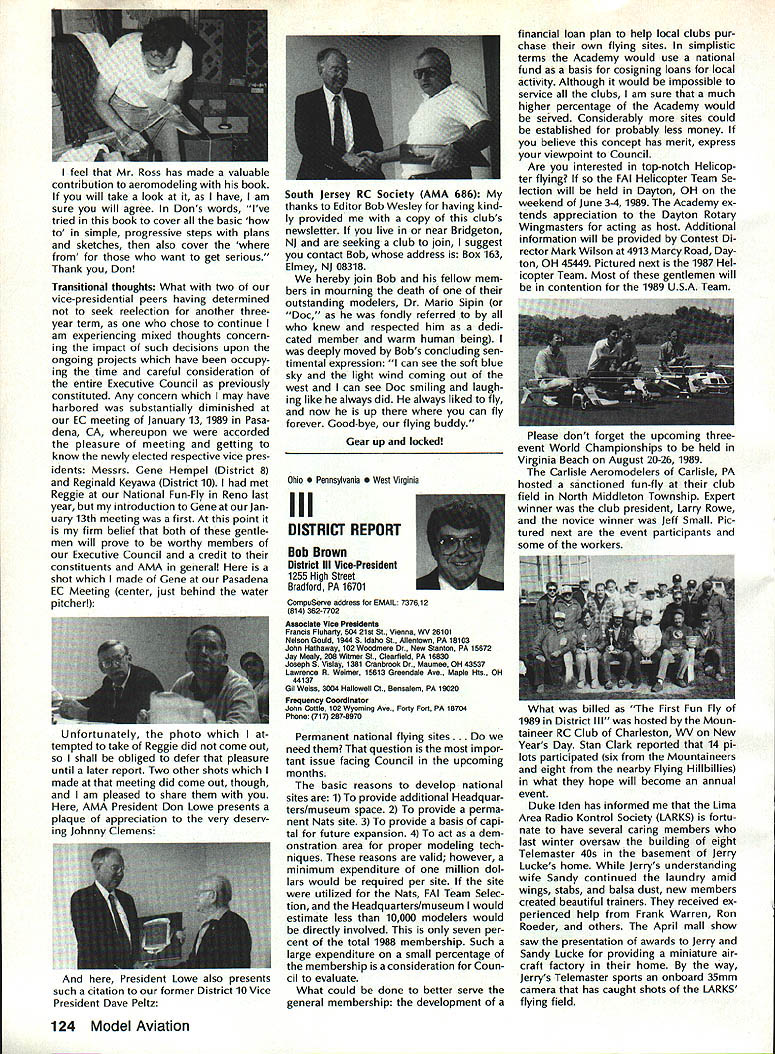
- "First Fun Fly of 1989 in District II": Mountaineer RC Club, Charleston, WV, New Year's Day — 14 pilots participated.
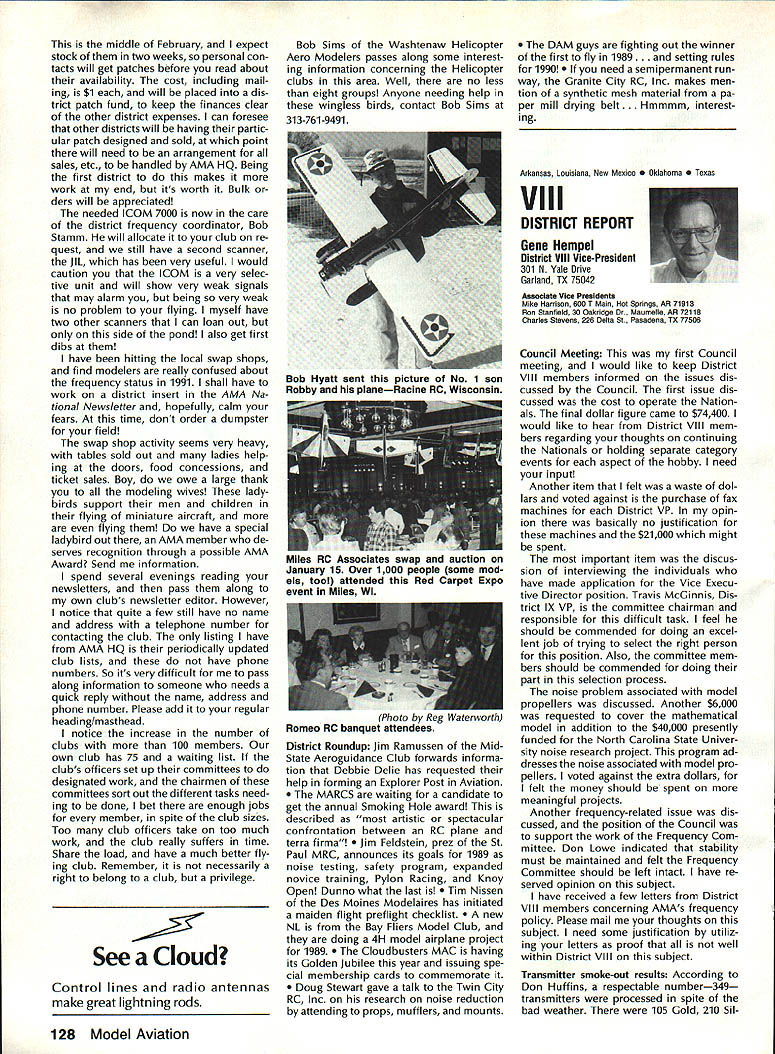
- Lima Area Radio Kontrol Society (LARKS) built eight Telemaster 40s in a basement project; Telemaster with onboard 35mm camera captured field shots.
---
District Report — District III
Bob Brown, District III Vice‑President 1255 High Street, Bradford, PA 16701
Topic: Permanent national flying sites — do we need them?
- Reasons to develop national sites:
- Provide additional Headquarters/museum space.
- Provide a permanent Nats site.
- Provide capital for future expansion.
- Serve as demonstration areas for proper modeling techniques.
- Considerations: Minimum expenditure per site estimated at $1,000,000. If utilized for Nats, FAI team selection, and Headquarters/museum, fewer than 10,000 members would directly benefit — a small percentage of total membership. Council must evaluate such large expenditures versus broad membership benefit.
- Proposal: Develop a financial loan plan to help local clubs purchase their own flying sites (using a national fund as basis for cosigning loans). This could serve a higher percentage of clubs and establish more sites with less money. Members should express viewpoints to the Council if this concept has merit.
---
District Report — District IV
Howard Crispin, District IV Vice‑President 611 Beechwood Dr., Charlottesville, VA 22901
Associate Vice Presidents (partial list):
- Robert E. Bauer — 1175 Otis Drive, Severn, MD 21144 (301-969-3576)
- Bob Cumpiano — 20503 Park Rd., Newport News, VA 23606
- Rick Christophers — 970 Star Crest, Harrisburg, VA 22801
- Jack Forrester — 5811 Fenton Dr., Mechanicsville, VA 23111
- Ralph Holland — 3507 Lenox St., Raleigh, NC 27610
- Sandy Moyers — 117 Orchard Lane, Wilmington, DE 19809
- Charles Sprinkle — 288 Holly Lane, Mocksville, NC 27028
Frequency Coordinator:
- Paul Yarbrough — 6404 Northrop Dr., Fayetteville, NC 28301 (910-488-5986)
Comments and issues:
- Cooperation between clubs is essential. Reports of clubs encroaching on others' airspace or fighting for the same field harm everyone. Flying sites are scarce; better to get a few flights than none.
- Frequency matters: A counterproposal to the FCC (on narrowband requirements) was submitted by one group without coordination with the Academy. This affects the Academy's credibility and the Frequency Committee's work. Some individuals filing with the FCC declined to attend the AMA Frequency Committee meeting.
- Polls: Only Executive Council polls can be published; the vice president's column is not the forum for national polls. Past polls (e.g., flying-site survey) suffered low response rates; policymaking based on a small respondent subset is problematic.
- Insurance and sanctioning: HQ should verify that named Contest Directors (CDs) are AMA Contest Directors when sanctioning events, especially trade shows that may be primarily for other activities.
- Sanctions: Sanctions for RC are rising; clubs should file sanction forms early to secure dates.
- Military base closings: Members should monitor base closings for potential flying-field opportunities; District IV had no suitable closings.
- District IV patch: A district patch is available; cost $1 including mailing; funds placed into a district patch fund.
- ICOM 7000: District frequency coordinator Bob Stamm manages the unit for club loan requests.
- Swap shop activity: strong; appreciation to volunteers and club spouses.
- Club growth and organization: Many clubs grow to 100+ members. Officers should delegate work to committees to involve members and avoid volunteer burnout.
- District Roundup: reports of Explorer Post formation, club projects (4‑H, trainer building), Golden Jubilee, maiden flight checklists, and noise-reduction talks.
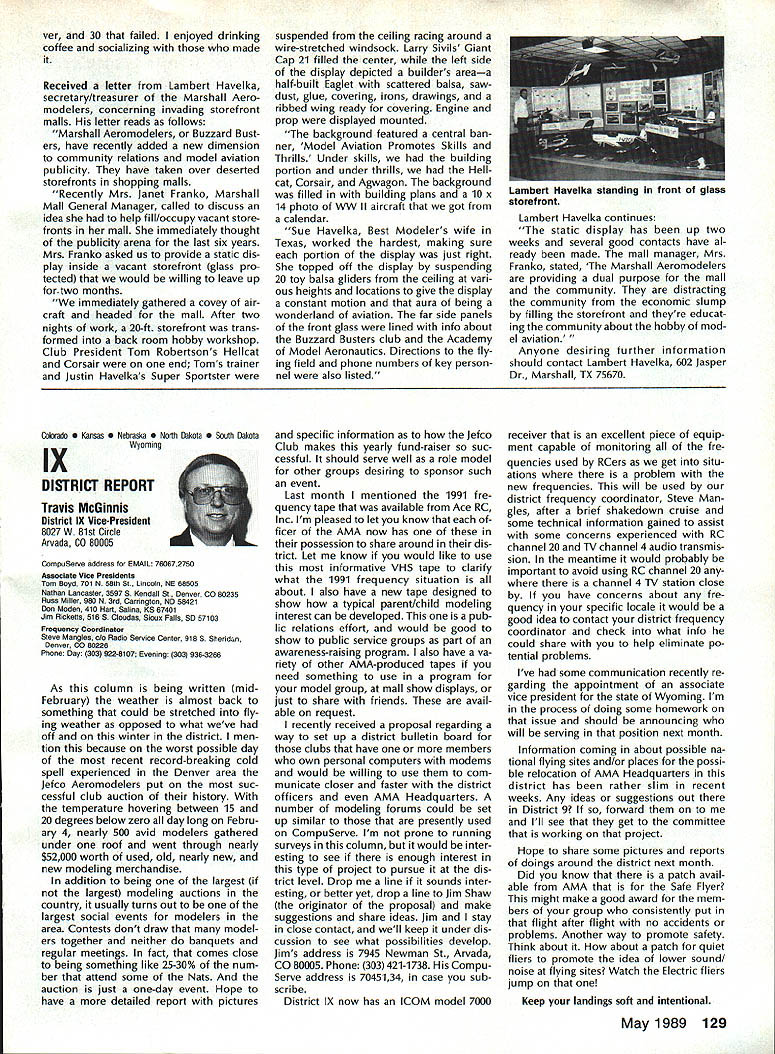
- Mall storefront display: Marshall Aeromodelers (Buzzard Busters) created a successful static display in a mall storefront to promote the hobby and attract community interest; contact Lambert Havelka for details.
---
Safety, Turbines, and Indoor Events
- Turbine engines: Safety concerns include structural adequacy and fire risk. Council suggested manufacturers demonstrate safety; AMA insurance will not yet extend coverage for turbine-engine activity. A controlled test program allowing limited insured test-flying might be considered if adequate data are produced.
- Nats indoor events: Indoor sites remain contested. A compromise was arranged: on-site Indoor events at Tri‑Cities Coliseum during Nats week, and, if finances permit, a one- or two-day activity at the Kibbie Dome (Idaho). The U.S. Indoor Championships (Johnson City, TN) received 4‑A status (June 1–4, 1989).
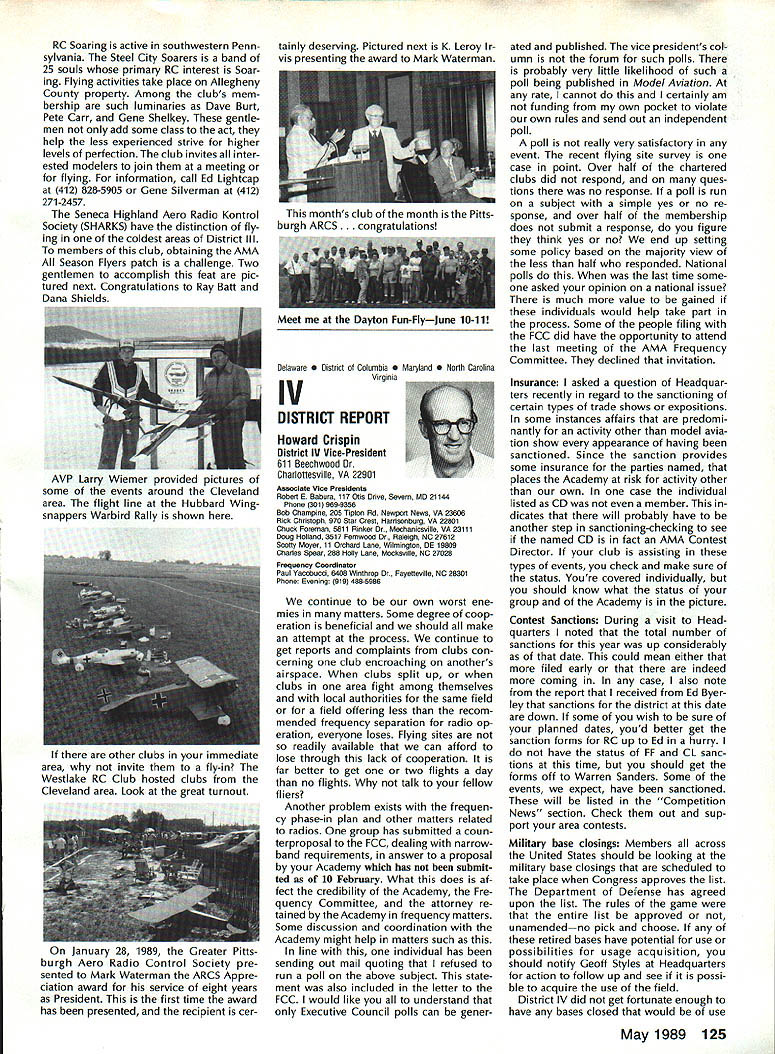
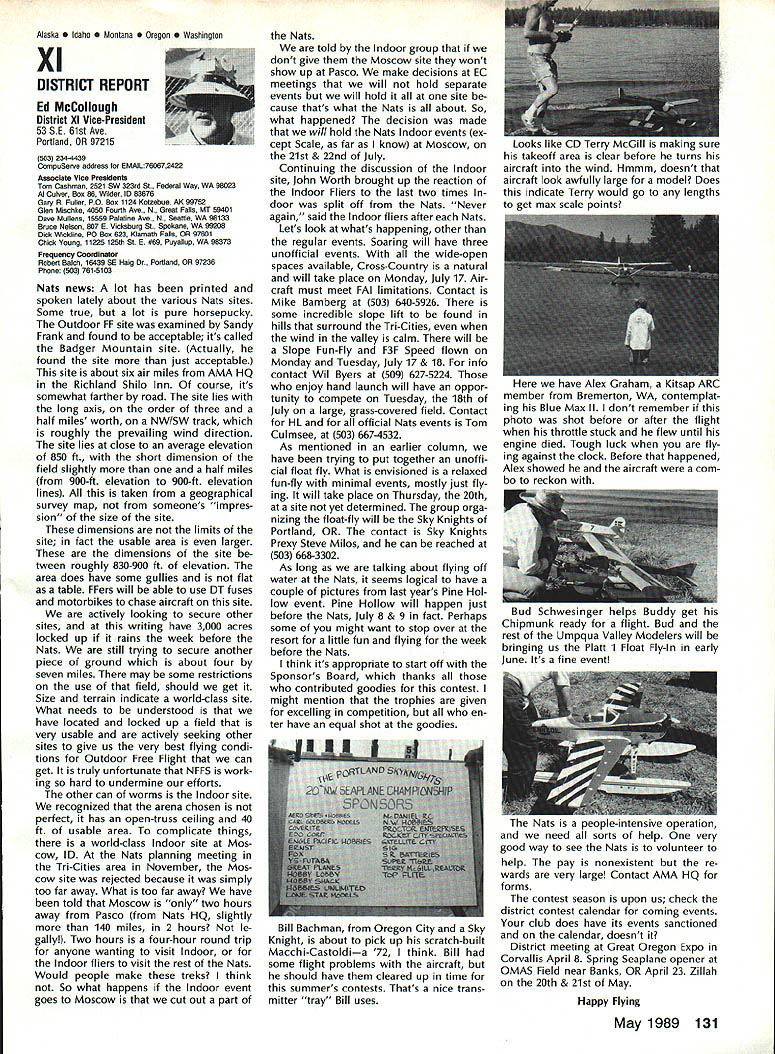
- Soaring and other unofficial Nats events: Cross-Country, Slope Fun-Fly, F3F speed, hand-launch competitions scheduled around Nats week; contacts provided in prior notices. An unofficial float fly was being organized (Sky Knights of Portland, OR).
---
Closing Notes
- The Sound Committee will seek propellers in required pitch ranges and assist groups willing to test category‑specific solutions.
- Volunteer help is essential for the Nats; contact AMA Headquarters for forms and opportunities.
- Fly safely, and continue efforts to reduce noise and preserve flying sites for the hobby.
Transcribed from original scans by AI. Minor OCR errors may remain.

