
AMA News
RC Tech Talk — Mostly layman's viewpoint (some high‑tech stuff)
Bob Underwood, AMA Technical Director
Unless you have already done so, read the piece titled "Frequency Bulletin — March 1989" in this issue before the remainder of this article.
A few points up front:
- My title, Technical Director, does not make me an expert on radio electronics. After four years as liaison for the Frequency Committee, industry, FCC and members, I have learned enough to be useful — symbols like kHz and dB no longer scare me.
- Because of my role, I often learn new information early and field many letters and calls. That puts me in a position to explain developments, but it also exposes me to rumors and misinformation. Remember the childhood "telephone" game: quick communication is not always accurate.
- Misinformation hurts the hobby: it creates anxiety, damages relationships, and divides clubs. Let's try to reduce that by sharing clear, factual information.
Where we stand on frequency matters
- The Academy (AMA) has four petitions to address; we have filed letters of opposition to requests to share AMA-assigned frequencies. Hopefully some petitions will not reach the public-comment stage.
- Two petitions would require that transmitters manufactured in the future meet narrow‑band requirements (capable of 20 kHz spacing). Exact implementation dates and grandfathering terms are unknown.
- Three possible FCC scenarios:
- Refuse to require narrow‑banding for new radios (worst case for modelers).
- Require narrow‑banding for future transmitters and provide a reasonable grandfather period for existing equipment (most likely).
- Accelerate transition if safety/operational problems are severe (historically unlikely).
- A reasonable FCC decision might be expected around mid‑1990, but rulemaking typically takes 9–12 months.
Practical issues for modelers
- In many urban areas, commercial transmissions close to AMA channels can make older equipment unusable now. Commercial permits issued in early 1988 rose sharply over 1987 — we anticipate continued commercial activity.
- The Academy is considering a service that supplies location and power-level data for commercial transmitters; coupled with new ICOM receivers purchased for each AMA district, this should help identify local interference sources. The Academy will produce guidelines and training so clubs receive interpreted, meaningful data rather than raw readings.
Sticker program, narrow‑banding and older gear
- Many clubs and individuals have purchased and tested ICOM receivers and other gear to assess the RF environment.
- Some radios supplied on problematic channels (e.g., channels adjacent to pager operation) have nevertheless performed well in some club tests.
- Can older transmitters be narrow‑banded? Yes — many can. The FCC allows modification by the type-acceptance holder or their representative as a Class I permissive change. Check with your manufacturer or importer for services or upgrade programs. The Academy is collecting official policy statements from manufacturers/importers to publish.
Short Q&A
- Are RCMA/AMA stickers required now? Not currently. Plan is to require them for sanctioned events effective December 20, 1990.
- Are narrow‑band transmitters required now? For sanctioned events on channels 12–34, yes. For general flying, not required but recommended.
- Can older transmitters be made narrow‑band? Yes — contact the manufacturer/importer; many have modification plans.
Final note We all feel apprehension; the AMA represents a large membership working to protect your interests. Expect continuing monthly Frequency Bulletins in the AMA National Newsletter and in Model Aviation.
---
Frequency Committee / Sticker Program — Chuck Ahern (report)
- The sticker program is progressing; Frequency Committee members check transmitters at trade shows. Over 50% of checked units now receive gold stickers.
- Sticker Station network: 26 authorized Sticker Stations (manufacturers, importers, distributors, independent service centers). Approval authorizes stickering only, not service or modification.
- Resolution bandwidth (RBW) measurement issue: AMA guidelines specify a transmitter signal at 20 kHz offset should be down 55 dB when measured with an analyzer using a 3 kHz RBW. Some analyzers lack a 3 kHz setting; guidance mapping other RBWs to the 3 kHz reading was distributed to Sticker Stations.
- Tektronix meeting (March 6): Tektronix provided a range of spectrum analyzers (IFR, Hewlett‑Packard, Tektronix) to compare measurements. Results enabled fine-tuning of guidance to Sticker Stations.
- Thanks to Tektronix staff and attendees for assistance and for showing assembly, testing and calibration procedures.
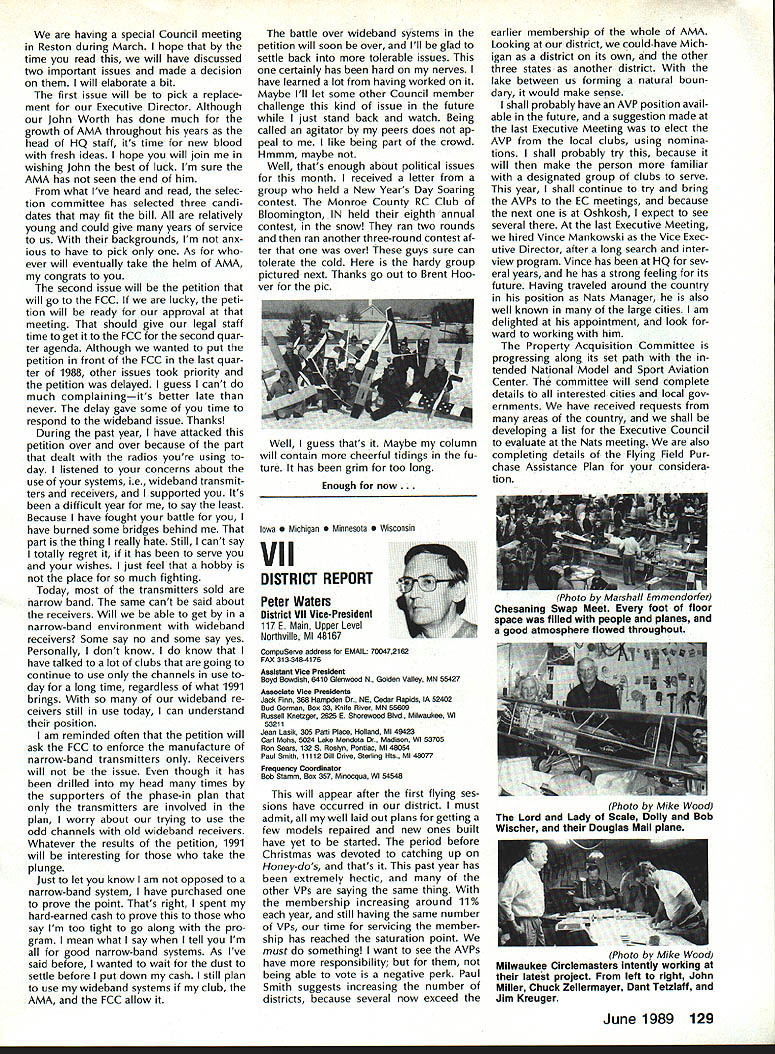
Tektronix meeting participants (L to R):
- Andy Spence, Tektronix
- Chuck Ahern, AMA Frequency Committee
- Bob Wegner, Sticker Station #103
- Morris Engelson, Tektronix
- Stan Griffiths, Tektronix
- Larry Hansen, Tektronix
---
AMA/Charles H. Grant Scholarship
- Up to $11,000 is available for distribution in various amounts this year.
- Awards depend on the number and qualifications of applicants.
- Criteria include AMA modeling activities, scholastic achievement, and citizenship.
- Applications are evaluated by the AMA/Charles H. Grant Scholarship Committee, which recommends awards to the Executive Council.
Frequency Bulletin — March 1989
Overview
- Several important petitions affecting Radio Control were filed with the FCC in March.
- Two petitions propose sharing AMA frequencies assigned in 1982:
- A bridge-crane company proposed sharing all 75 MHz frequencies with surface model users.
- Kenneth J. Seymour proposed shared use of all 72 and 75 MHz model frequencies for commercial and personal direction‑finding/tracking equipment.
Safety and operational concerns
- Shared use could affect model operation and pose potential safety hazards. For example, a crane relying on radio control could be interfered with by a nearby model car.
- Direction-finding/tracking devices for law enforcement or personal use (range estimated 1,000–5,000 yards on the ground) could function as moving single‑frequency model sites, creating practical frequency monopolies.
AMA response
- The Academy has filed letters of opposition to the two sharing petitions with the FCC.
- Sharing was likely targeted because model frequencies are license‑free and thus cheaper and faster for commercial users to adopt.
- The Academy will keep members informed as our attorney obtains more information.
Narrow‑banding petitions
- Two petitions (one from AMA, one from Glenn Whidden) request that new transmitters meet AMA's 1991 narrow‑band guidelines.
- January 1, 1991 is not a magical cutoff; it represents the end of a phase‑in period intended to reach 20 kHz spacing. Full achievement by that date was optimistic.
- The FCC could:
- Refuse narrow‑banding (bad outcome).
- Require narrow‑banding for new transmitters and allow a reasonable grandfather period for existing gear (likely).
- Accelerate transition if older equipment causes severe problems (unlikely historically).
- Rulemaking will take months; final decisions likely into 1990.
Supportive activities
- AMA is considering a service to map commercial transmitters (location and power level) to help clubs choose usable channels.
- AMA will provide guidelines and training so collected data are interpreted meaningfully for club and district officers.
- Programs are expanding to let individuals measure signal strength and collect interference data to forward to the FCC for action planning.
Goal
- Transition to narrow‑band operation with minimum sacrifice to modelers, working with manufacturers and the FCC.
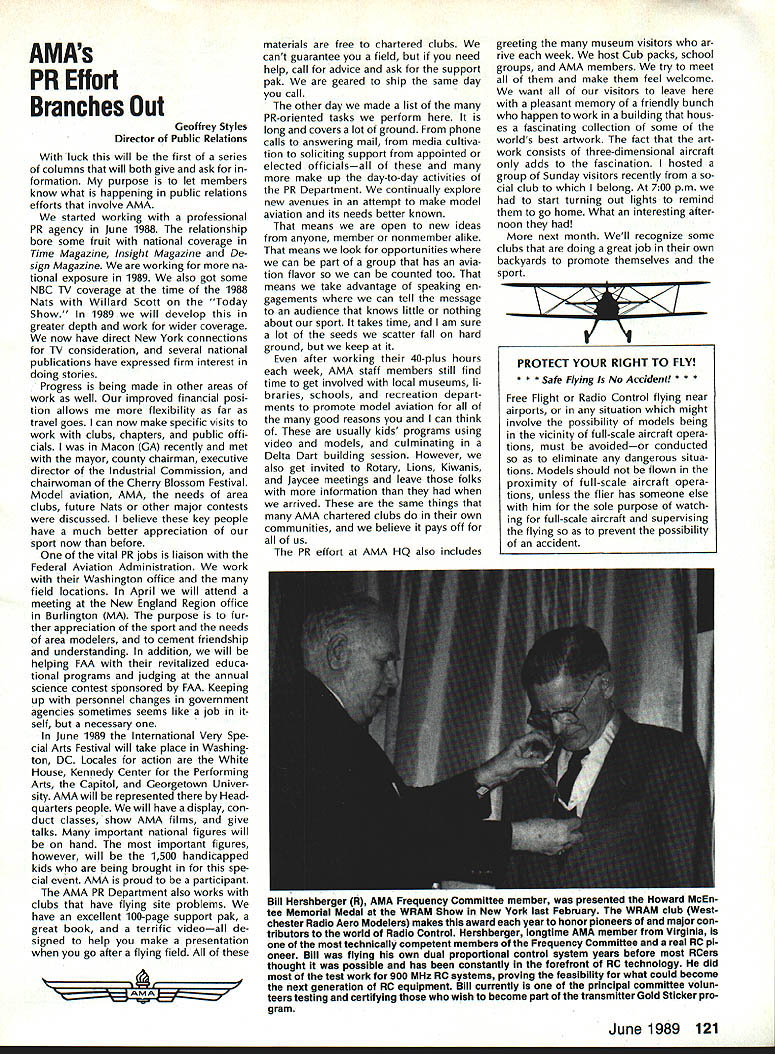
AMA's PR Effort Branches Out
Geoffrey Styles, Director of Public Relations
Key initiatives
- AMA began working with a professional PR agency in June 1988; results included national coverage (Time, Insight, Design) and NBC "Today Show" exposure at the 1988 Nats.
- In 1989 AMA plans broader national TV and print coverage, with New York TV connections and interest from major publications.
- Improved finances permit more travel by PR staff to meet local officials and promote model aviation (example: meetings in Macon, GA).
FAA liaison and events
- AMA works with FAA headquarters and regional offices; staff will attend meetings (e.g., New England region) to promote goodwill and FAA educational programs.
- AMA will participate in the International Very Special Arts Festival (June 1989) in Washington, DC: displays, classes, films, and talks for handicapped children.
Club support materials
- AMA provides a 100‑page support pack, a book, and a video to help chartered clubs pursue flying sites. These materials are free to chartered clubs and ship the same day upon request.
Community outreach
- AMA staff regularly support local museums, libraries and youth programs with models and presentations, and host museum visitors and club tours at Headquarters.
From the Clubs — Selected Reports and Notes
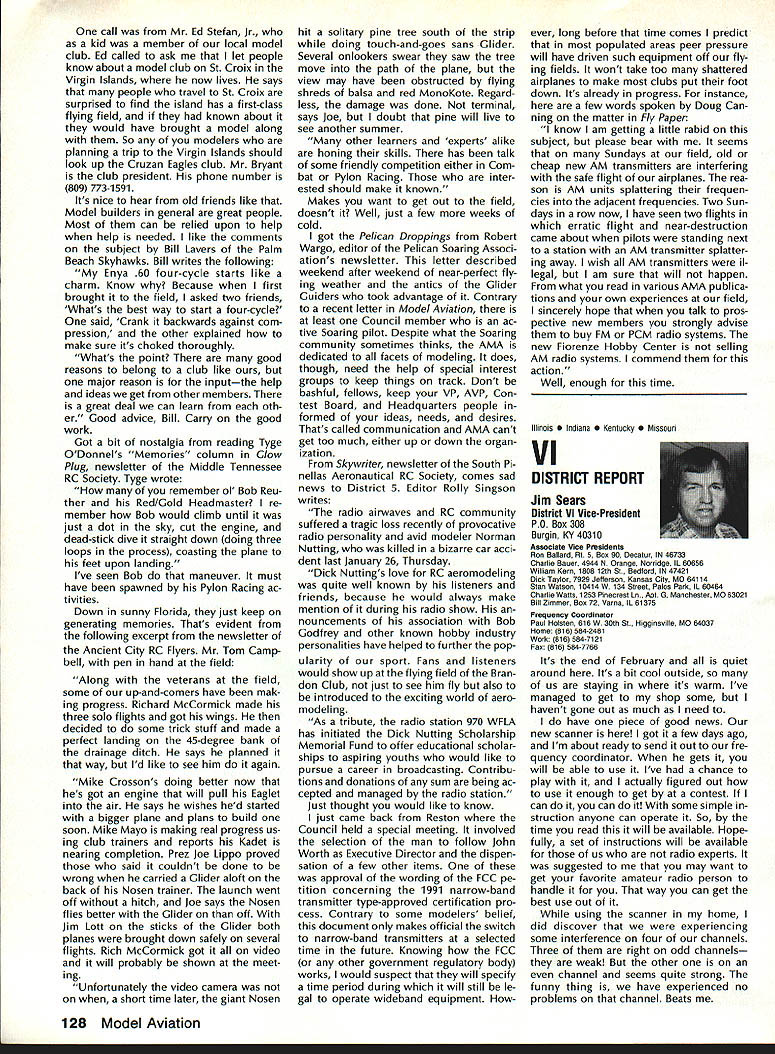
- Bill Hershberger (Frequency Committee member) received the Howard McEntee Memorial Medal at the WRAM Show (Westchester Radio Aero Modelers) for his pioneering RC work.
- Cruzan Eagles (St. Croix): A first‑class flying field exists on St. Croix; visitors should contact club president Mr. Bryant at (809) 773‑1591.
- Palm Beach Skyhawks: Club camaraderie and member assistance are valuable for beginners (example: engine starting tips and training help).
- Ancient City RC Flyers (Florida): Up‑and‑comers are progressing; an incident with an Nosen and a pine tree was recounted (damage not terminal).
- Pelican Soaring Association: Reports of excellent soaring weekends and active Glider Guides.
- Tribute: Dick Nutting, radio personality and avid modeler, was killed in an accident. The radio station 970 WFLA established the Dick Nutting Scholarship Memorial Fund in his honor.
District Reports
District 1 Report
Don Krafft, District 1 Vice‑President P.O. Box 1828, Duxbury, MA 02331 (617) 934‑6248
Associate Vice Presidents
- Bill Chandler, Orland, ME
- Dave Davenport, Townsend, MA
- Bob Larson, Essex, VT
- Richard Sherman, Plymouth, NH
- Bob Wallace, Avon, CT
Frequency Coordinator
- George Wilson, Marstons Mills, MA
Vice Executive Director appointment
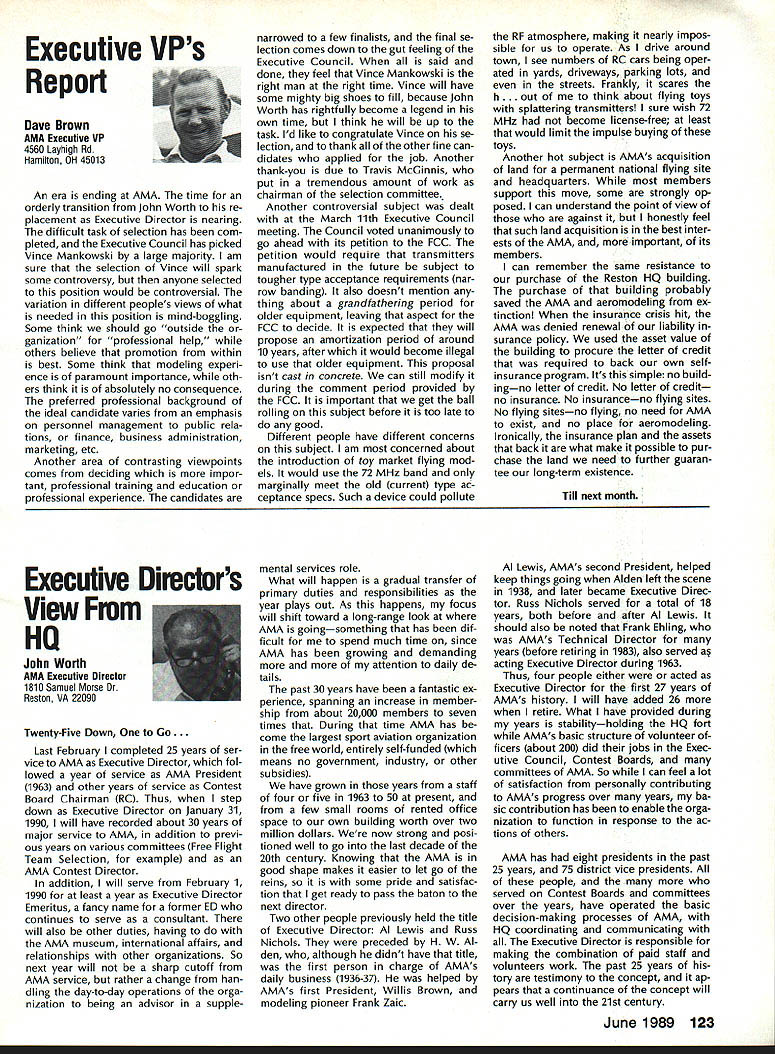
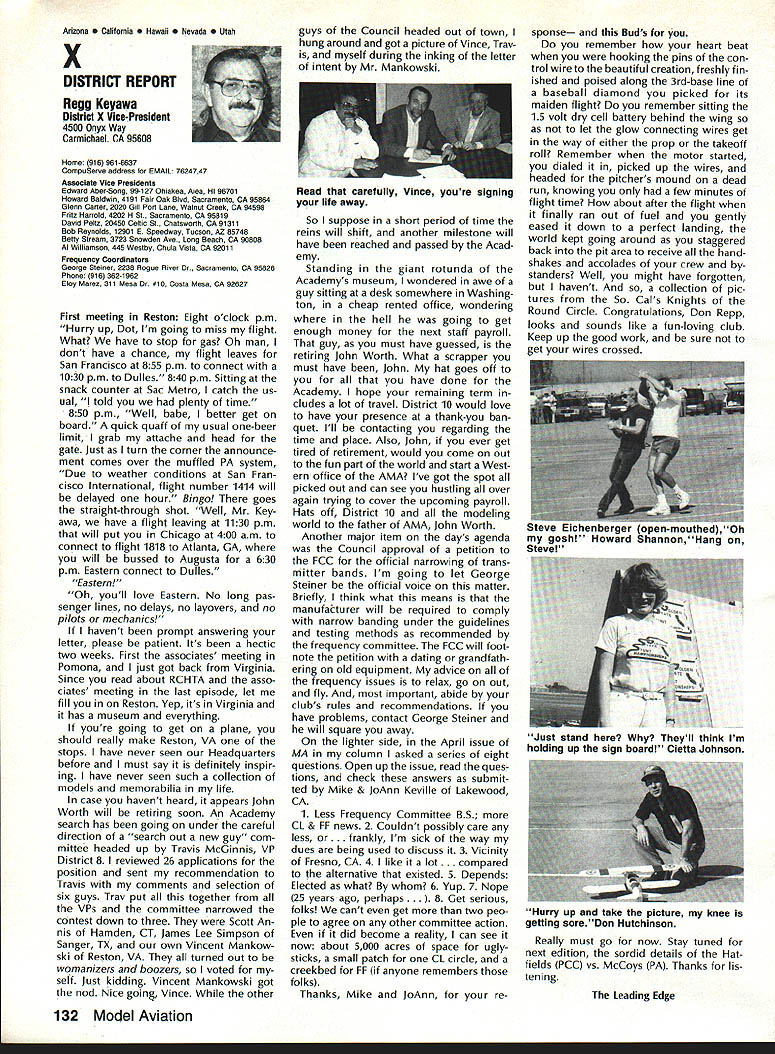
- Vince Mankowski has been named Vice Executive Director after a nationwide search.
District events
- District One Fun‑Fly: club contacts should have received flyers; call Don Krafft if you have not.
- Brimfield Float Fun‑Fly (1989) canceled due to state staffing/austerity issues.
Radio report — summary and guidance Brief history of RC frequencies
- 1950s: Started with single 27 MHz frequency (27.255), later additions (26.995, 27.045, etc.). These remain legal.
- 1960s (about 1966): Original 72 MHz "colored" frequencies allocated (72.08, 72.16, 72.24, etc.) — now illegal for RC use.
- 1980s: Due to increased commercial traffic, the AMA petitioned for additional exclusive RC frequencies. The FCC granted 80 frequencies: 50 in 72 MHz and 30 in 75 MHz ranges.
Frequency committee and flag system
- A volunteer Frequency Committee (12–14 technical members) developed the phase‑in plan and new transmitter-flag identification system. The old colored flags were impractical for 50 channels.
Definitions
- Narrow band (gold sticker): -55 dB at 20 kHz spacing.
- Wide band (silver sticker): -35 dB at 20 kHz spacing.
- Secondary user: RC is a secondary user relative to some commercial users; if interference occurs, modelers must address it.
Phase‑in program and options (effective through Dec 20, 1990)
- Currently, channels 12–34 require narrow‑band transmitters for sanctioned events (recommended for general use). Channels 38–56 may use wideband transmitters where no commercial interference exists.
- After December 20, 1990, odd‑numbered channels will be available; clubs have options:
- Use all available channels (likely requiring narrow‑band equipment).
- Use channels 12–34 and even channels 38–56 (narrow‑band required for 12–34; wideband may remain on 38–56 if interference-free).
- Use only even channels (current receivers could continue if no interference).
- If a club limits channel use, they must accommodate visiting pilots by freeing requested channels; sanctioned events typically use frequency control.
Flight‑line management and practices
- Pilot stations: position antennas about 20 ft apart to reduce interstation interference and 3IM-type glitches.
- Equipment care: have transmitters serviced periodically (at least every two years).
Do's and Don'ts
- Do not change your own crystals — illegal and degrades performance.
- Do not operate radios outside recommended specs.
- Do maintain at least 20 ft between transmitter antennas.
- Do have your transmitter serviced periodically.
- Do read the AMA Membership Manual for guidance.
- Do remember club rules become part of the AMA Safety Code for insurance purposes.
- Do be aware of commercial stations that may introduce interference; narrow‑band receivers may become necessary.
- Do be careful when purchasing equipment — some older wideband radios remain on shelves. Let the buyer beware.
- Do practice careful installation: keep antenna leads away from servo wiring, use chokes on long servo leads, and keep installations neat.
- Do avoid channel 20 in areas served by TV Channel 4 unless using a narrow‑band receiver (TV audio can interfere).
FAQ highlights
- Why 50 frequencies? To accommodate groups that need many simultaneous frequencies (e.g., sailplane events).
- Are stickers mandatory? No (except required for sanctioned events on channels 12–34).
- Is the new frequency identification plan required? No, but it is recommended; some clubs may require it.
Videotape and further information
- A two‑hour videotape covering the radio situation is available from your District VP, AVP, or Frequency Coordinator. Recommended for club officers.
Continued next month.
---
District IX Report
Travis McGinnis, District IX Vice‑President 8027 W. 81st Circle, Arvada, CO 80005 CompuServe: 76067,2750
Associate Vice Presidents
- Tom Boyd, Lincoln, NE
- Nathan Lancaster, Denver, CO
- Russ Miller, Carrington, ND
- Don Mook, Salina, KS
- Jim Ricketts, Sioux Falls, SD
Frequency Coordinator
- Steve Manges / Radio Service Center, Denver, CO
Days: (303) 922‑8107; Evenings: (303) 936‑3266
Key items
- Wyoming AVP appointment pending; vetting of candidates underway.
- District IX meeting: November 4–5, 1989 in Bismarck, ND — mark your calendars (44th annual District IX meeting).
- Congratulations to Vince Mankowski on his appointment as Vice Executive Director of AMA.
- Nationals: July 15–23, 1989 — advance entry deadline: midnight, June 16, 1989.
- District office plans: fax capability and increased communications with Headquarters and volunteers; CompuServe address remains available.
Closing
- Photos and local activity reports are encouraged for future columns. Keep cards, letters and pictures coming.
Executive Director Transition and Reflections
- John Worth is retiring after many years as Executive Director; his long service and dedication to AMA were recognized in multiple district reports.
- Vince Mankowski has been appointed Vice Executive Director and will transition into broader leadership responsibilities. Members are asked to support both John and Vince during the transition.
Miscellany and Anecdotes
- CIMAS (Columbia Indoor Miniature Aircraft Society) outreach: successful student recruitment at Columbia University with complimentary beginner kits and student officers appointed; student members received supplies and encouragement to form a sustained student group.
- Club anecdotes and nostalgia: letters and reports from clubs across the country highlighted the value of club instruction, member assistance, and the joy of shared activities (examples from Palm Beach Skyhawks, Monroe County RC Club, Temple Aeromodelers, and Rice Lake Model Airplane Club).
---
Continued coverage and updates will appear in upcoming issues of Model Aviation and the AMA National Newsletter. If you need further details on any item above, contact your district officer or AMA Headquarters.
Transcribed from original scans by AI. Minor OCR errors may remain.

