
AMA FREQUENCY COMMITTEE REPORT:
RC Expansion Needs Defined
As a followup to last summer's campaign to prevent merging 27 MHz RC frequencies with CB channels, AMA's Frequency Committee has been exploring what's needed next to improve the situation for RCers. Several months of study, using inputs from AMA members, RC industry leaders, and AMA's legal counsel, have produced the following document outlining the current problem and where we need to go from here.
The report is not a final document. It is merely an opening statement which is expected to be modified and added to as additional inputs from others are received, particularly those from FCC sources. Frequency Committee members are exploring with FCC officials the various possibilities in this report. At the same time the Committee is seeking further thoughts from the industry, AMA members, and members of related groups: RC car and boat organizations.
Thus, the document is not a fixed or final position paper. It is intended as a basic document to be elaborated on with more information and is subject to further change by the Frequency Committee. For now, however, it serves as a status report which will be used to initiate what might be called Phase Two of current FCC explorations—planning to replace the finger-in-the-dyke that we now have concerning 27 MHz operations, so that a better long-range solution to the problem of expanding RC needs may be achieved.
This report was developed from a meeting held at AMA HQ in mid-November. In attendance were John Strong, chairman of the Frequency Committee; Walt Good, former chairman and current member; two members of AMA's legal counseling staff, and several AMA HQ personnel.
Plan for the Acquisition of New RC Frequencies Prepared by the AMA Frequency Committee, December 1976
- Purpose—
To acquire new RC frequencies which will satisfy the needs of the total RC community on a long-term basis.
- Background—
The RC hobby began in the 1930's and has grown into a recognized sport with an estimated 250,000 modelers who use approximately half a million transmitters to control model planes, boats and cars by radio. An industry of over $200 million/yr. has developed to supply the electronics, kits and related accessories to this hobby. The electronics part of this industry has pioneered and refined RC equipment which is noted for its performance and has been copied throughout the world.
Because the control of RC models is a short range, line-of-sight, situation the transmitter power has become established at a level of under one watt. Hence, the interference of other radio services from RC transmitters has been, we are proud to state, essentially zero with no known complaints to the FCC.
The frequencies allocated for RC purposes are under the Class C license category of the Citizens Band Radio Service and are number 12 channels in two different bands.
Five of the channels are in the 27 MHz CB band. The potential loss of these frequencies is the chief stimulant to the exploration of new RC frequencies. Interference from CB operations to RC models has been given serious consideration in the FCC Docket 20120. In its July 27, 1976 release the FCC stated: "We believe that, eventually, alternate frequencies must be found to supplant the present 27 MHz Class C allocation because of the increasing problem of interference by Class D users to Class C radio control operations." The remaining seven channels are in the 72 MHz band. Five were allocated in 1966 and two were added in 1971, under the low-power (1 watt) regulations and have been very popular. Recently, due to sharing of channels, interference has been reported which has caused damage to some RC model airplanes. As a result only a few of the seven channels can be used in some areas due to safety problems. This situation has been aggravated by mixing high and low power operations on the same frequencies. Originally (1966) there were only a comparatively few high power allocations in the 72 MHz band but the number has increased in the past 10 years. With each
(continued on page 61)
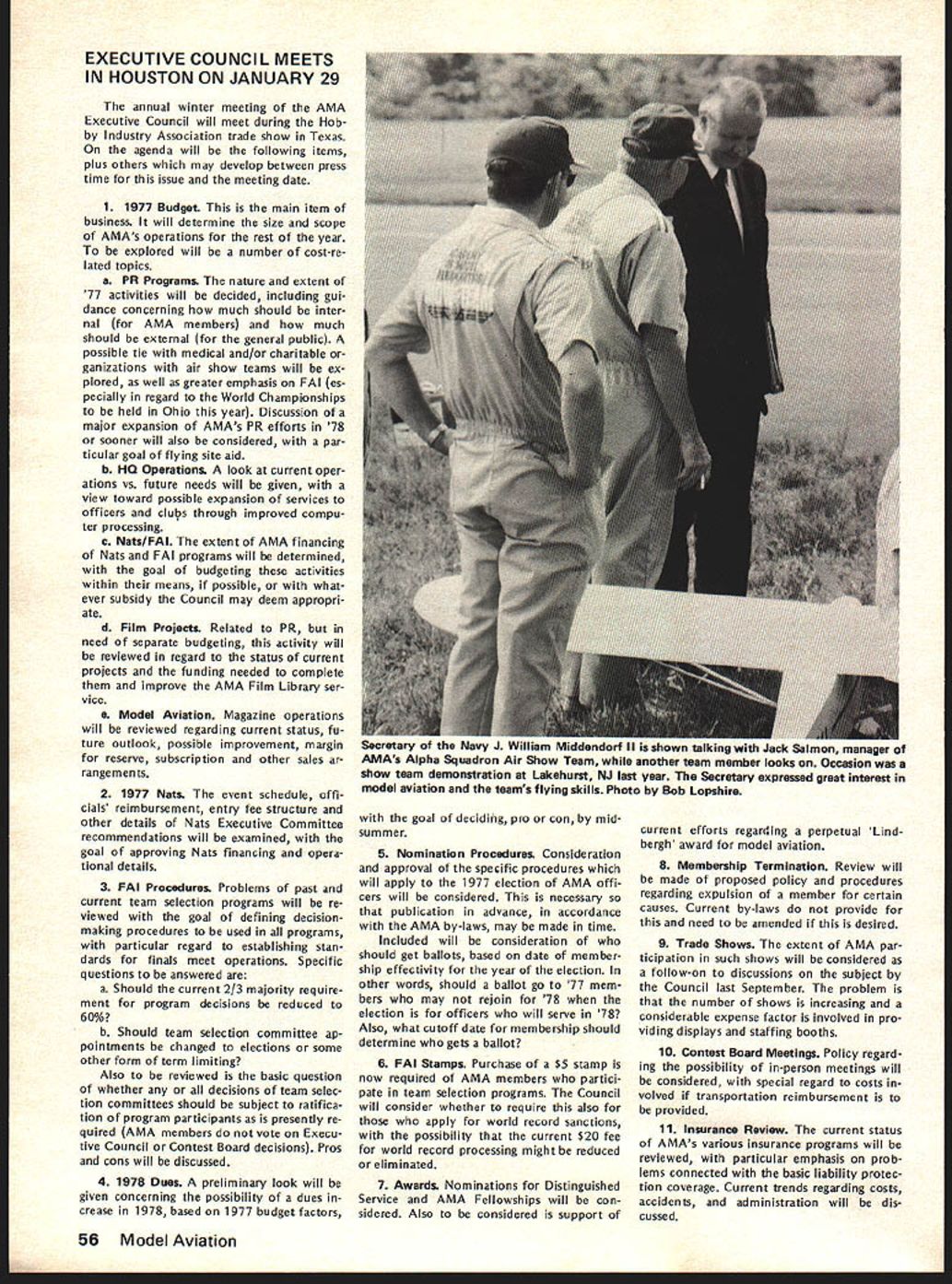
EXECUTIVE COUNCIL MEETS IN HOUSTON ON JANUARY 29
The annual winter meeting of the AMA Executive Council will meet during the Hobby Industry Association trade show in Texas. On the agenda will be the following items, plus others which may develop between press time for this issue and the meeting date.
- 1977 Budget. This is the main item of business. It will determine the size and scope of AMA's operations for the rest of the year. To be explored will be a number of cost-related topics.
a. PR Programs. The nature and extent of '77 activities will be decided, including guidance concerning how much should be internal (for AMA members) and how much should be external (for the general public). A possible tie with medical and/or charitable organizations with air show teams will be explored, as well as greater emphasis on FAI (especially in regard to the World Championships to be held in Ohio this year). Discussion of a major expansion of AMA's PR efforts in '78 or sooner will also be considered, with a particular goal of flying site aid.
b. HQ Operations. A look at current operations vs. future needs will be given, with a view toward possible expansion of services to officers and clubs through improved computer processing.
c. Nats/FAI. The extent of AMA financing of Nats and FAI programs will be determined, with the goal of budgeting these activities within their means, if possible, or with whatever subsidy the Council may deem appropriate.
d. Film Projects. Related to PR, but in need of separate budgeting, this activity will be reviewed in regard to the status of current projects and the funding needed to complete them and improve the AMA Film Library service.
e. Model Aviation. Magazine operations will be reviewed regarding current status, future outlook, possible improvement, margin for reserve, subscription and other sales arrangements.
- 1977 Nats. The event schedule, officials' reimbursement, entry fee structure and other details of Nats Executive Committee recommendations will be examined, with the goal of approving Nats financing and operational details.
- FAI Procedures. Problems of past and current team selection programs will be reviewed with the goal of defining decision-making procedures to be used in all programs, with particular regard to establishing standards for finals meet operations. Specific questions to be answered are:
a. Should the current 2/3 majority requirement for program decisions be reduced to 60%?
b. Should team selection committee appointments be changed to elections or some other form of term limiting?
Also to be reviewed is the basic question of whether any or all decisions of team selection committees should be subject to ratification (by the Council or members' delegate vote) (AMA members do not vote on Executive Council or Contest Board decisions). Pros and cons will be discussed.
- 1978 Dues. A preliminary look will be given concerning the possibility of a dues increase in 1978, based on 1977 budget factors, with the goal of deciding, pro or con, by midsummer.
- Nomination Procedures. Consideration and approval of the specific procedures which will apply to the 1977 election of AMA officers will be considered. (This is necessary so that publication in advance, in accordance with the AMA by-laws, may be made in time). Included will be consideration of who should get ballots, based on date of membership effectiveness for the year of the election. In other words, should a ballot go to '77 members who may not rejoin for '78 when the election is for officers who will serve in '78? Also, what cutoff date for membership should determine who gets a ballot?
- FAI Stamps. Purchase of a $5 stamp is now required of AMA members who participate in team selection programs. The Council will consider whether to require this also for those who apply for world record sanctions, with the possibility that the current $20 fee for world record processing might be reduced or eliminated.
- Awards. Nominations for Distinguished Service and AMA Fellowships will be considered. Also to be considered is support of current efforts regarding a perpetual "Lindbergh" award for model aviation.
- Membership Termination. Review will be made of proposed policy and procedures regarding expulsion of a member for certain causes. Current by-laws do not provide for this and need to be amended if this is desired.
- Trade Shows. The extent of AMA participation in such shows will be considered as a follow-on to discussions on the subject by the Council last September. The problem is that the number of shows is increasing and a considerable expense factor is involved in providing displays and staffing booths.
- Contest Board Meetings. Policy regarding the possibility of in-person meetings will be considered, with special regard to costs involved if transportation reimbursement is to be provided.
- Insurance Review. The current status of AMA's various insurance programs will be reviewed, with particular emphasis on problems connected with the basic liability protection coverage. Current trends regarding costs, accidents, and administration will be discussed.
AMA FREQUENCY COMMITTEE REPORT
Plan — Acquisition of New RC Frequencies Prepared by AMA Frequency Committee — December 1976
- Purpose
Acquire new RC frequencies which will satisfy the needs of the total RC community on a long-term basis.
- Background
The RC hobby began in the 1930s and has grown into a recognized sport. It is estimated 250,000 modelers use approximately one-half million transmitters to control model planes, boats and cars. A radio industry in excess of $200 million per year has developed to supply electronics, kits and related accessories. The hobby electronics parts industry has pioneered and refined RC equipment noted for its performance, which has been copied throughout the world.
Because control of RC models is a short-range, line-of-sight situation, transmitter power has become established at a level under 1 watt. Hence interference to other radio services from RC transmitters is at a practically zero level with no known complaints. FCC frequencies allocated to RC purposes are under the Class C license category.
The Citizens Band Radio Service has 12 channels in two different bands. Five channels in the 27 MHz CB band are potential loss frequencies and the chief stimulant for exploration of new RC frequencies. Interference between CB operations and RC models has given serious consideration to FCC Docket 20120. In its July 27, 1976 release the FCC stated it believes eventually alternate frequencies must be found to supplant the present 27 MHz Class C allocation because of increasing problems of interference from Class D users.
Class C radio control operations remain on seven channels in the 72 MHz band — five allocated in 1966 and two added in 1971 under low-power (1 watt) regulations — and have become very popular. Recently, because of the shared nature of these channels, interference has been reported which has caused damage to some RC model airplanes. As a result, the few 72 MHz channels cannot be used in some areas due to safety problems. The situation has been aggravated by mixing high- and low-power operators on the same frequencies. Originally, in 1966, comparatively few high-power allocations existed in the 72 MHz band; the number has increased in the past 10 years.
Just before Christmas the FCC announced that, effective January 1, 1977, certain classes of FCC licenses would require fee payment until further notice. This action resulted from litigation challenging the FCC's authority to determine amounts charged as fees. Until the question is resolved, the FCC is suspending fee payments. This affects RC, CB, Amateur and Broadcasting forms of FCC licenses. How long the formerly-free period will last is uncertain — perhaps several weeks or several months.
In the meantime there is a golden opportunity to boost the number of Class C RC licenses registered with the FCC to better indicate RC operators really exist and deserve consideration. Unfortunately, the use of club licenses masks the true number of RCers. AMA therefore urges obtaining individual licenses as soon as possible. Now that the cost for a license has been temporarily eliminated, there is no excuse for continuing to use a club license except for newcomers. AMA has on hand large quantities of FCC license application forms. Clubs should request immediately, by phone or letter, the number of license applications they need. THE FAITH SHOWN IN US BY THE OTHER NATIONS.
In the past few years under a steady plan of more and better involvement the UNITED STATES thru AMA has become a much more active participant in world modeling competitions and affairs. We have learned a lot about both what we can gain and what we can give in world aeromodelling. Our representation has been constantly improved with technical matters now in the hands of qualified experts in each category rather than in the hands of just one delegate. This plan is being expanded by a revolutionary plan of AMA sharing costs with recognized special interest groups. This plan in turn leaves our administrative experts with only administration and procedural problems to worry with! All of this section is strongly backed by our AMA Headquarters.
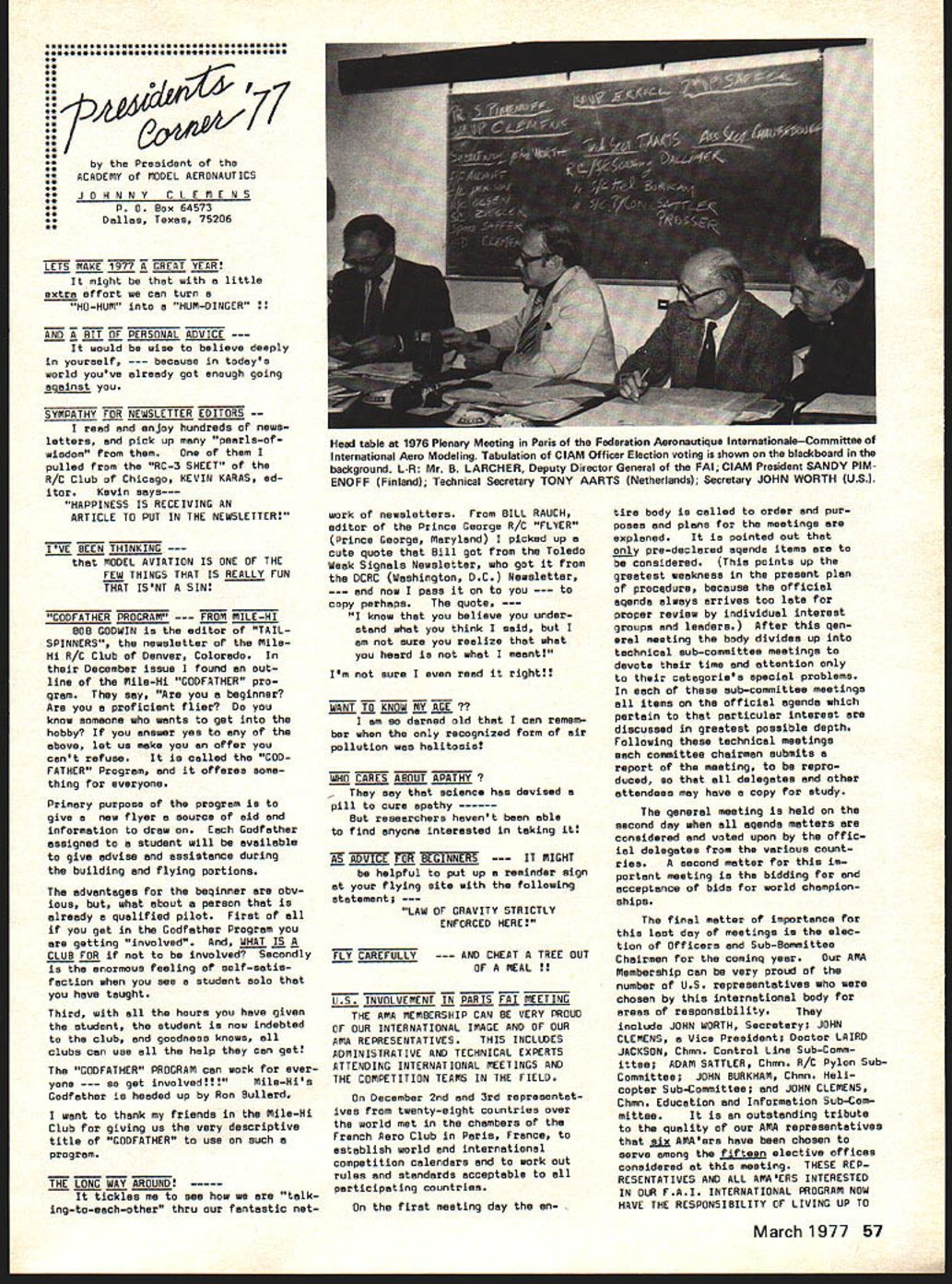
U.S. representatives at this year's F.A.I.-C.I.A.M. (Committee for International Aero Modeling) were JOHN NORTH doing his usual excellent job as Secretary, JOHN CLEMENS as official U.S. Delegate, and Dr. LAIRD JACKSON concerned with Control Line matters. RON CHIDGEY represented the U.S. in R/C Pattern matters, as did JIM SIMPSON in Soaring and JOHN BURKHAM in Helicopter. GEORGE SENAKIS looked after our Free Flight interests. The Scale Sub-Committee meeting was attended by both NORTH and CLEMENS.
I personally salute the folks active in our international programs, and to aid in developing more U.S. PRIDE I urge you to buy an FAI STAMP or send contributions to support our image in the eyes of the rest of the modeling world!
STOOPID LOGIC --- AGREE?
One of my flying buddies builds the sloppiest and worst looking models you ever saw. I was trying to challenge his pride to see if he wouldn't improve the looks of the planes he brought out to our flying field on weekends. He said, "Sure, I know they are crummy, but there are 168 hours in the week and I only spend about 2 or 3 of those hours out at the field. If I'm only embarrassed for about 2 or 3 hours out of 168, THAT AIN'T VERY MUCH!"
I guess that is the same sort of logic as asking, "If a tree fall in a forest and there is no one there to hear it, does it make any noise?"
RENEWING AN OLD FRIENDSHIP
A very pleasant surprise brought an old friend of mine, and AMA too, in to see me a couple of days ago. Over a sandwich at the across-the-street hamburger stand from my hobby shop Arthur (Art) Leneau, AMA-703 from East Weymouth, Mass., and I spent about an hour "catching-up" on the seven or eight years we had not seen each other. Most of you readers will not recognize the name "Art Leneau", but AMA will always have a debt to Art for a great amount of behind-the-scenes public relations work he did for AMA.
Public relations work is hard to score because you can't put figures or any attributable benefits on the "bottom line". But as I witness I can assure you that this personable Leneau fellow (and he does hold a Fellowship in AMA) was an unsung hero for his very effective efforts at encouraging the U.S. Navy to continue to co-sponsor our AMA "NATIONALS" with us. This at a time when Navy funds and available personnel had begun to run thin. This was during those "golden years" when we held the Nationals each year on a Naval Air Reserve Training Station, moving thru a cycle of four points touching all parts of the country.
Under this four-point plan the "NATS" were held one year at Willow Grove N.A.S. near Philadelphia, the next year at Glenview N.A.S. north of Chicago, the following year at Los Alamitos N.A.S. near Los Angeles, and then the year after that at the Dallas N.A.S.
With this 4-point system every youngster in the country had the National Model Airplane Championships held near his home during his Junior competitive years, and then again during his Senior Age Class competitive years, and, of course, once more during his Adult Open Age Class years.
The Academy of Model Aeronautics will always have a debt to the U.S. Navy for this support, while AMA was repaying that debt by interesting the youth of the U.S. in aviation, thus making available to Navy Air a superior selection of future Navy personnel. This "happy marriage" between AMA and our Navy continued for 25 years, and is a most important part of our history.
Considering that the 1976 AMA "Nationals" was held at Wright-Patterson Air Force Base and the 1977 "Nationals" are to be held at March Air Force Base at Riverside, California it is only logical to wonder if our leaders aren't possibly exploring the possibility of setting up a long range program of co-sponsorship with the U.S. Air Force. You can bet that AMA's leaders are looking at everything like this. And we are especially encouraged by the warm and enthusiastic cooperation we are being given toward the 1977 "NATS" by the RIVERSIDE AIR FORCE ASSOCIATION! And in case you are not familiar with the Air Force Association, it is a "booster" group of retired Air Force folks and interested industry and civic minded individuals that are dedicated toward building liaison between the Air Force, industry, and communities involved with the Air Force and it's personnel. Always great folks!
This item started out to be about Art Leneau, but I got carried away. Anyhow, Art asked me to say "Hello" to his old friends in AMA, he also is always "good" for a bunch of the latest funny stories. Good guy, so seek him out!
TONGUE-IN-CHECK MEASUREMENTS
Last month I mentioned that JIM and CATHY MILLER had met and married because of Cathy having kindly delivered Jim's mis-directed AMA mail to him. Jim got a sharp gal: Cathy overheard us discussing the FAA suggested 400 foot altitude limit for model planes and then said, "Four hundred feet? Let's see, in metric that would be four centimeters!!!"
THE NEWSLETTER EDITOR'S DILEMMA!!!
The SEATTLE RADIO AERO CLUB has a newsletter called "Plane Talk" that is edited by ED BROWN. I called Ed on the phone to get permission to copy an item from his paper. He said he didn't know where it came from originally, but that he had modified it to more suit AMA's newsletter editors. About newsletter editors he says:
- If he expresses his opinion on a subject - he is trying to run things.
- If he is silent - he is dumb and has lost interest.
- If he agrees with you - he lacks originality.
- If he does not agree with you - he is ignorant.
- If he tries to appear cordial - he is brown-nosing.
- If he is aloof - He should be trimmed down a bit.
- If he has an opinion - He is bull-headed.
- If he explains both pros and cons - he is pussyfooting.
- If he writes long detailed articles - he is tied up.
- If he writes short articles - he don't know the score.
- If he has been an editor a long time - he lacks new ideas.
- If he has been an editor a short time - he lacks experience.
- If he dresses well - He thinks he is a big shot.
- If he dresses shabby - he is not a proper representative.
- If he tries to get members to write articles - he is pushy.
- If he tries to hack it on his own - he thinks he is God's gift to the club.
- If he makes a lot of errors - he is illiterate.
- If he doesn't make any errors - he is a smart-aleck.
- If he takes off for a vocation - where the hell has he been all year?
- AND YOU THINK YOU'VE GOT PROBLEMS!!!
FROM THE SAME NEWSLETTER
At the SEATTLE RADIO AERO CLUB Banquet the "Destruction Award" went to RAD RUSSELL for his celebrated act of formation flying at which time he approached his buddy, DON OLSON'S plane from the rear and chowed into its tail off! Ironically the award was presented to RAD by Don Olson. To make Rad's day more complete, a prop jumped out and "hit" him in the hand. Yes, some 18 stitches-worth at $10.00 per stitch!
ONE MODELER SAID TO ANOTHER
"My right landing gear is shorter than my left landing gear. If one of your landing gears was shorter than the other what would you do?" His buddy answered, "I'd probably limp!"
THINK ABOUT IT
You don't buy a newspaper - you buy news. You don't buy life insurance - you buy security for others. You don't buy classes - you buy knowledge. You don't buy an AMA license - you buy dedicated leadership and the cooperation of the entire membership to join hands to do things you cannot do alone!
... that's all for now *****
AMA News
FCC Recognizes RC (from page 55)
merits and, eventually, with our own regulations.
The text of the FCC announcement:
REORGANIZATION OF CITIZENS RADIO SERVICE RULES AND RENAMING OF THE CITIZENS RADIO SERVICE (DOCKET 20120)
The Commission today adopted a Third Report and Order in Docket 20120, changing the names of the Citizens Radio Service and its subdesignations and implementing an editorial reorganization of Part 95 of the Rules.
The name of the Citizens Radio Service was changed to the Personal Radio Services; the Class A Citizens Radio Service was changed to the General Mobile Radio Service; the Class C Citizens Radio Service was changed to the Radio Control (R/C) Service; and the Class D Citizens Radio Service was changed to the Citizens Band (CB) Radio Service.
The reorganized Part 95 consists of four subparts, one for each of the three Personal Radio Services. The fourth subpart contains technical standards applicable to all Personal Radio Services. The Rules have been revised to require that licensees in the Personal Radio Services must have in their possession those subparts which are applicable to them, instead of a complete Rule Part 95. Additionally, only Subpart D is required to be furnished with each CB Radio Service unit sold.
The Commission stated that the new names are more descriptive of the nature of the services than the previous designations. The Commission also stated that the reorganization is an interim measure to assist licensees in understanding those rules which they must know. The Commission expects to make more substantive changes in the text of the Personal Radio Services Rules as its resources permit.
The reorganization and name changes become effective January 27, 1977.
RC AEROBATIC TEAM FINALS TO SPRINGFIELD, OHIO
A December vote by current team selection finalists has approved Springfield Municipal Airport in Ohio as the site for picking the team to represent the U.S. at the 1977 RC Aerobatic World Championships. The finals meet will take place on the weekend before the World Championships, which will be held at the same location!
The finals will be held on Saturday and Sunday, June 25-26, with the following Monday as a possible rain date if bad weather interferes with the weekend flying.
This is the first time that one of our teams will be selected so close to the World Championships—an ideal situation according to many who would like our team members to fly in the world event as soon as possible after they win the team selection meet, especially if team selection can be at the same location as the world event.
So the stage is set for a unique combination of events for RC Pattern enthusiasts—back-to-back weekends of the two top competitions for Aerobatic flying. Many participants are planning now to stay in Springfield for the 10 days of Pattern activity.
CALIF. NATS IS APPROVED!
The Commanding Officer of March Air Force Base has confirmed that the 1977 Nats is approved. The dates are August 7-14. Likewise, the University of California-Riverside has confirmed that dormitories are available during that period for Nats contestants and officials.
In the meantime negotiations are underway regarding the use of Santa Ana for Indoor. March Air Force Base will be used for all Control Line, Scale, and RC events except RC Soaring—the latter is expected to be held within 5-10 miles. Free Flight events are planned to be held just north of the air base, within a mile or two.
A Nats Executive Committee meeting was scheduled to take place in Riverside on January 22, with key representatives of California model interests to be invited. The meeting will have the determination of details of daily event scheduling, staffing, and budget for recommendation to the AMA Executive Council which was to meet a week later in Houston on January 29.
The Nats will be a joint operation of the AMA and the Air Force Association, the first of what is hoped to be many similar AMA/AFA events of the future. The Convention and Visitors Division of the Riverside Chamber of Commerce is also providing support.
RC WORLD CHAMPS PLANS UNDERWAY
Following approval by the Federation Aeronautique Internationale in December, AMA's offer to host the 1977 RC Aerobatics World Championships at Springfield, OH is now being converted to detailed planning. The event, scheduled for the July 4th weekend, will be held at the municipal airfield where the 1976 Nats Free Flight and RC Soaring events were flown.
Arrangements have already been made with nearby Wittenberg University for use of their air conditioned dormitories by contestants and officials. Breakfast and dinner meals will be at the university, lunches at the airfield.
Major motels within a few miles of the airport are Scots Inn, Holiday Inn, Ramada Inn. These are expected to be used by U.S. modelers, spectators and some officials.
Ten countries have already advised of intentions to send teams: Australia, Austria, Belgium, Canada, England, Finland, Ireland, Norway, South Africa, Switzerland. At least 20 countries are expected to participate, with a total of 60 or more team members.
One area of help by U.S. modelers is currently being solicited. This concerns meeting teams upon arrival in this country (N.Y., L.A., Chicago) and helping with model box handling and assistance in transferring to other transportation for Ohio. AMA members interested in helping with this effort are requested to send a note to AMA HQ. Arrivals in the U.S. are expected during the period from Saturday, June 25 through Wednesday, June 30; departures for the return trip will be on Tuesday, July 5th.
AEROMODELING HAZARDS
There is an apparent lack of awareness that modeling can be hazardous to your health. Since we build, glue, sandpaper, paint and solder, we are exposed to a myriad of chemical substances which can be extremely dangerous, particularly if concentrations build up in the body. Often we work in close, unventilated areas. Length of exposure to hazardous material is erratic based on our work pattern. Also we tend to not associate side effects of model work with illness. Some may use materials in a manner other than the manufacturer intended or there may be a lack of adequate information from the manufacturer on harmful ingredients. These factors can have a severe influence on health.
Hazardous materials that may affect model builders are: gases, irritating fumes, chemicals, dusts, and abrasives. These noxious materials may enter the body through inhalation, ingestion, and absorption through the skin. They may affect any organ in the body as well as the blood. Materials and methods used by modelers and craftsworkers can expose them to toxic chemical and metal dusts, mists, sprays, and fumes capable of causing serious and irreversible health impairment.
The Federal Occupational Safety and Health Act (OSHA) gave broad authority to the Department of Labor and to the Department of Health, Education and Welfare to assure safe and healthy working conditions for workers in industry with provisions for promotion of research and development of criteria for dealing with toxic material (such as safe exposure levels), for listing all known toxic substances and for the establishment of a National Institute for Occupational Safety and Health.
This impressive legislation is an attempt to protect those of us who work for others. For hobbyists there are no provisions. It is up to the individual to keep informed and to apply safety and precautionary procedures.
One example of a hazardous substance is polyester resin. Liquid polyester resins give off fumes which are injurious to the kidneys and the liver. Their effects are cumulative, meaning they don't fade away but increase as exposure to the materials continues. One obvious precaution, therefore, is to protect your skin when handling these resins in liquid form because the skin absorbs chemicals which are then carried into the blood stream and to the kidneys. In this case, both fumes and the liquid resin can be harmful. People have fainted after working for long periods with resins and have been ill with flu-like symptoms, excessive fatigue, headaches, and general malaise.
In general, extreme caution should be used with all plastics especially the catalyzing process—that is, in the liquid state or in heat forming, as well as when grinding or laminating. It is particularly important not to use these resins where children are present, since they tend to be more sensitive to the effects.
At least two substances commonly used in painting, sculpture, ceramics, and other crafts are highly toxic. These are lead and cadmium. While specific brand-name products (and even their chemical contents) which may be harmful cannot be compiled for the aeromodeler without the facilities of a scientific testing laboratory and many expensive man-hours of scientists.
But some examples include toxic metals in paints which are capable of causing brain and
AMA News
MEMBERSHIP TOTALS STILL WAY AHEAD
As of December 17 (Wright Brothers Day!) AMA had 37,341 members signed up for 1977; a 13.34% increase over the same time in 1976. This compares with 32,946 in '76; 30,709 in '75; 27,695 in '74; 26,049 in '73. Thus, we are running over 10,000 members ahead of where we were four years ago and about 4,400 members ahead of last year.
HUTCHINSON PROPERTY PURCHASE CANCELLED
After two years of on-again-off-again negotiations, AMA efforts to purchase airport property at Hutchinson, KS, were dropped. The property is now expected to be sold to a local manufacturer who already owns other land at the airport.
AMA could have bought the land at any time during the past two years but the purchase was contingent upon working out a satisfactory use agreement with the owner of the runways, ramp area, and control tower. These negotiations bogged down in uncertainties and delays for about a year.
Meanwhile, the buildings which AMA would have occupied suffered through two winters of deterioration without repair or maintenance. In the end, when offered one last chance to purchase last October, AMA had to regretfully decline. Thus ends what was a promising but problem-plagued period of controversy concerning whether or not the purchase should have been made.
RC Expansion (continued from page 55)
such allocation a substantial geographic area around the high power operation becomes virtually useless for low power operation. Also, an additional problem has been caused by the allowing of government, particularly military, operation in this band. Thus an otherwise satisfactory band has had its potential for growth reduced.
A small percentage of the RC modelers, those more technically oriented, fly with Amateur Radio frequencies. More could use these frequencies for RC but the requirements for an extensive written license examination with code test has tended to restrict interest.
In spite of problems which have been discouraging, RC modeling activity has grown at a modest rate over the years, and has become a stable hobby/sport with an attraction to a responsible element of the population. The record of RC modelers for compliance with FCC regulations and the resulting minimal interference to other services has been outstanding. This fact is stressed as deserving of encouragement and expansion.
- User Needs—
The RC users include those who control models of aircraft, cars and boats. Many of the users belong to national organizations and compete in thousands of contests each year. Many other users are fun-flyers, do not participate in competition and are not members of national organizations. The total number of RC enthusiasts is estimated at 250,000 with an average age of 35 years.
This plan applies to the needs of all of the RC users noted above.
The most important single need for the long term is the allocation of "interference-free" channels for RC operations. This requirement is inherent in the characteristics of the RC hobby wherein loss of control of the model, due to interference, can cause severe damage to the expensive equipment as well as potential damage to property and personal injury.
Interference-free operation can be best obtained on exclusively allocated channels. Channels which are shared with other low-power users may also satisfy this requirement if the sharing services are selected to minimize mutual interaction. The fact that RC models are used during the daytime, and in remote areas should make such a selection of shared users possible.
Simultaneous use of a number of channels is required in virtually all RC activities whether it is a racing competition or a group of fun-flyers at the local flying field. Thus the RC channels should be selected to allow simultaneous usage with the models in close proximity of each other (e.g., several yards apart).
Further, "changeable" channels by easy crystal replacement or circuit switching are necessary for many of the present RC events such as racing heats. Some of the larger competitions limit the entry to a fixed number of competitors for each RC channel by means of a pre-registration system. In this case a late registrant may enter by switching to an unfilled channel. Such switching is needed to permit the most effective use of channels available, especially in areas where some channels are less satisfactory than others.
The total number of frequencies to handle the long term need is judged to be 30. This is based on several factors.
a. Many contests have successfully used 17 channels in recent years by combining the 12 Class C channels with several from the 53 MHz Amateur band.
b. More channels than can actually be used are necessary since past experience has shown that some of the allocated RC channels cannot be used in some areas due to local interference problems.
c. Based on the modest but steady growth of the number of RC participants more channels are needed. Since the last channel allocation increase for RC (1971) the activity has grown at least 50%, verified by the increase in RC members of the AMA in the past 5 years.
d. There is a growing trend toward an increasing number of flying sites being established; very often near another site. Thus there is a need to accommodate groups operating within interference range of each other. If enough frequencies are available, interference can be avoided by agreements between adjacent groups to use different sets of frequencies.
e. There is probably an upper limit to the number of channels which can be simultaneously used at any one location. For example, as many as ten gliders are currently flown simultaneously at one site without problems. Currently two airfields separated by several miles are used to avoid frequency conflicts in large contests. In the future, additional frequencies would permit such events to be held on a single airfield. Thirty channels appear to be a reasonable judgment at this time and in the foreseeable future.
Thus it is proposed that a total of 30 channels be designated by retaining the existing seven channels from the 72 MHz band and adding 23 new channels. It is possible that the five channels in the 27 MHz band could be gradually phased out after the acquisition of enough new frequencies.
In summary the needs are:
- Interference-free channels
- Simultaneous use of the channels
- Capability of switching from one channel to another
- Total of 30 RC channels:
Retain 7 channels in 72 MHz band Add 23 new channels
- Potential New Frequencies—
Several potential areas for the exploration of sources for new frequencies are suggested below.
a. 72 MHz. The addition of more channels from the 72 MHz band is reasonable based on the technical performance of this band and the case it presents for the adaption of existing equipment lines. Although exclusive channels are desired, it may be possible that existing low power industrial channels could be opened to RC on a non-interference basis. Current RC channel separations could be lessened without introducing adjacent channel interference between RC operations.
If exclusive assignments were not possible, shared channels could be limited to the low power regulations (1 watt) and to selected shared services for compatibility. Additional channels exclusively for low power are needed to bypass situations where high power allocations make low power operations impractical or unsafe.
b. 32-42 MHz. There exists seven "guard band" spots at 31.995, 33.005, 33.995, 37.995, 39.005, 39.995 and 42.005 MHz which are 10 KHz wide and not currently assigned to any service. The adjacent channels are assigned to other services at separations of 15 KHz from these spots. Because these seven spots are unassigned, it is possible that they could be designated as "exclusive" for low power RC service.
To what extent these spots would be "interference-free" from the adjacent channels would need to be determined. It should be noted, however, that frequencies in this band are now in use in Europe and equipment in this frequency range is manufactured in the U.S. for distribution overseas.
It is believed that the 32-42 MHz band is technically and operationally excellent for RC usage.
c. 222-224 MHz. This band, which is shared by government and amateur radio users, has been offered to the FCC by the OTP (Office of Telecommunications Planning — Executive Branch) for a projected citizen radio service. Perhaps 10 low power RC channels with a 40 KHz spacing could be considered. However any shared use must be compatible; CB sharing would have the same difficult problems currently experienced on 27 MHz.
The technical aspects of the electronics would be straightforward and would permit small antennas. Propagation problems with multipath interference (flutter) would need to be explored.
d. 53 MHz. The present use of the 53 MHz portion of the 6-meter Amateur band has been successful for many years by RC operators with Amateur licenses.
It is proposed that a new class of license be established for RC users in the 1¼ and 6 meter bands, which would be called the RC Controller's License. This license would be similar in structure to the amateur communications class license which has been proposed as part of overall restructuring of the amateur service. The frequencies used for RC in the 53 MHz band, 53.1 to 53.8, would remain the same and the repeater service would honor these guard frequencies as recommended by the ARRL board of directors and their VHF Repeater Committee.
e. Other Frequencies. Other frequencies from 250 MHz to 1000 MHz have been discussed in the RC technical circles but no practical RC trials have been conducted to determine the efficacy of their operational use in this country. The Germans have recently allocated a band of RC frequencies at 433 MHz, but no operational results have been reported.
- Technical Requirements—
The type of present FCC regulations for RC equipment in the 72 MHz band have served well from a technical viewpoint and are recommended as the basis for any new RC frequency allocations. Specifically, no interference problems from RC equipment to other services have been encountered. The power requirement of less than one watt has been demonstrated as very satisfactory.
The only modification proposed to these requirements is to permit any type of modulation providing that the transmitter bandwidth requirement is complied with. This will allow more effective modulation techniques to be developed.
Switchable channels would also be a desired technical feature. Here the regulations should permit a switching system which would be compatible with the typical RC tiny light-weight receivers in the small hand-held transmitters.
Further, all of the RC frequencies from the several bands must be self-compatible with each other so that close by simultaneous operations are possible without mutual interference.
Just before Christmas the FCC announced that effective January 1, 1977 certain classes of FCC licenses would require fee payment until further notice. This action resulted from litigation challenging the FCC's authority to determine the amounts charged as fees. Until the question is resolved, the FCC is suspending fee payments. This affects RC, CB, Amateur, Broadcast and other FCC license forms. The long free period will last an uncertain time—perhaps several weeks or several months. In the meantime a golden opportunity is available to boost the number of Class C RC licenses registered with the FCC and better indicate RC operators really exist and deserve consideration.
Unfortunately, the use of club licenses masks the true number of RCers. AMA therefore is urging members to obtain individual licenses as soon as possible. Now that the cost of the license has been eliminated, there is no excuse for continuing use of club licenses except for newcomers. AMA has on hand large quantities of FCC license applications. Clubs should request immediately phone, letter or number of license applications.
AMA FREQUENCY COMMITTEE REPORT
operation is possible. This implies that interfering images, harmonics and spurious signal combinations should be avoided by careful selection of the new frequencies.
- Action Items—
a. Inform the FCC's Office of Plans and Policy and the Personal Use Radio Advisory Committee (PURAC) of the needs of the Radio Control Model Users.
b. Petition the FCC to avoid further assignments of 72 MHz high power stations on frequencies used mostly for low power. This would prevent further aggravation and provide a safer shared use of the 72 MHz channels since the one-watt RC modelers would not be competing with the higher wattage stations of other assignees.
c. Petition the FCC for additional RC allocations in the 72 MHz band for truly "exclusive" RC usage. Shared usage by low-power-only users may be an acceptable alternative.
d. Explore the adjacent channel assignments for the seven guard-band frequencies in the 32-42 MHz band to determine the feasibility of RC usage in this environment.
(1) Conduct radio listening tests (by AMA and RC industry) throughout the country on the seven guard-band frequencies to determine the extent of the occupation and usage in the neighborhood of these frequencies.
(2) Conduct flight tests with RC receivers which have been designed to reject the adjacent channel signals where discovered in the listening tests via special temporary authority under Class C, for AMA to supervise the operations of a number of transmitters at various locations and frequencies in conjunction with the RC industry.
(3) Petition the FCC for the allocation of the seven guard-band frequencies in the 32-42 MHz band on an exclusive basis. The petition would be activated only if the preliminary explorations outlined above were successful.
Summary
Modeler objections in 1976 to proposals in FCC Docket 20120 which threatened to drastically affect RC activity indicated that there was an increasing need to provide for continuing growth. This plan suggests positive directions which can be taken to serve the need. Maintaining the status quo is not sufficient as the growth is steadily adding pressure for relief. AMA and the RC industry are prepared to work with the FCC in implementing all aspects of the plan. Just before Christmas the FCC announced that, effective January 1, 1977, classes of FCC licenses would be issued only upon payment of a fee until further notice. The action resulted from litigation challenging the FCC's authority to determine the amounts charged as fees. Until the question is resolved the FCC is suspending fee payments. This affects RC, CB, Amateur, Broadcast and other forms of FCC licenses which have long been free. How long this period will last is uncertain—perhaps several weeks or several months.
In the meantime there is a golden opportunity to boost the number of Class C RC licenses registered with the FCC to better indicate that RC operators really exist and deserve consideration. Unfortunately the use of club licenses masks the true number of RCers. AMA, therefore, is urging you to obtain individual licenses as soon as possible. Now that the cost of a license has been eliminated there is no excuse for continuing the use of club licenses except by newcomers. AMA has on hand large quantities of FCC license applications. Clubs should request immediately, by phone or letter, the number of licenses needed.
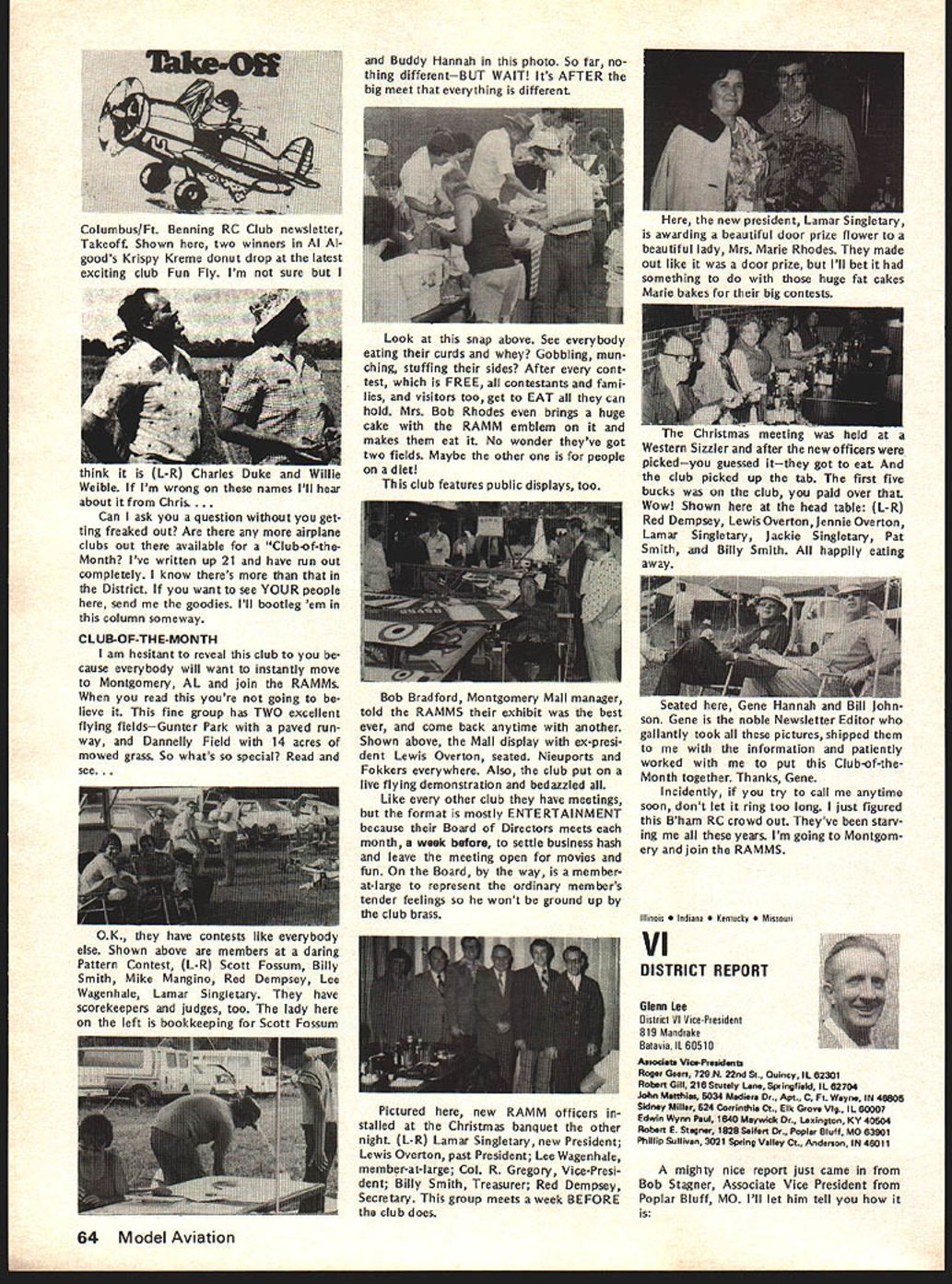
Take-Off
Columbus/Ft. Benning RC Club newsletter, Takeoff. Shown here, two winners in Al Algood's Krispy Kreme donut drop at the latest exciting club Fun Fly. I'm not sure but I think it is (L-R) Charles Duke and Willie Weible. If I'm wrong on those names I'll hear about it from Chris...
Can I ask you a question without you getting freaked out? Are there any more airplane clubs out there available for a "Club-of-the-Month"? I've written up 21 and have run out completely. I know there's more than that in the District. If you want to see YOUR people here, send me the goodies. I'll bootleg 'em in this column someway.
CLUB-OF-THE-MONTH
I am hesitant to reveal this club to you because everybody will want to instantly move to Montgomery, AL and join the RAMMs. When you read this you're not going to believe it. This fine group has TWO excellent flying fields—Gunter Park with a paved runway, and Dannelly Field with 14 acres of mowed grass. So what's so special? Read and see...
O.K., they have contests like everybody else. Shown above are members at a daring Pattern Contest, (L-R) Scott Possum, Billy Smith, Mike Mangino, Rod Dempsey, Lee Wagenhalse, Lamar Singletary. They have scorekeepers and judges, too. The lady here on the left is bookkeeping for Scott Possum and Buddy Hannah in this photo. So far, nothing different—BUT WAIT! It's AFTER the big meet that everything is different.
Look at this snap above. See everybody eating their curds and whey? Gobbling, munching, stuffing their sides? After every contest, which is FREE, all contestants and families, and visitors too, get to EAT all they can hold. Mrs. Bob Rhodes even brings a huge cake with the RAMM emblem on it and makes them eat it. No wonder they've got two fields. Maybe the other one is for people on a diet! This club features public displays, too.
Bob Bradford, Montgomery Mall manager, told the RAMMs their exhibit was the best ever, and come back anytime with another. Shown above, the Mall display with ex-president Lewis Overton, seated. Nieuports and Fokkers everywhere. Also, the club put on a live flying demonstration and bedazzled all.
Like every other club they have meetings, but the format is mostly ENTERTAINMENT because their Board of Directors meets each month, a week before, to settle business hush and leave the meeting open for movies and fun. On the Board, by the way, is a member-at-large to represent the ordinary member's tender feelings so he won't be ground up by the club brass.
Pictured here, new RAMM officers installed at the Christmas banquet the other night. (L-R) Lamar Singletary, new President; Lewis Overton, past President; Lee Wagenhalse, member-at-large; Col. R. Gregory, Vice-President; Billy Smith, Treasurer; Rod Dempsey, Secretary. This group meets a week BEFORE the club does.
Here, the new president, Lamar Singletary, is awarding a beautiful door prize flower to a beautiful lady, Mrs. Marie Rhodes. They made out like it was a door prize, but I'll bet it had something to do with those huge fat cakes Marie bakes for their big contests.
The Christmas meeting was held at a Western Sizzler and after the new officers were picked—you guessed it—they got to eat. And the club picked up the tab. The first five bucks was on the club, you paid over that. Wow! Shown here at the head table: (L-R) Red Dempsey, Lewis Overton, Jennie Overton, Lamar Singletary, Jackie Singletary, Pat Smith, and Billy Smith. All happily eating away.
Seated here, Gene Hannah and Bill Johnson. Gene is the noble Newsletter Editor who gallantly took all these pictures, shipped them to me with the information and patiently worked with me to put this Club-of-the-Month together. Thanks, Gene.
Incidentally, if you try to call me anytime soon, don't let it ring too long. I just figured this B'ham RC crowd out. They've been starving me all these years. I'm going to Montgomery and join the RAMMs.
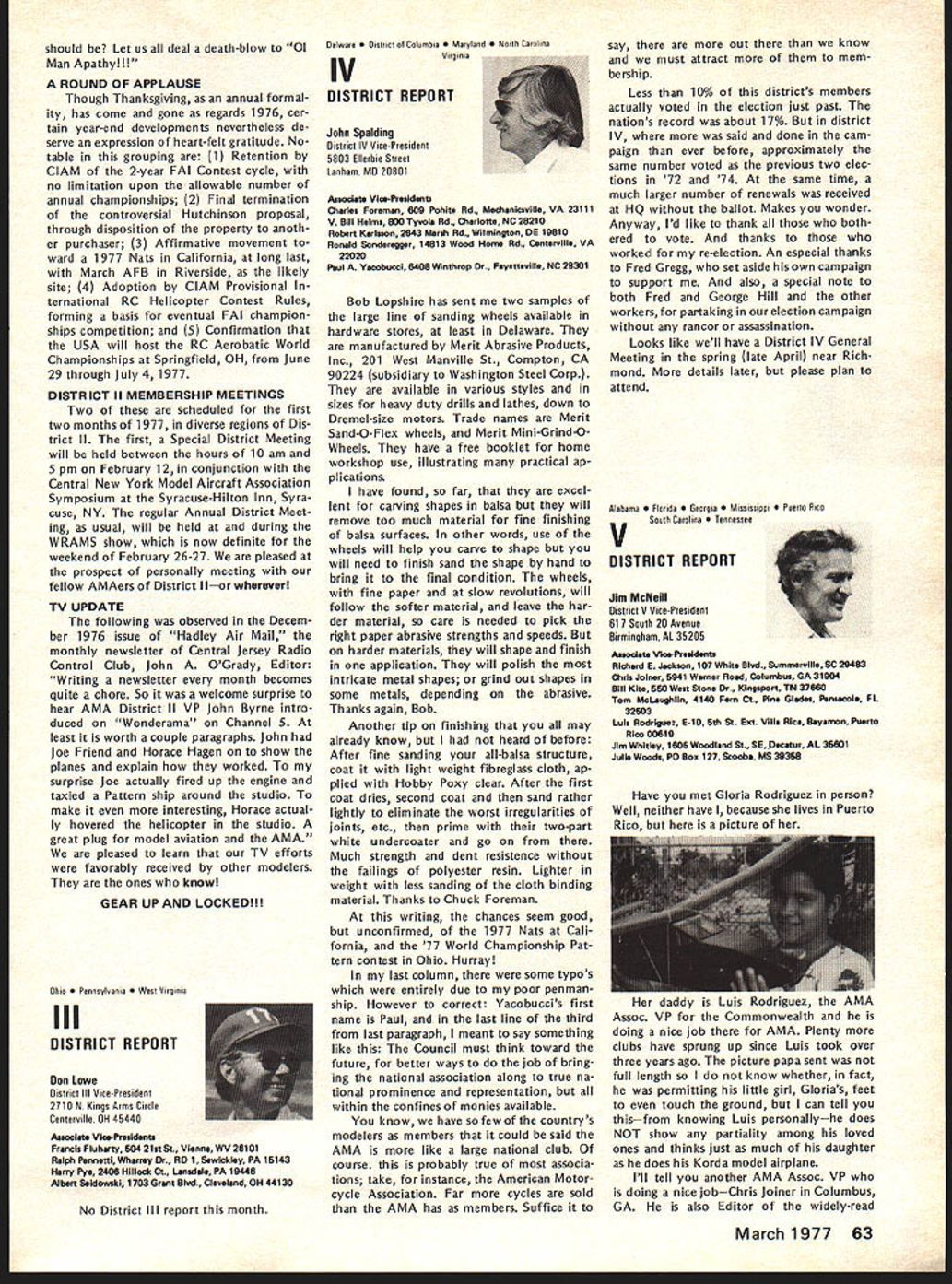
VI DISTRICT REPORT
Glenn Lee District VI Vice-President 819 Mandrake Batavia, IL 60510
Associate Vice-Presidents: Roger Gear, 729 N. 22nd St., Quincy, IL 62301 Robert Gill, 216 Stanley Lane, Springfield, IL 62704 John Mathias, 5045 Madeira Dr., Apt. C, Ft. Wayne, IN 46805 Sidney Miller, 624 Cornthwaite Ct., Elk Grove Vlg., IL 60007 Elwyn Wyan Paul, 1640 Maybrook Dr., Lexington, KY 40504 Robert E. Stagner, 2828 Sefton Dr., Poplar Bluff, MO 63901 Phillip Sullivan, 3021 Spring Valley Ct., Anderson, IN 46011
A mighty nice report just came in from Bob Stagner, Associate Vice-President from Poplar Bluff, MO. I'll let him tell you how it is: Outdoor modeling activity has really been winding down in our area. We have experienced an unusually cold and windy autumn that has provided very few decent flying days. Consequently many fliers are getting some extra workshop time and are already working on new aircraft for next year.
"1976 Activity Review: Our club is completing what we believe to be our most successful year of operation. We have organized several area activities that included static displays, public flying demonstrations, Delta Dart contests and the first unrestricted contest to be sponsored by our club. I have reported the details of these activities to you as they occurred. Our club, and model aviation in general, has received quite a bit of much needed publicity in this area as a result of our activities. This has resulted in a favorable impression and better recognition of our hobby/sport among area residents. Although our success has been based on excellent support and participation by all of the club members, I believe that Tom Hillis, our 1976 club president, is due special recognition for his efforts and leadership. Our members also feel that your visit to our club early this year really got us going and gave us momentum that has lasted throughout the year. We all appreciate that and look forward to seeing you again in the near future.
"1977 Club Officer Election: Our club has elected officers for 1977. Our 1976 President, Tom Hillis, did not accept renomination, and I was elected to serve as the 1977 President. Pete Aubuchon was re-elected Vice President and Jerry Marler was re-elected to serve as Secretary/Treasurer.
"1977 Activities Planning: We are already making plans for our club activities during 1977. The club Project Committee met and spent a long evening putting together a plan to recommend to the membership. This plan was presented to the club last Saturday night and received unanimous approval. This establishes a very ambitious program that we believe will allow us to build upon our 1976 successes. I will make detailed reports of these activities throughout the next year.
"Your January Column: We discussed your request concerning information about District VI clubs, and we would certainly like to participate in this project. Our members will bring models to the January 8, 1977 club meeting for some up-to-date pictures of the group. We will then send you some pictures and a club patch. We are also in the process of publishing a member information manual that will contain pertinent information about our club and about AMA. We will have it ready by the January meeting and will include a copy with the other information we send you. When the display is completed we would like to find out how to schedule it for use in some of our local activities.
"Show Team: We are continuing our efforts toward the formation of a show team. One of our members, Bob Baker, has designed an airplane that has been selected for use by the show team, and we are in the process of building up a supply of these to start practice sessions with next spring. Several of these airplanes are completed and we will include pictures of them with the other information we send you."
**********
Thanks, Bob, and I wish you and your club good luck in the coming year.
The success and ambition of this club is typical of many others in District VI and elsewhere, where clubs are finding out that it's fun to put on demonstrations or sponsor fun-flys and contests. Several clubs are organizing show teams, so I'm sure modeling will continue its progress in 1977.
We want all of the modelers to see and appreciate their brothers' activities in other categories—and we want the public to see the breadth and depth and diversity of model aviation.
The technical meeting will include a presentation of the world record (50 minutes plus) indoor microfilm model, some new product presentations (ALSA?), other subjects still developing at this writing.
The business meeting gives you a chance to meet your AMA President, Johnny Clemens; your AMA Executive Director, John Worth; and yours truly, your District VII Vice President. One special subject will deal with site acquisition concepts.
Entry of models for display will start at 8 am and close at noon. The public hours of the show are 10 am to 6 pm. Your models must stay through 6 pm and be out by 7 pm. A modest registration fee will be assessed.
The cocktail hour will have a cash bar. Dinner tickets will be limited, available by mail request from the CARDS, who will have mailed invitations to all District VII clubs as well as those in bordering states by the time you read this. You can write directly to CARDS, 2909 W. Michigan Ave., Lansing, MI 48917.
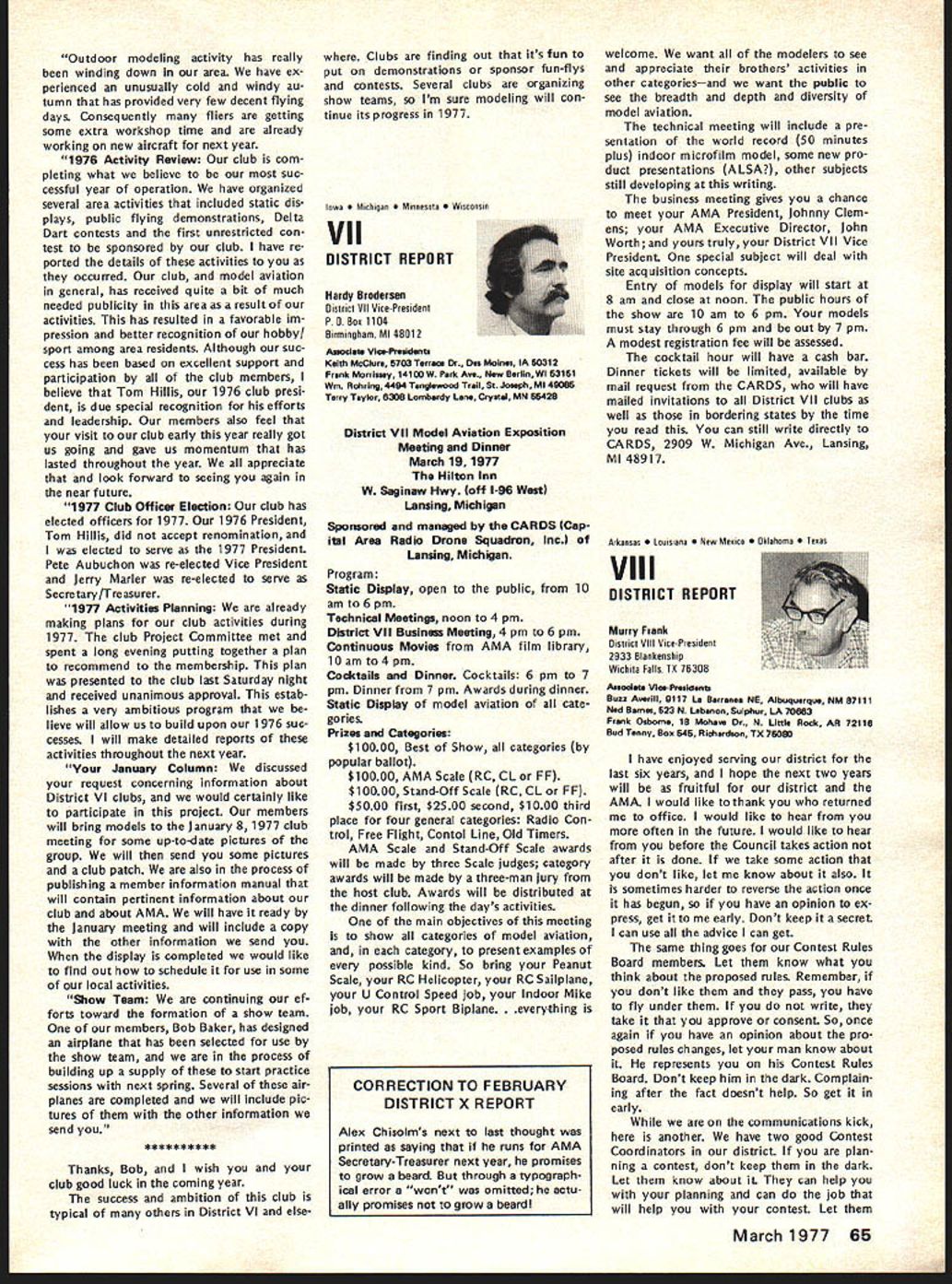
VII DISTRICT REPORT
Hardy Brodersen District VII Vice-President P. O. Box 1104 Birmingham, MI 48012
Associate Vice-Presidents: Keith McClure, 5703 Terrace Dr., Des Moines, IA 50312 Frank Morrissy, 14100 W. Park Ave., New Berlin, WI 53151 Wm. Rohring, 4444 Tangentwood Trail, St. Joseph, MI 49085 Terry Taylor, 6300 Lombardy Lane, Crystal, MN 55428
District VII Model Aviation Exposition
Meeting and Dinner March 19, 1977 The Hilton Inn W. Saginaw Hwy. (off I-96 West) Lansing, Michigan
Sponsored and managed by the CARDS (Capital Area Radio Drone Squadron, Inc.) of Lansing, Michigan.
Program:
- Static Display, open to the public, from 10 am to 6 pm.
- Technical Meetings, noon to 4 pm.
- District VII Business Meeting, 4 pm to 6 pm.
- Continuous Movies from AMA film library, 10 am to 4 pm.
- Cocktails and Dinner. Cocktails: 6 pm to 7 pm. Dinner from 7 pm. Awards during dinner.
- Static Display of model aviation of all categories.
Prizes and Categories:
- $100.00, Best of Show, all categories (by popular ballot).
- $100.00, AMA Scale (RC, CL or FF).
- $100.00, Stand-Off Scale (RC, CL or FF).
- $50.00 first, $25.00 second, $10.00 third place for four general categories: Radio Control, Free Flight, Control Line, Old Timers.
AMA Scale and Stand-Off Scale awards will be made by three Scale judges; category awards will be made by a three-man jury from the host club. Awards will be distributed at the dinner following the day's activities.
One of the main objectives of this meeting is to show all categories of model aviation and, in each category, to present examples of every possible kind. So bring your Peanut Scale, your RC Helicopter, your RC Sailplane, your U Control Speed job, your Indoor Mite job, your RC Sport Biplane... everything is welcome.
VIII DISTRICT REPORT
Murry Frank District VIII Vice-President 2933 Blakesnig Wichita Falls, TX 76308
Associate Vice-Presidents: Buzz Averill, 9117 La Barranca NE, Albuquerque, NM 87111 Ned Barnes, 623 N. Lebanon, Sulphur, LA 70663 Frank Osborne, 18 Mohave Dr., N. Little Rock, AR 72116 Bud Tenney, Box 545, Richardson, TX 75080
I have enjoyed serving our district for the last six years, and I hope the next two years will be as fruitful for our district and AMA. I would like to thank you who returned me to office. I would like to hear from you more often in the future. I would like to hear from you before the Council takes action on something that is done. If we take some action that you don't like, let me know about it also. It is sometimes harder to reverse the action once it has begun, so if you have an opinion to express, tell it to me early. Don't keep it a secret. I can use all the advice I can get.
The same thing goes for our Contest Rules Board members. Let them know what you think about the proposed rules. Remember, if you don't like them and they pass, you have to fly under them. If you do not write, they will assume that you approve or consent. So, once again if you have an opinion about the proposed rules changes, let your man know about it. He represents you on his Contest Rules Board. Don't keep him in the dark. Complaining after the fact doesn't help. So get it in early.
While we are on the communications kick, here is another. We have two good Contest Coordinators in our district. If you are planning a contest, don't keep them in the dark. Let them know about it. They can help you with your planning and can do the job that will help you with your contest.
CORRECTION TO FEBRUARY DISTRICT X REPORT
Alex Chisom's next to last thought was printed as saying that if he runs for AMA Secretary-Treasurer next year, he promises to grow a beard. But through a typographical error a "won't" was omitted; he actually promises not to grow a beard!
AMA News
know early enough so that they can coordinate with you, not for you.
Does your club have any outstanding members? Want to do something nice for them? One way is to get them leader status. HQ has the forms and I have a few also. If they already are a CD or a judge, then they already are a leader. Sometimes it pays to let them know that you really do appreciate what they do for you.
Do you have some non-AMA folks that you would like to honor? Like the Park Department head who helped you with your flying site, or the County Commissioner who helped get your land to fly on? Anyone who has been of some help to your club or modeling in general can be honored. We can arrange an official AMA certificate that is suitable for framing and looks great on an office wall.
Did your newsletter make my column last month? Put me on your mailing list and I will include it next time. They are helpful to me. From them I can tell what your club interest is and just what you are doing.
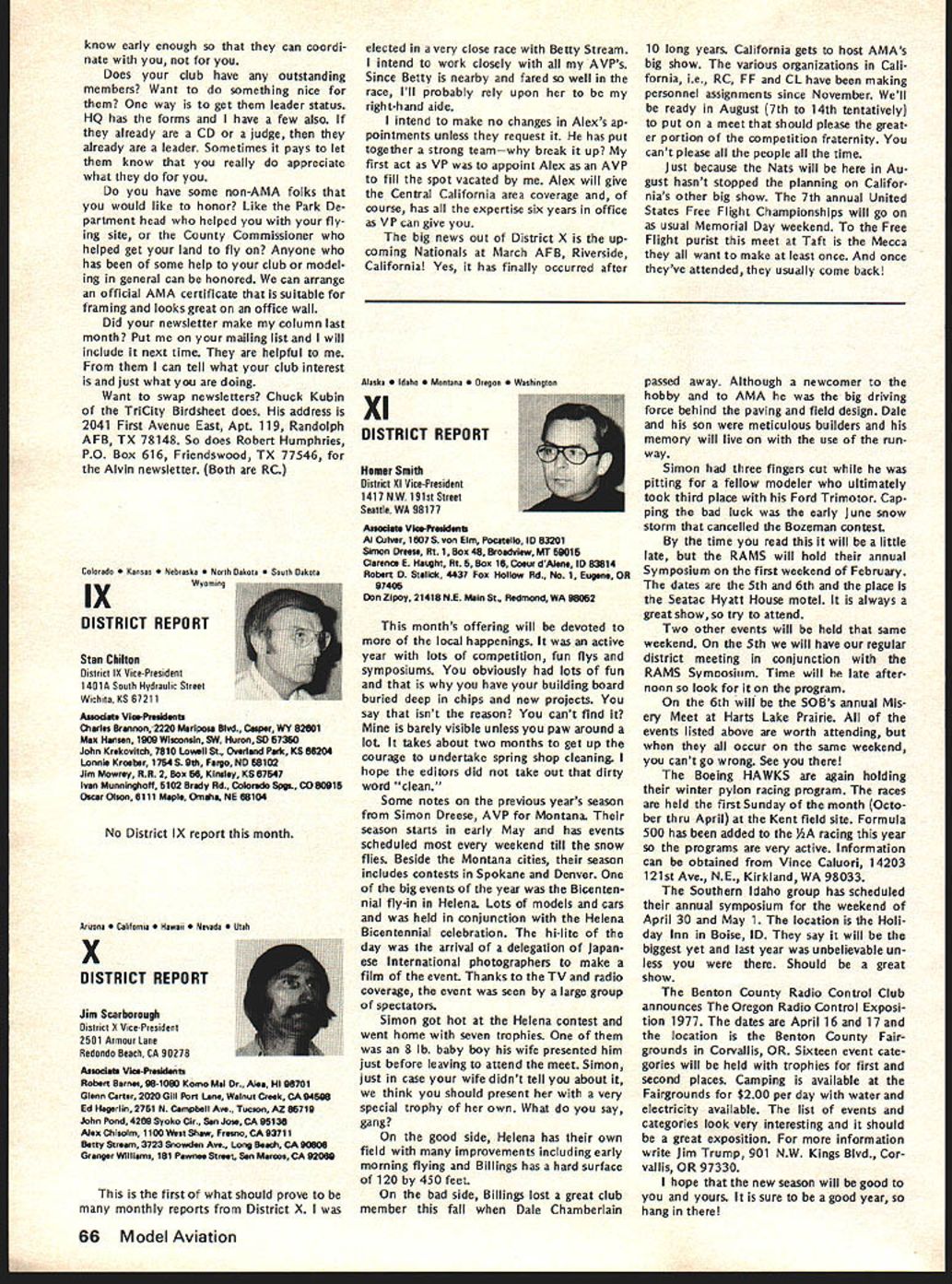
Want to swap newsletters? Chuck Kubin of the TriCity Birdsheet does. His address is 2041 First Avenue East, Apt. 119, Randolph AFB, TX 78148. So does Robert Humphries, P.O. Box 616, Friendswood, TX 77546, for the Alvin newsletter. (Both are RC.)
Just before Christmas FCC announced effective January 1, 1977 classes of FCC licenses would not be issued for a fee payment until further notice. This action results from litigation challenging FCC's authority to determine amounts charged as fees. Until the question is resolved FCC is suspending fee payments. This affects RC, CB, Amateur Broadcasting forms of FCC licenses. How long the free period will last is uncertain—perhaps several weeks, perhaps several months. In the meantime a golden opportunity is available to boost the number of Class C RC licenses registered with the FCC. It would better indicate that RC operators really exist and deserve consideration. Unfortunately, the use of club licenses masks the true number of RCers. AMA therefore urges obtaining individual licenses as soon as possible. Now that the cost of the license is eliminated there is no excuse for continuing to use a club license except for newcomers. AMA has on hand large quantities of FCC license applications. Clubs should request immediately phone letter number license a
Transcribed from original scans by AI. Minor OCR errors may remain.

