
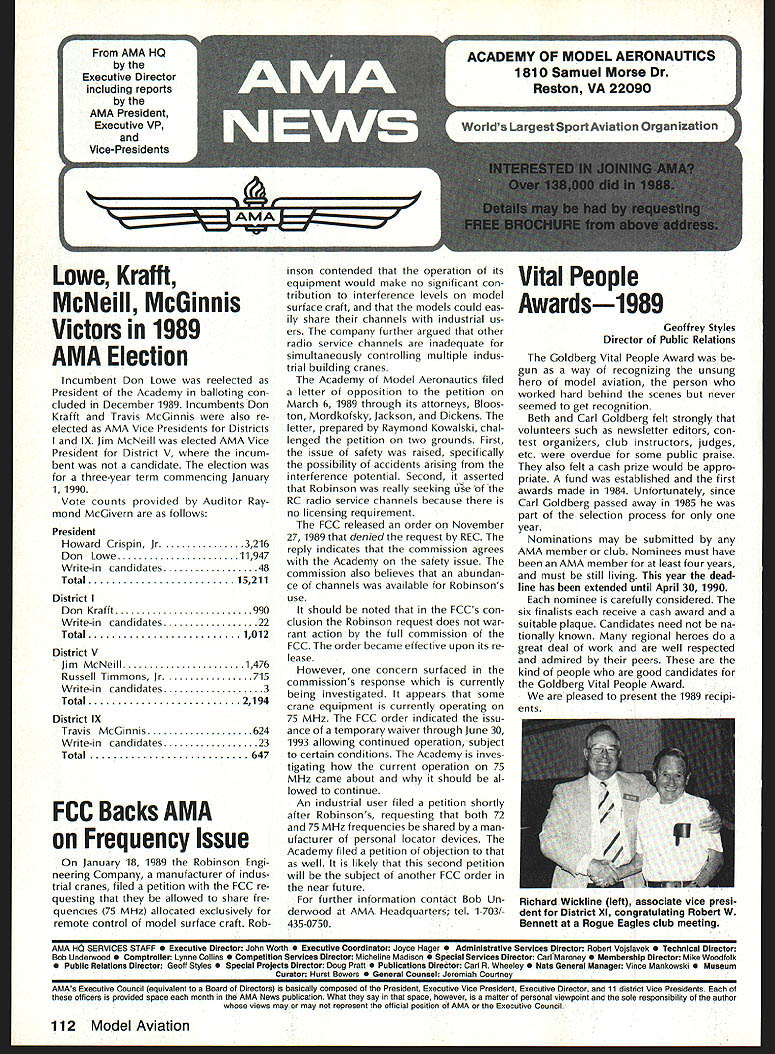
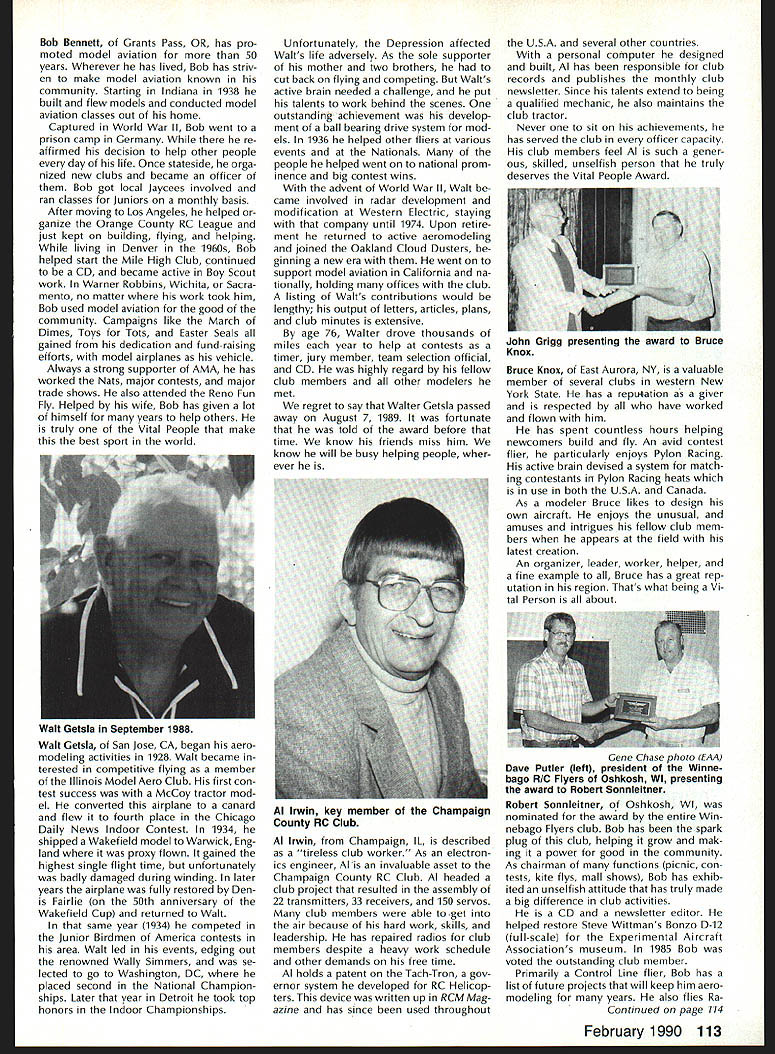
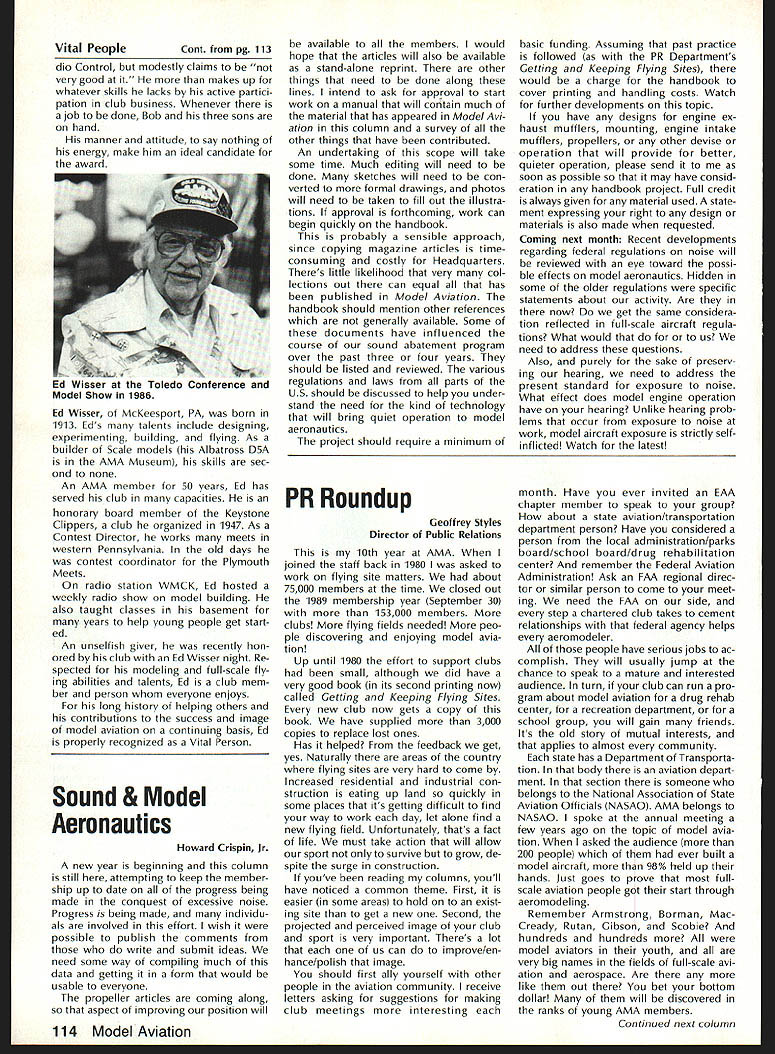
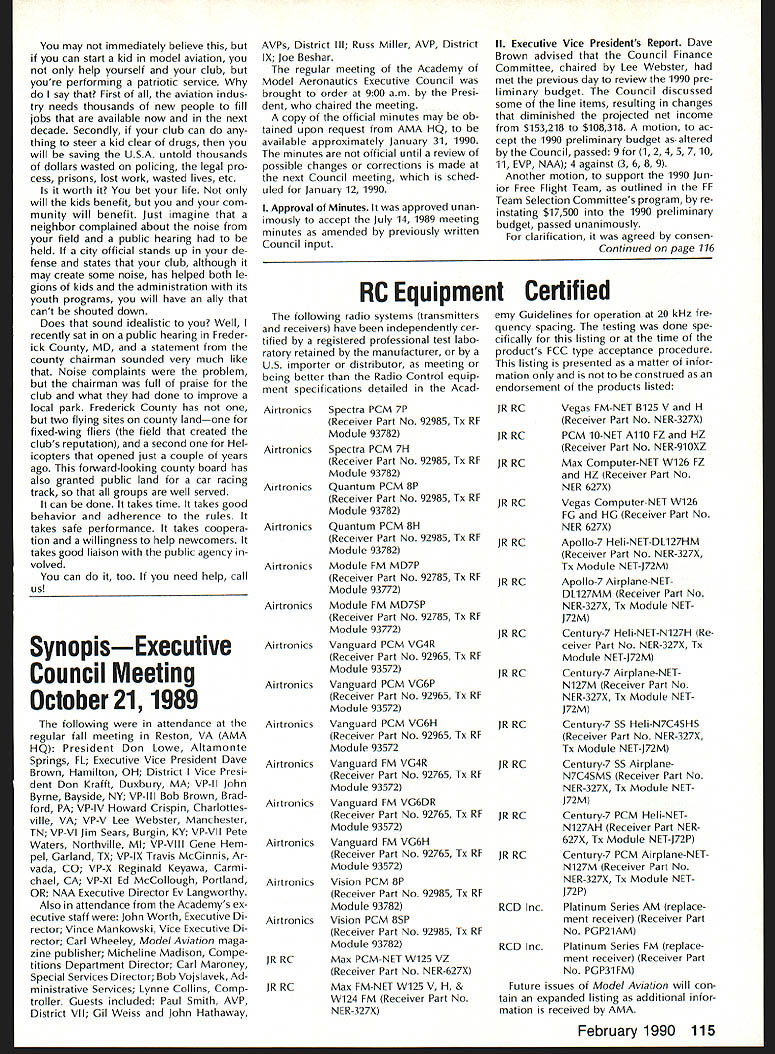
AMA News
Lowe, Krafft, McNeill, McGinnis Victors in 1989 AMA Election
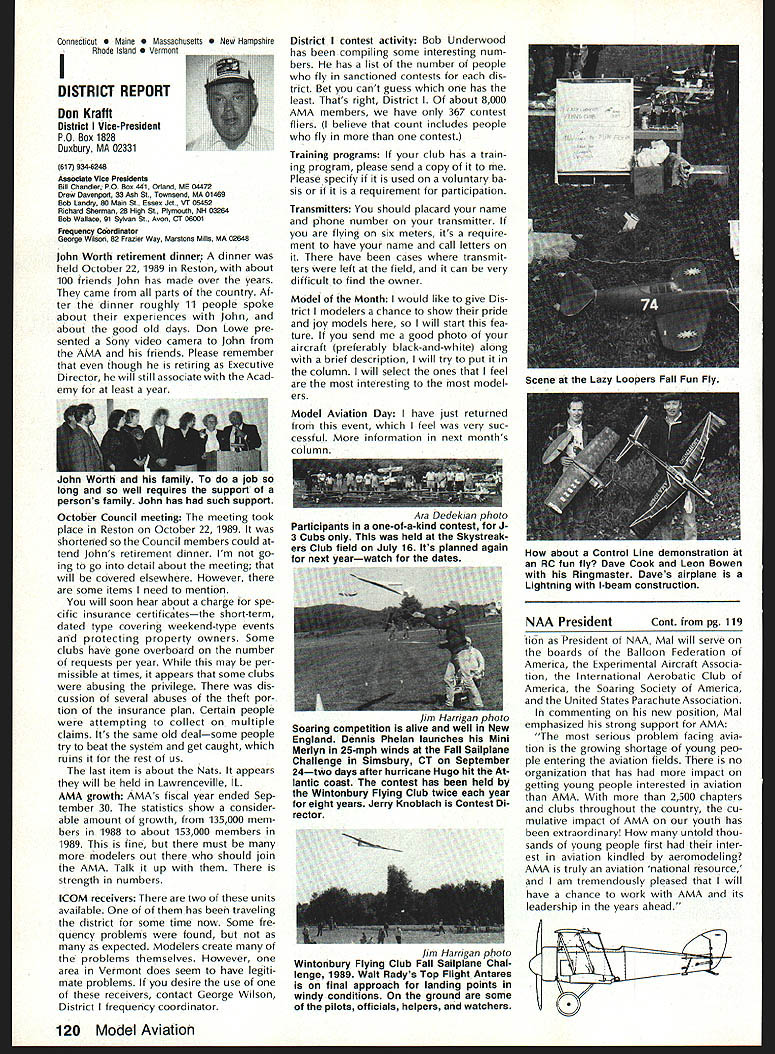
Incumbent Don Lowe was reelected President of the Academy in balloting concluded in December 1989. Incumbents Don Krafft and Travis McGinnis were also reelected as AMA Vice Presidents for Districts I and IX. Jim McNeill was elected AMA Vice President for District V, where the incumbent was not a candidate. The election is for a three-year term commencing January 1, 1990.
Vote counts provided by Auditor Raymond McGivern are as follows:
- President
- Howard Crispin, Jr.: 3,216
- Don Lowe: 11,947
- Write-in candidates: 48
- Total: 15,211
- District I
- Don Krafft: 990
- Write-in candidates: 22
- Total: 1,012
- District V
- Jim McNeill: 1,476
- Russell Timmons, Jr.: 715
- Write-in candidates: 3
- Total: 2,194
- District IX
- Travis McGinnis: 624
- Write-in candidates: 23
- Total: 647
---
FCC Backs AMA on Frequency Issue
On January 18, 1989, Robinson Engineering Company (REC), a manufacturer of industrial cranes, filed a petition with the FCC requesting permission to share frequencies in the 72–75 MHz band that are allocated exclusively to the remote-control model craft radio service. REC contended that operation of its equipment would make no significant contribution to interference levels affecting model surface craft and that the models could easily share channels with industrial users. The company also argued that other radio service channels were inadequate for simultaneously controlling multiple industrial building cranes.
The Academy of Model Aeronautics filed a letter of opposition to the petition on March 6, 1989, through its attorneys Blooston, Mordkofsky, Jackson & Dickens. The letter, prepared by Raymond Kowalski, challenged the petition on two grounds: first, safety concerns — specifically the potential for accidents arising from interference; second, that Robinson was essentially seeking use of RC radio-service channels because those channels do not require licensing.
The FCC released an order on November 27, 1989, denying REC’s request. The commission agreed with the Academy on the safety issue and concluded that an abundance of alternative channels was available for REC’s use. The commission determined the request did not warrant action by the full commission; the order became effective upon its release.
However, the FCC noted that some crane equipment appears to already be operating on 75 MHz. The order indicated issuance of a temporary waiver allowing continued operation through June 30, 1993, subject to specified conditions. The Academy is investigating how current operation on 75 MHz came about and whether such continued use is appropriate.
Shortly after REC’s petition, an industrial user filed a petition requesting that both 72 and 75 MHz frequencies be shared with a manufacturer of personal locator devices. The Academy filed an objection to that petition as well; it is likely the second petition will be the subject of another FCC order in the near future.
For further information contact Bob Underwood at AMA Headquarters: (703) 435-0750.
---
Goldberg Vital People Award — 1989
The Goldberg Vital People Award was established to recognize the unsung heroes of model aviation — volunteers who work behind the scenes (newsletter editors, contest organizers, club instructors, judges, etc.) but seldom receive public recognition. Beth and Carl Goldberg initiated the fund and the first awards were made in 1984. After Carl Goldberg’s passing in 1985, the selection process has been managed by a committee.
- Nominations may be submitted by any AMA member or club.
- Nominees must have been AMA members for at least four years and must be living at the time of nomination.
- The nomination deadline has been extended to April 30, 1990.
- Six finalists each receive a cash award and a plaque.
- Candidates need not be nationally known; regional contributors who are respected and admired by their peers are encouraged.
We are pleased to present the 1989 recipients and their citations.
- Bob Bennett (Grants Pass, OR)
- Promoted model aviation for more than 50 years, organized clubs, ran monthly junior classes, supported community campaigns (March of Dimes, Toys for Tots, Easter Seals), worked at meets and trade shows, and helped newcomers with instruction and fundraising. A dedicated AMA supporter aided by his wife.
- Walter (Walt) Getsla (San Jose, CA)
- Began aeromodeling in 1928, had notable early contest successes (including international entries), contributed technical innovations (ball bearing drive system), produced extensive letters, articles, plans, and minutes, and served as contest timer, jury member, and official into his later years. Walter was notified of the award before his passing on August 7, 1989.
- Al Irwin (Champaign, IL)
- A tireless club worker and electronics engineer who led projects assembling transmitters, receivers, and servos to help members get airborne. Holds a patent on the Tach-Tron governor system for RC helicopters; designed and maintained club records and newsletter with a home-built computer; serves in every club office and maintains club equipment.
- Bruce Knox (East Aurora, NY)
- Active in multiple clubs throughout western New York; an avid contest flier and Pylon Racing enthusiast who devised a contestant-matching system used in the U.S. and Canada. Known for helping newcomers, designing unusual aircraft, and providing leadership and example.
- Robert (Bob) Sonnleitner (Oshkosh, WI)
- Spark plug of the Winnebago Flyers club; chaired many functions (picnics, contests, mall shows), served as CD and editor, helped restore full-scale aircraft for the EAA museum, and was voted outstanding club member in 1985. Primarily a Control Line flier with numerous future projects planned.
---
PR Roundup
Geoffrey Styles Director of Public Relations
This is my 10th year at AMA. When I joined the staff in 1980 we had about 75,000 members. We closed out the 1989 membership year (September 30) with more than 153,000 members — more clubs, more flying fields needed, and more people discovering model aviation.
Up until 1980 the effort to support clubs was small, although the book Getting and Keeping Flying Sites (now in second printing) has helped. Every new club receives a copy; we have supplied over 3,000 replacement copies. From feedback, the book has helped, but in many areas flying sites remain hard to find due to rapid residential and industrial development.
If you've read my columns, you'll notice two themes:
- It is often easier to hold on to an existing site than to secure a new one.
- The projected and perceived image of your club and sport is very important.
Suggestions to enhance your club’s image and community standing:
- Ally with other people in the aviation community (EAA chapters, state aviation officials, FAA representatives).
- Invite speakers from local administration, parks boards, school boards, or rehabilitation centers.
- Run programs for schools, recreation departments, or rehab centers.
- Build relationships with Federal and local agencies; they can be strong allies.
Model clubs can attract full-scale aviation professionals who began in aeromodeling. Recruiting and mentoring youth is especially valuable — it supports the industry’s future workforce and can steer kids away from drugs and delinquency. Community engagement can turn potential noise complaints into public support, as demonstrated by a public hearing in Frederick County, MD, where county officials praised the club’s youth programs and land-use accommodations.
If your club needs help, call AMA Headquarters.
---
Synopsis — Executive Council Meeting (October 21, 1989)
The regular fall meeting of the Academy of Model Aeronautics Executive Council was held in Reston, VA (AMA Headquarters). The meeting was called to order at 9:00 a.m. by President Don Lowe.
Attendees included:
- Don Lowe — President (Altamonte Springs, FL)
- Dave Brown — Executive Vice President (Hamilton, OH)
- Don Krafft — VP I (Duxbury, MA)
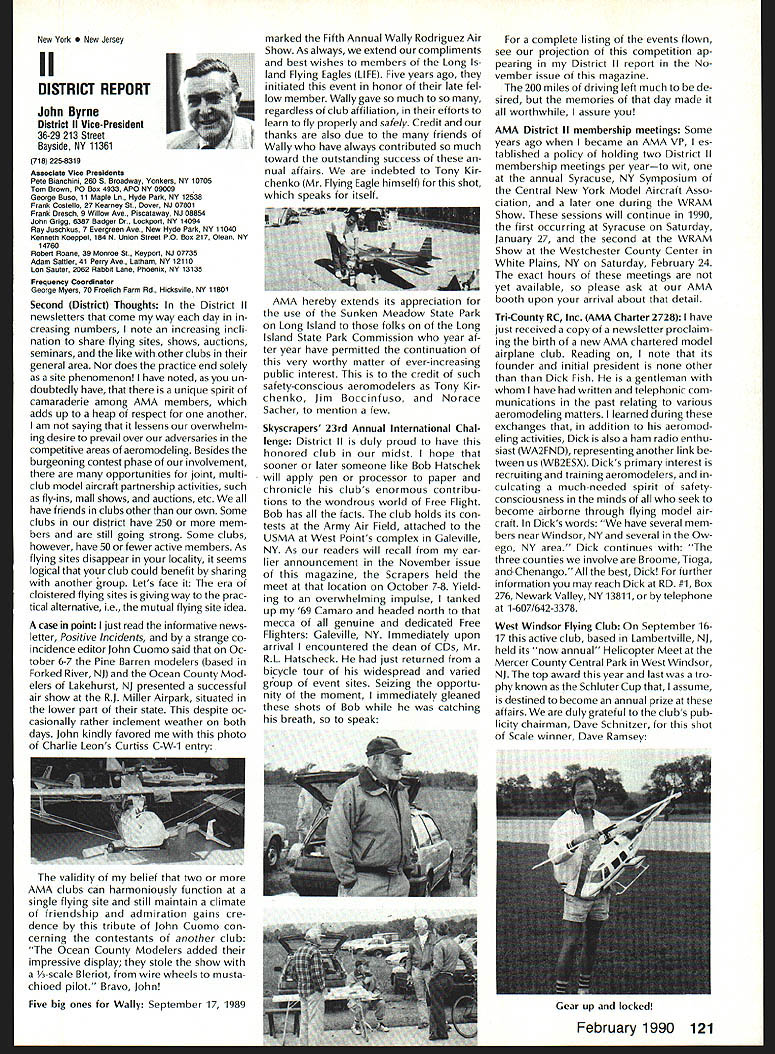
- John Byrne — VP II (Bayside, NY)
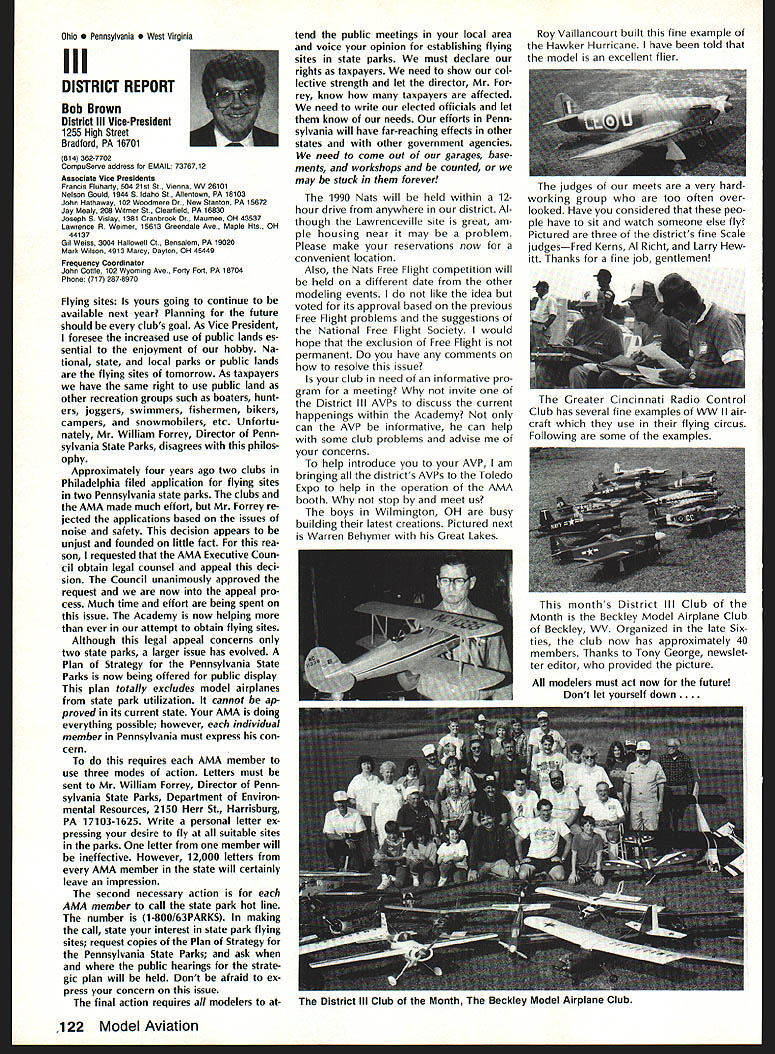
- Bob Brown — VP III (Bradford, PA)
- Howard Crispin — VP IV (Charlottesville, VA)
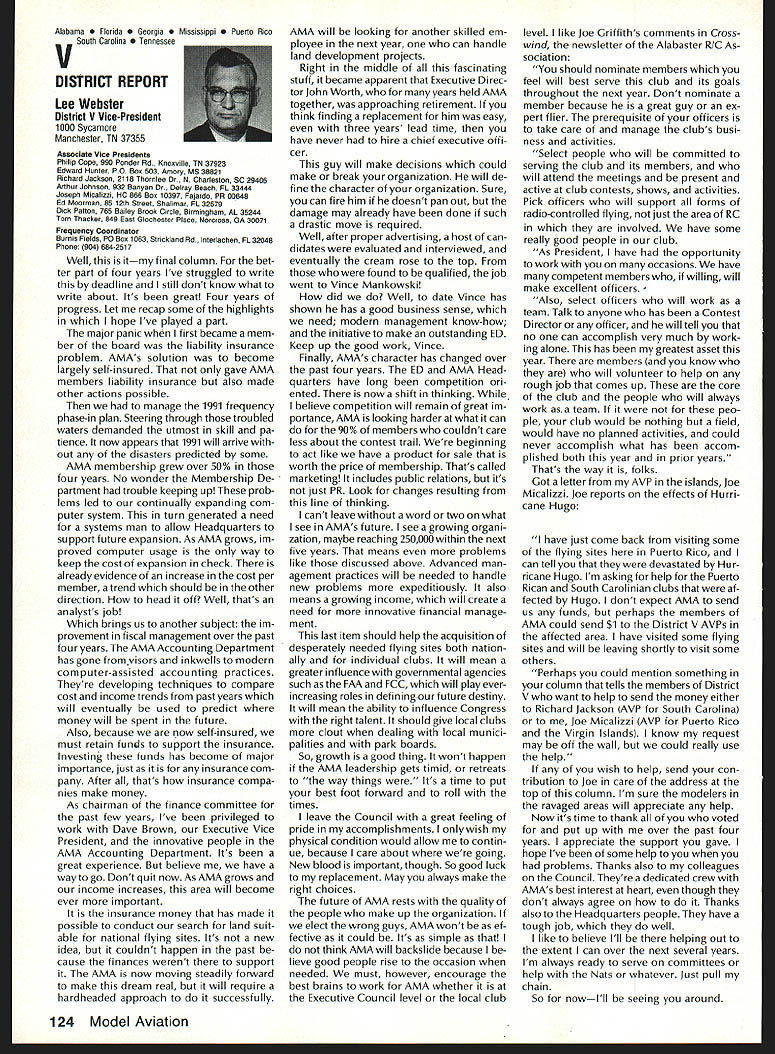
- Lee Webster — VP V (Manchester, TN)
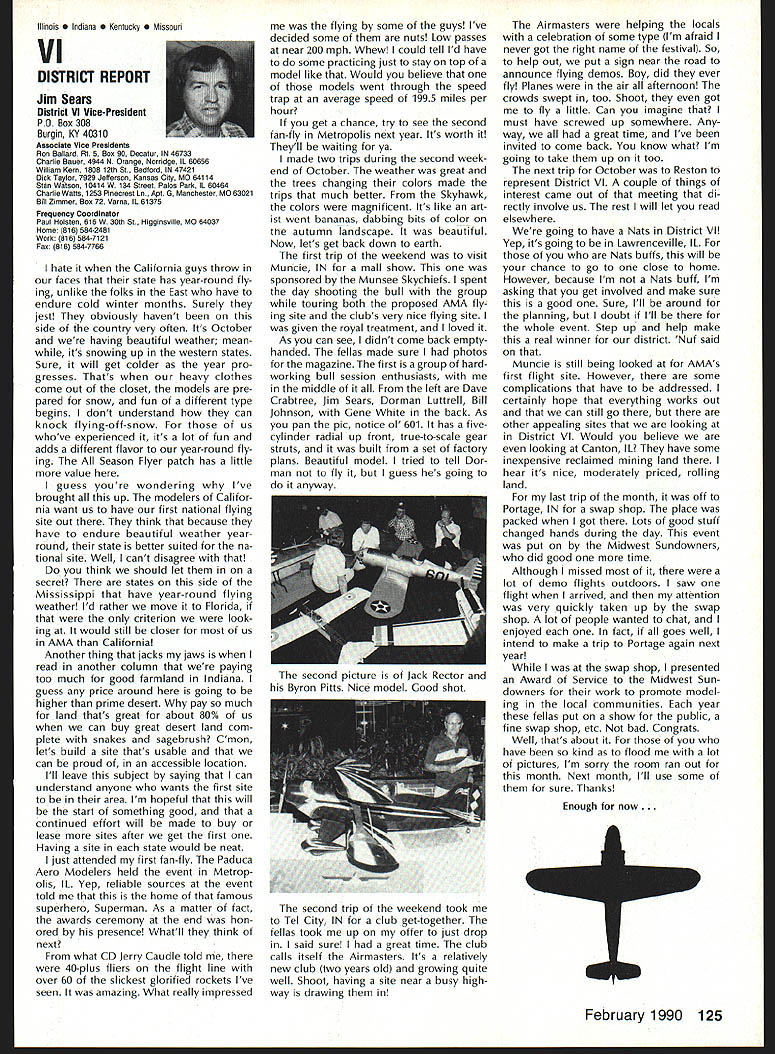
- Jim Sears — VP VI (Burlingame, CA)
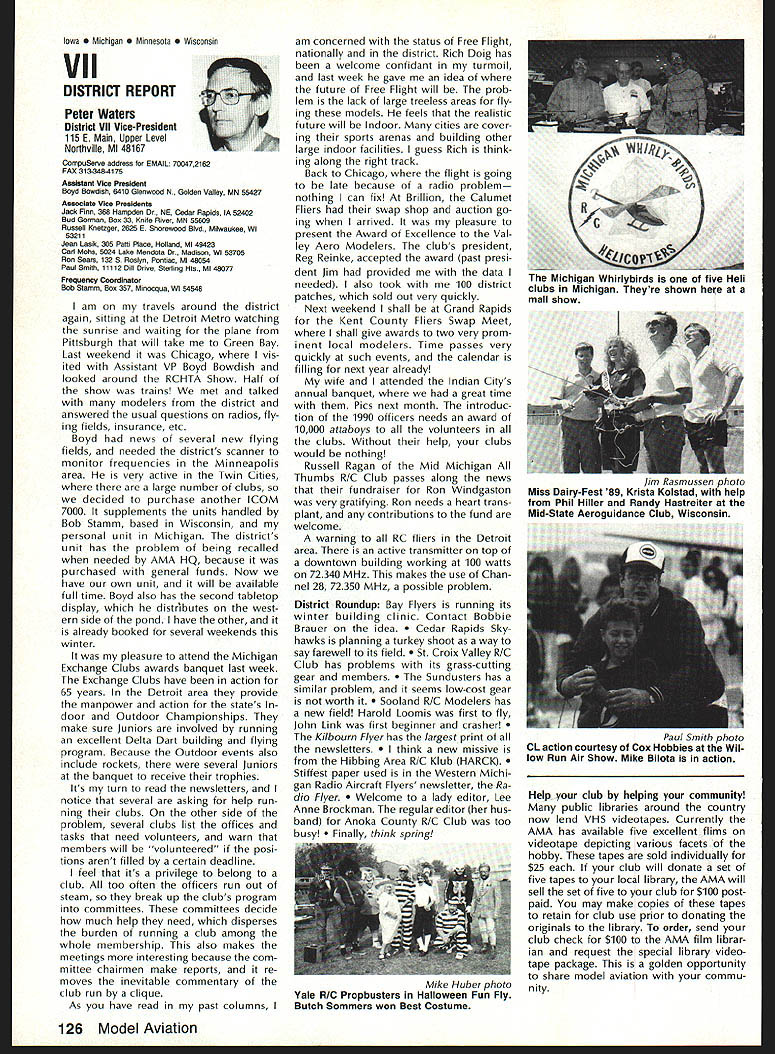
- Pete Waters — VP VII (Northville, MI)
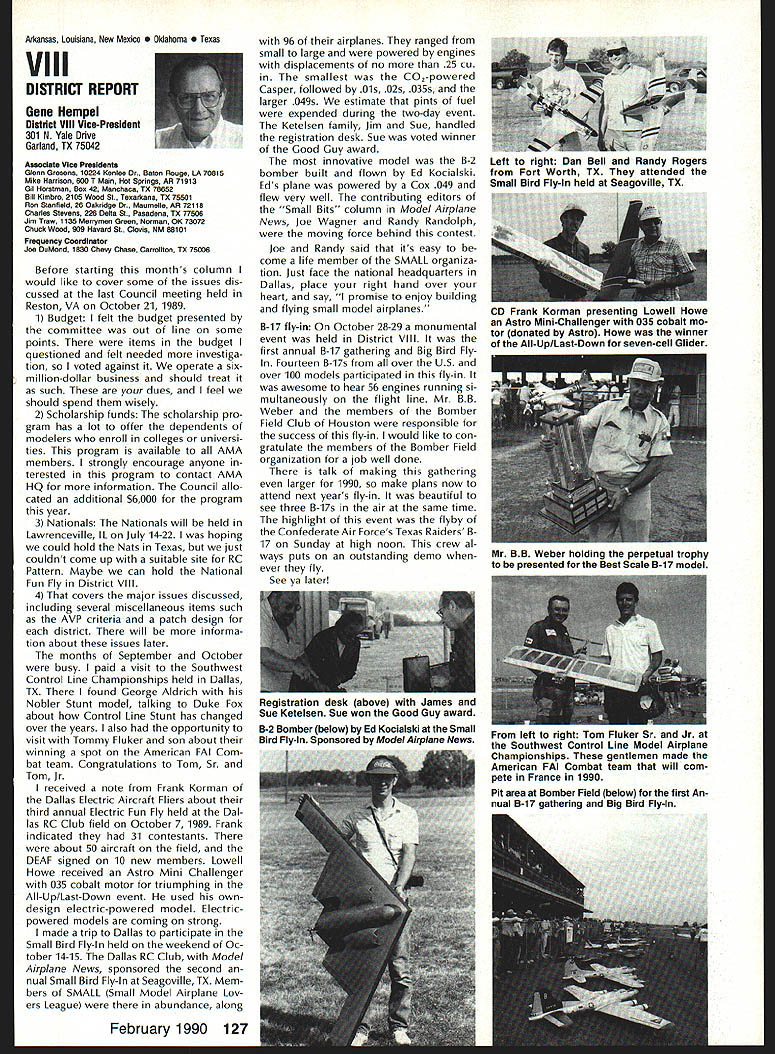
- Gene Hempel — VP VIII (Garland, TX)
- Travis McGinnis — VP IX (Arvada, CO)
- Reginald Keyvan — VP X (Carmichael, CA)
- Ed McClellough — VP XI (Portland, OR)
- Cy Langworthy — NAA Executive Director
Also in attendance from AMA executive staff:
- John Worth — Executive Director
- Vince Markowski — Vice Executive Director
- Carl Maroney — Model Aviation magazine publisher / Special Services Director
- Micheline Madison — Competitions Department Director
- Bob Voslavek — Administrative Services Director
- Lynn Collins — Comptroller
Guests included:
- Paul Smith — AVP, District VII
- Gil Weiss and John Hathaway — AVPs, District III
- Russ Miller — AVP, District IX
- Joe Beshar — AVP, District IX
Key actions and reports:
- Approval of Minutes
- The July 14, 1989 meeting minutes were unanimously accepted as amended by previously submitted Council input.
- Executive Vice President’s Report
- Dave Brown reported the Council Finance Committee (chaired by Lee Webster) reviewed the 1990 preliminary budget. Council changes reduced projected net income from $153,214 to $108,318. A motion to accept the altered 1990 preliminary budget passed (9 for, 4 against).
- A motion to support the 1990 Junior Free Flight Team with an allocation of $17,500 in the 1990 preliminary budget passed unanimously.
A copy of the official minutes will be available upon request from AMA Headquarters (approximately January 31, 1990). The minutes are not official until reviewed for possible changes or corrections at the next Council meeting (scheduled for January 12, 1990).
(For clarification, additional Council business was discussed — continued in official minutes.)
---
AMA Services Staff
- Executive Director: John Worth
- Executive Coordinator: Joyce Hager
- Administrative Services Director: Robert Voslavek
- Technical Director: Bob Underwood
- Comptroller: Lynn Collins
- Competition Services Director: Micheline Madison
- Special Services Director: Carl Maroney
- Membership Director: Mike Woodlock
- Public Relations Director: Geoff Styles
- Special Projects Director: Doug Pratt
- Publications Director: Carl R. Wheaton
---
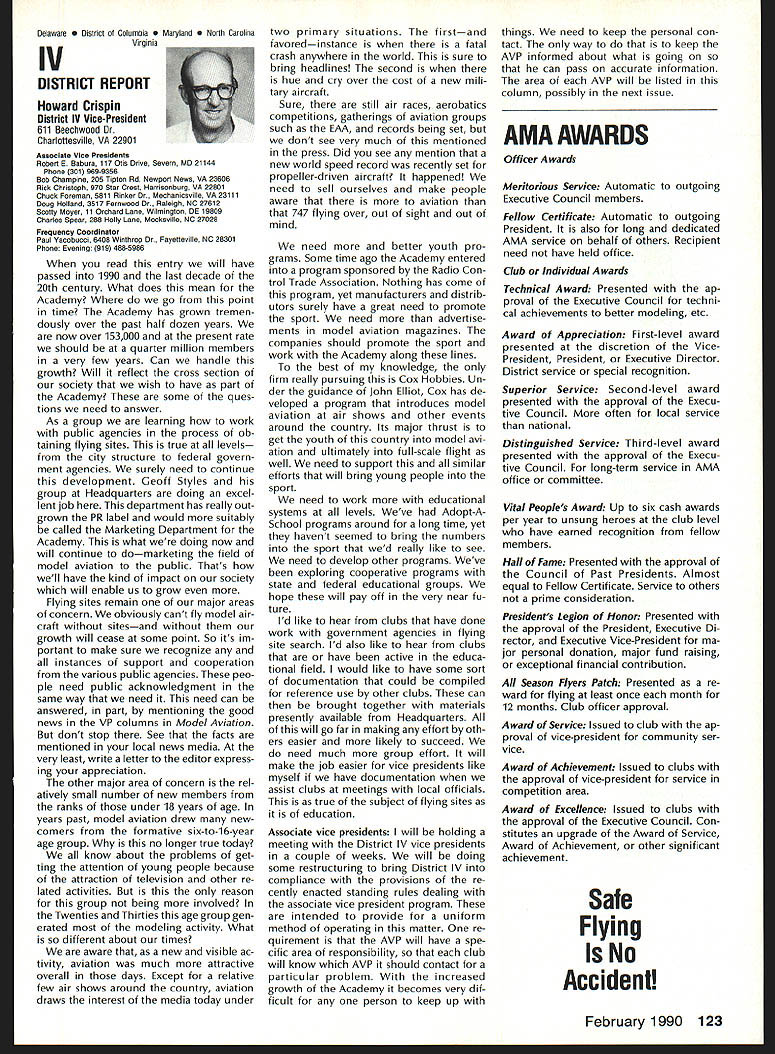
AMA Awards
Officer Awards
- Meritorious Service: Automatic to outgoing Executive Council members.
- Fellow Certificate: Automatic to outgoing President; also for long and dedicated service on behalf of others (recipient need not have held office).
Club or Individual Awards
- Technical Award: Presented with Executive Council approval for technical achievements that improve modeling.
- Award of Appreciation: First-level award presented at the discretion of the Vice President, President, or Executive Director for district service or special recognition.
- Superior Service: Second-level award presented with Executive Council approval, typically for significant local service.
- Distinguished Service: Third-level award presented with Executive Council approval for long-term service in AMA office or committee roles.
- Vital People’s Award: Up to six cash awards per year to unsung heroes at the club level nominated by fellow members.
- Hall of Fame: Presented with the approval of the Council of Past Presidents; comparable in stature to the Fellow Certificate.
- President’s Legion of Honor: Presented for major personal donations, fund-raising, or exceptional financial contributions (requires approval of the President, Executive Director, and Executive Vice President).
- All Season Flyers Patch: Awarded for flying at least once each month for 12 months (requires club officer approval).
- Award of Service: Issued to clubs for community service with the approval of the Vice President.
- Award of Achievement: Issued to clubs for competition-related service with the approval of the Vice President.
- Award of Excellence: Issued with Executive Council approval to upgrade an Award of Service, Award of Achievement, or in recognition of other significant achievements.
Transcribed from original scans by AI. Minor OCR errors may remain.

