
AMA News
PR Roundup
Geoffrey Styles, Director of Marketing
Bill Baker joined AMA in 1989 to assist the Public Relations Department, which had grown beyond the capacity of two people (Judy DiLoreta and Geoffrey Styles) to comfortably handle. Bill holds a journalism degree and was asked to share his impressions of AMA, its members, and model aviation. He wrote:
"I landed the Space Shuttle Columbia in the predawn darkness at Edwards Air Force Base, performing piloting tasks similar to those I first learned years ago with smaller model airplanes. I've built model airplanes all my life. It's taught problem solving, aerodynamics, and other things that have served me well in engineering, aviation, and in my career as an astronaut."
Astronaut Space Shuttle Commander Robert "Hoot" Gibson wrote those words in a letter to Geoffrey Styles shortly after Shuttle Mission 61‑C in early 1986. AMA has received similar testimonials from notable aviators such as Neil Armstrong, Dr. Paul MacCready, and Burt Rutan — evidence that model aviation often influences the choice of a full‑scale aviation career.
Several organizations have published alarming statistics about personnel shortages in the airline industry. The Future Aviation Professionals of America projects a need for 52,000 pilots in the next 10 years, while current training rates will yield only about 41,000. This raises urgent questions: Where will the next generation of pilots, mechanics, and support personnel come from, and can current systems produce them?
AMA supports education and outreach through programs, collegiate scholarships, and collaboration with related groups, but success also depends on grassroots efforts:
- Clubs can participate in the Adopt‑a‑School program: display static models, perform flying demonstrations, and donate Model Aviation subscriptions to school libraries to introduce children to the hobby.
- Teaching youth to fly model aircraft is ideal. AMA receives many inquiries from young people wanting instruction; clubs should respond by providing instructors, answering questions, inviting prospective members to meetings, and offering rides at the field.
- Quality, hands‑on instruction will heighten enthusiasm and attract students who may eventually enter aviation professions.
For information about participating, contact AMA's Marketing Department.
Nominating Committee
Composition and General Rules
- Composition
- a. The Nominating Committee consists of all 11 Vice Presidents and the Executive Vice‑President (12 members total).
- b. Members of the Nominating Committee are barred from becoming nominees for the offices under consideration.
- c. Voting by proxy is permitted, provided the proxy is from the same district as the absent member.
Nomination Procedures and Meeting Conduct
- Recording Secretary
- The Recording Secretary shall:
a. keep full, accurate, and detailed written minutes of the proceedings; b. assist the Teller in the distribution, collection, and tabulation of ballots; c. submit a full written report of the meeting and the results of all voting procedures to the President, Executive Vice President, meeting chairman, and Executive Director within 48 hours after adjournment.
- Meeting Conduct
- a. The Chairman shall open the meeting and preside over the proceedings.
- b. The Chairman shall appoint a Recording Secretary and a Teller. The Teller shall not be a candidate for office.
- Candidate Nominations
- All nomination letters must be received at AMA Headquarters 15 days prior to the Nominating Committee annual meeting.
- A letter of acceptance by the candidate must be on file at AMA HQ 10 days prior to the meeting.
- For the meeting scheduled July 13, the deadline for nomination receipt is close of business on Thursday, June 28.
- No person may nominate himself or herself for office.
- The candidate's campaign statement must accompany the acceptance letter.
- Selection of Nominees
- a. The Committee is limited (but not required) to three names on the ballot for each elective office.
- b. The Committee shall examine, evaluate, and discuss all written proposals; nomination letters will be entered into the record and at least one letter for each candidate shall be read aloud.
- c. The Chairman shall limit the discussion period to a reasonable time to allow ample discussion of qualifications.
- d. An incumbent is automatically placed on the ballot unless 4/5 of the Committee votes to withhold the incumbent's name (see Bylaws, Article IX, section 2).
- Voting
- a. One vote per member per ballot.
- b. Voting shall be by district, starting with District I and progressing through District XI and the Executive Vice‑President. If secret voting is desired, written ballots shall be used.
- c. If placing an incumbent's name on the ballot is in question, that vote shall precede voting for other nominees.
- d. When more than three names are nominated for an office, voting shall be by simple majority.
- e. A simple majority prevails (see 6.d for exception).
- f. If only three names are submitted for an office, the chairman may move for nomination by acclamation.
- Finalization of Proceedings
- a. At the conclusion of the meeting, the Committee will verify the minutes and the ballot developed by the Committee. Such verification will be a recorded vote requiring concurrence of a majority of Committee members. If concurrence is not reached, the Committee will continue deliberations until acceptance is achieved. The ballot developed will be final for that election. The acceptance vote will be recorded during the ensuing Council meeting.
- Adjournment
- An affirmative vote on an adjournment motion duly made and seconded will adjourn the meeting.
AMA 1991 Frequency Management Plans
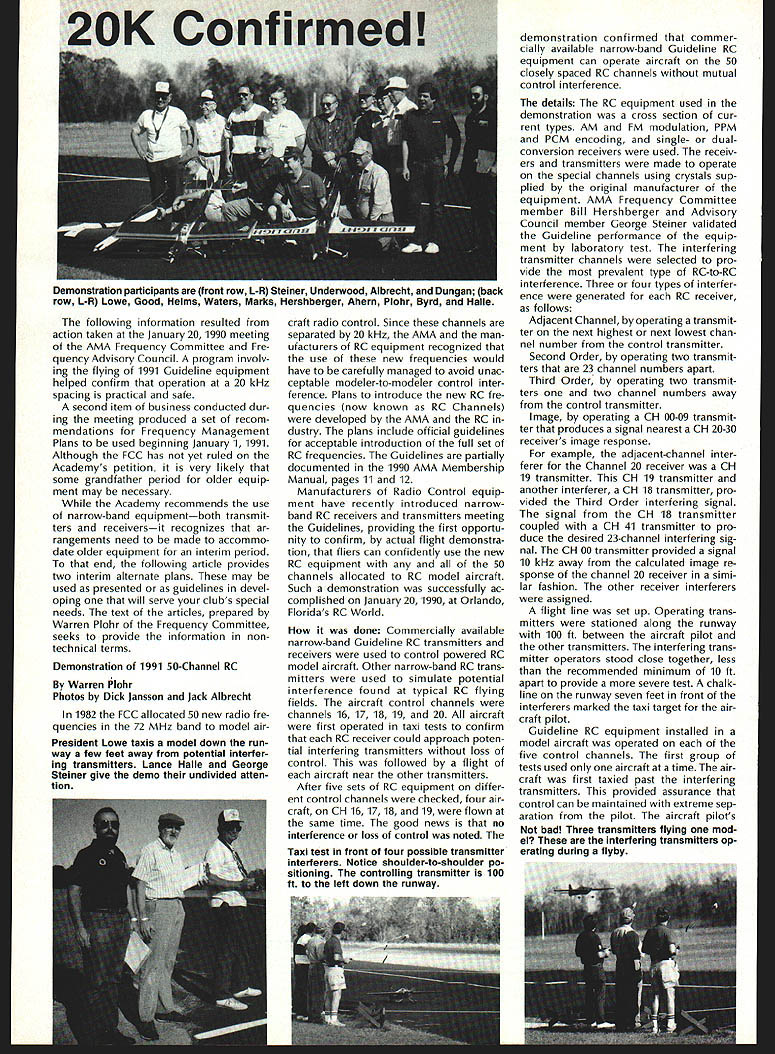
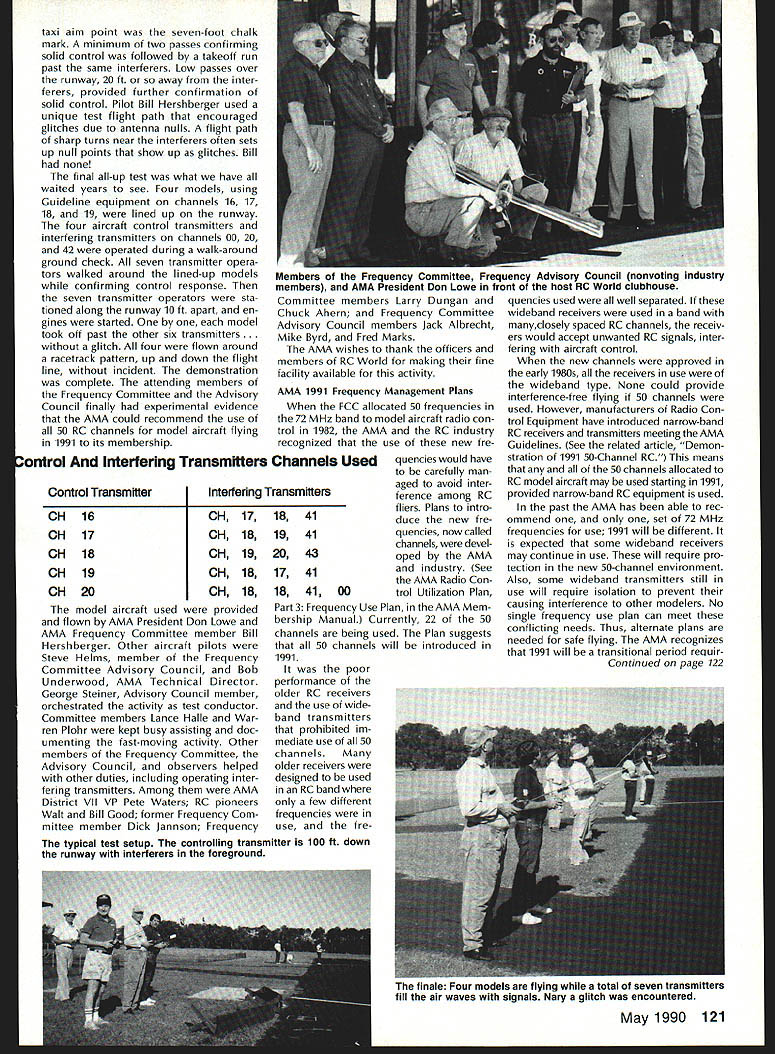
When the FCC allocated 50 frequencies in the 72 MHz band to model aircraft radio control in 1982, AMA and the RC industry planned careful management to avoid interference. Initially only 22 of the 50 channels were used because older wide‑band receivers would accept unwanted signals if channels were closely spaced. Manufacturers have since introduced narrow‑band receivers and transmitters meeting AMA guidelines, allowing use of all 50 channels starting in 1991 — provided narrow‑band equipment is used.
1991 will be a transitional period: some wide‑band receivers and transmitters may still be in use and will require protection or isolation. No single frequency use plan can meet these conflicting needs; therefore the AMA recommends a primary plan and two interim alternate plans.
Changes in the AMA Radio Control Utilization Plan (effective January 1, 1991)
72 MHz Band — Recommended Plan
- AMA recommended frequencies: 50 Aircraft Use Only channels, CH 11 through CH 60 inclusive.
- Narrow‑band receivers and transmitters must be used to operate on all 50 channels.
- Use of the 50 channels can be controlled with commonly used frequency pins; the only restriction is that all receivers and transmitters must be narrow band.
Interim Alternate Plans
- AMA recognizes that some sites may continue to use wide‑band equipment during the changeover and recommends two interim alternate plans to accommodate mixed equipment.
Both interim plans restrict wide‑band transmitters (silver sticker) to even‑numbered channels 38 through 56. This emphasizes that old wide‑band transmitters should not be converted to the new channels; converting them to narrow band is preferred.
Alternate Plan #1
- Recommends use of 25 Aircraft Use Only even‑numbered channels: 12 through 60.
- Narrow‑band or wide‑band receivers may be used on any even‑numbered channel.
- Narrow‑band transmitters (gold sticker) are required on all channels except even‑numbered channels 38 to 56. Either wide‑band or narrow‑band transmitters may be used on channels 38–56.
- Use of the 25 channels can be controlled with individual frequency pins as is common now.
Four recommended flight line restrictions:
- Keep an aircraft's flight path away from other operating transmitters.
- Maintain pilot flight station spacing of 10 to 20 ft.
- For fixed‑wing powered aircraft, flight path and pilot flight stations should be on parallel lines separated by a minimum of 25 ft.
- Keep transmitters operating on adjacent‑numbered channels near one another; avoid using numerically close channels that are far apart in distance.
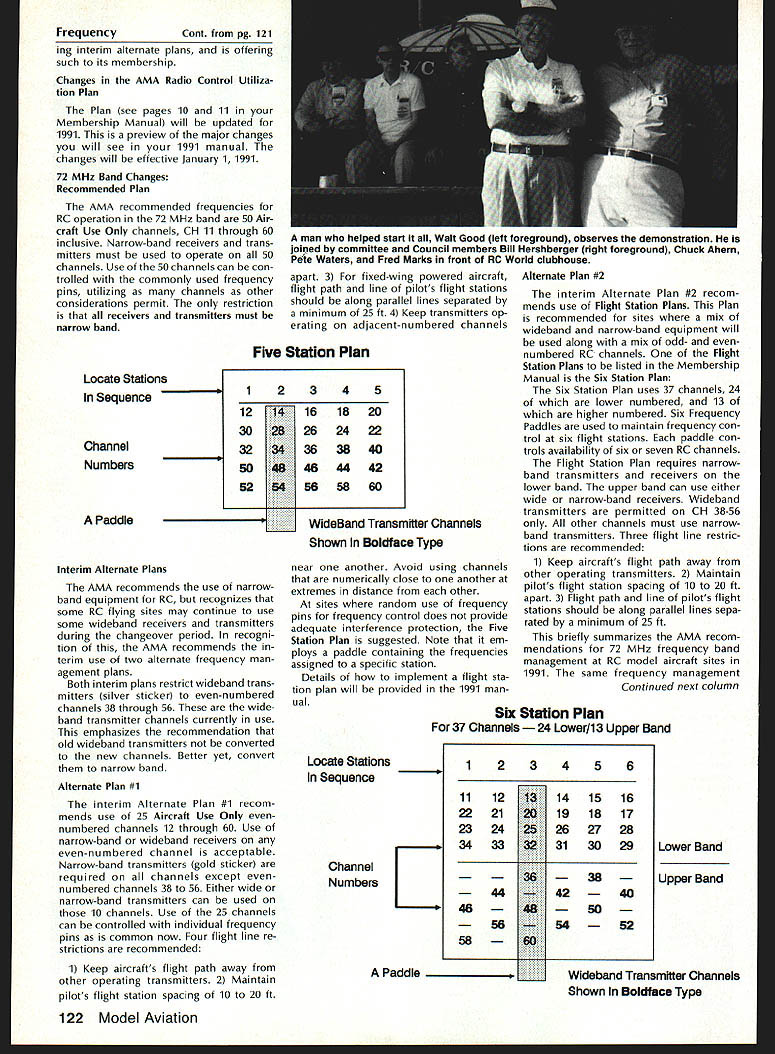
- Where random use of frequency pins does not provide adequate protection, the Five Station Plan is suggested. Details for implementing flight station plans will be provided in the 1991 Membership Manual.
Alternate Plan #2
- Recommends use of Flight Station Plans for sites with a mix of wide‑band and narrow‑band equipment and a mix of odd‑ and even‑numbered channels.
- One such plan is the Six Station Plan, which uses 37 channels (24 lower‑numbered and 13 higher‑numbered). Six Frequency Paddles maintain control at six flight stations; each paddle controls six or seven RC channels.
- The Flight Station Plan requires narrow‑band transmitters and receivers on the lower band. The upper band may use wide or narrow‑band receivers. Wide‑band transmitters are permitted on CH 38–56 only. All other channels must use narrow‑band transmitters.
Three recommended flight line restrictions:
Additional notes
- At AMA‑sanctioned events, all transmitters must be narrow band and display an RCMA/AMA Gold sticker.
- Channels 00–09 (six‑meter band, Amateur frequencies): all channels may be used only if all equipment is narrow band. Use of wide‑band receivers requires use of even‑numbered channels only; wide‑band transmitters cannot be used on any channel.
- Channels 62–90, single‑ and two‑color frequencies: no changes. RC frequencies on 75, 27, and 53 MHz will continue to be used without a requirement for narrow‑band equipment, though narrow‑band equipment reduces chances of interference from non‑RC transmissions.
Nomination (continued)
(See Nominating Committee section above for composition and procedures.)
Synopsis — Executive Council Meeting January 12, 1990
Attendees included:
- President Don Lowe, Altamonte Springs, FL
- Executive Vice President Dave Brown, Hamilton, OH
- District I VP Don Kraft, Dubuque, IA
- VP II John Byrne, Bayside, NY
- VP III Bob Brown, Bradford, PA
- VP IV Howard Crispin, Charlottesville, VA
- VP V Jim McNeill, Birmingham, AL
- VP VI Jim Sears, Burgin, KY
- VP VII Pete Waters, Northville, MI
- VP VIII Gene Hempel, Garland, TX
- VP IX Travis McGinnis, Arvada, CO
- VP X Reginald Keyawa, Carmichael, CA
- VP XI Ed McCullough, Portland, OR
- NAA Executive Director E. L. Langworthy
Also attending: John Worth, Executive Director; Vincent Wankowski, Vice Executive Director. Present from executive staff: Michelle Madison, Competitions Director; Bob Underwood, Technical Director. Guests included members and committee representatives.
Key actions and reports:
- Approval of Minutes
- The October 21, 1989 minutes were accepted as amended.
- Executive Vice President's Report
- Third‑quarter 1989 figures showed a surplus of over $400,000 due largely to better‑than‑projected investment income.
- AMA software is being used in the new Lockbay membership computer system.
- Costs for the recent R/C World Championships in Virginia exceeded $28,000; future similar commitments should be undertaken with an approved budget.
- In light of recent FAI team selection procedural problems, the Council authorized a meeting of the FAI Team Selection Committee chairmen to develop a complete set of operating documents.
A copy of the official minutes may be obtained from AMA HQ on or after April 21, 1990. Minutes are not official until reviewed and possibly corrected at the April 21 Executive Council meeting.
AMA Scholarships
AMA/Charles H. Grant Scholarship
- Up to $11,000 is available to distribute in various amounts based on AMA modeling activities, scholastic achievement, and citizenship.
- Applicants are evaluated by the AMA/Charles H. Grant Scholarship Committee, which makes recommendations to the Executive Council. Committee members include Bob Underwood (Chairman), Cliff Telford, Betty Stream, and Travis McGinnis.
- Selection favors well‑rounded applicants who demonstrate academic performance and active participation in modeling and community. Awards may be granted on the basis of any of the three criteria.
- Eligibility: current AMA member active in model airplane activity for the last three years; graduated from high school in the current or prior year; enrolled in a college or university certificate or degree program.
Other Scholarships
- Sig Memorial Scholarship: awards based on modeling achievement and financial need.
- Tom Hutchinson Memorial Scholarship: awards for achievements in Free Flight.
- Weak Signals Scholarship (started in 1988): awarded to the top candidate of the AMA/Charles H. Grant Scholarship.
- All three programs use information from the Charles H. Grant/AMA Scholarship application. Sig and Hutchinson programs weigh scholastic information differently.
- It is possible to receive awards from multiple programs.
- Applications available from AMA Headquarters. Deadline: May 31.
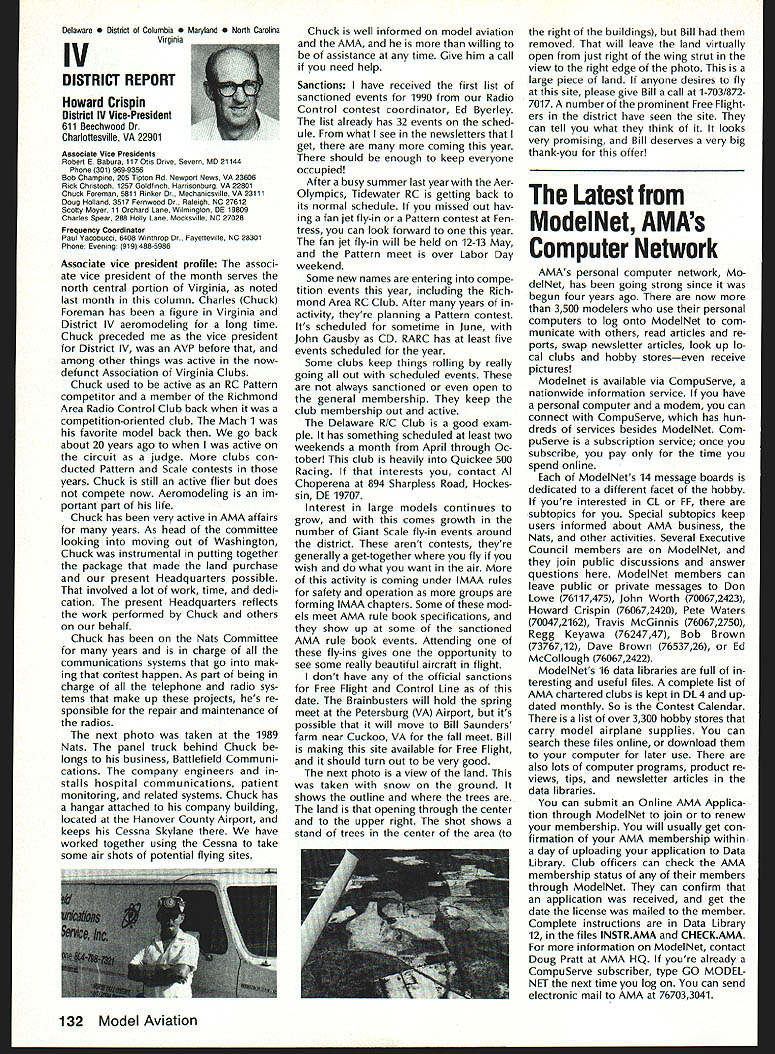
The Latest from ModelNet, AMA's Computer Network
- ModelNet is AMA's personal computer network on Compuserve; it has more than 3,500 modelers.
- With a personal computer and modem, Compuserve subscribers can access ModelNet (subscription service; time‑based charges apply).
- ModelNet features 14 message boards dedicated to hobby facets, special subtopics for AMA business, the Nats, and other activities. Several Executive Council members participate and can be contacted there.
- ModelNet has 16 data libraries with files such as the AMA chartered clubs list (DL 4), Contest Calendar (DL 3), and a list of over 3,300 hobby stores. Files may be searched online or downloaded.
- Online AMA Applications can be submitted via ModelNet; confirmation of membership is usually returned within a day. Club officers can check membership status through ModelNet. Instructions are in Data Library 12 (INSTR.AMA and CHECK.AMA).
- For more information contact Doug Pratt at AMA HQ. If you are a Compuserve subscriber, type GO MODELNET to access. Electronic mail to AMA is at 76703,3041.
District Reports
District V
Jim McNeill, District V Vice‑President 617 South 20th Avenue, Birmingham, AL 35205 Phone: (205) 322‑2127
Associate Vice Presidents:
- Bob Bartosiewicz, Orlando, FL
- Gustavo Diaz, Guaynabo, PR
- Richard Jackson, N. Charleston, SC
- Dr. John Martin, Miami, FL
- Dick Paton, Birmingham, AL
- Terry Rimer, Baldwin, FL
Frequency Coordinator:
- Burris Fields, P.O. Box 1013, Strickland Rd., Interlachen, FL 32048
Phone: (904) 684‑2517
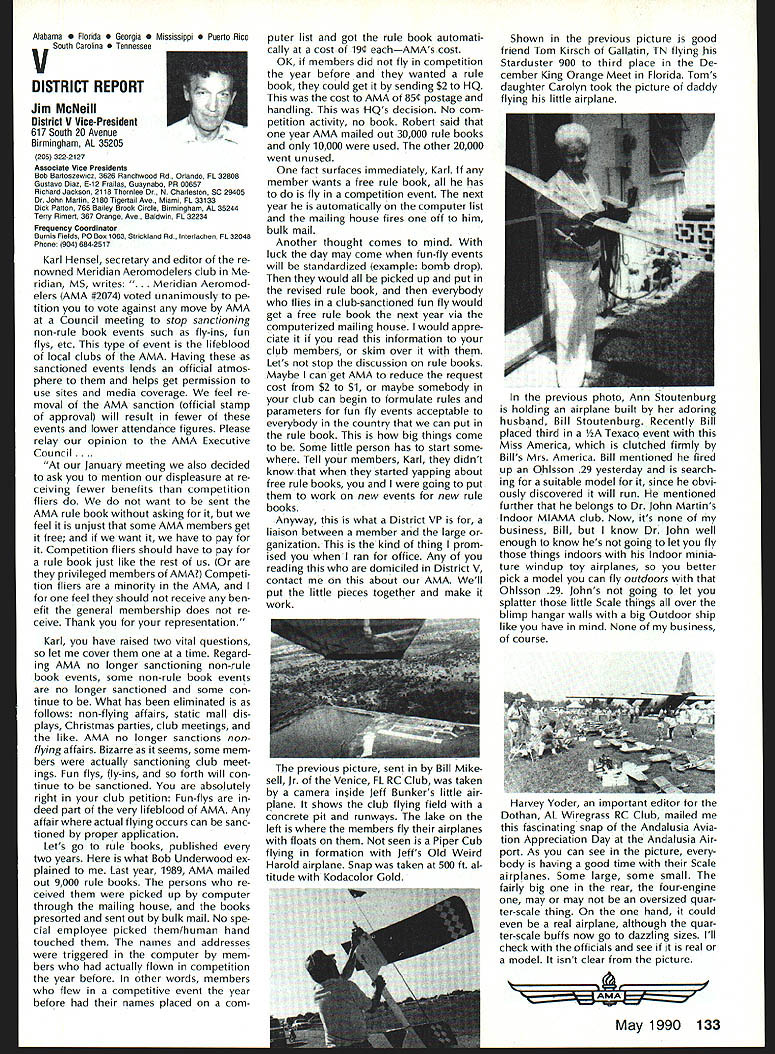
From the Meridian Aeromodellers (Karl Hensel): concerns about AMA discontinuing sanctioning of non‑rule book events (fun flys, fly‑ins) and complaints about rule book distribution.
Responses and clarifications:
- AMA no longer sanctions non‑flying affairs (static mail displays, Christmas parties, club meetings). Fun flys and fly‑ins that include flying will continue to be sanctioned.
- Rule book distribution: in 1989, AMA mailed about 9,000 rule books automatically to members who had flown in competition the previous year (triggered by membership/computer lists). Members who did not fly in competition could request a rule book by sending $2 to HQ (to cover postage and handling). If a member competes in an event, they will be added to the mailing list and receive a rule book the following year.
- Suggestion: if fun‑fly events are standardized nationally, they could be included in revised rule books, which would allow participants in sanctioned fun‑fly events to receive rule books automatically.
District V encourages members to engage in developing standardized events and to contact the District VP with ideas.
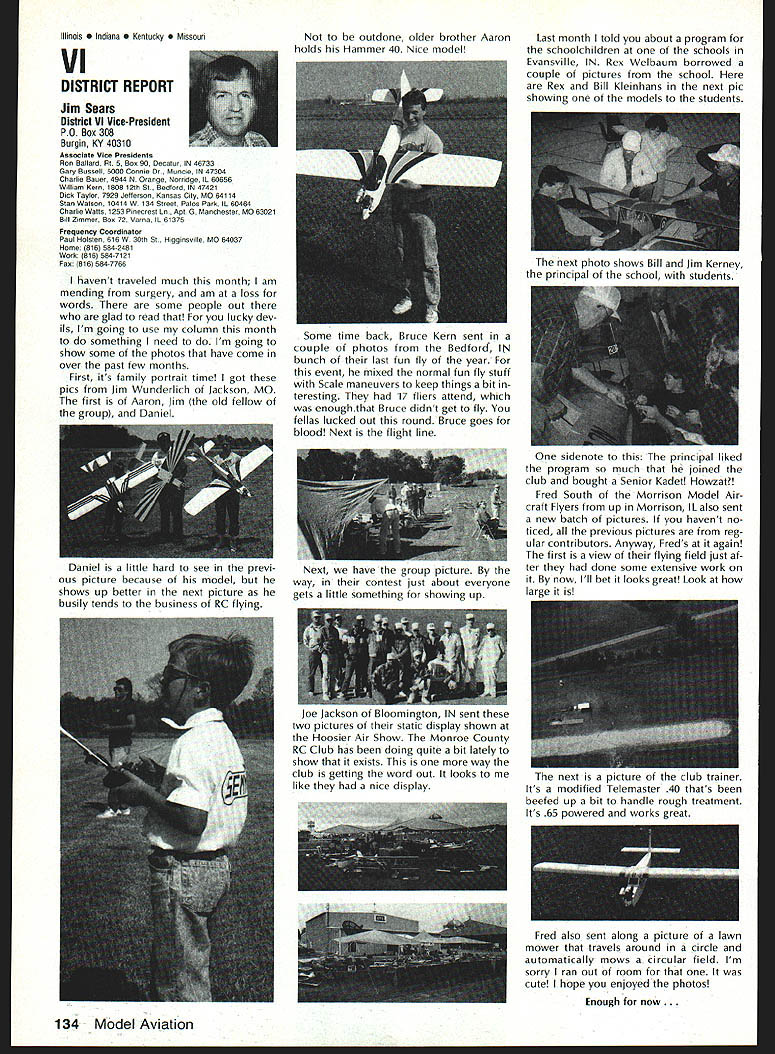
District VI
Jim Sears, District VI Vice‑President P.O. Box 308, Burgin, KY 40310
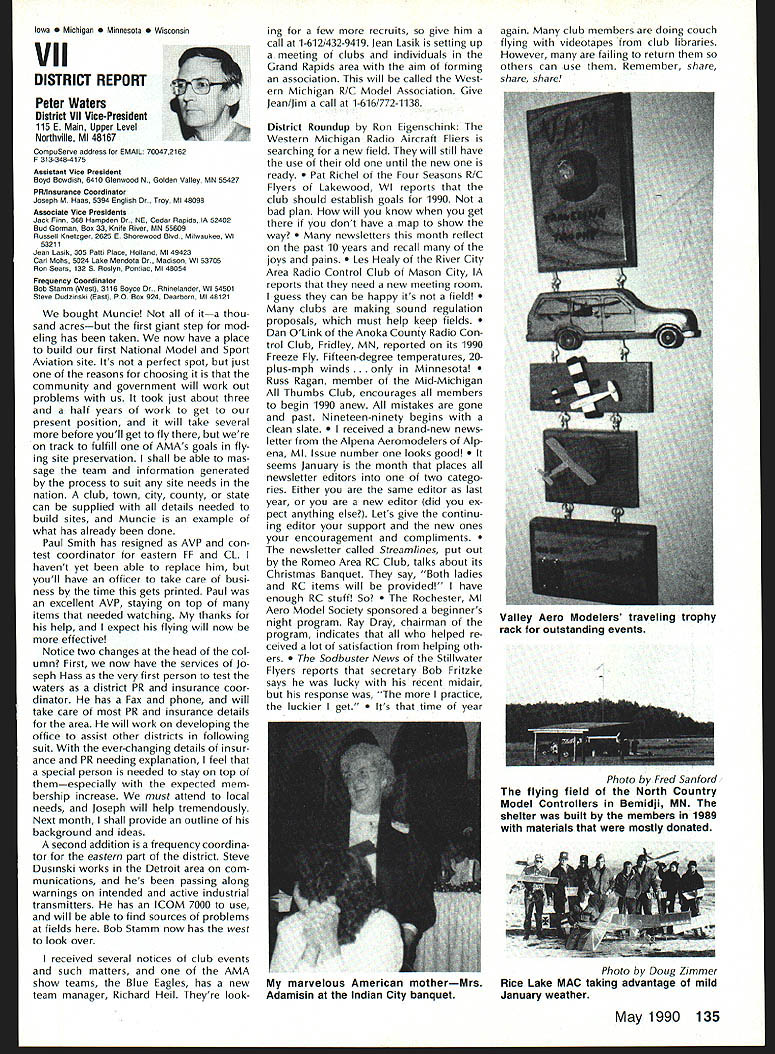
- Jim reports recovering from surgery and uses his column to share reader‑submitted photos and stories.
- Highlights include family photos of club members and pilots, club fun‑fly events that combine fun tasks with scale maneuvers, static displays at air shows, successful school outreach programs that led to a principal joining a club and purchasing a model, and club efforts to maintain and improve flying fields and trainer aircraft.
- Jim thanks contributors and encourages continued submissions.
Awards and Events
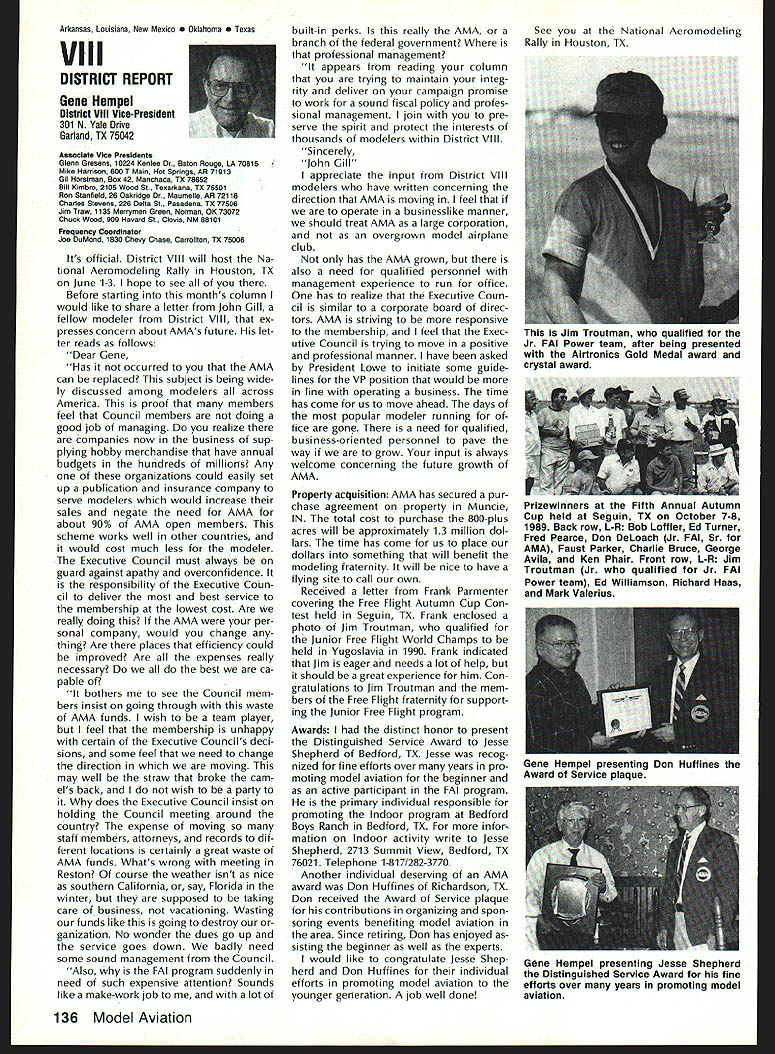
- Free Flight Autumn Cup (Seguin, TX): Jim Troutman qualified for the Junior Free Flight World Championships (Yugoslavia, 1990).
- Distinguished Service Award presented to Jesse Shepherd (Bedford, TX) for promoting beginner and indoor programs; contact: Jesse Shepherd, 2713 Summit View, Bedford, TX 76021, (817) 282‑3700.
- Award of Service presented to Don Huffines (Richardson, TX) for organizing and sponsoring local events.
- Upcoming event: National Aeromodelling Rally in Houston, TX. See AMA event listings for details.
Transcribed from original scans by AI. Minor OCR errors may remain.

