
AMA NEWS
PR Roundup
Geoffrey Styles Director of Marketing & PR
There seems to be a flurry of chartered-club outreach activity lately. That's great because it gives me useful information to pass along and provides excellent examples of AMA club community involvement. Clubs with a positive local image tend to get favorable consideration when a flying-site need arises.
Yesterday I heard from Jerry Bockius of Connecticut. Jerry, a public-spirited fellow, was asked by a Girl Scout group to help with an aviation project and needed to order 160 Delta Darts for program planning. No problem — the AMA Supply & Service group keeps the Dart in stock. I enjoyed meeting Jerry recently at the New England Model Aviation Weekend, so it was good to hear from him.
From the newsletter of the Catalina R/C Modelers (Tucson, AZ) I learned that George Suderman is working with an Explorer Group that began its program in January 1990. George hopes to get 25 or more Explorer Scouts started in model aviation. His club is standing behind him — once again the combined knowledge of senior AMA members carries a lot of power. Count up the years of experience in your club sometime; you'd be surprised how much aviation knowledge exists. Nationwide, AMA members' experience can be a very positive force for teaching young people.
We recently assisted the national office of the Boy Scouts of America in rewriting the aviation merit badge book. The previous edition was quite dated and needed new material. I haven't yet seen the revised version, but I hope the kids find it interesting and current. If anyone receives a copy, please send one along.
Clair Sieverling of Phoenix, AZ, sent a clipping from the Phoenix Gazette titled "Parenting," in which John Rosemond extols the benefits of hobbies. Rosemond defines a hobby as an activity a child pursues independently and regularly. He was surprised to find how few people had developed a true hobby. Television has eroded the desire for hobbies in many children; when entertainment is just a flick of a switch, there's less incentive to pursue a detailed, demanding pastime. What's lost is initiative and the opportunity to explore individual interests and personality. Model aviation offers many of those developmental benefits — if you have a chance to help young people, please do.
In recent weeks I've exchanged ideas with two interesting gentlemen: Kenneth Daly, Chief of the Junior Program Division at Maxwell Air Force Base, who is exploring use of model airplanes to stimulate aviation interest among ROTC members; and Doug Lunsford, District Executive of the Chisholm Trail Council (Boy Scouts of America), who wants to use model aviation to encourage science and math interest and to address long-term effects of the national pilot shortage.
Jeff Csatari, Special Features Editor for Boys' Life magazine, visited the 1989 Nats in Washington State and produced two very good stories in the October 1989 issue. If you missed them, find a copy — they do a nice job of showcasing our hobby.
Are model airplanes useful beyond recreation? According to a report in the Kingston Whig-Standard, Gordon Wallace of Amherstview, Ontario, developed a gull‑harassing flying machine. The International Civil Aviation Organization estimates roughly 10,000 bird strikes occur annually; gulls account for about 50% of those strikes, most of which occur below 3,000 ft during takeoff and landing. Wallace found that two to three days of harassment kept gulls away where firecrackers, distress calls, balloons, and flags had failed. I forwarded the story to the Federal Aviation Administration for their files.
Work with the FAA continues on a regular basis; I like to keep contacts warm. Incidentally, I recently received an award from the FAA recognizing the efforts of AMA and its members in youth education. Members and clubs working with kids — keep up the good work.
I also had two interesting trips earlier this year. One was to Green Bay, WI, where I spoke at an annual club gathering. Another was to Springfield, IL, where I served as an expert witness at a zoning appeals hearing to overturn a negative decision that threatened a proposed flying site. We succeeded and the matter was referred to the county board. The takeaway: be known, keep in touch with elected officials, and build a positive image in your community. Land is getting harder to come by; grassroots efforts start with your club.
One final note: for scale builders, the Research Library at the Experimental Aircraft Association (Oshkosh, WI 54903) has excellent scale and historical documentation. Contact Dennis Parks, Librarian, for more information.
See you next month.
Executive Director's View From HQ
Vince Mankowski Executive Director, Academy of Model Aeronautics 1810 Samuel Morse Dr., Reston, VA 22090
Walt Mooney: Word has been received from John Burns of Lakeside, CA, that Walt Mooney (known to many as "Mr. Peanuts") passed away March 1. Walt was an enthusiastic contributor to many parts of the aviation community, famed for his Peanut-class rubber-powered designs. He apparently suffered a heart attack while at work. Walt was an AMA supporter, an excellent modeler and designer, and will be missed.
Hoosier happenings: AMA is assembling property in Indiana by purchasing land from nine separate owners. Negotiations are complex because some parcels are owner-farmed and others tenant-farmed. Tenants' livelihoods, rental homes, and potential displacement of families make the process delicate. AMA's primary goal is to develop a flying site, but we must balance that with people's homes and income.
All sellers have agreed to sell and AMA has agreed to buy, with offers contingent on sale of other properties, title work, surveying, and zoning. Surveying and title work are underway. Zoning is the key issue: commercial zoning would offer the most discretion but could facilitate perimeter commercial development; agricultural zoning might limit future AMA uses; recreational zoning currently seems to provide the appropriate balance — allowing AMA planned uses while offering protection from incompatible development.
We appreciate Bob Wilkerson of Atlanta, GA, who assisted with a property appraisal and provided attorney referrals. AMA has retained excellent legal representation in Indiana and the process is progressing well.
Filing a zoning application requires submission of 20 copies of a detailed plan addressing roads, water, sanitation, power, and related impacts. We've been working with an architectural and engineering firm on concept drawings and have engaged an Indianapolis engineering firm for ongoing assistance. This is a complex project requiring significant coordination among owners, agents, attorneys, engineers, economic development officials, county officials, consultants, the AMA Property Acquisition Committee, and the Executive Council.
We expect to go to settlement on the properties in June. Work is underway to convert concept drawings into working drawings and to schedule development. Phased leasing and rentals are likely; exact dates remain tentative, but a practical timetable targets mid‑1991 for major development milestones.
Wouldn't it be wonderful to hold a 50th‑anniversary celebration on a new site? That would tie the past and the future together nicely.
HQ news: Membership processing has improved — over 80% of membership cards are processed in seven days or less. Mailroom equipment has been replaced earlier than last year, and club mailings have gone out early. With the Indiana property purchase, Headquarters will be heavily involved in development planning while maintaining service to the membership.
Making a Mall Show Work
Geoffrey Styles Director of Marketing
A mall show is an excellent tool for building community relations. Malls are heavily populated and give you center stage to show the non‑modeling public who you are, what you do, and why. You can demonstrate that model airplanes are well-crafted, sophisticated machines designed for specific purposes.
Mall shows further your club's goals in practical ways. The most important asset of any model club is its flying field. Often a club spokesperson had to make a strong pitch to a landowner or property manager to secure a site — dispelling myths and explaining community benefit. Imagine how much easier that job would have been if the landowner had seen modelers actively representing the sport in the community.
Mall shows also help with neighbor relations. Educating neighbors about the constructive and educational aspects of the hobby can turn skeptics into supporters. If your field is secure, a mall show can still attract new members — many kids (and adults) love aviation and will respond to a hands‑on introduction. Demonstrate quiet muffler systems, electric flight, or silent glider flight to broaden public understanding and appreciation.
AMA can help your club make a successful presentation. We can provide brochures and handouts, district vice presidents have films and videotapes plus a tabletop display booth, and we can supply press release forms and sample radio announcements. AMA's Supply and Service Department offers an extensive selection of videotapes to explain the hobby. When the National Mall Show program began in 1983, participating clubs benefited immediately; as the program grew, so did national image and membership. Today mall shows are widespread and boost local appreciation of model aircraft.
Contact AMA Headquarters for a starter kit: ask for Judy, Bill, or Geoff. The information is free and can help improve your club's public image.
Club and Member News
Mike Marchand Fund
A member of the Tunnel City RC Club, Michael (Mike) Marchand, has leukemia and is scheduled for a bone marrow transplant at Children's Hospital in Boston on Friday, March 16, 1990. He will require extended isolation after the operation. The club has set up a fund and is holding events to raise money. To donate, send contributions to:
- Mike Marchand Fund
Tunnel City RC Club Hoosick Savings Bank North Adams, MA 01247
Mike will turn 18 at the end of March; contributions are appreciated.
Earle "Bud" Gay (1919–1990)
Submitted by Bob Wallace; written by Mike Adajian (Canton, CT)
Earle "Bud" Gay (AMA 419) recently passed after a long battle with heart disease. Bud dedicated most of his life to advancing model aviation and mentoring youngsters. He organized the Connecticut Chapter of AMA (CCAMA) in 1951 to improve information exchange and state contest coordination, persuading AMA HQ that CCAMA would function within AMA policy. Bud was an AMA member since 1939 and remained actively involved in many facets of modeling: indoor and outdoor rubber and tow-line, microfilm, gas-powered free flight, control line, and radio control. He served in multiple roles — club president, life member of Central Connecticut Radio Club (an honor given only three times in 40 years), AMA District IV VP, District I Contest Board member, AMA Leader Member, and AMA Contest Director. Bud served in the U.S. Air Force (1943–1945) and worked for Sikorsky Aircraft. He retired after 15 years as director of Crafts and Hobbies at a famous Connecticut institution for the emotionally impaired. Bud is survived by his wife Dot, a son (Robert), a daughter (Candy), and two granddaughters. He left a lasting legacy in the modeling community.
AMA AWARDS
Officer Awards
- Meritorious Service: Automatic to outgoing Executive Council members.
- Fellow Certificate: Automatic to outgoing President; also for long and dedicated AMA service on behalf of others (recipient need not have held office).
Club or Individual Awards
- Technical Award: Presented with Executive Council approval for technical achievements that better modeling.
- Award of Appreciation: First-level award presented at the discretion of the Vice‑President, President, or Executive Director for district service or special recognition.
- Superior Service: Second-level award presented with Executive Council approval; typically for local service.
- Distinguished Service: Third-level award presented with Executive Council approval for long-term service in AMA office or committee.
- Vital People's Award: Up to six cash awards per year to unsung heroes at the club level.
- Hall of Fame: Presented with the approval of the Council of Past Presidents; akin to Fellow Certificate.
- President's Legion of Honor: Presented with approval of the President, Executive Director, and Executive Vice‑President for major donations, fundraising, or exceptional financial contribution.
- All Season Flyers Patch: Awarded for flying at least once each month for 12 months (club officer approval required).
- Award of Service: Issued to clubs for community service (vice‑president approval).
- Award of Achievement: Issued to clubs for competitive service (vice‑president approval).
- Award of Excellence: Issued with Executive Council approval as an upgrade for significant achievement or to upgrade other awards.
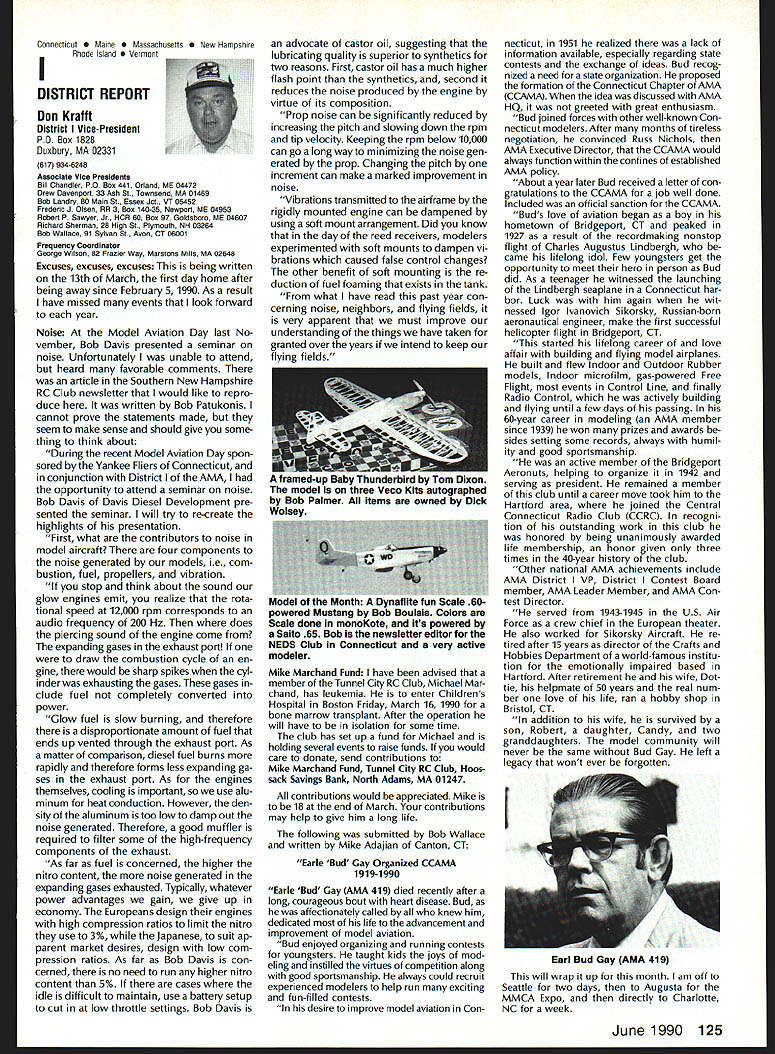
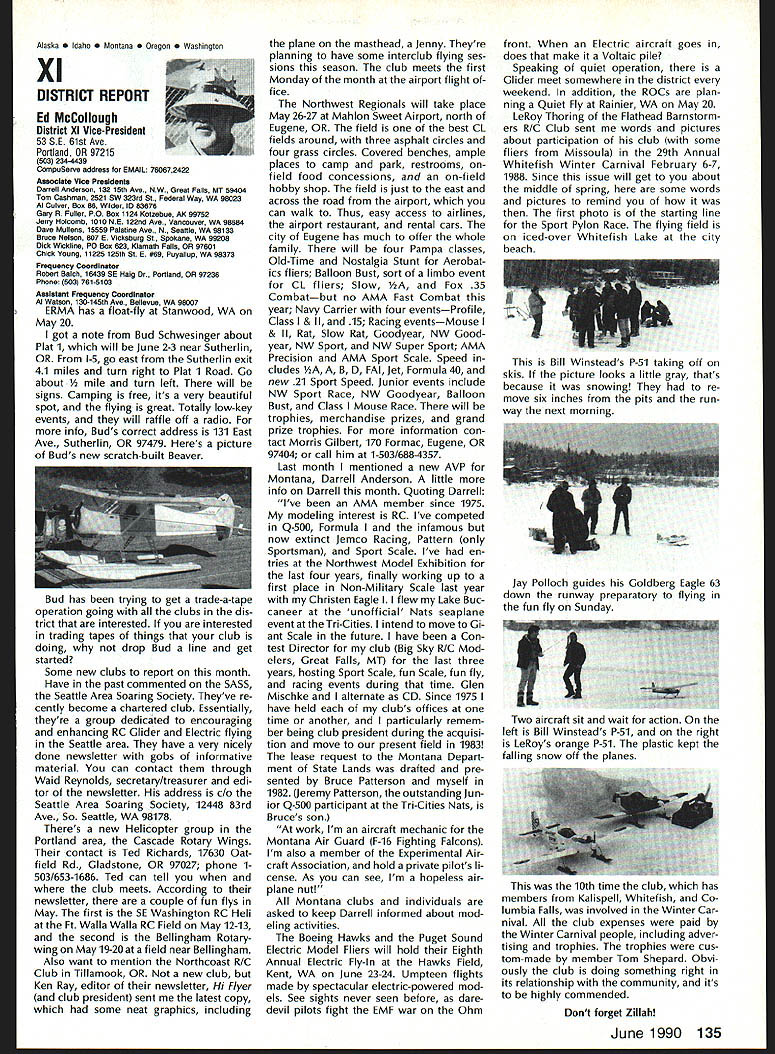
XI DISTRICT REPORT
Ed McCollough District XI Vice‑President 53 S.E. 61st Ave., Portland, OR 97215 Phone: (503) 234-4493 Email/Computer address: 76067.2422
Associate Vice Presidents:
- Daniel Anderson — 2315 154 Ave. N.W., Great Falls, MT 59404
- Tom Cashman — 3521 SW 23rd St., Federal Way, WA 98023
- Al Culver — Box 86, Wilder, ID 83676
- Gary R. Fuller — P.O. Box 112, Kettle Falls, WA 99141
- Jerry Hanan — 10320 N.E. 122nd Ave., Vancouver, WA 98684
- Dave Mullins — 35569 Palatine Ave. N., Seattle, WA 98133
- Bruce Nelson — 550 E. Klevburg St., Spokane, WA 99208
- Dick Wickele — 102 Fox Creek Lane, Pullman, WA 99163
- Chuck Yocum — 12125 213th St. E., Puyallup, WA 98374
Frequency Coordinator:
- Robert Rabi — 16436 SE High Dr., Portland, OR 97236; Phone: (503) 761-1037
Assistant Frequency Coordinator:
- Al Watson — 130‑145th Ave., Bellevue, WA 98007
Events and club news:
- ERMA float-fly at Stanwood, WA on May 20.
- Plat 1: June 2–3 near Sutherlin, OR. From I‑5, take the Sutherlin exit, go east 4.1 miles, turn right to Plat 1 Road, go 1/2 mile and turn left — signs will be posted. Camping is free. For more info, contact Bud Schwesinger, 131 East Ave., Sutherlin, OR 97479. Bud is organizing a tape-trading operation among interested clubs.
- New clubs: Seattle Area Soaring Society (SASS) — dedicated to RC glider and electric flying; contact Ward Reynolds, 12448 83rd Ave. S., Seattle, WA 98178. Cascade Rotary Wings (helicopter group) in Portland area — contact Ted Richards, 17630 Oatfield Rd., Gladstone, OR 97027; Phone: (503) 653-1686.
- Northcentral RC Club (Tillamook, OR) — club newsletter Hi Flyer; interclub flying sessions planned; club meets first Monday each month at the airport flight office.
Northwest Regionals:
- Date: May 26–27 at Mahlon Sweet Airport north of Eugene, OR. Features excellent CL facilities (three asphalt circles, four grass circles), covered benches, camping, restrooms, concessions, and an on-field hobby shop. Events include Pampa classes, Old‑Time and Nostalgia Stunt, Balloon Bust, Combat classes, Navy Carrier events, various racing classes (Mouse, Rat, Goodyear, Sport), Precision and Sport Scale, and Speed events (V4, A, B, D, FAI, Jet, Formula 40, .21 Sport Speed). Junior events and numerous trophies/prizes. Contact Morris Gilbert, 170 Formac, Eugene, OR 97404; Phone: 1-503/688-4357.
Montana AVP:
- Darrell (Daniel) Anderson is the new AVP for Montana. AMA member since 1975; modeling interest in RC, with participation in Q‑500, Formula I, Pattern (Sportsman), and Sport Scale. Contest Director for Big Sky R/C Modelers (Great Falls, MT). Darrell is an aircraft mechanic for the Montana Air Guard (F‑16s), an EAA member, and holds a private pilot's license. Montana clubs/individuals should keep Darrell informed of activities.
Electric and quiet-flying events:
- Boeing Hawks and Puget Sound Electric Model Fliers: Eighth Annual Electric Fly‑In at Hawks Field, Kent, WA, on June 23–24.
- Numerous glider meets and a Quiet Fly at Rainier, WA on May 20.
Whitefish Winter Carnival:
- Flathead Barnstormers R/C Club supported the 29th Annual Whitefish Winter Carnival (Feb 6–7). Members flew in snowy conditions; the club was fully supported by Carnival organizers who covered expenses and provided trophies. The club's strong community relationship is commendable.
Zillah reminder: Don't forget the Zillah events!
Easy-to-Build and Inexpensive
A letter from 12‑year‑old Katie Bosman of Sturgeon Bay, WI, praised the Monoplane Glider featured in November. Katie modified it, built several similar small free flights, and prefers simple gliders because they are easy and inexpensive. Simple, low-cost designs are ideal for beginners.
The 30/30 Mini Wake (design notes)
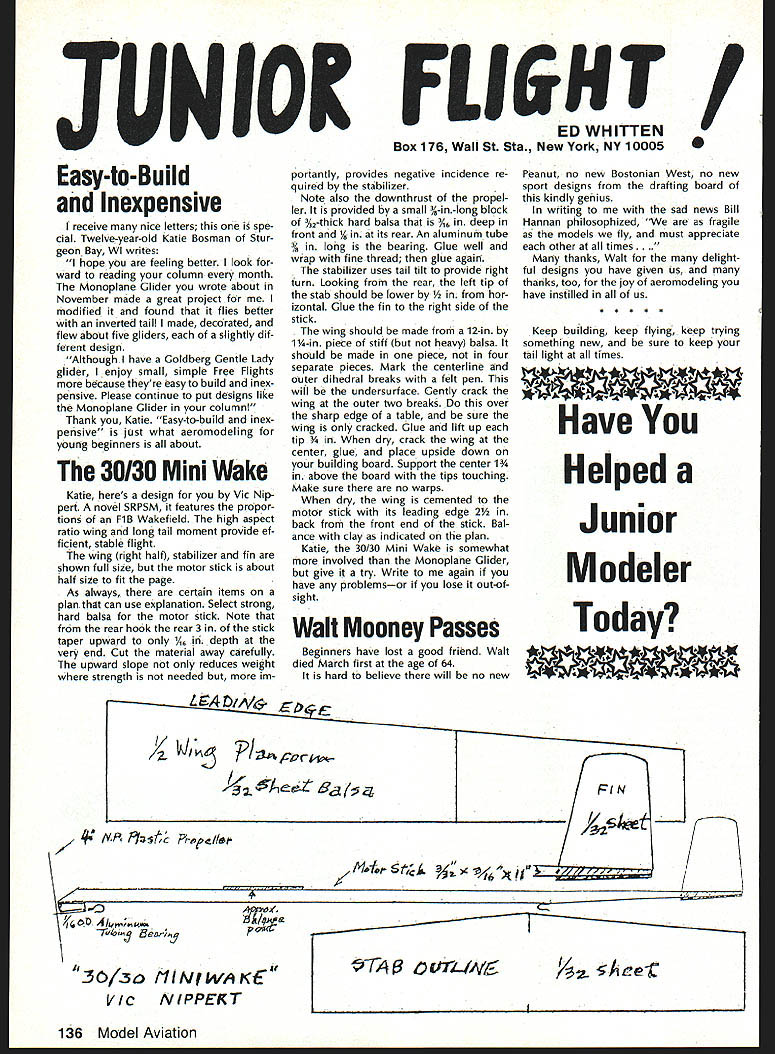
A design by Vic Nippert: a small SRPSM (single‑rubber powered model) with F1B Wakefield proportions. Features high-aspect-ratio wing and long tail moment for efficient, stable flight.
Construction notes:
- Select strong, hard balsa for the motor stick. The rear 3 in. of the stick tapers upward to 1/8 in. depth at the very end; cut carefully to provide negative incidence for the stabilizer.
- Propeller downthrust is provided by a small 1/4‑in. long block of 3/32‑in. thick hard balsa, tapered from 3/16 in. in front to 1/8 in. at the rear. Use a 3/32‑in. aluminum tubing bearing. Glue well, wrap with fine thread, and glue again.
- The stabilizer uses tail tilt to provide a right turn: when viewed from the rear, the left tip of the stab should be 1/8 in. lower than horizontal. Glue the fin to the right side of the stick.
- Make the wing from a 12 in. × 1‑1/4 in. piece of stiff (but not heavy) balsa in one piece. Mark the centerline and dihedral breaks. Crack the outer two breaks gently over a table edge and lift each tip 1/8 in. Glue and then crack the center, glue, and place the wing upside down on the board supported 3/4 in. at the center. Ensure no warps.
- Cement the wing to the motor stick with the leading edge 2‑1/2 in. back from the front end of the stick. Balance with clay as indicated on the plan.
Katie — the 30/30 Mini Wake is more involved than the Monoplane Glider, but worth a try. Write if you need help.
Walt Mooney Passes
Beginners and veterans alike lost a good friend when Walt Mooney died on March 1 at age 64. His many Peanut and other designs brought joy to modelers for decades. We thank Walt for his contributions and the passion for aeromodeling he shared with so many.
Keep building, keep flying, and keep your landings looking good!
Transcribed from original scans by AI. Minor OCR errors may remain.

