
AMA News
PR Roundup
Geoffrey Styles Director of Marketing
Last month I wrote about some positive news reports that crossed my desk—clippings, newspapers, letters from clubs. This month I want to give an example from the other side of the coin.
All serious modelers agree that the flying site is a club's most important asset. There are several ways to lose a site; a story from northern Illinois shows one of the worst. A couple in Lake County complained to the property administrator that their home was being buzzed as early as 7:00 a.m., and they reported crashes close to the house. A local newspaper headline read, "World War II Is Finally Over." Needless to say, all flying at that site has been halted pending investigation.
That behavior is, frankly, downright stupid. It puts all of us in a bad light and negates the efforts of sensible aeromodelers, hardworking chartered clubs, and AMA HQ staff who work to build a responsible image. It gives modelers a negative image we do not need and cannot afford.
Flying model aircraft is not an absolute right — it is a privilege. Public agencies can and will pass bylaws or ordinances to restrict or ban model flying if they have sufficient reason. Getting such bans reversed is a major task; it is far easier to have an ordinance put on the books than to have it removed.
We all know the educational and constructive benefits of model aviation, so I won't restate them here. The need to be responsible fliers is paramount. Anyone who thinks they can get away with reckless behavior for long is harming the sport. The sport has too many positives to be spoiled by people who will not or cannot obey rules. Safety officers and field marshals need to be fair and just—and they must be supported by their club executives.
Interest in model aircraft and model aviation continues to grow. So far this year AMA membership is about 12% ahead of 1989. That means more clubs are forming, more flying fields are being found, and more modeling products are being sold. However, many people still fly but do not belong to AMA. Imagine what it would mean if every AMA member brought in one new member in 1990—we would double our size before year’s end. When we address public officials we currently speak for about 170,000 members; that voice would be even stronger if we spoke for 350,000. In politics, numbers matter.
If you have friends or acquaintances who fly but do not support the national organization, encourage them to get involved and help preserve and maintain model flying privileges for everyone. We must be strong enough, in numbers and reputation, to deal with federal and state agencies.
On flying sites: more chartered clubs are purchasing their own fields. Mike Robin (Minnesota) helped form a group that completed a recent land purchase. Another example comes from Terry Terrenoire (New York).
Terry’s club, the AeroGuidance Society, Inc., had a field for many years but was forced out by development and a hostile neighbor. A town bylaw was introduced and passed, forcing the club to look elsewhere. The club created a fund from a special assessment to every member. After years of searching, they found suitable land and used three financing methods to buy it:
- A special assessment that created the fund.
- Sale of land already owned but no longer usable.
- Sale of $100 face-value bonds to club members yielding 6% interest.
The 45-person club raised the initial $22,000 needed to purchase the new land. Since then they added two pavilions, two outhouses, chain-link fencing, a half-mile of roadway, a tractor, and a mower. The club paid off its debt, kept a $15 special assessment in effect to buy adjacent buffer land, and later purchased an additional 24-acre parcel as membership grew to over 70. Annual dues are now $50 and the club now owns nearly 100 acres. Their goal is to reach about 200 acres to ensure long-term safety from development.
Planning, member participation (including willingness to pay), and good advice have paid off for the AeroGuidance Society. If you have recently bought a field, send us your story—we’ll pass the details along to interested clubs.
More next month.
---
Executive Director's View From HQ
Vince Mankowski AMA Executive Director 1810 Samuel Morse Dr. Reston, VA 22090
By the April 21 Executive Council meeting, I will have held the Executive Director position for about 80 days. Rather than a personal viewpoint, I thought the Council’s 80-day report might interest the membership.
- A new organizational plan and Headquarters chart have been implemented. The "Whom to Contact at Headquarters" form has been updated.
- Membership and club renewal workflows have been flowcharted and are under study for efficiency improvements. Several job descriptions have been rewritten.
- Equipment and furniture in Membership, Competition, administrative, and stockroom areas have been relocated to increase efficiency.
- Several employees have been sent to classes (filing, business writing, computer software) at a local community college.
- We have advertised for a Systems Manager for AMA.
- We completed an extensive study on adding floorspace inside the Headquarters building and negotiated with contractors for best price and schedule.
- After a review of capital inventory books, we plan a complete inventory in July 1990.
Other initiatives and activities:
- Increasing AVP and VP involvement in hobby trade shows; a trade-show attendance policy has been drafted.
- A study of museum and library use; a policy on research and photocopying is in place.
- Evaluation of fundraising and Patron programs is underway.
- An insurance outline for AMA sanctioning event kits is being developed.
- Mailings have been sent to clubs around the Nats and a similar mailing will go out to clubs around the Rally.
- Work is underway on a safety booklet, a sound video, and possibly additional safety videos.
- A Charter Club Award is being developed to encourage charter clubs to engage in projects that help preserve flying sites.
- We are studying AMA coverage and safety codes for car and boat operation.
- District patches have new, cost-effective procurement and delivery options being developed for district vice presidents.
- Initial exploration of national or district flying site directories is in progress; district directories listing district officers are being produced.
Membership renewal improvements for 1991:
- A checkbox on the renewal form will allow members to opt out of additional mailings (credit cards, etc.).
- We are exploring telephone renewal by credit card to spread out workload and let members renew earlier (with charging timed as appropriate).
Day-to-day operations continue, and we are converting older files into a searchable computer format. Recent travel included trips to Paris, the Toledo Show, Lawrenceville, N.J., Williamsville, N.Y., and Muncie, with multiple stopovers. Modern communication (fax, voicemail, CompuServe) keeps us connected; I have so far avoided beepers.
Membership and club renewals are being processed. Charter Club renewals are more involved, but mid-April filings were largely completed. Over 2,000 clubs submitted renewal information and were responded to within a few working days. Throughout April, AMA staff have worked long hours to keep up.
A final personal note: returning to Toledo after 3 a.m. on April 8, I lost luggage in New York and Detroit and missed the chance to photograph Fred Marks receiving the Distinguished Service Award for his work on the AMA Frequency Committee. Jerry Smith (R/C Modeler) kindly provided a photo so it could be shared.
---
Club and Local News
Tailfeather News
"Tailfeather News" is an interesting club newsletter I recently received. The club meets a couple of blocks from my home in Bayside but flies on Long Island. For many years they met in the basement of Dick Calegari’s photographic shop; now the group is moving to a location nearer the flying field. Thanks to President Don Segre for the invitation.
Staten Island Radio Control Modelers
Dan Speranzo reports that the Staten Island club will again send copies of its newsletter, The Dead Stick Gazette. Production difficulties had temporarily interrupted distribution. I admire the Staten Island clubs’ eagerness to assist one another with shows, contests, picnics, and other public projects. Clubs gain much by sharing public projects.
Obituary: Leo Spencer (AMA 6021)
On March 1, 1990, the aeromodelling community lost Leo Spencer after a protracted illness. Leo was an active modeler since the early 1930s—a builder, flyer, organizer of exhibitions, contests, fly-ins, and fundraisers. His greatest achievement was the Cradle of Aviation Expo at Long Island’s Mitchell Field (scheduled this year for June 2–3). He founded the Nassau Flyers and the Condors (a chapter of IMAA), and he helped bring aeromodeling to the attention of Long Island government officials. Leo’s sense of humor and ability to make others laugh will be greatly missed. Thanks for everything, Leo.
---
AMA Film Library
Presently in stock are 19 films available for rent by AMA chartered clubs and open members for $10 (an additional $50 deposit is required). All films are 16mm; most were shot in color and sound. Send a self-addressed, stamped business-size (No. 10) envelope to the Film Librarian, Academy of Model Aeronautics, for a full listing and order form.
Partial listing:
- Diamonds in the Sky — AMA’s 1986 film covering major aspects of Radio Control aeromodeling: Soaring, Helicopter, Electric Power, Aerobatics, Pylon Racing, and Scale. About 30 minutes. (Film by Jay Gerber)
- The Pioneers — The Good brothers (Walt and Bill) recount efforts in the 1930s and 1940s to develop Radio Control systems, including their own historical footage. About 27 minutes. (Film by Jay Gerber)
- Those Marvelous Miniatures — Spectacular footage across the model aviation spectrum: sailplanes at Torrey Pines, seaplanes at Brimfield, peanut free-flight models to large RC craft. About 46 minutes; requires projector capable of 13 1/4-in. film and is best appreciated on a large screen. (Film by Jay Gerber)
---
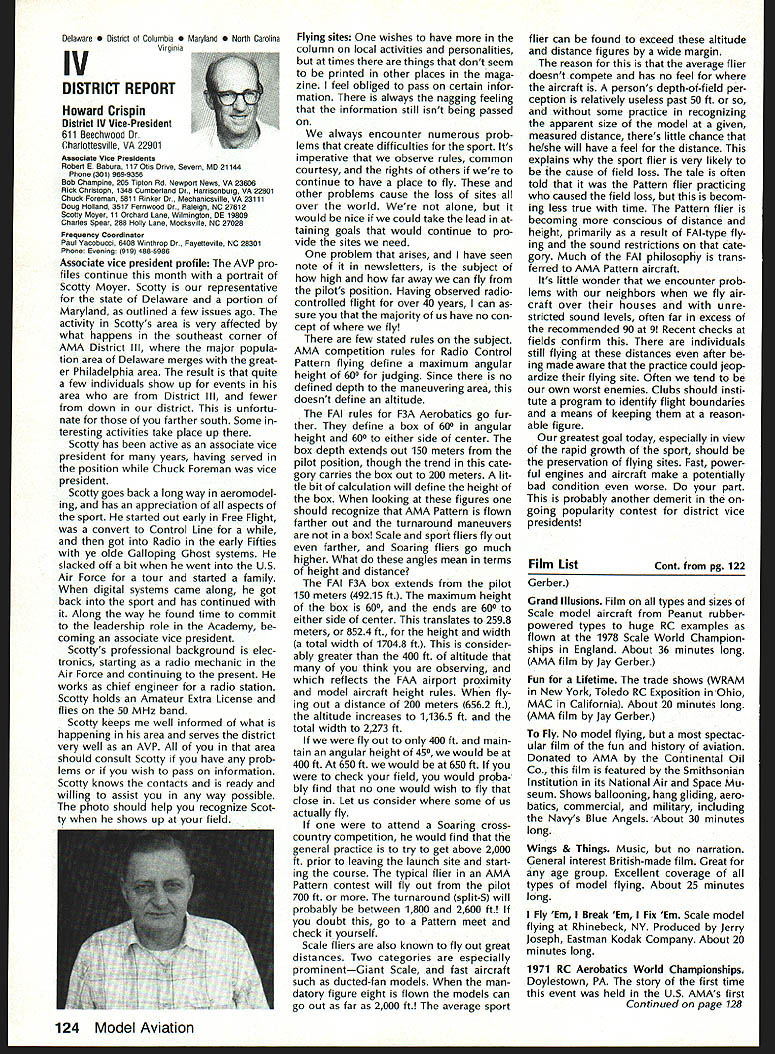
Flying Sites and Safety
We always encounter problems that threaten flying sites. Observing rules, common courtesy, and the rights of others is imperative to preserve our places to fly.
One recurring issue is how high and how far away models are being flown. Having observed radio-controlled flight for over 40 years, I can assure you most pilots have no real concept of where they fly. There are few stated rules on the subject:
- AMA Radio Control Pattern judging defines a maximum angular height of 60° for judging, but no defined depth to maneuvering areas.
- FAA F3A Aerobatics rules define a box: 60° angular height, 60° to either side of center, and a box depth extending 150 meters from the pilot position (some events extend to 200 meters).
Some conversions:
- At 150 meters (492.15 ft.) out from the pilot, a 60° apex height equates to about 259.8 meters (852.4 ft.), with total width about 1,704.8 ft.
- At 200 meters (656.2 ft.) out, the apex height increases to approximately 1,136.5 ft., total width about 2,273 ft.
These figures are considerably greater than the 400 ft. altitude many people assume is the limit. Soaring contest pilots often aim to get above 2,000 ft. before leaving the launch site. Pattern competitors may fly out 700 ft. or more, with turnaround maneuvers between 1,800 and 2,600 ft. Scale and sport fliers, especially with giant-scale or high-speed ducted-fan models, can go out as far as 2,000 ft. or more. The average sport flier, who seldom competes, often lacks a sense of distance—the human eye’s depth perception is unreliable past about 50 ft.
This lack of distance awareness and unrestricted sound (often exceeding recommended 90 dB) can cause neighbor problems and jeopardize flying sites. Clubs should:
- Identify and mark flight boundaries.
- Set reasonable distance and height limits.
- Enforce sound and safety standards.
Preserving flying sites is our greatest goal amid rapid growth of the sport. Fast, powerful engines and aircraft make potential problems worse. Do your part.
---
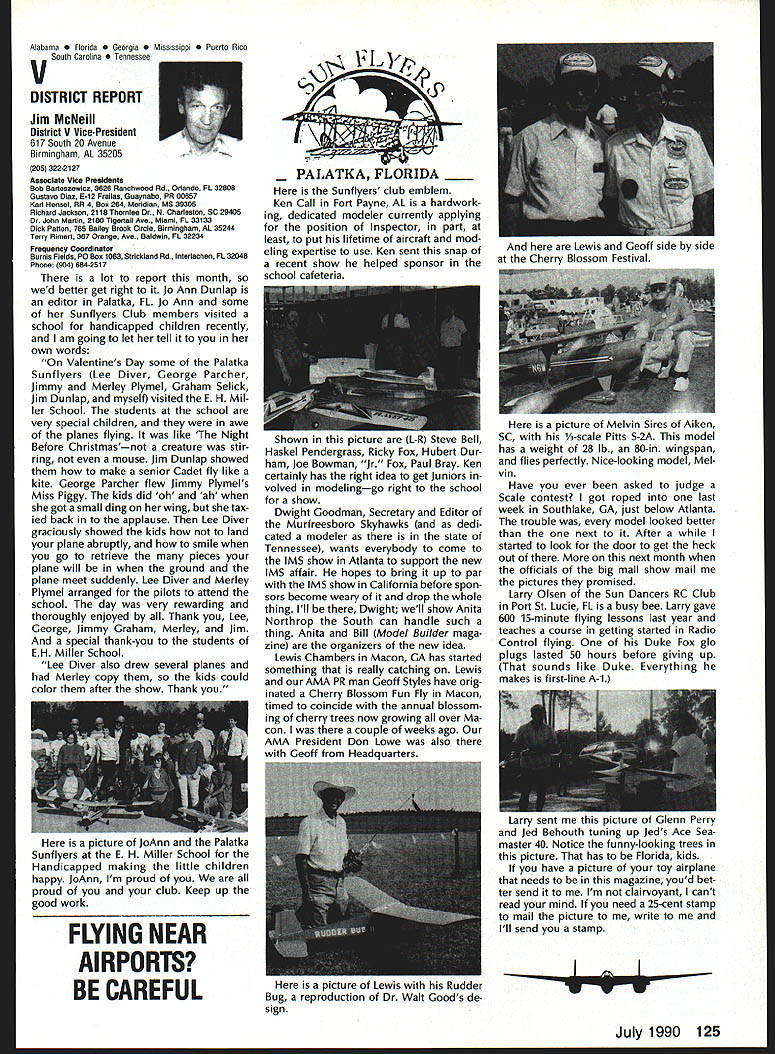
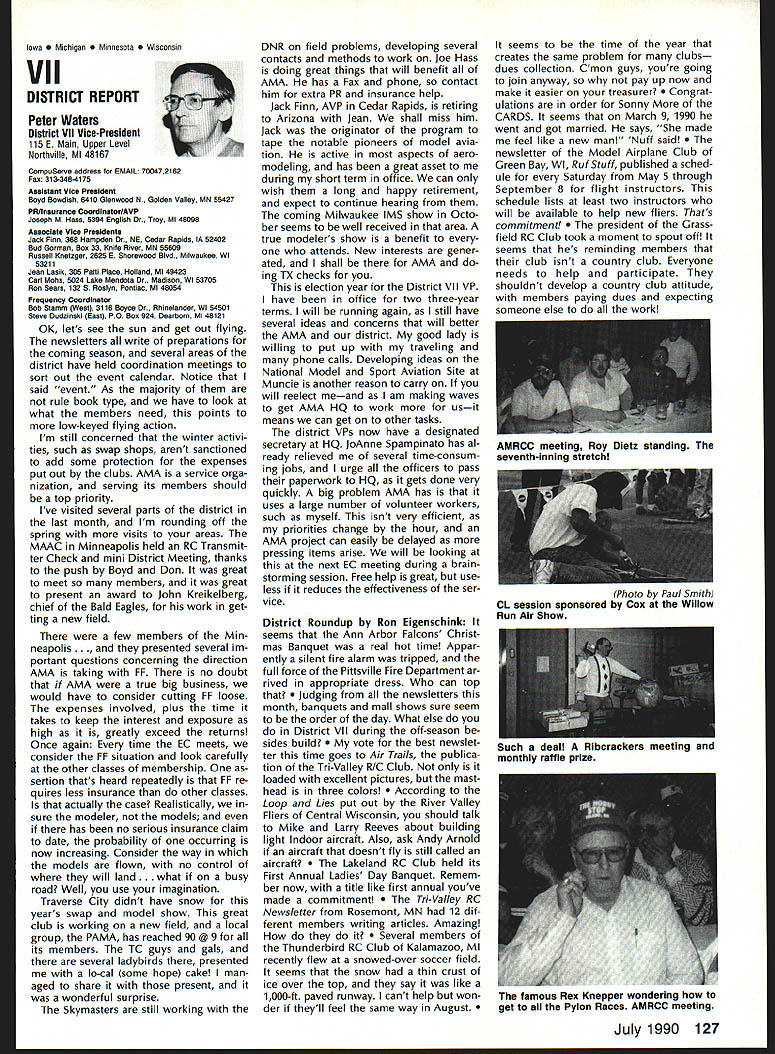
Reports from the Field
- Frozen Conditions Fly: Don Freestone (Frozen Tails) reports a January 1, 1990 outing with the thermometer at −46°F. Despite 1½ inches of snow on the runway, flights were successful. An iced tail posed an anxious moment, but the day turned out well—congratulations to all involved.
- Lake Hood / Alaska: Bob Heitkamp won at Lake Hood; he, Jim Wilder, and Lou Bonnett drove down from Juneau. Bob is a fine builder and pilot and took first place with his S-5.
- Balch and OMAS Photos: Action shots from last summer include various models (Heinkel, T-60, Cub, GS Stinson, Telemaster, Hansen's Taurus). Jim Alderson taxied his three-channel SE-5A at OMAS last summer—impressive flying with only rudder and elevator.
- Puyallup EXPO '90: There were 22 control-line aircraft on display. Frank Macy won with a Fireball (the 50th Anniversary Fireball commemorates the commercial introduction of control-line modeling in 1940). Bob Parker was second with an unfinished C-47.
- Pine Hollow: July 14–15; a great place to fly and vacation. For information, contact Jerry Holcomb.
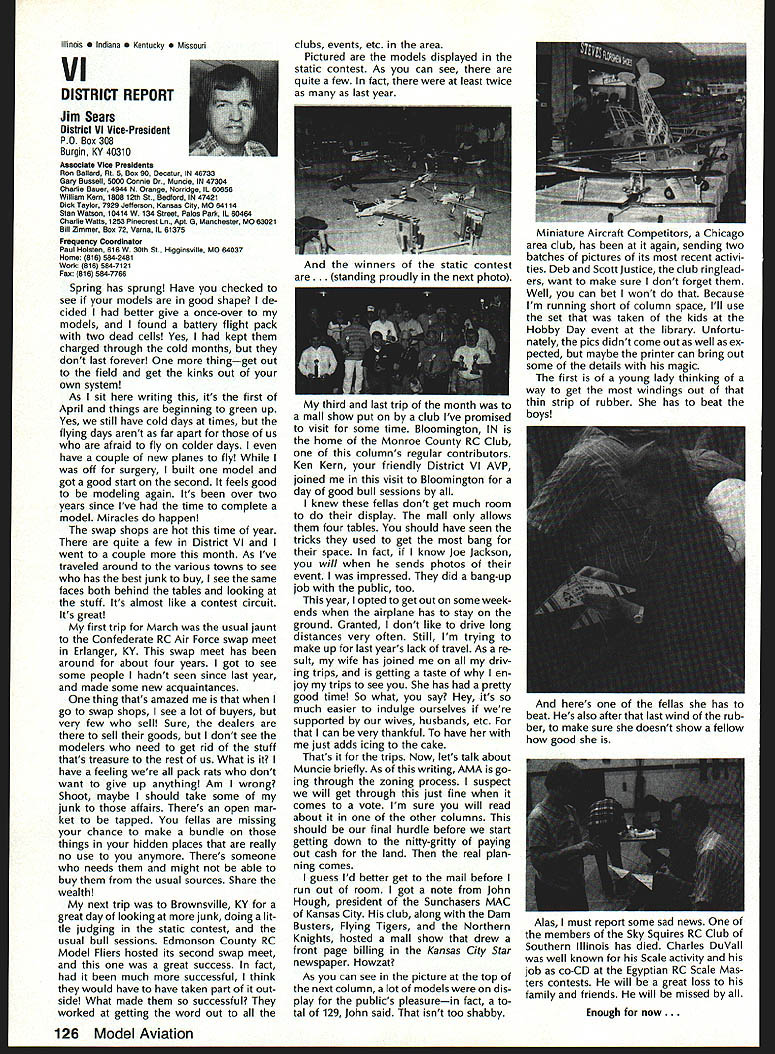
- Sky Squires RC Club (Southern Illinois): Sad news—Charles DuVall, known for his scale activity and co-contest director at the Egyptian RC Scale Masters, has passed away. He will be greatly missed.
- Chicago Area / Miniature Aircraft Competitors: Photos and reports from Hobby Day events show strong junior participation—kids competing to get the most windings from a thin strip of balsa rubber, etc. More youth outreach like this is encouraged.
Enough for now.
Transcribed from original scans by AI. Minor OCR errors may remain.

