
AMA News
PR Roundup — Bill Baker, Assistant Marketing Director
A recent edition of Showgram, the air-show team newsletter, suggested forming a lobbying organization to represent AMA and the sport of model aviation before local, state, and federal governments. By definition, a lobby is a group acting on behalf of a special-interest group to influence legislation or government decisions that affect that interest.
Forming an organized lobby requires registration with Congress, filing specified paperwork, paying prescribed fees, and providing detailed monthly reports to Congress about money spent on lobbying. AMA currently performs many government-relations functions without the red tape and expense of being a registered, formal lobbying group. Good examples are our long-standing relationships with the Federal Communications Commission (FCC) and the Federal Aviation Administration (FAA).
We work closely with the FAA to help ensure model flying remains free of inappropriate federal regulation. Strong letters of support have been provided by Admiral James Busey, FAA Administrator, and Quentin Taylor, Acting Associate Administrator for Airports. Those written commitments can be helpful to a club or member working with a regional FAA office. AMA’s collaborative relationship with the FCC also brings direct benefits to members by helping protect and make radio channels available for model flying when needed.
When action is required, AMA takes an active role. Recently we worked with Louisiana modelers to defeat a state bill that would have empowered counties to regulate model aviation. In the Northeast, AMA supported members who felt they were improperly banned from flying in two Philadelphia regional parks by the Bureau of State Parks. AMA retained legal counsel, provided support for several months, and helped mobilize member turnout for public hearings — much of that turnout was the result of overnight mailings organized by AMA Headquarters. On almost every business day AMA staff advise chartered clubs on how to work with local authorities, and our representatives appear before state, county, and city boards to support requests for new flying fields or retention of flying privileges.
Most efforts to date have targeted legislators and government agencies. Face‑to‑face meetings with members of Congress emphasize the recreational and educational benefits of model aviation. Behind-the-scenes work helps build long-term relationships; perseverance has yielded contacts such as Undersecretary of the Interior Frank Bracken; Congressman Peter Kostmayer (D‑Pennsylvania); Congressman Ron Packard (R‑California); Congressman Norman Mineta (D‑California); Congressman Frank Wolf (R‑Virginia); and Congressman Lewis Payne (D‑Virginia). Several of these members serve on the House Aviation Subcommittee and have a genuine appreciation for aeromodeling.
Good progress has been made with the Department of the Interior, the Bureau of Land Management, and the Department of Veterans Affairs. AMA participates in Interior’s Take Pride in America program and is planning a model program for veterans to use in VA hospitals nationwide. These contacts help build a sound foundation for illustrating AMA’s interest and value.
How members and clubs can help:
- Invite local officials and your elected state and federal representatives to visits or organized events.
- Send them information about the sport and a subscription to Model Aviation magazine.
- Talk about the recreational and educational benefits of model aviation for people of all ages.
- Maintain contacts now so you build supporters and informed officials before a crisis arises.
If you need to influence local or state government:
- Work as a group — political action is most effective when citizens act collectively.
- Vote, write letters, place phone calls, circulate petitions, and attend legislative and public meetings.
- Demonstrate the size of your membership — clubs can influence politicians by showing the number of votes they represent.
- AMA is available to bolster local efforts with assistance and advice.
AMA HQ Services Staff
- Executive Director: Vince Mankowski
- Director, Operations: Robert Voislavek
- Technical Director: Bob Underwood
- Comptroller: Lynne Collins
- Competition Services Director: Micheline Madison
- Special Services Director: Carl Maroney
- Membership Processing Supervisor: Joyce Hager
- Marketing Director: Geoff Styles
- Projects Director: Doug Pratt
- Publications Director: Carl R. Wheeley
- Events Coordinator: Chip Smith
- Museum Curator: Hurst Bowers
- General Counsel: Bob Jackson
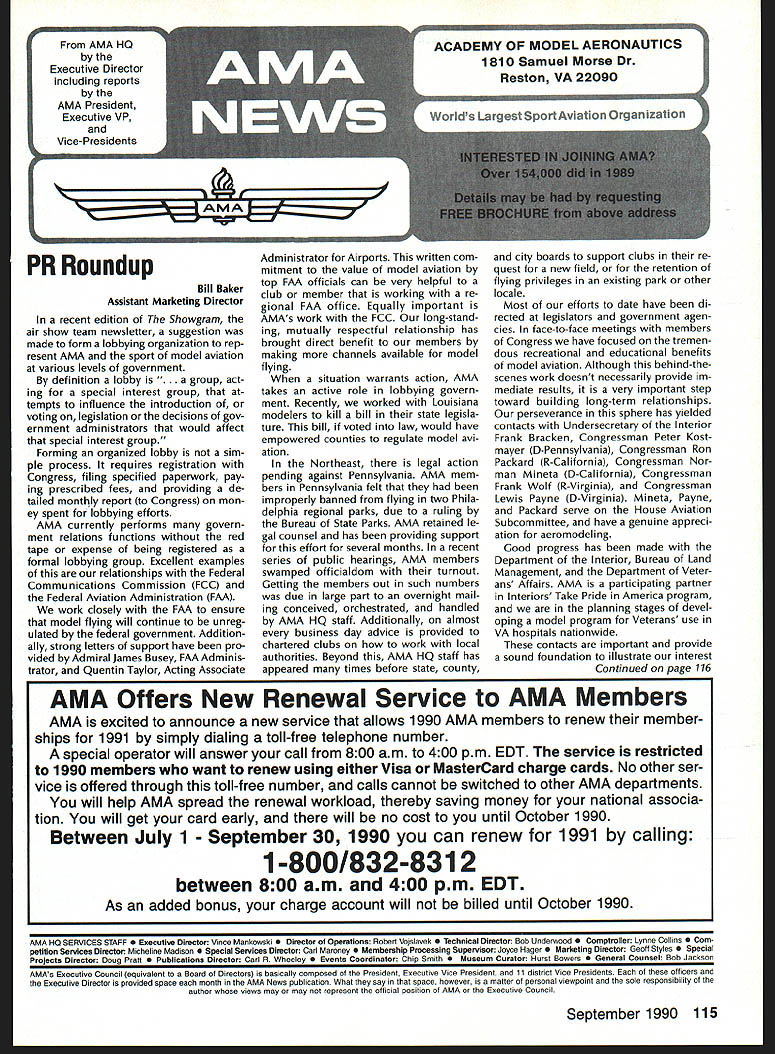
AMA Offers New Renewal Service
AMA members: a new service allows 1990 AMA members to renew 1991 memberships by dialing a toll-free telephone number. A special operator will answer calls between 8:00 a.m. and 4:00 p.m. EDT and can assist with renewal and credit-card payment.
All-Season Flyer's Patch
Modelers who fly every month of the year are eligible to buy and wear the All-Season Flyer's Patch.
- To obtain a patch, send a photocopy of your typewritten or handwritten declaration (see the AMA Supply and Service Catalog) with your club secretary’s signature.
- If you do not belong to a club, have another adult member sign the declaration.
- Include a check or money order for $2.50 (no cash), payable to the Academy of Model Aeronautics.
- To add year tabs for subsequent years, follow the same procedure and include $1.00 per tab.
How to Put AMA in Your Will
To perpetuate your interest in model aviation and help future generations, include this simple clause in your will:
"I give and bequeath (amount of dollars) to the Academy of Model Aeronautics, Inc."
Be sure to state the amount both in words and numbers (for example: five thousand dollars ($5,000)). Such a bequest is tax deductible.
Executive VP's Report
I was nearly missed getting an important message before leaving for the airport — thanks to those who tried to reach me, especially District 10 VP Reggie Keyawa. After rearranging travel through Delta to continue to Boston the next day, I returned home to survey damage at our local airport: the hangar roof had been blown away, many airplanes were strewn about, and my Cessna Skyhawk was crushed. I documented the damage, notified the insurance company, and made the final logbook entry.
By comparison, the destruction to the community was extensive — hundreds of homes and businesses damaged — but miraculously no serious injuries or loss of life were reported. Financial losses will be large, but life goes on.
The next day I continued on to Boston and then to Ireland to judge the Triple Crown Championships RC Pattern meet in Cork. The event, often called the Home Internationals, is team-oriented (England, Scotland, Ireland, and Wales). The Irish team won and may well surprise competitors at the next World Championships. After a week of touring, I stopped at a contest in Limerick for a typical Irish meet, which closely resembles our contests in structure and skill level. Ireland is a great place; modelers there are friendly, enjoy late socializing, and are generous hosts.
On return I faced an eight-hundred-mile drive with a loaded truck and then resumed work at the plant and upcoming meetings. The life of travel, contests, and meetings continues — it's a great life if you don't weaken.
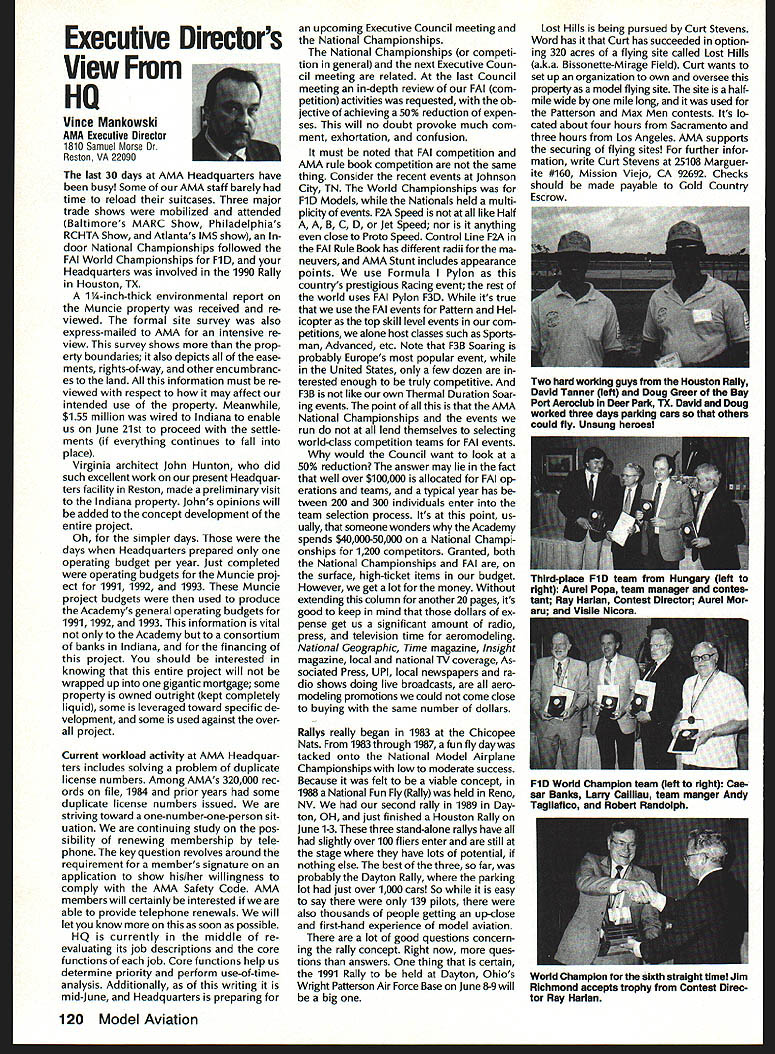
Executive Director's View From HQ
Vince Mankowski AMA Executive Director 1810 Samuel Morse Dr. Reston, VA 22090
The last 30 days at AMA Headquarters have been busy. Staff attended three major trade shows (Baltimore MARC Show, Philadelphia RCHTA Show, and Atlanta IMS Show), the Indoor National Championships, the FAI World Championships for F1D, and the 1990 Rally in Houston, TX.
We received and reviewed a 1¼-inch-thick environmental report on the Muncie property and an express-mailed formal site survey that details easements, rights-of-way, and other encumbrances. These affect intended use of the property. Meanwhile, $1.55 million was wired to Indiana to proceed toward settlement on June 21, pending continued favorable developments.
Virginia architect John Hunton, who designed our Reston Headquarters, made a preliminary visit to the Indiana property. His opinions will be incorporated into project concept development.
Budgeting has become more complex: we prepared operating budgets for the Muncie project for 1991–1993 and used those to produce the Academy’s general operating budgets for the same years. This information is vital to AMA and the consortium of banks financing the project. The project financing will not be a single mortgage; some property will be owned outright, some leveraged for development, and some used against the overall project.
Current HQ activity includes resolving duplicate license numbers in our database (among 320,000 records there were some duplicate numbers issued through 1984). We aim to achieve a one-number–one-person system. We continue to study telephone renewal options; a key question is whether a member’s signature is required to confirm agreement with the AMA Safety Code. Members will be informed as developments permit.
HQ is re-evaluating job descriptions and core functions to determine priorities and perform use-of-time analyses. As of mid‑June, HQ prepared for an upcoming Executive Council meeting and the National Championships. The Council requested an in-depth review of FAI (international) competition activities with an objective of achieving a 50% reduction in related expenses. This review will generate discussion.
Note: FAI competition and AMA rule-book competition are not identical. Events differ in format, radii, scoring, and classes. For example, AMA’s Formula I Pylon is this country’s premier racing event, while FAI uses F3D; F3B soaring (popular in Europe) differs from U.S. Thermal Duration events. These differences complicate selection of world-class FAI teams from the events run domestically.
Why consider reduction? Over $100,000 is allocated to FAI operations and teams annually, and a typical year sees 200–300 individuals enter team selection. Questions arise about allocation of resources for national events and FAI participation. However, these expenditures yield significant radio, press, and television exposure for aeromodeling that would be otherwise unaffordable.
Rallies began in 1983 with the Chicopee Nationals. Since 1988 we’ve held stand-alone rallies in Reno (1988), Dayton (1989), and Houston (1990). These events attract more than 100 fliers and thousands of spectators, giving many people up-close experience with model aviation. The 1991 Rally will be held at Wright-Patterson Air Force Base, Dayton, Ohio, on June 8–9 and is expected to be a major event.
Lost Hills (Bissonette–Mirage Field) is being pursued by Curt Stevens, who has optioned 320 acres and intends to set up an organization to own and oversee the property as a model flying site. The site is approximately half a mile wide by one mile long and has hosted major contests. AMA supports securing flying sites. For more information, contact Curt Stevens at 25108 Marquardt #160, Mission Viejo, CA 92692.
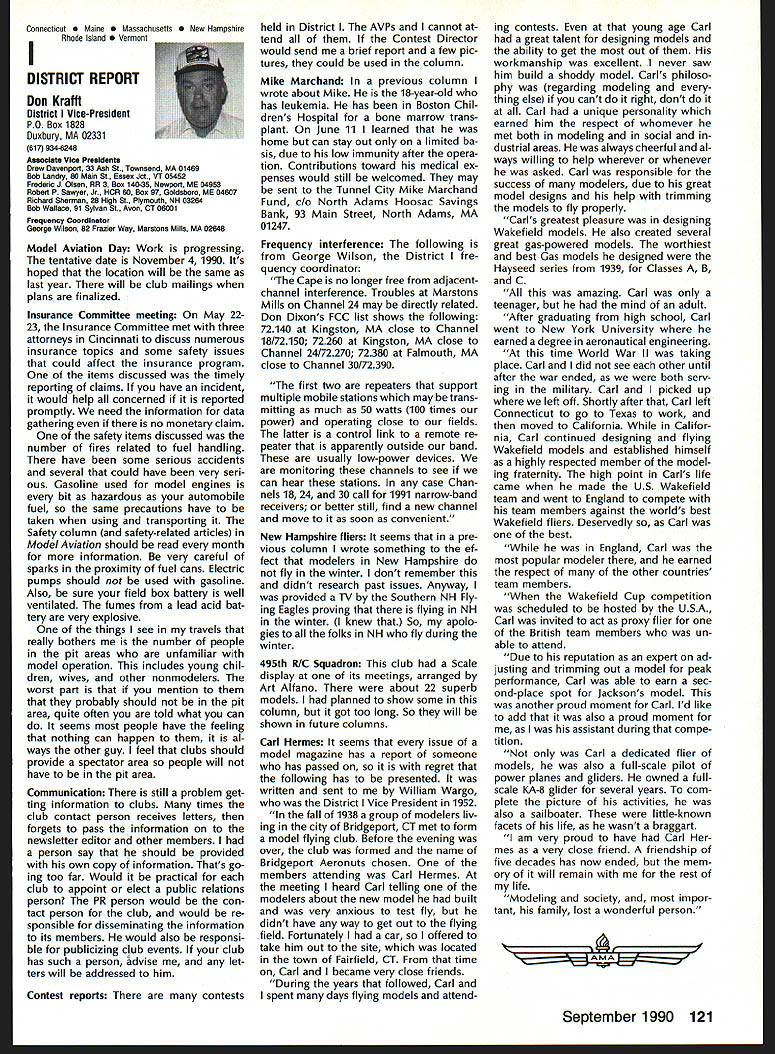
DISTRICT REPORT — Don Krafft, District II Vice-President
Don Krafft P.O. Box 1828 Duxbury, MA 02331 (617) 934-6248
Associate Vice Presidents:
- Drew Davenport, 33 Ash St., Townsend, MA 01469
- Ray Lundby, 80 Main St., Essex Jct., VT 05452
- Robert J. Olson, R.R. 3, Box 4433, Newport, ME 04953
- Robert F. Sawyer, 58 Lock St., Box 271, Calais, ME 04607
- Richard Sherman, 28 High St., Plymouth, NH 03060
- Bob Wallace, 91 Sylvan St., Avon, CT 06001
- Frequency Coordinator George Wilson, 82 Frazer Way, Marstons Mills, MA 02648
Model Aviation Day:
- Work is progressing; tentative date is November 4, 1990. Location likely the same as last year. Club mailings will follow when plans are finalized.
Insurance Committee meeting (May 22–23, Cincinnati):
- The Insurance Committee met with three attorneys to discuss insurance topics and safety issues that could affect the insurance program.
- Report incidents promptly, even if no monetary claim is expected; timely reporting helps data-gathering.
- Fuel-handling fires have been a concern. Gasoline for model engines is as volatile as automobile fuel; take the same precautions in use and transport. Read the Safety column in Model Aviation for details.
- Avoid sparks near fuel cans; do not use electric pumps with gasoline. Ensure field-box batteries have ventilation; lead-acid battery fumes can be explosive.
Pit-area safety:
- Many non-modelers (children, spouses) are seen in pit areas and may be unfamiliar with operations. Clubs should provide spectator areas to keep non-participants out of pits.
Communication:
- Clubs often fail to pass on information received from AMA. Consider appointing a club public-relations contact responsible for disseminating information and publicizing club events. If your club has such a person, advise me and letters will be addressed to them.
Contest reports:
- The AVPs and I cannot attend all contests in District II. If a Contest Director sends a brief report and a few pictures, they may be used in the column.
Mike Marchand:
- Mike, an 18-year-old with leukemia who underwent a bone marrow transplant at Boston Children’s Hospital, is home on limited outings due to low immunity. Contributions to medical expenses are welcome to the Tunnel City Mike Marchand Fund, c/o North Adams Hoosac Savings Bank, 93 Main Street, North Adams, MA 01247.
Frequency interference (from George Wilson, District I coordinator):
- Adjacent-channel interference is occurring on the Cape. Problems at Marstons Mills on Channel 24 may relate to nearby repeaters:
- 72.140 at Kingston, MA (close to Channel 18/72.150)
- 72.260 at Kingston, MA (close to Channel 24/72.270)
- 72.380 at Falmouth, MA (close to Channel 30/72.390)
- The first two are repeaters supporting multiple mobile stations with high power and may operate near flying fields. Channels 18, 24, and 30 call for 1991 narrow-band receivers; better yet, find a new channel and move as soon as convenient.
New Hampshire fliers:
- I previously implied there was no winter flying in New Hampshire. That was incorrect — the Southern NH Flying Eagles provided evidence of winter flying. My apologies.
495th R/C Squadron:
- The club held a Scale display arranged by Art Alfonso with about 22 superb models. Photos will appear in future columns.
Carl Hermes (obituary and remembrance):
- William Wargo provided a remembrance of Carl Hermes, a founding member of the Bridgeport Aeronauts and a talented designer and flier. Highlights:
- Carl began modeling early, had excellent workmanship, and designed notable Wakefield and gas models (including the Hayseed series, 1939).
- He earned a degree in aeronautical engineering from NYU and served in World War II.
- Carl competed internationally as part of the U.S. Wakefield team and acted as a proxy flier for a British team member, helping secure a second-place finish.
- He was also a full-scale pilot (including a KA-8 glider) and a sailboater.
- Carl’s generosity, skill, and friendship were greatly valued; his passing is a loss to modeling, society, and his family.
Technical Award — Bob Underwood, Technical Director
Near the end of 1985, the AMA Executive Council approved a Technical Award to honor developments that:
- Improve the performance of model aircraft or their components,
- Enable equipment to perform new tasks,
- Simplify or facilitate building or flying tasks, and
- Encourage safety or sound suppression.
The Technical Award recognizes significant technical contributions to the hobby/sport. Bob and Bill Hunter of Satellite City received the first Technical Award for introducing cyanoacrylate (CA) adhesives to the modeling community.
Nomination process:
- Any two AMA members may nominate an individual or group.
- Nominations must be received by September 1 each year.
- Nomination forms are available from AMA Headquarters; contact the Technical Director, Bob Underwood.
- Voting is done by the AMA Council of Past Vice-Presidents.
Transcribed from original scans by AI. Minor OCR errors may remain.

