
AMA News
PR Roundup
- New AMA brochure — Flights of Fancy
We have produced a new brochure called Flights of Fancy to replace the former blue handout Sky's the Limit. Our outside PR agency worked closely with us on the concept and supervised production and printing. Flights of Fancy includes a brief description of the AMA Museum. Plans include placing the brochure in literature racks at tourist stops along the main highways and interstates leading to Washington, D.C. We will use remaining Sky's the Limit copies this summer for shows; for mall shows, trade shows, club events and other times when AMA handouts are required, we will ship Flights of Fancy. We welcome feedback from individuals and clubs on public reaction.
- Austrian aeromodeling (Enzesfeld, Austria)
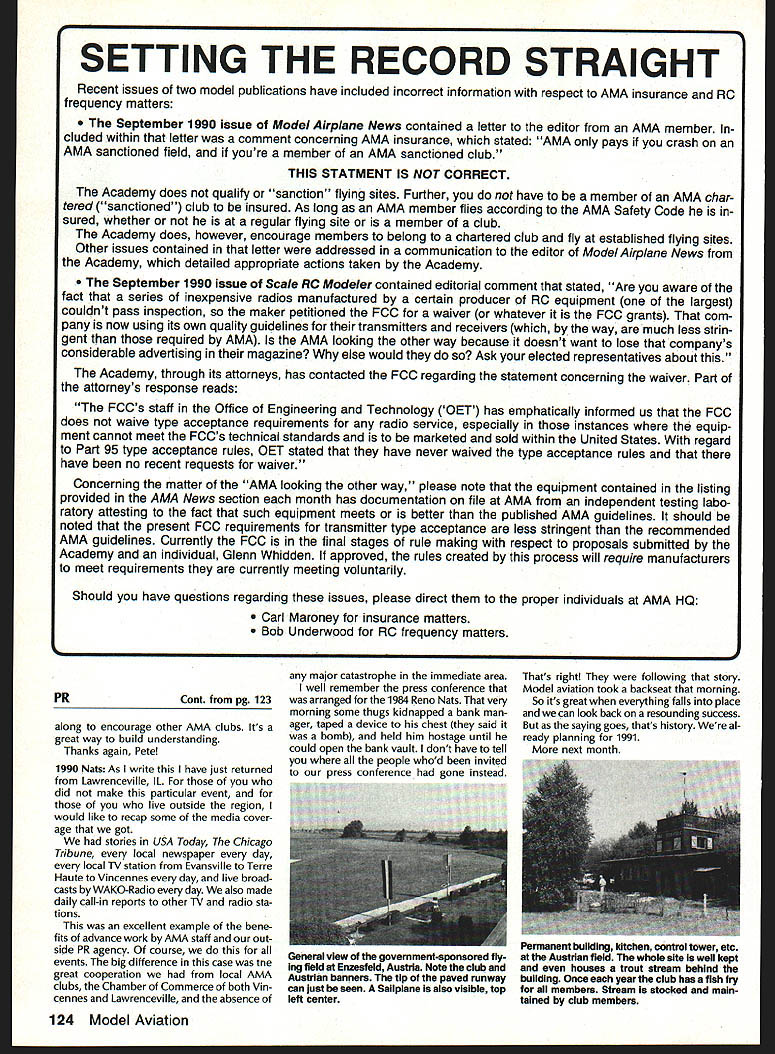
In May/June I visited Vienna and was hosted by Dr. Georg Breiner, President of the Austrian Aero Club. I attended an Old-Timer meet at the permanent flying field in Enzesfeld and was impressed by a control-tower–type building with a fully equipped kitchen, eating area, storage for tractors and maintenance equipment, and an observation deck with a windsock. At noon we enjoyed Hungarian goulash and Vienna sausages — excellent flying-field food. The Austrians' motto was "Fly first, drink later." The warm welcome confirmed that modelers are friendly everywhere.
- Iowa Aviation Preservation Center (Greenfield Municipal Airport)
A new aviation museum in southwestern Iowa houses 11 historic planes dating from 1920 to 1940. Hours: weekdays 10:00 a.m.–5:00 p.m., weekends 1:00–5:00 p.m. Admission: $2 adults, $1 children under 12. The center is home to the Iowa Aviation Hall of Fame. Hugh Sidey (Time magazine) was born in Greenfield and is an AMA member. Further details: Diane Weiland, Executive Director, 1-515-343-7184.
- Cape Ann R/C Club (Rowley, MA)
Sam DiNoto reported a familiar situation: new residences near an existing flying field produced safety complaints and threatened the field's existence. A former student, David Preston, gathered more than 200 signatures from neighbors supporting the field. The club runs an annual open house, adopted stringent bylaws, appointed 20 field coordinators (club membership ~235), and mandated a sound level of 90 dB at 12 ft. Their proactive community outreach and rules helped preserve the field.
- Redlands Miniature Aircraft Association (Norton AFB show)
The club displayed about 70 aircraft (static) at the Norton AFB air show attended by over 200,000 visitors. They ran a VCR presentation, raffled an R/C trainer (proceeds to charity), supplied literature, answered visitors' questions, and later performed flying demonstrations. The event generated high interest and potential new members.
- 1990 Nationals (Lawrenceville, IL) media coverage
The event received wide coverage: USA Today, Chicago Tribune, daily local newspapers, local TV stations across the region, and live radio broadcasts. Good advance PR work by AMA staff and cooperation from local clubs and chambers of commerce contributed to the success.
- Other notes
- Place Christmas Plans Orders Early: Orders for Model Aviation Plans arriving after December 1, 1990 will not be delivered until after Christmas.
- Invitation: Plan now to attend the 1991 AMA National Fun Fly at Wright-Patterson Field, Dayton, OH, June 8–9, 1991 (held at the Air Force Museum).
---
Sound & Model Aeronautics
Howard Crispin Jr.
Nationals: sound measurements
Sound measurements were taken during the first round of RC Scale at this year's Nationals at the Contest Director's request. Scale rules require "an effective muffler" but do not define it, and propeller selection has often been neglected. While some Scale aircraft registered low sound levels, most were loud. The loudest measured was 107 dBA at nine feet. Several appeared louder in the air than on the ground.
I propose that next year each contestant complete a form listing model name, engine, muffler, propeller (brand/configuration) and other pertinent data so sound readings can be correlated with equipment. The intent is to apply this to all categories.
Pennsylvania demonstration
A demo for Pennsylvania officials (part of negotiating flying-site agreements for the state park system) addressed noise standards. The highest recorded sound level during the demo was 91 dBA (measured over grass) for a Pattern plane. Officials were impressed with the relative quiet and are considering standards for the park system; AMA and Pennsylvania members await the outcome.
Muffler modifications (homemade ideas)
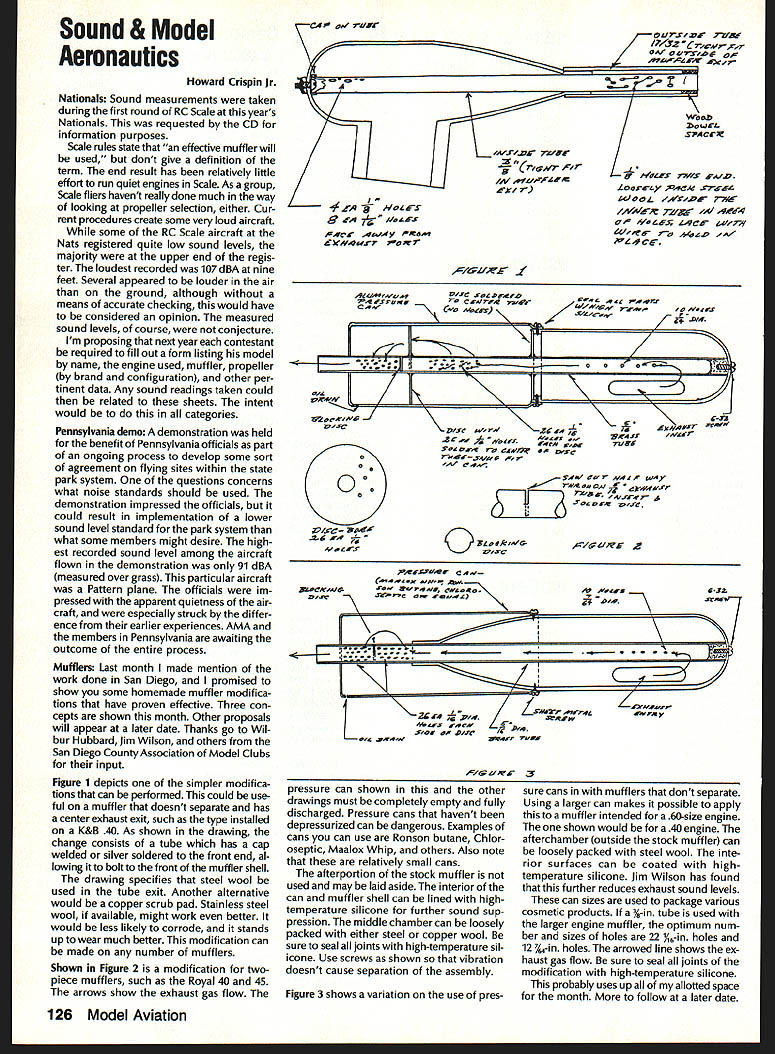
San Diego County Association of Model Clubs members contributed several effective homemade muffler concepts. Three general approaches:
- Single-piece muffler with center exhaust (example: K&B .40)
- Fit a tube to the front of the muffler shell; cap the front end and bolt it to the muffler shell.
- Pack steel wool (or copper scrub pad; stainless steel wool preferred) in the tube exit to suppress sound.
- This is a simple modification applicable to many mufflers.
- Two-piece muffler conversion using pressure cans (examples: Royal .40/.45)
- Use small, fully-depressurized pressure cans (e.g., Ronson butane, Chloraseptic, Maalox whip) as after chambers.
- Line the interior of the can and muffler shell with high-temperature silicone for sound suppression.
- Loosely pack the middle chamber with steel or copper wool; seal all joints with high-temperature silicone.
- Use screws so vibration does not separate the assembly. Ensure cans are completely emptied and depressurized before use.
- Larger pressure-can variation for mufflers that don't separate (suitable for .60–.90 engines)
- Use a larger can for larger-engine mufflers; loosely pack the afterchamber with steel wool and coat interior surfaces with high-temperature silicone.
- If using a 1/2-in. tube with a larger engine muffler, suggested hole pattern: two 2–2½-in. holes and twelve ½-in. holes (optimum numbers/sizes may vary).
- Seal all joints with high-temperature silicone.
Safety note: pressure cans must be fully discharged before use; improperly depressurized cans are dangerous.
More modification ideas will appear in future columns.
---
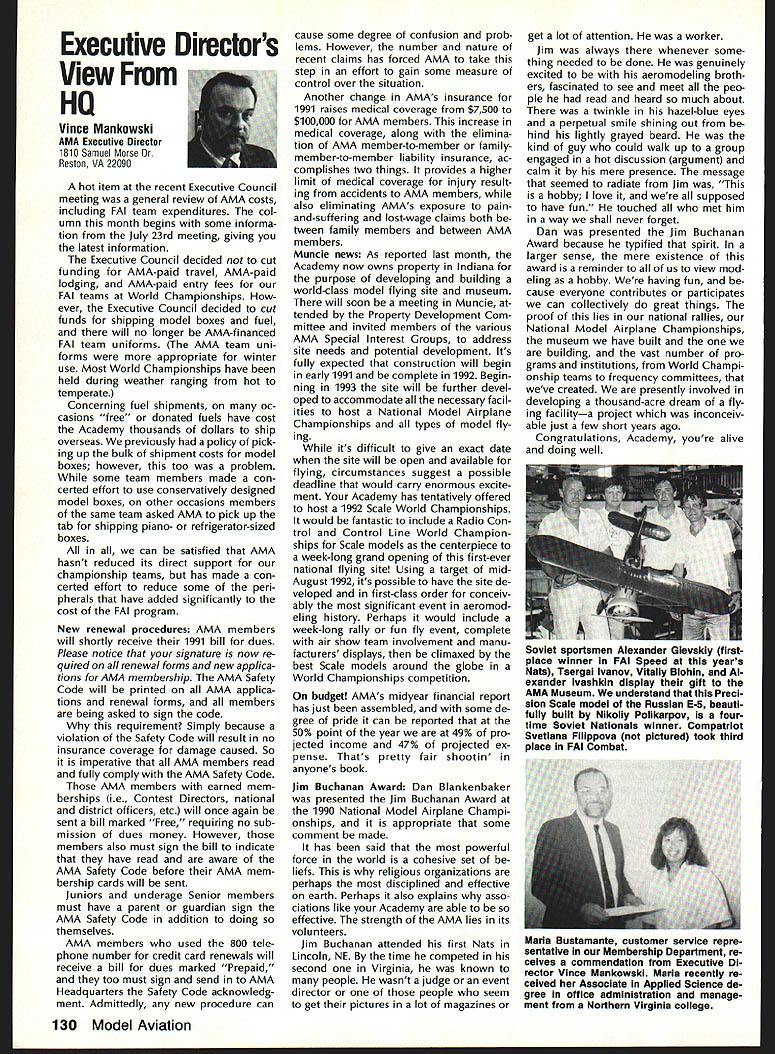
Executive Director's View From HQ
Vince Mankowski AMA Executive Director 1810 Samuel Morse Dr. Reston, VA 22090
A hot topic at the July 23 Executive Council meeting was a general review of AMA costs, including FAI team expenditures.
FAI team funding changes
- The Executive Council decided NOT to cut AMA-paid travel, lodging, or entry fees for FAI teams at World Championships.
- The Council DID cut funds for shipping model boxes and fuel and eliminated AMA-paid FAI team uniforms. The uniforms were judged unnecessary for mostly warm-weather championships.
- Shipping of donated or "free" fuels and oversized model boxes had cost AMA significant amounts; teams will now be responsible for shipping boxes and fuel.
Overall, AMA remains committed to direct support of championship teams while reducing peripheral costs.
New renewal procedures (1991)
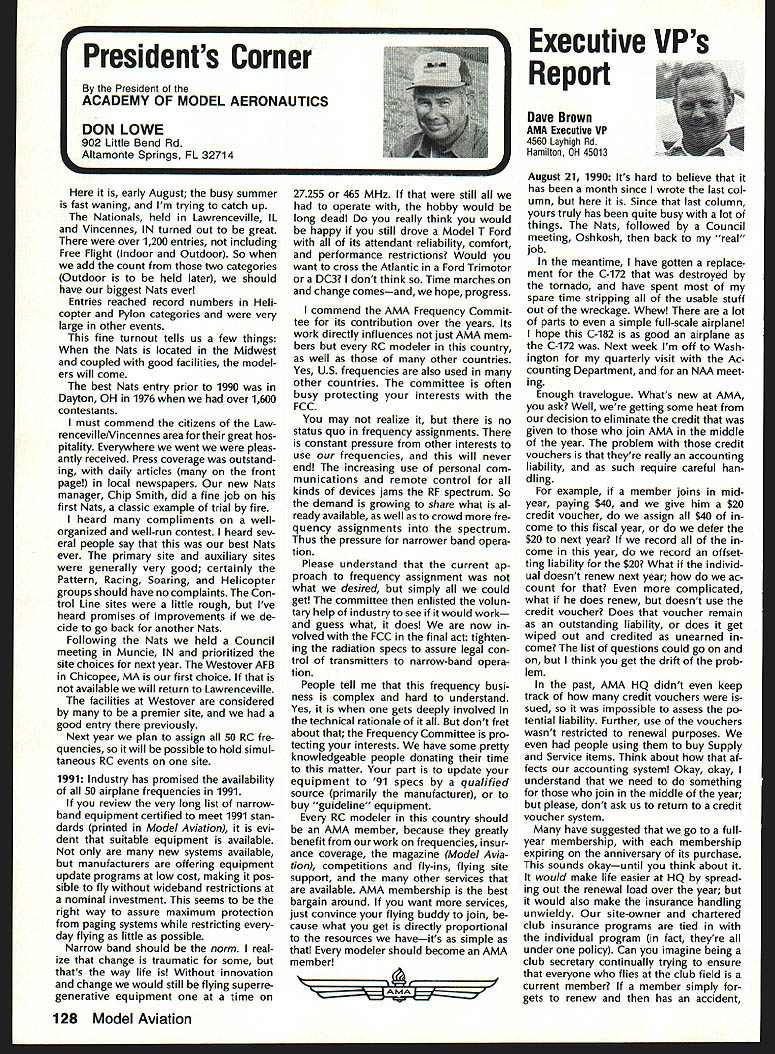
- 1991 renewal bills will require members' signatures on all renewal forms and new applications. The AMA Safety Code will be printed on forms and must be signed.
- Signed acknowledgment is necessary because Safety Code violations may result in no insurance coverage for damage caused.
- Earned-membership billings (marked "Free") still require a signature acknowledging the Safety Code before membership cards are issued.
- Juniors and underage Senior members must have a parent or guardian sign in addition to themselves.
- Members who used the 800 number for credit-card renewals will receive bills marked "Prepaid" and must also sign and return the Safety Code acknowledgment.
These procedures respond to the number and nature of claims and aim to improve control over safety compliance.
Insurance changes for 1991
- Medical coverage for AMA members increased from $7,500 to $100,000.
- AMA eliminated member-to-member and family-member-to-member liability insurance, reducing exposure to pain-and-suffering and loss-of-wage claims between members while substantially increasing medical coverage for accidents.
Muncie property and development
- AMA now owns property in Indiana intended for a world-class flying site and museum. A meeting of the Property Development Committee and invited Muncie AMA Special Interest Group members will address site needs and development.
- Construction is expected to begin early 1991 and complete in 1992. Further development is planned for 1993 to accommodate National Model Airplane Championships and a variety of flying types.
- AMA has tentatively offered to host a 1992 Scale World Championships as a centerpiece event for the grand opening. Target: mid-August 1992.
- Midyear financials: at the 50% point of the year AMA stands at 49% of projected income and 47% of projected expense.
Jim Buchanan Award
Dan Blankenbaker received the Jim Buchanan Award at the 1990 National Model Airplane Championships. The award honors volunteers who exemplify the spirit of modeling as a fun, inclusive hobby. Jim Buchanan was remembered as a dedicated worker and enthusiast who promoted camaraderie and enjoyment.
Rally cancellation
The AMA Rally in Muncie scheduled for early September was canceled due to concerns about traffic impact on adjoining county and state roads and differences between intended and proposed use; local owner Mr. Reese and the community agreed cancellation was appropriate.
---
Executive Council: meeting highlights
- Minutes of the April 21 Executive Council meeting were approved.
- Executive Vice President distributed the audit report for the year ending December 31, 1989. Pro forma statements consider the Muncie property purchase and development; an operating loss for 1991 is expected with a return to surplus in 1992. The EVP recommended the AMA Safety Committee review liability exposure for sanctioned events that do not follow AMA rules.
- Executive Director reported on pilot programs: 1991 renewals pilot, an 800 telephone line open July–September 1990, and a $10 minimum for credit-card purchases. Scholarship award recommendations will be presented earlier to the Council.
- CompuServe trial for Associate Vice Presidents was judged acceptable and will continue.
- Executive Director Emeritus is updating the FAA document, AMA history since 1967, personality profile videos, and museum display placards. The videos are deemed historical and not for popular distribution.
- Finance Committee to fine-tune the 1991 budget.
- Nats Steering Committee reported empirical expense/income data close to projections.
- A Special Interest Group seeking advice on an employment contract for a managing editor will receive a legal opinion from the Council.
- Property Acquisition and Development Committee (PADCOM) planning joint meetings with Special Interest Groups to discuss long-range flying-site use and development; Council members visited the purchased property.
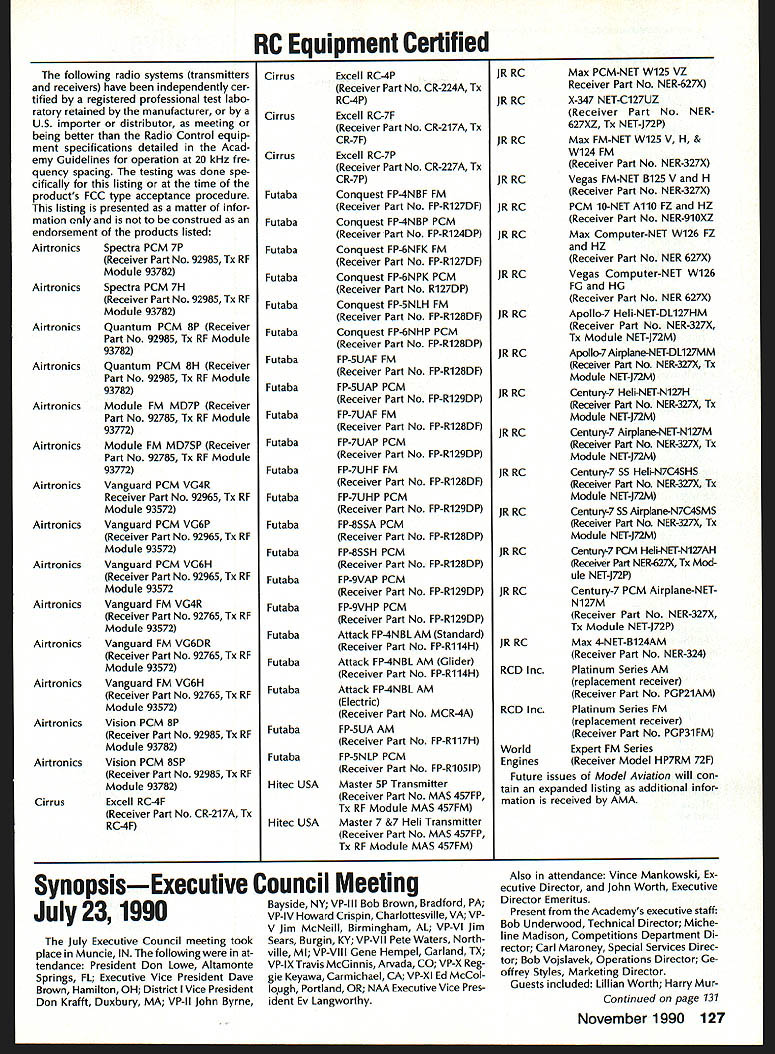
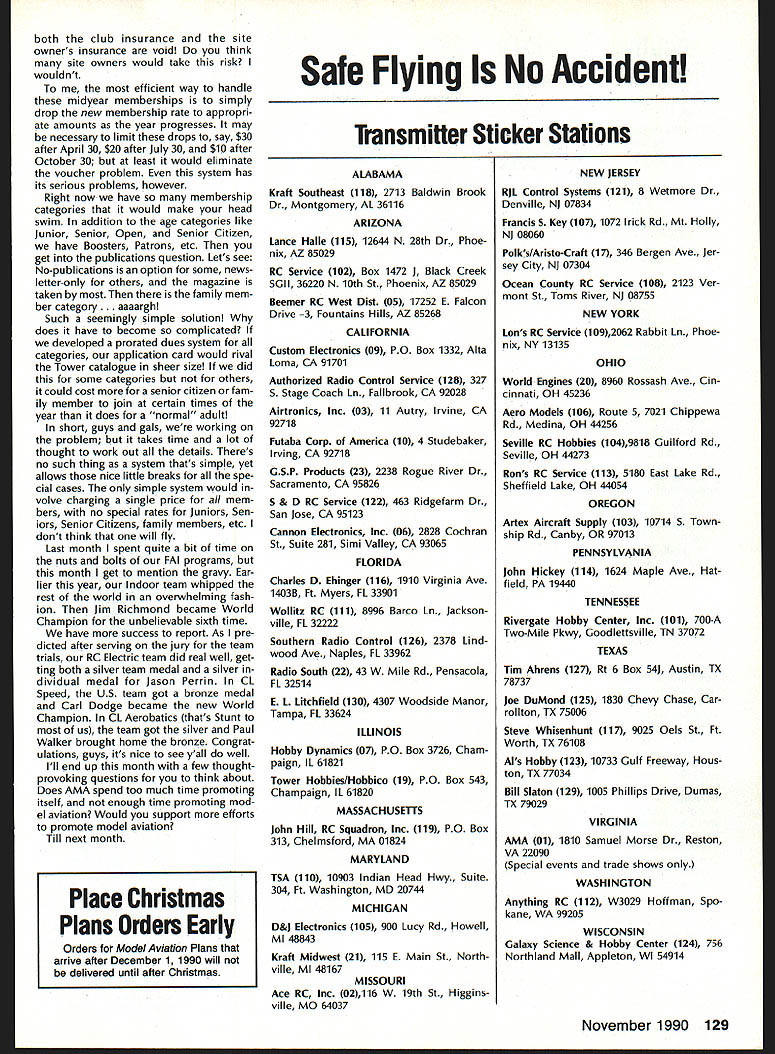
- Frequency: Technical Director reported on monitors/analyzers inventory; FCC Notice of Proposed Rule Making about narrow-band transmitters requires a response; AMA will no longer check transmitters at most trade shows as private sticker stations assume that role.
- Sound Committee and Insurance & Safety Committee discussed legal liability issues and proposed insurance changes (details to be developed).
---
District Reports
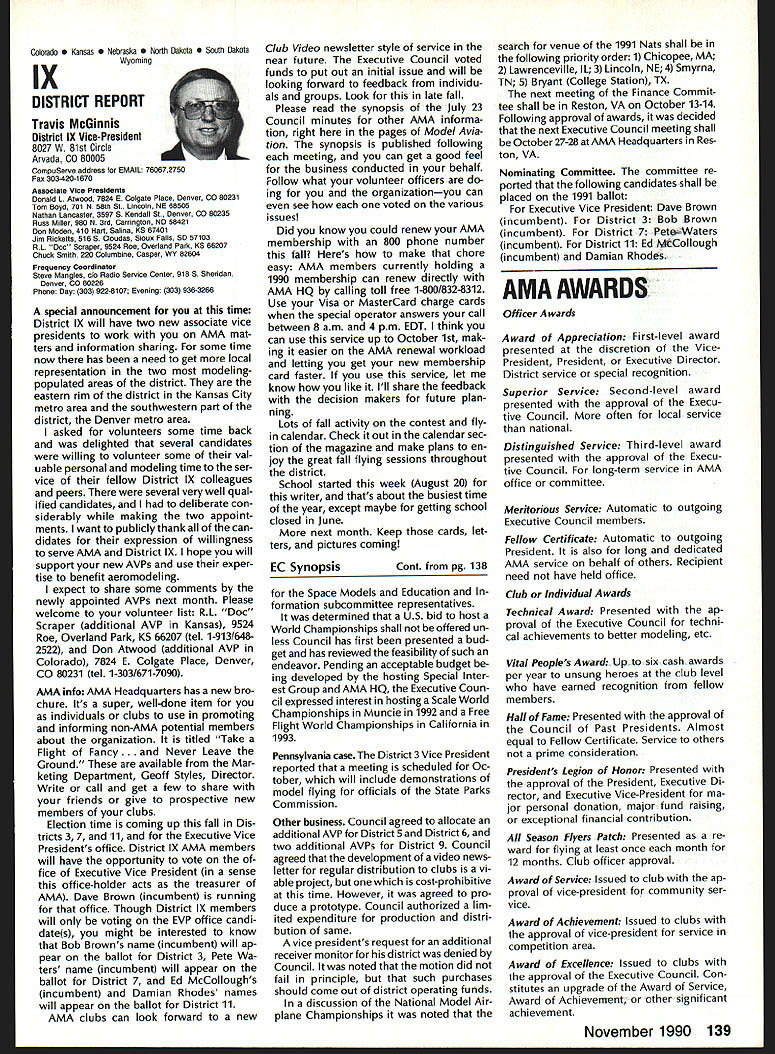
District V Report
Jim McNeill, District V Vice‑President 617 South 20th Avenue, Birmingham, AL 35205 (205) 322‑2127
- Safety Inspectors for Giant Scale: To apply, write AMA Technical Director Robert Underwood at HQ to receive a questionnaire and quiz. Leadership membership or CD status is not required; about 30 Safety Inspectors now exist in the U.S. Some inspectors have full-size aircraft inspection experience.
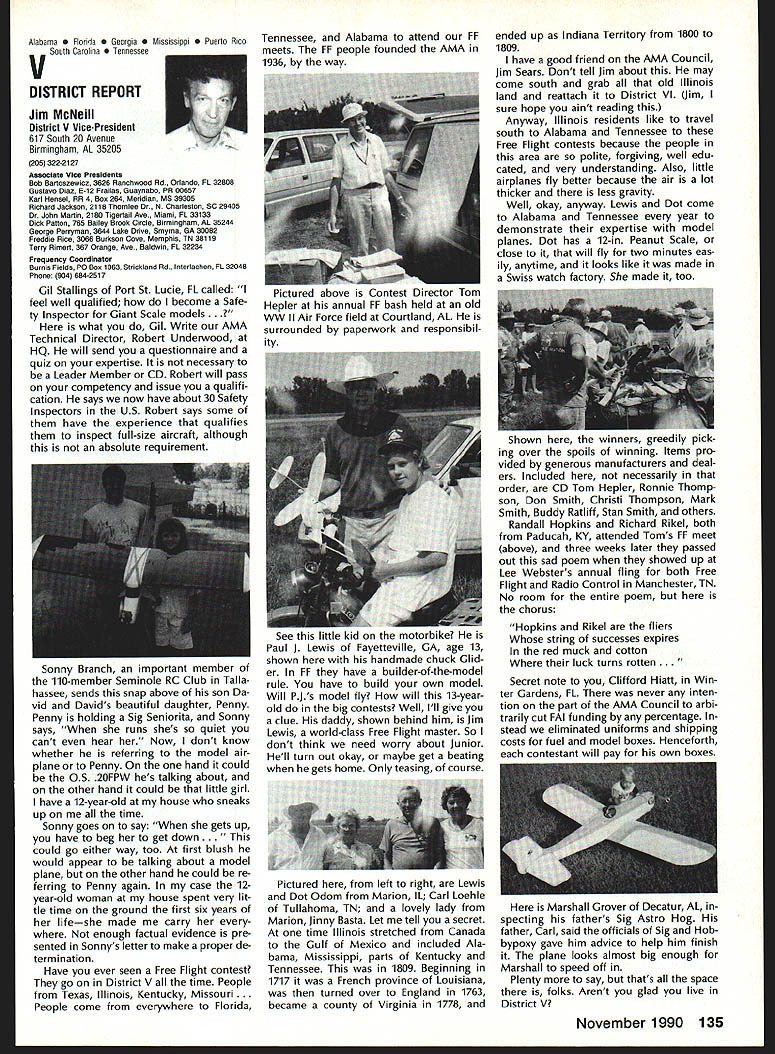
- Anecdotes and club activity: Seminole RC Club (Tallahassee) member Sonny Branch sent a photo of his granddaughter Penny with a Sig Seniorita. Free Flight (FF) contests remain popular in District V with participants traveling from many states; FF members founded the AMA in 1936.
- Events: Free Flight meets and demonstrations draw attendees from across the country. Quickie Racing and local meets show healthy participation.
- FAI funding clarification: The Council did not arbitrarily cut FAI funding across the board; uniforms and shipping costs were eliminated to reduce expenses — contestants will be responsible for their own boxes.
District XI Report
Ed McCollough, District XI Vice‑President 53 S.E. 61st Ave., Portland, OR 97215 (503) 234‑4439 CompuServe address for E‑MAIL: 76067,2422
Associate Vice Presidents:
- Darrell Anderson, 132 15th Ave. N.W., Great Falls, MT 59404
- Tom Cashman, 525 W. 326th St., Federal Way, WA 98023
- Al Culver, Box 656, Wilder, ID 83676
- Jerry Holcomb, 1010 N.E. 122nd Ave., Vancouver, WA 98684
- Dave Mullins, 15550 Palatine Ave. N., Seattle, WA 98133
- Bruce Nelson, 807 E. Vicksburg St., Spokane, WA 99208
- Dick Wickline, P.O. Box 623, Klamath Falls, OR 97601
- Chick Young, 11225 128th St. E., #69, Puyallup, WA 98373
Frequency Coordinator:
- Robert Bach, 16339 SE High Dr., Portland, OR 97236 — Phone: (503) 761‑1503
Assistant Frequency Coordinator:
- Al Jackson, 1300‑145th Ave., Bellevue, WA 98007
Notes:
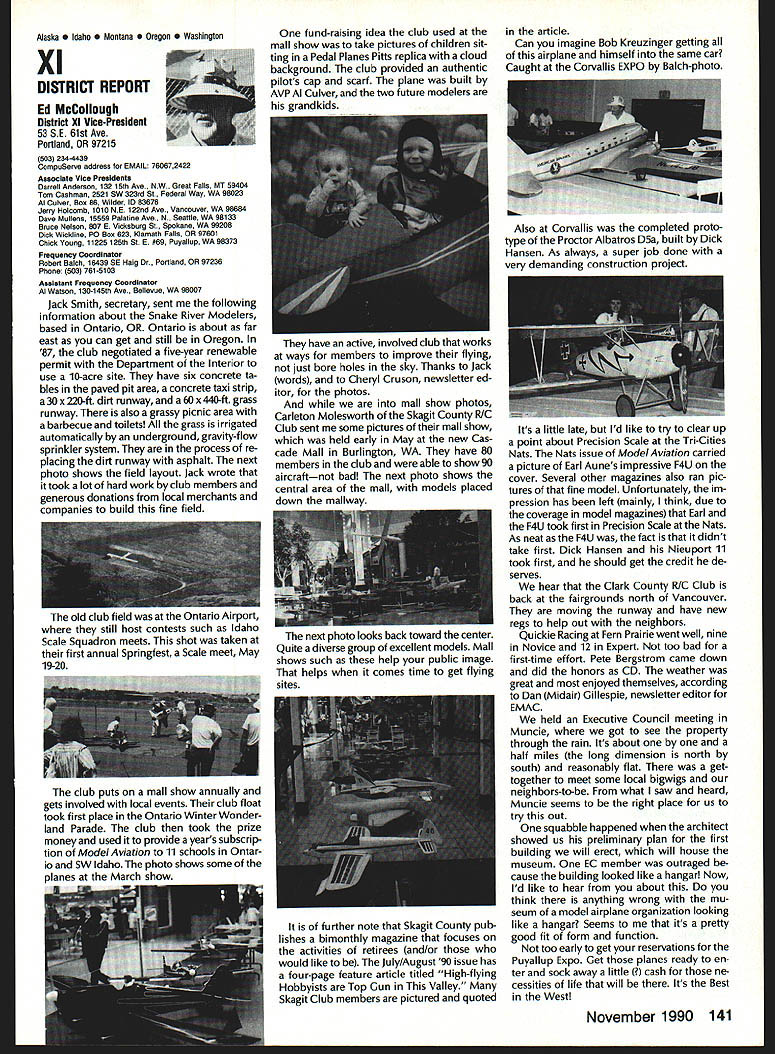
- Snake River Modelers (Ontario, OR) negotiated a five‑year renewable permit for a 10‑acre site with excellent facilities: concrete pit tables, taxi strip, a 30 x 220‑ft runway, a 60 x 440‑ft grass runway, irrigated grass picnic area with barbecue and toilets; replacing dirt runway with asphalt is in progress. Fundraising and local donations made the field possible.
- Skagit County R/C Club mall show at Cascade Mall (Burlington, WA) displayed ~90 aircraft; the club (80 members) received a four‑page feature in a local retiree magazine.
- Proctor Albatross D5a prototype (built by Dick Hansen) was completed in Corvallis.
- Coverage correction: At the Tri‑Cities Nats, Dick Hansen's Nieuport 11 took first in Precision Scale (contrary to some magazine impressions).
- Clark County R/C Club returned to the fairgrounds north of Vancouver with runway relocation and neighbor-friendly measures.
- Quickie Racing at Fern Prairie: good turnout, favorable weather.
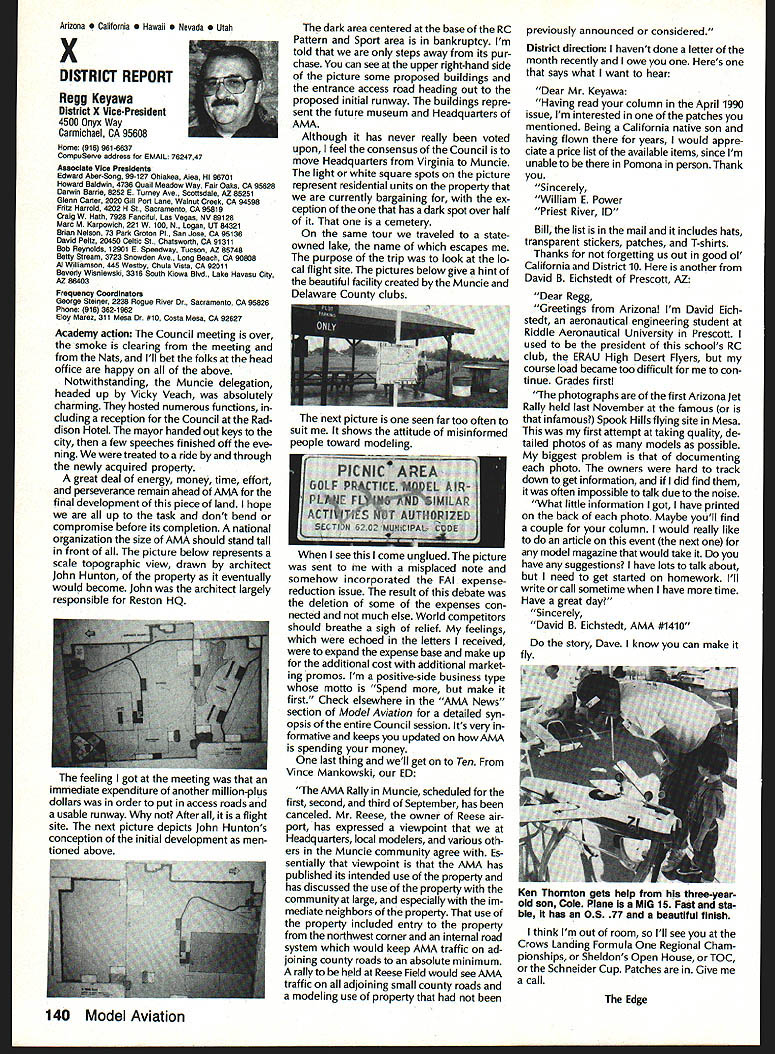
- Executive Council visited Muncie property; members discussed museum/hangar plans and site layout. Opinions vary on museum architecture; some feel a hangar-like museum is appropriate.
---
Junior Flight!
Ed Whitten Box 176, Wall St. Sta., New York, NY 10005
Why Didn't the Gallaudet A-2 Fly Well?
As beginners we must learn the proportions of a good flying model. Free Flight models must be inherently stable because there is no pilot to make corrections.
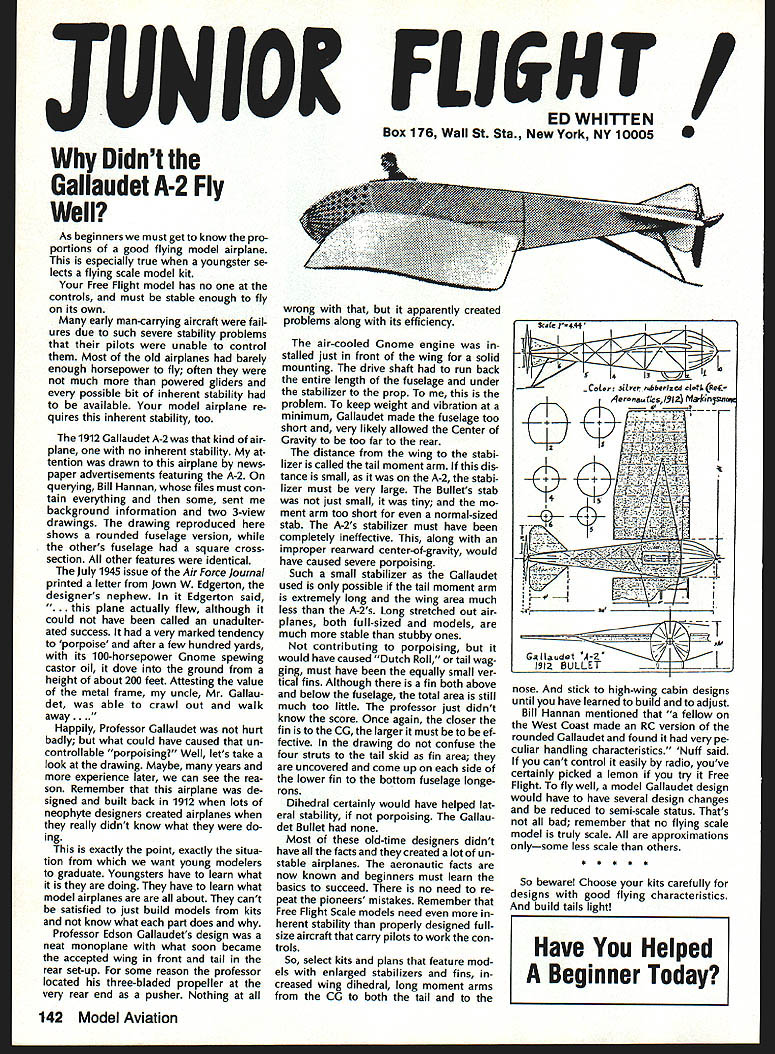
The 1912 Gallaudet A-2 was a neat monoplane but lacked inherent stability. Historical reports say the A-2 tended to "porpoise" and soon dived after a few hundred yards. Analysis of the design suggests the problems:
- Propeller placement and drive shaft layout forced a short fuselage. The pusher propeller at the very rear required a long drive shaft running under the stabilizer.
- The tail moment arm (distance from wing to stabilizer) was too short for the small stabilizer used; a small stabilizer close to the CG is ineffective. This likely contributed to severe porpoising.
- Vertical fin area was too small (one fin above and one below the fuselage) and positioned too close to the CG to provide adequate directional stability, possibly causing Dutch roll (tail wagging).
- The airplane lacked a tailwheel, which might have helped lateral stability.
Many early designers lacked the accumulated aerodynamic knowledge of later years; beginners should avoid repeating those mistakes.
Recommendations for Free Flight beginners:
- Choose kits/plans with enlarged stabilizers and fins.
- Favor long moment arms (tail and nose) and increased wing dihedral.
- Prefer high-wing cabin designs until you understand building and trimming.
- Remember that nearly all flying scale models are approximations; many require semi-scale changes for good flying characteristics.
Have you helped a beginner today?
---
Closing note
The AMA continues to support club outreach, safety, and development of facilities that grow the hobby while managing costs prudently. Contributions and feedback from clubs and members remain essential to our success.
Transcribed from original scans by AI. Minor OCR errors may remain.

