
AMA News
PR Roundup
Geoffrey Styles, Director of Marketing
I get inquiries from clubs that have never run a mall show. Some time ago I prepared basic guidelines to send such clubs and would like to pass the information along. As this column is planned for the January 1991 issue, you should have plenty of time—early December 1990—to take advantage of these ideas.
Making a mall show work A mall show is an excellent tool for building community relations. What better arena can you find? You can have center stage in one of the most heavily populated spots in town and show the non-modeling public who you are, what you do, how you do it, and why. Mall shows let you demonstrate that your airplanes are beautifully built, sophisticated flying machines designed for specific purposes.
Mall shows can further the practical goals of aeromodeling clubs. Remember how you obtained your flying field: probably a club member approached a landowner or property manager and made a case for model aviation. That person may have had to dispel myths and misunderstandings and show how a flying site could be a community asset. Imagine how much easier that job would have been if the landowner had already formed a positive opinion of modeling through a mall display. The same logic applies to problem neighbors near your field—proper education can make a friend of someone previously opposed.
If your field is secure and you have no neighbor troubles, consider other constructive benefits of a mall show. It’s a chance to recruit new members: many kids (and adults) will be curious about model airplanes. You can demonstrate muffler systems, quiet engine mounts, electric planes, glider silent flight, and more. The more you show people, the more understanding and receptive they will become. Good public relations is healthy for your club and your standing in the community.
AMA support AMA can help your club make a good presentation. We can send brochures and handouts. Each district vice president has films, videotapes, and a tabletop display booth available for borrowing. AMA can supply press release forms and sample radio announcements you can adapt. The Supply & Service Department offers an extensive videotape selection to build a club library. Hundreds of clubs have used these tapes to entertain and stimulate interest during mall shows.
The National Mall Show program began in 1983 and has grown steadily. Several clubs benefited immediately; as participation increased, so did our national image and overall membership. Each mall show helps promote appreciation of model aircraft locally.
Contact AMA Headquarters (ask for Judy, Bill, or Geoff) for advice and helpful hints—this information is free.
What to do at your mall show When you run a mall show there are many elements you can include. You want to show off your models, please mall management, entertain, and inform the public. Many mall marketing offices report that a well-run model aviation weekend brings in more foot traffic than any other event they hold.
Possible features:
- Finished models of all types.
- Open framework models.
- Covering demonstrations.
- A cutaway working model with radio installed.
- Building demonstrations.
- Audio-visual center (VCR monitor).
- Club brochure or pamphlet.
- Ballot for viewers to vote for "Best of Show."
- Delta Dart building session for kids.
- Invite local plastic model club.
- Invite local RC car group.
- Invite local model railroad group.
Normally the mall provides ropes/stanchions for crowd control, tables, and chairs. If possible, hang models from ceilings or beams to create an illusion of flight. By inviting other modeling groups you enlarge the overall effect (provided space allows). Your goal is to get your message out: the sport is great, your club is responsible and creative, and you’re an integral part of the community.
If your club has a special problem—such as needing a new flying site—prepare a brochure or single-page handout explaining your needs and providing officer names, meeting times/places, field location, and contact information. State that guests are welcome.
Other ideas:
- Offer qualified speakers to civic organizations (Rotary, Kiwanis, Lions) for luncheon meetings to raise local awareness.
- Ask a local hobby shop to donate a kit (with engine and radio), build it, and raffle it as a fundraiser—include an invitation to join your club and offer instruction to the winner.
Summary If you haven't run a mall show, consider planning one. It takes work, but the payoff is community acceptance and better response to your needs. Invite a politician or local celebrity to open the show or present prizes to help gain media coverage. Get print, radio, or TV coverage and you’ll be ahead. Clubs that show their activities in public are regarded as part of the community—start planning today.
Appeal for interesting modelers If you are an interesting modeler (company CEO, very young modeler, astronaut, female with special skills, showbiz or sports celebrity, etc.) and would allow your name and photo to be used for promoting the sport, please contact me.
More next month.
---
Sound & Model Aeronautics
Howard Crispin Jr.
Quiet operation A report on sound levels at the IMAA Festival (held at Oshkosh in June and published in High Flight) shows much work is needed on noise reduction for large aircraft. The greatest number of measurements were above 100 dBA; readings taken at nine feet ranged up to 113 dBA. No engine speed figures were recorded, which would have been useful for analysis.
Many large aircraft operate with essentially mufflerless engines—often only an exhaust stack. Based on stand tests of SuperTigre 2000 and 3000 engines with various mufflers and propellers, readings well below 90 dBA are possible. It is difficult to understand reports of 109 dB at Oshkosh for engines of that type. Even the stock SuperTigre muffler should permit values around 96–97 dBA with a properly selected propeller. One 3000 at Oshkosh read 96 dB with a Tatone muffler; others checked from 98 up to 109 dB. Part of the variance may be propeller speed.
Other operational problems with larger engines include vibration; a sign of excessive vibration may be the loss of a muffler or pipe during flight. It is essential that mufflers be properly braced to the engine or the solid mount.
---
Important Clarification
The caption under the reproduction of the R/C/AMA — AMA Gold sticker on page 43 of the December 1990 issue contains misleading information. The last part reads, "And you'll need to get AMA insurance." That sentence refers only to flying in AMA‑sanctioned events. The Gold sticker is required for AMA‑sanctioned events; it is not required for general sport flying or other flying outside AMA‑sanctioned events unless a club or field rule for the site requires that all transmitters have a Gold sticker.
---
Are You a Ham?
AMA members who fly models on six‑meter frequencies (50 or 53 MHz): please help the Academy better represent members who use these frequencies. Mail a postcard to AMA Headquarters with your name, address, AMA number, call sign, and the amateur frequencies you use.
On February 1, 1991, AMA will draw two cards from the frequency list and award:
- First place — a brand new radio system on a six‑meter frequency of your choice.
- Second place — another prize.
Drawing open only to AMA members who are current amateur license holders, Technician class or higher.
Help us help you as we work with the FCC and ARRL.
---
AMA Hall of Fame — 1990 Additions
Five names were added to AMA's Model Aviation Hall of Fame in 1990:
- Joe Beshar
- Paul Boyer
- Jim Cahill
- Carl Fries
- Milton Huguelet
Brief biographies
- Joe Beshar: Chairman of the AMA Electric Power Team Selection Committee; active in SAM (Society of Antique Modelers) and VR/CS (Vintage RC Society). Former SAM president and current VR/CS treasurer.
- Paul Boyer: Retired U.S. Navy Commander; long-time liaison between the Navy, AMA, and the hobby industry, helping sustain the National Model Airplane Championships.
- Jim Cahill (Mount Prospect, IL): Known for contest successes with rubber-powered models; designer of the Clodhopper (won the 1938 Wakefield World Championships). (Note: Jim Cahill passed away on October 29.)
- Carl Fries: Founder of the National Free Flight Society and world record holder in the 1930s; inducted into the NFFS Free Flight Hall of Fame in 1979.
- Milton Huguelet: Nationals Champion in 1938 and 1946 (first to be overall champion twice); founding member of the Chicago Aeronuts; master of Indoor Hand‑Launch Glider and rubber-powered microfilm-covered models.
---
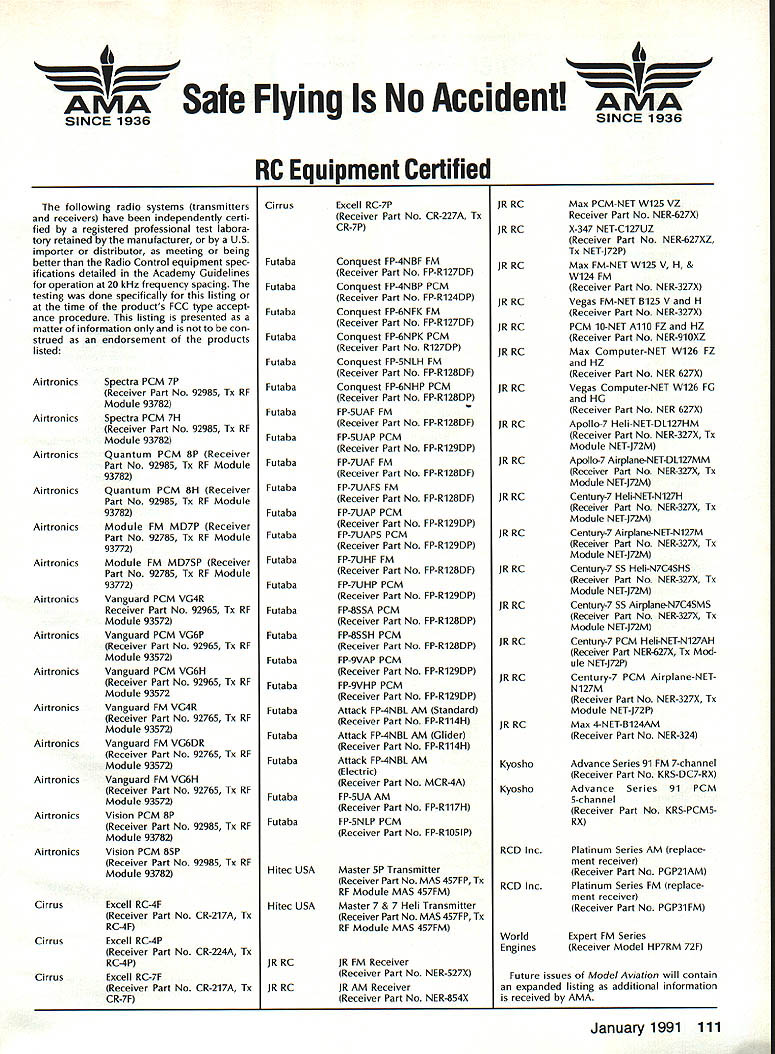
RC Equipment Certified
The following radio systems (transmitters and receivers) have been independently certified by a registered professional test laboratory or by a U.S. importer/distributor as meeting or being better than the Radio Control equipment specifications in the Academy Guidelines for operation at 20 kHz frequency spacing. This listing is informational and is not an endorsement.
- Airtronics Spectra PCM 7P (Receiver Part No. 92985, Tx RF Module 93782)
- Airtronics Spectra PCM 7H (Receiver Part No. 92985, Tx RF Module 93782)
- Airtronics Quantum PCM 8P (Receiver Part No. 92985, Tx RF Module 93782)
- Airtronics Quantum PCM 8H (Receiver Part No. 92985, Tx RF Module 93782)
- Airtronics Module FM MD7P (Receiver Part No. 92785, Tx RF Module 93772)
- Airtronics Module FM MD7SP (Receiver Part No. 92785, Tx RF Module 93772)
- Airtronics Vanguard PCM VG4R (Receiver Part No. 92965, Tx RF Module 93572)
- Airtronics Vanguard PCM VG6P (Receiver Part No. 92965, Tx RF Module 93572)
- Airtronics Vanguard PCM VG6H (Receiver Part No. 92965, Tx RF Module 93572)
- Airtronics Vanguard FM VG4R (Receiver Part No. 92765, Tx RF Module 93572)
- Airtronics Vanguard FM VG6DR (Receiver Part No. 92765, Tx RF Module 93572)
- Airtronics Vanguard FM VG6H (Receiver Part No. 92765, Tx RF Module 93572)
- Airtronics Vision PCM 8P (Receiver Part No. 92985, Tx RF Module 93782)
- Airtronics Vision PCM 8SP (Receiver Part No. 92985, Tx RF Module 93782)
- Cirrus Excell RC-4F (Receiver Part No. CR-217A, Tx RC-4F)
- Cirrus Excell RC-4P (Receiver Part No. CR-224A, Tx RC-4P)
- Cirrus Excell RC-7F (Receiver Part No. CR-217A, Tx CR-7F)
- Futaba Excell RC-7P (Receiver Part No. CR-227A, Tx CR-7P)
- Futaba Conquest FP-4NBF FM (Receiver Part No. FP-R127DF)
- Futaba Conquest FP-4NBP PCM (Receiver Part No. FP-R124DP)
- Futaba Conquest FP-6NFK FM (Receiver Part No. FP-R127DF)
- Futaba Conquest FP-6NP PKM (Receiver Part No. R127DP)
- Futaba Conquest FP-5UH FM (Receiver Part No. FP-R128DF)
- Futaba Conquest FP-5UNH FM (Receiver Part No. FP-R128DF)
- Futaba Conquest FP-6NHP PCM (Receiver Part No. FP-R128DP)
- Futaba FP-5UAF FM (Receiver Part No. FP-R129DF)
- Futaba FP-5UAP FM (Receiver Part No. FP-R129DP)
- Futaba FP-7UAF FM (Receiver Part No. FP-R128DF)
- Futaba FP-7UAS FM (Receiver Part No. FP-R128DF)
- Futaba FP-7UAP FM (Receiver Part No. FP-R129DP)
- Futaba FP-7UH P FM (Receiver Part No. FP-R128DF)
- Futaba FP-7UHP PCM (Receiver Part No. FP-R129DP)
- Futaba FP-8SSA PCM (Receiver Part No. FP-R128DP)
- Futaba FP-8SSB PCM (Receiver Part No. FP-R128DP)
- Futaba FP-9VAP PCM (Receiver Part No. FP-R129DP)
- Futaba FP-9VHP PCM (Receiver Part No. FP-R129DP)
- Futaba Attack FP-4NBL AM (Standard) (Receiver Part No. FP-R114H)
- Futaba Attack FP-4NBL AM (Glider) (Receiver Part No. FP-R114H)
- Futaba Attack FP-4NBL AM (Electric) (Receiver Part No. MCR-4A)
- Futaba FP-5UAF AM (Receiver Part No. FP-R117H)
- Futaba FP-5NLP PCM (Receiver Part No. FP-R105IP)
- Hitec USA Master 5P Transmitter (Receiver Part No. MAS 457FP, Tx RF Module MAS 457FM)
- Hitec USA Master 7 & 7 Heli Transmitter (Receiver Part No. MAS 457FP, Tx RF Module MAS 457FM)
- JR RC JR FM Receiver (Receiver Part No. NER-527X)
- JR RC JR AM Receiver (Receiver Part No. NER-854X)
- JR RC Max PCM-NET W125 VZ (Receiver Part No. NER-627X)
- JR RC X-347 NET-C127UZ (Receiver Part No. NER-627XZ, Tx NET-J72P)
- JR RC Max FM-NET W125 V, H, & W124 FM (Receiver Part No. NER-327X)
- JR RC Vegas FM-NET B125 V and H (Receiver Part No. NER-327X)
- JR RC PCM 10-NET A110 FZ and HZ (Receiver Part No. NER-910XZ)
- JR RC Max Computer-NET W126 FZ and HZ (Receiver Part No. NER-627X)
- JR RC Vegas Computer-NET W126 FG and HG (Receiver Part No. NER-627X)
- JR RC Vegas (Receiver Part No. NER-327X, Tx Module NET-J72M)
- JR RC Apollo 7 — Heli-NET-DL127HM (Receiver Part No. NER-327X, Tx Module NET-J72M)
- JR RC Apollo 7 Airplane-NET-DL127MM (Receiver Part No. NER-327X, Tx Module NET-J72M)
- JR RC Century-7 Heli-NET-J72HM (Receiver Part No. NER-327X, Tx Module NET-J72M)
- JR RC Century-7 Airplane-NET-J72M (Receiver Part No. NER-327X, Tx Module NET-J72M)
- JR RC Century-7 SS Heli-N7C4SHS (Receiver Part No. NER-327X, Tx Module NET-J72M)
- JR RC Century-7 SS Airplane-N7C4SMS (Receiver Part No. NER-327X, Tx Module NET-J72M)
- JR RC Platinum Series AM (replacement receiver) (Receiver Part No. PGP21AM)
- RCD Inc. Platinum Series FM (replacement receiver) (Receiver Part No. PGP31FM)
- World Engines Expert FM Series (Receiver Model HP7RM 72F)
- Kyosho Advance Series 91 FM 7-channel (Receiver Part No. KRS-DC7-RX)
- Kyosho Advance Series 91 PCM 5-channel (Receiver Part No. KRS-PCM5-RX)
Future issues of Model Aviation will contain an expanded listing as additional information is received by AMA.
---
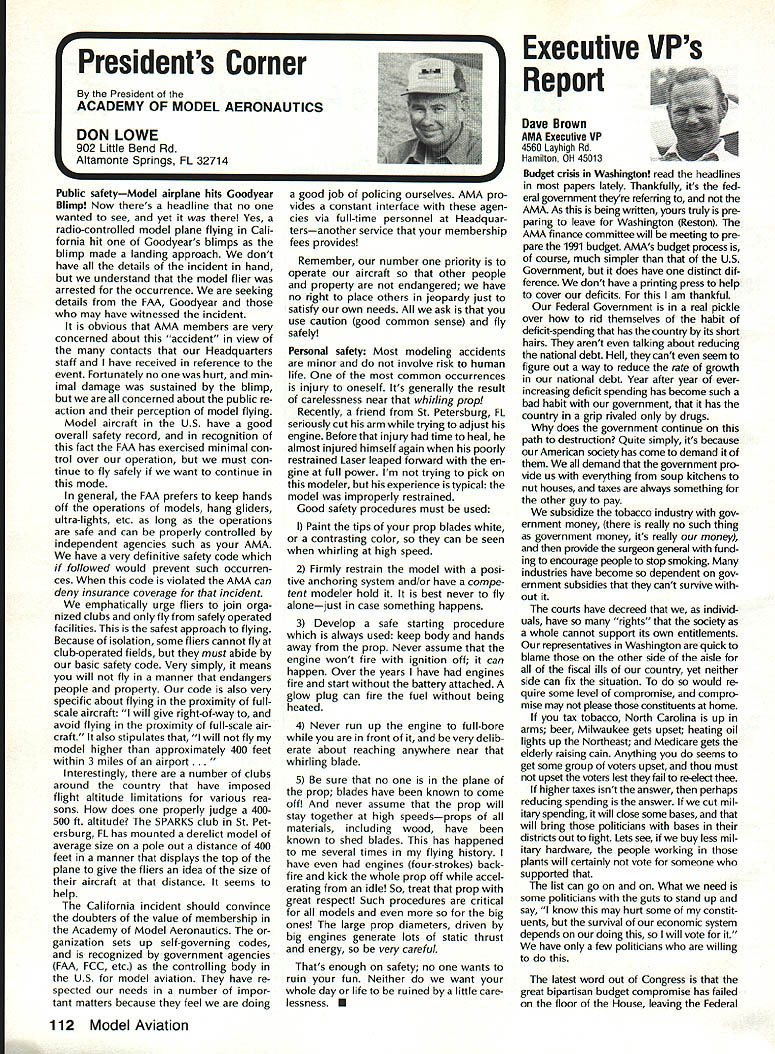
President's Corner
Don Lowe, President, Academy of Model Aeronautics 902 Little Bend Rd., Altamonte Springs, FL 32714
Public safety A radio-controlled model airplane in California hit a Goodyear blimp during a landing approach. The model flier was arrested; AMA is seeking more details from the FAA, Goodyear, and witnesses. Fortunately no one was hurt and damage to the blimp was minimal, but the public reaction is a concern. Model aircraft in the U.S. have a good safety record; the FAA prefers minimal intervention as long as operations are safe and self-governed by organizations such as AMA.
AMA has a definitive safety code. When the code is violated the AMA can deny insurance coverage for the incident. We urge fliers to join organized clubs and fly from safely operated fields. If you cannot fly at a club field, you must still abide by the basic safety code: do not fly in a manner that endangers people or property. Specifically:
- Give right-of-way to and avoid flying in the proximity of full-scale aircraft.
- Do not fly higher than approximately 400 feet within 3 miles of an airport.
Some clubs impose flight altitude limits for local reasons. The SPARKS club in St. Petersburg, FL, mounted a derelict model on a pole at a 400-foot distance to give flyers an idea of aircraft size at that distance—an effective visual aid.
Personal safety Most modeling accidents are minor but often result from carelessness near a spinning propeller. Good safety procedures include:
- Paint the tips of prop blades a contrasting color for visibility.
- Firmly restrain the model with a positive anchoring system or have a competent modeler hold it. It's best not to work alone.
- Develop and always use a safe starting procedure: keep body and hands away from the prop. Never assume the engine won't fire.
- Never run an engine to full power while you are in front of it; be deliberate around a whirling blade.
- Ensure no one is in the plane of the prop. Props can shed blades; treat the prop with great respect, especially on large models where energy and static thrust are significant.
Fly safely and use common sense.
---
Executive VP's Report
Dave Brown, AMA Executive VP 4560 Layhigh Rd., Hamilton, OH 45013
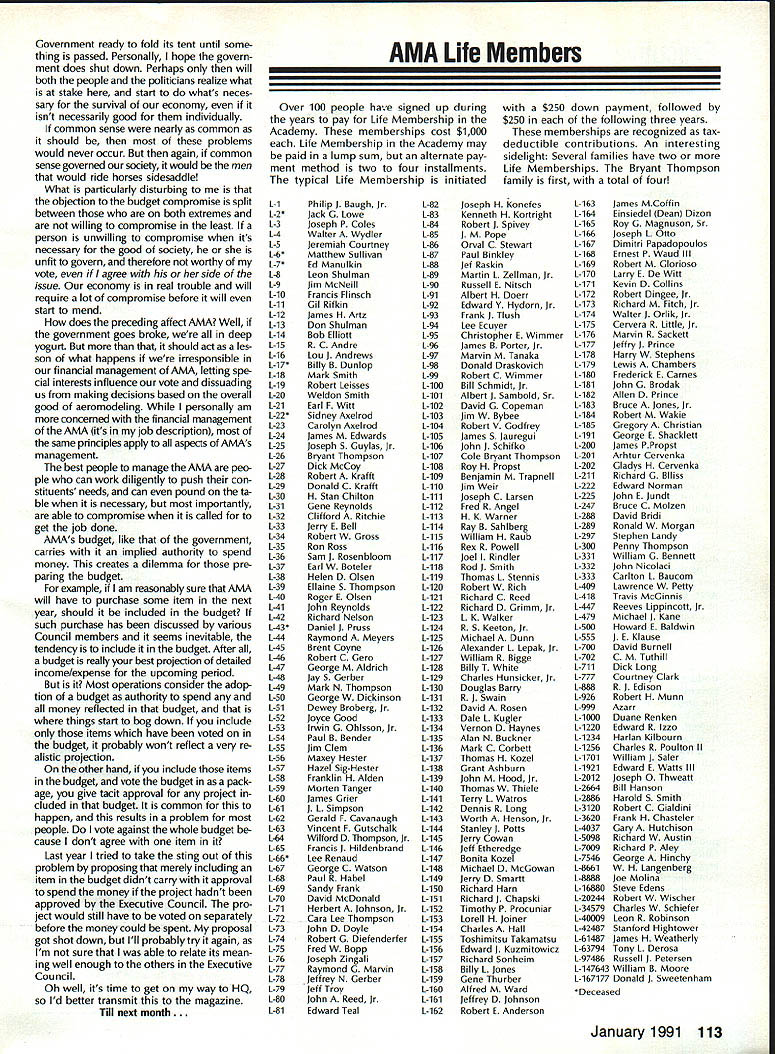
Budget and governance AMA’s budget process is simpler than the federal government’s, but similar issues arise: projected spending creates an implied authority to spend. If the budget includes items not yet voted on, adoption may be seen as tacit approval for spending. I previously proposed that including an item in the budget not automatically authorize expenditure unless the project was separately approved; that proposal was defeated and I may reintroduce it.
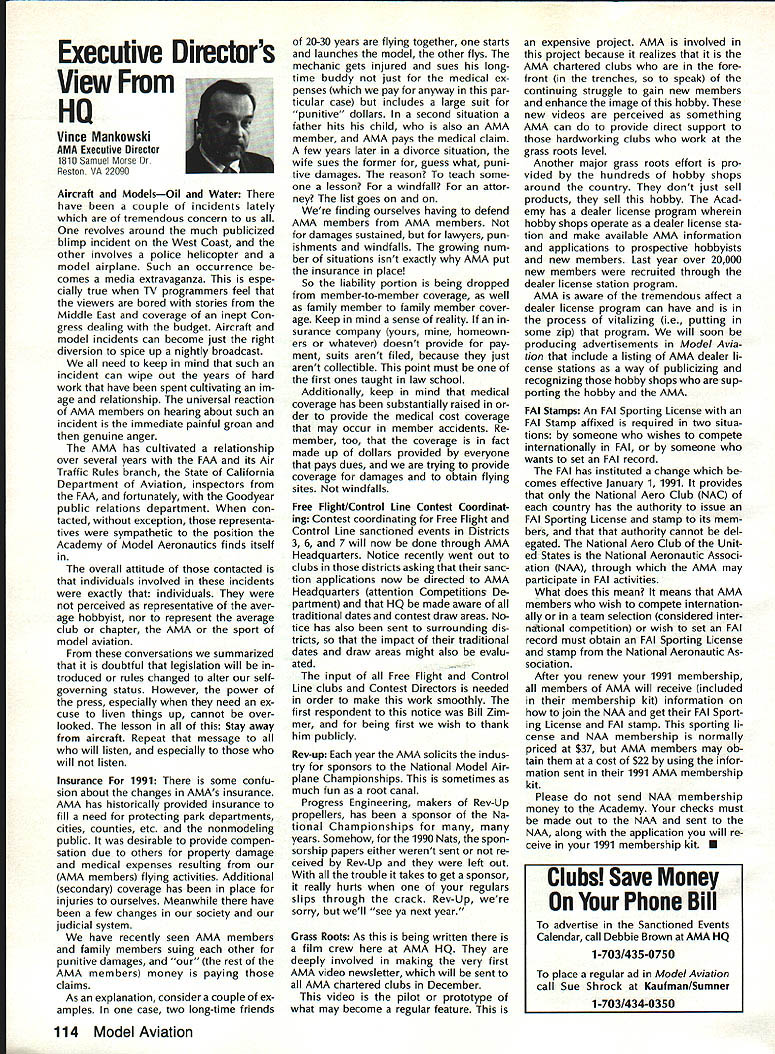
Insurance changes There is confusion about AMA insurance changes. Historically, AMA provided liability coverage to protect park departments, municipalities, and the non-modeling public, and secondary coverage for members' injuries. Recent social and legal changes (including members suing members for punitive damages) have forced changes. Examples include long-time friends suing each other for punitive damages after on-field accidents, or family members pursuing punitive claims later in divorce actions.
As a result:
- Liability coverage for member-to-member and family-member-to-family-member punitive claims is being dropped.
- Medical coverage has been reduced but retained to cover legitimate medical costs from member accidents.
The coverage is funded by dues; the goal is to provide protection for damages and support flying site acquisition—not to fund windfalls.
Free Flight/Control Line contest coordination Contest coordination for Free Flight and Control Line sanctioned events in Districts 3, 6, and 7 will now be handled through AMA Headquarters. Clubs in those districts have been asked to mail sanction applications to Headquarters (Competitions Department) and to provide traditional dates and draw areas. Input from clubs and contest directors is needed.
Rev‑Up sponsorship AMA solicits industry sponsors for the National Model Airplane Championships. Progress Engineering (Rev‑Up propellers) has sponsored the Nationals for years but was inadvertently left out of the 1990 sponsor list due to paperwork oversight. We regret the error and hope to have Rev‑Up back next year.
Grass roots efforts AMA produced a pilot video newsletter to be sent to all AMA-chartered clubs in December. The project is expensive but intended to support clubs at the grass-roots level. The dealer license program (hobby shops as AMA license stations) recruited over 20,000 members last year; AMA is revitalizing the program and will publicize dealer license stations in Model Aviation.
FAI stamps Effective January 1, 1991, the FAI requires that only the National Aero Club (NAC) of each country issue FAI Sporting Licenses and stamps, and that this authority cannot be delegated. The NAC of the United States is the National Aeronautic Association (NAA). AMA members who wish to compete internationally or set FAI records must obtain an FAI Sporting License and stamp from the NAA.
After renewing 1991 AMA membership, members will receive information in their membership kit on how to join the NAA and obtain the FAI Sporting License and stamp. The normal NAA price is $37; AMA members may obtain it for $22 using the information provided. Do not send NAA membership money to AMA—checks must be made out to and sent to the NAA.
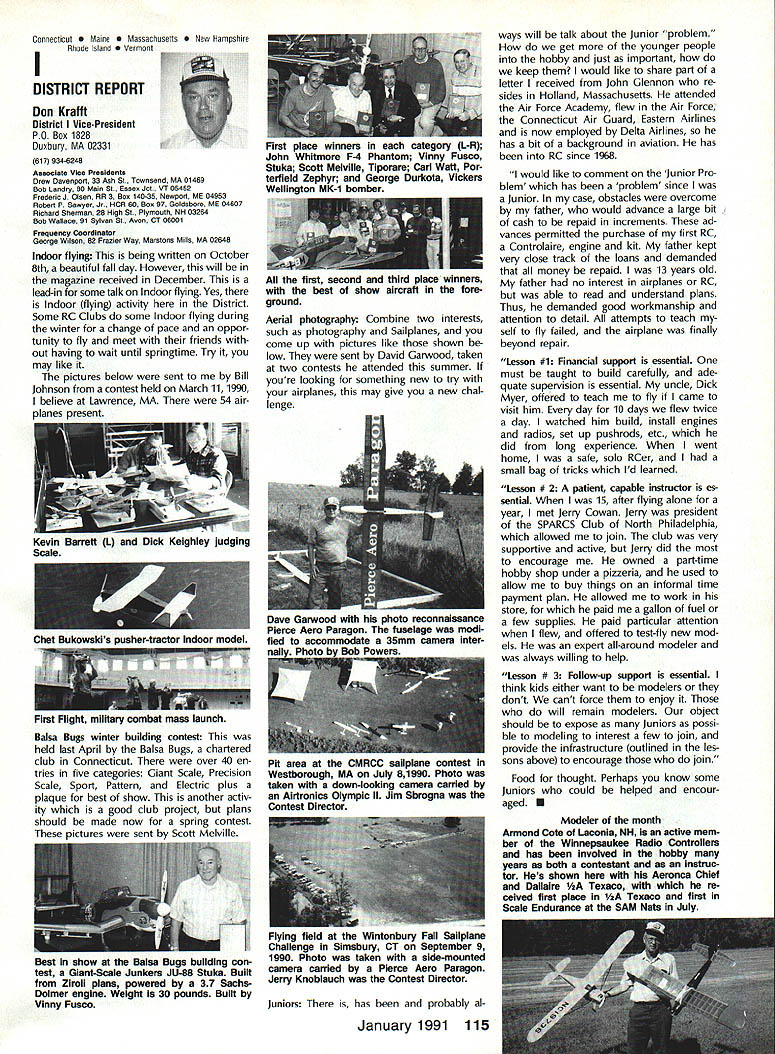
Juniors Getting and keeping Juniors in the hobby remains a long-standing challenge. A letter from John Glennon (experienced aviator and R/C flier since 1968) outlined lessons from his youth:
- Lesson 1: Financial support is essential; supervised building and repayment plans helped him buy his first R/C at 13.
- Lesson 2: A patient, capable instructor is essential—mentors who teach building, installation, setup, and flying accelerate progress.
- Lesson 3: Follow-up support is essential—clubs should expose many Juniors to modeling and provide the infrastructure to support those who are serious.
Modeler of the month Armond Cotter (Laconia, NH), member of the Winnipesaukee Radio Controllers, is recognized for long involvement as contestant and instructor. He placed first in 1/2A Texaco and first in Scale Endurance at the SAM Nats.
---
AMA Awards
Officer Awards
- Award of Appreciation: First-level award presented at the discretion of the Vice-President, President, or Executive Director (district service or special recognition).
- Superior Service: Second-level award presented with Executive Council approval (usually local service).
- Distinguished Service: Third-level award presented with Executive Council approval for long-term service in AMA office or committee.
- Meritorious Service: Automatic award to outgoing Executive Council members.
- Fellow Certificate: Automatic to outgoing President; also for long and dedicated service on behalf of others (recipient need not have held office).
Club or Individual Awards
- Technical Award: For technical achievements that improve modeling (Executive Council approval).
- Vital People's Award: Up to six per year for unsung club-level heroes.
- Hall of Fame: Presented with Council of Past Presidents approval.
- President's Legion of Honor: For major personal donation or exceptional financial contribution (approval by President, Executive Director, and Executive VP).
- All Season Flyers Patch: For flying at least once each month for 12 months (club officer approval).
- Award of Service: Issued to clubs for community service (vice-president approval).
- Award of Achievement: Issued to clubs for service in competition or other areas (vice-president approval).
- Award of Excellence: Issued to clubs with Executive Council approval; constitutes an upgrade of other awards for significant achievement.
---
District Reports
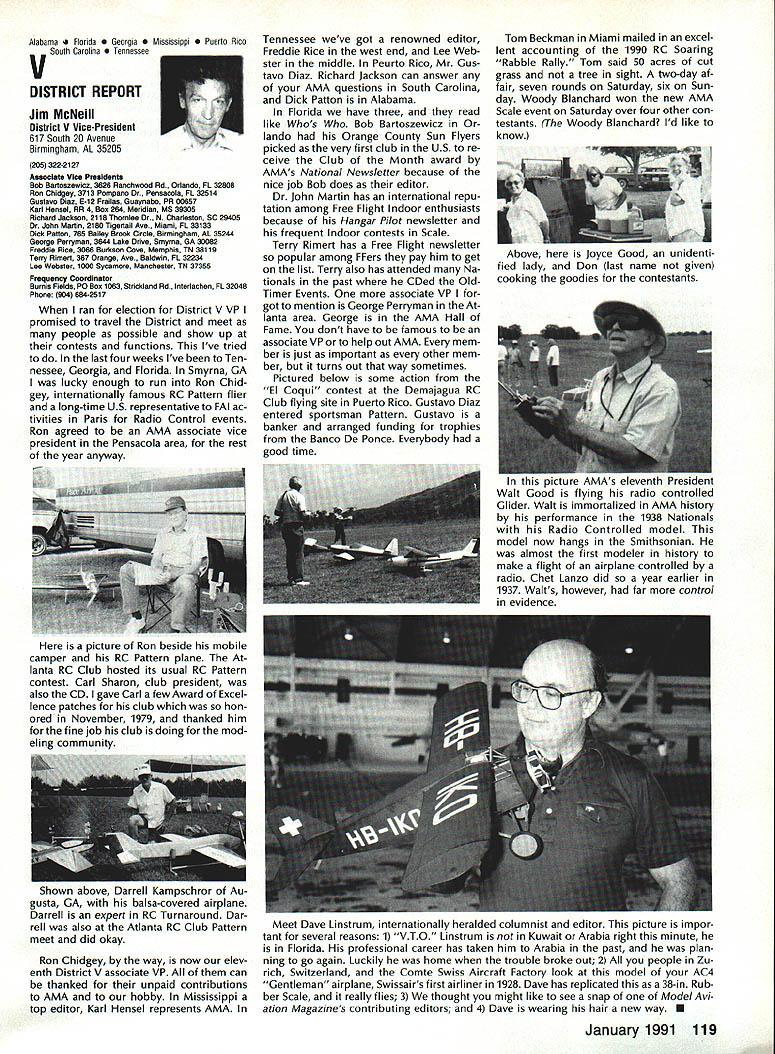
III District Report
Bob Brown, District III Vice‑President 1255 High Street, Bradford, PA 16701
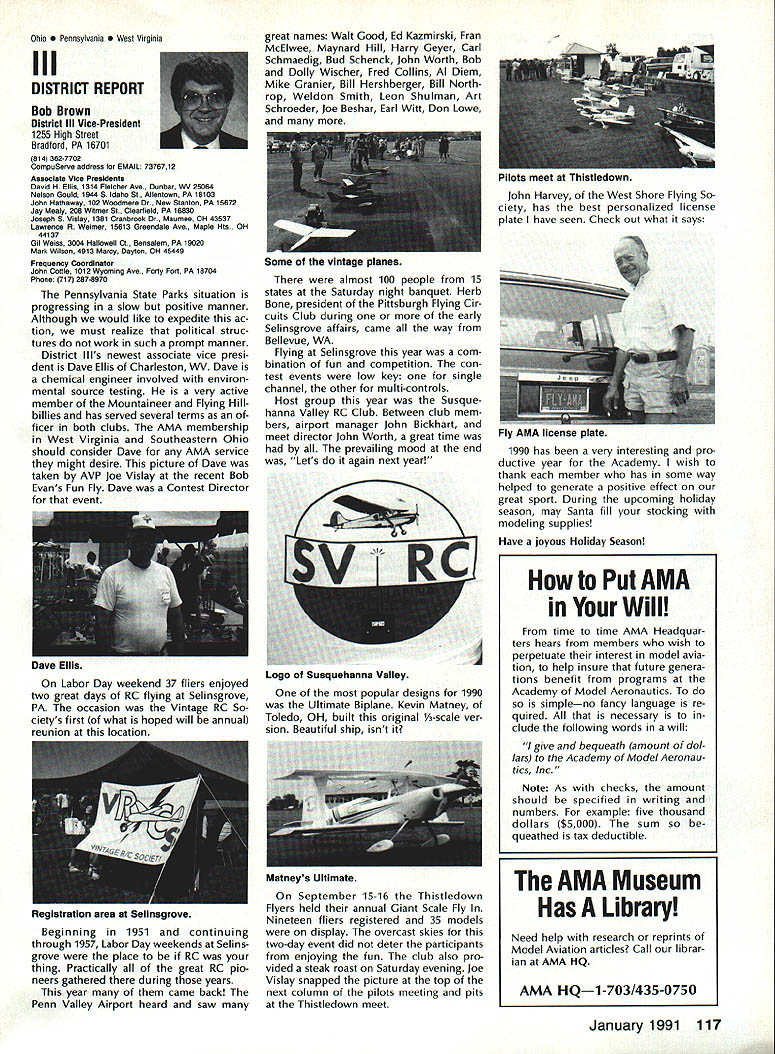
The Pennsylvania State Parks situation is progressing slowly but positively. District III's newest associate vice president is Dave Ellis of Charleston, WV (chemical engineer, active in Mountaineer and Flying Hillbillies). On Labor Day weekend the Vintage RC Society held a reunion at Selinsgrove, PA, bringing together many pioneers and nearly 100 people from 15 states. The Thistledown Flyers' Giant Scale Fly In (Sept 15–16) had 19 registrants and 35 models on display. Thanks to all who helped make 1990 a productive year for the Academy.
V District Report
Jim McNeill, District V Vice‑President 617 South 20th Avenue, Birmingham, AL 35205 (205) 322-2127
Associate Vice Presidents include:
- Bob Bartoszewicz (Orlando, FL)
- Ron Chidgey (Pensacola, FL)
- Gustavo Diaz (Guaynabo, PR)
- Karl Hensel (Meridian, MS)
- Richard Jackson (Charleston, SC)
- Dr. John Martin (Miami, FL)
- Dick Patton (Birmingham, AL)
- George Perryman (Sumter, GA)
- Freddie Rice (Memphis, TN)
- Terry Rimer (Baldwin, FL)
- Lee Webster (Manchester, TN)
Frequency Coordinator:
- P. B. Poff (Interlachen, FL)
I promised to travel the district and attend events. Recent visits included Tennessee, Georgia, and Florida. Bob Bartoszewicz’s Orange County Sun Flyers were the first U.S. club to receive the AMA Club of the Month award. Dr. John Martin is well known in indoor Free Flight, and Terry Rimer produces a popular Free Flight newsletter. Tom Beckman reported on the 1990 RC Soaring "Rabble Rally" with excellent turnout.
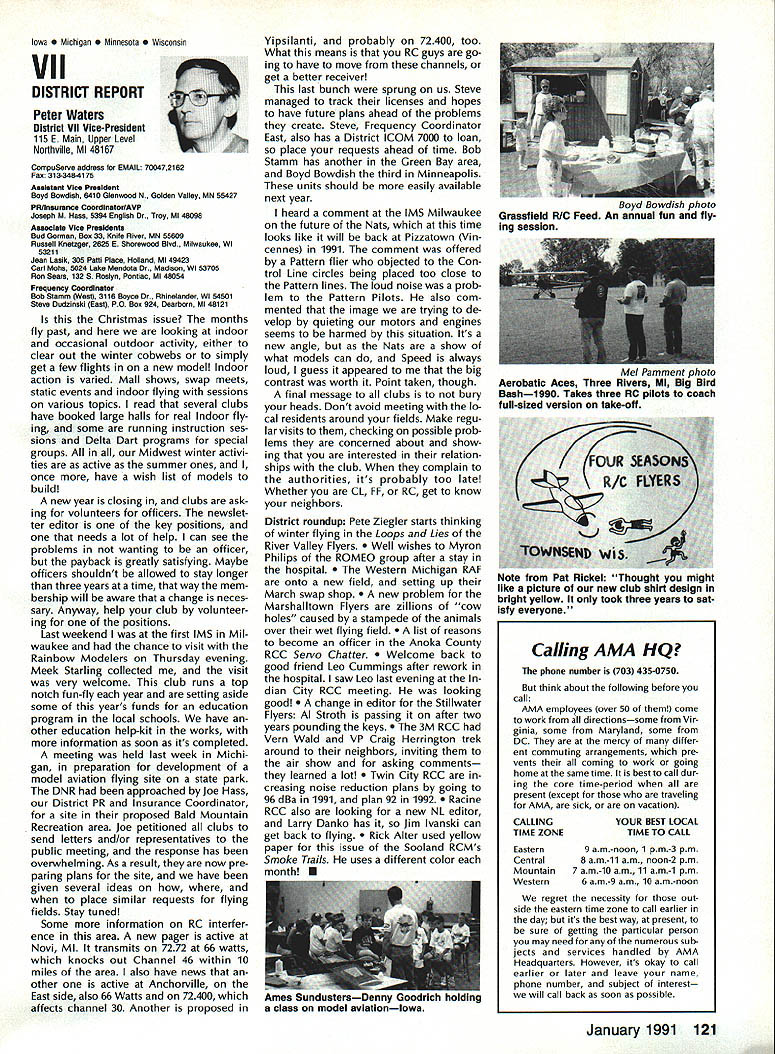
VII District Report
Gene Hempel, District VII Vice‑President 301 N. Yale Drive, Garland, TX 75042
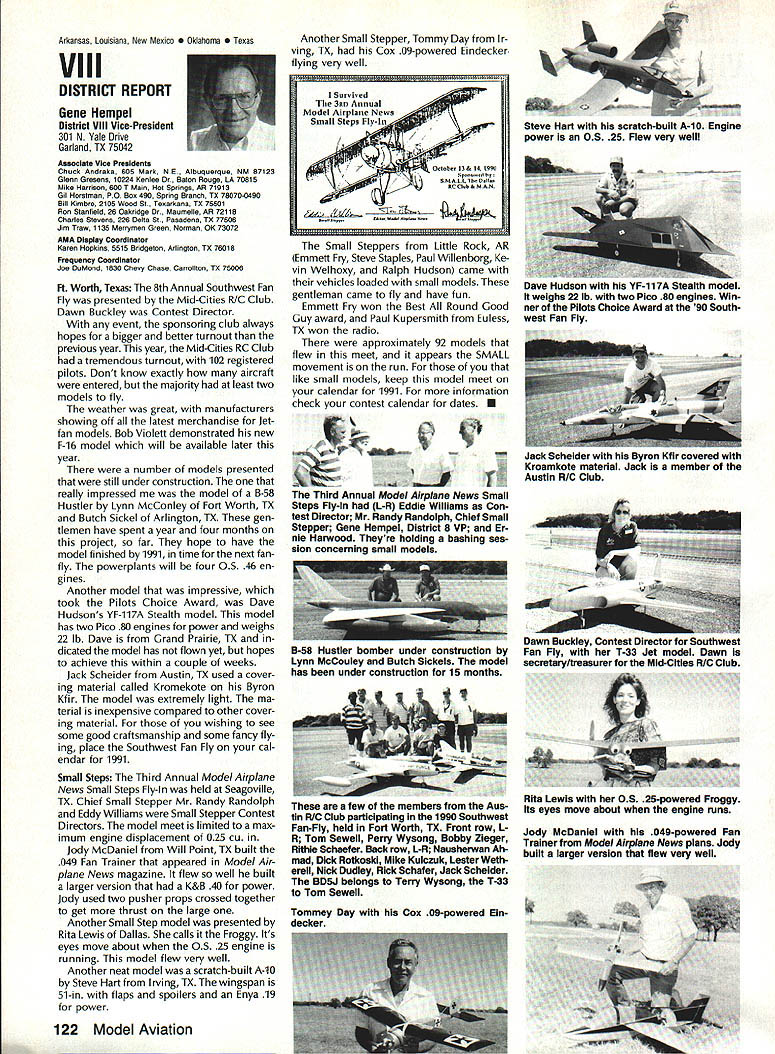
Fort Worth: The 8th Annual Southwest Fan Fly (Mid‑Cities R/C Club) had a tremendous turnout—102 registered pilots. Highlights included Bob Violet’s F‑16 demonstration, a B‑58 Hustler project (four O.S. .46 engines) by Lynn McConley and Butch Sickel, and Dave Hudson’s YF‑117A Stealth model (Pilots Choice Award) with two Pico .80 engines, 22 lb. The Southwest Fan Fly is a must‑see for craftsmanship and flying; mark your calendar for 1991.
IX District Report
Travis McGinnis, District IX Vice‑President 8027 W. 81st Circle, Arvada, CO 80005
Congratulations to:
- Roger Maves (Colorado Springs) and Ken Phair for placing in the FAI Team Selection Finals (Roger won F1B; Ken earned a place on the F1C team).
- Ed Collins (Boulder, CO) for 25 years as Contest Director for the Tin‑Cup Towline Team contest.
- Bill Gibbons for superior service to the Magnificent Mountain Men club and the FAI Free Flight program; organizer for the Denver Area Indoor Model Club.
The Free Flight Team Selection contest at Lost Hills produced the following selections for the 1991 FF World Championships:
- F1A: Randy Weiler, James Parker, Bob Isaacson, alternate Matt Gewain
- F1B: Roger Maves, George Xenakis, Norman Furutani, alternate Robert Milligan
- F1C: Kenneth Oliver, Kenneth Phair, Randy Archer, alternate Terry Kerger
---
Club and Regional News
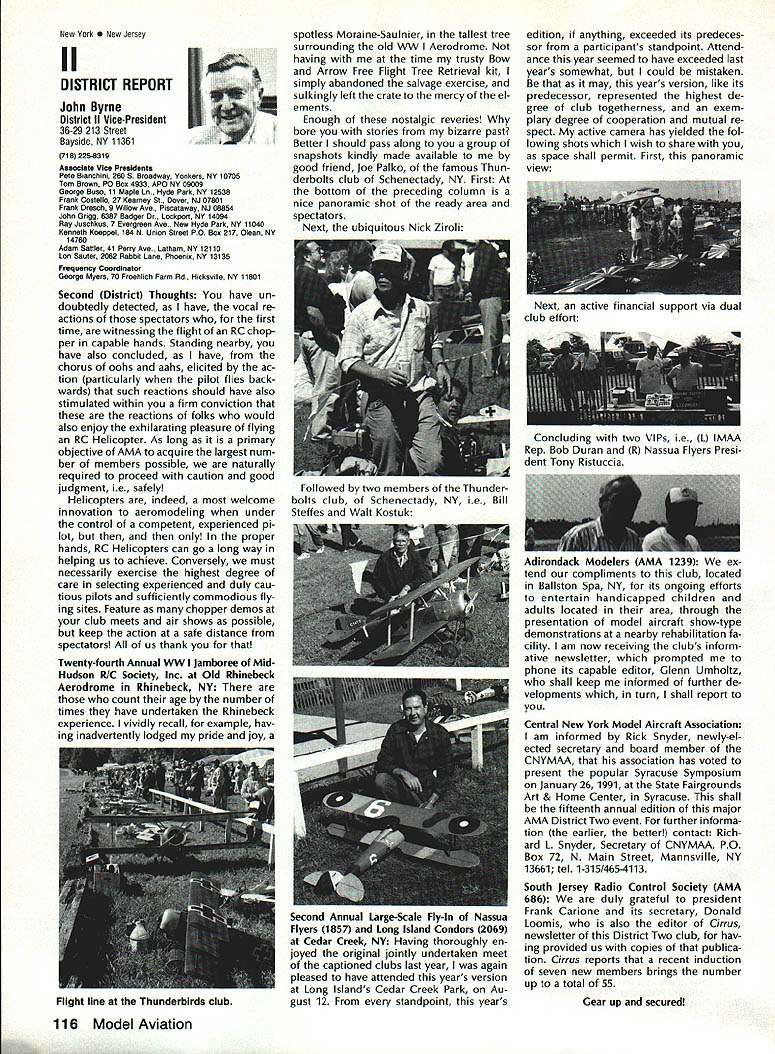
- Adirondack Modelers (AMA 1239), Ballston Spa, NY: Recognized for entertaining handicapped children and adults with model-aircraft demonstrations at a rehabilitation facility. Contact editor Glenn Umholtz for more information.
- Central New York Model Aircraft Association: Syracuse Symposium scheduled for January 26, 1991, at the State Fairgrounds Art & Home Center. Contact Richard L. Snyder, P.O. Box 72, Manlius, NY 13166; tel. 1-315-465-4113.
- South Jersey Radio Control Society (AMA 686): Recent induction of seven new members brings total to 55.
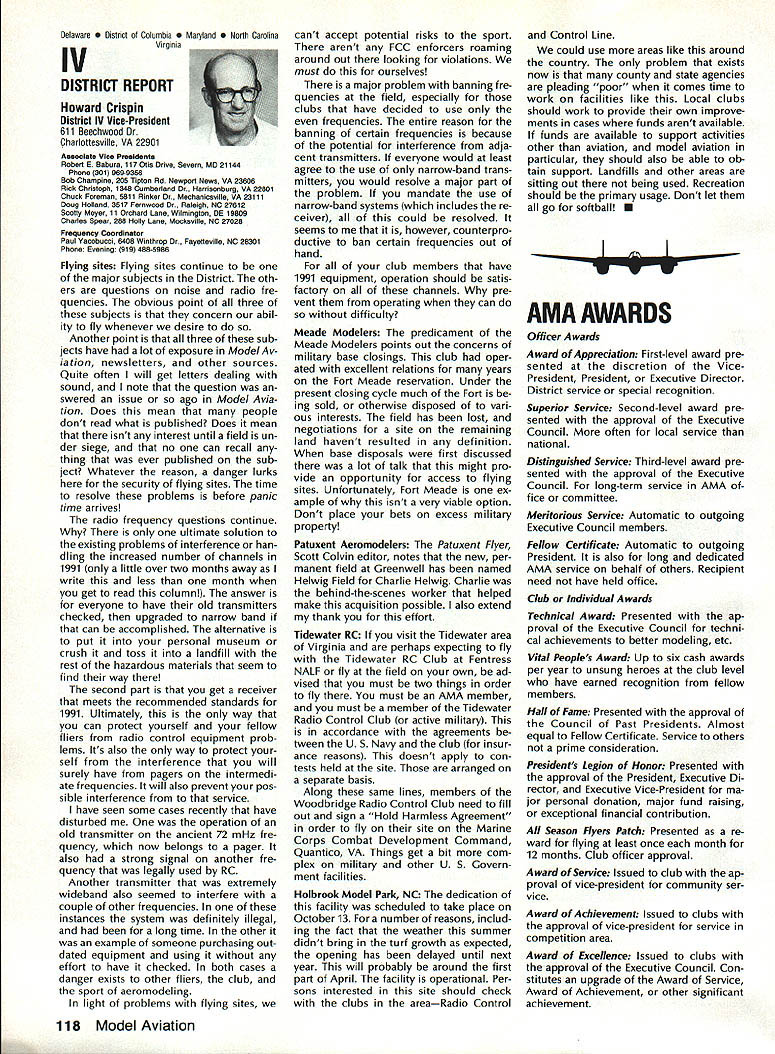
Meade Modelers: The Meade Modelers lost their Fort Meade flying field due to base closure/disposal. Negotiations for replacement sites have been unsuccessful so far—base disposals are not a reliable source of flying sites.
Patuxent Aeromodellers: The new permanent Greenbelt field was named Wesley Field for Charlie Helwig.
Tidewater RC: To fly at Fortress AAF or on the club field you must be an AMA member and a member of the Tidewater Radio Control Club (or active military) under Navy insurance agreements. Contest arrangements may differ. Woodbridge R/C Club members must sign a "Hold Harmless Agreement" to fly on Marine Corps facilities such as Quantico.
Holbrook Model Park, NC: The dedication planned for October was postponed; the facility is operational with a likely reopening around the first of April.
---
Free Flight / Control Line Contest Coordinating (note)
Contest coordinating for Free Flight and Control Line sanctioned events in Districts 3, 6, and 7 will now be processed through AMA Headquarters. Clubs should mail sanction applications to HQ (Competitions Department) and provide traditional dates and draw areas. Surrounding district dates will be evaluated for impact. Input from clubs and contest directors is essential.
---
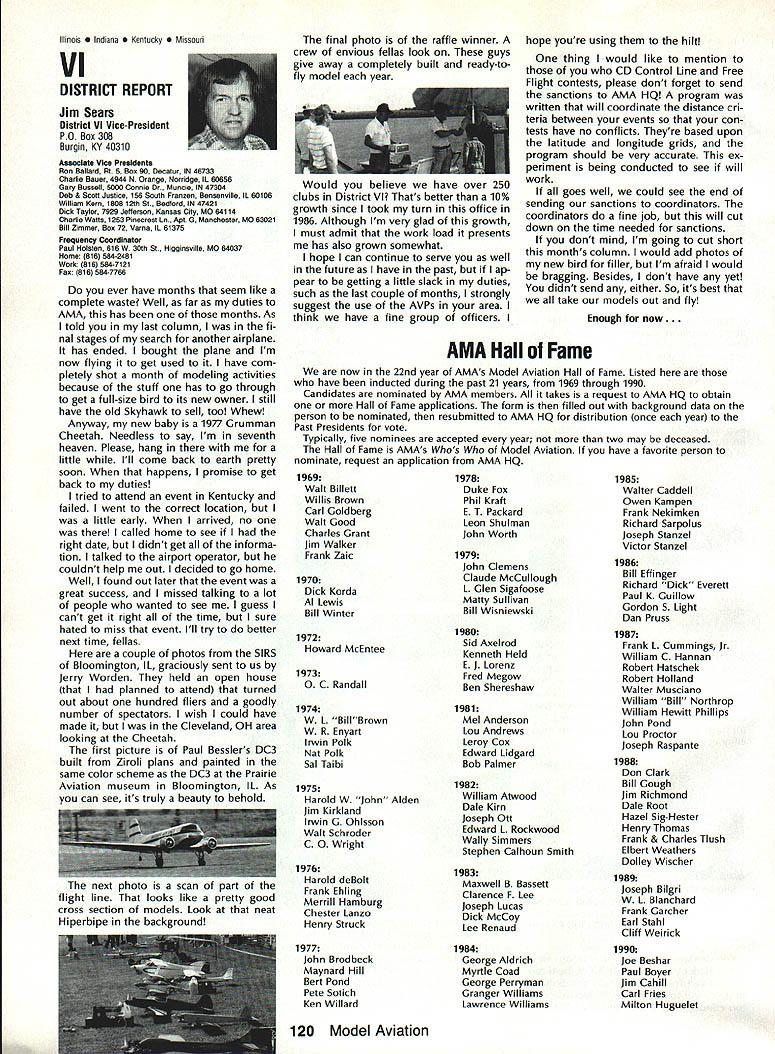
AMA Hall of Fame (1969–1990)
Candidates are nominated by AMA members; forms are available from AMA HQ. Typically five nominees are accepted each year (no more than two may be deceased).
1969
- Walt Billett
- Wills Brown
- Carl Goldberg
- Walt Good
- Charles Grant
- Jim Walker
- Frank Zaic
1970
- Dick Korda
- Al Lewis
- Bill Winter
1972
- Howard McEntee
1973
- O. C. Randall
1974
- W. L. "Bill" Brown
- W. R. Eynart
- Irwin Polk
- Nat Polk
- Sal Taibi
1975
- Harold W. "John" Alden
- Jim Kirkland
- Erwin G. Ohlsson
- Walt Schroeder
- C. O. Wright
1976
- Harold deBolt
- Frank Ehling
- Merrill Hamburg
- Chester Lanza
- Henry Struck
1977
- John Brodbeck
- Maynard Hill
- Bert Pond
- Pete Smith
- Ken Willard
1978
- Duke Fox
- Phil Kraft
- E. T. Packard
- Leon Shulman
- John Worth
1979
- John Clemens
- Claude McCullough
- L. Glen Sigafoose
- Matty Sullivan
- Bill Wisniewski
1980
- Sid Axelrod
- Kenneth Held
- E. J. Lorenz
- Fred Megow
- Ben Shereshaw
1981
- Mel Anderson
- Lou Andrews
- Leroy Cox
- Edward Liggett
- Bob Palmer
1982
- William Atwood
- Dale Kirn
- Joseph Ott
- Edward L. Rockwood
- Wally Simmers
- Stephen Calhoun Smith
1983
- Maxwell B. Bassett
- Clarence F. Lee
- Joseph Lucas
- Dick McCoy
- Lee Renaud
1984
- George Aldrich
- Myrtle Coad
- George Perryman
- Granger Williams
- Lawrence Williams
1985
- Walter Caddell
- Owen Kampen
- Frank Nekimken
- Richard Sarpolis
- Joseph Stanzel
1986
- Bill Effinger
- Richard "Dick" Everett
- Paul K. Gulick
- Gordon S. Light
- Dan Pruss
1987
- Frank L. Cummings, Jr.
- William C. Hannan
- Robert Hartsheck
- Robert Holland
- Walter Musciano
- William "Bill" Northrop
- William Hewitt Phillips
- John Pond
- Lou Proctor
- Joseph Raspante
1988
- Don Clark
- Bill Gough
- Jim Richmond
- Dale Root
- Hazel Sig-Hester
- Henry Thomas
- Frank & Charles Tish
- Elbert Weathers
- Dolley Wischner
1989
- Joseph Bigari
- W. L. Blanchard
- Frank Graber
- Earl Stahl
- Cliff Weirick
1990
- Joe Beshar
- Paul Boyer
- Jim Cahill
- Carl Fries
- Milton Huguelet
---
Transcribed from original scans by AI. Minor OCR errors may remain.

