
AMA News
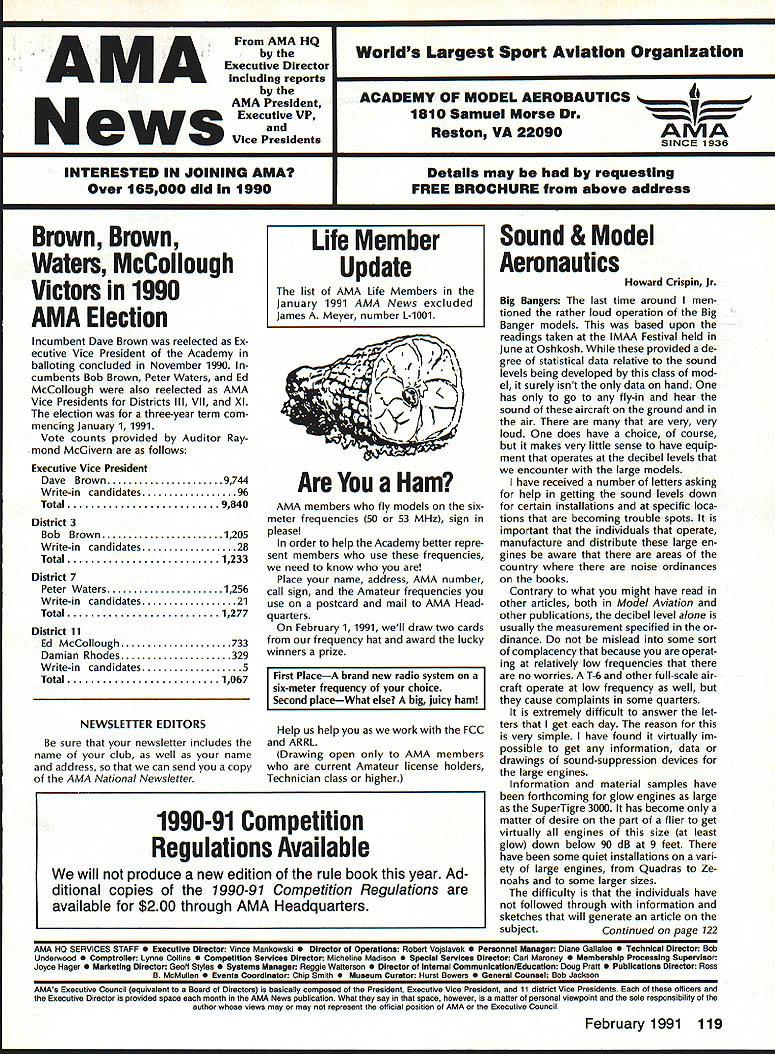
1990 AMA Election — Brown, Brown, Waters, McCollough Victors
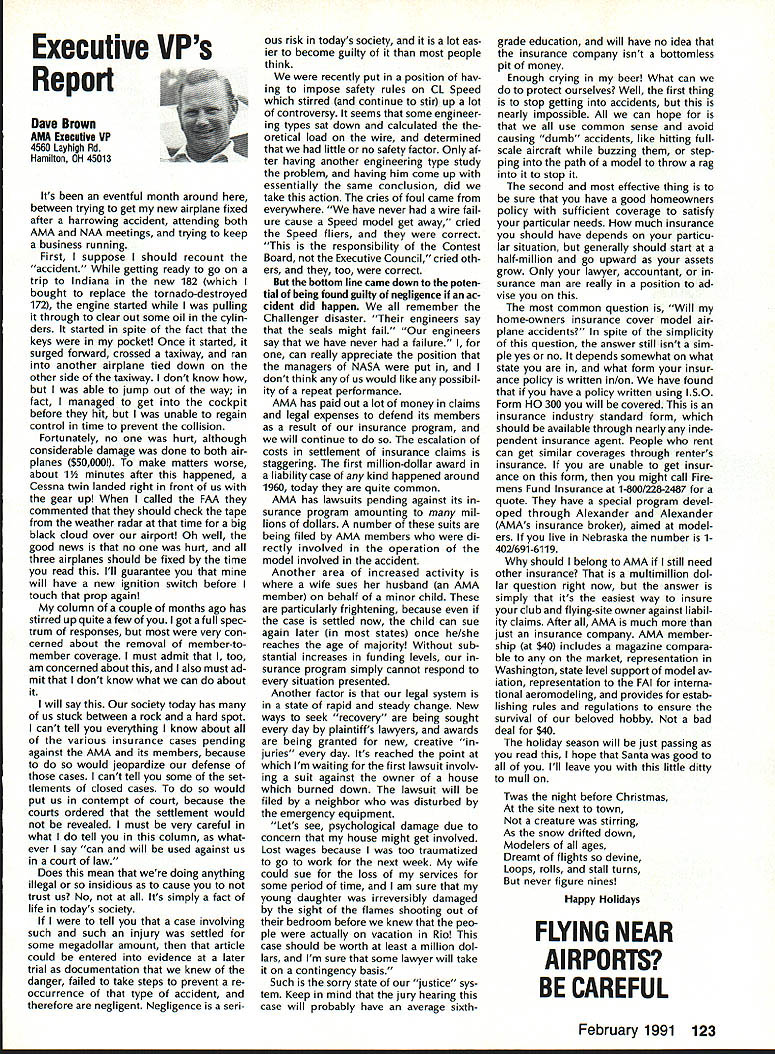
Incumbent Dave Brown was reelected Executive Vice President of the Academy in balloting concluded November 1990. Incumbents Bob Brown, Peter Waters, and Ed McCollough were also reelected as AMA Vice Presidents for Districts III, VII, and XI. The election is for a three-year term commencing January 1, 1991. Vote counts, provided by Auditor Raymond McGivern, follow:
- Executive Vice President
- Dave Brown — 9,744
- Write-in candidates — 96
- Total — 9,840
- District 3
- Bob Brown — 1,205
- Write-in candidates — 28
- Total — 1,233
- District 7
- Peter Waters — 1,256
- Write-in candidates — 21
- Total — 1,277
- District 11
- Ed McCollough — 733
- Damian Rhodes — 329
- Write-in candidates — 5
- Total — 1,067
Newsletter Editors
Be sure your club newsletter includes the name of the club as well as the name and mailing address of the person to whom we can send a copy of the AMA National Newsletter.
Amateur Radio / Six‑Meter Frequencies
Are AMA members who are Amateur Radio license holders flying models on six‑meter frequencies (50–53 MHz)? If so, please help the Academy better represent members who use these frequencies. Send a postcard to AMA Headquarters with:
- name
- address
- AMA number
- call sign
- the amateur frequencies you use
Mail your postcard by February 1, 1991. Two cards will be drawn from the frequency hat and lucky winners will receive prizes:
- First prize — a brand‑new radio system on a six‑meter frequency of your choice
- Second prize — ham‑related prize
Drawing open only to AMA members who are current Amateur license holders (Technician class or higher). Help us help you as we work with the FCC and ARRL.
1990–91 Competition Regulations Available
We will not produce a new edition of the rule book this year. Additional copies of the 1990–91 Competition Regulations are available for $2.00 through AMA Headquarters.
Life Member Update
The list of AMA Life Members published in the January 1991 AMA News excluded James A. Meyer, number L‑1001. (This omission has been noted for correction.)
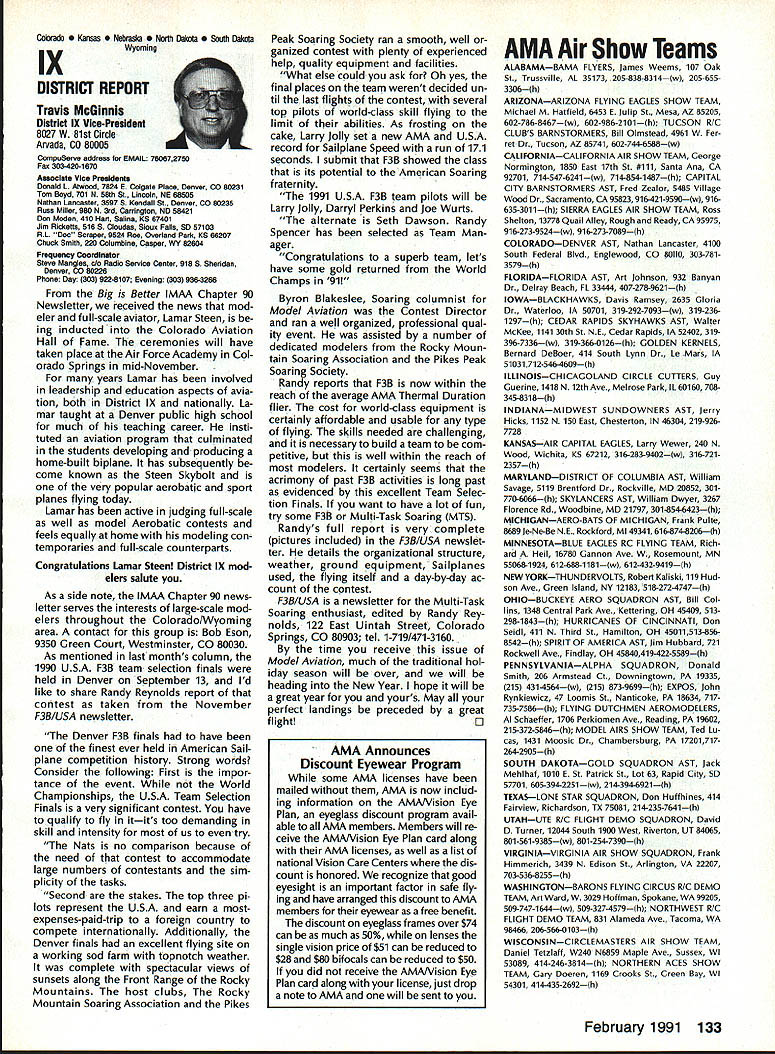
AMA Announces Discount Eyewear Program
AMA members are eligible for the AMA/Vision Eye Plan, an eyeglass discount program. Members receive an AMA/Vision Eye Plan card with their AMA license and a list of participating national Vision Care Centers. Typical savings include:
- Frames over $74 — up to 50% off
- Single‑vision lenses — typical price reduced from $51 to $28
- Bifocals — typical price reduced from $80 to $50
If you did not receive the AMA/Vision Eye Plan card with your license, send a note to AMA and one will be sent to you.
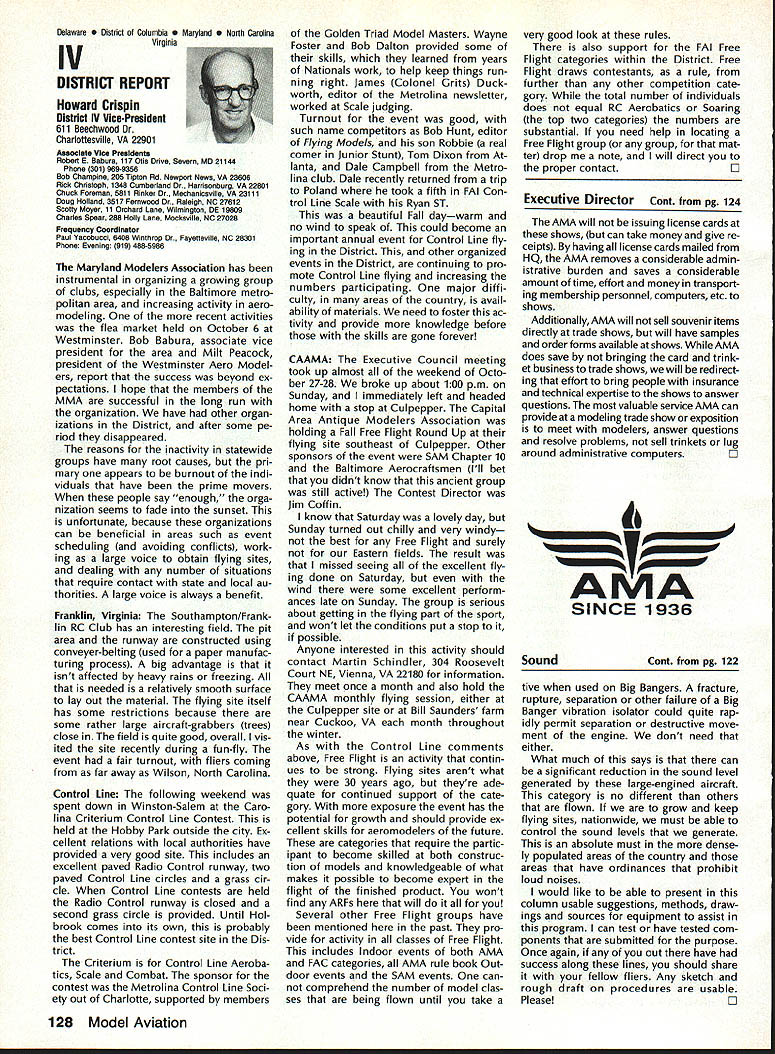
Sound & Model Aeronautics
Howard Crispin, Jr.
Big Bangers: In a previous column we discussed the rather loud operation of "Big Banger" models. Readings taken at the IMAA Festival in June at Oshkosh provided statistical data on sound levels for this class of model. Fly‑ins and local events also provide ample anecdotal evidence: many large models are very loud both on the ground and in the air. While pilots have choices, it makes little sense to operate equipment at the high decibel levels encountered with some large models.
Noise ordinances: Several letters have requested help in getting sound levels down at specific installations and trouble spots. It is important that operators, manufacturers, and distributors of large engines be aware that many areas have noise ordinances. Contrary to some reports, the decibel level alone is often the measurement specified in ordinances, so do not be misled into complacency by thinking low frequency equals no problem. Full‑scale aircraft such as the T‑6 operate at low frequency and can still generate complaints.
Information shortage: It has been difficult to respond to inquiries because sound‑suppression information, data, and drawings for larger engines have been hard to obtain. Material and samples have been more forthcoming for glow engines (for example, installations with the SuperTigre 3000 have demonstrated that some glow engines can be reduced below 90 dB at 9 feet). There are quiet installations for engines such as Quadras and Zenoahs, but many large installations lack effective suppression because operators have not followed through with information and sketches that would allow dissemination of best practices.
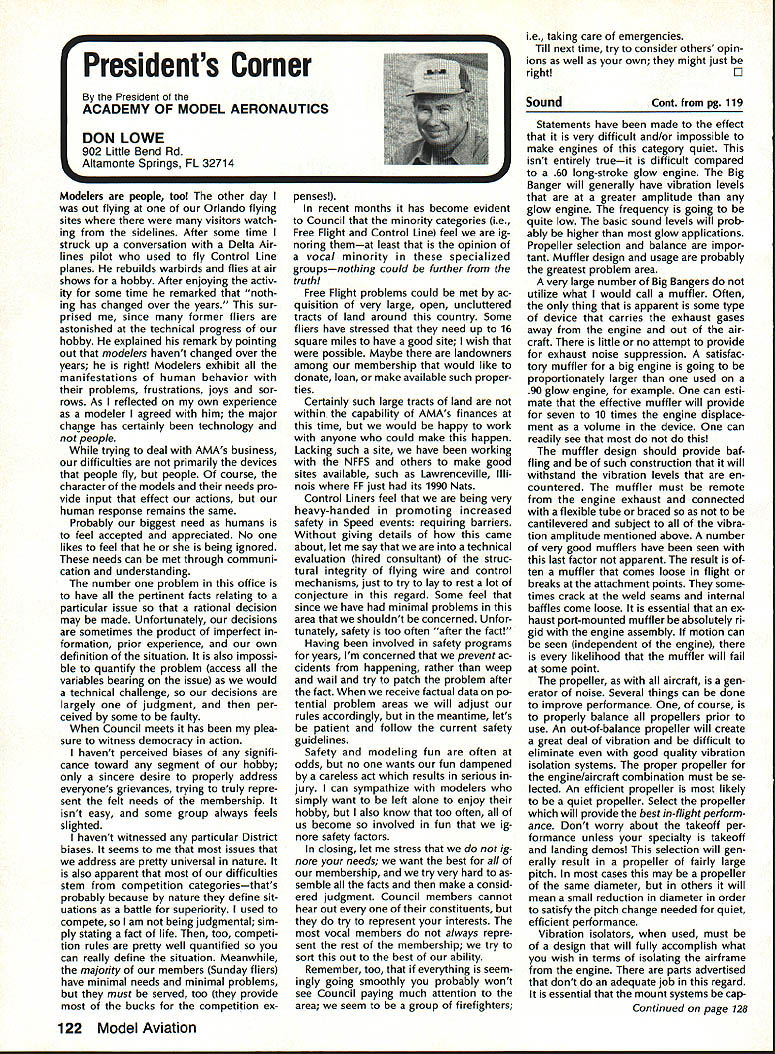
Mufflers and exhaust: Many Big Bangers lack proper mufflers; often the exhaust is merely routed away from the engine without noise suppression. A satisfactory muffler for a large engine must be proportionately larger than one used on a .90 glow engine — estimate seven to eleven times the engine displacement volume as a guideline. The muffler should provide baffling and be constructed to withstand high vibration. It must be either remote from the engine exhaust and connected with a flexible tube or be solidly braced so it is not cantilevered. Poor attachment or insufficient bracing can cause mufflers to come loose, crack welds, or fail at internal baffles.
Propellers and balance: The propeller is a major noise generator. Steps to reduce noise include:
- Properly balance all propellers before use. An out‑of‑balance prop creates vibration that is hard to eliminate even with good isolation.
- Select the proper propeller for the engine/aircraft combination. An efficient propeller is likely to be quieter.
- Consider propeller pitch and diameter tradeoffs; often a prop with fairly large pitch (and possibly a small reduction in diameter) will yield quieter, efficient performance.
Vibration isolators: When used, isolators must effectively isolate the airframe from the engine. Some commercially advertised mounts do not perform adequately. Isolators should reduce vibration without inducing other problems (for example, excessive motion at the muffler attachment). Soft‑type mounts can help reduce vibration transfer, fuel‑foaming, and wear on servos, but must be selected and installed properly.
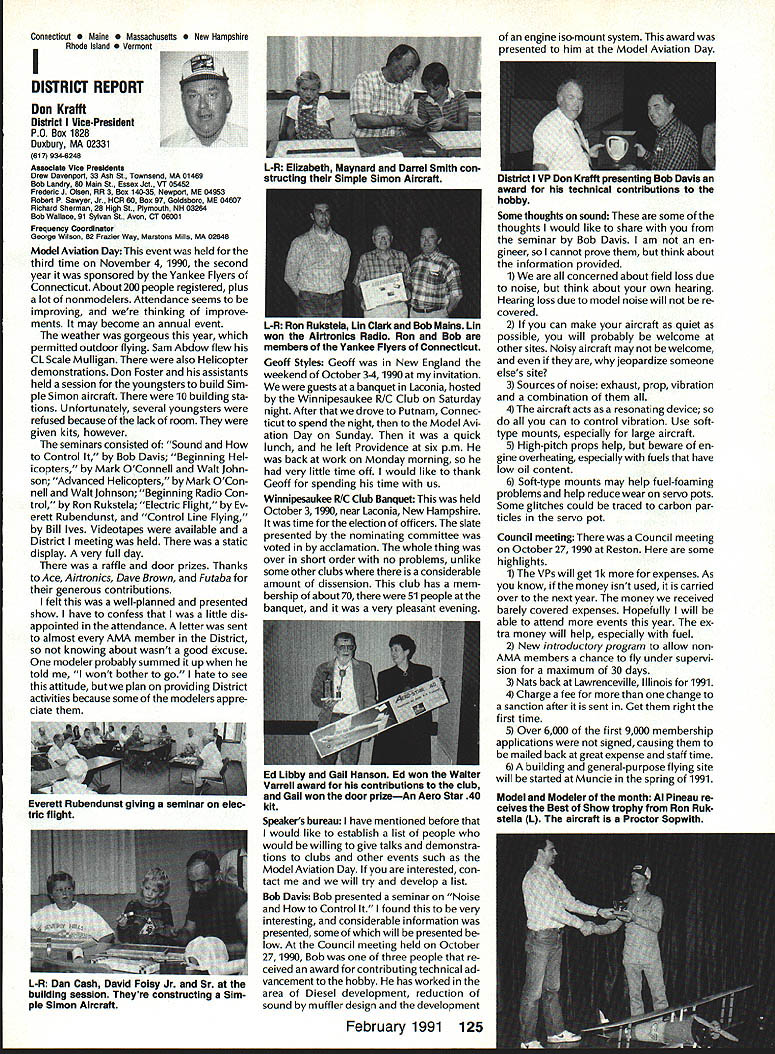
Seminars and resources: Bob Davis presented a seminar on "Noise and How to Control It," sharing practical information on diesel development, muffler design, and engine iso‑mount systems. He received an award at the Council meeting for technical contributions to the hobby. We are compiling information and would like to publish more technical articles as data and drawings become available.
Speaker bureau: We plan to develop a list of people willing to give talks and demonstrations to clubs and events such as Model Aviation Day. If you are interested, contact AMA Headquarters for details.
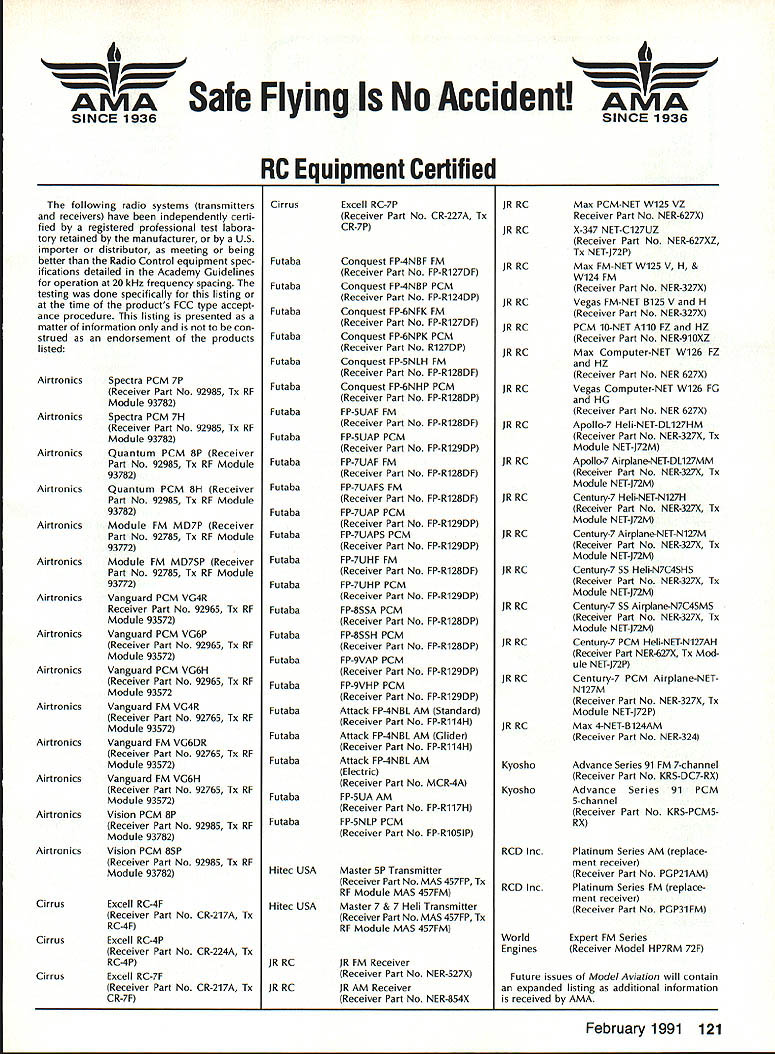
RC Equipment Certified
The following radio systems (transmitters and receivers) have been independently certified by a registered professional test laboratory (retained by the manufacturer or U.S. importer/distributor) as meeting or exceeding the Radio Control equipment specifications in the Academy Guidelines for operation at 20 kHz frequency spacing. This listing is informational and is not an endorsement.
- Airtronics
- Spectra PCM 7P (Receiver Part No. 92985, Tx RF Module 93782)
- Spectra PCM 7H (Receiver Part No. 92985, Tx RF Module 93782)
- Quantum PCM 8P (Receiver Part No. 92985, Tx RF Module 93782)
- Quantum PCM 8H (Receiver Part No. 92985, Tx RF Module 93782)
- Module FM MD7P (Receiver Part No. 92785, Tx RF Module 93772)
- Module FM MD7SP (Receiver Part No. 92785, Tx RF Module 93772)
- Vanguard PCM VG4R (Receiver Part No. 92965, Tx RF Module 93572)
- Vanguard PCM VG6P (Receiver Part No. 92965, Tx RF Module 93572)
- Vanguard PCM VG6H (Receiver Part No. 92965, Tx RF Module 93572)
- Vanguard FM VG4R (Receiver Part No. 92765, Tx RF Module 93572)
- Vanguard FM VG6DR (Receiver Part No. 92765, Tx RF Module 93572)
- Vanguard FM VG6H (Receiver Part No. 92765, Tx RF Module 93572)
- Vision PCM 8SP (Receiver Part No. 92985, Tx RF Module 93782)
- Cirrus
- Excell RC-4F (Receiver Part No. CR-217A, Tx RC-4F)
- Excell RC-4P (Receiver Part No. CR-224A, Tx RC-4P)
- Excell RC-7F (Receiver Part No. CR-217A, Tx CR-7F)
- Futaba
- Excell RC-7P (Receiver Part No. CR-227A, Tx CR-7P)
- Conquest FP-4NBF FM (Receiver Part No. FP-R12D7P)
- Conquest FP-4NBP PCM (Receiver Part No. FP-R12D8P)
- Conquest FP-6NFK FM (Receiver Part No. FP-K12D7P)
- Conquest FP-6NFP PCM (Receiver Part No. FP-R12D8P)
- Conquest FP-6PNP PCM (Receiver Part No. FP-R12D8P)
- Conquest FP-7F-PCM (Receiver Part No. FP-R12D8DF)
- FP-5UAF FM (Receiver Part No. FP-R12D8F)
- FP-5UAP PCM (Receiver Part No. FP-R12D8P)
- FP-7UAF FM (Receiver Part No. FP-R12D8F)
- FP-7UAFS FM (Receiver Part No. FP-R12D8F)
- FP-8UAF PCM (Receiver Part No. FP-R12D9P)
- FP-7UHF FM (Receiver Part No. FP-R12D8F)
- FP-8SSA PCM (Receiver Part No. FP-R12D8P)
- FP-8SSM PCM (Receiver Part No. FP-R12D8P)
- FP-9VAP PCM (Receiver Part No. FP-R12D9P)
- FP-9VHP PCM (Receiver Part No. FP-R12D9P)
- Attack FP-4NBL AM (Standard) (Receiver Part No. FP-R114H)
- Attack FP-4NBL AM (Glider) (Receiver Part No. FP-R114H)
- Attack FP-4NBL AM (Electric) (Receiver Part No. MCR-4A)
- FP-5UA AM (Receiver Part No. FP-R117H)
- FP-5NLP PCM (Receiver Part No. FP-R1051P)
- Hitec USA
- Master 5P Transmitter (Receiver Part No. MAS 457FP, Tx RF Module MAS 457FM)
- Master 7 & 7 Heli Transmitter (Receiver Part No. MAS 457FP, Tx RF Module MAS 457FM)
- JR RC
- JR FM Receiver (Receiver Part No. NER-527X)
- JR AM Receiver (Receiver Part No. NER-854X)
- Max PCM-NET W125 VZ (Receiver Part No. NER-627X)
- X-347 NET-C127U2 (Receiver Part No. NER-627XZ, Tx NET-J72P)
- Max FM-NET W125 V, H, & W124 FM (Receiver Part No. NER-327X)
- Vegas FM-NET B125 V and H (Receiver Part No. NER-327X)
- PCM 10-NET A110 FZ and HZ (Receiver Part No. NER-910XZ)
- Max Computer-NET W126 FZ and HZ (Receiver Part No. NER-627X)
- Vegas Computer-NET W126 (Receiver Part No. NER-627X)
- Apollo-7 Heli-NET DL127HM (Receiver Part No. NER-327X, Tx Module NET-J72M)
- Apollo-7 Airplane-NET DL127MM (Receiver Part No. NER-327X, Tx Module NET-J72M)
- Century-7 Heli-NET N127H (Receiver Part No. NER-327X, Tx Module NET-J72M)
- Century-7 Airplane-NET N127M (Receiver Part No. NER-327X, Tx Module NET-J72M)
- Century-7 SS Heli-NC74SHS (Receiver Part No. NER-327X, Tx Module NET-J72M)
- Century-7 SS Airplane-NC74SMS (Receiver Part No. NER-327X, Tx Module NET-J72M)
- (Century?) PCM Heli-NET N127AH (Receiver Part No. NER-627X, Tx Module NET-J72P)
- Century-7 PCM Airplane-NET N127M (Receiver Part No. NER-327X, Tx Module NET-J72P)
- Max 4-NET B124AM (Receiver Part No. NER-324)
- Kyosho
- Advance Series 91 FM 7-channel (Receiver Part No. KRS-DC7RX)
- Advance Series 91 PCM 5-channel (Receiver Part No. KRS-PCM5-RX)
- RCD Inc.
- Platinum Series AM (replacement receiver) (Receiver Part No. PGP21AM)
- Platinum Series FM (replacement receiver) (Receiver Part No. PGP31FM)
- World Engines
- Expert FM Series (Receiver Model HP7RM 72F)
Future issues of Model Aviation will contain an expanded listing as additional information is received by AMA.
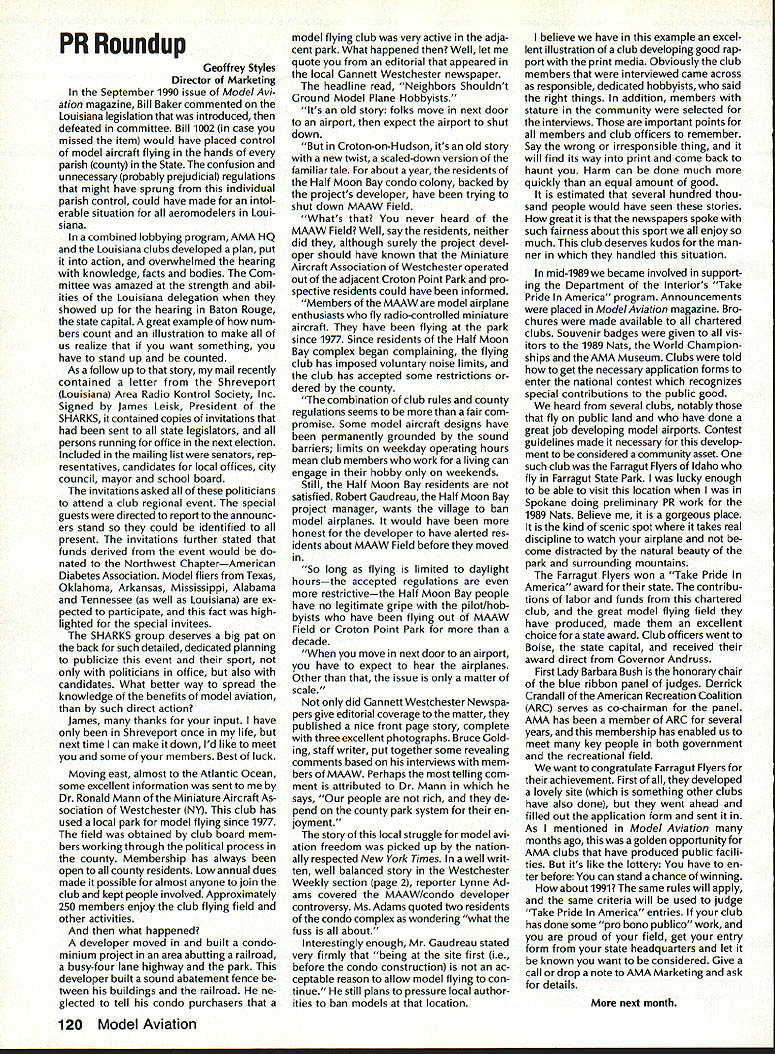
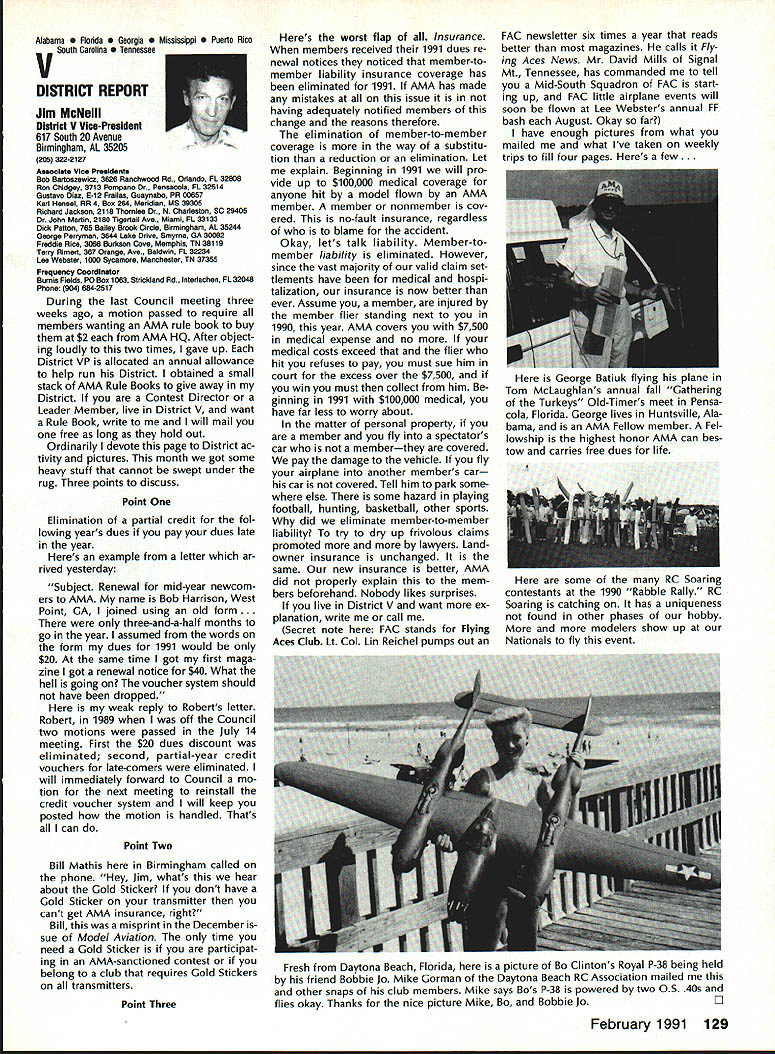
Insurance Changes (Explanation)
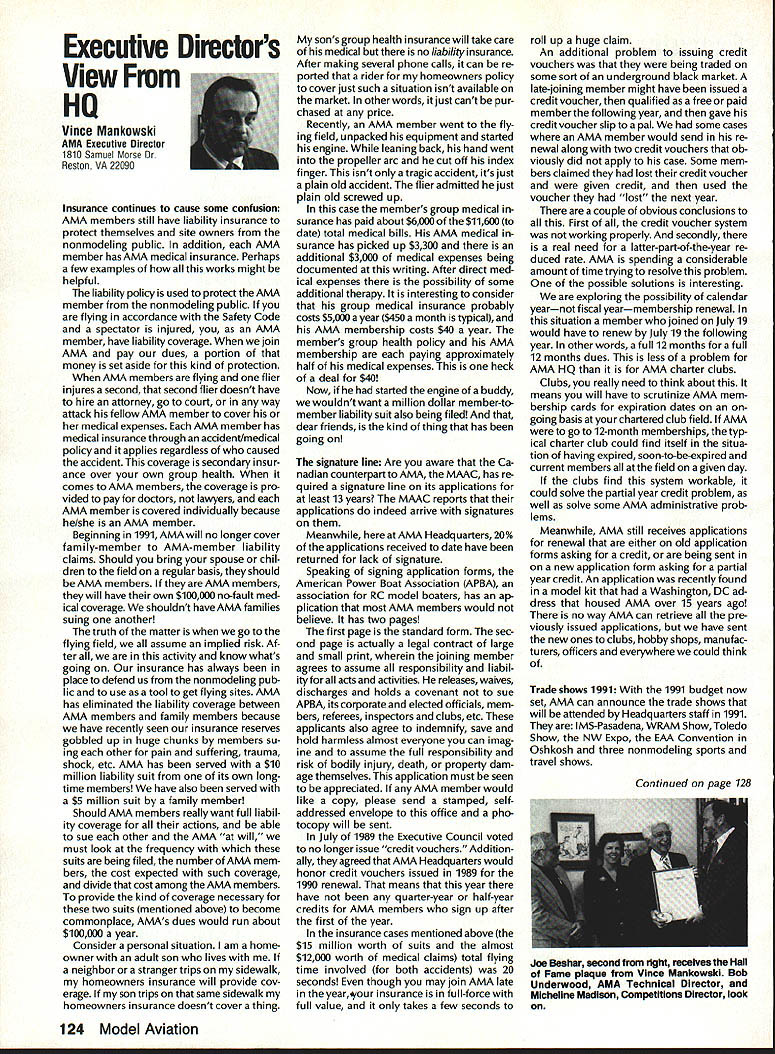
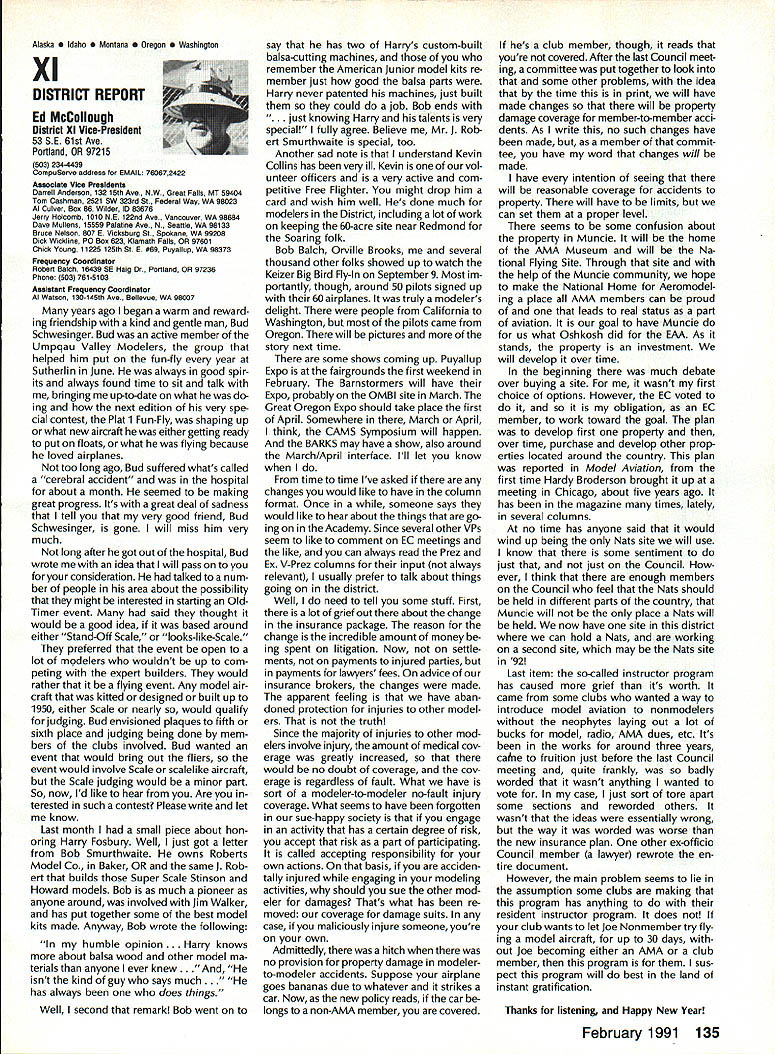
When members received their 1991 dues renewal notices they noted that member‑to‑member liability coverage was eliminated for 1991. AMA recognizes that members were not adequately notified of the change and the reasons for it.
Key points:
- Member‑to‑member liability was removed and replaced with broader no‑fault medical coverage.
- Beginning in 1991 AMA will provide up to $100,000 in medical coverage for anyone hurt by a model flown by an AMA member. This is no‑fault coverage and applies to members and nonmembers injured by an AMA member's model.
- Previously, many valid claim settlements were for medical and hospitalization; the new medical coverage is therefore more meaningful for injured parties.
- Personal property nuance: if a member flies a model into a nonmember spectator's car, the vehicle damage is covered. If a member damages another member's car, that member's car is not covered under the replaced member‑to‑member liability.
- Landowner insurance remains unchanged.
- The change was intended to reduce frivolous claims; AMA acknowledges the need for better member communication when making such changes.
Members seeking more explanation (for example, those in District V) are encouraged to contact their vice president or AMA Headquarters.
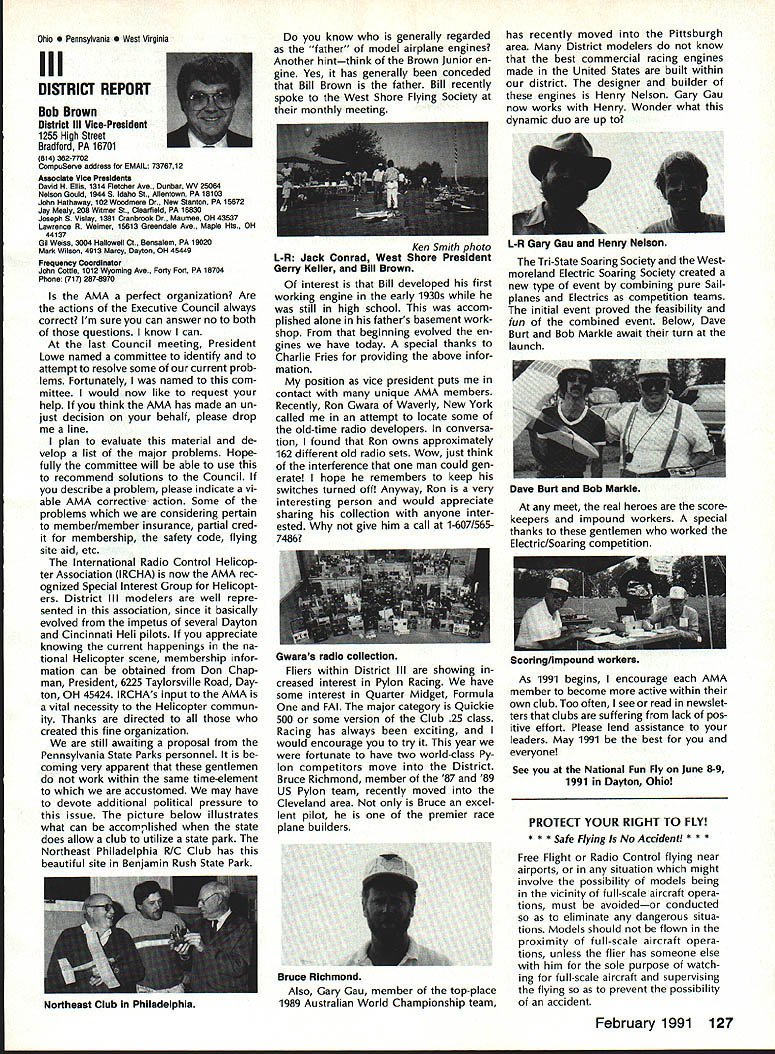
District III Report
Bob Brown, District III Vice‑President
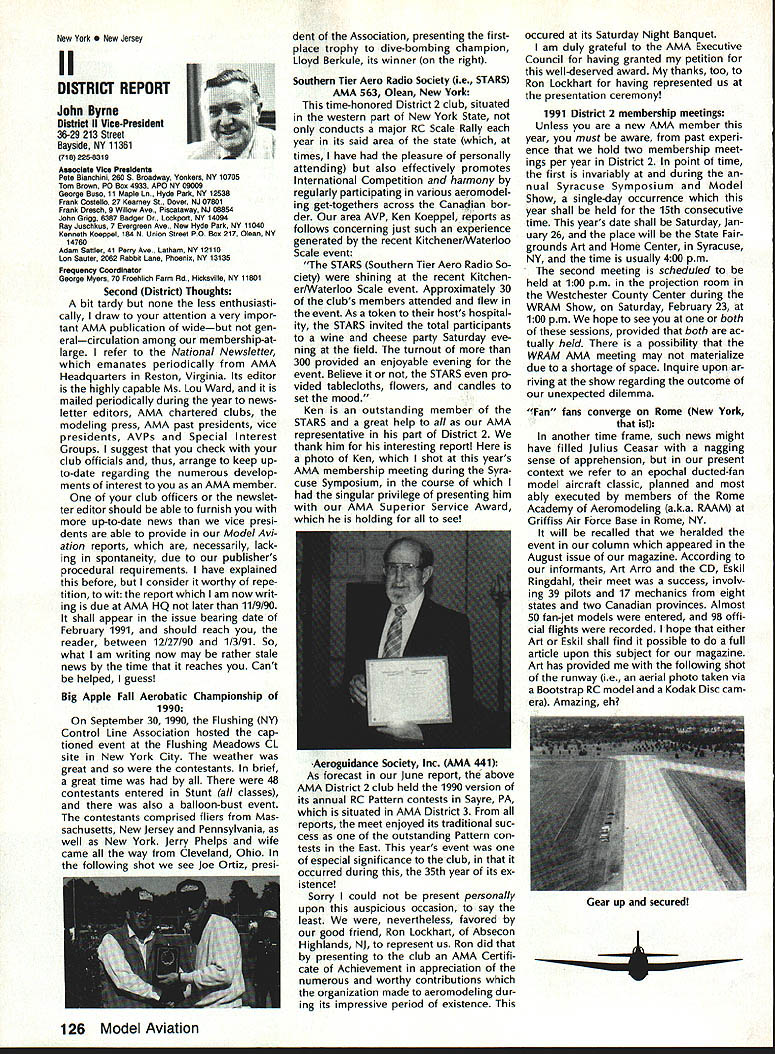
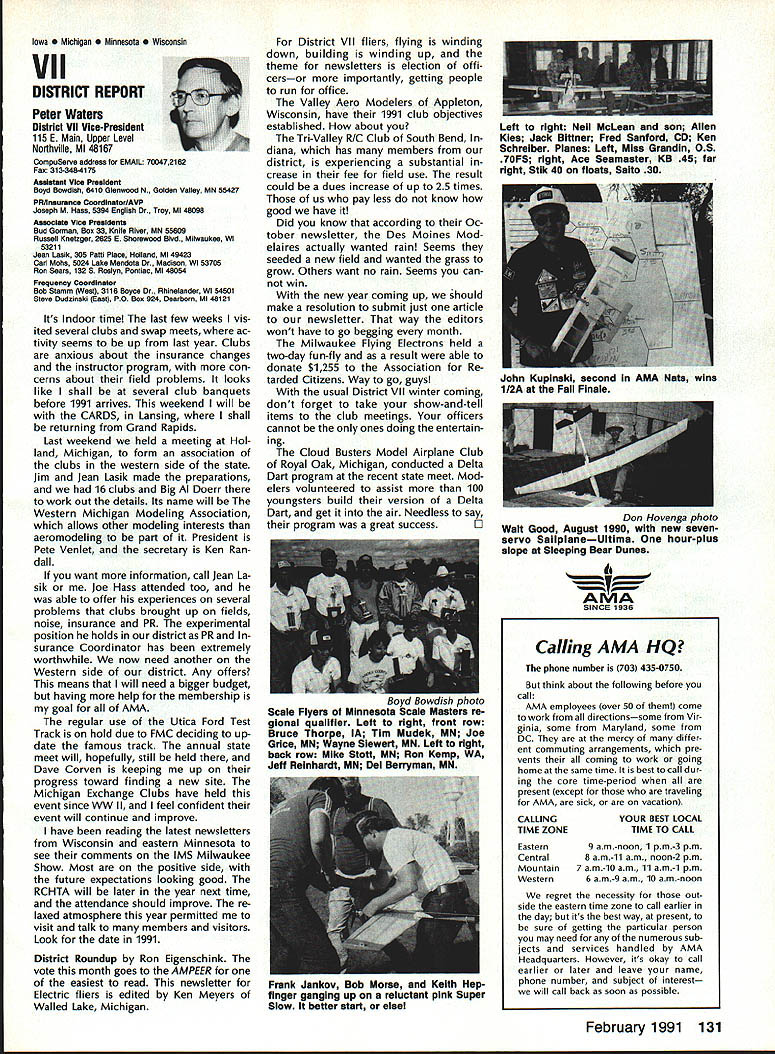
- Is the AMA perfect? No. Are all Executive Council actions always correct? No. You can help. President Lowe named a committee to identify and attempt to resolve current problems; I was named to that committee. If you believe the AMA has made an unjust decision affecting you, please write me with a description of the problem and propose a viable corrective action. Topics under consideration include member/member insurance, partial credit for membership, the safety code, flying site aid, and others.
- IRCHA recognition: The International Radio Control Helicopter Association (IRCHA) is now the AMA‑recognized Special Interest Group for helicopters. District III is well represented in IRCHA. Membership information is available from Don Chapman, President, 6225 Taylorsville Road, Dayton, OH 45424. IRCHA's input to AMA is vital to the helicopter community.
- Pennsylvania State Parks: We await a proposal from Pennsylvania State Parks personnel; their timeline is slower than we expected and may require increased political pressure. The Northeast Philadelphia R/C Club has a fine site at Benjamin Rush State Park, illustrating what is possible when a state allows club use.
- Historical note: Bill Brown is generally regarded as the "father" of model airplane engines (think Brown Junior). Bill developed his first working engine in the early 1930s while in high school in his father's basement workshop. Thanks to Charlie Fries for this information.
- Anecdote: Ron Guwara of Waverly, New York, contacted me seeking old‑time radio developers. Ron owns about 162 different old radio sets and would welcome sharing his collection. Contact him at 1‑607/565‑7486.
- Racing and events: Flyers in District III show increased interest in pylon racing (Quarter Midget, Formula One, FAI). The Quickie category's major classes are .049 and Club .25. Two world‑class pylon competitors recently moved into the district: Bruce Richmond (member of the '87 and '89 U.S. pylon team) in Cleveland, and Gary Gau (member of the 1989 Australian World Championship team) in the Pittsburgh area. Henry Nelson, a top U.S. commercial racing engine builder, is based in our district; Gary Gau now works with Henry.
- Combined electric/soaring event: The Tri‑State Soaring Society and the Westmoreland Electric Soaring Society combined pure sailplanes and electrics into team competition, proving the concept is feasible and fun. Thanks to scorekeepers and impound workers.
As 1991 begins, I encourage each AMA member to become more active within their clubs and to support club leaders. See you at the National Fun Fly on June 8–9, 1991 in Dayton, Ohio!
AMA HQ Services Staff
- Executive Director: John R. Mankowski
- Director, Operations: Robert Voisine
- Personnel Manager: Diane Gallalee
- Technical Director: Bob Underwood
- Comptroller: Lynne Collins
- Competition Services Director: Micheline Madison
- Special Services Director: Carl Maroney
- Membership Processing Supervisor: Joyce Hager
- Marketing Director: Geoff Styles
- Systems Manager: Reggie Westergon
- Director, Internal Communication/Education: Doug Pratt
- Publications Director: Ross B. McMullen
- Events Coordinator: Chip Smith
- Museum Curator: Hurst Bowers
- General Counsel: Bob Jackson
Transcribed from original scans by AI. Minor OCR errors may remain.

