
Sound & Model Aeronautics
Howard Crispin Jr.
Past articles and reports have referred to the influence of the propeller on the sound of our aircraft in flight. These articles discuss different aspects of the propeller, but they often don't use easy-to-understand terms to describe what takes place as the propeller turns and moves the aircraft through the air. An explanation of some of the terms will make it easier to understand what is meant by an efficient, quiet propeller.
What follows is a summary simple enough to reach a broad audience. Many of today's fliers have no background in the theory of flight; their only interest may be starting the engine and getting the aircraft into the air. If everyone is to understand the requirements for quieter operation, a little knowledge of things such as the propeller will help in the long run.
Propeller theory hasn't changed much since the early days of aviation. Pick up a fundamental text written in the 1930s and compare it to one written recently—you'll find very little difference. Modern experimenters have the advantage of more precise lift data because computers can perform mathematical tasks that were very difficult in the past.
The function of the propeller is to furnish thrust. The propeller exerts thrust by rotating and imparting backward momentum to the air through which it moves. The power provided by the engine to the propeller is called brake horsepower (BHP). The output that is available for flight or for propeller thrust is called available horsepower. If there were no losses in operation, input to the propeller would equal output.
What is pitch? Historically, and in some publications today, the term airscrew is used. This is a good description: the propeller screws its way through the air, similar to how a wood screw moves into wood with each turn. The pitch number given for a propeller is based on movement through a solid medium, which isn't quite accurate for a propeller moving through air. The actual distance traveled will be less than the stated pitch; this loss in distance per revolution is called slip. That is why a propeller's output is less than its input. Output is also dependent on a number of design variables that affect propeller efficiency. Available horsepower equals brake horsepower times efficiency (expressed as a decimal).
You will see propeller-balancing instructions that tell you to remove weight from one of the blades. You will see terms such as face, back of the blade, and leading edge. The leading edge is the edge of the blade that first meets the air. The face is the side corresponding to the cambered surface of the airfoil (usually the more curved side), and the back is the other side (often the flatter side).
The propeller blade functions in the same manner as a wing. As the blade rotates, backward momentum is imparted to the airflow. The relative wind and a positive angle of attack produce lift and drag forces. The direction of the relative wind depends on the speed and direction of rotation, as well as the forward speed (speed of advance).
If the blade angle were fixed along the entire length, there would be variations in lift and drag among sections because the local angle of attack changes with radius. A section that gives maximum lift-to-drag at one radius will not be optimal at others. That is why propeller blades are given twist, or washout, toward the tips: the pitch is greatest near the hub and least at the tip. This distributes lift more evenly along the blade.
The reaction of the air given a backward push by the propeller is called thrust. Thrust is the force required to overcome the drag of the aircraft in flight. The power output of the propeller is the product of thrust and speed of advance. Expressed as horsepower:
Horsepower (output) = (T × V) / 33,000
- where T is thrust in pounds and V is airspeed in feet per minute.
The result of all forces acting on the propeller and resolved in the plane of rotation is called torque (turning moment). Torque about the axis is the product of the force and the radius r at which the force acts. Let N be revolutions per minute and Q the propeller torque. The power input to the propeller is the product of torque and rotational speed. Expressed algebraically (in consistent units):
Power input = 2π N Q
In terms of input horsepower: HP (input) = (2π N Q) / 33,000
The efficiency E of the propeller is the ratio of power output to power input:
E = (T V / 33,000) / (2π N Q / 33,000) = (T V) / (2π N Q)
The relationships among T (thrust), V (airspeed), and Q (torque) must be determined to evaluate efficiency and other propeller factors. Next month: propeller efficiency and other propeller factors to be considered.
---
Charles Hampson Grant Scholarship Winners Announced
The Academy of Model Aeronautics' Scholarship Committee has announced the 1990 recipients of the Charles Hampson Grant Scholarship Fund. Scholarship Committee Chairman Bob Underwood reported that nine students were selected based on academic achievement, extracurricular and community involvement, and participation in model aviation.
"These young modelers best exemplify the spirit of Charles Hampson Grant," Underwood said. "They are bright, eager and have a sense of community. We can hope that our contributions to their education will assist them in achieving success in their chosen field of study."
Recipients:
- Eric Balay — Denver, CO. Awarded $1,000. Freshman at the University of Colorado at Boulder studying aerospace engineering. Active modeler for five years; has built numerous R/C, control-line, and free-flight models. Serves as a flight instructor in his club, Denver RC Eagles. A 1990 graduate of East High School; listed in Who's Who in American High School Students; participated in band, Key Club, Boy Scouts, Eagle Scouts, and church youth group.
- Richard Carlton — Grass Valley, CA. Awarded $1,000. Aeronautical engineering major at the University of California, Davis. Member of the Sierra Eagles Air Show Team and the Sierra Foothills RC Fliers; has served as newsletter editor and flight instructor. Began the Nevada Union RC Club.
- Christopher Cheycer — Manchester, CT. Awarded $2,000. Sophomore studying biochemistry and premedical at Case Western Reserve University. Active modeler since age seven; competes in Pattern, Pylon Racing, and RC Helicopter events. Dedicated many hours to teaching and public demonstrations. Graduated top two percent of his high-school class and tutored peers. Participated in charity events and freshman assistance programs; founding father of Sigma Nu fraternity.
- Frank Drammissi — Philadelphia, PA. Awarded $1,000. Freshman at Villanova University studying mechanical engineering. Member of three AMA clubs in the Philadelphia area; enjoys building and flying .40 and .60 Pattern ships. Enrolled as a midshipman in the Navy ROTC program and hopes to become a Naval Aviator. 1990 graduate of St. John Neumann High School; National Honor Society member; varsity golf and track.
- Todd Eigenschink — Coshocton, OH. Awarded $5,000. Computer science major at Rose-Hulman Institute of Technology. Avid R/C modeler; competed at the 1989 National Model Airplane Championships. Designs and produces his own model airplanes with the aid of his personal computer. Valedictorian of Lakeside Lutheran High School (1990); national merit scholar; studying Russian for a Technical Translator's Certificate; assists father's Kiwanis club.
- Anthony Hutchins — Portland, IN. Awarded $1,000. Enrolled at Purdue University in the Aeronautic Technology program. Introduced to Free Flight modeling at a young age; won several Junior Free Flight events and represented the U.S. at the Junior World FF Championships in Poland. Graduate of Jay County High School; four-year National Honor Society member; participated in French and Latin clubs and varsity golf and tennis.
- Ryan Stauffer — Winston-Salem, NC. Awarded $4,000. Freshman at University of North Carolina–Charlotte studying mechanical engineering and computer science. Enjoys RC and CL flying; member of the Riverside Aeromodelers; has competed in local contests and assisted as judge and registrar for helicopter events. Graduated second in his class from North Forsyth High School and active in many school clubs and community volunteer work.
- Donald Slusarczyk — Brecksville, OH. Awarded $7,000. Studying aeronautical/aerospace engineering at Ohio State University. Indoor modeler since age 12; has set 50 national records in Jr./Sr. Indoor categories and qualified for FAI Indoor Team Selection Trials at age 15. Past awards include the Sig Memorial Award and the Stout Commercial Award. Active in community demonstrations and local service organizations.
- Robert Teseo — New York, NY. Awarded $2,000. Freshman studying physics and education at Queens College. Began flying models six years ago and has become active in R/C sailplanes; successful at local, regional, and national contests. Graduate of Flushing High School; served on student government; involved in computer club, newspaper and yearbook staffs, varsity baseball, band, peer counseling, and leadership programs.
The Charles Hampson Grant Scholarship Fund was established in 1987 in memory of Grant's achievements in full-scale and model aviation. Candidates must be high-school graduates currently enrolled in a university program and have been involved in modeling in the past three years.
Recipients are selected by the AMA Scholarship Committee (Chair: Bob Underwood; members: Cliff Telford, Betty Stream, Charles Bauer, Russ Miller). Application forms are available from AMA Headquarters, Attn.: Scholarship Applications, 1810 Samuel Morse Drive, Reston, VA 22090. All applications are reviewed by the committee, which submits recommendations to AMA's Executive Council for final decision.
---
NEW PHONE NUMBERS
Note: Calls cannot be transferred between these numbers.
- AMA HQ: (703) 435-0750
General AMA business; Model Aviation subscriptions (member and non-member), back issues/copies of articles, address changes, and servicing in the Sanctioned Events Calendar.
- MA Editorial: (703) 435-0760
Magazine article submission and information, full-size plans from Model Aviation, hobby shop resale accounts, advertising billing questions.
- MA Advertising: (703) 435-0350
Advertising rates, specs, schedule, etc. (except not applicable to Sanctioned Events Calendar).
For more information about the Flying Site Assistance Package, Partnerships, or assistance in your search, contact AMA's Marketing Department, 1810 Samuel Morse Drive, Reston, VA 22090; tel. 1-703/435-0750.
---
NRPA Membership and Adopt‑A‑School
Because many AMA clubs now fly on public land and others are lobbying public officials for flying sites, the AMA is a member of the National Recreation and Park Association (NRPA), the national association for parks and recreation professionals. Membership allows AMA to stay current on trends in the recreation community and to communicate the benefits of model aviation to park professionals, encouraging them to develop model flying areas.
Each year AMA exhibits at the NRPA Congress, providing a chance to meet park professionals—many of whom have model flying areas and positive experiences with modelers. At the October 1990 Congress in Phoenix, AMA Marketing Director Geoff Styles presented AMA's message to more than 500 park professionals.
One way for a club to develop a positive public image while engaging children in model aviation is participation in the Adopt‑A‑School program. Clubs report great success—members and students enjoy it and it benefits the community. For information on developing such a program or to share your club’s Adopt‑A‑School efforts, contact AMA's Marketing Department.
---
AMA News
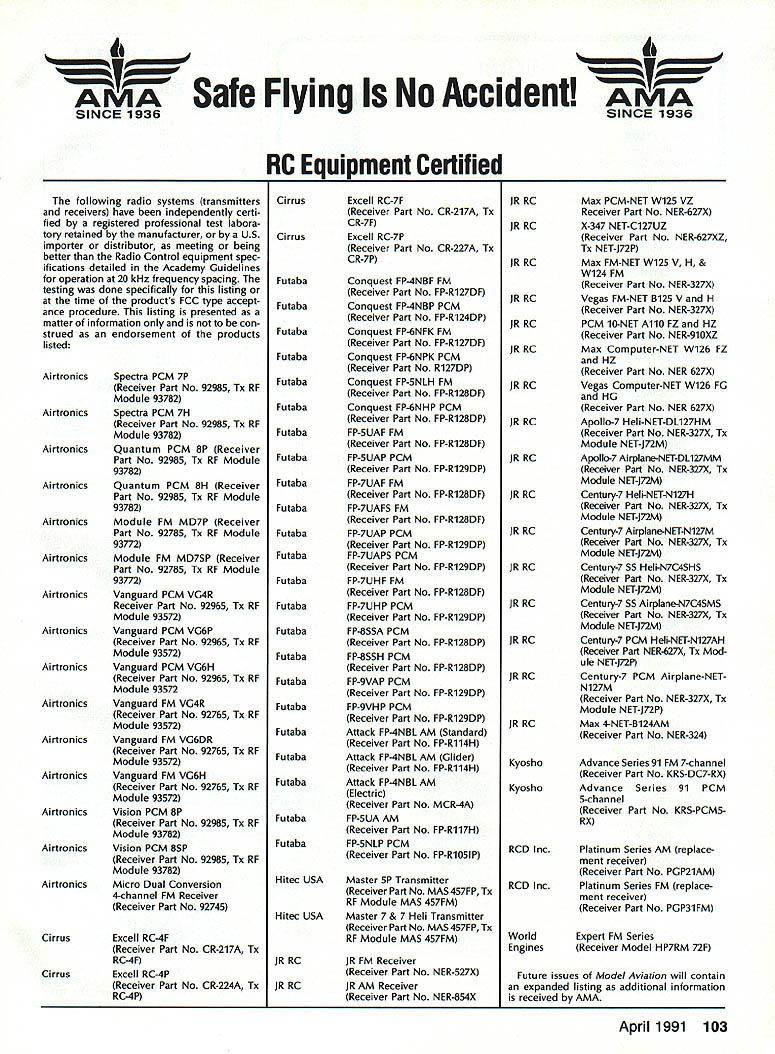
RC Equipment Certified
The following radio systems (transmitters and receivers) have been independently certified by a registered professional test laboratory retained by the manufacturer, or by a U.S. importer or distributor, as meeting or exceeding the Radio Control equipment specifications detailed in the Academy Guidelines for operation at 20 kHz frequency spacing. This testing was performed at the time of the product's FCC type acceptance and certification. This listing is provided for information only and is not to be construed as an endorsement.
(Manufacturer listings not included in this text.)
---
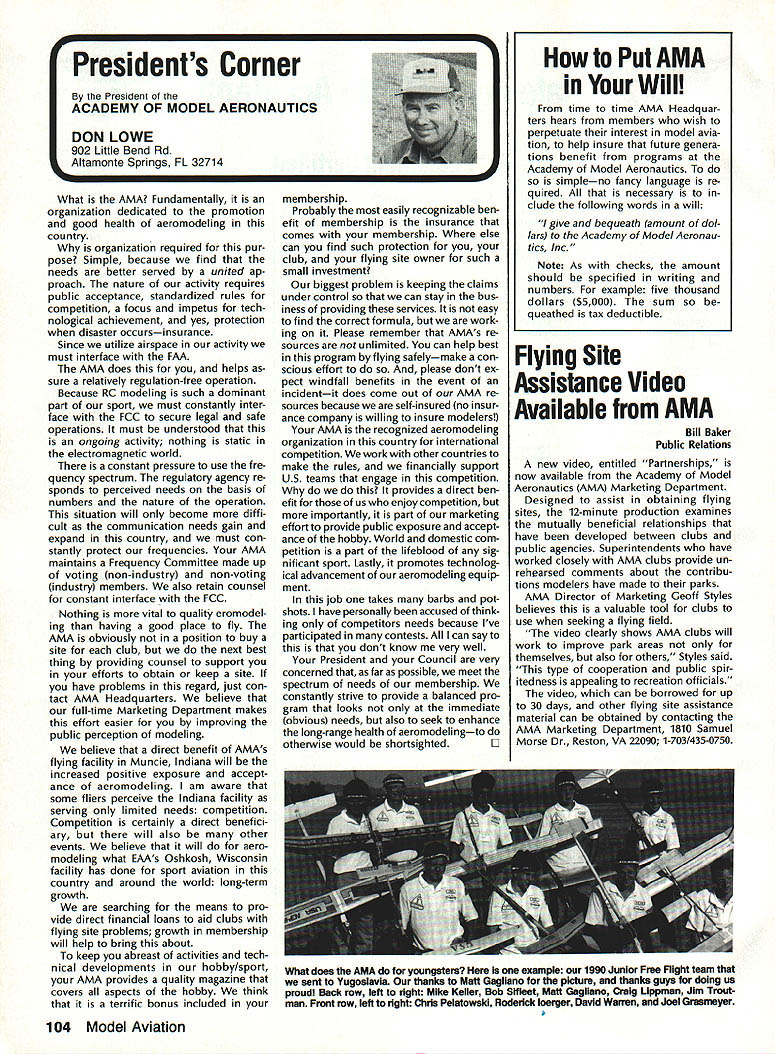
How to Put AMA in Your Will!
From time to time, members wish to perpetuate their interest in model aviation and help ensure future generations benefit from AMA programs. To include AMA in a will, use this simple wording:
"I give and bequeath (amount of dollars) to the Academy of Model Aeronautics, Inc."
Specify the amount both in words and numbers (for example: five thousand dollars ($5,000)). The sum bequeathed is tax deductible.
---
Flying Site Assistance Video Available from AMA
Bill Baker, Public Relations
A new 12-minute video, "Partnerships," is available from the AMA Marketing Department to assist clubs in obtaining flying sites. The video examines mutually beneficial relationships between clubs and public agencies; park superintendents who have worked with AMA clubs provide comments. The video is a valuable tool for clubs seeking fields.
The video can be borrowed for up to 30 days. To obtain the video and other flying-site assistance materials, contact the AMA Marketing Department, 1810 Samuel Morse Dr., Reston, VA 22090; 1-703/435-0750.
---
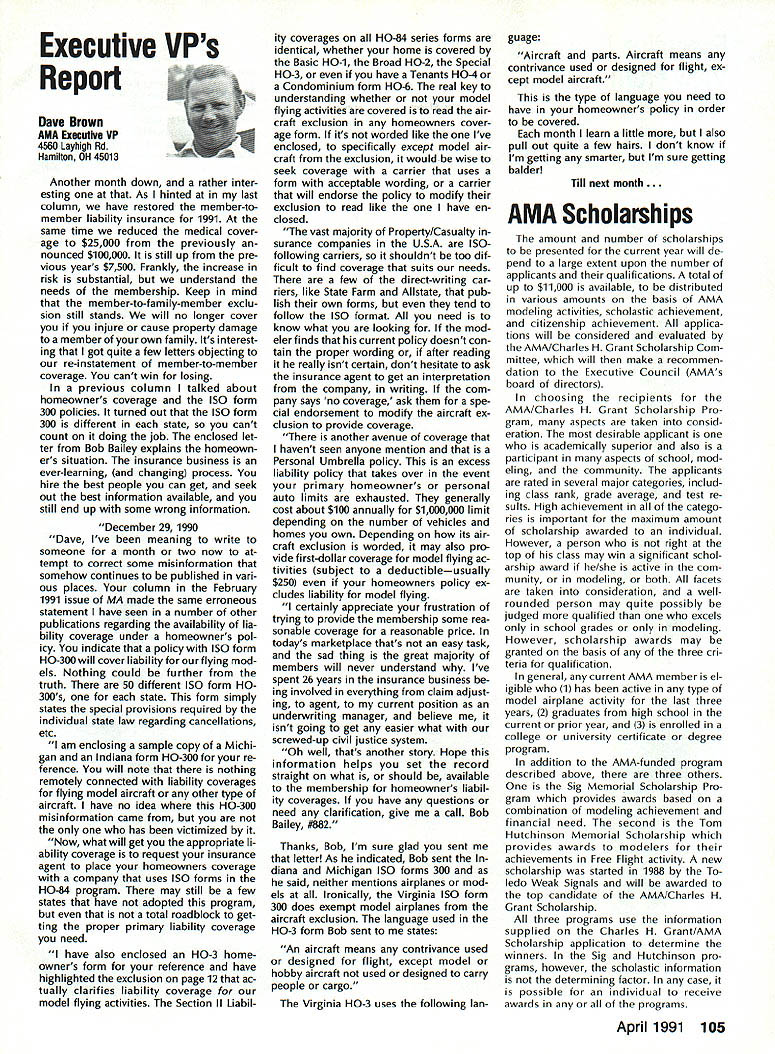
AMA Scholarships (Program Details)
The amount and number of scholarships for the current year depend on applicants and qualifications. A total of up to $1,000 (per year under certain funds) may be available, distributed based on AMA modeling activities, scholastic achievement, and citizenship. Applicants are evaluated by the AMA/Charles H. Grant Scholarship Committee, which recommends recipients to the Executive Council.
Selection criteria include class rank, grade average, test results, modeling activity, and community involvement. A well-rounded applicant may be judged more qualified than one who excels solely in scholastics or modeling. In general, any current AMA member is eligible who:
- Has been active in any type of model airplane activity for the last three years,
- Graduates from high school in the current or prior year, and
- Is enrolled in a college or university certificate or degree program.
Additional related programs:
- Sig Memorial Scholarship Program — awards based on modeling achievement and financial need.
- Tom Hutchinson Memorial Scholarship — awards for achievements in Free Flight activity.
- Toledo Weak Signals scholarship (started 1988) — awarded to the top candidate of the AMA/Charles H. Grant Scholarship.
Application information: the three programs use the Charles H. Grant/AMA Scholarship application; Sig and Hutchinson consider modeling achievements over scholastic criteria.
---
Executive Director's View From HQ
Vince Mankowski, AMA Executive Director 1810 Samuel Morse Dr., Reston, VA 22090
Each month this column updates the membership on AMA activities. The past 30 days have been a whirlwind.
Member-to-member liability insurance has been reinstated. Headquarters sent postcards and inserted information in the National Newsletter and Model Aviation magazine; letters were also sent to chartered clubs. Communications have increased: three years ago, the magazine was the sole communication; now there are additional vehicles such as the National Newsletter, Cloud 9 (for Museum Patron supporters), and the AMA Today video.
The first issue of AMA Today, a 25-minute video sent to all chartered clubs on a trial basis, drew overwhelmingly positive response. Plans are underway to continue it. The Cabane newsletter, created to summarize safety alerts, frequency alerts, rule-book changes, and recommended procedures for Contest Directors (CDs), has also been well received.
In three years AMA has added multiple communication vehicles. If you haven't seen the National Newsletter or Cloud 9, contact your club or AMA Headquarters. Contest Directors may have a copy of the Cabane, and chartered clubs may loan the video newsletter.
Headquarters is tracking staff hours spent on various projects and improving expense tracking. Better use and control of employee work time — and improved control over absenteeism — have effectively gained enough productive hours equivalent to hiring another person.
A potential change in membership structure is under discussion: shifting from a single 12-month renewal date to either a rolling 12-month membership or quarterly expiration. Clubs should consider how such changes would affect field management.
Reminders:
- Hall of Fame nominations are due soon; efforts are underway to move the March deadline to May 30.
- Transmitters are required to have gold stickers at sanctioned events beginning this year. Sanctioned events published in the Competition Calendar carry responsibilities to provide a frequency-safe environment; requiring gold-sticker transmitters and 1991 receivers helps achieve that.
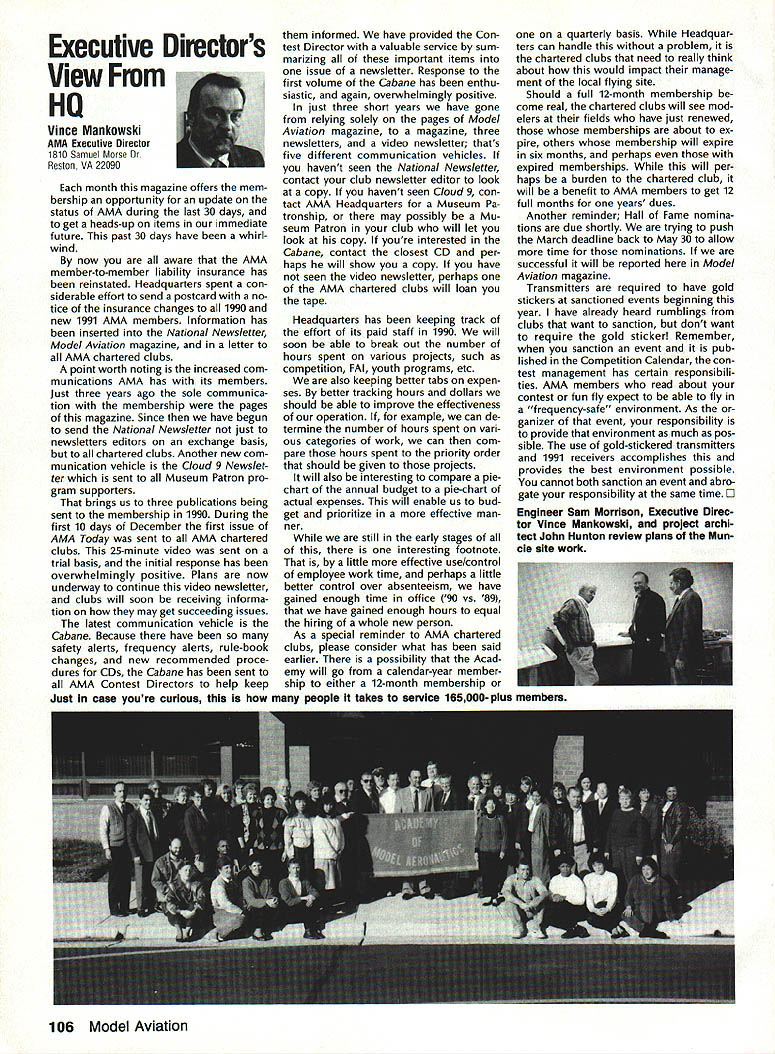
Finally, this is how many people it takes to service over 165,000 members.
---
DISTRICT I REPORT
Don Krafft, District I Vice-President P.O. Box 1828, Duxbury, MA 02331 — (617) 934-6248
Associate Vice Presidents:
- Drew Davenport, 33 Ash St., Townsend, MA 01469
- Bob Landry, 80 Main St., Essex Jct., VT 05452
- Frederic O. Olsen, P.O. Box 1405, Newport, ME 04953
- Richard Sherman, 28 High St., Plymouth, NH 03264
- Ed Thornton, 27 E. Green Ave., West Warwick, RI 02893
- Bob Mullen, 51 Sylvan St., Avon, CT 06001
Frequency Coordinator:
- George Wilson, 32 Frazier Way, Marstons Mills, MA 02648
Notes from Don Krafft:
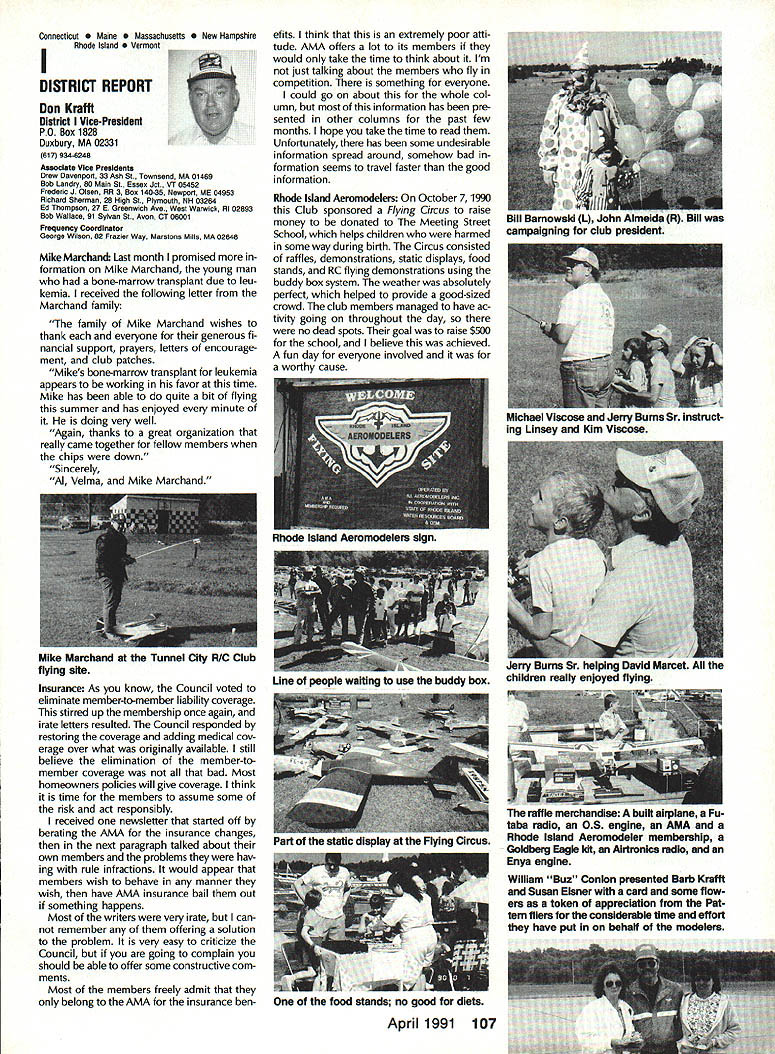
- Mike Marchand update: The Marchand family thanks everyone for support during Mike's bone-marrow transplant for leukemia. The transplant appears to be working and Mike has been able to fly this summer.
- Insurance: The Executive Council temporarily eliminated member-to-member liability coverage, which caused unrest. The Council restored the coverage and added medical coverage. Don urges members to act responsibly and offer constructive input rather than just criticism.
- Rhode Island Aeromodelers: On October 7, 1990 the club sponsored a Flying Circus to raise money for The Meeting Street School (serving children harmed at birth). The event included raffles, demonstrations, static displays, food, and RC flying demonstrations using the buddy-box system. The weather was excellent and the club's goal of raising $500 was believed to be achieved.
Club notes:
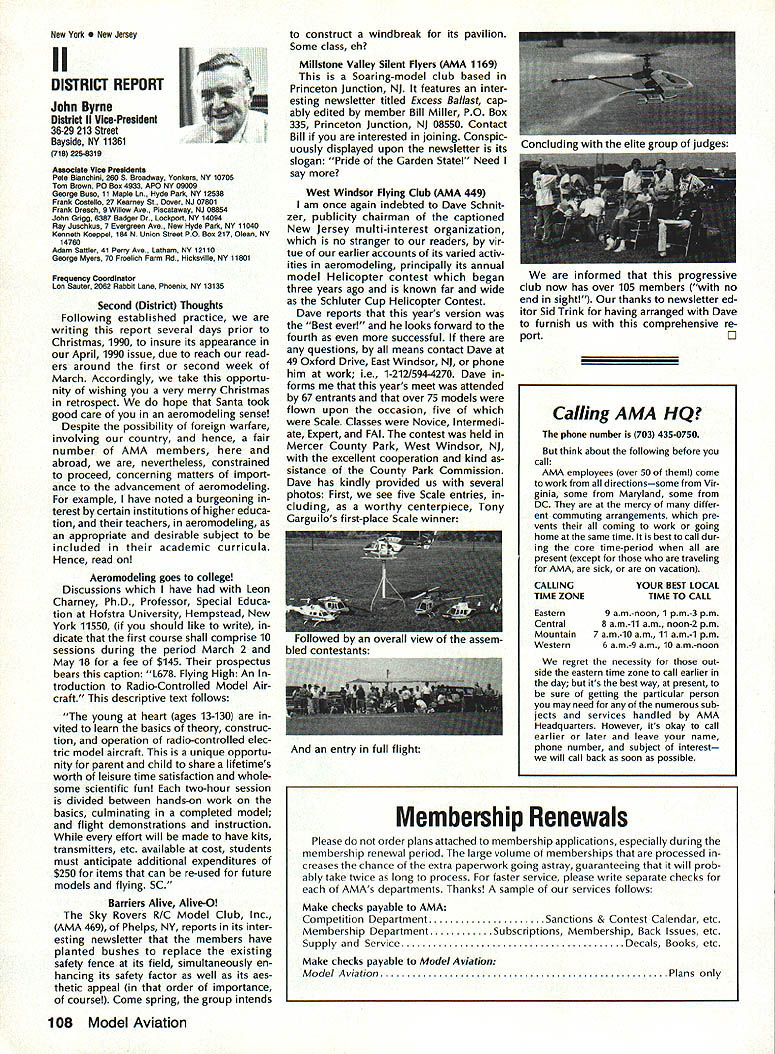
- Millstone Valley Silent Flyers (AMA 1169): Soaring-model club in Princeton Junction, NJ. Newsletter: Excess Ballast (Bill Miller, P.O. Box 335, Princeton Junction, NJ 08550).
- West Windsor Flying Club (AMA 449): Noted for its model helicopter contest (Schlueter Cup). This year's meet drew 67 entrants and over 75 models; classes included Novice, Intermediate, Expert, and FAI. The club now has over 105 members.
---
AMA News
Your AMA Officers Are Waiting To Hear From You!
Effective communication is a two-way street. AMA's volunteer officers want to hear members' thoughts. Write to your AMA vice-president or associate vice-president to complete the communications link.
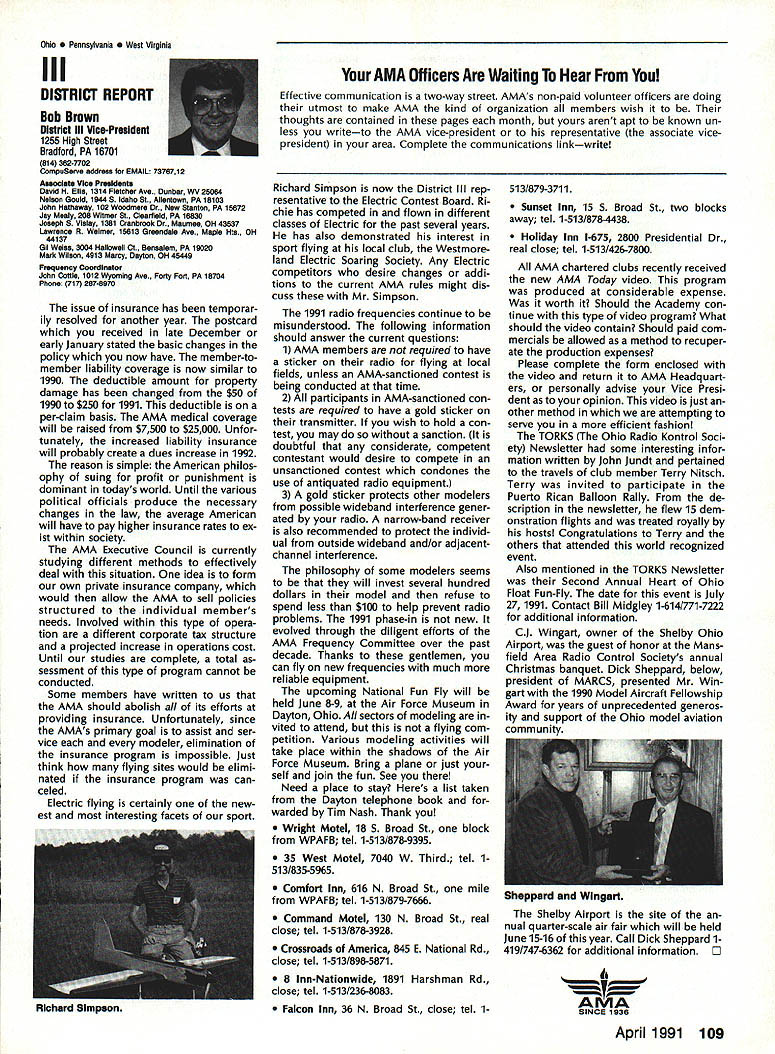
- Richard Simpson is the District III representative to the Electric Contest Board. Electric competitors with rule suggestions may contact him.
Radio-frequency reminders:
- AMA members are not required to have a sticker on their radio for flying at local fields unless an AMA-sanctioned contest is being conducted.
- All participants in AMA-sanctioned contests are required to have a gold sticker on their transmitter. You may hold a contest without sanction if you wish.
- A gold sticker protects other modelers from possible wideband interference generated by your radio. A narrow-band receiver is recommended to protect against outside wideband and adjacent-channel interference.
National Fun Fly:
- Date: June 8–9 (year noted in original as next season)
- Location: Air Force Museum, Dayton, Ohio
- Not a competition; all modeling sectors invited.
- Recommended hotels (from Dayton listings):
- Wright Motel, 18 S. Broad St.; tel. 1-513/878-3935
- 35 West Motel, 7040 W. Third; tel. 1-513/835-5965
- Comfort Inn, 616 N. Broad St.; tel. 1-513/879-7666
- Command Motel, 130 N. Broad St.; tel. 1-513/878-3928
- Crossroads of America, 845 E. National Rd.; tel. 1-513/898-9871
- Inn-Nationwide, 1891 Harshman Rd.; tel. 1-513/236-8083
- Falcon Inn, 36 N. Broad St.; tel. 1-513/879-3711
- Sunset Inn, 15 S. Broad St.; tel. 1-513/878-4438
- Holiday Inn, I-675, 2800 Presidential Dr.; tel. 1-513/426-7800
All AMA chartered clubs recently received the AMA Today video. Feedback is requested via the enclosed form or by contacting your Vice President.
Other items:
- TORKS (The Ohio Radio Kontrol Society) Newsletter reported club member Terry Nitsch's participation in the Puerto Rican Balloon Rally.
- Shelby Ohio Airport owner C.J. Wingart received the 1990 Model Aircraft Fellowship Award for generosity and support of Ohio model aviation. The annual quarter-scale air fair at Shelby Airport is scheduled for June 15–16 (contact: Dick Sheppard, 1-419/747-4562).
---
DISTRICT V REPORT
Jim McNeill, District V Vice-President 617 South 20th Avenue, Birmingham, AL 35205 — (205) 322-2127
Associate Vice Presidents:
- Ron Chitwood, Pensacola, FL
- Linda Crowley, Riverview, FL
- Gustave Diaz, Apopka, FL
- Karl Hessel, Tarpon Springs, FL
- Richard Jackson, N. Charleston, SC
- Dr. John Martin, Miami, FL
- Dick Patton, Birmingham, AL
- George Perry, Smyrna, GA
- Terry Rhett, Baldwin, FL
- Lou Williamson, Manchester, TN
Frequency Coordinator:
- Burnis Fields, P.O. Box 1063, Interlachen, FL 32048 — (904) 745-2517
Notes from Jim McNeill:
- Free AMA rule book offer: You do not have to be a Leader Member or Contest Director to obtain a rule book. Jim will mail free rule books to District V residents while supplies last (he purchased a small stack from AMA Headquarters).
- Rule book mailing policy: Previously, members received a rule book automatically. Then the policy changed to request-only. The Council later required a $2 mailing fee. Jim objects to charging for rule books and will mail free copies as his supply allows.
- Membership expiration proposals: There is a proposal to change annual dues handling. Two alternatives:
- When you pay your dues you get 12 months membership from that day (recommended by Jim).
- Memberships expire quarterly (membership expires to the nearest next quarterly date).
- Current system: all memberships expire December 31 regardless of payment date.
- Jim asks District V members to vote on the preferred method and mail their selection to him at:
Jim McNeill, 617 South 20th Avenue, Birmingham, AL 35205
Poll options to mail:
- Payment of dues results in 12 full months of membership regardless of date of payment.
- Quarterly plan: membership expires to the nearest next year quarter.
- Leave it like it is.
- News flash: Two modelers in the district need assistance:
- David Dunkelberger, 2280 Stuart Ave., Atlanta, GA 30315 — has big RC 3-1/2 size and needs leadership to assemble and fly it.
- Faris Frederick, Rt. 4, Box 148, Rogersville, AL 35652 — has a new RC helicopter and needs local expertise.
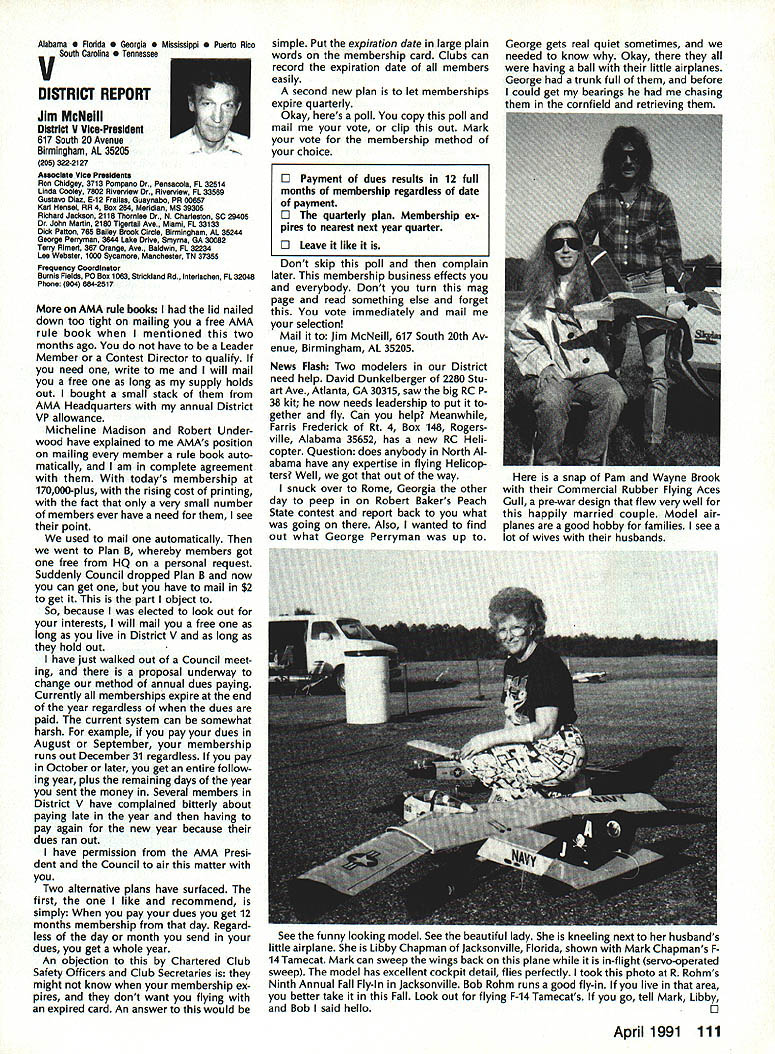
- Reports: Jim attended the Peach State contest in Rome, Georgia, and reports good activity and camaraderie.
---
DISTRICT X REPORT
Regg Keyawa, District X Vice-President 4500 Onyx Way, Carmichael, CA 95608 — (916) 981-6537 CompuServe EMAIL: 76247,47
Notes:
- January events: Regg attended the IMS Show in Pasadena and reported that member-to-member liability insurance is back. AMA representatives (including Carl Marmoney, Bob Underwood, and Bill Baker) were present to answer questions.
- Plans: Regg and associates spent time planning a large jamboree; details forthcoming.
- Upcoming attendance: Regg will attend the Warbirds Mini-Reno Air Race (sponsored by Arizona Model Aviators) and then a Council meeting in Reston.
Marc Karpowich — AMA Associate VP, District Ten (Utah Territory)
Marc reports District Ten (covering Utah, northern Nevada to Winnemucca, and a club in Flagstaff, AZ) is active with about 14 clubs. Highlights:
- Presidents Day fun-fly by Remote Possibilities Club in St. George, UT — a popular event.
- Brigham City Flier Auction and Show — successful annual auction with year-long interclub individual contests (e.g., Most Loops in Two Minutes).
- Bridgerland RC Club growth — Glider, Float Fly, Pattern, and Fun-Fly contests.
- Elko RC Club — new flying site developed through negotiations with the Nevada Bureau of Land Management and the city.
Marc welcomes visitors and offers help locating local flight sites.
---
XI DISTRICT REPORT
Ed McCollough, District XI Vice‑President 53 S.E. 61st Ave., Portland, OR 97215 — (503) 234‑4439 EMAIL: 76087,2422
Associate Vice Presidents:
- Darrell Anderson, Great Falls, MT
- Tom Cashman, Federal Way, WA
- Al Culver, Wilder, ID
- Jerry Hobson, Vancouver, WA
- Tom McCowan, Anchorage, AK
- Dave Mullins, Seattle, WA
- Bruce Nelson, Spokane, WA
- Dick Wohlert, Kamiah, ID
- Chuck Young, Puyallup, WA
Assistant Frequency Coordinator:
- Al Watson, Bellevue, WA
Notes from Ed McCollough:
- Great Oregon Expo: Scheduled for April 21–22; static show at the Benton County fairgrounds and a fun fly at Adair on Sunday.
- Many district members contribute to model magazines (Model Builder, Model Aviation, Model Airplane News).
- Keizer Big Bird event: Successful with many spectators and aircraft on display; candy drop for children attracted crowds.
- Jim Parsons Memorial Stunta‑Thon: Photos and thanks to organizers and judges.
- Club assistance: District XI clubs contributed to flood relief efforts; Skagit County club donated proceeds and local groups added funds.
- Farragut Flyers (Idaho) won a "Take Pride in America" award for their field development work.
---
AMA News (other items and miscellany)
- Several regional newsletters and club reports highlighted good communication, events, and club activities. Editors and contributors are encouraged to submit articles—every club member can help.
- District roundup notes included mall shows, float fun‑flies, and local awards.
- Colorado Competition Society (CCS): Organized to promote competitive RC activities without owning a field. CCS supplies contest expertise, equipment, and personnel to help local clubs host quality, safe events. Contact Hal Garwood, 4622 S. Devenney Street, Morrison, CO 80465; (home) 1-303/697-5970, (work) 1-303/730-8973.
---
If you have updates, event results, or news from your club or district, please forward them to AMA Headquarters or your district vice-president.
Transcribed from original scans by AI. Minor OCR errors may remain.

