
AMA News
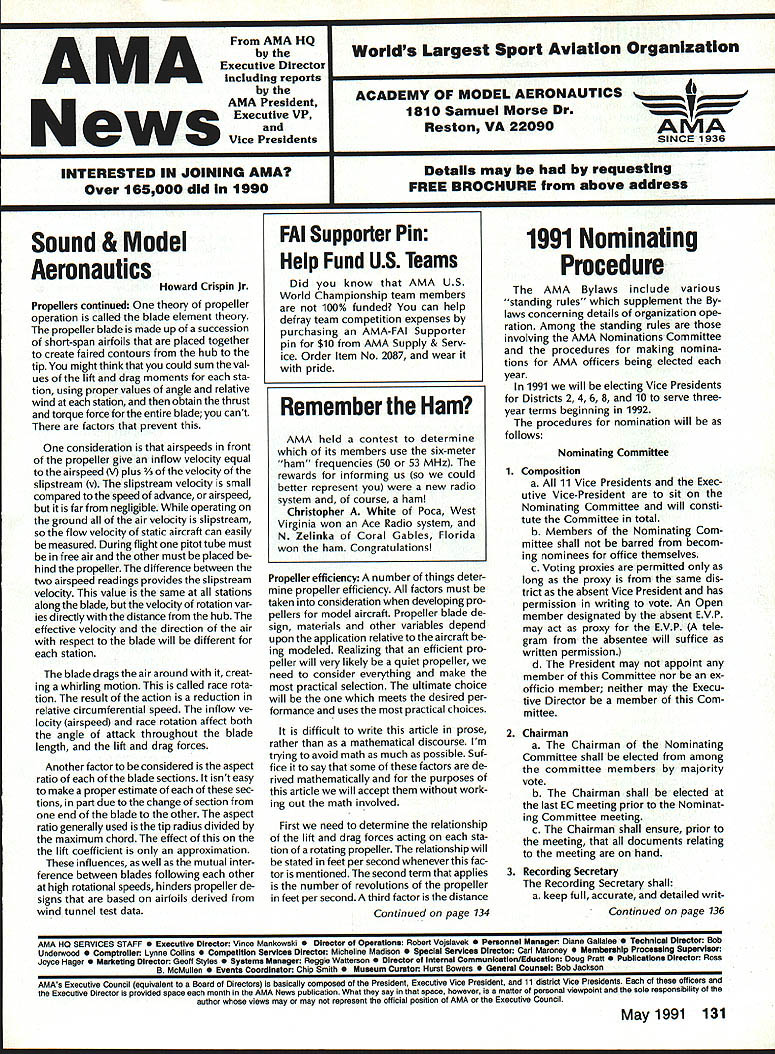
Sound & Model Aeronautics — Propellers
Howard Crispin Jr.
Theory — blade-element concept:
- A propeller blade is made up of a succession of short-span airfoils faired together from hub to tip. Although one might think thrust and torque could be found by summing lift, drag and moment values at each station (using the proper local angle and relative wind), several factors prevent a simple summation.
Key influences:
- Inflow and slipstream: The inflow velocity at the blade is the free‑stream airspeed (V) plus the slipstream velocity. The slipstream velocity is small compared to the speed of advance at high airspeeds but is not negligible at low airspeeds or on the ground (where all the air velocity is slipstream). During flight, a pitot in the free airstream and one placed behind the propeller can be used; the difference between the two readings gives slipstream velocity. That slipstream velocity is (for a given flight condition) the same at all stations, but rotational speed varies with radius, so the effective relative wind (magnitude and direction) differs by station.
- Wake (rotational) effects: The blade drags air around with it, creating wake rotation. This reduces the relative circumferential speed seen by the blade and changes the local angle of attack, altering lift and drag along the span.
- Aspect ratio and section changes: Blade sections change along the span. A common approximation for aspect ratio is tip radius divided by maximum chord, but this only approximates its effect on the lift coefficient. Mutual interference between blades (especially at high RPM) further complicates predictions. These factors limit how well wind‑tunnel airfoil data can be applied directly to propeller design.
Propeller efficiency:
- Efficiency depends on many variables: blade geometry, airfoil sections, twist distribution, materials, application (aircraft type and speed regime) and even installation effects. An efficient propeller tends to be a quiet one; therefore noise reduction and efficiency goals are often aligned.
- Much of propeller theory is mathematical. This article avoids detailed math; suffice to note that lift and drag relationships for each rotating station (expressed in consistent velocity units) combine with local rotational speed and radius to determine station contributions—yet the interactions described above prevent simple summation without corrections.
Measurement notes:
- Slipstream velocity can be measured on the ground (static aircraft) by measuring air velocity in the slipstream. In flight, use a pitot in free air and another behind the propeller; their difference is the slipstream velocity. Remember that rotation speed varies with radius, so station‑by‑station effective velocity and angle of attack differ.
FAI Supporter Pin — Help Fund U.S. Teams:
- AMA U.S. World Championship team members are 100% funded. You can help defray team expenses by purchasing an AMA‑FAI Supporter pin for $10 (AMA Supply & Service Order Item No. 2087).
---
Propeller efficiency (additional notes)
- When developing propellers for models, practical selection must consider blade design, materials and the intended aircraft. Although many derivations are mathematical, design choices should meet desired performance while remaining practical. An efficient propeller normally produces lower noise; noise reductions of a few decibels per change can add up (a 3 dB reduction halves perceived sound level).
---
From AMA HQ — Propellers (summary)
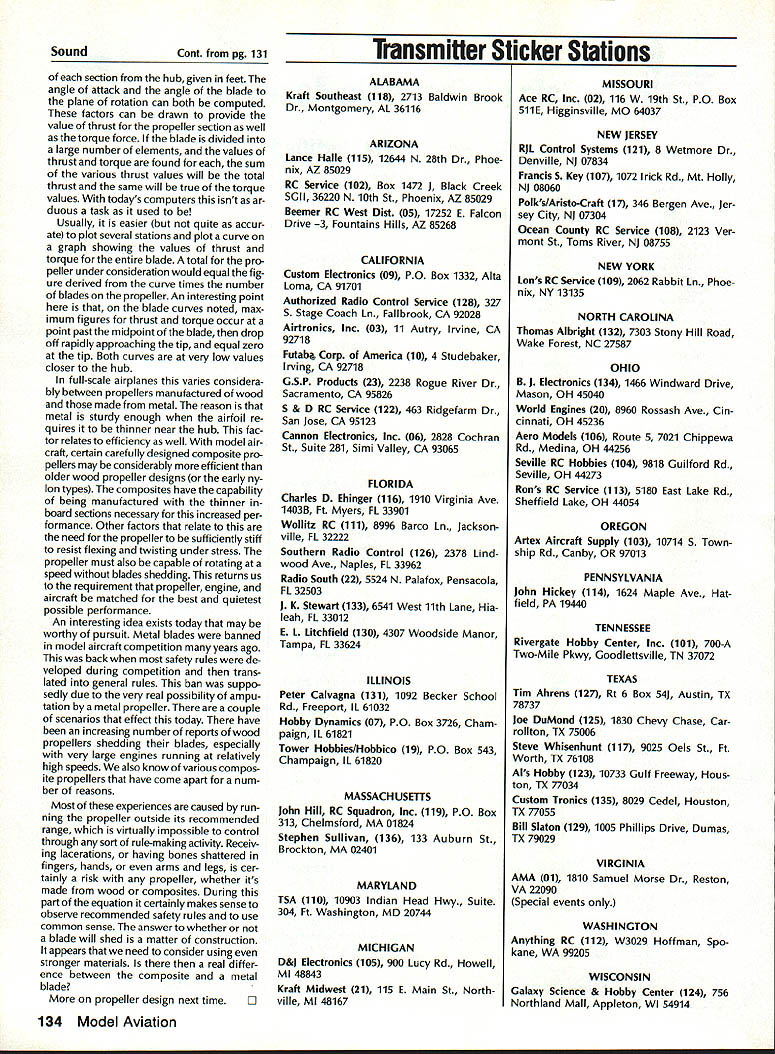
- Blade‑element theory is the common framework for propeller analysis, but inflow, slipstream, wake rotation and aspect‑ratio effects limit direct application of wind‑tunnel airfoil data. During ground operation the slipstream dominates, but in flight measure slipstream with a pitot ahead and one aft of the prop. Wake rotation (sometimes described as “race rotation” in scans) reduces circumferential speed and affects angles of attack and lift/drag distribution. High rotational speeds and mutual blade interference complicate designs based on isolated airfoil data.
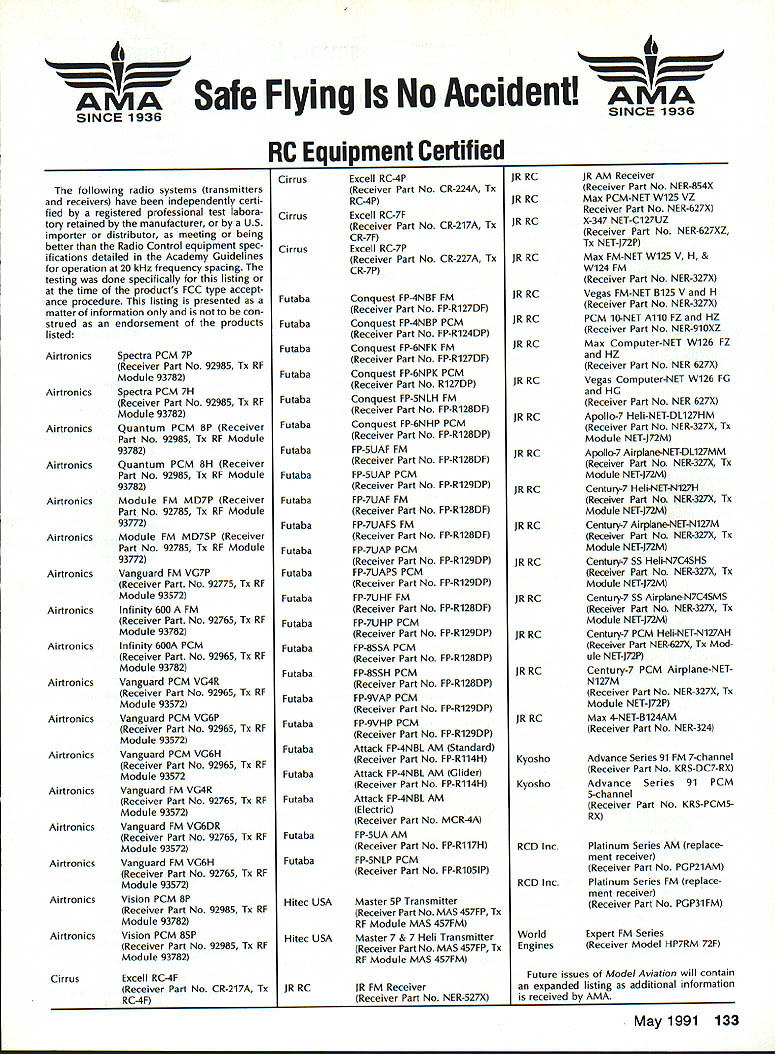
RC Equipment Certified
The following radio systems (transmitters and receivers) have been independently certified by a registered professional test laboratory retained by the manufacturer, or by a U.S. importer or distributor, as meeting or exceeding the Radio Control equipment specifications in the Academy Guidelines for 20 kHz frequency spacing. This listing is informational and not an endorsement.
- Airtronics — Spectra PCM 7P (Receiver Part No. 92985, Tx RF Module 93782)
- Airtronics — Spectra PCM 7H (Receiver Part No. 92985, Tx RF Module 93782)
- Airtronics — Quantum PCM 8P (Receiver Part No. 92985, Tx RF Module 93782)
- Airtronics — Quantum PCM 8H (Receiver Part No. 92985, Tx RF Module 93782)
- Airtronics — Module FM MD7P (Receiver Part No. 92785, Tx RF Module 93772)
- Airtronics — Module FM MD7SP (Receiver Part No. 92785, Tx RF Module 93772)
- Airtronics — Vanguard FM VG7P (Receiver Part No. 92775, Tx RF Module 93572)
- Airtronics — Infinity 600 A FM (Receiver Part No. 92765, Tx RF Module 93782)
- Airtronics — Infinity 600A PCM (Receiver Part No. 92986, Tx RF Module 93782)
- Airtronics — Vanguard PCM VG4R (Receiver Part No. 92965, Tx RF Module 93572)
- Airtronics — Vanguard PCM VG6P (Receiver Part No. 92965, Tx RF Module 93572)
- Airtronics — Vanguard PCM VG6H (Receiver Part No. 92965, Tx RF Module 93572)
- Airtronics — Vanguard FM VG4R (Receiver Part No. 92765, Tx RF Module 93572)
- Airtronics — Vanguard FM VG6DR (Receiver Part No. 92765, Tx RF Module 93572)
- Airtronics — Vanguard FM VG6H (Receiver Part No. 92765, Tx RF Module 93572)
- Airtronics — Vision PCM 8P (Receiver Part No. 92985, Tx RF Module 93782)
- Airtronics — Vision PCM 8SP (Receiver Part No. 92985, Tx RF Module 93782)
- Cirrus — Excell RC-4F (Receiver Part No. CR-217A, Tx RC-4F)
- Cirrus — Excell RC-4P (Receiver Part No. CR-224A, Tx RC-4P)
- Cirrus — Excell RC-7F (Receiver Part No. CR-217A, Tx CR-7F)
- Cirrus — Excell RC-7P (Receiver Part No. CR-227A, Tx CR-7P)
- Futaba — Conquest FP-4NBF FM (Receiver Part No. FP-R127DF)
- Futaba — Conquest FP-2NBF PCM (Receiver Part No. FP-R124DP)
- Futaba — Conquest FP-6NKF FM (Receiver Part No. FP-R127DF)
- Futaba — Conquest FP-6NPK PCM (Receiver Part No. FP-R127DP)
- Futaba — Conquest FP-5NLH FM (Receiver Part No. FP-R128DF)
- Futaba — Conquest FP-5NP PCM (Receiver Part No. FP-R128DP)
- Futaba — FP-5UAF FM (Receiver Part No. FP-R128DF)
- Futaba — FP-5UAP PCM (Receiver Part No. FP-R129DP)
- Futaba — FP-7UAF FM (Receiver Part No. FP-R128DF)
- Futaba — FP-7UAFS FM (Receiver Part No. FP-R128DF)
- Futaba — FP-7UAFS PCM (Receiver Part No. FP-R128DP)
- Futaba — FP-7UAP PCM (Receiver Part No. FP-R129DP)
- Futaba — FP-7UAF PCM (Receiver Part No. FP-R129DP)
- Futaba — FP-7UHS FM (Receiver Part No. FP-R128DF)
- Futaba — FP-7UHP PCM (Receiver Part No. FP-R129DP)
- Futaba — FP-8SSA PCM (Receiver Part No. FP-R128DP)
- Futaba — FP-8SSB PCM (Receiver Part No. FP-R128DP)
- Futaba — FP-9VAP PCM (Receiver Part No. FP-R129DP)
- Futaba — FP-9VHP PCM (Receiver Part No. FP-R129DP)
- Futaba — Attack FP-24NBL AM (Standard) (Receiver Part No. FP-R114H)
- Futaba — Attack FP-24NBL AM (Glider) (Receiver Part No. FP-R114H)
- Futaba — FP-E4NBL AM (Electric) (Receiver Part No. MCR-4A)
- Futaba — FP-5UA AM (Receiver Part No. FP-R117H)
- Futaba — FP-5NLP PCM (Receiver Part No. FP-R105IP)
- Hitec USA — Master 5P Transmitter (Receiver Part No. MAS 457P, Tx RF Module MAS 457FM)
- Hitec USA — Master 7 & 7 Hel Transmitter (Receiver Part No. MAS 457P, Tx RF Module MAS 457FM)
- JR RC — JR AM Receiver (Receiver Part No. NER-854X)
- JR RC — Max PCM-NET W125 VZ (Receiver Part No. NER-627X)
- JR RC — X-347 NET-C12U2 (Receiver Part No. NER-627X, Tx NET-J72P)
- JR RC — Max FM-NET W125 V, H, & W124 FM (Receiver Part No. NER-327X)
- JR RC — Vegas FM-NET 125 V and H (Receiver Part No. NER-327X)
- JR RC — PCM 10-NET A110 VZ and HZ (Receiver Part No. NER-910XZ)
- JR RC — Net Computer-NET W126 FZ and HG (Receiver Part No. NER 627X)
- JR RC — Vegas Computer-NET W126 FG and HG (Receiver Part No. NER 627X)
- JR RC — Apollo-7 Heli-NET DL127ZHM (Receiver Part No. NER-327X, Tx Module NET-J72M)
- JR RC — Apollo-7 Airplane-NET DL127XM (Receiver Part No. NER-327X, Tx Module NET-J72M)
- JR RC — Century-7 Heli-NET N127H (Receiver Part No. NER-327X, Tx Module NET-J72M)
- JR RC — Century-7 Airplane-NET N127M (Receiver Part No. NER-327X)
- JR RC — Century-7 SS Heli-NET C34SFS (Receiver Part No. NER-327X, Tx Module NET-J72M)
- JR RC — Century-7 SS Airplane-NET C34SMS (Receiver Part No. NER-327X, Tx Module NET-J72M)
- JR RC — Century-7 CM Heli-NET N127AH (Receiver Part No. NER-627X, Tx Module NET-J72P)
- JR RC — Century-7 PCM Airplane-NET N127M (Receiver Part No. NER-327X, Tx Module NET-J72P)
- JR RC — MAX 4-NET B124AM (Receiver Part No. NER-324)
- Kyosho — Advance Series 91 FM 7-channel (Receiver Part No. KRS-DCF-RX)
- Kyosho — Advance Series 91 PCM (Receiver Part No. KRS-PCM5-RX)
- RCD Inc. — Platinum Series AM (replacement receiver) (Receiver Part No. PGP21AM)
- RCD Inc. — Platinum Series FM (replacement receiver) (Receiver Part No. PGP31FM)
- World Engines — Expert FM Series (Receiver Model HP7RM 72F)
Note: Future issues of Model Aviation will contain an expanded listing as additional information is received by AMA.
---
1991 Nominating Procedure
AMA Bylaws include standing rules supplemental to the Bylaws regarding organization operation. The officers to be elected in 1991 include the Vice Presidents for Districts 2, 4, 6, 8 and 10 to serve three‑year terms beginning 1992. Procedures for nomination are as follows.
Nominating Committee
- Composition
- a. All 11 Vice Presidents and the Executive Vice‑President shall sit on the Nominating Committee; together they constitute the Committee.
- b. Members of the Nominating Committee shall be barred from becoming nominees for the offices themselves.
- c. Voting proxies are permitted. A written proxy from the absent Vice President in the same district is acceptable; an appointed member designated by an absent EVP may act as proxy. An EVP telegram or absentee will suffice as written permission.
- d. The President may appoint a member of the Committee; the President is not an ex‑officio member of the Committee; neither may the Executive Director be a member of the Committee.
- Chairman — duties
- a. The Chairman shall open the meeting and preside over the proceedings.
- b. The Chairman shall appoint a Recording Secretary and a Teller. The Teller shall not be a candidate for office.
- c. The Chairman shall assist the Teller in the distribution, collection and tabulation of ballots.
- d. The Chairman shall allow each nominee ten minutes of the proceedings (for presentation).
- e. The Chairman shall submit to the President, Executive Vice‑President, meeting chairman and Executive Director a full written report of the meeting and results of all voting procedures within 48 hours after adjournment.
- Meeting conduct
- a. The Chairman shall preside and maintain order.
- b. The Chairman shall limit discussion periods to reasonable time to allow ample but orderly review of candidates' qualifications.
- Candidate nominations
- a. All nomination letters must be received at AMA Headquarters fifteen (15) days prior to convening of the Nominating Committee Annual Meeting.
- b. A letter of acceptance by the candidate must be on file at AMA Headquarters ten (10) days prior to the meeting.
- c. Because the Nominating Committee is scheduled to meet on July 12, the deadline for nomination receipt by AMA HQ is close of business on Thursday, June 27 (for that meeting).
- d. No person may nominate himself or herself for office.
- e. The candidate's campaign statement must accompany his/her acceptance letter.
- Selection of nominees
- a. Ballot placement is limited (but not required) to three (3) names for each elective office.
- b. The Committee shall examine, evaluate and discuss all written proposals for candidacy. Nominating letters shall be placed in evidence by the Chairman, and at least one of the letters for each candidate shall be read aloud.
- c. The Chairman shall limit the discussion period to reasonable time for ample discussion of qualifications.
- d. An incumbent is automatically placed on the ballot, except that a vote by three‑quarters (3/4) of the Committee against placement may withhold the incumbent's name from the ballot (see Bylaws, Article IX, Section 2).
- Voting
- a. One vote per member per ballot.
- b. Oral voting shall be by district, starting with District I and progressing in ascending numerical order through District XI and EVP. If secret voting is desired, written ballots shall be used.
- c. If placing an incumbent's name on the ballot is in question, voting on that issue shall precede voting for other nominees. Voting for national offices shall follow respective offices (President, Executive Vice‑President, Vice Presidents).
- d. When more than three names are nominated, elimination will be by simple majority vote.
- e. A simple majority prevails except where noted (e.g., 6.d for withholding an incumbent requires three‑quarters).
- f. If only three names are submitted for a district or national office, the Chairman may move for a nomination by acclamation.
- Finalization of proceedings
- a. At the conclusion of the meeting the Committee will verify the minutes and the ballot developed by the Committee.
- b. Such verification will be a recorded vote requiring three‑quarters (3/4) of the Committee for acceptance. Failing such acceptance, the Committee will continue to deliberate until acceptance is reached.
- c. The ballot developed will be final for that election. The acceptance vote will be recorded during the ensuing Council meeting.
- Adjournment
- An affirmative vote of an adjournment motion duly made and seconded will adjourn the meeting.
---
District Reports
District I Report
Don Kraftt — District I Vice‑President P.O. Box 1828, Duxbury, MA 02331 (617) 934‑6248
Associate Vice Presidents:
- Drew Davenport, 33 Ash St., Townsend, MA 01469
- Bob Landry, 80 Main St., Essex, VT 05452
- Frederic L. Jones, Jr., Box 145, N. Weymouth, ME 04953
- Richard Sherman, 28 High St., Plymouth, NH 03030
- Ed Thompson, 27 S. Greenfield Ave., West Warwick, RI 02893
- Bob Wallace, 91 Sylvan St., Avon, CT 06001
Frequency Coordinator:
- George Wilson, 82 Frazier Way, Marstons Mills, MA 02648
Pattern Fun and Fellowship:
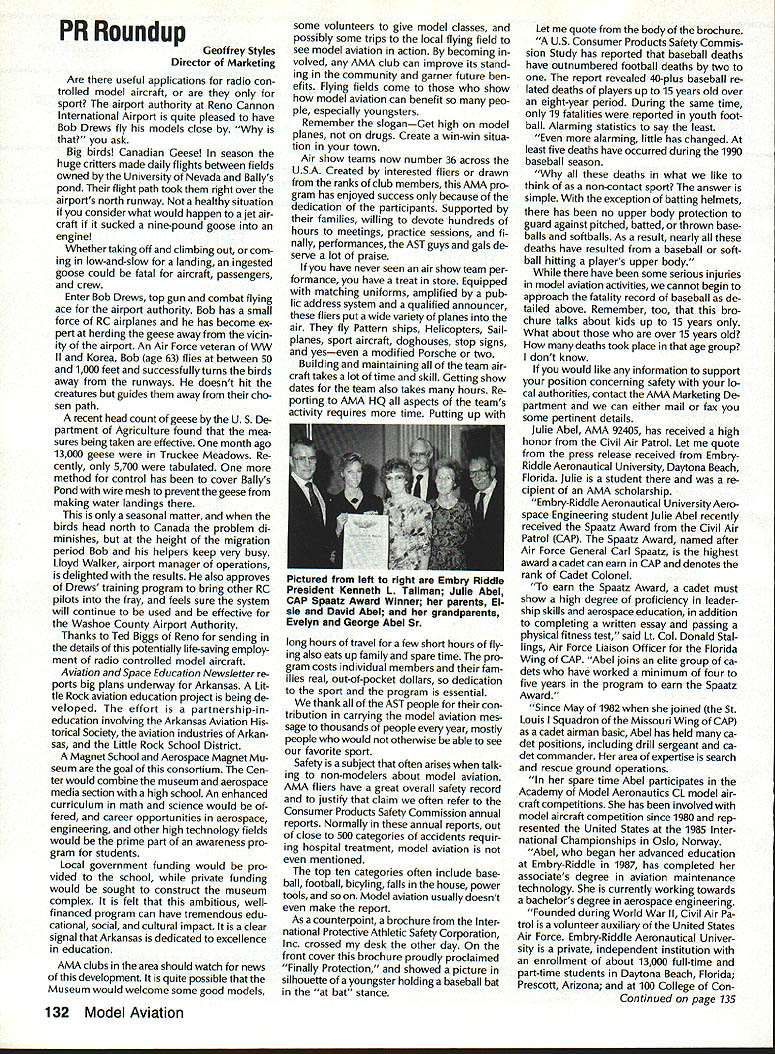
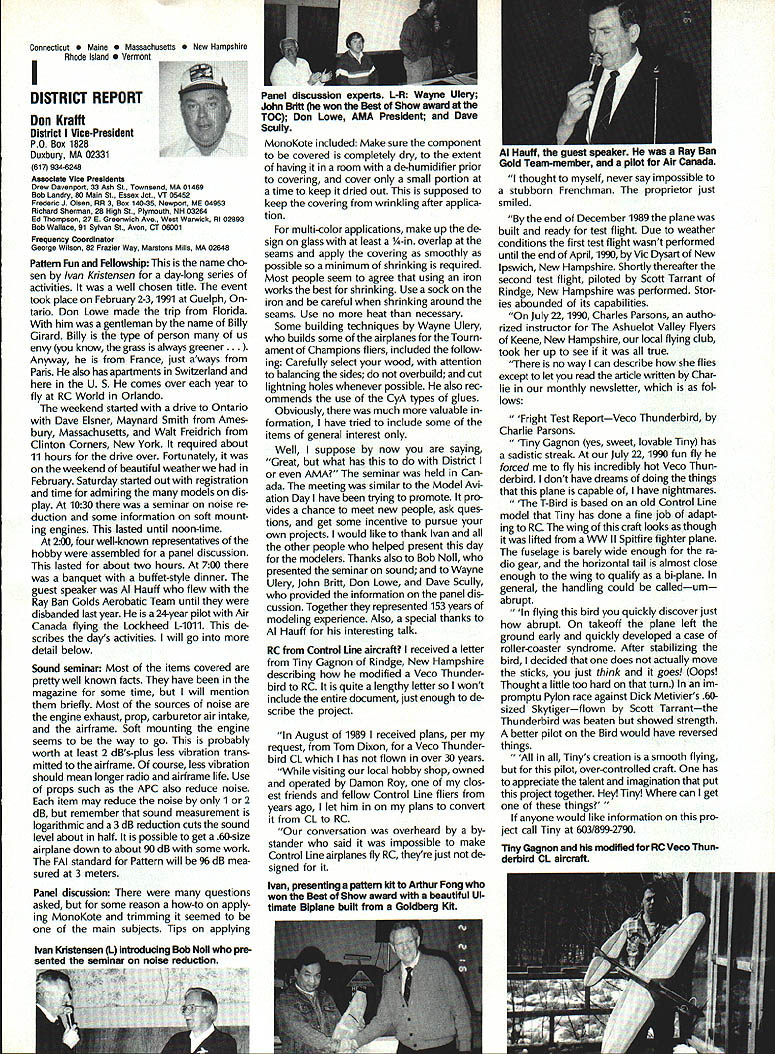
- Ivan Kristensen organized a do‑it‑yourself event on February 23, 1991 at Guelph, Ontario. Presenters included Don Lowe, Billy Girard (from France), Dave Elsner, Maynard Smith and Walt Freidrich. Saturday included registration, model displays, a noise‑reduction seminar (including soft‑mounting engines), and a panel discussion; the day concluded with a banquet and guest speaker Al Hauff (former Ray Ban Golds aerobatic team, Air Canada pilot).
Sound seminar highlights:
- Sources of noise include engine, exhaust, prop, carburetor intake and airframe. Soft mounting the engine can reduce vibration transmitted to the airframe by about 2 dB+. Use of low‑noise props (e.g., APC) helps. Remember that decibels are logarithmic: 3 dB is roughly a halving/ doubling perception of sound power. Careful work can lower a 6–12 dB airplane to about 90 dB. FAI Pattern standard is 96 dB at 3 meters.
Panel discussion / construction tips:
- MonoKote application tips: ensure components are dry (consider a de‑humidified room), cover small portions at a time, use at least 1/4‑in. overlap on multicolor seams, use an iron with a cork and minimal heat for shrinking, and take care at seams.
- Wayne Ulery’s building tips: select wood carefully, balance sides, avoid overbuilding, cut lightning holes, and use cyanoacrylate (CYA) adhesives where appropriate.
RC from control‑line aircraft:
- Tiny Gagnon (Rindge, NH) converted a Veco Thunderbird CL to RC using servos and modifications. First test flights occurred in April 1990; by July 22, 1990 Charlie Parsons (Ashuelot Valley Flyers) performed a flight test and reported the model flew predictably and very fast. Tiny can be contacted at (603) 899‑2790 for project details.
---
District III Report
Bob Brown — District III Vice‑President 1255 High Street, Bradford, PA 16701 (814) 362‑7702 CompuServe address for EMAIL: 7367,12
Associate Vice Presidents:
- David H. Ellis, 1314 Fletcher Ave., Dunbar, WV 25064
- Nelson Gould, 1345 L. Stallo St., Alliance, OH 44601
- John Hathaway, 102 Woodcrest Dr., New Stanton, PA 15672
- Jay Mercy, 2810 Merl St., Cleveland, PA 16090
- Joseph S. Wiley, 1381 Cranbrook Dr., Maumee, OH 43537
- Lawrence H. Warner, 15613 Grondale Ave., Maple Hts., OH 44137
- Gil Weiss, 3004 Hallowell Ct., Bensalem, PA 19020
- Mark Wilson, 4913 Maney, Dayton, OH 45409
Frequency Coordinator:
- John Costle, 1072 Wyoming Ave., Forty Fort, PA 18704 — (717) 287‑8970
Pennsylvania State Parks negotiations:
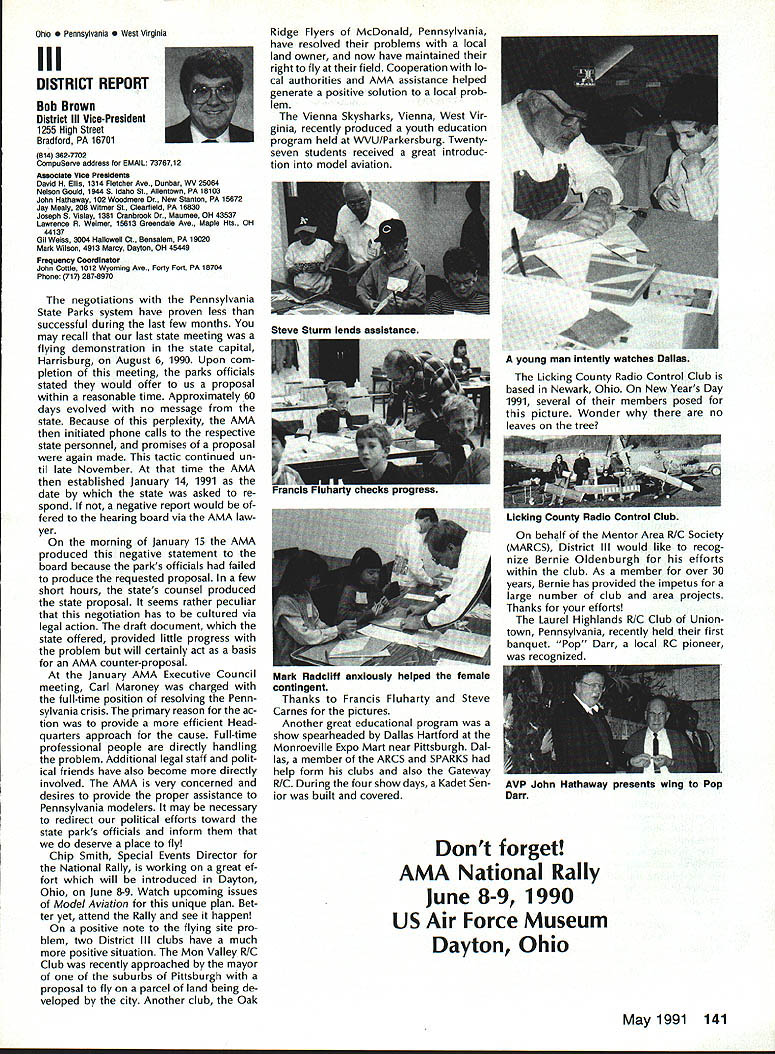
- Negotiations with the Pennsylvania State Parks have been protracted. After promises and delays, the state produced a draft proposal only after AMA set a response deadline; the draft provides a basis for an AMA counter‑proposal. Carl Maroney has been charged with a full‑time role to help resolve the Pennsylvania issue using additional legal and political resources.
National Rally & other events:
- Chip Smith (Special Events Director) is preparing a major initiative to be introduced at Dayton, Ohio on June 8‑9. Watch Model Aviation for details or attend the Rally.
Site successes:
- Two clubs in District III had positive outcomes: Mon Valley R/C Club was approached by a mayor to fly on a city parcel under development; Oak Ridge Flyers resolved a usage agreement with a local landowner.
Youth education:
- The Vienna Skysharks (Vienna, WV) ran a youth education program at W.V.U./Parkersburg with 27 students introduced to model aviation.
NAA (National Aeronautic Association) relations:
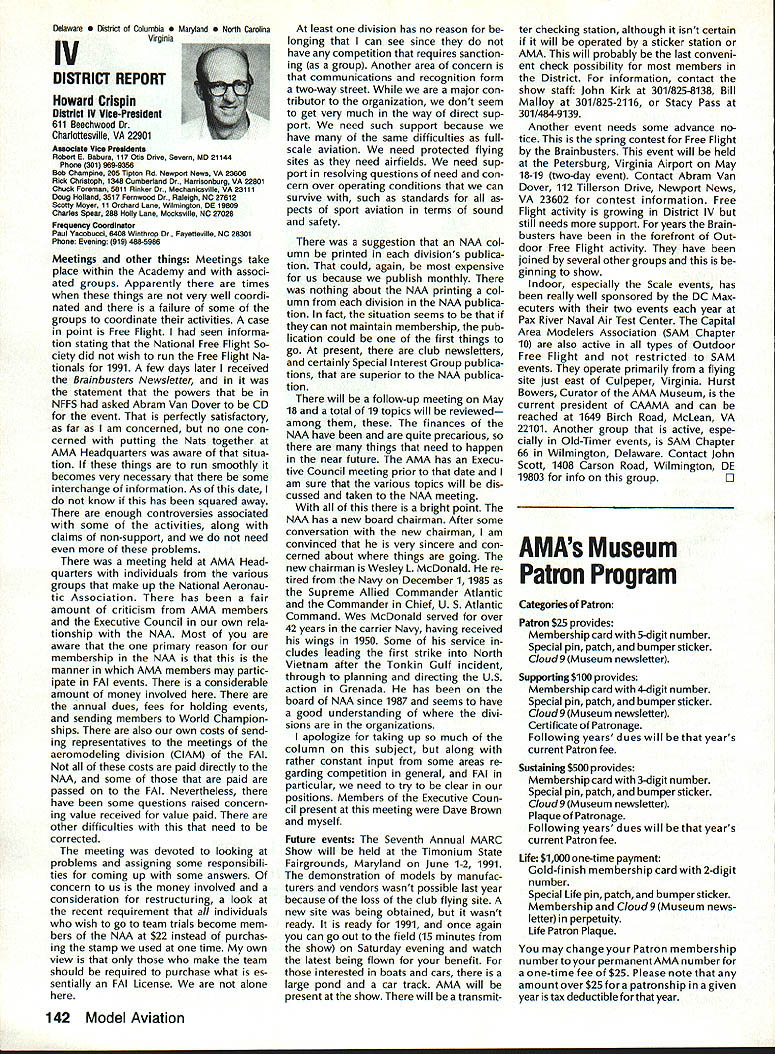
- AMA attended a meeting with NAA representatives addressing concerns about the value received for membership fees, FAI licensing costs, and communication. Topics include NAA finances, restructuring, and membership requirements for team trials. AMA members and Council representatives will continue discussions; Wesley L. McDonald (new NAA board chairman, retired Navy admiral) appears committed to addressing division issues.
Future events:
- Seventh Annual MARC Show — Timonium State Fairgrounds, Maryland on June 1 (field flying 15 minutes from show). Contact John Kirk at 301/825‑8138, Bill Malloy at 301/825‑2116, or Stacy Pass at 301/484‑9139.
- Free-Flight spring contest — Petersburg, VA Airport on May 18‑19. Contact Abram Van Dover, 112 Tillerson Drive, Newport News, VA 23602.
---
District V Report
Jim McNeill — District V Vice‑President 617 South 20 Avenue, Birmingham, AL 35205 (205) 322‑2127
Associate Vice Presidents:
- Bob Bastarwick, 3626 Ranchwood Rd., Orlando, FL 32806
- Ron Oakley, 3713 Pompano Dr., Pensacola, FL 32504
- Linda Crowe, 7802 Riverview Dr., Riverview, FL 33569
- Gustavo Diaz, 12 E. Plazas, Guaynabo, PR 00965
- Karl Hersh, R.F.D., Box 2634, Meridian, MS 39305
- Richard Jackson, 2816 Thorndale Dr., Charleston, SC 29405
- Dr. John Martin, 2108 Tennival Ave., Miami, FL 33133
- Dick Patton, 705 Bailey Brook Circle, Birmingham, AL 35244
- George Perryman, 3644 Lake Drive, Smyrna, GA 30082
- Terry Rimer, 367 Orange Ave., Baldwin, FL 32234
- Lee Webster, 1030 Sycamore, Manchester, TN 37355
Frequency Coordinator:
- Burnis Fields, P.O. Box 1063, Strickland Rd., Interlachen, FL 32048 — (904) 684‑2517
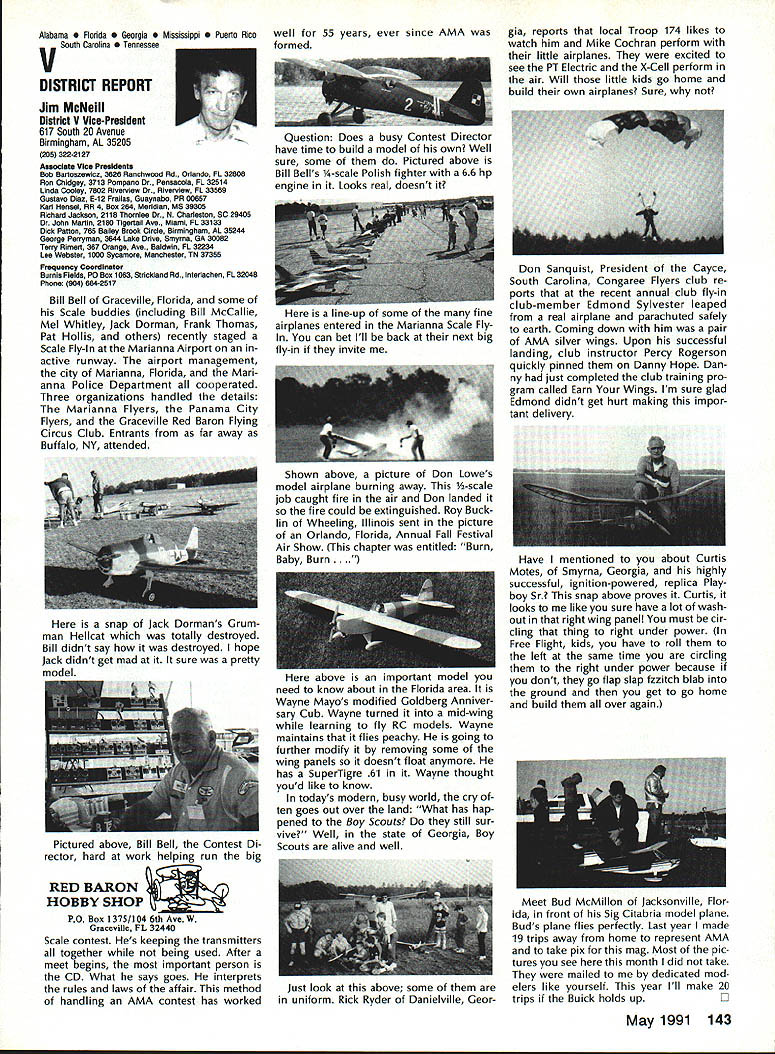
Marianna Scale Fly‑In:
- Bill Bell (Graceville, FL) and colleagues staged a Scale Fly‑In at Marianna Airport on an inactive runway. Clubs cooperating included the Marianna Flyers, Panama City Flyers and Graceville Red Baron Flying Circus Club. Entrants came from as far as Buffalo, NY.
Contest director note:
- The CD is the key official at a meet — interprets rules and runs the event.
Photos and incidents:
- Reports and photos included a 1/4‑scale Polish fighter with a 6.6 hp engine, an in‑air fire on Don Lowe’s 3/4 scale model which was landed safely, and Curtis Motes’ ignition‑powered replica Playboy Sr.
Youth involvement:
- Boy Scouts in Georgia (Troop 174) enjoyed demonstrations of electric models such as the PT Electric and the X-Cell — good PR for recruiting new modelers.
Club reports and items:
- Don Sanquist (Cayce, SC) reports parachute jump delivering AMA silver wings; many clubs and flyers contributed photos and notes this month.
---
District VI Report
Jim Sears — District VI Vice‑President P. O. Box 308, Burgin, KY 40310 (606) 748‑5834
Associate Vice Presidents:
- Ron Ballard, Rt. 5, Box 90, Decatur, IN 46733
- Charlie Bauer, 4044 N. Orange, Muncie, IN 47305
- Gary Bessell, 5000 Concorde, Muncie, IN 47304
- Cal Estell, 3 Castle Dr., RR 2, Florissant, MO 63034
- Del & Scott Justice, 156 South Franklin, Bennerville, IL 60106
- Walter Koenig, 1602 E. 3rd St., Bedford, IN 47421
- Dick Kayser, 7929 Jefferson, Kansas City, MO 64114
- Bill Zimmerman, Box 72, Varna, IL 61375
Frequency Coordinator:
- Paul Holston, 616 W. 30th St., Higginsville, MO 64037 — Phone: (816) 548‑2481; Work: (816) 544‑7121; Fax: (816) 584‑7766
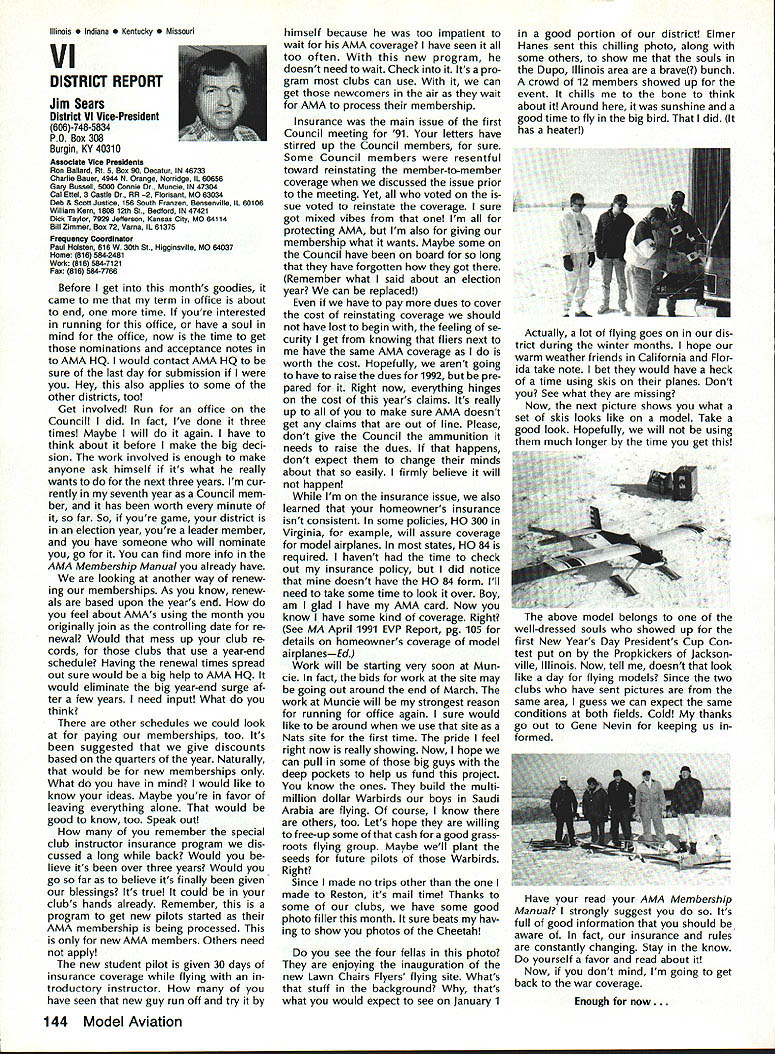
Open call for involvement:
- Jim encourages members to run for Council positions and seeks input on membership renewal scheduling (staggered by join month vs. year‑end), and on proposed new membership payment schedules/discounts.
New student‑pilot insurance:
- A student instructor insurance program for new AMA members gives 30 days of coverage while flying with an introductory instructor; designed to let newcomers fly safely while membership is processed.
Insurance and Council issues:
- Insurance dominated the first Council meeting of 1991. Member‑to‑member coverage was reinstated after strong member input. Jim emphasizes the value of feeling secure that fellow fliers have coverage and notes potential dues implications depending on claim costs.
Muncie site work:
- Work at Muncie is planned soon; bids expected. Jim expresses desire to be involved as the project develops into a national flying site.
Photo and trip notes:
- Winter flying and field events in the district provided many photos for the column; small winter events (ski-equipped planes, New Year's Day contests) were highlighted. Jim urges members to read the AMA Membership Manual for insurance and rules updates.
---
District VIII Report
Gene Hempel — District VIII Vice‑President 301 N. Yale Drive, Garland, TX 75042
Associate Vice Presidents:
- Chuck Andorka, Albuquerque, NM
- Glenn Gresser, Baton Rouge, LA
- Bill Horsman, Spring Branch, TX
- Jim Rimer, Texarkana, TX
- Ron Stanfield, Maumelle, AR
- Charles Stevens, Pasadena, TX
- Jim Truax, Norman, OK
AMA Display Coordinator:
- Karen Hopkins, Arlington, TX
Frequency Coordinator:
- Joe DuMond, Carrollton, TX
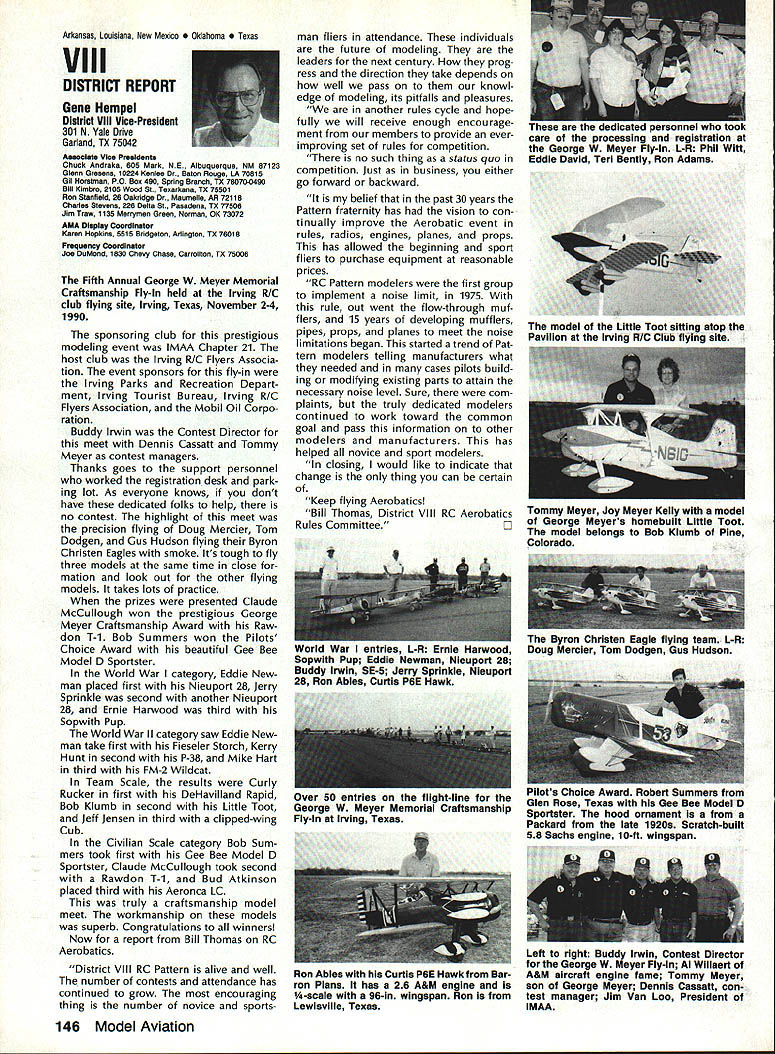
George W. Meyer Memorial Craftsmanship Fly‑In:
- Fifth annual event held at the Irving R/C Club flying site, Irving, TX (Nov 2–4, 1990). Sponsors included Irving Parks & Recreation Department, Irving Tourist Bureau, Irving R/C Flyers Association and Mobil Oil Corporation. Contest director Buddy Irwin led the meet. Claude McCullough won the George Meyer Craftsmanship Award with his Rawdon T‑1; Bob Summers won Pilots’ Choice with a Gee Bee Model D Sportster. Detailed category winners listed in the report.
RC Aerobatics (from Bill Thomas):
- Pattern participation is growing — particularly novice and sportsman classes which are vital for the sport's future. Pattern modelers were early adopters of noise limits (1975), driving development of mufflers, props and quieter planes. Change is constant; continued improvement and passing knowledge to newcomers is essential.
---
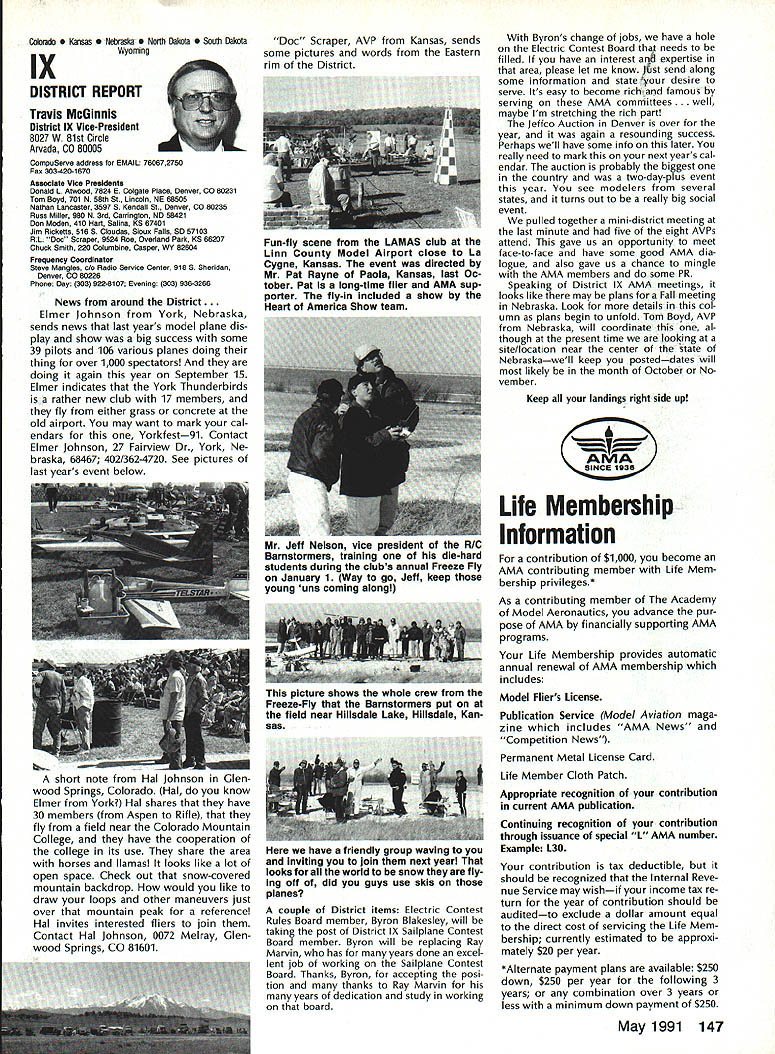
District IX Report
Travis McGinnis — District IX Vice‑President 8027 W. 81st Circle, Arvada, CO 80005
News from around the district:
- Elmer Johnson (York, NE) reports a successful model display and show with 39 pilots and 106 planes for over 1,000 spectators; next event set for Sept 15, Yorkfest‑91.
- LAMAS club fun‑fly at Linn County Model Airport (La Cygne, KS) directed by Pat Rayne.
- R/C Barnstormers’ Freeze Fly and student training photos submitted.
- Hal Johnson (Glenwood Springs, CO) reports 30 members flying near Colorado Mountain College; club shares space with horses and llamas.
- Byron Blakesley will move from Electric Contest Rules Board to Sailplane Contest Board; volunteers needed for the Electric Contest Board.
- Jeffco Auction (Denver) was a major success and a large social event.
- Planning for a fall District IX meeting in Nebraska is underway; Tom Boyd (AVP) will coordinate.
Closing note:
- Keep all landings right side up!
---
Other AMA News Items
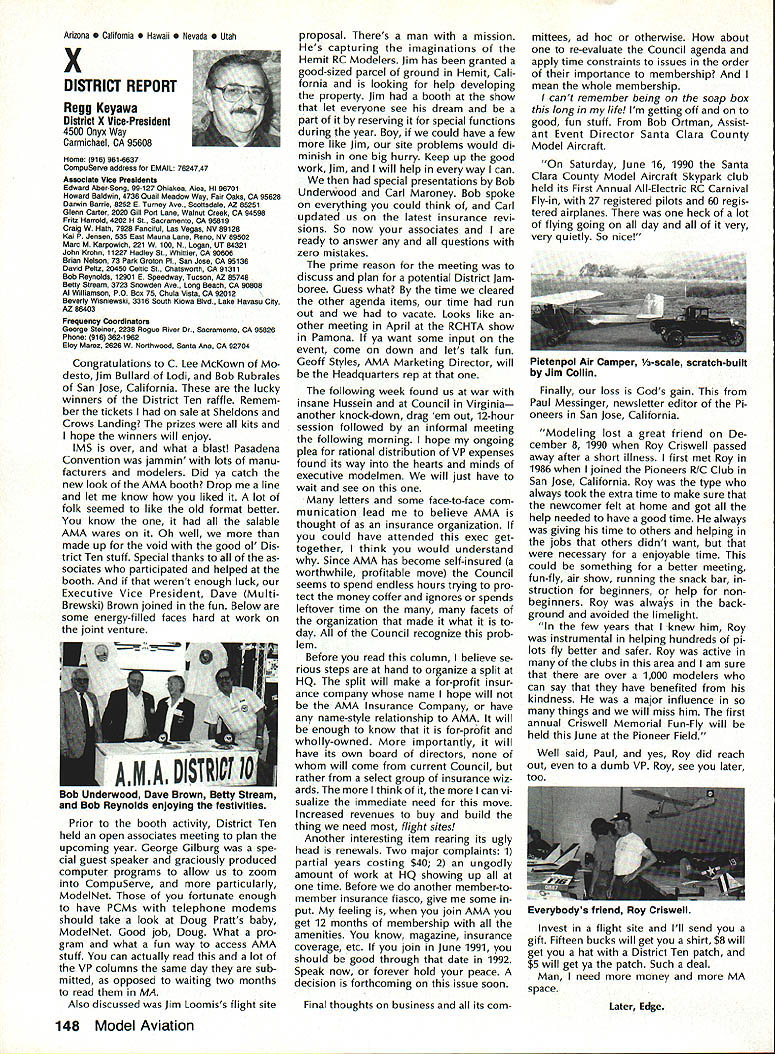
- Jim Loomis flight site proposal (Hemet, CA): Hemet R/C Modelers are pursuing development of a flying site; volunteers and support are welcome.
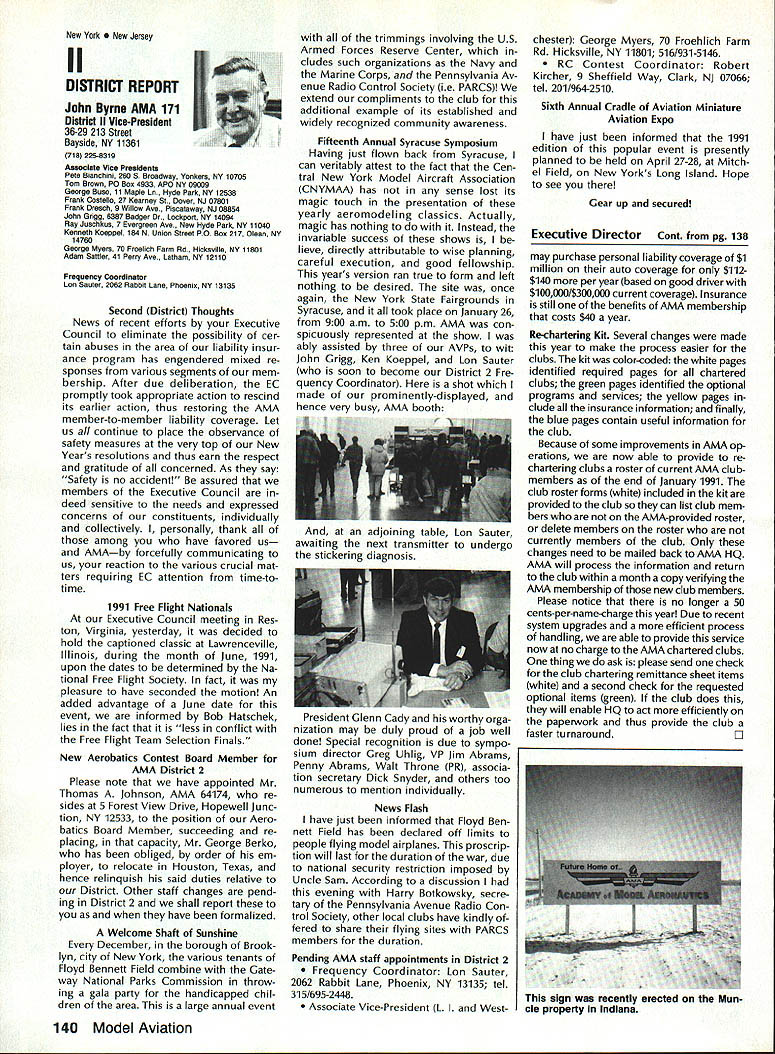
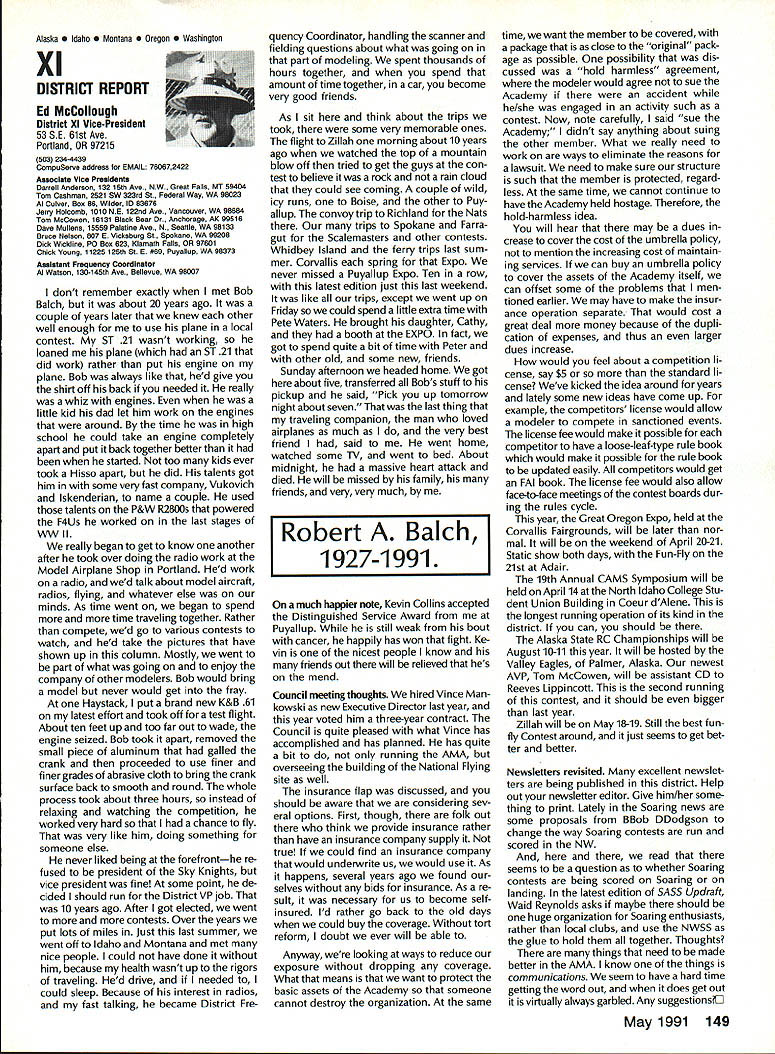
- Vince Mancowski (Executive Director): AMA hired Vince Mancowski last year and approved a three‑year contract. Council is pleased with his progress and the planned development of a National Flying Site.
- Insurance: AMA became self‑insured some years ago when open market bids were unavailable. Council is evaluating ways to reduce exposure without dropping membership coverage, including exploring umbrella policies and organizational restructuring. Ideas such as a “hold harmless” agreement and a separate for‑profit insurance entity are under discussion. Members may hear about a potential dues increase to fund broader coverage.
- Competitor’s license concept: A possible competitor’s license (modest fee) was discussed to fund rule books, FAI materials, and contest‑board meetings.
- Events and symposiums:
- Great Oregon Expo (Corvallis Fairgrounds): weekend of April 20–21 (static shows both days; fun‑fly at Adair on the 21st).
- 19th Annual CAMS Symposium: April 11, North Idaho College, Coeur d’Alene.
- Alaska State RC Championships: August 10–11, hosted by the Valley Eagles of Palmer, AK.
- Zillah Fun‑Fly: May 18–19 (noted as an outstanding event).
- Newsletters and PR: Many district newsletters are active and of high quality; editors are encouraged to receive member submissions.
---
In Memoriam / Awards
- Robert A. Balch (1927–1991) noted in district communications.
- Kevin Collins received the Distinguished Service Award; he is recovering from cancer.
- Roy Criswell (San Jose, CA) — remembered for his long volunteer service and mentorship; the first annual Criswell Memorial Fun‑Fly will be held in June at Pioneer Field.
---
If you have additional items, photos (high‑resolution preferred), or corrections for your district report, please send them to AMA Headquarters for inclusion in future issues.
Transcribed from original scans by AI. Minor OCR errors may remain.

